FIG. 82Senses
What you would see falling into a black hole
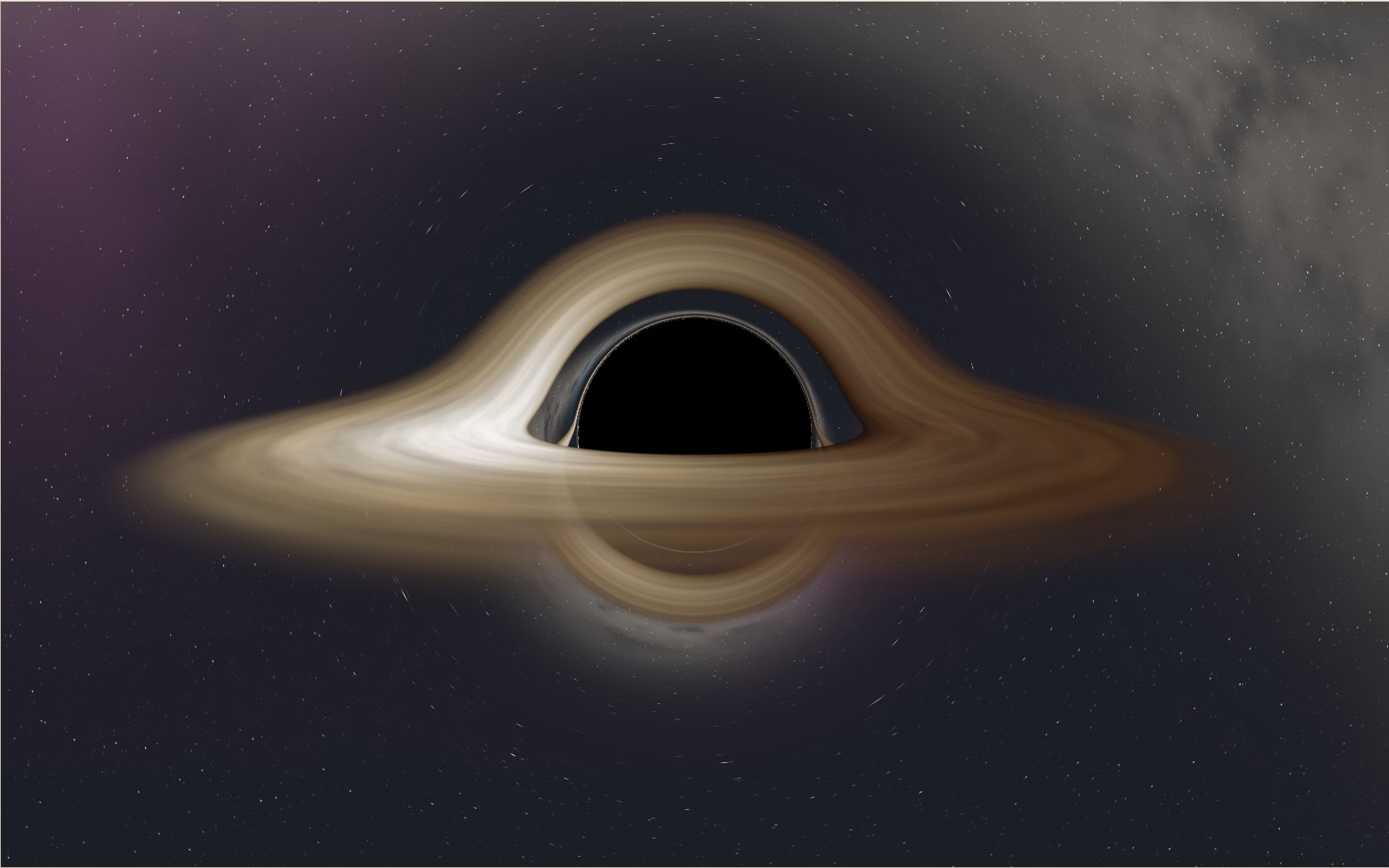
From 40 times the horizon radius a black hole's shadow is only 7.4° wide, yet starlight from directly behind it already forms a ring 28° across.
This device cannot show the 3D model. You can read the guide steps below as text.
1 / 8 A black hole seen from 40 rsYou are hovering at 40 times the Schwarzschild radius, slightly above the plane of a thin gas disk. The black shadow is 7.4° wide, and the disk wraps over and under it because its far side is bent into view. The picture is computed, not photographed.
Drag to turn. Scroll or pinch to zoom.
What would you actually see on the way in?
Films show black holes as a black ball with a glowing ring, and that picture is not far off. But what would you see if you rode a spacecraft toward one and looked out of the window? The stars would not stay where they are on a star chart. Light passing close to the hole is bent so strongly that the whole sky seems to slide round it, a galaxy hiding directly behind it turns into a circle, and the gas swirling around it is bright on one side and dim on the other.
This exhibit draws that view while you move. A shader on your graphics card follows a light ray backwards from every pixel through the curved space around a non-rotating black hole, then paints whatever the ray ends on. The slider sets your distance in units of the horizon radius rs, the mass menu sets what one rs is in kilometres, and the readout works out clock rates and tidal forces for the place you are hovering. What you see on the stage is a computed image, never a photograph.
How a computer bends starlight
Near a black hole a light ray does not travel in a straight line, and no camera trick can fake the result. The only honest way to draw it is to follow each ray. The space around a non-rotating, uncharged mass is described by the Schwarzschild solution of Einstein's equations. In that geometry a light ray always stays in one flat plane through the centre, and its path obeys a short equation in which u = 1/r:
u'' + u = (3/2) rs u²
Without the right-hand side this is the equation of a straight line. The extra term is the bending. Riccardo Antonelli pointed out in his open ray tracer Starless that exactly the same path is traced by an imaginary particle in ordinary flat space pushed toward the centre by a force proportional to 1/r⁵. That is not a weak-field shortcut; the shape of the orbit is the same as in general relativity, and only the clock used to step along it is fake. The shader moves such a particle a few hundred small steps per pixel. If it drops inside rs, the pixel is black. If it crosses the equatorial plane between 3 and 12 rs, it has hit the disk. If it gets far away, the shader adds the small bend still to come between there and infinity (for a nearly straight path that remaining bend is tan(ψ/2) rs / r, where ψ is the angle between the ray and the radial line), then reads the colour of the sky in that direction.
One more correction matters close in. A spacecraft hovering at radius r measures angles in its own frame, and its sense of "straight out" and "sideways" differs from the coordinates in which the path is computed. The conversion is tan α_coordinates = tan α_measured / √(1 − rs/r). Leave it out and the view near the hole comes out far too small.
The horizon radius, checked by hand
The size that sets everything here is the Schwarzschild radius:
rs = 2GM / c²
For the Sun, NASA's fact sheet gives GM = 1.32712 × 10²⁰ m³/s², and the speed of light is exactly 299,792,458 m/s. So rs = 2 × 1.32712 × 10²⁰ / (2.99792458 × 10⁸)² = 2,953 m. If the Sun were squeezed into a ball 5.9 km across, it would be a black hole. The Earth would have to fit inside a radius of 8.87 mm.
The two black holes photographed so far are far larger. ESO, reporting the Event Horizon Telescope results, gives about four million solar masses for Sagittarius A* at the centre of our galaxy, which makes rs about 11.8 million km. For M87* in the galaxy Messier 87 it gives 6.5 billion solar masses, so rs is 19.2 billion km and the horizon is 38.4 billion km across. ESO's own wording is "just under 40 billion km", which agrees.
Here is the useful surprise. If you measure distance in units of rs, the picture does not depend on mass at all. At 10 rs from a black hole of one solar mass and at 10 rs from M87* the sky looks exactly the same. That is why the mass menu changes the kilometres and the forces in the readout but leaves the image alone.
Why the shadow is wider than the hole
At 1.5 rs light can travel in a circle round the hole. This is the photon sphere. A ray that comes in with an impact parameter (its sideways miss distance) smaller than (3√3/2) rs ≈ 2.598 rs spirals in and never comes back. Seen from far away, the black disk is therefore about 2.6 times wider than the horizon itself. That matches ESO's statement that M87*'s event horizon is "2.5 times smaller than the shadow it casts".
For an observer hovering at radius r the exact half-angle of the shadow, measured from the direction of the centre, follows from the same orbit equation:
sin α = (3√3/2) (rs / r) √(1 − rs/r)
At 40 rs the shadow is 7.35° across. At 8 rs it is 35.4°, at 3 rs it reaches exactly 90°, and at 1.5 rs it covers half of the whole sky. Closer than that the black part is more than a hemisphere. The dashed orange circle you get with Part names on is this formula; the edge of the black patch in the image comes out of the ray tracer, and the two land on top of each other.
A galaxy behind the hole becomes a ring
Turn on Galaxy behind and a small bright galaxy is placed exactly behind the black hole, on the far side from you. Its light can pass the hole on the left, the right, above or below, and every one of those paths is bent by the same amount toward you. You see a full circle, the Einstein ring.
The size of that ring is not a formula you can look up for a nearby observer, so the page finds it the hard way. In the background it runs the same ray equation in double precision and searches for the launch angle at which a ray ends up pointing straight away from you. From 20 rs it finds a ring 40.4° across; from 40 rs, 27.7°. Far away the ring approaches the familiar weak-field estimate θ ≈ √(2 rs / D): at 200 rs the full calculation gives 11.88° and the estimate gives 11.46°. Look just outside the shadow and you will also see a second, much thinner copy of the ring. That one is light that went all the way round the hole once more before reaching you.
Why one side of the disk is brighter
Gas does not fall straight in. It orbits and slowly spirals down in a flat disk. In the exhibit the disk runs from 3 rs, the innermost stable circular orbit, out to 12 rs. Its brightness falls with radius as in the standard thin-disk model, with a flux proportional to r⁻³ (1 − √(3 rs / r)).
At the inner edge the gas moves at half the speed of light, as measured by someone hovering beside it. Light from gas moving toward you is shifted to higher frequency and squeezed into a forward beam; light from gas moving away is shifted down and spread out. The disk also sits deep in the gravity well, which takes energy from all its light. The shader combines both into one frequency ratio:
g = √(1 − 3rs/2r) / ( √(1 − rs/r_obs) × (1 − Ω b) )
Here Ω is the orbital angular speed of the gas and b the ray's angular momentum per unit energy. Brightness scales as g⁴. For light leaving the inner edge straight along the gas motion, g is 1.41 on the approaching side and 0.47 on the receding side, so the brightness ratio is 3⁴ = 81. NASA's 2019 visualization by Jeremy Schnittman shows the same lopsided disk and calls it relativistic Doppler beaming.
You also see the back of the disk. The bright band arching over the top of the shadow is the part of the disk that lies behind the hole. Its light leaves the disk upward and is bent over the top toward you. A fainter band under the shadow is the underside of the same disk.
How much slower a hovering clock runs
A clock held at rest at radius r runs slow compared with a clock far away by the factor
√(1 − rs / r)
At 40 rs that is 0.987, so one hour here is 1.013 hours far away, which is barely noticeable. At 3 rs the factor is 0.816. At 1.6 rs it is 0.612, so one hour here is 1.63 hours far away. As r approaches rs the factor heads to zero and a hovering observer would need an ever larger rocket thrust to stay put. That is why the slider stops at 1.05 rs.
Small black holes stretch you, large ones let you pass
Gravity pulls harder on your feet than on your head if you fall feet first. The difference across a body of length L is
Δa = 2GM L / r³
and for a body falling straight in, the same expression holds in general relativity. For a 2 m body near a black hole of one solar mass the difference reaches 1 g at about 3,800 km. At 6 rs, only 17.7 km from the centre, it is 9.7 million g. Andrew Hamilton's JILA pages call what happens next "spaghettification": you are pulled apart lengthwise and squeezed sideways.
For a supermassive black hole it is the other way round. Because rs grows with mass while the tidal pull at the horizon falls as 1/M², at the horizon of Sagittarius A* the difference is only about 1.3 × 10⁻⁴ g, and at M87* it is about 5 × 10⁻¹¹ g. You would cross the horizon without feeling anything at all.
Hovering and falling see different skies
The readout normally assumes you hover with rockets. Turn on Falling observer and the view is redrawn for someone who dropped in from rest far away, who passes each radius at √(rs / r) times the speed of light. Moving that fast, you see the scene ahead crowded together and the scene behind spread out, a special-relativistic effect called aberration. At 1.15 rs a hovering observer sees a shadow 250° across, while a falling one sees only about 80°.
Hamilton points out a common misconception here. The story that the outside universe shrinks to a bright dot above you is true only for an observer who hovers ever closer. A falling observer still sees the sky spread over a large part of the view at the horizon, and, in his words, "you would not see any sign that you crossed the horizon".
Twenty black holes side by side
The table below the stage lists 20 black holes with the mass and distance their discoverers published. The lightest is a 4.46-solar-mass black hole in the star cluster Omega Centauri, found from the wobble of a companion star. The heaviest is the 40-billion-solar-mass giant at the centre of Holm 15A in the galaxy cluster Abell 85, 700 million light-years away. In between are the dormant black holes found by ESA's Gaia mission, Cygnus X-1, four black holes made in mergers that LIGO heard as gravitational waves, and the centres of galaxies near and far.
Two columns are worked out on the page. The horizon radius uses rs = 2GM/c² with the mass in the table, so it runs from 13.2 km to 118 billion km. The shadow size seen from Earth uses the far-field shadow diameter 2 × 2.598 rs divided by the distance. For M87* that gives 39.5 microarcseconds and for Sagittarius A* 49.6. Those two are by far the largest shadows on our sky in the list, and they are the two black holes shown in the Event Horizon Telescope images that ESO released in 2019 and 2022. The shadow of the Andromeda Galaxy's black hole comes next at 18.7. For objects billions of light-years away the simple division does not hold, because the expansion of the universe changes how size and distance relate, so those rows show a dash.
| Black hole | Mass (Suns) | Distance | rs |
|---|---|---|---|
| Omega Centauri stellar black hole | 4.46 | 18,000 ly | 13.2 km |
| Gaia BH1 | about 10 | 1,560 ly | 29.5 km |
| Gaia BH2 | about 10 | 3,800 ly | 29.5 km |
| GW151226 merger remnant | 21 | 1.4 billion ly | 62.0 km |
| Cygnus X-1 | 21 | 7,200 ly | 62.0 km |
| Gaia BH3 | about 33 | 1,926 ly | 97.5 km |
| GW170104 merger remnant | 49 | 3 billion ly | 145 km |
| GW170814 merger remnant | 53 | 1.8 billion ly | 157 km |
| GW150914 merger remnant | 62 | 1.3 billion ly | 183 km |
| Centre of Omega Centauri | at least 8,200 | 17,700 ly | 24,200 km |
| GN-z11 | 2 million | seen 430 million years after the Big Bang | 5.91 million km |
| Sagittarius A* | about 4 million | 27,000 ly | 11.8 million km |
| UHZ1 | 10 to 100 million | 13.2 billion ly | 29.5 to 295 million km |
| M60-UCD1 | 21 million | 54 million ly | 62.0 million km |
| Andromeda Galaxy centre | 140 million | 2.5 million ly | 413 million km |
| Centaurus A centre | more than 200 million | 11 million ly | 591 million km |
| M87* | 6.5 billion | 55 million ly | 19.2 billion km |
| NGC 1600 | 17 billion | 64 megaparsecs | 50.2 billion km |
| NGC 4889 | 21 billion | 300 million ly | 62.0 billion km |
| Holm 15A | 40 billion | 700 million ly | 118 billion km |
Why the view widens close in
At 3 rs the shadow is 90° across, wider than the 60° view a normal camera would show, and the whole screen would be black. So as the shadow grows the page switches to a wider view drawn like a fisheye lens, in which the angle from the centre of the screen grows evenly with distance on the screen. The camera stays where it is. The Look away slider turns your gaze up to 180° away from the hole, which is the only way to see the sky that is left when you hover inside the photon sphere. The buttons along the bottom of the stage fly you straight to 40, 12, 6, 3, 1.6 or 1.1 rs.
What the real photographs show
The Event Horizon Telescope links radio dishes around the world into one Earth-sized instrument. ESO reported on 10 April 2019 that it had imaged M87*, 55 million light-years away, from observations made at 1.3 mm wavelength in a 2017 campaign with eight telescopes. The picture shows a bright ring around a dark central region, the shadow. On 12 May 2022 the same collaboration released an image of Sagittarius A*, about 27,000 light-years away, which ESO describes as appearing about as large in the sky as a doughnut on the Moon. Gas takes days to weeks to orbit M87*, but minutes for Sgr A*, which made the second image harder to make.
The 2020 Nobel Prize in Physics went to Roger Penrose for showing that black hole formation is a robust prediction of general relativity, and to Reinhard Genzel and Andrea Ghez for the discovery of a supermassive compact object at the centre of our galaxy.
Sagittarius A* at human scale
Take the numbers above and put them in the solar system. With rs = 11.8 million km, the horizon of Sagittarius A* is 23.6 million km across, about 17 times the Sun's diameter of 1.39 million km. The photon sphere, 1.5 rs, lies 17.7 million km from the centre, or 0.12 astronomical units. The shadow seen from far away is 2 × 2.598 × 11.8 million km, about 61 million km, or 0.41 astronomical units. That is a little more than Mercury's orbital radius of 0.39 astronomical units, and from 27,000 light-years away it shrinks to the 49.6 microarcseconds in the table.
Light itself needs time to cross this space. A light ray takes rs / c = 11.8 million km / 299,792 km/s = 39 s to cover one horizon radius. The same arithmetic for one solar mass gives 2,953 m divided by the speed of light, 9.9 microseconds. Distances in rs are therefore also times in light-seconds, which is why the sky in the exhibit looks the same for every mass while the clock in the readout does not.
How fast the inner edge of the disk orbits
The innermost stable orbit of 3 rs is 6 GM/c². Kepler's third law in the form T = 2π √(r³ / GM) then gives, for a clock far away, T ≈ 92 GM/c³. The quantity GM/c³ is 4.925 microseconds for the Sun, and it scales with mass. The result is a period of about 0.45 milliseconds for one solar mass, so the gas circles over 2,000 times per second. For Sagittarius A* at four million solar masses it is about 1,800 s, or 30 minutes. For M87* at 6.5 billion solar masses it is about 2.96 million s, or 34 days.
This is why the two Event Horizon Telescope targets are so different. ESO notes that gas takes days to weeks to orbit M87* but only minutes for Sagittarius A*. The simple formula ignores spin and general-relativistic corrections to the period seen from far away, so treat the results as estimates of order, not measurements.
Two black holes colliding: GW150914
Everything above concerns a single quiet black hole. The first direct detection of black holes came from a collision. LIGO's two detectors, in Livingston, Louisiana and Hanford, Washington, recorded gravitational waves on 14 September 2015 at 09:51 UTC. The signal came from two black holes of about 36 and 29 solar masses, 1.3 billion light-years away, spiralling together and merging. LIGO states that about 3 solar masses were converted into gravitational waves in a fraction of a second, with a peak power about 50 times that of the whole visible universe.
Run the horizon formula on this event. The two horizons were rs = 106 km and 85.6 km, and the merged hole has 62 solar masses, so rs = 183 km, the number in the table. Notice that 183 km is smaller than the sum of the two, 191.6 km. The missing 3 solar masses of rest energy, 8.9 km of horizon radius, went out as ripples in space and not as light.
Common misconceptions
"A black hole sucks everything in like a vacuum cleaner." NASA says black holes do not suck in other matter: from far enough away, their gravity is the same as any object of the same mass, and if the Sun were replaced by a black hole of the same mass, the planets would stay in their orbits (and get cold). Earth's orbit, 150 million km from the Sun, is about 50 million rs from a solar-mass black hole. At that distance the 40 rs view in this exhibit is already a very close one.
"The black region is the black hole." The dark patch in the exhibit is the shadow, 2.6 times wider than the horizon seen from far away. The horizon is a surface, not an object, and it sits inside the shadow.
"Nothing can come out, so light cannot get close." Light can orbit at 1.5 rs and plenty of it escapes from the disk. The disk is the brightest thing in the picture. It is only inside the horizon that nothing returns.
"Falling in always tears you apart at the edge." Only for small black holes. For a supermassive one the tidal force at the horizon is tiny, as the numbers above show.
Things to try on the stage
- Press the 40
rsbutton, then drag Distance (rs) down slowly to 3rs. The shadow grows until it is 90° wide at 3rs. - Turn Sky grid on and Accretion disk off. Count the grid lines that wrap round the hole at 15
rs. - Turn Galaxy behind on at 20
rsand read the ring's diameter, 40.4°. Move to 40rsand it falls to 27.7°. - Set Mass to one Sun and go to 6
rs. Read the tidal figure, about 9.7 million g. Then set it to M87* and read the same line. - Turn Falling observer on at 1.15
rsand compare the shadow with the hovering value of 250°. - Raise Look away from centre to 180° at 1.6
rsto see what is left of the sky.
Where this model is simpler than nature
- The black hole does not spin. Real black holes are expected to rotate, which squashes the shadow slightly and moves the disk's inner edge.
- The disk is a thin, opaque sheet. The gas near Sgr A* and M87* is thought to be a thick, hot and mostly transparent flow, which is why the EHT images look like blurred rings and not like this disk.
- Disk colours are a display scale from deep red to blue-white. A real disk around a stellar black hole shines mostly in X-rays. For readability the disk's brightness leaves out the overall blueshift that a hovering observer would see in all incoming light, which near the horizon would turn everything white.
- The stars are generated, not a real catalogue, and the sky does not change with time.
- Ray paths are integrated in a few hundred steps, and fewer on phones, so thin features such as the second Einstein ring can look grainy.
Questions
Is this a real photograph?
No. Every frame is computed in your browser from the geometry of a non-rotating black hole. Real images of black holes come from the Event Horizon Telescope, whose pictures of M87* and Sagittarius A* were made at radio wavelengths.
Why doesn't changing the mass change the picture?
All lengths in the Schwarzschild geometry scale with rs. At the same number of rs the bending is identical for every mass. The mass changes how many kilometres that distance is, how long things take and how strong the tidal pull is, and those are the numbers in the readout.
Can you see the event horizon itself?
No. The horizon gives off no light. What you see is the shadow, the set of directions from which no light reaches you, which is about 2.6 times wider than the horizon when seen from far away.
What is the difference between the photon ring and the Einstein ring?
The photon ring is the thin bright edge of the shadow, made by light that circled the hole near the photon sphere at 1.5 rs. Its size depends only on the black hole and your distance. The Einstein ring is the image of one particular object lying behind the hole, so it only appears when something bright is lined up behind it.
Why does the slider stop at 1.05 rs?
The readout assumes you hover at a fixed distance, and the thrust needed for that grows without limit as you approach rs. Inside the horizon no amount of thrust is enough. Falling observers do cross the horizon, but drawing their view inside it needs other coordinates, which this exhibit does not use.
Would time look frozen if I watched a friend fall in?
From far away, the light from your friend arrives later and later and is shifted ever further toward red, so they seem to slow and fade near the horizon. Your friend notices nothing special and crosses in a finite time on their own clock.
Why does the phone version look grainier?
Phones run the same ray tracer with fewer integration steps and fewer pixels so the frame rate stays usable. If the frame rate still drops, the page lowers the resolution further.
Which known black hole is the closest?
In this list it is Gaia BH1, about 1,560 light-years away in Ophiuchus, found by ESA's Gaia mission from the wobble of its companion star. Gaia BH3, at 1,926 light-years, is the most massive black hole of stellar origin known in our galaxy, about 33 Suns.
How do astronomers weigh a black hole they cannot see?
By watching what moves around it. Gaia and the Hubble team in Omega Centauri timed the orbits of nearby stars, the Andromeda and M60-UCD1 masses come from fast-moving stars near the centre, ESO's Centaurus A measurement used a disk of gas, and LIGO reads the mass from the shape of the gravitational-wave signal.
If the Sun became a black hole, would it swallow the Earth?
No. NASA says a black hole of the Sun's mass would pull on the planets exactly as the Sun does now, so they would stay in their orbits, although with no sunlight it would get cold. Earth is about 50 million rs away, far beyond any region where the curved-space effects in this exhibit matter.
Terms
- Schwarzschild radius (rs):
2GM/c², the radius of the event horizon of a non-rotating black hole. 2.95 km for one solar mass. - Event horizon: the surface at
rsfrom inside which nothing, including light, can get out. - Photon sphere: the radius 1.5
rsat which light can orbit the hole in a circle. - Shadow: the dark patch in the sky made by rays that end inside the horizon.
- Einstein ring: the circular image of a source lying exactly behind a lensing mass.
- Accretion disk: gas spiralling inward in a flat disk around a black hole.
- Innermost stable circular orbit: the smallest circular orbit, 3
rsaround a non-rotating black hole, used here as the inner edge of the disk. - Doppler beaming: brightening of light from a source moving toward the observer.
- Gravitational time dilation: a clock deeper in gravity runs slow, by
√(1 − rs/r)for a hovering clock. - Tidal force: the difference in gravitational pull across an object.
Sources
- NASA NSSDCA, Sun Fact Sheet (GM of the Sun). https://nssdc.gsfc.nasa.gov/planetary/factsheet/sunfact.html (checked 2026-10-17)
- NIST, CODATA value: Newtonian constant of gravitation. https://physics.nist.gov/cgi-bin/cuu/Value?bg (checked 2026-10-17)
- NIST, CODATA value: speed of light in vacuum. https://physics.nist.gov/cgi-bin/cuu/Value?c (checked 2026-10-17)
- ESO, eso1907, Astronomers Capture First Image of a Black Hole (10 April 2019). https://www.eso.org/public/news/eso1907/ (checked 2026-10-17)
- ESO, eso2208, Astronomers reveal first image of the black hole at the heart of our galaxy (12 May 2022). https://www.eso.org/public/news/eso2208/ (checked 2026-10-17)
- NASA Science, Black Holes. https://science.nasa.gov/universe/black-holes/ (checked 2026-10-17)
- NASA Science, Black Hole Anatomy. https://science.nasa.gov/universe/black-holes/anatomy/ (checked 2026-10-17)
- NASA Scientific Visualization Studio, Black Hole Accretion Disk Visualization (J. Schnittman, 2019). https://svs.gsfc.nasa.gov/13326 (checked 2026-10-17)
- R. Antonelli, Raytracing a Black Hole (Starless). https://rantonels.github.io/starless/ (checked 2026-10-17)
- A. J. S. Hamilton, JILA, Journey into a Schwarzschild black hole. https://jila.colorado.edu/~ajsh/insidebh/schw.html (checked 2026-10-17)
- Nobel Prize Outreach, The Nobel Prize in Physics 2020. https://www.nobelprize.org/prizes/physics/2020/summary/ (checked 2026-10-17)
- ESA, Gaia discovers a new family of black holes (Gaia BH1, BH2). https://www.esa.int/Science_Exploration/Space_Science/Gaia/Gaia_discovers_a_new_family_of_black_holes (checked 2026-10-17)
- ESA, Sleeping giant surprises Gaia scientists (Gaia BH3). https://www.esa.int/Science_Exploration/Space_Science/Gaia/Sleeping_giant_surprises_Gaia_scientists (checked 2026-10-17)
- ESA/Hubble, heic2409, intermediate-mass black hole in Omega Centauri. https://esahubble.org/news/heic2409/ (checked 2026-10-17)
- ESA/Hubble, heic2610, first of the star cluster's missing black holes. https://esahubble.org/news/heic2610 (checked 2026-10-17)
- LIGO Lab, GW170104 press release (GW150914, GW151226, GW170104). https://www.ligo.caltech.edu/page/press-release-gw170104 (checked 2026-10-17)
- LIGO Lab, GW170814 news release. https://www.ligo.caltech.edu/news/ligo20170927 (checked 2026-10-17)
- ICRAR, First black hole ever detected is more massive than we thought (Cygnus X-1). https://www.icrar.org/biggest-black-hole/ (checked 2026-10-17)
- ESA/Webb, weic2406, GN-z11. https://esawebb.org/news/weic2406 (checked 2026-10-17)
- NOIRLab, gemini1407, M60-UCD1. https://noirlab.edu/public/news/gemini1407/ (checked 2026-10-17)
- NASA Chandra, UHZ1. https://chandra.harvard.edu/photo/2023/uhz1/ (checked 2026-10-17)
- ESA/Hubble, heic0512, Andromeda's central black hole. https://esahubble.org/news/heic0512/ (checked 2026-10-17)
- ESA/Hubble, heic2501, Andromeda distance. https://esahubble.org/news/heic2501/ (checked 2026-10-17)
- ESO, eso0109, Centaurus A. https://www.eso.org/public/news/eso0109/ (checked 2026-10-17)
- ESA Science & Technology, A 17-billion-solar-mass black hole (NGC 1600). https://sci.esa.int/web/hubble/-/57676-thomas-et-al-2016 (checked 2026-10-17)
- ESA/Hubble, heic1602, NGC 4889. https://esahubble.org/news/heic1602/ (checked 2026-10-17)
- Max Planck Institute for Extraterrestrial Physics, Holm 15A. https://www.mpe.mpg.de/7387190/news-publication-03122019 (checked 2026-10-17)
- LIGO Lab, GW150914 press release (masses, distance, energy radiated). https://www.ligo.caltech.edu/page/press-release-gw150914 (checked 2026-10-23)
More exhibits
Northern lights over an Arctic village
The green of the northern lights comes from oxygen about 100 km up, and in the biggest storms the red glow above it can be seen as far south as Korea.
Travelling at the speed of light
Light goes round the equator 7.5 times in a second, yet the same light needs 2.5 million years to reach the Andromeda galaxy.
Why we have seasons: tilted Earth, changing daylight
The Earth is closest to the Sun in the first week of January, in the middle of the northern winter.
Moon phases: why a crescent is not Earth’s shadow
The Moon passes between the Earth and the Sun every 29.5 days, so why is there no solar eclipse every month?
Satellites orbiting Earth right now
On 20 October 2026 the public catalogue listed 16,768 working satellites, and two in every three belonged to one company's internet network.
Your weight and jump height on other planets and moons
A 50 cm jump on Earth becomes a 3 m leap on the Moon, 18 m on Ceres and a one-way trip off asteroid Bennu.