Loading the model
This device cannot show the 3D model. You can read the guide steps below as text.
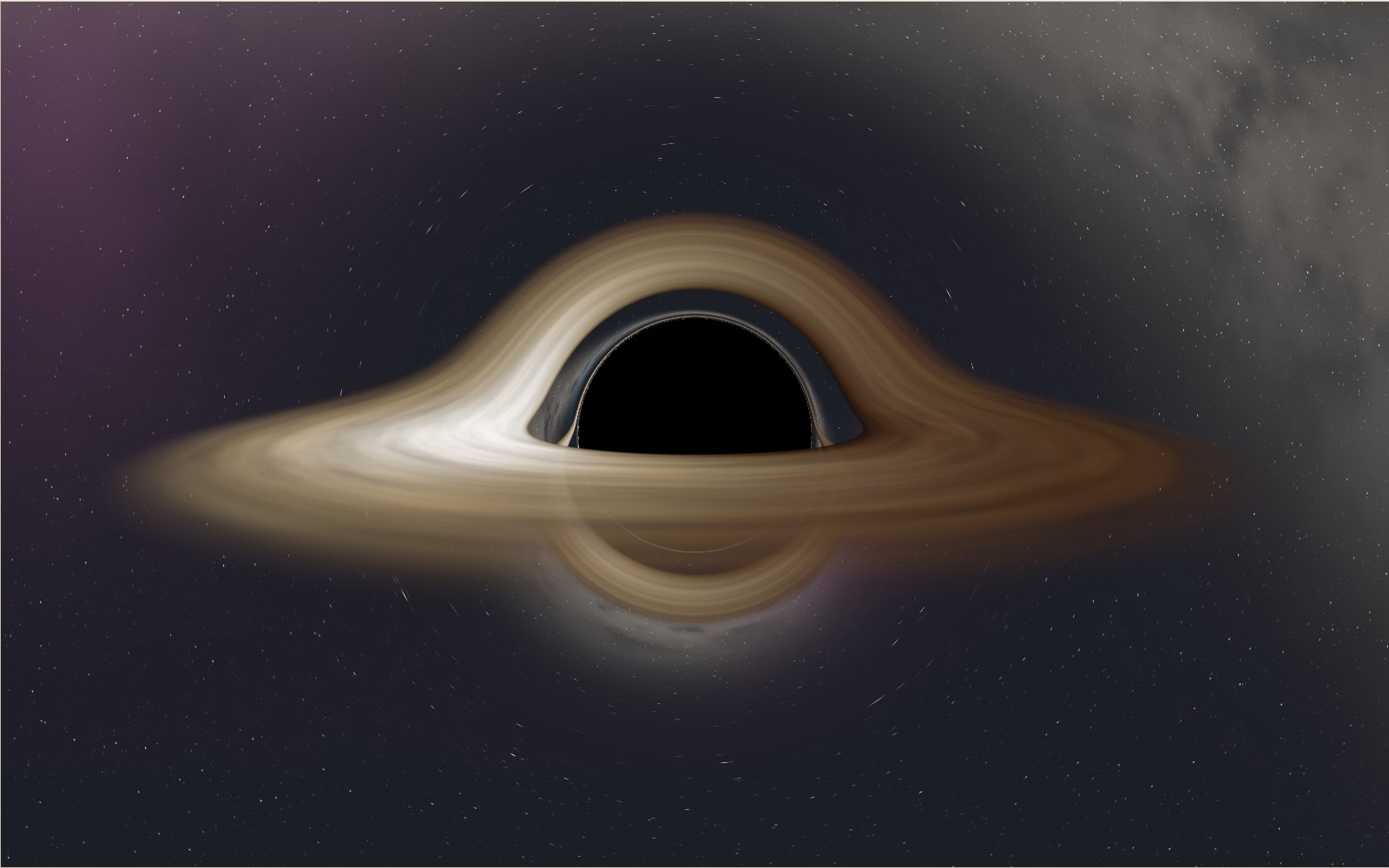
1 / 8 A black hole seen from 40 rs You are hovering at 40 times the Schwarzschild radius, slightly above the plane of a thin gas disk. The black shadow is 7.4° wide, and the disk wraps over and under it because its far side is bent into view. The picture is computed, not photographed.
Drag to turn. Scroll or pinch to zoom.
Guide Parts Controls
01 A black hole seen from 40 rs You are hovering at 40 times the Schwarzschild radius, slightly above the plane of a thin gas disk. The black shadow is 7.4° wide, and the disk wraps over and under it because its far side is bent into view. The picture is computed, not photographed.
02 Straight lines in the sky bend The disk is off and a grid of lines every 15° is laid over the distant sky. At 15 rs the lines close to the hole curve round it and a second, squeezed copy of the whole grid appears just outside the shadow.
03 A galaxy behind the hole becomes a ring A small galaxy now sits exactly behind the black hole. Its light passes on every side and arrives as a complete circle, the Einstein ring. From 20 rs its diameter is 40.4°, almost three times the 14.5° shadow.
04 One side of the disk is brighter Seen nearly edge-on from 30 rs, the gas on the left comes toward you at up to half the speed of light and the gas on the right moves away. Light from the approaching side is shifted to higher energy and beamed forward, so that side shines far brighter.
05 The photon ring at the edge of the shadow At 8 rs the shadow is 35.4° across. The thin bright ring at its edge is light that has gone round the hole near 1.5 rs, where light can travel in a circle. Turn on Part names to see the circle the formula predicts.
06 Close to the photon sphere At 1.6 rs, just outside the photon sphere, the shadow is 168° across, more than the whole half of the view in front of you, and the outside universe fills only what is left behind you. A clock here runs at 0.612 of the rate of a distant clock, so one hour here is 1.63 hours far away.
07 A small black hole pulls you apart Now the mass is one Sun, so rs is only 2.95 km. At 6 rs, 17.7 km from the centre, your feet are pulled about 9.7 million g harder than your head. A body would already be stretched like a noodle about 3,800 km out, where the difference first reaches 1 g.
08 A giant black hole lets you fall through With M87* (6.5 billion Suns) rs is 19.2 billion km and the tidal pull at 1.15 rs is about 3 × 10⁻¹¹ g. You are now falling inward at 93% of light speed. Ahead the shadow shrinks to 80°, and nothing marks the moment you cross the horizon.
Shadow The black patch is the set of directions in which a traced ray ends inside the horizon. It is about 2.6 times wider than the horizon itself, because light that passes close by is pulled in as well. Photon ring The thin bright edge of the shadow. Light here has looped round the hole once or more near 1.5 rs, where light can orbit. The dashed orange circle marks its exact size. Einstein ring A small galaxy placed exactly behind the hole. Its light comes round every side at once and is seen as a full ring. The dotted blue circle is the size worked out in your browser. Accretion disk A thin ring of hot gas orbiting from 3 rs, the innermost stable orbit, out to 12 rs. Brightness falls with radius as in the standard thin-disk model. Bright side Gas coming toward you is brighter and bluer, gas moving away is dimmer and redder. The difference comes from the Doppler shift together with gravitational redshift. Far side of the disk The arch over the top of the shadow is the part of the disk behind the hole. Its light is bent over the top on its way to you, so you see both faces of the disk at once. Starry sky A generated star field with a faint galaxy band. Each pixel shows the star at the end of its bent ray, so stars near the hole appear moved, stretched or doubled. Sky grid Lines every 15° of longitude and latitude, fixed to the distant sky. Watching straight lines bend is the easiest way to see how strongly the rays are deflected. Clock rate How fast a clock hovering at this distance ticks compared with one far away: √(1 − rs/r). At 1.6 rs one hour here is 1.63 hours far away. Tidal pull Difference in pull between head and feet for a 2 m body falling feet first, Δa = 2GM·L/r³, shown in units of Earth gravity g together with a sketch of the stretch. Second Einstein ring A much thinner ring just outside the shadow. It is light from the same galaxy that went all the way round the hole once more before reaching you. Underside of the disk The faint band under the shadow. It is the bottom face of the disk, seen because its light is bent under the hole toward you. Inner edge at 3 rs Closer than 3 rs gas cannot stay on a stable circular orbit and falls in, so the disk stops here. Gas at this edge moves at half the speed of light. Falling view With Falling observer on, the sky is redrawn for someone dropping in from rest far away. Moving that fast crowds the scene ahead and spreads the scene behind. Widening view When the shadow grows bigger than the screen, the view widens like a fisheye lens so the edge of the shadow stays visible. The camera does not move. Distance shortcuts Buttons on the stage that fly you straight to 40, 12, 6, 3, 1.6 or 1.1 rs without dragging the slider. Known black holes A table below the stage with 20 black holes, from 4.46 to 40 billion Suns. Pick one and the readout uses its mass.