Loading the model
This device cannot show the 3D model. You can read the guide steps below as text.
1 / 18 A flashlight turns on The dot of light runs round the equator. In one second it covers 299,792 km, 7.5 times round. Then it leaves Earth. Drag to look around; the buttons along the top open five more scenes.
Drag to turn. Scroll or pinch to zoom.
Guide Parts Controls
01 A flashlight turns on The dot of light runs round the equator. In one second it covers 299,792 km, 7.5 times round. Then it leaves Earth. Drag to look around; the buttons along the top open five more scenes.
02 The Moon in 1.3 seconds The bright sphere is the flash. It reaches the Moon, 384,400 km away, after 1.28 s. Laser echoes from mirrors left by Apollo take twice that.
03 The Sun in 8 minutes 19 seconds One astronomical unit is exactly 149,597,870,700 m. Sunlight that reaches you now left the Sun's surface 8 min 19 s ago, a little more or less as Earth's distance changes through the year.
04 Neptune in about 4 hours Neptune is about 30 au from the Sun. The flash needs about 4 hours, so a probe at Neptune always reports what happened hours ago. The scale slides as the sphere grows.
05 Voyager 1, one light-day away NASA expects Voyager 1 to be one light-day from Earth on 18 Nov 2026, 25.902 billion km. A command takes a whole day to arrive and the answer another day to return.
06 Proxima Centauri, 4.25 years Beyond the Solar System the gaps jump. The nearest star is 4.25 light-years away (Gaia DR3). The stars around it are drawn at their true distances.
07 A star whose distance is argued over Betelgeuse is somewhere between about 440 and 640 light-years away, depending on the study. Its light in tonight's sky set off somewhere between about 1390 and 1590.
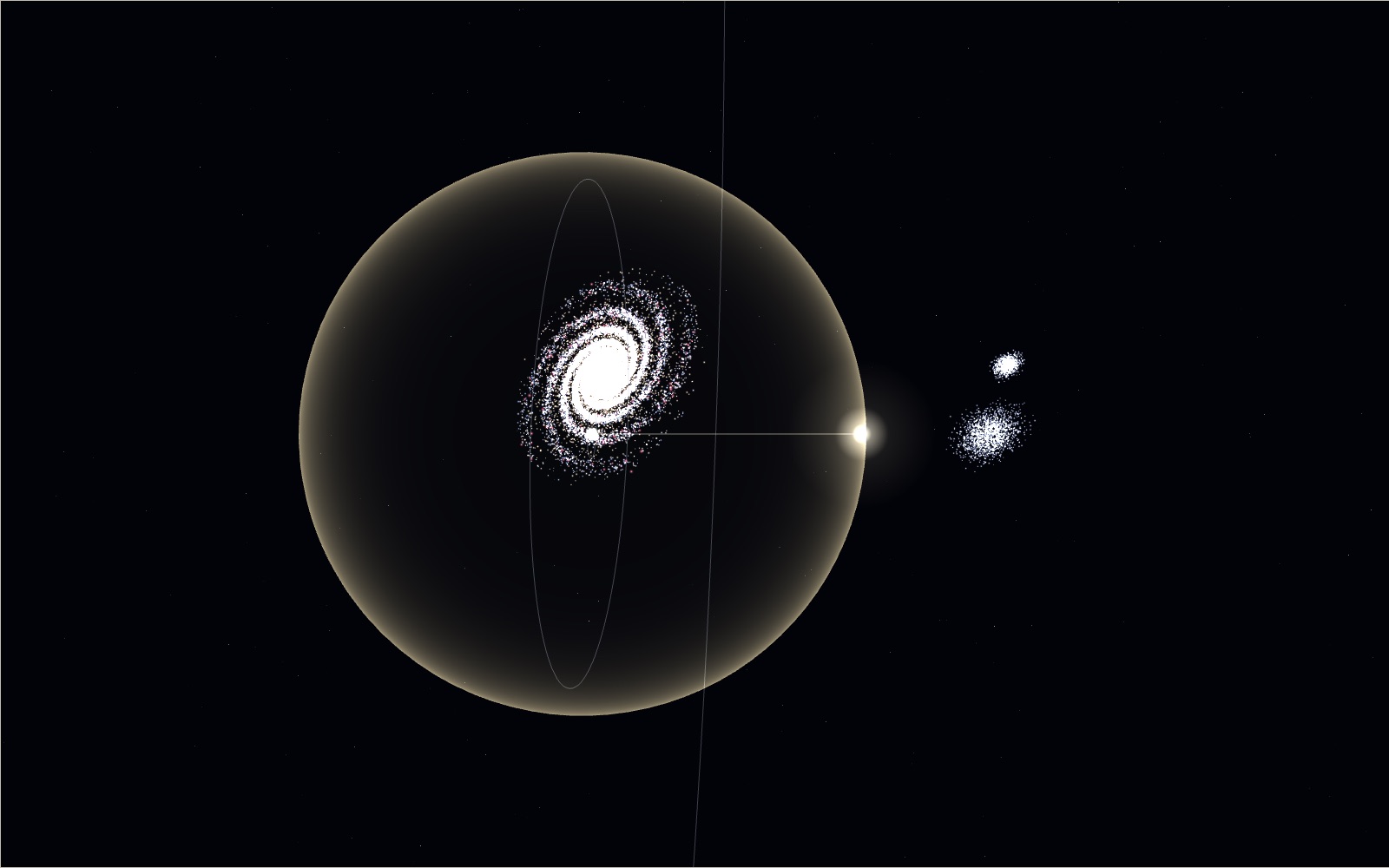
08 The centre of the Milky Way The black hole Sgr A* is 8,178 parsecs away, about 26,700 light-years. Pulled back this far, the points that made the Milky Way band in the sky become the galaxy itself.
09 Andromeda, 2.5 million years The farthest object most people can see without a telescope. The flash, still going, would need 2.5 million years to get there.
10 Talking to a Mars rover Press Send. The command leaves Earth as light, reaches Mars minutes later, the rover drives 2 m and its reply comes back the same way. The map shows the real distance for the chosen date.
11 Mars at its nearest in 2027 Around 20 Feb 2027 Mars comes within about 0.68 au and a command takes 5.6 minutes. Move the date to see the delay grow to about 20 minutes as Mars heads behind the Sun.
12 Rømer and the eclipses of Io In 1676 Rømer saw that Io slipped into Jupiter's shadow later than predicted when Earth was farther away. The extra time is the time light needs to cross the extra distance.
13 Fizeau's toothed wheel Light goes out through a gap, travels 8,633 m to a mirror and back in 57.6 µs. At 12.06 turns a second the next tooth has moved into its path and the eyepiece goes dark.
14 Slower in water and glass Five pulses start together. In water light moves at 225,000 km/s and in glass at 206,000 km/s. Nothing is lost: the pulses speed up again when they leave.
15 Diamond, the slowest lane Diamond has a refractive index of 2.417. Light needs 24.2 ns to cross 3 m of it, against 10 ns in a vacuum. The laser beam bends most here.
16 Near light speed At 0.9 c the trip to Proxima takes 4.7 years on Earth but only 2.1 years on board. This is a concept calculation at a steady speed.
17 The sky bunches forward At 0.999 c the ship's clock runs 22 times slower than Earth's. The stars crowd toward the front and turn bluer ahead, redder behind.
18 Your birthday star Enter your birth date under the stage. The gold mark shows a star whose light set off about when you were born, with its distance from SIMBAD.
Earth Where the flash starts. Its equator is 40,075 km long. The flash A sphere of light growing at 299,792 km every second. Everything inside it has seen the flash. Moon 384,400 km on average: 1.28 s. Sun One astronomical unit away: 8 min 19 s. Neptune About 30 au from the Sun: about 4 hours. Voyager 1 The farthest spacecraft, one light-day from Earth on 18 Nov 2026. Proxima Centauri The nearest star, 4.25 light-years by Gaia DR3. Milky Way Our galaxy, drawn from 46,000 points; the Sun sits about 26,700 light-years from the centre. Galactic centre The black hole Sgr A*, 8,178 parsecs away. Andromeda galaxy The nearest big galaxy, 2.5 million light-years away. Mars From 54.6 to 400.2 million km from Earth: 3 to 22 minutes one way. Mars rover A rover about 3 m long beside a person, at true size. Command signal A radio pulse moving at c between the two planets. Toothed wheel Fizeau's wheel had 720 teeth. Light went out through a gap and came back. Far mirror On Montmartre, 8,633 m from the wheel in 1849. Io Jupiter's moon whose late eclipses told Rømer that light takes time. Race lanes Five lanes 3 m long: vacuum, air, water, glass and diamond. Diamond lane Refractive index 2.417: light moves at 124,000 km/s. Starship An imagined ship flying to Proxima at a steady speed. Stars ahead Aberration bunches the stars toward the front and the Doppler effect makes them bluer. Tonight's sky Stars from SIMBAD at their true places for now. Birthday star The star whose light left about when you were born.