Loading the model
This device cannot show the 3D model. You can read the guide steps below as text.
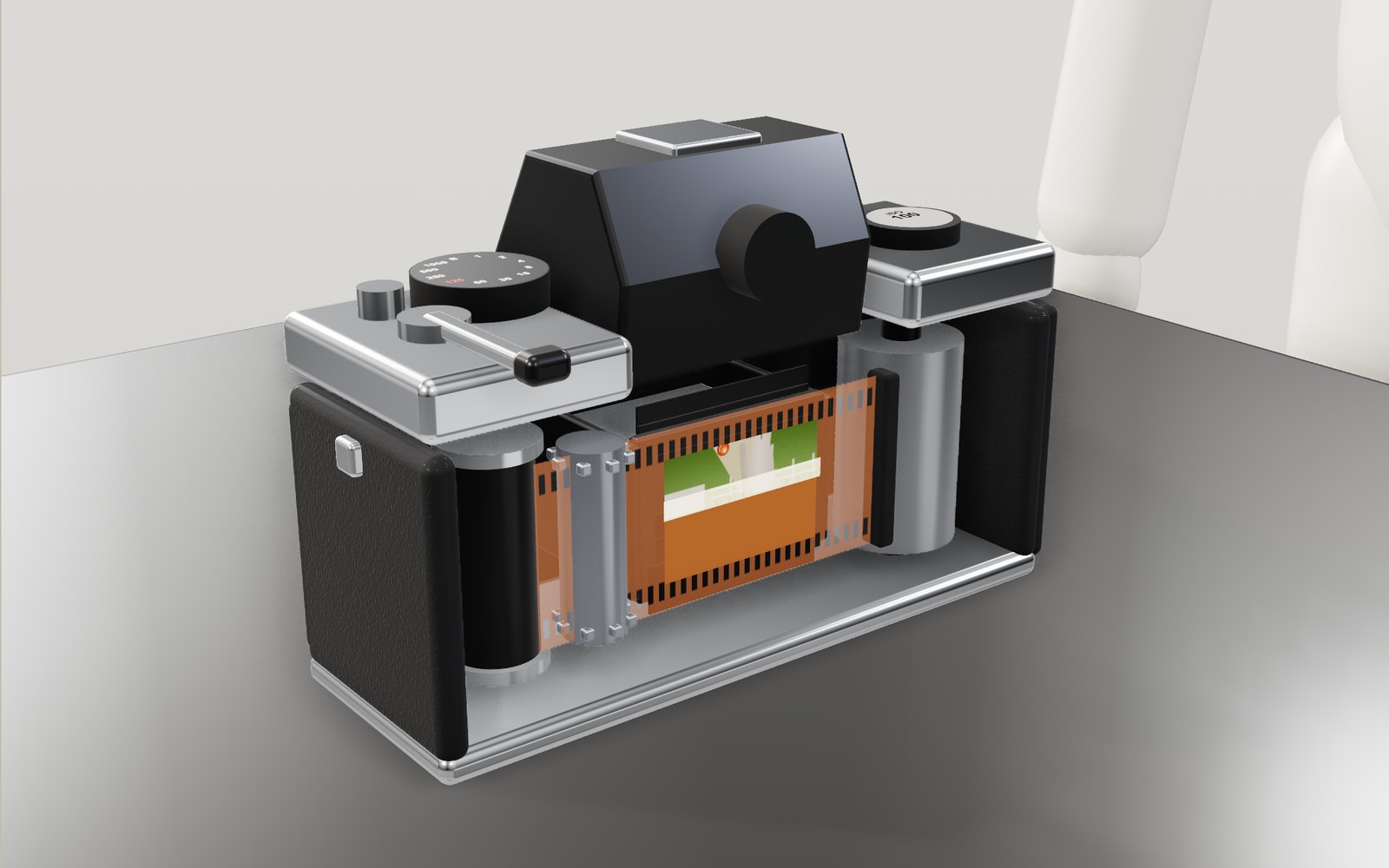
1 / 15 A shutter at 1/1000 of a second This is the back of a single-lens reflex with its door open, played 300 times slower than life. Press Release and watch the film: the picture does not appear all at once. A bright band slides down it.
Drag to turn. Scroll or pinch to zoom.
Guide Parts Controls
01 A shutter at 1/1000 of a second This is the back of a single-lens reflex with its door open, played 300 times slower than life. Press Release and watch the film: the picture does not appear all at once. A bright band slides down it.
02 Two curtains and a slit The first curtain runs down and uncovers the film. A thousandth of a second later the second curtain sets off after it. Between them is a slit only a few millimetres wide, and that slit makes the whole picture.
03 A slower time, a wider slit At 1/60 of a second the first curtain is all the way down before the second one starts, so the whole frame is open at once. Watch the speed dial and the slit width in the readout.
04 The mirror swings up From the side, with the body made clear: the lens closes to its working aperture, the mirror flies up against the screen, the curtains run, and then everything returns. In the model all of it takes about 50 thousandths of a second.
05 Aperture The blades in the lens close to a smaller hole for the picture. f/16 is a smaller hole than f/8 and lets in a quarter of the light. A smaller hole also makes more of the scene sharp.
06 Film speed and grain A night street needs fast film. At ISO 3200 the exposure works by hand, but the print grows grainy. The readout shows how many stops over or under the picture is.
07 Depth of field A 135 mm lens at f/2.8 focused on the person at 3 m: the trees at 45 m dissolve. Watch the depth-of-field bar under the controls as you change the aperture.
08 A rangefinder The 1925 type has no mirror. Its cloth curtains run sideways, so here the slit sweeps from one side to the other.
09 Two lenses The twin-lens reflex looks through the upper lens and takes the picture with the lower one. Fold back the hood and the screen shows the picture reversed left to right.
10 An upside-down picture Behind a view camera, the ground glass shows the scene upside down and reversed. Photographers focused it under a dark cloth before sliding in a sheet of film.
11 1839: five minutes in front of the lens A daguerreotype plate is so slow that in the model a sunny street needs about five minutes. Walkers smear away to nothing; the person standing still stays.
12 The darkroom The film goes into a tank in total darkness, then developer, stop bath, fixer and a long wash. Only after fixing does the negative stop reacting to light.
13 An instant print comes up The folding instant camera pushes the picture out between two rollers that spread the reagent. Over the next minutes an opaque layer clears and the dyes arrive: the picture comes up while you hold it.
14 17 layers in 2 mm Beside the camera, one film unit taken apart. Press each layer: the three colour layers, the dyes, the timing layer and the acid that stops everything at the end.
15 A camera you use once The single-use camera has one shutter speed, one aperture and a fixed focus, sold with the film already inside. Its flash is built in.
Body The light-tight box. See inside makes it clear so the mirror, the curtains and the film show. Lens Glass that bends light into an upside-down picture on the film. Turning the focus ring moves it to and from the film. Aperture blades Thin blades that close to a smaller hole. Each stop smaller lets in half the light and makes more of the scene sharp. Lens shutter or cap Blades in the lens that open and close (or, on the 1839 camera, a cap taken off by hand). The whole picture is exposed at once. First curtain Covers the film until the release is pressed, then runs across and uncovers it. Second curtain Follows the first after the set time and covers the film again. The gap between them is the slit. Mirror Sends the light from the lens up to the screen so you can see the picture, and swings out of the way for the exposure. Focusing screen A ground glass where the picture is seen and focused before it is taken. Pentaprism A five-sided glass block that turns the picture on the screen the right way round for the eye. Finder Where you look: a rangefinder window, a folding hood over the screen, or an eyepiece. Film or plate The light-sensitive part: a roll of film, a sheet, a silvered plate or a self-developing film unit. Film advance A lever, knob, crank or thumbwheel that winds on one frame and, on many cameras, readies the shutter again. Bellows A folded light-tight tube between lens and film that can stretch for focusing or fold away. Viewing lens The upper lens of a twin-lens reflex, used only for looking and focusing. Spreading rollers Two steel rollers that burst the pod and spread the reagent as the print comes out. Instant print The film unit pushed out of the camera. The picture comes up inside it over several minutes. Film unit layers An instant film unit taken apart, from the clear window to the black base. Press a layer to read about it. Flash A short burst of light timed to the moment the shutter is fully open. Developing tank A light-tight tank with a spiral reel. Once the film is inside, the lights can go on. Trays Developer, stop bath and fixer for the paper prints. Safelight A dim red lamp. Black-and-white paper is not sensitive to red, so prints can be handled under it. Mannequin A mannequin of your height, for size. Cameras are smaller than they look in pictures.