FIG. 122Old Machines
How a phonograph works: from tinfoil to cassette and CD
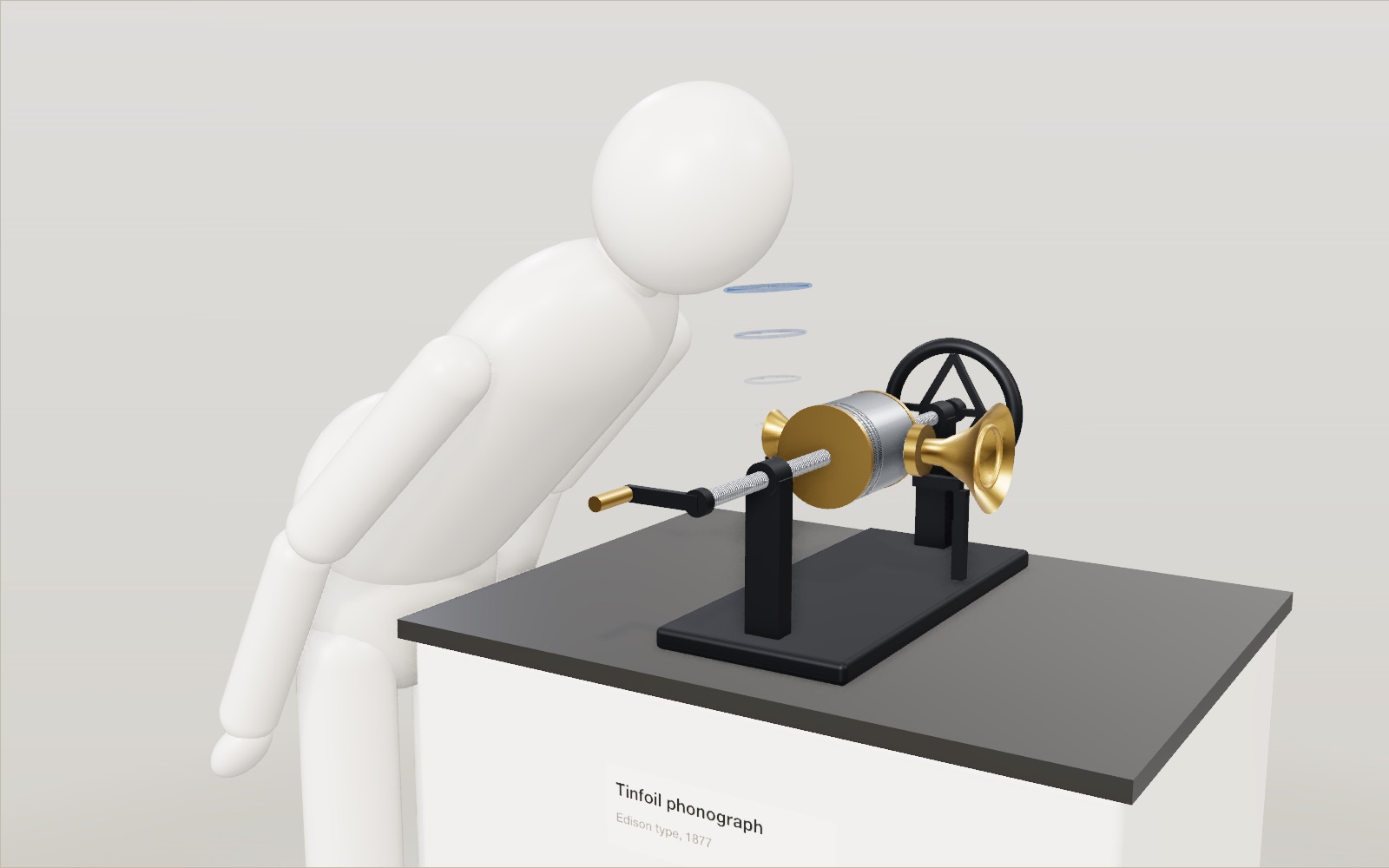
Edison's first phonograph cut a voice into tinfoil in 1877, and the same needle played it back from a groove 2.54 mm apart.
This device cannot show the 3D model. You can read the guide steps below as text.
1 / 14 A voice cut into tinfoilThe mannequin speaks into the mouthpiece. The needle presses the sound into the foil while the drum turns, then the drum goes back and the same groove speaks again.
Drag to turn. Scroll or pinch to zoom.
What happens when you speak into a phonograph
Stand in front of the stage for a few seconds and you see the oldest trick in sound recording. A mannequin leans over a small iron machine and speaks into a mouthpiece. Behind the mouthpiece a thin diaphragm shivers with the voice, and a steel point fixed to it presses into a sheet of tinfoil wrapped round a drum. The drum turns and slides sideways on a screw, so the point leaves a spiral track in the foil. Then the drum goes back to where it started, a second, lighter point rides the same track, and the voice comes back out of a little horn.
That is all a phonograph is: a way to turn the movement of air into the shape of a groove, and the shape of a groove back into the movement of air. Everything else on this page, the wax cylinders, the 78 rpm discs, the electric pickups, the tapes and the compact disc, is a different answer to the same two questions. Where do you store the shape of the wave, and how do you read it back without destroying it?
The stage has seven machines. Pick one with the Machine control. Zoom takes you from the whole machine to the needle or the tape head, and then under a microscope, where the groove, the magnetized particles on a tape or the pits of a CD are drawn from the same signal you can hear. Speed changes how fast the medium passes the needle or head, and the readout shows what that does to the pitch. Sound stays off until you switch it on, and your own voice goes into the groove only if you press Record my voice and allow the microphone. Nothing you record leaves the page.
Sound is a pressure wave
A voice is air being pushed and pulled. Your vocal folds open and close more than a hundred times a second, and each puff raises the air pressure a tiny amount in front of your mouth. The raised pressure travels outward at the speed of sound, about 343 m/s in air at room temperature, followed by a dip, then another rise. A microphone, an eardrum or a phonograph diaphragm sitting in that air is pushed in and out by the same pattern.
Two numbers describe a simple wave. The frequency is how many times a second the pressure goes up and down, measured in hertz (Hz). The wavelength is how far the wave travels during one of those cycles. They are tied together by the speed:
wavelength = speed ÷ frequency
In air a tone of 1,000 Hz (1 kHz) has a wavelength of 343 ÷ 1,000 = 0.343 m, about the width of a pair of shoulders. The same formula appears again and again on this page, because every recording medium is a kind of slow, frozen air. When a groove passes a needle at 0.5 m/s, a 1 kHz tone takes 0.5 ÷ 1,000 m = 0.5 mm of groove. When a cassette tape passes the head at 4.76 cm/s, the same tone takes 47.6 µm of tape.
A real voice is not one tone. The vocal folds give a fundamental around 100 to 250 Hz, and the shape of the mouth and throat lifts some of the harmonics above it. Those lifted bands, called formants, are what make an "ah" different from an "ee". The spoken line on the stage is built the same way in your browser: a buzz at about 120 Hz shaped by 3 formants for each vowel. It is not a recording of anyone, so there is no copyright in it.
The tinfoil phonograph of 1877
According to the Thomas A. Edison Papers at Rutgers University, Edison had the idea of recording sound in July 1877 while he was working on a telephone transmitter. In a laboratory note he described a telephone diaphragm with an embossing point held against paraffin paper moving rapidly, and wrote that the vibrations were "indented nicely". He came back to the idea over the following months, and by the end of November he had a basic design.
The first phonograph was a grooved cylinder on a long shaft. The shaft had a screw pitch of 10 threads per inch and was turned by a hand crank. Instead of paraffined paper, Edison wrapped a piece of tinfoil around the cylinder as the recording surface. The machinist John Kruesi built it during the first week of December 1877. When it was finished, Edison put on the foil and recorded the nursery rhyme "Mary Had a Little Lamb". The Edison Papers note that the first phonograph had separate recording and playback mechanisms, and that later designs combined them.
The patent followed quickly. US patent 200,521, for an improvement in phonographs or speaking machines, was granted on 19 February 1878. The machine was exhibited widely in the United States and Europe and made Edison famous as the "Wizard of Menlo Park". It was also of real interest to scientists, who used it to study acoustics.
But the Edison Papers are blunt about its limits: the tinfoil recordings were never entirely satisfactory, and it was another ten years before Edison produced a commercial machine. Foil tears, it cannot be taken off and put back on the drum in exactly the same place, and the indentations flatten each time a needle runs over them. Try it on the stage. Set Times played to 10 and play the foil: the groove is shallower, the sound is quieter and duller, and the noise is louder.
Why 10 threads per inch? Each turn of the crank moves the drum one thread sideways, so the groove spirals with a pitch of 25.4 ÷ 10 = 2.54 mm. That is wide enough for a steel point to follow by itself, which matters on a machine with no tone arm and nothing to steer the needle except the groove it is cutting.
Twenty years earlier: Scott's phonautograph
Edison was not the first person to record sound. The National Park Service's Thomas Edison National Historical Park now says plainly that sound recording was invented twice: first by Édouard-Léon Scott de Martinville in France in 1857, then 20 years later by Edison.
Scott's phonautograph drew the vibrations of a membrane onto paper blackened with soot, wrapped around a hand-cranked cylinder. It was meant for looking at sound, not for hearing it again. No one could play a phonautogram back, so for a century and a half there was no proof that the traces held anything you could recognise.
In 2008 researchers working as First Sounds found Scott's surviving recordings in French archives and turned them into sound with an optical scanning method developed at Lawrence Berkeley National Laboratory. First Sounds explains that a tuning fork helped a great deal. During 1860 Scott ran a 250 Hz tuning fork trace alongside his recordings, which gives a timecode: wherever the fork's wiggles bunch up, the cylinder was turning slowly, and the sound can be stretched back to its true speed. Recordings from 1857 have no such trace, and the speed of the hand on the crank wandered so much that their melodies cannot be recognised.
The best known result is "Au clair de la lune", recorded on 9 April 1860. First Sounds calls it the earliest clearly recognizable record of the human voice yet recovered. A recitation from Ducis's Othello, made in April 1860, is the earliest record of spoken language that can be played at its exact original speed. A phonautogram of a 435 Hz tuning fork from 1859 is the oldest recognizable sound reproduced so far.
The stage's first scene is Edison's machine, because it was the first that could play its own recording. The Scott case in the list under the controls opens the microscope instead, because a phonautogram is closer to a picture of a groove than to a groove.
How a groove holds a wave
Look at the tinfoil groove under the microscope. As the voice pushes the diaphragm in, the point goes deeper; as the pressure drops, it rises. The groove therefore has a constant path across the drum but a depth that goes up and down with the sound. Collectors call this hill and dale, or vertical cut. Edison's cylinders kept it for their whole history.
The other way to store the same wave is to keep the depth constant and let the groove swing sideways. This lateral cut is what Emile Berliner used for his gramophone discs, and by about 1920 it had become the norm for discs, as Yale University Library's guide to 78 rpm records notes. On the stage, the gramophone and the electric player show a lateral groove: the walls stay the same height while the path wiggles from side to side, and the needle is pushed left and right.
Either way, the recording is the wave itself, written along a line. The relation between the line and time is the surface speed: how many metres of groove pass the needle each second. For a cylinder, the surface speed is the circumference times the turns per second. The model's tinfoil drum is 101.6 mm across and turns at about 60 rpm (both are model values, since the original was turned by hand), so
v = π × 0.1016 m × 60 ÷ 60 s = 0.319 m/s
At that speed one cycle of a 1 kHz tone takes 0.319 ÷ 1,000 m, which is 319 µm of foil. A 10 kHz tone would take 31.9 µm, finer than a foil impression made by a blunt steel point could hold. That is one reason the tinfoil sounded muffled: the medium could not carry the short waves of the high notes.
The microscope shows exactly as much groove as the caption says, and the waveform in the readout is the signal under the needle at that moment. With Slow motion set to 100 or 1,000 times slower, you can watch the groove's shape slide under the point. On the tinfoil drum, 10 mm of foil holds 10 ÷ 319 s, or 31 ms, of sound.
Wax replaces foil
The Edison Papers say that Edison's early attempts to sell a tinfoil phonograph failed, and that it was Alexander Graham Bell and Charles Sumner Tainter, demonstrating a wax-record cylinder machine in the mid-1880s, who brought him back to sound recording. Bell, his cousin Chichester Bell and Tainter worked together as the Volta Laboratory Associates in Washington. Their machine, the graphophone, cut the groove into wax instead of pressing it into foil. Cutting removes a thin thread of material and leaves a clean, durable groove that can be played many times.
Between 1887 and 1889 Edison and his staff developed improved phonographs and wax cylinders that were technically better than the graphophone. They were also expensive and hard to run because of their electric motor, so they found only a limited market as dictating machines. Edison also tried to sell a talking doll with a small phonograph inside, but it was too fragile.
The phonograph found its first real audience in a different way. In the 1890s agents installed coin slots on dictating phonographs and opened phonograph parlors, where customers could hear a recording for a nickel. Later in the decade cheap spring-motor phonographs appeared, and Edison's company improved the way records were copied. From then on it led the industry for about a decade.
The UCSB Cylinder Audio Archive describes the brown wax cylinders of 1895 to 1901 as the first sound recordings sold on a wide commercial scale. They were cut at speeds that varied from about 120 to 160 rpm, and they came with a paper slip naming the recording, since only a number was written on the cylinder itself. Most slips are lost. Nearly every commercial brown wax cylinder therefore begins with a spoken announcement of the title and performer. Brown wax blanks could also be used again: the old groove was shaved off, and Edison claimed a blank could be reused up to 100 times. The archive compares it with a rewritable disc.
Copying was the weak point. Until 1902, a performer sang the same song over and over in front of a handful of recording horns, and each performance produced only a small batch of cylinders.
Numbers on a cylinder
In 1902 Edison introduced the Gold-Moulded process. A metal mould was made from a wax master, and a blank was heated inside it so that it expanded into the grooves. The name comes from the trace of gold used to make the master conductive. The playback speed was standardized at 160 rpm, and the groove pitch stayed at 100 threads per inch. UCSB notes that at 160 rpm a cylinder of 100 threads per inch plays for about 1.5 to 2.5 minutes, which is why these were sold as two-minute records.
The model's wax cylinder is 55.6 mm across (2 3/16 in), and the playing length along it is taken as 4 in. Then:
- turns = 100 threads per inch × 4 in = 400 turns
- playing time = 400 ÷ 160 rpm = 2.5 min
- surface speed = π × 0.0556 m × 160 ÷ 60 s = 0.466 m/s
- groove length = 400 × π × 0.0556 m = 69.9 m
A 1 kHz tone takes 0.466 ÷ 1,000 m = 466 µm of groove. The interesting number is what does not change. A cylinder has the same diameter at the start of the groove as at the end, so the groove passes the stylus at 0.466 m/s all the way through. A disc cannot do that, as the next sections show.
In 1908 Edison doubled the groove density. The Amberol cylinder had 200 threads per inch and played for about 4 minutes. It needed a new stylus, and old machines had to be refitted. In 1912 both the two-minute and four-minute wax lines ended, and Edison switched to the Blue Amberol, a celluloid cylinder with the same 4-minute groove. Celluloid did not shatter if you dropped it. UCSB adds a twist: shrinkage and deformation over the following century have made many Blue Amberols difficult to play, and they often sound worse today than the wax cylinders they replaced.
Other makers tried bigger and different cylinders. Concert cylinders, sold from late 1898, were 5 inches across, more than twice the standard size, and louder. They were first recorded at 120 rpm, then 144 rpm in late 1899 and 160 rpm in early 1902, and they cost $4 to $5 each compared with 35 to 50 cents for a standard cylinder. In France, the clockmaker Henri Lioret made a talking doll with a small celluloid cylinder in 1893 and went on to make his own durable celluloid music cylinders, played at 100 or 120 rpm, holding from 30 seconds to 4 minutes.
Berliner's flat disc
Emile Berliner, a German-born inventor in Washington, studied both the phonograph and the graphophone before trying something else. The Library of Congress Information Bulletin describes how he made the move from cylinders to flat, double-sided zinc discs with a spiral groove traced by a needle. On 8 November 1887 he was granted a patent for the gramophone, a device to record and reproduce sounds, US patent 372,786.
The flat disc had one enormous advantage. A cylinder had to be copied from a master, and before moulding that meant recording again or copying through horns. A disc could be stamped. Make a metal negative of the master once, and you can press thousands of identical records from it. The Library of Congress article says the flat discs could be mass-produced at a much lower cost than Edison's cylinders. Berliner also saw the gramophone as a home entertainment machine from the start, while others thought of the phonograph as an office dictating machine.
The road was not smooth. On a trip to Germany in 1889 Berliner agreed with a toy firm to make little toy discs and hand-turned players. Back in America he founded the American Gramophone Company and then the United States Gramophone Company in Washington. To keep the speed even he worked with Eldridge R. Johnson's machine shop in Camden, New Jersey, on machines with spring motors, and the same article credits Johnson with the idea of putting labels on discs. On the stage, the paper label in the middle of the gramophone's disc is one of the hidden finds, and so is the spring key on the cabinet.
A fire broke out at Berliner's Washington factory on 29 September 1897. Patent disputes and rival copies followed, and in June 1900 a court injunction shut down the Berliner Gramophone Company of Philadelphia. Berliner passed his patent rights to Johnson, who formed the Victor Talking Machine Company, with Berliner keeping a financial interest.
Why discs won
A disc is easy to store on a shelf, easy to post and easy to make by the thousand, and it holds a little more music than a two-minute cylinder. UCSB's history of the Blue Amberol notes that by 1912 Edison's fiercest competitors were the Victor Talking Machine Company and the Columbia Phonograph Company, which had already stopped making cylinders. Yale's guide sums up the result: by the 1910s, flat discs were the main medium for sound recording. Edison kept the Blue Amberol going until 1929.
Edison also made discs of his own. Iowa State University's museum holds an Edison Diamond Disc phonograph and describes the records as 1/4 in thick, made of clay and shellac, and played with a genuine diamond. The Diamond Disc series ran from 1912 to 1929. True to Edison's cylinders, its groove was cut hill and dale, not side to side.
The cylinder had one thing the disc did not: it kept the same groove speed from start to finish. On a disc the outer turns are much longer than the inner ones, but they take the same time to play. The groove slows down as the needle moves in, and high notes near the label are packed into a shorter stretch of groove. Turn on the microscope over the gramophone and look at the readout as the arm moves inward. The surface speed drops, and so does the length of groove that one wave of 1 kHz takes.
Numbers on a 78
Early disc speeds varied widely. Yale's guide says that recording and playing speeds ranged from 72 to 86 rpm before settling at 78, and that by 1910 most records were made at about 78 to 80 rpm. In 1925, 78.26 rpm was chosen as a standard for motorized players, because a common 3,600 rpm motor turning a 46-tooth gear gives
3,600 ÷ 46 = 78.26 rpm
The same guide gives the playing time per side: about 3 minutes for a 10-inch disc and about 4 to 5 minutes for a 12-inch. The model's 10-inch gramophone disc has its groove from a radius of 117 mm to 50 mm with 96 grooves per inch. Those three numbers are model values chosen to be typical, not measurements of one record, so the results below are estimates:
- turns = (117 − 50) mm ÷ 25.4 mm × 96 = 253 turns
- playing time = 253 ÷ 78.26 rpm = 3.2 min
- groove speed at the edge = 2π × 0.117 m × 78.26 ÷ 60 s = 0.96 m/s
- groove speed at the end = 2π × 0.050 m × 78.26 ÷ 60 s = 0.41 m/s
- groove length ≈ 253 × π × (0.117 + 0.050) m = 133 m
The 3.2 minutes agrees with Yale's figure of about 3 minutes. At the outer edge a 1 kHz tone takes 959 µm of groove; near the label it takes 410 µm. For the 12-inch disc of the electric player the model uses 146 mm to 60 mm, which gives 325 turns, 4.2 minutes, and 1.20 m/s at the edge falling to 0.49 m/s at the end. Yale's 4 to 5 minutes again fits.
Why so short? The groove of a 78 is wide, because a steel needle in a shellac groove needs room, and the disc turns fast. The long-playing record of 1948 kept the disc but used a fine groove and 33⅓ rpm; the vinyl record exhibit takes up that part of the story.
The horn and acoustic recording
Before 1925 there was no electricity anywhere in a record. Yale's guide describes it: the performer sang or played into a large horn, and the power of the sound itself vibrated the recording stylus and cut the wax master. Playback ran the other way. The groove moved the needle, the needle moved a mica diaphragm in the soundbox, and the horn passed the diaphragm's movement into the room.
A horn is a matching device. A diaphragm a few centimetres across is very bad at pushing a large mass of air, and a bare one sounds thin and quiet. The horn's narrow throat lets the diaphragm push a small column of air hard, and the gradual widening passes that push to a wider and wider column until it reaches the room. The longer and wider the horn, the lower the notes it can pass. That is why the gramophone on the stage carries a flower horn half a metre across, and why horns grew large enough to fill a corner of a parlour.
The weakness of acoustic recording was range. Yale's guide notes that acoustical recording never gave high fidelity and that its dynamic range was limited. Very quiet and very loud sounds could not both be captured, deep bass did not move the stylus enough, and singers were placed close to or far from the horn to balance a group.
On the stage, the gramophone's sound is band-limited to about 200 Hz to 5 kHz with surface noise and crackle added. Those are model values meant to make the difference audible next to later machines, not measurements of a particular record.
Electrical recording from 1925
In 1925 the microphone arrived. Yale's guide explains that from then on the artist sang into a microphone, an amplifier turned the small electrical signal into a strong one, and that signal drove the cutting stylus. Records made this way are called electrical recordings, and the first was issued in 1925. Yale adds that the term is not usually used after magnetic tape arrived in 1947, when recording sessions moved to tape before being cut to disc.
Electricity changed both ends. At the recording end, a microphone does not need the performer to shout into a horn, so a whole orchestra could be recorded from a normal distance, and the amplifier could boost bass that had been too weak to cut. At home, an electric player replaced the horn with 3 parts: a pickup that turns the needle's movement into a voltage, an amplifier with vacuum valves that makes the voltage large, and a loudspeaker that moves the air. The electric player on the stage has all of them. Turn on See inside to see the valves glow and the paper cone behind the grille.
The motor changed too. A spring runs down, and a governor can only hold its speed approximately. An electric motor tied to the mains frequency keeps an exact speed, and a gear sets the record speed. That is where 3,600 ÷ 46 comes from: a motor running at 3,600 rpm, which is 60 turns a second on a 60 Hz supply, and a 46-tooth gear. The gear is one of the hidden finds under the electric player's platter.
The model's electric player is band-limited to about 90 Hz to 7 kHz on the stage, a model value chosen to sound fuller than the acoustic gramophone and narrower than tape.
Speed and pitch
Every analogue machine on the stage has the same rule. If you play a recording faster than it was made, every frequency in it rises by the same factor. Play it at twice the speed and a 440 Hz tone becomes 880 Hz, one octave up. In the language of music, the shift in semitones is
semitones = 12 × log₂(played speed ÷ recorded speed)
A few examples worked out from that formula:
- A 78.26 rpm record played at 80 rpm: 12 × log₂(80 ÷ 78.26) = 0.38 semitones sharp. Early records made at speeds from 72 to 86 rpm sound slightly wrong at a fixed speed for this reason.
- A 78.26 rpm record played at 33⅓ rpm: 12 × log₂(33.333 ÷ 78.26) = -14.78 semitones, more than an octave down and slow.
- A cassette running 6 % fast: 12 × log₂(1.06) = 1.01 semitones sharp.
- Twice the speed: 12 × log₂(2) = 12 semitones, exactly one octave.
Try the Speed control. At 43 % the readout shows about -14.6 semitones, close to what a 78 sounds like on a turntable set to 33⅓. Playing time follows speed the other way: a side that lasts 3.2 minutes at 100 % lasts 3.2 ÷ 0.43 = 7.4 minutes at 43 %.
This is also why the hand-cranked tinfoil phonograph needed a flywheel, and why the spring motors of cylinder and disc machines needed a governor. A wobble of a few per cent in speed is a wobble of a fraction of a semitone in pitch, and the ear notices it, especially on a held note. Tape machines had the same problem with the capstan, and listeners called the slow version wow and the fast version flutter.
The compact disc is the exception. Change its motor speed on the stage and the pitch stays where it is. The reason is in the section on why a CD keeps its pitch.
Magnetic recording: wire, paper and tape
The groove was not the only idea. The Library of Congress essay "A Tale of Tape", from the National Recording Preservation Plan, traces magnetic recording to an article by the American engineer Oberlin Smith in 1878. The first working machine was Valdemar Poulsen's telegraphone of 1898 in Denmark, which magnetized a moving steel wire. Wire recording never had great fidelity, the essay says, but it was a major breakthrough and stayed in use for many years. It tangled, tore easily and was hard to edit.
In 1927 the German inventor Fritz Pfleumer, who had worked on fusing gold powder into cigarette paper, applied the same idea to coat paper with magnetic powder. He patented this sound paper in 1928 and licensed it to the electrical company AEG in 1932. AEG built a recorder around long spools of tape, and the Library of Congress essay says AEG showed the Magnetophon K1, the first practical tape recorder, at the Berlin Radio Show in 1935. By the late 1930s German tape had moved from paper to a plastic base.
Sources differ on the details, and the stage marks this. A 2002 Audio Engineering Society convention paper by Manfred Krause names the model shown in 1935 as the K2, not the K1. The same pair of sources also differs on the next step, high-frequency bias: the Krause paper places it in the model K4 in 1940, and the Library of Congress essay credits Walter Weber in 1941 in Germany. The essay adds that W. L. Carlson and G. W. Carpenter had filed for a similar patent in the United States in 1921, granted in 1927, and that Marvin Camras also patented high-frequency bias in 1941. The case list under the controls gives the date as about 1940 to 1941.
After the Second World War, US Army Signal Corps officers studied the German machines, and John T. Mullin brought back 2 Magnetophon tape transports. A tape could be erased, recorded again, cut with a blade and joined with a splice, so for the first time a recording could be edited. Yale's guide dates the arrival of magnetic tape in record making to 1947. The splice on the reel-to-reel deck on the stage is a hidden find.
How a tape head writes and reads
A tape recorder stores sound as magnetism in tiny particles of iron oxide coated on a plastic ribbon. The record head is a ring of soft iron with a coil around it and a very narrow gap at the front, where the tape touches it. Current from the microphone amplifier flows through the coil and makes a magnetic field that leaks out of the gap into the tape. As the tape moves past, each stretch of it is left magnetized in the direction and strength the field had at that moment.
The playback head is the same shape. When the magnetized tape passes its gap, the changing field passes through the iron ring and induces a small voltage in the coil. On the stage, the microscope over the reel-to-reel deck shows the particles turning north or south with the signal under the head, coloured red and blue.
Wavelength sets the limit again. On tape the wavelength is the tape speed divided by the frequency:
- reel-to-reel at 19.05 cm/s: 1 kHz takes 0.1905 ÷ 1,000 m = 190.5 µm, and 10 kHz takes 19.05 µm
- compact cassette at 4.76 cm/s: 1 kHz takes 47.6 µm, and 10 kHz takes 4.76 µm
To play a wave the head's gap has to be narrower than about half its wavelength, so the cassette's 4.76 µm at 10 kHz needs a gap of a couple of micrometres. Slow tape asks for very fine heads and fine particles, which is why the cassette took years of improvement before people used it for music, and why studios ran tape at faster speeds such as 38.1 cm/s.
Magnetic particles do not respond in proportion to weak fields. They resist small changes and then switch all at once, an effect called hysteresis. Recorded straight, quiet sounds come out distorted and buried in noise. High-frequency bias solves this. A tone far above hearing is added to the signal in the record head. It shakes the particles back and forth so fast that they settle in proportion to the audio signal riding on top. The bias itself is too high to hear and is not reproduced by the playback head. The erase head uses a stronger version of the same high-frequency field to scramble whatever was on the tape before.
The capstan, not the reels, sets the speed. The reels turn faster or slower as their tape packs grow or shrink, so the tape is pinched between a steel capstan turning at an exact speed and a rubber roller. On the stage, look at the take-up reel on the reel-to-reel: it turns quickly at first, when its pack is small, and more slowly as it fills.
The compact cassette
The Philips Museum tells the story from the company's archives. In 1961 the recorder development group at Philips in Hasselt, Belgium, was asked to make a small battery-powered recorder and a cassette for it, to replace the reel-to-reel tape recorders then common at home. The head of product development was Lou Ottens. He decided that ease of use came first: young and old, and even the clumsiest, had to be able to work it. Size came next. Ottens had a block of wood cut to fit his jacket pocket, and that size set the size of the cassette and the recorder. The block is a hidden find on the stage, next to the portable recorder.
The Philips Pocket Recorder EL 3300 and its cassette were first shown at the Internationale Funkausstellung in Berlin in 1963. Philips then gave other manufacturers a free licence to the compact cassette system, as long as they kept to its technical rules. By September 1967, the Philips Courier reported, 70 firms around the world were making cassette recorders based on it. It remained an important sound carrier for over 35 years and became the most widely used home recording system.
Inside the shell nothing is threaded. Two hubs carry the tape, which runs along the front edge past openings where the head, the capstan and the pinch roller reach in. A felt pad on a spring presses the tape against the head from behind. The course notes on cassette decks from IIT Kanpur give the speed as 1.875 inches per second, 4.76 cm/s, held by the pinch roller pressing the tape on the capstan: too little pressure and the tape slips, too much and it may be crushed.
A C60 cassette holds 30 minutes per side. At 4.76 cm/s that needs
30 min × 60 s × 4.76 cm/s = 8,568 cm = 85.7 m of tape
The model's tape is 3.81 mm wide and the shell 100.4 × 63.8 × 12 mm, with the hubs 42.5 mm apart. Those are the dimensions built into the model.
The compact disc
Philips worked on the next carrier while the cassette was still rising. With Sony it introduced the compact disc in November 1982, first in Japan and 4 months later in Europe and the United States, according to the Philips Museum. The system joined two technologies: optical reading of a disc with a laser, and digital coding and processing of the signal. The audio format is the standard IEC 60908, and the data version of the disc is described in ECMA-130, which Ecma International publishes free.
A CD does not store the shape of the wave. It measures the wave 44,100 times a second in each of 2 channels, writes each measurement as a 16-bit number, and stores the numbers. The sampling theorem, explained in J. O. Smith's notes at Stanford's CCRMA, says that a signal sampled at a given rate can be rebuilt exactly if it holds no frequency above half that rate. Half of 44,100 is 22,050 Hz, above what most adults can hear. The raw audio rate is
44,100 × 16 bit × 2 = 1,411,200 bit/s
The numbers are coded into a pattern of pits pressed into plastic, read from below through the disc. ECMA-130 sets the spiral's track pitch at 1.6 µm ± 0.1 µm and the scanning velocity between 1.2 and 1.4 m/s at a channel bit rate of 4.3218 Mbit/s. It also says that a change from pit to land or land to pit stands for a 1, and no change for a 0. The coding keeps pits and lands between 3 and 11 channel bits long. One channel bit lasts 1 ÷ 4.3218 MHz = 231.4 ns, so at 1.2 m/s:
- shortest pit = 3 × 231.4 ns × 1.2 m/s = 0.833 µm
- longest pit = 11 × 231.4 ns × 1.2 m/s = 3.054 µm
At 1.4 m/s they are 0.972 µm and 3.563 µm. The microscope on the stage shows 3 neighbouring tracks of pits and the laser spot, scrolled a further 1,000 times slower than the Slow motion setting, because at 1.3 m/s the 8 µm in view would pass in about 6 µs.
ECMA-130 adds that the track spirals outward when the disc turns counter-clockwise as seen by the laser. A CD plays from the centre to the edge, the opposite of a record. That is one of the reverse cards under the controls.
Why a CD keeps its pitch
A record player plays faster and the pitch rises, because the groove is the wave and you are pushing the wave past the needle faster. A CD player works differently. The disc spins at whatever speed keeps the track passing the laser at a constant 1.2 to 1.4 m/s, so the motor runs faster near the centre and slower near the edge. At 1.3 m/s:
- at a radius of 25 mm: 1.3 ÷ (2π × 0.025 m) × 60 = 497 rpm
- at a radius of 58 mm: 1.3 ÷ (2π × 0.058 m) × 60 = 214 rpm
The numbers read from the disc go into a small memory, and a crystal clock sends them out to the converter at exactly 44,100 per second per channel. If the disc spins a little fast, the memory fills, and the player slows the motor down. The output never sees the disc's speed, so the pitch cannot change with it.
On the stage, setting Speed to 150 % on the CD player makes the disc spin faster, but the readout says the pitch is unchanged, and the sound does not move. The status line explains why.
The track is long. A 74-minute disc read at 1.2 to 1.4 m/s holds 74 × 60 × 1.2 = 5,328 m to 74 × 60 × 1.4 = 6,216 m of spiral, between 5.3 and 6.2 km. At a track pitch of 1.6 µm, the band from a radius of 25 mm to 58 mm holds (58 − 25) mm ÷ 0.0016 mm = 20,625 turns. 74 minutes of stereo at 1,411,200 bit/s is 74 × 60 × 1,411,200 ÷ 8 = 783.2 million bytes of audio before error correction.
How much fits on one side
The table under the controls works out each machine from its inputs. In short:
- tinfoil: 40 turns at about 60 rpm, about 0.7 minutes (estimate)
- wax cylinder: 400 turns at 160 rpm, 2.5 minutes
- 10-inch 78: 253 turns at 78.26 rpm, about 3.2 minutes (estimate)
- 12-inch electrical 78: 325 turns, about 4.2 minutes (estimate)
- reel-to-reel: 548.6 m (1,800 ft) of tape at 19.05 cm/s, 48 minutes
- compact cassette C60: 85.7 m at 4.76 cm/s, 30 minutes per side
- compact disc: 74 minutes
Two things stand out. The first is how much the wavelength matters. A 78 groove passes the needle at about 1 m/s and fits only 3 minutes; a cassette moves 20 times slower and fits 30 minutes, because tape can hold waves 20 times shorter. The second is that the CD's surface speed of 1.3 m/s is faster than any of the grooves, yet it holds 74 minutes, because its track is 1.6 µm apart instead of 265 µm, and it stores numbers instead of the wave.
The reel-to-reel figure is worked out as 548.6 m ÷ 0.1905 m/s = 2,880 s = 48 minutes on a 7-inch reel of 1,800 ft. The cassette figure is the C60's 30 minutes per side, which needs the 85.7 m worked out above. The tinfoil figure is 40 turns ÷ 60 rpm = 0.67 minutes.
Listening to grooves without touching them
A needle wears what it plays, and a cracked wax cylinder or a disc made of wax on cardboard may not survive one more play at all. Since the early 2000s, physicists at Lawrence Berkeley National Laboratory have read grooves with light instead. Their method, called IRENE, makes a high-resolution optical scan of the groove, computes how a stylus would have moved through it and turns that motion into a sound file, removing scratches and skips on the way.
The Berkeley Lab Engineering Division describes how the project began more than 20 years ago with the Library of Congress. One early effort digitized more than 3,000 wax recordings of Native Americans from the Phoebe Hearst Museum of Anthropology at UC Berkeley. The team then turned to about 200 experimental recordings from Alexander Graham Bell's Volta Laboratory in the 1880s, kept at the Smithsonian's National Museum of American History, some of them thin wax coatings on binder board. One of those discs holds Bell's own voice. In 2025 the team used a speech-recognition program to help transcribe a badly cracked Volta disc whose words no one had been able to make out.
Preservation of ordinary recordings is the larger job. The Council on Library and Information Resources and the Library of Congress published a national study in 2010, The State of Recorded Sound Preservation in the United States, and the 2006 report Capturing Analog Sound for Digital Preservation sets out how to transfer analogue sound safely. The Library of Congress's own guide to the care of audio materials covers storing and handling discs and tapes.
Digital discs need care too. NIST and the Library of Congress tested recordable CDs and DVDs by ageing them at raised heat and humidity, in a 2005 study published as NIST Special Publication 500-263, and the Library's preservation scientists continue to study CD longevity.
How the model differs from real machines
The stage shows the principle of each machine, and some parts are simplified.
- The tinfoil drum's diameter of 101.6 mm, its speed of 60 rpm and its 4 in of playing length are model values. The original was turned by hand at whatever speed the operator chose.
- The disc radii and the 96 grooves per inch of the 78s are typical model values. Real 78s varied by maker and year.
- The microscope draws the groove, the particles and the pits from the same signal you hear, with the amplitude exaggerated so the shape can be seen. The length shown is the length stated in the caption; the depth and width are not to the same scale.
- Tape particles are drawn much larger and fewer than real ones, which are well under a micrometre long.
- The CD shows pits and lands with lengths of 3 to 11 channel bits, but in a random pattern, not real coded audio. Error correction, the eight-to-fourteen code and the focusing servo are left out.
- Sound is made in your browser: a band filter, a little noise and crackle and a speed change. Band limits and noise levels are model values chosen to make the differences clear, not measurements.
- The first scene runs a quarter of the tinfoil's spiral in 6 seconds so you can see it turn.
Questions
Who invented sound recording, Edison or Scott?
Both, in different senses. Édouard-Léon Scott de Martinville recorded sound in 1857 with his phonautograph but could not play it back. Edison's phonograph of 1877 was the first machine that could record and play back. The National Park Service now says that sound recording was invented twice.
What was the first thing Edison recorded?
The Edison Papers at Rutgers say that when John Kruesi finished the machine in December 1877, Edison recorded the nursery rhyme "Mary Had a Little Lamb".
Why did Edison use tinfoil?
It was a surface soft enough to take an impression from a steel point and stiff enough to keep it for a few plays. It was a stopgap: the recordings were never entirely satisfactory, and wax replaced it about ten years later.
What is the difference between hill and dale and lateral cut?
In a hill and dale groove the needle moves up and down as the depth changes. In a lateral groove the depth stays the same and the needle moves side to side. Edison's cylinders and Diamond Discs used hill and dale; Berliner's gramophone discs used lateral cut.
Why do 78s turn at 78 rpm?
In 1925, 78.26 rpm was chosen because a 3,600 rpm motor with a 46-tooth gear gives 3,600 ÷ 46 = 78.26, and most existing records were made at about 78 to 80 rpm.
Why does a record sound higher when it is played faster?
Every frequency rises by the same factor as the speed. The shift is 12 × log₂(speed ratio) semitones, so twice the speed is 12 semitones, one octave up.
Why did cylinders lose to discs?
Discs could be stamped by the thousand from a metal negative, were easier to store and post, and held a little more music. By the 1910s discs were the main medium, although Edison made cylinders until 1929.
Could you record at home on a disc?
Not with a gramophone. Wax cylinder phonographs could record, and blanks could be shaved and reused; Berliner's gramophone only played pressed discs.
What is acoustic recording?
Recording without electricity, before 1925. Performers sang or played into a horn and the sound itself moved the cutting stylus.
How does a tape recorder store sound?
As magnetism. The record head's field magnetizes iron oxide particles on the tape in step with the signal, and the playback head turns that pattern back into a voltage.
What is tape bias?
A tone far above hearing added to the signal while recording. It shakes the magnetic particles so that they settle in proportion to the music, which removes most of the distortion and noise of recording without it.
Why does a cassette run at 4.76 cm/s?
It is 1⅞ inches per second, which keeps a small shell playing for a long time. The price is short wavelengths: 10 kHz takes only 4.76 µm of tape, so heads and tape had to be very fine.
Why does a CD not change pitch if the motor speeds up?
The player stores the numbers it reads in a small memory and sends them out by a fixed clock at 44,100 per second per channel. The motor speed only changes how full that memory is.
Does a CD play from the outside in?
No. Its track spirals outward from the centre, the opposite of a record.
Can an old record be played without touching it?
Yes. The IRENE method developed at Lawrence Berkeley National Laboratory scans the groove with light and computes the sound. It has been used on wax cylinders and on Alexander Graham Bell's experimental discs.
Is my voice saved when I use the microphone?
No. The 3 seconds stay in the page's memory to draw the groove and play it back. Nothing is saved or sent, and closing the page forgets it. If you do not allow the microphone, everything else still works.
Terms
- Phonograph: a machine that records sound as a groove and plays it back, originally on a cylinder.
- Gramophone: Berliner's name for a machine that plays flat discs.
- Diaphragm: a thin disc that moves with air pressure, in a mouthpiece, soundbox or reproducer.
- Stylus: the point that cuts or follows a groove.
- Hill and dale (vertical cut): a groove whose depth follows the sound.
- Lateral cut: a groove whose sideways path follows the sound.
- Surface speed: how many metres of groove or tape pass the needle or head each second.
- Wavelength on the medium: surface speed divided by frequency.
- Acoustic recording: recording through a horn, with no electricity.
- Electrical recording: recording with a microphone and amplifier, from 1925.
- Pickup: the part that turns a needle's movement into a voltage.
- Capstan: the shaft that pulls tape at an exact speed.
- Pinch roller: the rubber roller that presses tape against the capstan.
- Bias: an inaudible high tone added while recording on tape.
- Sampling: measuring a signal at regular intervals; a CD does it 44,100 times a second.
- Pit and land: the low and high areas on a CD track; each change between them is a 1.
Sources
- Thomas A. Edison Papers, Rutgers University, Tinfoil Phonograph (idea July 1877, embossing point on paraffin paper, 10 threads per inch, tinfoil, Kruesi first week of December 1877, "Mary Had a Little Lamb", separate recording and playback, never entirely satisfactory). https://edison.rutgers.edu/life-of-edison/inventions?view=article&id=542:tinfoil-phonograph-invention&catid=91 (checked 26 October 2026)
- Thomas A. Edison Papers, Rutgers University, Wax Cylinder Phonograph (Bell and Tainter mid-1880s, 1887 to 1889, dictating machine, talking doll, nickel parlors, spring motors). https://edison.rutgers.edu/life-of-edison/inventions?view=article&id=544:wax-cylinder-phonograph&catid=91 (checked 26 October 2026)
- National Park Service, Thomas Edison National Historical Park, The Origins of Sound Recording (sound recording invented twice, Scott 1857, recordings found 2008). https://www.nps.gov/edis/learn/historyculture/origins-of-sound-recording.htm (checked 26 October 2026)
- National Park Service, Who Invented Sound Recording?, exhibit by David Giovannoni. https://www.nps.gov/edis/learn/historyculture/origins-of-sound-recording-the-inventors.htm (checked 26 October 2026)
- First Sounds, The Phonautograms of Édouard-Léon Scott de Martinville (250 Hz tuning fork, Au clair de la lune 9 April 1860, Othello, 435 Hz fork 1859). https://www.firstsounds.org/sounds/scott.php (checked 26 October 2026)
- Google Patents, US200521A, Improvement in phonograph or speaking machines, T. A. Edison, granted 19 February 1878. https://patents.google.com/patent/US200521A/en (checked 26 October 2026)
- Google Patents, US372786A, Gramophone, E. Berliner, granted 8 November 1887. https://patents.google.com/patent/US372786A/en (checked 26 October 2026)
- Library of Congress Information Bulletin, Father of the Gramophone: Emile Berliner and the Birth of Recording (June 2011). https://www.loc.gov/loc/lcib/1106/berliner.html (checked 26 October 2026)
- UCSB Cylinder Audio Archive, Cylinder Recordings: A Primer. https://cylinders.library.ucsb.edu/history.php (checked 26 October 2026)
- UCSB Cylinder Audio Archive, Brown Wax Cylinders (1895–1901). https://cylinders.library.ucsb.edu/history-brownwax.php (checked 26 October 2026)
- UCSB Cylinder Audio Archive, Concert Cylinders of the Brown Wax Era. https://cylinders.library.ucsb.edu/history-concerts.php (checked 26 October 2026)
- UCSB Cylinder Audio Archive, Edison Gold-Moulded Cylinders (1902–1912). https://cylinders.library.ucsb.edu/history-goldmoulded.php (checked 26 October 2026)
- UCSB Cylinder Audio Archive, Edison Amberol Cylinders (1908–1912). https://cylinders.library.ucsb.edu/history-amberol.php (checked 26 October 2026)
- UCSB Cylinder Audio Archive, Edison Blue Amberol Cylinders (1912–1929). https://cylinders.library.ucsb.edu/history-blueamberol.php (checked 26 October 2026)
- UCSB Cylinder Audio Archive, Lioret Cylinders (1893–1900). https://cylinders.library.ucsb.edu/history-lioret.php (checked 26 October 2026)
- Yale University Library, Music Cataloging, The history of 78 RPM recordings. https://web.library.yale.edu/cataloging/music/historyof78rpms (checked 26 October 2026)
- Iowa State University Museums, Edison Disc Phonograph: Diamond Disc, Official Laboratory Model, 95.3.1. https://emuseum.its.iastate.edu/objects/5810/edison-disc-phonograph-diamond-disc--official-laboratory-m (checked 26 October 2026)
- Science Museum Group, Berliner gramophone. https://collection.sciencemuseumgroup.org.uk/objects/co117385/berliner-gramophone (checked 26 October 2026)
- Library of Congress, National Recording Preservation Plan, A Tale of Tape (Smith 1878, Poulsen 1898, Pfleumer 1927 and 1928, Magnetophon 1935, Weber 1941, Carlson and Carpenter 1921, Camras, Mullin). https://www.loc.gov/static/programs/national-recording-preservation-plan/tools-and-resources/documents/A-Tale-of-Tape.pdf (checked 26 October 2026)
- M. Krause, The Legendary "Magnetophon" of AEG, Audio Engineering Society Convention 112, paper 5605 (2002) (K2 in 1935, AC bias in K4 in 1940). Cited by its paper number: the e-library page refuses automated requests.
- National Inventors Hall of Fame, Valdemar Poulsen. https://www.invent.org/inductees/valdemar-poulsen (checked 26 October 2026)
- Lemelson-MIT Program, Valdemar Poulsen. https://lemelson.mit.edu/resources/valdemar-poulsen (checked 26 October 2026)
- BASF, Chronology 1934 (magnetic tape). https://www.basf.com/rs/sr/who-we-are/History/chronology/1925-1944/1934 (checked 26 October 2026)
- Simon Fraser University, Handbook for Acoustic Ecology, Tape Recording. https://www.sfu.ca/sonic-studio-webdav/handbook/Tape_Recording.html (checked 26 October 2026)
- IIT Kanpur, Audio Player's Cassette Deck Mechanism (course notes: 4.76 cm/s, capstan and pinch roller, felt pad). https://home.iitk.ac.in/~amit/courses/371/adarsh/contents.html (checked 26 October 2026)
- Philips Museum, Providing the soundtrack to people's lives (Hasselt 1961, Lou Ottens, wooden block, EL 3300 at IFA Berlin 1963, free licence, 70 firms by September 1967). https://www.philips.nl/en/a-w/philips-museum/stories/soundtrack-to-peoples-lives.html (checked 26 October 2026)
- Philips, Lou Ottens, inventor of the cassette tape, passed away (2021). https://www.philips.com/a-w/about/news/archive/standard/news/articles/2021/20210310-lou-ottens-loved-technology-when-he-talked-about-it-his-eyes-would-twinkle.html (checked 26 October 2026)
- Philips Museum, Compact disc: the audio revolution (November 1982 in Japan, four months later in Europe and the US). https://www.philips.nl/en/a-w/philips-museum/stories/compact-disc.html (checked 26 October 2026)
- Philips Museum, Music box for the future. https://www.philips.nl/en/a-w/philips-museum/stories/music-box-for-the-future.html (checked 26 October 2026)
- IEC 60908, Audio recording, Compact disc digital audio system. https://webstore.iec.ch/en/publication/3885 (checked 26 October 2026)
- Ecma International, ECMA-130, Data interchange on read-only 120 mm optical data disks (CD-ROM), 2nd edition, June 1996 (track pitch 1.6 µm ± 0.1 µm, 1.2 to 1.4 m/s, 4.3218 Mbit/s, spiral outward). https://www.ecma-international.org/wp-content/uploads/ECMA-130_2nd_edition_june_1996.pdf (checked 26 October 2026)
- J. O. Smith, Mathematics of the Discrete Fourier Transform, Sampling Theorem, Stanford CCRMA. https://ccrma.stanford.edu/~jos/mdft/Sampling_Theorem.html (checked 26 October 2026)
- O. Slattery and J. Zheng, NIST/Library of Congress (LoC) Optical Media Longevity Study, NIST Special Publication 500-263 (2005). https://www.nist.gov/publications/nistlibrary-congress-loc-optical-media-longevity-study (checked 26 October 2026)
- Library of Congress, Preservation Science, CD-ROM Longevity Research. https://www.loc.gov/preservation/scientists/projects/cd_longevity.html (checked 26 October 2026)
- Library of Congress, Preservation, Care, Handling and Storage of Audio Visual Materials. https://www.loc.gov/preservation/care/record.html (checked 26 October 2026)
- Lawrence Berkeley National Laboratory, Engineering Division, Voices from the past get an AI assist (2025) (IRENE, Library of Congress, 3,000 wax recordings, Volta Laboratory, Bell's voice). https://engineering.lbl.gov/2025/08/29/voices-from-the-past-get-an-ai-assist/ (checked 26 October 2026)
- IEEE Spectrum, Particle Physics Resurrects Alexander Graham Bell's Voice. https://spectrum.ieee.org/particle-physics-resurrects-alexander-graham-bells-voice (checked 26 October 2026)
- Council on Library and Information Resources, Capturing Analog Sound for Digital Preservation, Publication 121 (2006). https://www.clir.org/pubs/reports/pub121/ (checked 26 October 2026)
- Council on Library and Information Resources and Library of Congress, The State of Recorded Sound Preservation in the United States, Publication 148 (2010). https://www.clir.org/pubs/reports/pub148/ (checked 26 October 2026)
More exhibits
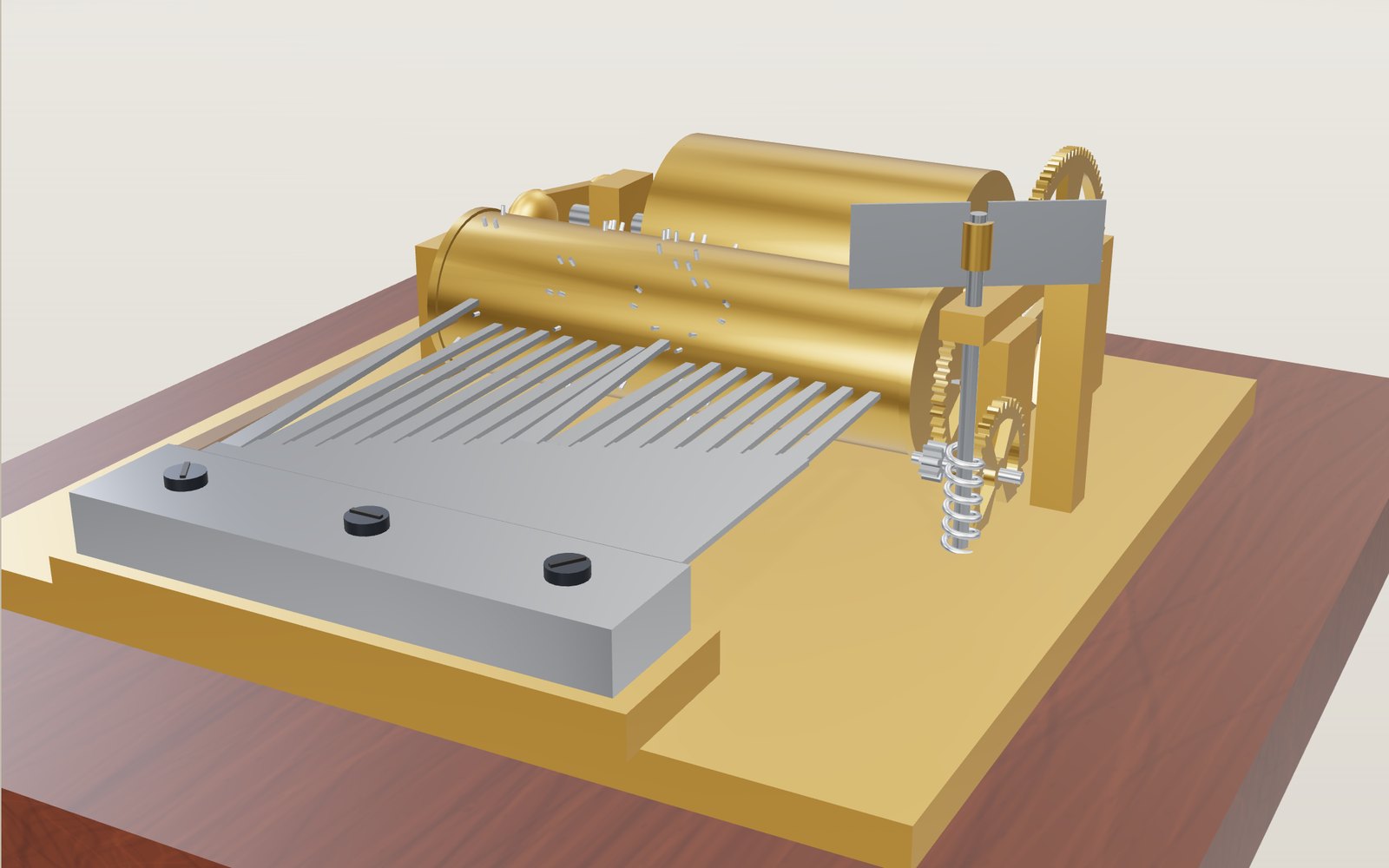
How a music box works
A steel tooth 30.6 mm long rings at 261.6 Hz, and cutting it to half that length would raise the note two octaves.
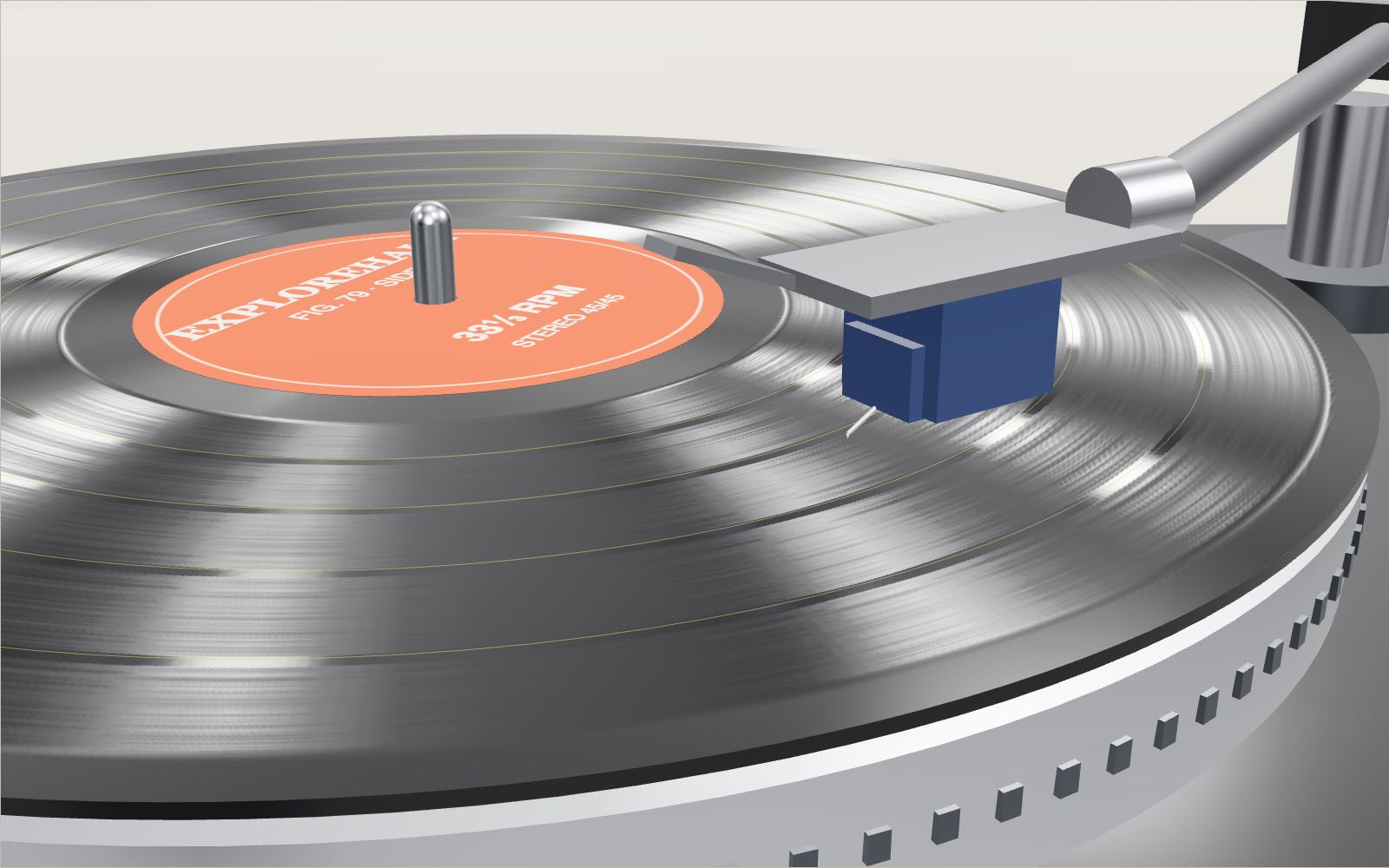
How does a vinyl record work? Grooves, stereo and RIAA
At the outer edge of an LP the groove slides under the stylus at half a metre per second, and by the last song it has slowed to 21 centimetres.
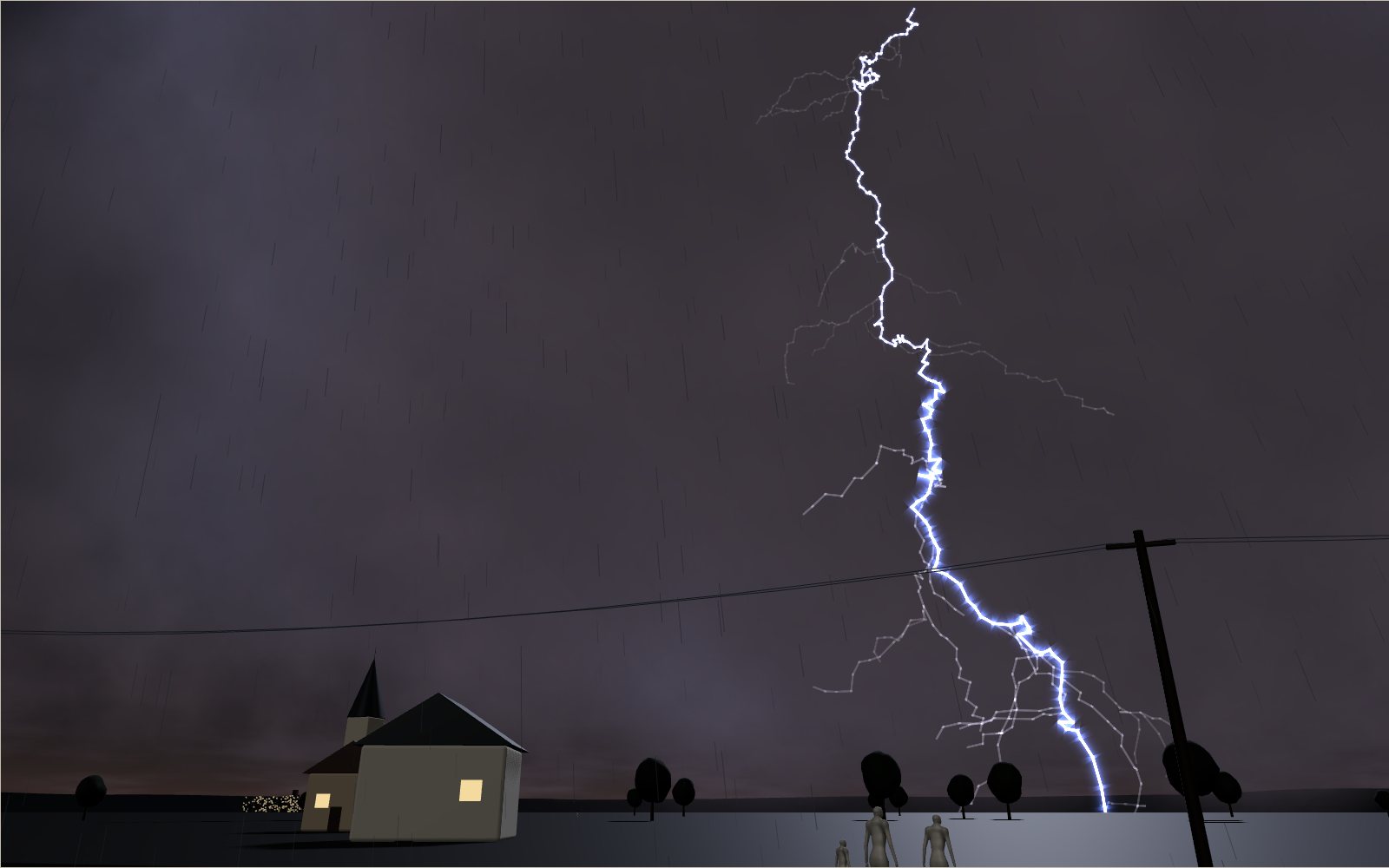
How lightning and thunder work
A lightning channel heats the air to about five times the temperature of the Sun’s surface, and its thunder needs about 3 seconds to cover each kilometre to you.
Morse telegraph: key it yourself, step by step
On 24 May 1844 a key in the US Capitol pressed dots and dashes into a paper tape in Baltimore, about 40 miles (64 km) away.
How a piano works: the grand action and equal temperament
Press a key 10 millimetres and a felt hammer flies to the string, hits it and falls away before it can stop the note.
What sound looks like: sound waves, frequency and decibels
A 440 Hz tone packs the air into dense layers 78 centimetres apart, yet even at 94 dB each bit of air moves less than a thousandth of a millimetre.