FIG. 19Senses
How a piano works: the grand action and equal temperament
Press a key 10 millimetres and a felt hammer flies to the string, hits it and falls away before it can stop the note.
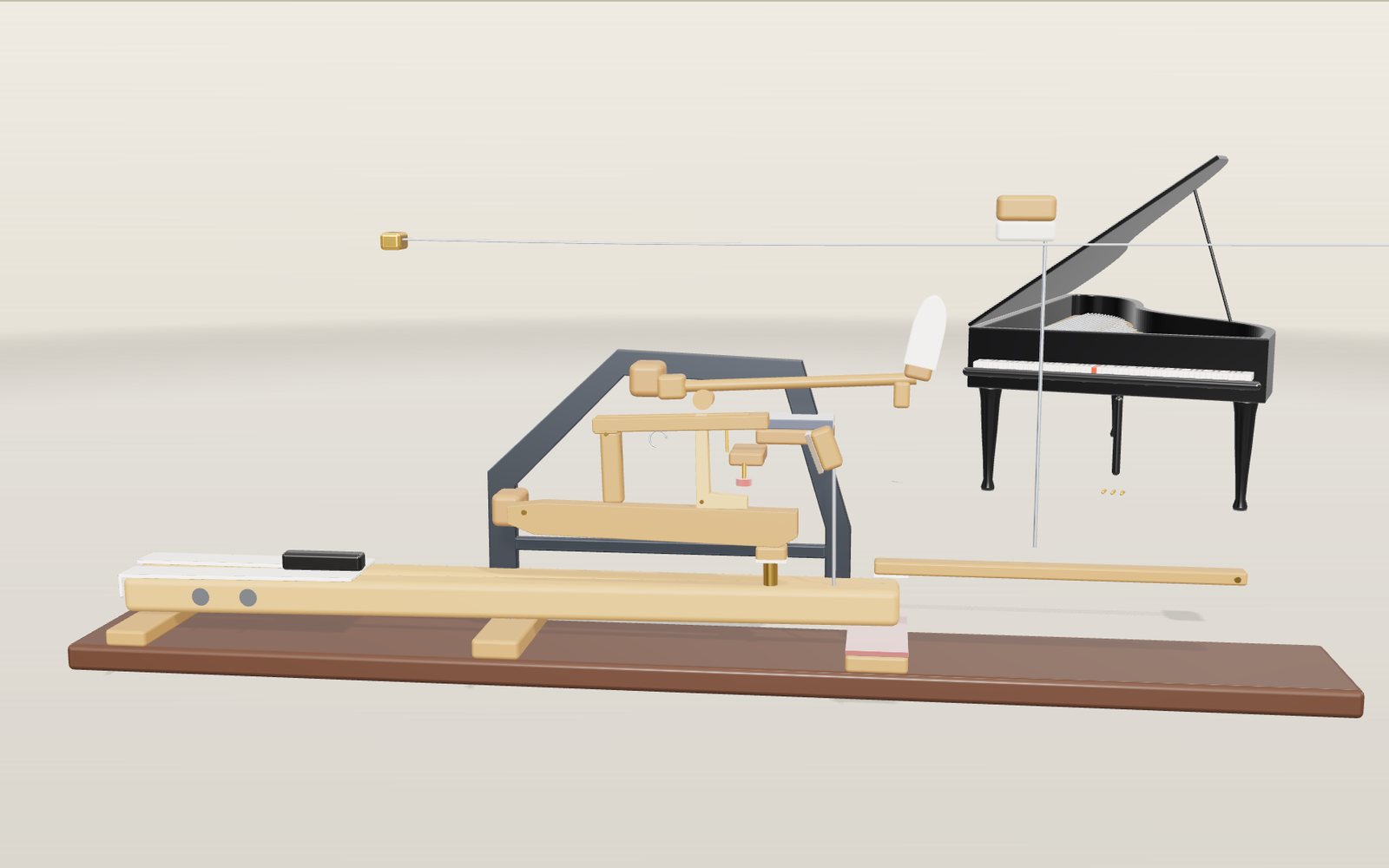
This device cannot show the 3D model. You can read the guide steps below as text.
1 / 12 One key, eleven partsThis is the mechanism behind a single key of a grand piano, seen from the side. Play the keyboard under the model and this key moves in slow motion while you hear the note at normal speed.
Drag to turn. Scroll or pinch to zoom.
What happens when you press a piano key
Press a key on a grand piano and you feel it go down about a centimetre. Somewhere behind the music desk a felt hammer the size of a thumb flies up, hits a steel string and drops away again, all in a few hundredths of a second. You never see it, because it happens inside the case and much too fast.
The model above shows the mechanism behind one key, seen from the side, with the speed turned down as far as 1/50. Play the keyboard under it and the model repeats the stroke in slow motion while you hear the note at normal speed. The box in the corner of the model shows how far the key has gone down, how far the hammer still is from the string, and the frequency of the note you played, worked out from A4 = 440 Hz.
Why the hammer has to let go of the string
The obvious way to build a piano would be to fix a hammer to the back of each key. Press the key, the hammer hits the string. The trouble starts a moment later. With your finger still on the key, the hammer would stay pressed against the string, and a felt pad resting on a vibrating wire stops it within a few cycles. You would hear a dull knock instead of a note.
So the hammer has to be thrown, not pushed. For most of the key's travel a small wooden piece called the jack pushes the hammer up. A couple of millimetres before the hammer reaches the string, the jack is tipped out from under it and the hammer covers the last distance on its own momentum. It hits the string, bounces off and falls back. This trick is called escapement, and every piano since Bartolomeo Cristofori's first instruments around 1700 has had some version of it.
Escapement creates a second problem. Once the jack has slipped out, it has to get back under the hammer before the same note can be played again. In a simple action that only happens when the key comes all the way up. Fast repeated notes, such as a trill, would be slow and uneven. The grand piano solves this with a second lever, the repetition lever, which holds the hammer up just high enough for the jack to slide back underneath while the key is still only part of the way up. Because the hammer can be released twice in this way, the mechanism is often called the double escapement action.
What each part does
Follow the push from your finger to the string.
- Key. A wooden lever rocking on a steel balance pin. In the model the pin is 240 mm from the front edge, so the front goes down while the back end goes up.
- Capstan. A brass button screwed into the back of the key. It lifts the wippen.
- Wippen. A lever hinged on its own flange. It carries the jack and the repetition lever and turns the key's lift into an upward push.
- Jack. Shaped like an L. Its upright arm pushes on the knuckle under the hammer shank; its short toe points toward the let-off button.
- Let-off button. A felt button on a screw. When the jack's toe reaches it, the jack tips over and lets go of the hammer.
- Hammer. A thin shank with a head of tightly pressed wool felt over a wooden core. The knuckle sits close to the shank's pivot, which is why a small push makes the head travel a long way.
- Repetition lever. Held up by a spring, it catches the knuckle after let-off and keeps the hammer raised while the jack resets.
- Backcheck. A felt pad on a wire at the back of the key. It catches the hammer on its way down so it cannot bounce back into the string.
- Damper. A block of felt resting on the string. The far end of the key lifts it through an underlever, so the string can ring while you hold the key.
- String. High-carbon steel wire. Most notes have three strings tuned to the same pitch, while the bass goes down to two and then one; the model shows three wires for one note. Together the strings pull on the iron frame with tens of tonnes of force: by 1875 Steinway claimed a plate that could take 70,000 pounds, about 32 tonnes.
- Keybed and action frame. The board, rails and metal standards that keep all of this lined up.
- Use the pedals. Press Damper pedal next to the keyboard, play a few notes and let go of the keys: they keep ringing. Press it again to release. Then hold C3, press Sostenuto, let go of C3 and play short notes higher up: only C3 keeps sounding.
- Watch the una corda. Press Una corda and open the Strings view. Play a note: the action slides sideways and the first of the three strings stays still.
- Tune a third by ear. In the panel, open Beats, choose Major 3rd and Your tuning, and drag the upper note towards −13.7 cents while you press Listen. The beating slows and stops.
Click any part in the Parts tab and the camera moves to it. See inside makes the keybed and frame transparent so you can watch the jack and the let-off button.
One stroke, millisecond by millisecond
The model follows a firm note. The key takes 50 ms to go down, eased in and out. Here is what happens on the way, using the model's own timing.
- 0 ms: the key starts down. The capstan lifts the wippen, the jack lifts the knuckle and the hammer starts to rise. At the same time the far end of the key takes up a small gap and begins lifting the damper off the string.
- 41 ms: the key has done 92 % of its travel. The jack's toe meets the let-off button and the jack tips out. The hammer head is about 3 mm from the string and moving at roughly 0.66 m/s.
- 46 ms: after about 4.6 ms of free flight, the felt meets the string. From here on the key has no say in what the hammer does.
- After the strike: the hammer rebounds and drops onto the backcheck, which holds it a little below the string while the key stays down. The repetition lever lifts it slightly and the jack slides back under the knuckle.
- Release: the key comes up, the backcheck lets go, the hammer returns to rest and the damper drops back onto the string.
At the slowest speed (1/50) the 46 ms from finger to string take 46 × 50 = 2,300 ms, or 2.3 seconds on screen, and the free flight alone lasts about a quarter of a second. That is long enough to see that the jack has already moved away when the felt arrives.
The lever ratios, worked out
Each lever in the action trades force for distance. Here are the numbers for the model, which uses a key dip of 10 mm and a balance pin 240 mm from the front of the key.
- Key angle at full dip: atan(10 / 240) = 2.39°.
- The capstan sits 155 mm behind the pin, so it rises 155 × sin 2.39° = 6.5 mm.
- The wippen's pivot is 145 mm in front of the capstan, so the wippen turns by 6.5 / 145 rad = 2.55°.
- The jack is 105 mm from the wippen pivot, so it rises 105 × sin 2.55° = 4.7 mm.
- The knuckle is 18 mm from the hammer shank's pivot, so the hammer swings 4.7 / 18 rad = 14.9°.
- The tip of the felt is about 148 mm from that pivot, so it travels 148 × 0.259 = 38 mm.
From 10 mm at the key to 38 mm at the hammer head is a ratio of about 3.8. The let-off point at 92 % of the key travel leaves 38 × 0.08 = 3.1 mm of free flight. On a real grand these distances are set by a technician during regulation, by turning screws such as the let-off button and the capstan, and the exact figures differ from maker to maker. A higher ratio means a lighter, faster hammer for the same finger movement, and a heavier feel under the finger, which is why makers add lead weights to the front of the keys. The model has two of them, the grey discs near the front of the key.
Twelve equal steps: where the frequencies come from
A piano is tuned in twelve-tone equal temperament. The octave, a doubling of frequency, is split into twelve semitones, and each semitone multiplies the frequency by the same number. Twelve equal multiplications have to make 2, so that number is the twelfth root of 2:
r = 2^(1/12) = 1.059463
The reference is A4, the A above middle C, which ISO 16 fixes at 440 Hz. Number the keys the way MIDI does (A4 is 69, middle C is 60) and any note m has the frequency
f = 440 × 2^((m − 69) / 12)
Some values to check against the panel when you play:
| Note | m | Calculation | Frequency |
|---|---|---|---|
| A0 (lowest key) | 21 | 440 × 2^(−48/12) = 440 / 16 | 27.50 Hz |
| C3 | 48 | 440 × 2^(−21/12) | 130.81 Hz |
| C4 (middle C) | 60 | 440 × 2^(−9/12) | 261.63 Hz |
| A4 | 69 | 440 × 2^0 | 440.00 Hz |
| C6 | 84 | 440 × 2^(15/12) | 1,046.50 Hz |
| C8 (highest key) | 108 | 440 × 2^(39/12) | 4,186.01 Hz |
C6 is three octaves above C3, so its frequency is 2³ = 8 times higher: 130.81 × 8 = 1,046.50 Hz. One cycle of middle C lasts 1 / 261.63 s = 3.82 ms, so even a short note held for half a second has made the string swing back and forth about 0.5 × 261.63 = 131 times.
Why equal temperament is slightly out of tune
Simple frequency ratios sound smooth together. A perfect fifth is 3 : 2 and a major third is 5 : 4. Equal temperament cannot hit these exactly, because no power of 2^(1/12) is a ratio of small whole numbers.
- The equal-tempered fifth is 2^(7/12) = 1.498307 instead of 1.5. That is 1.96 cents flat (a cent is 1/100 of a semitone), which is hard to hear.
- The equal-tempered major third is 2^(4/12) = 1.259921 instead of 1.25. That is 13.7 cents sharp, which a trained ear can hear.
You can hear the difference as beats. Play C4 and G4 together: the third harmonic of C4 is 3 × 261.63 = 784.88 Hz and the second harmonic of G4 is 2 × 392.00 = 783.99 Hz, so they beat at about 0.9 times a second. Play C4 and E4 and the fifth harmonic of C4 (1,308.13 Hz) against the fourth of E4 (1,318.51 Hz) beats about 10 times a second. Tuners count these beats to set the temperament. The price is that every key sounds equally acceptable, so music can move to any key without retuning.
The scale menu under the keyboard marks the notes of a scale with dots, and the chord display names what you are holding down. Hold C, E and G and it reads C. Hold A, C and E and it reads Am.
A string in numbers: Mersenne's law
A string is the easiest part of a piano to put numbers on. A stretched string vibrates at a fundamental frequency
f = (1 / 2L) × √(T / μ)
where L is the vibrating length in metres, T is the tension in newtons and μ is the mass of one metre of wire. The square root is the speed of a wave along the string, and the wave has to run to the far end and back, a distance of 2L, for every cycle. HyperPhysics at Georgia State University sets this out with a calculator whose default is a 100 cm string under 50 lb (222 N) with 0.2872 g per metre. The wave speed comes out at 880 m/s and the note at 440 Hz.
Here is the same calculation for an A4 string. The numbers are my assumptions, chosen to be typical, and are not measurements of one piano: plain steel wire 1.0 mm across (density 7,850 kg/m³) and a vibrating length of 0.33 m. For comparison, the thinnest piano strings are about 0.85 mm across, according to the Jaatinen and Pätynen study in the sources.
- Mass per metre: μ = 7,850 × π × (0.0005)² = 6.17 × 10⁻³ kg/m.
- Wave speed: v = 2Lf = 2 × 0.33 × 440 = 290 m/s.
- Tension: T = μv² = 0.00617 × 290² = 520 N, the weight of about 53 kg hanging from the wire.
- A4 has three strings, so this one key pulls on the frame with about 1.56 kN.
For scale, the Steinway plate of 1875 was built to take up to 70,000 pounds, which is 311 kN. A grand has 226 strings if you count the way HyperPhysics does (10 single bass strings, 18 notes with two, 60 notes with three: 10 + 36 + 180), so the plate could allow 1.4 kN for each. Another study counts 220 on average, and the number differs from maker to maker. Either way 520 N is well inside the limit.
The square root explains why tuning is so delicate. One cent changes the frequency by a factor of 2^(1/1200), so the tension has to change by 2^(1/600) − 1 = 0.116 %. For this string that is 0.60 N out of 520 N. A pin that creeps by that much has moved the note by a cent.
It also explains why the strings are not simply halved for each octave. With the same wire and length, doubling the frequency takes four times the tension: 2,080 N for A5 in this example. Halving the length does the job at the same tension, but real makers settle for less. HyperPhysics gives a length ratio between 1.88 and 1.94 to 1 per octave. Over seven octaves, halving each time would shrink the string by 2⁷ = 128, and 1.9 per octave shrinks it by 1.9⁷ = 89. The top strings are therefore 128 / 89 = 1.43 times longer than halving would give, so the wave on them has to travel 1.43 times faster, which means T / μ must be 1.43² = 2.05 times larger. The makers keep the tension in a similar range and let the mass per metre drop instead, which is why the treble wire is thin. HyperPhysics says the same in one sentence: the string mass is varied to constrain the frequencies to their proper values.
The bass has the opposite problem. Take A0 at 27.5 Hz with an assumed length of 1.2 m and a tension of 700 N. Then μ = 700 / (2 × 1.2 × 27.5)² = 0.161 kg/m and the wave speed is only 66 m/s. A plain steel rod with that mass per metre would be 5.1 mm thick and far too stiff. So the maker winds copper or brass around a thinner steel core, which adds mass without adding much stiffness. The finished bass strings reach about 8.5 mm across. One cycle of A0 lasts 36 ms, while one cycle of A4 lasts 2.3 ms.
Why the treble is tuned sharp: inharmonic partials and stretch tuning
The sound section above uses the formula f_n = n × f × √(1 + B n²) for the partials. An ideal flexible string would have partials at exactly 1, 2, 3 and so on times the fundamental. A steel wire also resists bending, and the effect grows as the wavelength gets shorter, so each higher partial sits a little sharp. B is the inharmonicity coefficient. It depends on the diameter, length, tension and stiffness of the wire. Robert Young measured it in six pianos in 1952 and found the theory of stiff strings fits the data. Rudolf Rasch and Vincent Heetvelt measured every string of a medium-sized grand in 1985 and also found the measurements in excellent agreement with the formula. They add that higher strings usually have higher inharmonicity, which cancels part of its effect on the beat frequencies.
With the model's B = 0.00016 at middle C (261.63 Hz), the partials come out like this.
| Partial n | Exact multiple | With B | Sharp by |
|---|---|---|---|
| 2 | 523.26 Hz | 523.43 Hz | 0.55 cents |
| 4 | 1,046.52 Hz | 1,047.86 Hz | 2.21 cents |
| 6 | 1,569.78 Hz | 1,574.29 Hz | 4.97 cents |
| 8 | 2,093.04 Hz | 2,103.73 Hz | 8.82 cents |
| 10 | 2,616.30 Hz | 2,637.15 Hz | 13.74 cents |
Young reports about 1.2 cents for the second mode of the middle C string, and found it about the same in all six pianos. That corresponds to B ≈ 0.00035, twice the model's value. So the model is milder than the real instruments, and the 8th partial in the table does not sound at all because the strike point cancels it.
This is the reason for stretch tuning. Suppose the A4 string has B = 0.0004 (my assumption). Its second partial is at 2 × 440 × √(1 + 4 × 0.0004) = 880.70 Hz, which is 1.4 cents above 880. If the tuner sets A5 to exactly 880.00 Hz, the partial and the A5 fundamental beat 0.7 times a second. The tuner removes the beat by raising A5 by about 0.7 Hz. Repeat that up the keyboard and every octave comes out a little wider than 2 : 1. HyperPhysics puts the result at up to 30 cents sharp at the top and up to 30 cents flat at the bottom. At C8 that is 4,186.01 × 2^(30/1200) = 4,259 Hz instead of 4,186 Hz, and A0 ends up near 27.03 Hz instead of 27.50 Hz.
A 2022 study by Jussi Jaatinen and Jukka Pätynen at Aalto and Helsinki (Journal of the Acoustical Society of America) found that in well-tuned upright and grand pianos the tuning is stretched without exception, and the deviation grows with distance from the reference key, usually A4 or C4. Their tuners and orchestra musicians chose a curve like the one Railsback measured in the 1930s. They conclude that string inharmonicity is the main cause, with a general preference for wide octaves also playing a part.
Tuners work from beats. In the middle of the keyboard they first set a tempering octave, usually F3 to A3. The equal-tempered F3 is 174.61 Hz, so its fifth harmonic is 873.07 Hz, and the fourth harmonic of A3 is 4 × 220 = 880 Hz. The two beat at 6.93 Hz (the paper gives 6.95). Because the inharmonicity of each piano is different, the paper notes that instrument-specific charts are needed.
The keys on this page do not stretch. The frequency in the readout is the plain equal-temperament formula. The synthesised notes have sharp upper partials, but no note is moved away from its formula value the way a tuner would move it.
How the sound is made on this page
No recordings are used. Each note is built in your browser with the Web Audio API, and nothing plays until you press a key yourself.
- Partials. Up to twelve sine waves at whole-number multiples of the note's frequency. A real string is stiff, so its upper partials sit slightly sharp: f_n = n × f × √(1 + B n²). The model uses B = 0.00016 at middle C, which puts the 10th partial 13.7 cents above 10 × f.
- Strike point. A hammer that hits the string at 1/8 of its length cannot excite partials that have a node there. The amplitude of partial n is scaled by |sin(nπ/8)|, so the 8th partial is missing and the 7th and 9th are weak.
- Decay. Each partial drops quickly at first and then rings on more slowly, and higher partials die faster. The slow time constant is 3.4 s at middle C, 5.0 s at C3 and 1.6 s at C6, so low notes ring longer, as they do on a real piano.
- Damper. When you let go of a key, the volume falls with a time constant of 70 ms, so the note is 60 dB quieter after 0.07 × ln 1000 = 0.48 s.
- Hammer knock. 20 ms of filtered noise for the felt hitting the wire.
What the model leaves out
A real action has more parts than the model shows. The hammer flange, the drop screw that sets how high the repetition lever lets the hammer rest, the regulating screws, the key bushings and the felt punchings are left out or merged into larger shapes. The string is shortened and runs straight, while a real string continues back over a bridge on the soundboard, which is what turns the string's vibration into sound in the air. The model also uses one fixed stroke speed; on a real piano, how hard you press changes the hammer's speed and the tone, not only the volume. Mouse and touch presses on the keyboard here use the position on the key as a stand-in for that: pressing near the front of a key plays louder.
Where the grand action came from
Cristofori, a keyboard maker at the Medici court in Florence, had built his first piano by 1700. The three of his instruments that survive all date from the 1720s, and the one from 1720 is in the Metropolitan Museum of Art in New York. His action already used levers to multiply the key's movement, let the hammer fly free for the last part of its travel, and lifted the damper with the end of the key.
The hammers of that time were covered in leather. Jean-Henri Pape began using felt hammer coverings in 1826 according to the Smithsonian's Steinway history, while the same museum's piano catalogue dates his layered, tapered felt to 1839. Felt allowed heavier hammers and a wider range from soft to loud. Builders in London and Vienna went separate ways with the action itself, and the English action of the late 18th century became the base of the modern grand. The repetition lever came from France: Sébastien Érard's double escapement action of 1821. The grand action in the model is a direct descendant of that design.
Four ways to sound a string
The grand action in the model is one answer to a question that keyboard makers had been working on for centuries: how should a key set a string moving? The Smithsonian's catalogue of its own collection, written by Helen Hollis, describes the earlier answers well enough to compare.
| Instrument | What touches the string | What the player controls |
|---|---|---|
| Harpsichord | A plectrum carried by a jack plucks the string when the key goes down | Almost nothing: the pluck is the same however hard the key is struck |
| Clavichord | A metal strip called a tangent strikes the strings and stays pressed against them while the key is down | Loudness, and also a small wobble in pitch, but the sound is very quiet |
| Cristofori's piano, 1700s | A leather-covered hammer is thrown at two strings tuned in unison and falls away | Loudness over a wide range |
| Modern grand | A felt hammer with double escapement, three strings for most notes | Loudness, tone colour and fast repeated notes |
The Smithsonian text says of the harpsichord that, because the plucking happens at a distance by remote control, the player has virtually no power to vary the dynamics, and gradation of volume cannot be achieved. It quotes a description of the clavichord's range as "from almost nothing at the least to not very much at the most". It adds that the tangent keeps pressing on the strings while the key is held, which is what makes the sound so small, and that by varying the pressure the player can make a slight wavering of pitch the Germans call Bebung. That is the reverse of the piano's problem: the clavichord never lets go, and the piano's whole action exists to let go.
The Viennese makers took the hammer idea in a different direction. The Metropolitan Museum's essay by Jayson Kerr Dobney says Johann Andreas Stein developed his Prellmechanik perhaps as early as 1769, simplifying Cristofori's action by dropping the intermediate lever so the hammer sits in direct contact with the key. The hammer is mounted in a block called a kapsel with a beak at its end. When the key is pressed, the beak catches on an escapement, which throws the hammer toward the string. The essay calls it the first successful action that differed significantly from Cristofori's. The Cornell Center for Historical Keyboards quotes Hummel's comparison: the Viennese instrument has a light and very fast mechanism and speaks clearly and promptly in every register, while the English instrument has a deeper touch and a fuller sound. Mozart bought a piano by Anton Walter around 1783, according to the Met, and Bösendorfer was the last major firm to give up the Viennese action, switching to the English one in the early 20th century.
Érard's repetition lever, introduced in 1821, joined the two traditions. The Smithsonian describes it as a refinement that lets the hammer, while the key is down, stay arrested on its rebound at a point close to the strings instead of dropping back to rest. That makes the action more responsive, makes rapid repetition of a note easier, and gives some of the touch of the Viennese action without losing the power of the English one. This is the part you can follow in the model with the Repetition lever part selected.
Other things grew alongside the action. The Met essay says pianos got louder mainly by going from two unison strings per note in the 18th century to three by the early 19th, and that overstringing, which allowed very thick strings under great tension, made the bass louder. The range grew from five octaves (61 keys) in the late 18th century to seven octaves (85 keys) by the middle of the 19th century, and the cases grew heavier to carry the load. The Smithsonian dates the Steinway overstrung square piano with a full iron frame to 1855, and says the iron frame and overstringing became the standard for all later models. Cornell's collection shows how many extras there were: a copy of an 1824 Conrad Graf piano with three pedals, and an 1835 Joseph Simon piano that originally had five, including a bassoon stop with parchment pressed on the bass strings and a janissary stop with a drum and bell. Today's three pedals are the soft pedal (una corda), the sostenuto and the damper pedal, as HyperPhysics lists them. The model now has all three; see the section on pedals below.
The upright is a different problem again. The Smithsonian says Matthias Müller of Vienna and John Isaac Hawkins, an Englishman working in Philadelphia, each stood the piano on its end in 1800, with the strings running down to the bottom of the case. The text points out that a vertical piano needs a different action. The fall of the hammer is no longer helped by gravity, so some kind of spring arrangement must be devised to bring the hammer back promptly after it has struck. A grand does not have this problem, because gravity does the job. The Smithsonian holds a Hawkins upright of 1801. When its catalogue was written in 1973, the only other one known was at the Broadwood firm in London.
The three pedals
A modern grand has three pedals, and the model now has them too, in a lyre to the left of the action. Yamaha's description is the one the model follows. The right pedal is the damper pedal (also called the sustain pedal). It lifts every damper off every string, so notes keep sounding after you let go of the keys, and strings you never struck start to ring in sympathy with the ones you did. In the model the damper on the string rises and stays up, and the synthesised notes keep ringing until you release the pedal.
The middle pedal is the sostenuto. It is a selective damper pedal. When you press it, it holds up only the dampers that were already raised because their keys were down at that moment. Notes you play afterwards are damped as usual when you let go. The trick is to hold a low note, press the sostenuto, release the key and then play staccato chords above it: the bass keeps ringing and the chords stay short. Steinway's version dates from 1874; the Smithsonian's catalogue lists it among the features of the 1903 White House piano, and US patent 156,388 of 27 October 1874 describes a pedal in the lyre that works independently of the damper pedal and acts on the damper levers. In the model the panel shows which notes the sostenuto is holding.
The left pedal is the una corda. On a grand it slides the whole keyboard and action a little to the right, so that a hammer that struck three strings now strikes two, and one that struck two now strikes one. The hammer also meets the strings with a part of its felt that has not been packed hard by playing, so the tone changes as well as the volume. In the model the keybed, key, wippen, let-off rail and hammer move 5.5 mm sideways while the three strings and the damper stay put, and the first string no longer vibrates when you play. The synthesised note is made about 28 percent softer and its upper partials weaker; that amount is a choice of this page, not a measurement.
Older pianos had more pedals. The Smithsonian's grand by André Stein from about 1825 has four: damper, bassoon (a roll of paper lowered onto the bass strings to make them buzz), buff (soft leather tabs moved between hammers and strings) and una corda. A giraffe piano by the same maker from about 1810 has six, including a bass drum and bells. Today Fazioli fits a fourth pedal on its F308 concert grand that brings the hammers closer to the strings, which makes the sound softer without changing its colour.
Double escapement: striking again before the key is up
The repetition lever in the model is the part Érard added in 1821. After the hammer strikes and falls, the lever holds it up a little. As the key starts to rise, the jack can slip back under the knuckle long before the key is fully up, so the pianist can strike the same note again from a key that has risen only part of the way. A single escapement action, like Cristofori's or the English grand action in the Smithsonian's model, has to let the key come almost all the way up before the jack resets.
You can try it on the keyboard. Set Speed to a slow value, press a key, let go and press the same key again while the slow motion still shows the key rising. If the key is between about 1 and 5.5 mm down at that moment (10 to 55 percent of the 10 mm dip), the model counts it as a repetition: the key goes down again from where it was, the hammer starts from the height the repetition lever held it at, and the readout shows the key depth at the second stroke. If you press again while the key is still almost at the bottom, the model treats it as a fresh stroke, because in this simplified model the jack has not yet reset. The real thresholds depend on the regulation of each piano; these are the model's values.
Designing a string: length, tension and thickness
The string bench in the panel is a plain steel wire between two fixed points. Its pitch follows the formula from the HyperPhysics pages on standing waves: f = (1/2L)√(T/μ), where L is the length that vibrates, T the tension and μ the mass of one metre of wire. For a round steel wire μ = ρ × π d²/4. The page takes the density ρ = 7,860 kg/m³ and Young's modulus E = 200 GPa from the HyperPhysics table of engineering materials. That table lists structural steel; piano wire is a much stronger steel, but its density and stiffness are close, so these values show the right sizes.
Take a 1 mm wire 40 cm long. One metre of it weighs 7,860 × π × 0.001²/4 = 0.00617 kg, or 6.17 g. To sound A4 = 440 Hz it needs T = μ(2Lf)² = 0.00617 × (2 × 0.4 × 440)² = 765 N, about the weight of 78 kg. That is the A4 preset on the bench. Halve the length and the pitch doubles; to get the same octave by tension alone you would need four times the pull. Real pianos cannot follow the halving rule all the way down: a bass string would be metres long. HyperPhysics notes that the length ratio per octave is about 1.88 to 1.94 rather than 2, and that the low strings are wound with copper to add mass without adding much stiffness. Steinway gives the longest speaking string of its Model D as 201 cm, agraffe to bridge. The bench's longest-string preset uses that length with a plain wire only to show the scale; a plain wire at that length would not reach the lowest notes.
Stiffness is the other half of the story. Harvey Fletcher's 1964 paper in the Journal of the Acoustical Society of America gives the inharmonicity coefficient of a stiff string as B = π³ E d⁴ / (64 T L²). Thick, short, slack wires have a large B; thin, long, tight ones a small B. The bars on the bench show how far each partial n sits above n × f, in cents, from f_n = n × f × √(1 + B n²). On the A4 preset B is about 7.9 × 10⁻⁴, so the 2nd partial is 2.7 cents sharp and the 8th 42 cents sharp. Try the top C8 preset, 5 cm long, and the bars climb much higher; a short treble string is very stiff for its length. This is why the treble of a real piano is stretched, as the next section and the article above explain.
Hearing equal and just intervals as beats
When two notes sound together, a partial of one often lands close to a partial of the other. If the two partials are not exactly equal, the sound swells and fades as many times a second as they differ in hertz; HyperPhysics calls this the beat frequency. The beat panel picks five intervals from C4 and shows the pair of partials that nearly coincide. For the major 3rd C4–E4 it is the 5th partial of C4 (1,308.13 Hz) against the 4th of E4 (1,318.51 Hz), so equal temperament beats 10.38 times a second. For the perfect 5th C4–G4 it is the 3rd of C4 against the 2nd of G4, 0.89 beats a second.
Just intonation uses the small whole-number ratios from the HyperPhysics page on just tuning: 5:4 for the major 3rd, 3:2 for the 5th, 4:3 for the 4th, 6:5 for the minor 3rd and 5:3 for the major 6th. A just major 3rd is 1200 × log₂(5/4) = 386.31 cents, which is 13.69 cents narrower than the equal-tempered 400. Choose Your tuning and drag the upper note: the beat rate falls along a straight line and reaches zero at −13.69 cents. The chart marks that point with a dashed line. The 5th and the 4th are only 1.96 cents away from just, which is why they sound almost still; the thirds and sixths are 13.69 to 15.64 cents away and beat quickly. The Listen button plays both notes for 3 seconds with six pure partials each, so the beats are easier to hear than on the struck-piano sound.
The stretch part of the panel does the same for an octave. With an inharmonicity B for A4, its 2nd partial sits at 2 × 440 × √(1 + 4B). At B = 0.0004 that is 880.70 Hz, 1.38 cents above 880, and a 2:1 A5 beats against it 0.70 times a second. The two buttons play the 2:1 octave and the stretched one, in which A5 sits on the partial and the beat is gone.
The whole instrument at one sixth
Behind the action stands a concert grand at one sixth of full size. Its outline follows the Steinway Model D as Steinway lists it: 274 cm long and 156 cm wide; the same page gives 483 kg, a total string tension of 20,418 kg and a longest string of 201 cm. The case curve, the legs and the string layout are drawn by eye from that outline. Inside are a spruce soundboard, a gold-coloured cast iron plate with round openings, straight treble strings and a second tier of bass strings crossing over them, the overstringing that Henry Steinway's US patent 26,532 of 1859 describes as strings in two tiers that bring the bridges nearer the middle of the soundboard. One key on the keyboard is red: middle C, the key the full-size model in front shows. The lid is hinged on the long straight side and propped open on the curved side, as on a real grand.
The catalogue and where its numbers come from
The catalogue in the panel lists 38 pianos and firsts, from the 1700 Medici inventory to the Bösendorfer Imperial with 97 keys. Most of the history comes from Helen Hollis's 1973 Smithsonian catalogue, which describes the instruments in the national collection and dates the milestones around them: Silbermann showing Bach his pianos in 1736 and Bach playing them at Potsdam in 1747, Zumpe's square piano in a London concert in 1767, Stein's piano praised by Mozart in 1777, the first uprights by Müller and Hawkins in 1800, Érard's repetition action in 1821, Babcock's iron frame in 1825, Chickering's frames of 1840 and 1843, the 88 keys reached in the 1870s and Steinway's 100,000th piano in 1903. The Steinway patents of 1857, 1859 and 1874 are read from Google Patents. Modern instruments are quoted from the makers' own pages: Steinway for the Model D, Bösendorfer for the 290 Imperial (290 cm, 552 kg, 97 keys) and Fazioli for the fourth pedal of the F308. Yamaha's guide says a piano may have as many as 230 strings.
The sources do not always agree on dates. Hoover's Smithsonian essay dates Pape's felt hammer coverings to 1826, while Hollis says he produced tapered layers of treated felt in 1839; the catalogue gives the 1839 date with Hollis as its source. Where an entry has no single year, as for a current model, the year is left blank.
Common misunderstandings
- "The hammer stays on the string while the note sounds." It touches for an instant and bounces off. If it stayed, the felt would stop the string, which is exactly what the escapement prevents. The string then rings alone until the damper comes down, or until the sound has died away.
- "Playing louder only changes the volume." On a piano a louder note is also a brighter one. Daniel Russell at Penn State explains that hammer felt acts as a hardening spring: at large impact forces the felt behaves harder, so a loud note contains more high frequencies than a quiet one. His page also gives the date when felt became standard on hammers as about 1830, and says hard hammers make a bright or harsh tone and soft ones a dull tone. The model uses one fixed stroke, so it cannot show this.
- "A is 440 Hz by nature." It is a convention, fixed by ISO 16. A 442 Hz tuning, which some orchestras use, is 1200 × log₂(442 / 440) = 7.85 cents higher. That is small, but an instrument at 442 Hz and one at 440 Hz sounding A4 together beat 2 times a second.
- "A tuned piano matches the equal-temperament formula." Only in the middle. The tuning is stretched away from the reference key, by up to about 30 cents at the extremes. The numbers on this page are the formula, not a real tuned grand.
- "Three strings means a higher or a fuller note." The three strings are tuned to the same pitch. The Met essay gives their purpose as loudness: moving from two to three per note was one of the main ways pianos grew louder.
Try it on the screen
- Check the formula. Click the keyboard and play A4. The Frequency line in the model's corner box shows 440.00 Hz, and the line under the key name below the model reads 440 × 2^(0/12). Play A3 and A5. You should see 220 and 880 Hz, a ratio of 2 each time.
- Watch the semitone ratio. Play C4, then C♯4 (the black key next to it). The frequencies are 261.63 and 277.18 Hz. Divide the second by the first and you get 1.0595, the same number as for any other pair of neighbouring keys.
- Slow the stroke down. Drag Speed to its lowest position (1/50×), play a note and read the phase line: Key going down, Let-off: hammer in free flight, Hammer hits the string, Hammer caught by the backcheck, Key coming up. In the first phase, the Hammer to string line should shrink to about 3 mm at let-off.
- Find the jack. Open the Parts tab and pick Jack, then turn on See inside. At let-off the jack's toe meets the let-off button and the jack tips out from under the hammer.
- Count the parts. Drag Take apart to the end and count the pieces. There are thirteen parts in the list, the eleven of the action plus the pedals and the 1:6 grand, and Part names labels them.
- Compare two intervals. Hold C4 and G4 together, then C4 and E4. The Chord line reads C5 for the first pair and major 3rd for the second. Listen for the slow beating in the first and the faster beating in the second, about 0.9 and 10 a second by the arithmetic above. This synthesis includes sharp partials, so your ear may hear slightly different rates.
- Use a scale. In the Scale menu choose C major pentatonic. Five of every twelve keys get a dot, and the first dotted key is the tonic.
- Octave arithmetic. Play C3, then C4, C5 and C6, moving up with the X key (Z moves down). The frequencies are 130.81, 261.63, 523.25 and 1,046.50 Hz, each double the last.
Questions
Why does a piano need escapement at all?
If the hammer stayed in contact with the string, the felt would stop the vibration almost at once. The jack lets go a few millimetres early so the hammer reaches the string on its own momentum and bounces straight off.
What is let-off, and how big is the gap?
Let-off is the moment the jack tips out from under the hammer. In the model it happens at 92 % of the key travel, with the hammer about 3.1 mm from the string. On a real piano a technician sets the gap by turning the screw that holds the let-off button.
Why does A4 have to be 440 Hz?
It does not have to be, but it is the agreed reference. The international standard ISO 16 fixes it at 440 Hz, and NIST broadcasts a 440 Hz tone on its WWV time station. Some orchestras still tune a little higher.
How is the frequency of a key worked out?
Count the semitones n from A4 and compute 440 × 2^(n/12). Middle C is 9 semitones below A4, so it is 440 × 2^(−9/12) = 261.63 Hz.
Why do low notes ring longer than high notes?
Low strings are longer and heavier, and the way they hand their energy to the bridge and soundboard is different from the short treble strings. The details vary from piano to piano. The synthesiser here copies that with a decay time constant that grows toward the bass: 1.6 s at C6, 3.4 s at C4 and 5.0 s at C3.
What does the repetition lever add?
It holds the hammer up after a note so the jack can slip back under the knuckle while the key is only part of the way up. That lets a pianist repeat a note without letting the key rise fully.
Can I play with a computer keyboard?
Yes. Click the keyboard once so it has focus, then use the letters from A to K for white and black keys, and Z and X to change octave. The keys only respond while the keyboard has focus, so the page still scrolls normally.
How much tension is in one piano string?
It depends on the note and the maker. For an assumed A4 string of 1.0 mm steel wire with a 0.33 m speaking length, Mersenne's law gives about 520 N. HyperPhysics says a whole grand carries about 30 tons, and Steinway's 1875 plate was built for up to 70,000 pounds (311 kN).
Why are the bass strings wrapped in copper?
A plain steel wire heavy enough to sound 27.5 Hz at a sensible length would be thick and stiff. Winding copper or brass around a thinner core adds mass per metre without adding much stiffness, and stiffness is what pushes the partials sharp.
What is stretch tuning?
It is tuning the octaves slightly wider than 2 : 1. Stiff strings have partials that sit sharp of exact multiples, so tuners raise the treble and lower the bass until the beats between partials disappear. HyperPhysics gives the result as up to about 30 cents at each end of the keyboard.
Why do some notes have one string and others three?
The bass notes get one or two heavy strings, and the other 60 or so notes get three. More strings make a louder note. The Met says the change from two to three unison strings was one of the main ways pianos grew louder in the early 19th century.
What is different about an upright piano's action?
The hammers lie on their sides, so gravity cannot return them after the strike. A spring arrangement does that job. Müller in Vienna and Hawkins in Philadelphia both built upright pianos in 1800, according to the Smithsonian.
Why can a harpsichord not play soft and loud?
Its jack carries a plectrum that plucks the string the same way each time, whatever the force on the key. Cristofori's invention gave the player control by replacing the plectrum with a hammer, and his name for it was "harpsichord with soft and loud".
What do the three pedals do?
The right pedal lifts all the dampers so notes keep sounding. The middle pedal, the sostenuto, holds up only the dampers of keys that were down when you pressed it. The left pedal, the una corda, slides the action so each hammer strikes one string fewer, which makes the tone softer and a little different in colour. Yamaha describes all three this way, and the model and the sound follow it.
How many strings does a piano have?
More than 88. Yamaha says a piano may have as many as 230: three per note in the treble, two in the middle and lower range and one for the lowest notes. HyperPhysics gives one common layout as 10 single, 18 double and 60 triple strings, which adds up to 10 + 36 + 180 = 226.
Why does the una corda change the colour, not only the loudness?
Because the hammer meets the strings with a different part of its felt. Yamaha points out that the shifted hammer strikes in a slightly different position, where the felt is less hard, and the small difference in hardness changes the tone. Fewer strings also means less energy, so the note is quieter.
Terms
- Action: the whole mechanism between the key and the hammer.
- Escapement: the jack's release of the hammer just before it reaches the string.
- Let-off: the point where escapement happens, set by the let-off button.
- Key dip: how far the front of the key goes down, about 10 mm on a grand.
- Equal temperament: a tuning in which every semitone is the same frequency ratio, 2^(1/12).
- Cent: one hundredth of an equal-tempered semitone; an octave has 1,200 cents.
- Partial: one of the sine-wave components of a note. On a piano string they are close to whole-number multiples of the fundamental.
- Inharmonicity: the way a stiff string's partials sit slightly sharp of exact multiples.
- Damper pedal: the right pedal; it lifts every damper so notes keep ringing.
- Sostenuto: the middle pedal; it holds up only the dampers already raised when it is pressed.
- Una corda: the left pedal of a grand; it shifts the action so each hammer strikes one string fewer.
- Double escapement: an action in which the repetition lever lets the jack reset before the key is fully up, so a note can be repeated quickly.
- Beat: the regular swelling and fading heard when two partials differ slightly; its rate is their difference in hertz.
- Just intonation: tuning intervals to small whole-number ratios such as 5:4 and 3:2.
Sources
- The Metropolitan Museum of Art, The Piano: The Pianofortes of Bartolomeo Cristofori (1655–1731) (1700 Medici inventory; escapement and check; three surviving pianos, Met 1720, Rome 1722, Leipzig 1726; the site answers scripted requests with a 429 checkpoint). https://www.metmuseum.org/essays/the-piano-the-pianofortes-of-bartolomeo-cristofori-1655-1731 (checked 17 October 2026)
- Cynthia Adams Hoover, The Steinways and Their Pianos in the Nineteenth Century, Smithsonian National Museum of American History (Érard's double escapement action 1821, Pape's felt hammer coverings 1826, Steinway's 1875 plate for up to 70,000 pounds). https://americanhistory.si.edu/steinwaydiary/resources/The%20Steinways%20and%20Their%20Pianos%20in%20the%20Nineteenth%20Century.pdf (checked 17 October 2026)
- ISO, ISO 16:1975 Acoustics: Standard tuning frequency (Standard musical pitch) (A at 440 Hz; iso.org answers scripted requests with 403). https://www.iso.org/standard/3601.html (checked 17 October 2026)
- NIST, WWV and WWVH Digital Time Code and Broadcast Format (a 440 Hz tone broadcast once an hour). https://www.nist.gov/pml/time-and-frequency-division/time-distribution/radio-station-wwv/wwv-and-wwvh-digital-time-code (checked 17 October 2026)
- C. Otey, A Physical Model of the Piano for Sound Synthesis, Physics 210 coursework, Stanford University, 2007 (one string per note in the bass to three per note in the treble). http://large.stanford.edu/courses/2007/ph210/otey2/ (checked 17 October 2026)
- Eleanor Roy, Investigating the Inharmonicity of Piano Strings, Edinburgh Student Journal of Science, University of Edinburgh, 2024 (stiffness makes the partials sharper than whole-number harmonics; inharmonicity coefficient). https://journals.ed.ac.uk/esjs/article/view/9815 (checked 17 October 2026)
- UNSW Sydney, School of Physics, Music Acoustics, Note names, MIDI numbers and frequencies. https://newt.phys.unsw.edu.au/jw/notes.html (checked 15 October 2026)
- Georgia State University, HyperPhysics, Equal Temperament. http://hyperphysics.phy-astr.gsu.edu/hbase/Music/et.html (checked 15 October 2026)
- MDN Web Docs (Mozilla), Web Audio API. https://developer.mozilla.org/en-US/docs/Web/API/Web_Audio_API (checked 15 October 2026)
- HyperPhysics, Georgia State University, The Piano (88 keys; 10 single, 18 double and 60 triple strings; about 30 tons of tension; length ratio 1.88 to 1.94 per octave; wound bass strings; stretched tuning up to about 30 cents; striking point near 1/7). http://hyperphysics.phy-astr.gsu.edu/hbase/Music/pianof.html (checked 22 October 2026)
- HyperPhysics, Georgia State University, Standing Waves on a String and Wave Velocity in String (f = (1/2L)√(T/μ), 100 cm string at 50 lb gives 880 m/s and 440 Hz). http://hyperphysics.phy-astr.gsu.edu/hbase/Waves/string.html (checked 22 October 2026)
- Helen R. Hollis, Pianos in the Smithsonian Institution, Smithsonian Studies in History and Technology 27, 1973 (harpsichord, clavichord, Cristofori's pianos, Érard's repetition action of 1821, uprights of 1800, Steinway's iron frame). https://www.govinfo.gov/content/pkg/GOVPUB-SI-PURL-gpo23127/pdf/GOVPUB-SI-PURL-gpo23127.pdf (checked 22 October 2026)
- Jayson Kerr Dobney, The Piano: Viennese Instruments, The Metropolitan Museum of Art, Heilbrunn Timeline of Art History, 2009 (Stein's Prellmechanik, Walter, two to three unison strings, overstringing, range of five to seven octaves, Bösendorfer; the site answers scripted requests with a 429 checkpoint). https://www.metmuseum.org/essays/the-piano-viennese-instruments (checked 22 October 2026)
- Cornell Center for Historical Keyboards, Cornell University, Pianos (Viennese and English fortepianos, Hummel's comparison, Graf and Simon pedals). https://historicalkeyboards.as.cornell.edu/pianos (checked 22 October 2026)
- Jussi Jaatinen and Jukka Pätynen, Effect of inharmonicity on pitch perception and subjective tuning of piano tones, Journal of the Acoustical Society of America 152(2), 2022, University of Helsinki and Aalto University (stretched tuning, Railsback curve, F3 to A3 beat of 6.95 Hz, string diameters). https://acris.aalto.fi/ws/portalfiles/portal/98111997/Effect_of_inharmonicity_on_pitch_perception_and_subjective_tuning_of_piano_tones.pdf (checked 22 October 2026)
- Robert W. Young, Inharmonicity of Plain Wire Piano Strings, Journal of the Acoustical Society of America 24(3), 1952 (six pianos; about 1.2 cents for the second mode of middle C; doi.org answers scripted requests with 403). https://doi.org/10.1121/1.1906888 (checked 22 October 2026)
- Rudolf A. Rasch and Vincent Heetvelt, String Inharmonicity and Piano Tuning, Music Perception 3(2), 1985 (abstract; the publisher answers scripted requests with 403). https://doi.org/10.2307/40285331 (checked 22 October 2026)
- Daniel A. Russell, Penn State, The piano hammer as a nonlinear spring (felt hammers standard since about 1830; hammer hardness and brightness; loud notes sound brighter). https://www.acs.psu.edu/drussell/piano/nonlinearhammer.html (checked 22 October 2026)
- Yamaha, Grand Pianos: What effect do the pedals have? (damper lifts all dampers; sostenuto holds those already raised; una corda shifts the action, three strings to two, two to one, different felt position). https://faq.yamaha.com/usa/s/article/000001467 (checked 27 October 2026)
- Yamaha, How Does a Piano Work? (up to 230 strings; three, two or one string per note; the three pedals; double escapement). https://hub.yamaha.com/pianos/p-acoustic/how-does-a-piano-work/ (checked 27 October 2026)
- Steinway & Sons, Model D Concert Grand Piano (274 cm long, 156 cm wide, 483 kg, string tension 20,418 kg, longest string 201 cm agraffe to bridge). https://www.steinway.com/pianos/steinway/grand/model-d (checked 27 October 2026)
- Bösendorfer, Concert Grand 290 Imperial (290 cm, 552 kg, 97 keys, a full 8 octaves). https://www.boesendorfer.com/en/pianos/pianos/Concert-Grand-290-Imperial (checked 27 October 2026)
- Fazioli, F308 (a fourth pedal left of the usual three that reduces the hammer-blow distance). https://www.fazioli.com/en/pianos/f308/ (checked 27 October 2026)
- Henry Steinway, US Patent 26,532, 20 December 1859 (strings of a grand in two tiers, covered strings crossing over the others, bridges nearer the middle of the soundboard), Google Patents. https://patents.google.com/patent/US26532A/en (checked 27 October 2026)
- US Patent 156,388, Improvement in piano-forte attachments, 27 October 1874 (a pedal in the lyre, independent of the damper pedal, acting on the damper levers), Google Patents. https://patents.google.com/patent/US156388A/en (checked 27 October 2026)
- Henry Steinway, US Patent 17,238, 5 May 1857 (piano action for freer repetition), Google Patents. https://patents.google.com/patent/US17238A/en (checked 27 October 2026)
- HyperPhysics, Georgia State University, Young's Modulus (table: steel 7,860 kg/m³, 200 GPa). http://hyperphysics.phy-astr.gsu.edu/hbase/permot3.html (checked 27 October 2026)
- HyperPhysics, Georgia State University, Just Tuning (whole-number ratios 5:4, 3:2, 4:3, 6:5, 5:3). http://hyperphysics.phy-astr.gsu.edu/hbase/Music/just.html (checked 27 October 2026)
- HyperPhysics, Georgia State University, Beats (the beat frequency equals the difference of the two frequencies). http://hyperphysics.phy-astr.gsu.edu/hbase/Sound/beat.html (checked 27 October 2026)
- Harvey Fletcher, Normal Vibration Frequencies of a Stiff Piano String, Journal of the Acoustical Society of America 36(1), 203–209, 1964 (inharmonicity of a stiff string; doi.org answers scripted requests with 403, checked through the Crossref record). https://doi.org/10.1121/1.1918933 (checked 27 October 2026)
- Calculations on this page: f = 440 × 2^((m − 69)/12); cents = 1200 × log₂(ratio); lever ratios from the model's dimensions; f_n = n f √(1 + B n²) for the string partials; T = μ(2Lf)² with assumed wire sizes and lengths for the string examples.
More exhibits
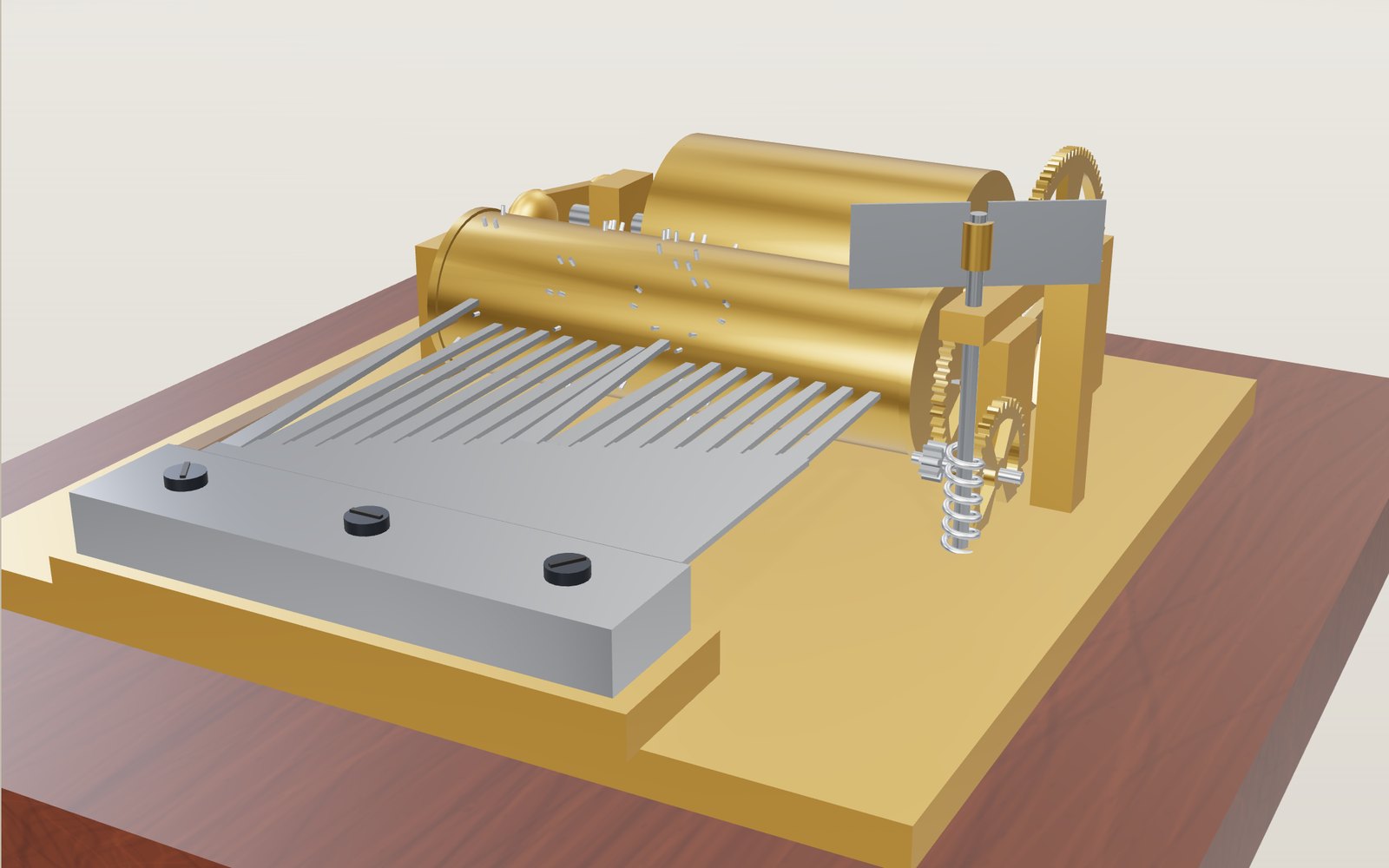
How a music box works
A steel tooth 30.6 mm long rings at 261.6 Hz, and cutting it to half that length would raise the note two octaves.
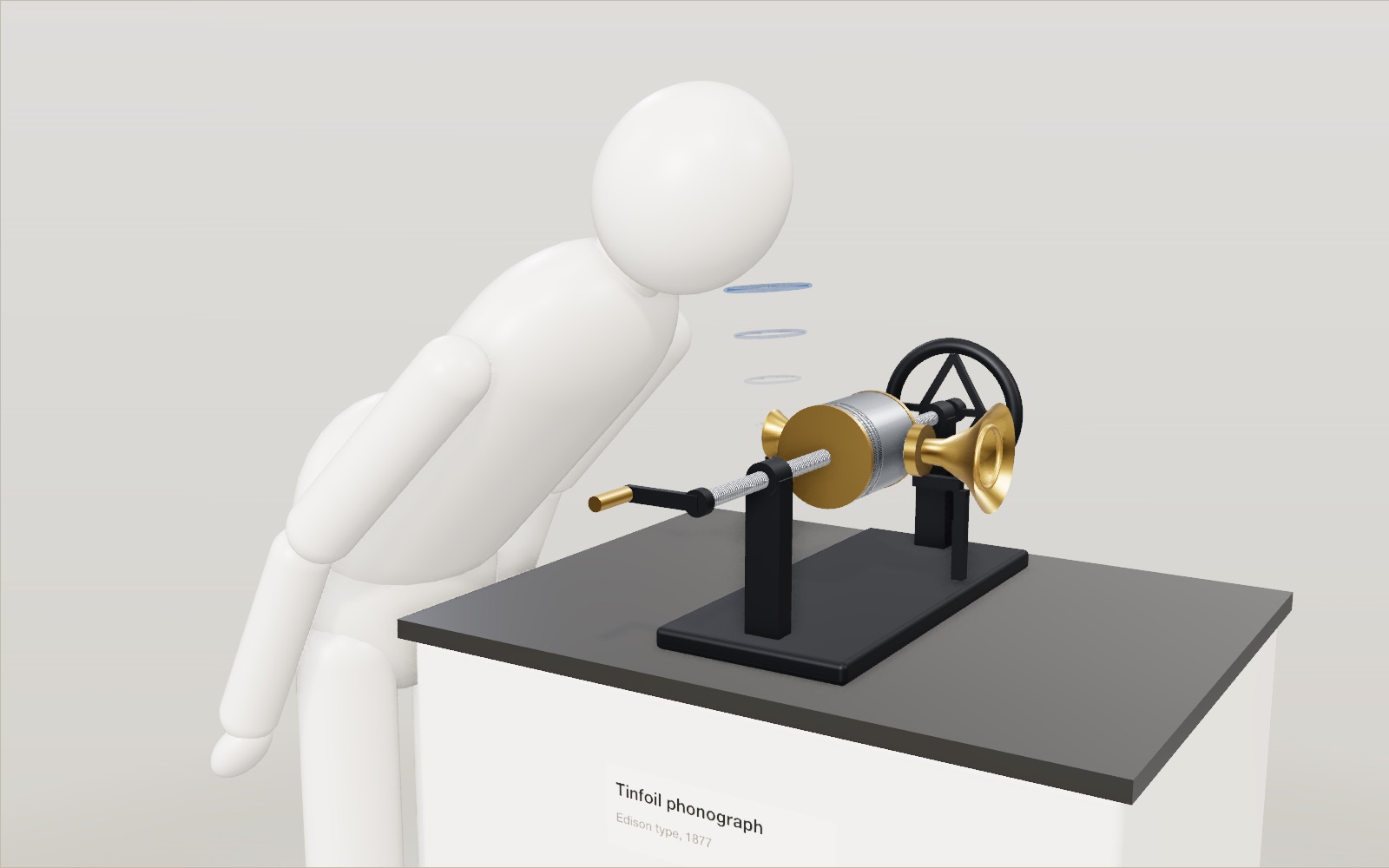
How a phonograph works: from tinfoil to cassette and CD
Edison's first phonograph cut a voice into tinfoil in 1877, and the same needle played it back from a groove 2.54 mm apart.
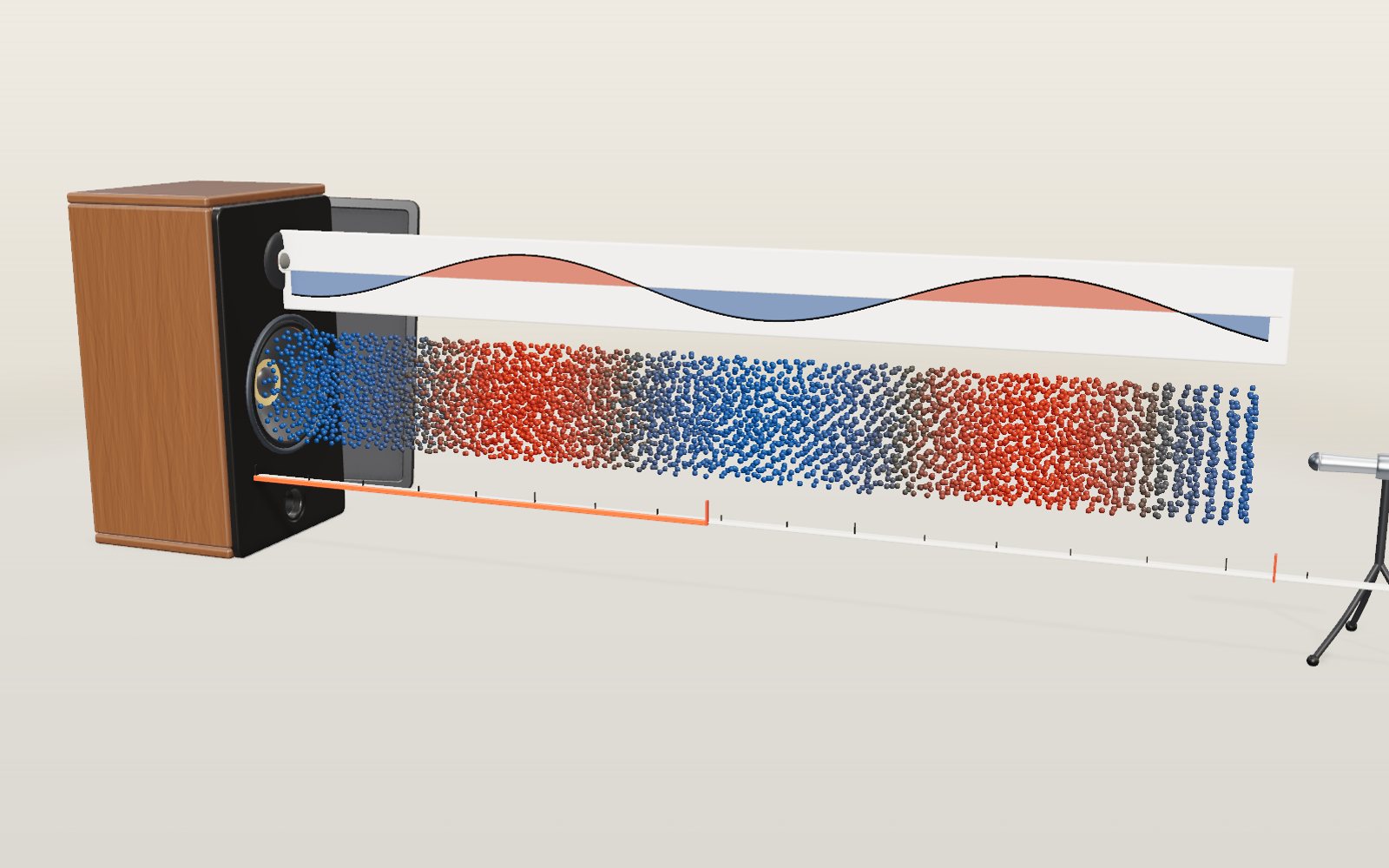
What sound looks like: sound waves, frequency and decibels
A 440 Hz tone packs the air into dense layers 78 centimetres apart, yet even at 94 dB each bit of air moves less than a thousandth of a millimetre.
How does a vinyl record work? Grooves, stereo and RIAA
At the outer edge of an LP the groove slides under the stylus at half a metre per second, and by the last song it has slowed to 21 centimetres.

How do bats see with sound? Echolocation explained
An echo from a moth 1 m away comes back to a bat in under 6 thousandths of a second, and that delay is how the bat knows the distance.
How a pendulum clock works, and why its length sets the time
A pendulum clock counts seconds with one rod 99.4 cm long. Change its length, its temperature and its place on Earth, swap four escapements and see how many seconds a day each costs.