Loading the model
This device cannot show the 3D model. You can read the guide steps below as text.
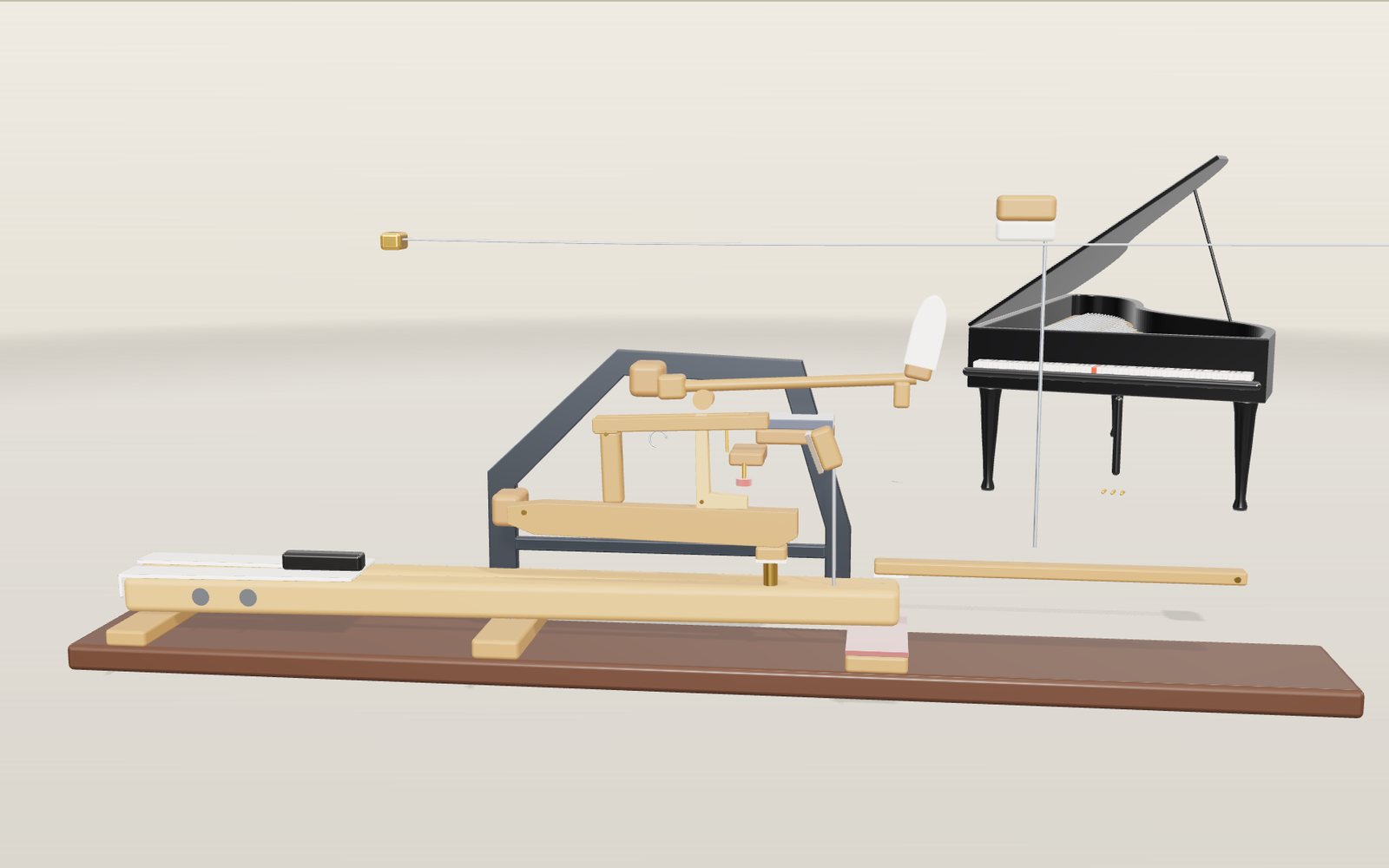
1 / 12 One key, eleven parts This is the mechanism behind a single key of a grand piano, seen from the side. Play the keyboard under the model and this key moves in slow motion while you hear the note at normal speed.
Drag to turn. Scroll or pinch to zoom.
Guide Parts Controls
01 One key, eleven parts This is the mechanism behind a single key of a grand piano, seen from the side. Play the keyboard under the model and this key moves in slow motion while you hear the note at normal speed.
02 The key is a lever The key rocks on a steel pin about halfway along. Press the front down 10 mm and the back end rises about 9.6 mm, lifting everything behind it.
03 Capstan and wippen A brass capstan on the back of the key lifts the wippen. The wippen turns on its own pin and carries the jack upward.
04 The jack throws the hammer The jack pushes on the knuckle under the hammer shank, 18 mm from its pivot. The jack rises less than 5 mm, and the hammer head moves about 38 mm.
05 Let-off Slowest speed. About 3 mm before the string, the jack's toe meets the let-off button and the jack tips out. The hammer covers the last stretch on its own.
06 Strike and check The felt touches the string only for a moment and bounces off. If it stayed in contact it would stop the vibration. On the way down the backcheck catches it.
07 The dampers While the key is down the damper is lifted off the string, so the note rings. Let go and the felt drops back onto the string and the sound stops.
08 Playing the same note again The repetition lever holds the hammer up while the key rises. The jack slips back under the roller when the key is only part way up, so the note can be struck again quickly.
09 Three pedals In front of the action stand the three pedals. Press them with the buttons next to the keyboard, then play. The damper pedal lifts every damper, the sostenuto keeps only the dampers already up, and the una corda slides the action so the hammer misses one of the three strings.
10 Length, tension and thickness A string's pitch follows f = (1/2L)√(T/μ). On the string bench in the panel, halve the length and the pitch goes up an octave; four times the tension does the same. The bars show how a stiff steel wire pushes its upper partials sharp.
11 Beats between two notes Under Beats, play an equal-tempered major 3rd C4–E4: its shared partials differ by about 10 Hz, so the sound swells 10 times a second. Move the upper note about 14 cents flat and the beating stops at the just ratio 5:4.
12 The whole instrument Behind the action stands a concert grand at 1:6, sized from a Steinway Model D, 274 cm long. The red key is the key you have been watching. The catalogue in the panel lists 38 pianos and firsts with their sources.
Key A wooden lever on a pin. The front goes down 10 mm and the back end comes up. Capstan A brass button screwed into the back of the key. It pushes the wippen up. Wippen The lever that carries the jack and the repetition lever and passes the key's push upward. Jack A small upright piece that pushes the hammer, then tips out from under it just before the hammer reaches the string. Repetition lever Holds the hammer up after a note so the jack can reset with the key only part way up. Let-off button A felt button on a screw. When the jack's toe meets it, the jack tips and lets go of the hammer. Hammer A wooden shank with a head of hard wool felt. It hits the string and bounces straight off. Backcheck A felt pad on a wire at the back of the key. It catches the falling hammer so it cannot bounce back up. Damper A felt block that sits on the string. The key lifts it off; when you let go, it stops the sound. String Steel wire under high tension. Most notes have three strings tuned to the same pitch. Keybed and action frame The board, rails and metal standards that hold every key and every part of the action in line. Pedals Three brass levers in a lyre under the keyboard: una corda on the left, sostenuto in the middle, damper on the right. Concert grand, 1:6 A whole concert grand at one sixth size: curved case, cast iron plate, crossed strings and 88 keys. The red key is the one shown full size.