FIG. 79Old Machines
How does a vinyl record work? Grooves, stereo and RIAA
At the outer edge of an LP the groove slides under the stylus at half a metre per second, and by the last song it has slowed to 21 centimetres.
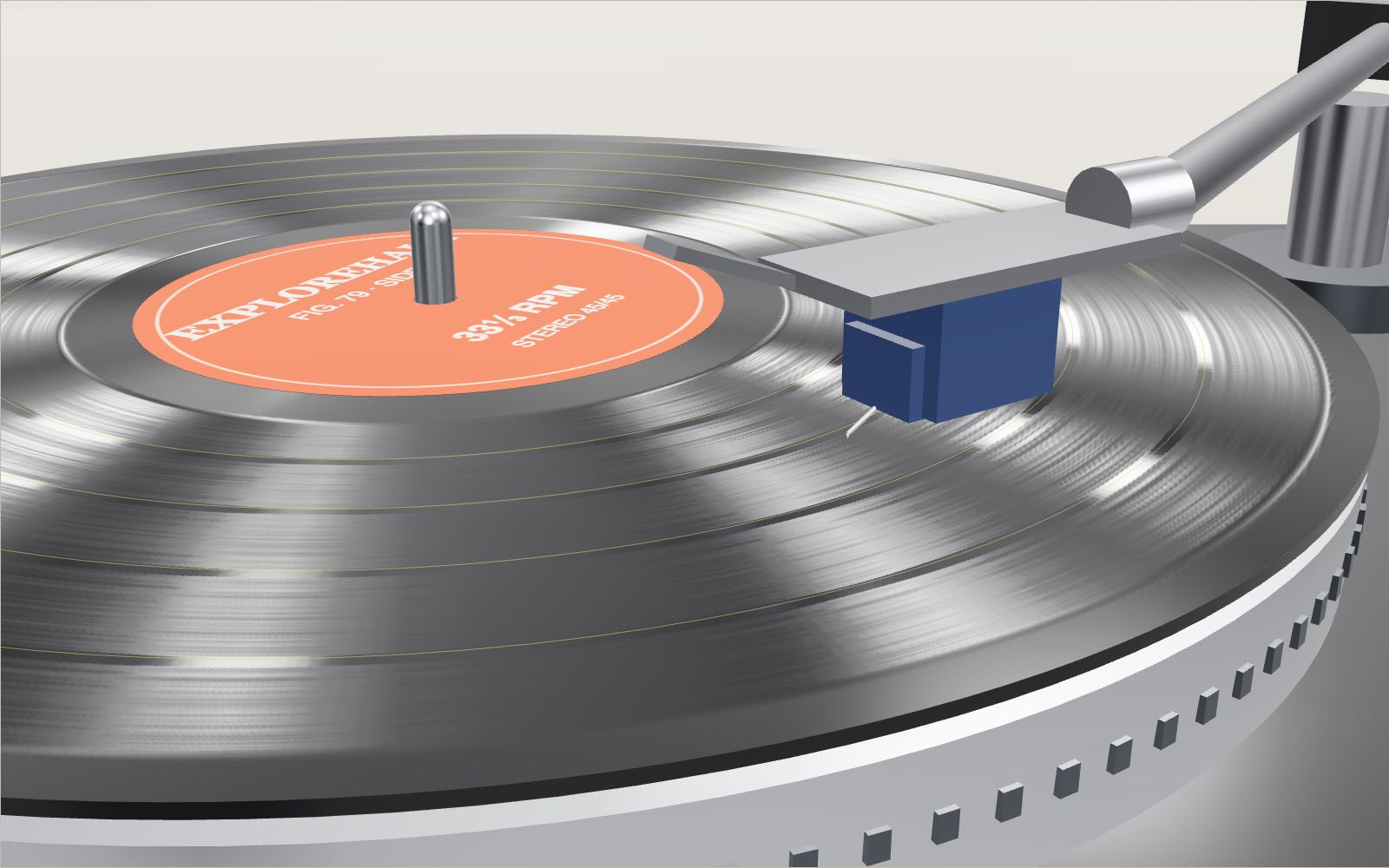
This device cannot show the 3D model. You can read the guide steps below as text.
1 / 10 A record playerThe platter turns the record at 33⅓ rpm and the tonearm rests the stylus in the groove near the outer edge. Sound is off until you switch it on in Controls.
Drag to turn. Scroll or pinch to zoom.
What the model shows
Hold a record up to the light and you can see the music, faintly. Loud passages look rougher and wider than quiet ones, and the gaps between songs show up as smooth, shiny rings. What you cannot see with the naked eye is how a single scratch in plastic manages to carry a whole orchestra, in stereo.
This model follows the sound from the groove to the wire. It has a turntable with a 12-inch LP, a pivoted tonearm and a moving-magnet cartridge, plus a second set that shows the groove under the stylus at up to about 2,000 times. You can switch between 33⅓, 45 and 78 rpm, move the stylus from the first groove to the last, slow time down by up to 1,000 times and listen to a short tune that the page builds with the Web Audio API. The sound stays off until you turn it on.
A wiggle in a groove is a sound
Sound in air is a pressure wave. A microphone turns it into an electrical signal that rises and falls in the same pattern, and a cutting lathe turns that signal back into motion: a sharp cutter swings from side to side while a lacquer disc turns underneath it. The cutter leaves a spiral groove that wiggles exactly the way the signal wiggled. Playback runs the chain the other way. A stylus rides in the groove, the wiggles push it back and forth, and the cartridge turns the motion back into a voltage.
So a groove is a graph of the sound, drawn with time running along the spiral. One full wiggle is one cycle of the wave. The tune on this page starts with an E above middle C sung at 659 Hz on the left channel, so the groove for that note wiggles 659 times for every second it passes under the stylus.
How long is one of those wiggles? That depends on how fast the groove moves. At the start of the side the stylus sits 146 mm from the centre, and at 33⅓ rpm the groove slides past at 2π × 0.146 m × 33.33 / 60 = 0.510 m/s. Divide by 659 Hz and each wiggle is 0.774 mm long. The same note near the label, at a radius of 60.3 mm, moves at 0.210 m/s and is squeezed into 0.319 mm. Switch on Slow motion in the groove view and you can watch these wiggles drift past the stylus.
The groove under a microscope
A modern stereo groove is a V cut into the vinyl with its two walls at 90° to each other, so each wall leans at 45° from the vertical. In this model the groove is 60 µm wide at the top and 30 µm deep. One side of the record plays for 22 minutes, which at 33⅓ rpm is 22 × 33.33 = 733 turns of the spiral. They have to fit between radii of 146 mm and 60.3 mm, so the average distance from one turn to the next is (146 − 60.3) / 733 = 0.117 mm. That is 8.6 grooves per millimetre, about 217 to the inch. Real records vary the spacing: the cutting lathe opens it up for loud bass and closes it for quiet passages, which is why the bright bands between songs are easy to spot.
The stylus is a diamond polished to a rounded tip. This model uses a tip radius of 0.7 thousandths of an inch, 17.8 µm. A ball that size cannot reach the bottom of a 90° groove. Its centre sits 17.8 × √2 = 25.2 µm above the bottom, and it touches each wall at a point about 17 µm below the surface. That is deliberate. The stylus rides on the two walls, so both walls steer it, and dirt that settles in the bottom of the groove is left alone.
How big are the wiggles sideways? Cartridges are rated at a groove velocity of 5 cm/s, a common reference level. At 1,000 Hz that velocity needs a peak displacement of 0.05 / (2π × 1,000) = 8.0 µm. The tune in the model uses 10 µm on the left channel and 12 µm on the right, so the swing is a sixth of the groove width. In the 3D view the wiggles are drawn twice their real size so that you can see them at all.
Two walls at 45 degrees carry two channels
A mono groove only needs to move sideways. Stereo needs two independent signals in one groove, read by one stylus. The solution record makers adopted is called the 45/45 system. The cutter is driven along two directions at right angles to each other, each tilted 45° from the vertical, and each direction belongs to one channel. On standard records the left channel moves the stylus at right angles to the inner wall, the one nearer the label, and the right channel at right angles to the outer wall. In the microscope view the inner walls are tinted blue and the outer walls orange.
The neat part is what happens when both channels carry the same sound. Add a 45° push up-and-to-the-left to an equal 45° push down-and-to-the-left and the vertical parts cancel, leaving pure sideways motion. That is exactly the groove a mono record has, so a mono player can play a stereo record and a stereo player can play a mono one. When the two channels are opposite, the sideways parts cancel and the stylus moves only up and down. The three cases work out as follows: left alone gives (0.707, 0.707), left equal to right gives (1.414, 0) and left opposite to right gives (0, 1.414).
Use the Channels control to hear and see this. With only the left channel on, the stylus slides along the outer wall and only the inner wall changes shape. A magazine article from 1958 made the same point: it is the movement of the tip that carries the channels, and saying each wall holds one recording is a handy shortcut rather than the whole story.
How the cartridge turns motion into voltage
The stylus sits on the end of a cantilever, a thin aluminium tube about 5.5 mm long. Near its other end the cantilever passes through a rubber damper that acts as a pivot, and behind the pivot it carries a tiny magnet. When the groove pushes the stylus one way, the magnet swings the other way between four fixed coils, two for each channel, set at 45° to match the groove walls.
A moving magnet changes the magnetic flux through a coil, and Faraday's law says the voltage in the coil is proportional to how fast the flux changes. So a magnetic cartridge measures velocity, not position. A typical moving-magnet cartridge gives 3 to 6 mV at the 5 cm/s reference. The model uses 5 mV. The left-channel E at 659 Hz with a 10 µm swing moves at a peak of 2π × 659 × 10 µm = 4.1 cm/s, which gives about 4.1 mV. The coil output screen under the stage draws both channels as voltages over the last 6 ms.
There is a catch. If the groove were cut to give equal voltage at every frequency, bass notes would need enormous sideways swings, wide enough to break into the next groove, and treble would need swings so small that they would vanish into the hiss. Records are therefore cut with the bass turned down and the treble turned up, following the RIAA curve with time constants of 3,180, 318 and 75 µs. The phono preamplifier applies the exact opposite curve. The tune in this model sits between 196 and 880 Hz, a range where the curve changes little, so the model leaves it out.
Speed under the stylus at 33⅓, 45 and 78 rpm
Every point on a turning record goes around once per turn, but outer points have farther to go. The speed of the groove under the stylus is v = 2πr × rpm / 60.
| Speed | Outer groove (r = 146 mm) | Inner groove (r = 60.3 mm) |
|---|---|---|
| 33⅓ rpm | 0.510 m/s | 0.210 m/s |
| 45 rpm | 0.688 m/s | 0.284 m/s |
| 78 rpm | 1.193 m/s | 0.493 m/s |
The ratio between outside and inside is 146 / 60.3 = 2.42 at every speed. At the start of an LP side the groove passes the stylus at 1.8 km/h, a slow walk. Near the label it is down to about 0.8 km/h.
Why the inner grooves are harder to play
Slower groove means shorter wiggles. A 20 kHz tone at the outer edge of an LP has a wavelength of 0.510 / 20,000 = 25.5 µm. Near the label it is 10.5 µm. The stylus tip in this model is 35.6 µm across, more than three times longer than that inner wiggle. A round tip cannot follow a bend much tighter than itself, so high notes lose detail and pick up distortion towards the end of a side. This is why mastering engineers often put quiet or less demanding songs last, and why some audiophile reissues are cut at 45 rpm across two discs: at 45 rpm every wavelength is 1.35 times longer.
The pivoted arm adds a smaller effect. The cutting lathe moves its cutter in a straight line along a radius, but the stylus swings on an arc. In the model the headshell is angled 20.7° so the cartridge lines up with the groove at a radius of 100 mm. Elsewhere it is a little off, and the arm turns through 22.6° from the first groove to the last.
Changing the speed changes the pitch
The groove holds no clock. It only holds wiggles in a row, and the turntable decides how fast they arrive. The record in the model was cut for 33⅓ rpm. Play it at 45 rpm and every wiggle arrives 45 / 33.33 = 1.35 times as often, so every frequency is multiplied by 1.35. In music that is 12 × log₂(1.35) = 5.2 semitones higher, a little more than a fourth, and the tune also runs 1.35 times faster. At 78 rpm the factor is 2.34, or 14.7 semitones, more than an octave. An A at 440 Hz comes out at 594 Hz at 45 rpm and 1,030 Hz at 78 rpm.
Press the speed buttons under the stage with the sound on and you hear exactly this. The page plays the same recorded buffer and only changes its playback rate, the way the platter only changes how fast it turns.
How long is the groove on one side?
Each turn of the spiral is a circle with a slightly smaller radius than the last. Averaging over the side, the radius is (146 + 60.3) / 2 = 103.15 mm, so an average turn is 2π × 103.15 mm = 0.648 m long. Multiply by 733 turns and one side holds 475 m of groove, almost half a kilometre. Both sides together come to about 0.95 km. A numerical sum along the exact spiral gives 475.28 m, so the shortcut of using the average circle is good to well under a millimetre per turn.
A neat check: 475 m in 22 minutes is 0.360 m/s, which is exactly the groove speed at the average radius of 103.15 mm. On one side the stylus covers the length of about four and a half football pitches while it creeps only 85.7 mm towards the centre.
Cylinders, 78s, LPs and 45s side by side
The list under the stage compares 23 sound carriers, from Edison's tinfoil to RCA's grooved video disc. Pick a disc there and the model swaps in a disc of that size at its speed. Two numbers explain most of the differences: how fast the groove moves, and how long it is.
A cylinder has one big advantage that the list makes plain. Every turn of a cylinder groove is the same length, so the surface speed never changes. A standard wax cylinder is 2¼ inches across, and at the 120 rpm used for early recordings its surface moves at π × 0.0572 m × 120 / 60 = 0.36 m/s from the first note to the last. The Library of Congress notes that the constant speed of the cylinder was part of why its sound was so good. A disc gives that up in exchange for being flat, cheap to press and easy to store.
| Format | Size | Speed | Speed at the edge |
|---|---|---|---|
| Wax cylinder (early) | 2¼ in | 120 rpm | 0.36 m/s, all the way |
| 10-inch 78 | 10 in | 78 rpm | 1.04 m/s |
| 12-inch 78 | 12 in | 78 rpm | 1.24 m/s |
| Vitaphone disc | 16 in | 33⅓ rpm | 0.71 m/s |
| 12-inch LP | 12 in | 33⅓ rpm | 0.53 m/s |
| 7-inch 45 single | 7 in | 45 rpm | 0.42 m/s |
| CED videodisc | 30 cm | 450 rpm | 7.07 m/s |
The edge speed is π × diameter × rpm / 60, the speed a groove would have at the very rim. The music starts a little inside it. A 78 moves its groove twice as fast as an LP, which is how shellac discs with coarse grooves could still record treble. The LP slowed down and made up for it with a much finer microgroove, so the same 12 inches hold 22 minutes instead of about four and a half. The 45 single went the other way on size: a 7-inch disc at 45 rpm moves its outer groove at about the speed of a 10-inch LP. In Korea the 78 is often called the SP record, and the 45 with its large centre hole is known as the doughnut record.
A CED videodisc stored 60 minutes of video on each side of a 12-inch disc. A stylus read the signals encoded in its groove.
Groove speed and length: a worked check
The numbers in the sections above can be checked with one line of arithmetic each, and doing it by hand is the best way to trust them. Take the start of a side at 33⅓ rpm. One turn takes 60 / 33.33 = 1.8 s. The groove there is a circle of radius 146 mm, so one turn is 2π × 0.146 = 0.917 m long, and 0.917 m in 1.8 s is 0.510 m/s, or about 51 cm/s. Near the label the radius is 60.3 mm, a turn is 0.379 m, and 0.379 / 1.8 = 0.210 m/s, about 21 cm/s. The outer groove therefore passes the stylus at roughly 50 cm/s and the inner groove at roughly 20 cm/s, as the speed readout shows when you drag the Stylus at slider.
The same two quantities give the groove length of a side without any averaging trick. Slide the stylus to the end of the side and read Groove so far: the counter reaches about 475 m after 22 minutes. Divide by the time, 475 m / 1,320 s, and you get 0.360 m/s. That is the speed at the middle radius, which is what you expect, because the stylus spends the same time on every turn but each turn gets a little shorter.
Amplitude and frequency: why the RIAA curve exists
A groove stores two things at once. How far the stylus swings sideways is the amplitude, and how many swings fit into a second is the frequency. A magnetic cartridge does not respond to the swing itself but to its speed, and for a steady tone the peak speed is 2π × frequency × swing. If a record were cut so that every note had the same swing, the cartridge voltage would rise in proportion to frequency, and the bass would be 1,000 times quieter than a treble note 1,000 times higher. If it were cut so that every note had the same speed, a 20 Hz note would need a swing 50 times larger than a 1,000 Hz note, and the groove would break into its neighbour.
The industry settled on a compromise, the RIAA curve, defined by three time constants: 3,180 µs, 318 µs and 75 µs. They correspond to corner frequencies of 1 / (2π × 3.18 ms) = 50 Hz, 1 / (2π × 0.318 ms) = 500 Hz and 1 / (2π × 75 µs) = 2,122 Hz. Computed from those constants, the record is cut with the bass reduced by about 19 dB at 20 Hz and 13 dB at 100 Hz, relative to 1,000 Hz, and the treble raised by about 14 dB at 10 kHz and 20 dB at 20 kHz. The phono preamplifier applies the exact inverse. Texas Instruments describes the same three constants, 3,180 µs, 318 µs and 75 µs, in its application note on a phono preamplifier. The bass swing is thereby held to a size a groove can carry, and the treble sits well above the noise of the vinyl. As a side effect, the scratches and pops that are mostly high frequency are turned down by the preamplifier along with the treble boost.
The 45/45 groove in numbers
In the 45/45 system each wall of the groove carries one channel. The two directions of motion are at right angles to each other, so they do not interfere: pushing the stylus along the direction of the left channel does not move it along the direction of the right channel at all. When both channels carry the same signal, the two motions add up to a purely sideways swing, which is exactly what a mono groove does. That is why a mono record could be played on a stereo cartridge, and why, with equal signals, the picture in the groove view looks like a plain sideways wiggle. When the two channels carry opposite signals, the stylus moves straight up and down instead, the hill and dale motion of Edison's cylinders.
Use the channel choice under the stage to see this. With L only the stylus moves at 45° towards the inner wall, with R only towards the outer wall, and with L + R the movement is the sum of the two. In the model the left channel swings 10 µm and the right channel 12 µm, so the diagonal motions combine into a path that is neither purely sideways nor purely vertical.
Wear and tracking force
The stylus must press down hard enough to stay in the groove when the wiggles try to throw it out, so the arm applies a small downward force. In this model the stylus touches each wall at a point only a few micrometres across. As an illustration with assumed values, a force of 1.5 g, which is 0.0147 N, shared between two contact patches of 10 µm × 10 µm each, gives a pressure of 0.0147 / (2 × 1 × 10⁻¹⁰ m²) = 7.4 × 10⁷ Pa, about 740 atmospheres. These are not measured values and the real contact area changes as the stylus wears in, but they show why a record can wear, and why a diamond is used for the tip. Dust in the groove is pressed into the walls under the same pressure, which is why cleaning a record before playing it matters. The model leaves tracking force out, and the stylus never loses contact.
The record's second life: sales
Vinyl did not simply disappear when compact discs and streaming arrived. The Recording Industry Association of America, in its 2024 year-end revenue report, says that vinyl continued a nearly 20-year surge while total US music revenue grew 3% to $17.7 billion at estimated retail value. The RIAA also publishes its yearly sales figures in an online database where each format can be compared over time. A record is a physical object you can hold, and its large cover, its fixed listening time and the fact that you must turn it over after 22 minutes are exactly the features that people who return to it say they like.
Common misunderstandings
- The needle burns the sound out of the record. The stylus does not melt or burn anything. It follows the groove walls mechanically, and the sound is produced by the cartridge.
- The grooves can be seen as the sound. The wiggles are only 8 to 12 µm across, far smaller than the eye can resolve. What you see as bands are changes in groove spacing.
- Vinyl sounds better because it has more detail. A vinyl record has a limited signal-to-noise ratio and loses treble towards the label. Its character comes from this and from the cutting and playback chain, not from extra detail.
- A record plays at the same groove speed everywhere. The speed at the label is only 41% of the speed at the edge, as the table above shows.
- Mono records are damaged by stereo cartridges. A mono groove moves only sideways, and a stereo cartridge reads both walls with the same signal.
Try it on the screen
- Press Sound on, then switch the speed between 33⅓, 45 and 78 rpm and listen to the pitch rise. Read the Pitch value: it shows 5.2 semitones at 45 rpm.
- Drag Stylus at from the first groove to the last. The Groove speed readout falls from 0.510 m/s to 0.210 m/s and the Wavelength readout shrinks with it.
- Choose L only, then R only, then L + R, and watch the coil output screen. Each channel drives its own pair of coils.
- Move the Zoom to Stylus tip and look at where the tip meets the walls. It does not reach the bottom of the groove.
- Open the formats list and pick the 12-inch LP, then the 7-inch 45 and the CED videodisc. The edge speed changes from 0.53 m/s to 0.42 m/s to 7.07 m/s.
Dropping the needle by hand
On a real turntable you can lift the arm, swing it over the record and lower it wherever you like. The model lets you do the same: drag the arm, or press Lift the arm and tap the record. While the arm is up the stylus touches nothing, so the coils give no signal and no sound plays. When it comes down, the stylus settles into whichever turn of the spiral is under it and the record carries it inwards by one groove spacing every turn.
The four shiny rings on the record are track bands. A pressing plant that publishes its own glossary, Gotta Groove Records, explains that these bands are not silence added between songs. They are places where the cutting engineer spaced the grooves wider, so that the gap shows up as a ring you can aim at. In this model each band is two silent turns that move the stylus 2 mm inwards, and the music between the bands has a constant spacing of about 0.107 mm per turn. With those model values the side holds five tracks of 4:46, 5:02, 4:12, 3:55 and 3:50. Drop the stylus into the third band and track 4 starts a moment later.
Cutting your own groove
Under the stage there is a small cutting lathe. The page makes the sound itself, a sine tone between 50 Hz and 10 kHz, a C major chord or a short melody of eight notes, and you choose where it sits between the speakers. Pressing Cut sends the camera to the groove view. A heated sapphire cutter digs the new groove into blank lacquer: the grooves nearer the label have not been reached yet and are still smooth, while the ones nearer the edge were cut a turn earlier. After a few seconds the cutter lifts away and the stylus plays your groove back.
Where the sound sits decides how the cutter moves. Left only tilts the motion 45° towards the inner wall, right only towards the outer wall, a centred sound moves the cutter purely sideways and two channels in opposite phase move it purely up and down. The last case is the one cutting engineers avoid in the bass: a deep tone that only moves up and down can lift the cutter out of the lacquer. In the model the warning appears when the vertical swing passes 24 µm, 80% of the 30 µm groove depth.
The panel prints the biggest swing of each cut. With RIAA on, a full-level 50 Hz tone swings 23 µm sideways. Switch RIAA off and the same tone swings 159 µm, because the cutter now gets the bass at full strength. Neighbouring grooves are 117 µm apart on average and each groove is 60 µm wide, so two grooves touch when the swing passes (117 − 60) ÷ 2 = 28 µm. That is why the groove crashes into its neighbour. The levels and limits here are model values; real lathes also widen the spacing for loud bass.
RIAA you can hear
The chart under the lathe draws the cutting curve, the playback curve and their sum. The cutting curve is the RIAA curve turned upside down: computed from the time constants 3,180 µs, 318 µs and 75 µs it is −19.3 dB at 20 Hz, −16.9 dB at 50 Hz, 0 dB at 1 kHz, +13.7 dB at 10 kHz and +19.6 dB at 20 kHz. The playback curve in the phono preamplifier is its mirror image, so the two add up to a flat line. Press Hear it without the playback curve and the page plays the groove as it was cut, with the bass turned down and the treble turned up. The filter used for this is an approximation of the curve, two shelves rather than the exact network.
Edge and label
Play the same groove at the edge and near the label and the readout shows why the inner grooves are harder. At 146 mm and 33⅓ rpm the groove passes at 0.51 m/s, so one cycle of a 10 kHz tone is 51 µm long. At 62 mm it passes at 0.216 m/s and the same cycle is only 22 µm long, shorter than the 35.6 µm width of a 17.8 µm stylus tip. A round tip resting on such a wiggle bridges the troughs. In the model the tip follows practically all of the 10 kHz swing at the edge but only about 38% near the label. A simple curvature test gives the highest frequency the tip can follow at the 5 cm/s reference level: v² ÷ (2π × 0.05 m/s × 17.8 µm), about 46 kHz at the edge and 8.4 kHz at 62 mm. Near the label the page also turns the treble down by that amount. These are model values that show the trend, not the response of any one cartridge.
Dust, scratches and ticks
Sprinkle dust and some specks land near the stylus. Each time the turning record brings a speck under the tip, the stylus is knocked sideways for an instant, the cartridge turns that sudden movement into a sharp spike of voltage and you hear a tick. A brush removes the dust. A scratch is different: it crosses many grooves, so it ticks once every turn for as long as the stylus is in that part of the record, and cleaning does not help. Gotta Groove Records also lists faults that come from pressing itself, such as stock marks, small dimples that can give a soft thump each turn.
From lacquer to pressed record
The groove you cut is never played in a factory. Gotta Groove Records describes the chain that turns it into thousands of copies. The lacquer, an aluminium disc coated with nitrocellulose, is sprayed with a silver solution and put into a bath of nickel sulfamate, where an electric current grows a layer of nickel on its face. Peeled off, that layer is the father, a negative with ridges where the lacquer had grooves. Plating the father gives the mother, a positive with grooves that could even be played, and plating the mother gives stampers, negatives again. Two stampers go into a hydraulic press, and a biscuit of vinyl with a paper label on each side is squeezed between them. The label goes into the press with the vinyl and helps to cool the middle of the record. Deutsche Grammophon describes the same father, mother and son principle and says it has used it since 1922. Click through the seven steps under the stage to see the surface flip from grooves to ridges and back.
How much groove a song needs
Enter the length of a song you like and choose a 12-inch LP at 33⅓, a 12-inch single at 45 or a 7-inch single at 45. The model cuts the song from the outer edge at the spacing that would fill the whole side, and reports how many songs of that length fit on a side, how many turns the song takes and how long its groove is. A song of 3 minutes 35 seconds on the model LP takes 119 turns and 104 m of groove, and six of them fit on a 22-minute side. A song that is longer than a side only fits if the grooves are squeezed closer, and closer grooves must swing less, so the page also gives the level drop that would need, 20 × log₁₀ of the spacing ratio. Side lengths and radii are model values.
What this model simplifies
- The groove has a sharp bottom and straight walls. Real cutters leave a small rounded bottom.
- The groove spacing is constant. Real lathes vary it with the music.
- The tune is cut as a flat signal with no RIAA curve, so the coil voltages match the groove directly.
- The cartridge motion is drawn 45 times larger than life and the 3D groove wiggles twice their real size. The screens under the stage use real units.
- Tracking force, anti-skating and the springiness of the cantilever are left out. The stylus follows the groove perfectly.
From tinfoil to the long-playing record
Thomas Edison sketched a machine in July 1877 that would record sound by embossing it into tinfoil, according to the Library of Congress. The first tinfoil phonograph was built by his machinist John Kruesi later that year. The Library notes that the famous date of 12 August is doubtful, since Edison did not file his patent until 24 December 1877 and the diary of his assistant Charles Batchelor suggests the machine was built in early December. Edison's machine and its wax-cylinder successors cut their grooves up and down, a pattern called hill and dale.
Emile Berliner went sideways. On 8 November 1887 he was granted a patent for the gramophone, which recorded with a lateral groove of even depth, and soon afterwards he moved the recording onto a flat disc. Discs could be stamped from a master in large numbers, and by the 1910s they had pushed cylinders aside. For half a century most discs were shellac and turned at around 78 rpm.
The Library of Congress dates the next step to June 1948, when Columbia introduced the "Long Playing" record, a 12-inch disc at 33⅓ rpm with a much finer microgroove. RCA Victor answered in 1949 with the 7-inch 45 rpm disc and a record changer, and The Henry Ford museum holds one of those early RCA 45 players. A patent for cutting two channels on the two walls of one groove was granted to W. Bartlett Jones as early as 1932, and the first commercial stereo LPs appeared on the Audio Fidelity label in November 1957.
Questions
Why does a record sound higher when it plays too fast?
The groove only stores wiggles in order. If they pass the stylus faster, there are more of them per second, and more cycles per second is a higher frequency. Going from 33⅓ to 45 rpm multiplies every frequency by 1.35, which is 5.2 semitones.
Is the groove at the edge really moving faster than near the label?
Yes. Both go around once per turn, but the outer groove has a longer circle to cover. At 33⅓ rpm it moves at 0.510 m/s at a radius of 146 mm and 0.210 m/s at 60.3 mm.
How can one groove hold two channels?
Each channel moves the stylus along one of two directions at 45° to the vertical. The left channel works at right angles to the inner wall and the right channel at right angles to the outer wall. The cartridge has two pairs of coils lined up with those directions, so each pair picks up its own channel.
Does the stylus touch the bottom of the groove?
No. A 17.8 µm tip in a 90° groove sits on the two walls, about 17 µm below the surface, and the bottom of the groove stays a few micrometres below the tip.
Why is the output of a cartridge so small?
The magnet weighs a tiny fraction of a gram and moves only micrometres. A moving-magnet cartridge produces about 3 to 6 mV, and moving-coil types often less than 1 mV, so a phono preamplifier boosts the signal and applies the RIAA curve.
How long is the groove on an LP?
In this model one 22-minute side is 733 turns between radii of 146 mm and 60.3 mm, which adds up to about 475 m. Both sides make nearly a kilometre.
What were SP and doughnut records?
In Korea those are everyday names for two of the formats in the list. The SP is the shellac 78 rpm disc, usually 10 or 12 inches across. The doughnut record is the 7-inch 45 rpm single, named for its large centre hole. RCA Victor sold it with record changers that held a stack of 45s on a tall spindle and dropped them one at a time.
Why does a record need the RIAA curve?
Because the bass would otherwise need swings too large for the groove and the treble would be buried in noise. The record is cut with the bass reduced and the treble raised, and the preamplifier undoes it.
Can a stereo cartridge play a mono record?
Yes. A mono groove moves only sideways, which means both walls carry the same signal, and a stereo cartridge reproduces it on both channels.
Why does vinyl wear out?
The stylus presses on the walls with a force that makes a very high local pressure, and dust makes it worse. A clean record and a good stylus last far longer.
Does this page play sound by itself?
No. Nothing plays until you press Sound on or switch on Sound in Controls. The tune is computed in your browser with the Web Audio API; no recording is downloaded.
Terms
- Groove: the spiral channel cut into the record; its wiggles are the recorded sound.
- Microgroove: the fine groove introduced with the LP, much narrower than the groove of a 78.
- Stylus: the polished diamond tip that rides in the groove.
- Cantilever: the thin tube that carries the stylus at one end and the magnet at the other.
- Moving-magnet cartridge: a pickup in which a magnet on the cantilever moves between fixed coils.
- 45/45 system: the stereo method in which each channel moves the stylus at 45° to the vertical.
- RIAA curve: the standard treble boost and bass cut used when cutting a record, undone on playback.
- Linear speed: how fast the groove passes the stylus, 2πr × rpm / 60.
- Wavelength (in the groove): the length of one wiggle, groove speed divided by frequency.
- Semitone: one twelfth of an octave, a frequency ratio of 2^(1/12).
Sources
- Library of Congress, History of the Cylinder Phonograph. https://www.loc.gov/static/collections/edison-company-motion-pictures-and-sound-recordings/articles-and-essays/history-of-edison-sound-recordings/history-of-the-cylinder-phonograph.html (checked 17 October 2026)
- Library of Congress, Recorded Sound Section timeline (PDF: July 1877 sketches, 1932 Bartlett Jones patent, June 1948 Columbia LP, 1949 RCA 45, November 1957 stereo LP). https://www.loc.gov/static/managed-content/uploads/sites/6/2017/02/recorded_sound_timeline-2013.pdf (checked 17 October 2026)
- Library of Congress Information Bulletin, Audrey Fischer, Father of the Gramophone (patent of 8 November 1887). https://www.loc.gov/loc/lcib/1106/berliner.html (checked 17 October 2026)
- National Park Service, Thomas Edison National Historical Park, Origins of Sound Recording: Thomas Edison. https://www.nps.gov/edis/learn/historyculture/origins-of-sound-recording-thomas-edison.htm (checked 17 October 2026)
- The Henry Ford, RCA 45 rpm Record Player, Model 6-JY-1C, 1949-1951. https://www.thehenryford.org/collections/explore/artifact/172093 (checked 17 October 2026)
- Museum of Obsolete Media, 7-inch single (1949 – ). https://obsoletemedia.org/7-inch-single/ (checked 17 October 2026)
- Norman H. Crowhurst, How the Stereo Disc Works, Radio-Electronics, July 1958, via RF Cafe. https://www.rfcafe.com/references/radio-electronics/stereo-disc-july-1958-radio-electronics.htm (checked 17 October 2026)
- Texas Instruments, Magnetic cartridges. https://www.ti.com/lit/pdf/snaa046a (2026-10-23)
- Texas Instruments, RIAA equalization. https://www.ti.com/lit/pdf/snaa046a (2026-10-23)
- HyperPhysics (Georgia State University), Faraday's Law. http://hyperphysics.phy-astr.gsu.edu/hbase/electric/farlaw.html (checked 17 October 2026)
- HyperPhysics (Georgia State University), Equal Temperament (semitone ratio 2^(1/12)). http://hyperphysics.phy-astr.gsu.edu/hbase/Music/et.html (checked 17 October 2026)
- University of Illinois, PSAP, Grooved cylinders. https://psap.library.illinois.edu/collection-id-guide/cylinder (2026-10-23)
- Museum of Obsolete Media, Blue Amberol Records (1912 – 1929). https://obsoletemedia.org/blue-amberol-records/ (checked 17 October 2026)
- Museum of Obsolete Media, Edison Disc Record / Diamond Disc (1912-1929) (80 rpm, vertical cut). https://obsoletemedia.org/edison-diamond-disc/ (checked 17 October 2026)
- Los Angeles Archivists Collective, Vitaphone Revitalized (discs up to 16 inches, 33⅓ rpm, played from the centre outwards). https://www.laacollective.org/work/vitaphone-revitalized (checked 17 October 2026)
- Mainspring Press, RCA Program Transcription long-playing records 1930s (33⅓ rpm Program Transcriptions, December 1931). https://mainspringpress.org/tag/rca-program-transcription-long-playing-records-1930s/ (checked 17 October 2026)
- Museum of Obsolete Media, V-Disc (1943 - 1949). https://obsoletemedia.org/v-disc/ (checked 17 October 2026)
- Mainspring Press, Columbia Microgroove LP records history (7-inch 33⅓ single, January 1949). https://mainspringpress.org/tag/columbia-microgroove-lp-records-history/ (checked 17 October 2026)
- Museum of Obsolete Media, 7-inch EP (1952 - ) (RCA Victor). https://obsoletemedia.org/7-inch-ep/ (checked 17 October 2026)
- Museum of Obsolete Media, Vinyl flexi-disc (1962 – ) (Eva-Tone Soundsheet). https://obsoletemedia.org/flexi-disc/ (checked 17 October 2026)
- Museum of Obsolete Media, SQ Quadraphonic (1971 - 1982). https://obsoletemedia.org/sq-quadraphonic/ (checked 17 October 2026)
- Museum of Obsolete Media, 12-inch single (1973 – ). https://obsoletemedia.org/12-inch-single/ (checked 17 October 2026)
- Museum of Obsolete Media, CED videodiscs. https://obsoletemedia.org/rca-ced-videodisc/ (2026-10-23)
- Calculations on this page: edge speed π × diameter × rpm / 60; groove speed 2πr × rpm / 60; 733 turns × 2π × 103.15 mm = 475 m; pitch change 12 × log₂(rpm ratio); tip geometry in a 90° groove.
- Recording Industry Association of America, 2024 Year-End Music Industry Revenue Report. https://www.riaa.com/reports/2024-year-end-music-industry-revenue-report-riaa/ (checked 24 October 2026)
- Recording Industry Association of America, U.S. Sales Database. https://www.riaa.com/u-s-sales-database/ (checked 24 October 2026)
- Gotta Groove Records, Glossary of Common Vinyl Terms (track bands, lacquers, electroforming, father, mother, stamper, biscuit, labels, matrix number, stock marks). https://www.gottagrooverecords.com/glossary-of-common-vinyl-terms (checked 27 October 2026)
- Deutsche Grammophon, From sound to sound carrier: How records are made, Google Arts & Culture (father, mother and son since 1922; shellac since 1897; PVC from the second half of the 1950s). https://artsandculture.google.com/story/from-sound-to-sound-carrier-how-records-are-made-deutsche-grammophon/sQXxvma_5Ol3IA (checked 27 October 2026)
- History of Sound Recording Technology, How Vinyl Records Were Made. https://recordinghistory.org/technology/how-vinyl-records-were-made/ (checked 27 October 2026)
- Smithsonian National Museum of American History, Edison Tin Foil Phonograph. https://americanhistory.si.edu/collections/object/nmah_855475 (checked 27 October 2026)
- Smithsonian National Museum of American History, Berliner Gramophone Record (rubber disc of May 1898, 78 rpm lateral cut as the industry standard). https://americanhistory.si.edu/collections/nmah_852763 (checked 27 October 2026)
- Library of Congress, Gramophone: specification forming part of Letters Patent No. 372,786, dated 1887 November 8. https://www.loc.gov/item/berl0124 (checked 27 October 2026)
- Sony Group, Sony History, Volume 2, Chapter 7: Digitizing Music (CDP-101 on 1 October 1982). https://www.sony.com/en/SonyInfo/CorporateInfo/History/SonyHistory/2-07.html (checked 27 October 2026)
- Recording Industry Association of America, 2025 Year-End Revenue Report (vinyl $1,042.9 million wholesale, 46.8 million units). https://www.riaa.com/wp-content/uploads/2026/03/RIAA-Year-End-Revenue-2025.pdf (checked 27 October 2026)
- Calculations on this page (model): track bands and track lengths, groove swing V × RIAA gain ÷ (2π f) with V = 5 cm/s, touching limit (117 − 60) ÷ 2 µm, tracing limit v² ÷ (2π V r_tip), song fit from the side spacing.
More exhibits
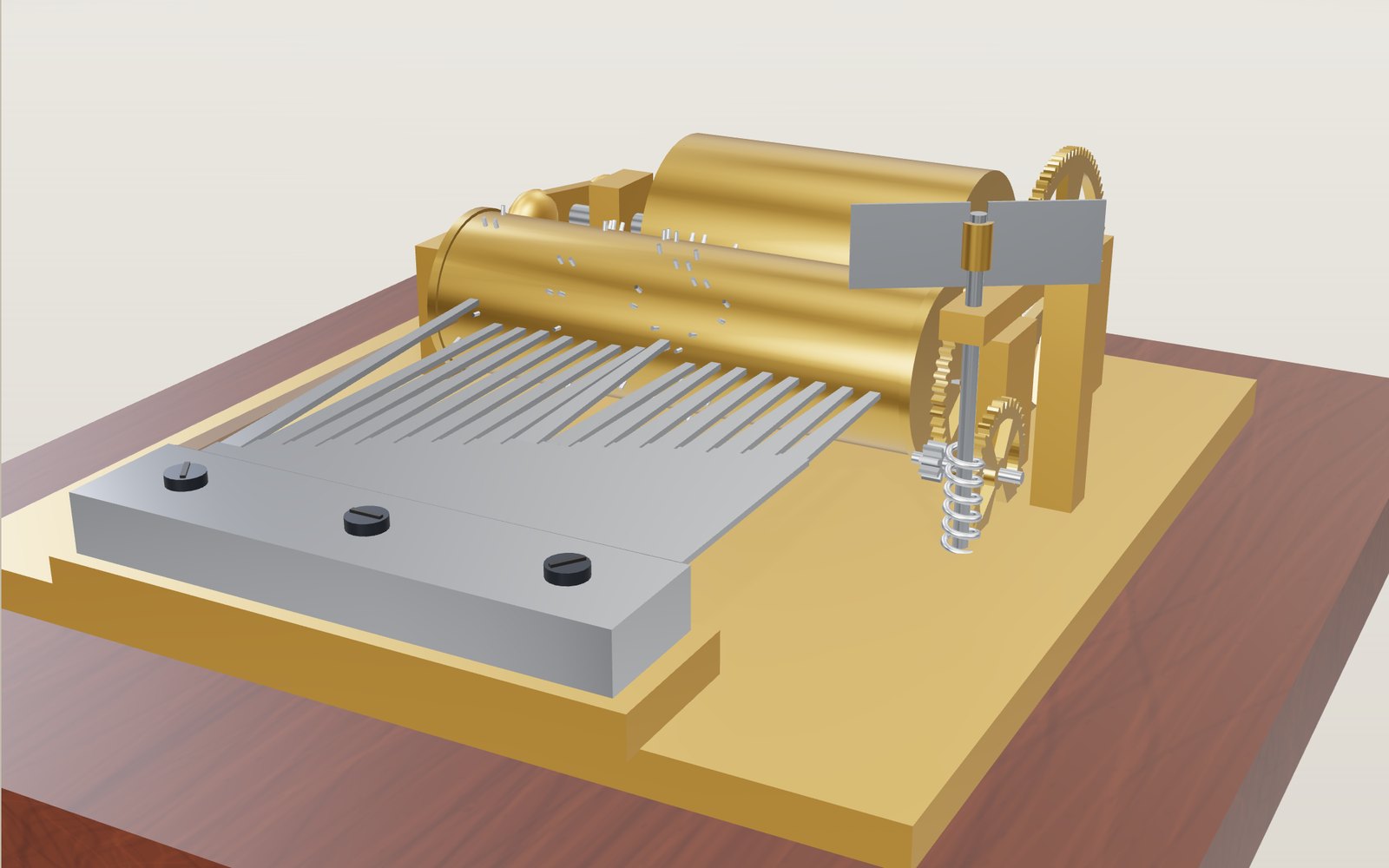
How a music box works
A steel tooth 30.6 mm long rings at 261.6 Hz, and cutting it to half that length would raise the note two octaves.
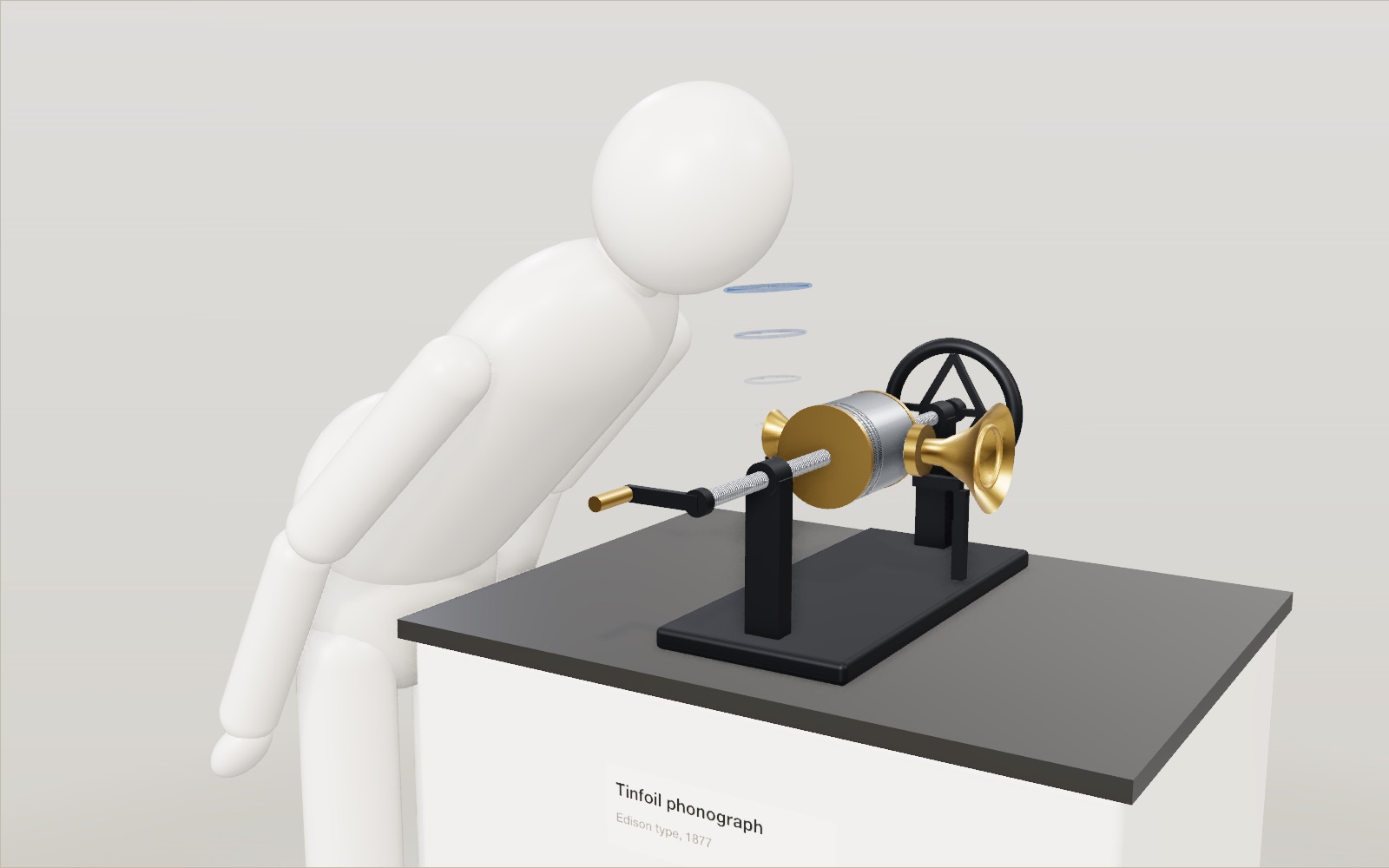
How a phonograph works: from tinfoil to cassette and CD
Edison's first phonograph cut a voice into tinfoil in 1877, and the same needle played it back from a groove 2.54 mm apart.
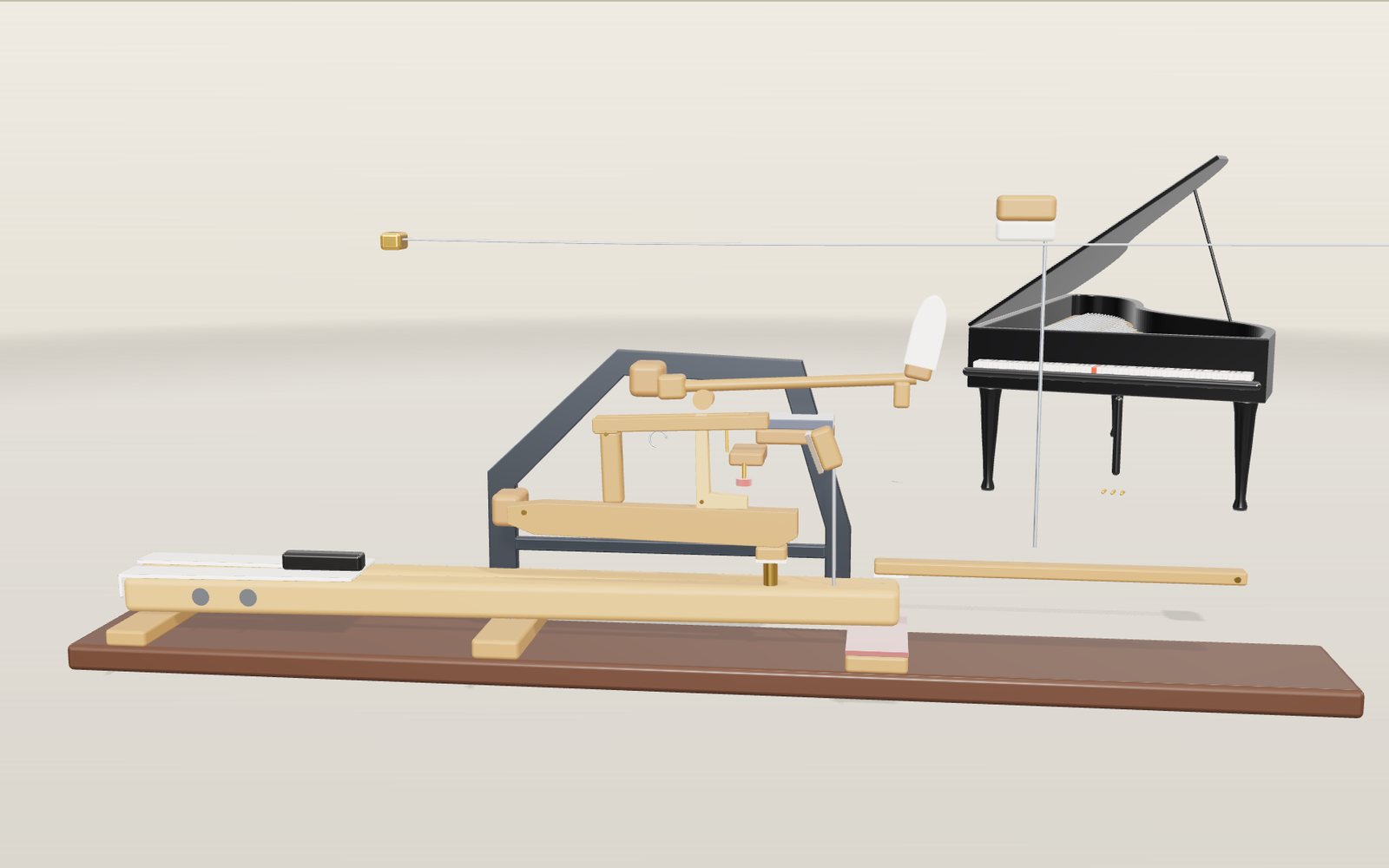
How a piano works: the grand action and equal temperament
Press a key 10 millimetres and a felt hammer flies to the string, hits it and falls away before it can stop the note.
What sound looks like: sound waves, frequency and decibels
A 440 Hz tone packs the air into dense layers 78 centimetres apart, yet even at 94 dB each bit of air moves less than a thousandth of a millimetre.

How do bats see with sound? Echolocation explained
An echo from a moth 1 m away comes back to a bat in under 6 thousandths of a second, and that delay is how the bat knows the distance.
How a pendulum clock works, and why its length sets the time
A pendulum clock counts seconds with one rod 99.4 cm long. Change its length, its temperature and its place on Earth, swap four escapements and see how many seconds a day each costs.