Loading the model
This device cannot show the 3D model. You can read the guide steps below as text.
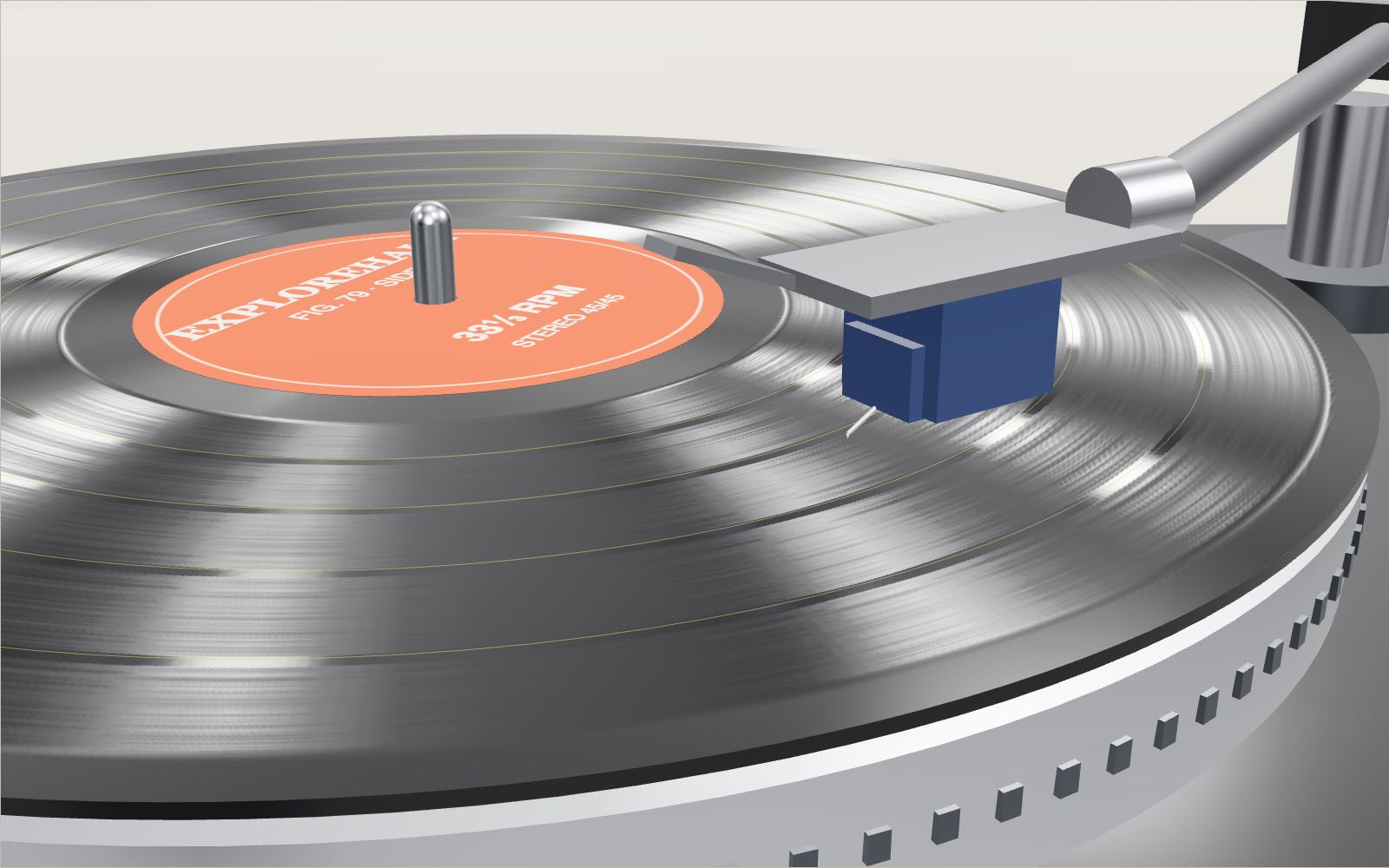
1 / 10 A record player The platter turns the record at 33⅓ rpm and the tonearm rests the stylus in the groove near the outer edge. Sound is off until you switch it on in Controls.
Drag to turn. Scroll or pinch to zoom.
Guide Parts Controls
01 A record player The platter turns the record at 33⅓ rpm and the tonearm rests the stylus in the groove near the outer edge. Sound is off until you switch it on in Controls.
02 The stylus sits in the groove The cartridge rides at the end of the arm. Only its diamond tip touches the record, and the groove does all the steering.
03 The groove under a microscope This is 2.3 mm of groove at about 300 times. Time runs 1,000 times slower so you can watch the wiggles slide past the stylus. Each wiggle is one cycle of sound.
04 Two walls, two channels The groove walls lean at 45°. The left channel is cut into the inner wall (blue) and the right into the outer wall (orange). The ball-shaped tip touches both walls at once.
05 A magnet makes the signal The cartridge is see-through. The stylus swings the cantilever, the magnet on its far end moves between four coils, and each pair of coils gives a few millivolts for its channel.
06 Change the speed Now the record plays at 45 rpm. It was cut for 33⅓, so everything comes out 1.35 times faster and 5.2 semitones higher. Try the three speed buttons under the stage.
07 Outer and inner grooves The stylus is now near the label. One turn is 2.42 times shorter here, so the groove passes 2.42 times slower and the same note is squeezed into a shorter wiggle.
08 How long is the groove? The orange line draws the spiral, one line for every 20 real turns. One side of this record is 733 turns, about 475 m of groove.
09 Drop the needle yourself Press Lift the arm on the stage, or drag the arm itself. The four shiny rings are the bands between tracks. Land the stylus in one, then try to start track 4 from its first seconds.
10 Cut your own groove A hot sapphire cutter carves a 1,000 Hz tone on the left channel into blank lacquer, so the groove moves at 45°. Grooves nearer the label are still smooth. Under the stage you can cut a chord or a melody, switch RIAA off and play your groove back.
Record A 12-inch (304.8 mm) vinyl disc. One side here plays 22 minutes, a single spiral groove of about 475 m from a radius of 146 mm to 60.3 mm. Groove A V-shaped cut 60 µm wide with walls at 90° to each other. Neighbouring turns sit 117 µm apart on average. The inner wall carries the left channel and the outer wall the right. Stylus A diamond tip ground to a radius of 17.8 µm (0.7 thousandths of an inch). It touches the two walls about 17 µm below the surface and never the bottom of the groove. Cantilever A thin aluminium tube about 5.5 mm long. The stylus sits on one end; the other end pivots in a rubber damper inside the cartridge. Magnet A tiny permanent magnet on the far end of the cantilever. When the stylus swings one way, the magnet swings the other way between the coils. Coils Four coils on pole pieces, set in two pairs at 45°. Each pair belongs to one channel and turns the moving magnetic field into a few millivolts. Cartridge The body that holds the generator. Turn on See inside to look at the magnet and coils. The four coloured pins carry left and right signals to the arm. Tonearm A pivoted arm 233.5 mm from pivot to stylus. It turns through 22.6° from the first groove to the last, and the headshell is angled 20.7° to follow the groove. Counterweight Balances the arm so that only two grams press the stylus into the groove. Turning it forwards or back sets the tracking force. Platter A heavy aluminium disc that turns at 33⅓, 45 or 78 rpm. Its mass smooths out small changes in motor speed. The dots on the rim are a speed strobe. Spindle The steel pin that centres the record. If the hole is off by a fraction of a millimetre, the pitch rises and falls once every turn. Plinth The heavy base that holds motor, platter and arm together and keeps floor vibration out of the groove. The three buttons choose the speed. Speed buttons Three buttons for 33⅓, 45 and 78 rpm. The lit one is the speed the platter is turning at now. Motor and belt A small motor at the back turns a pulley 17 mm across, and a rubber belt carries the drive to the hub under the platter. The belt also soaks up motor vibration. Mat A 3 mm rubber mat between platter and record. It grips the record and damps ringing in the metal platter. Label The paper label, 100 mm across. The groove stops at a radius of 60.3 mm, leaving a smooth run-out band before the label. Headshell The plate at the end of the arm that holds the cartridge. It is turned 20.7° so the cartridge lines up with the groove, and the finger lift lets you lower the arm by hand. Damper A small rubber ring where the cantilever pivots. It lets the stylus move freely at audio frequencies but stops it from ringing on after a sharp sound.