FIG. 12Old Machines
How a music box works
A steel tooth 30.6 mm long rings at 261.6 Hz, and cutting it to half that length would raise the note two octaves.
This device cannot show the 3D model. You can read the guide steps below as text.
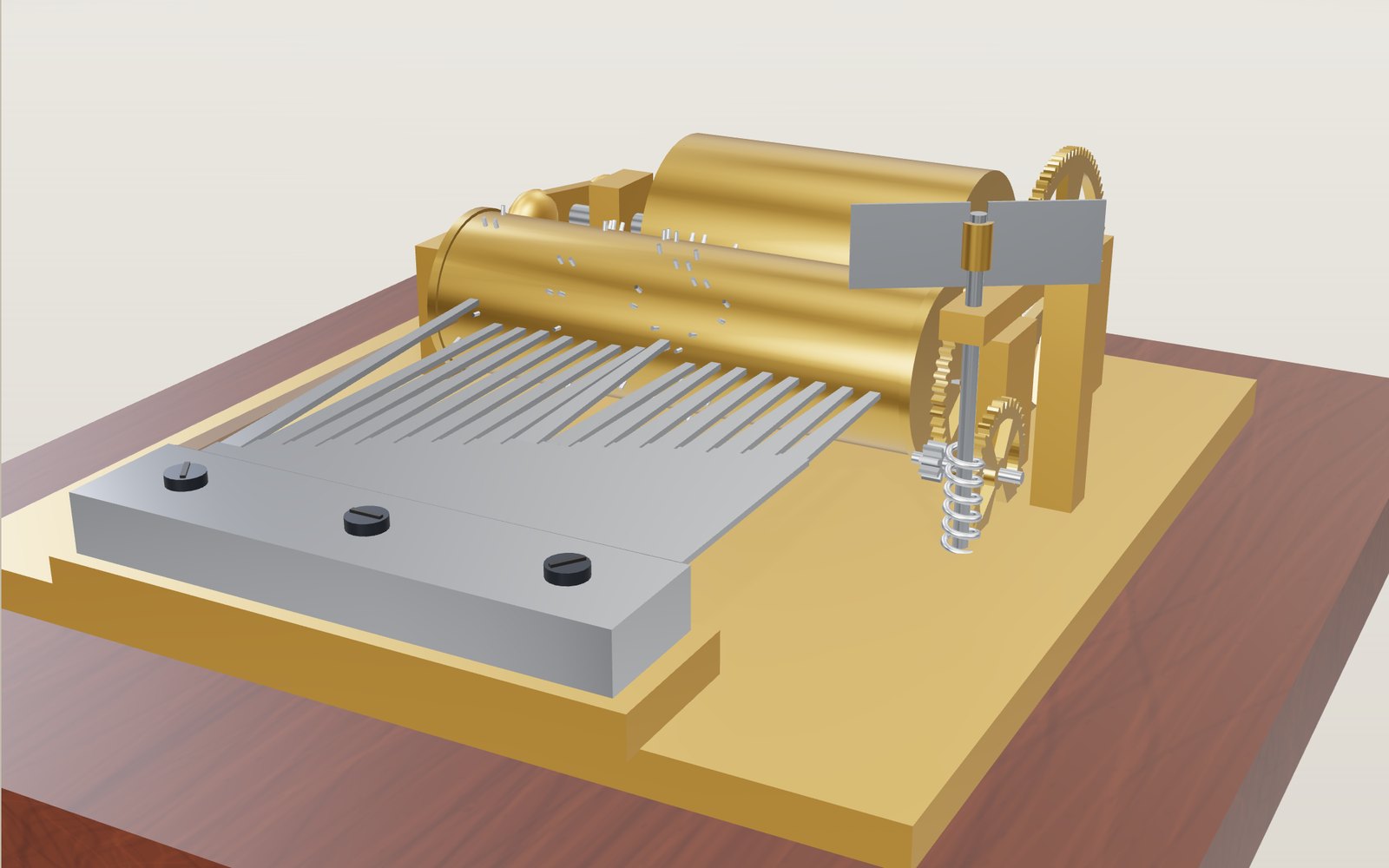
1 / 14 The whole movementSpring at the back, cylinder in the middle, comb at the front, fan on the right. It is playing silently. Press Play in Controls or tap any tooth to hear it.
Drag to turn. Scroll or pinch to zoom.
What the model shows
Open a small music box and you find no strings, no reeds and no hammers. There is a brass drum covered in short pins, a strip of steel cut into teeth, a coiled spring and a little fan that spins so fast it blurs. That is the whole instrument. This model rebuilds such a movement in code so you can follow one note from the spring to your ear, and then it shows two larger relatives that work on the same idea: a disc music box and an orchestrion.
The cylinder movement has 18 teeth tuned to a C major scale from C4 (middle C, 261.6 Hz) to F6 (1,396.9 Hz). The cylinder is 13 mm across and 40 mm long and carries two tracks. Track A starts with Beethoven's Ode to Joy (46 pins) and track B with the old French round Frère Jacques (48 pins). When the spring is fully wound and the fan has its standard vanes, the cylinder turns once every 16 seconds, which is 120 beats a minute.
Under the controls there is a lab. You can pin your own tune on the cylinder, load any of 29 tunes that are out of copyright, change the length and thickness of any tooth, and try four small tasks. A list of 37 machines, makers and museums, from a 9th-century flute player to a music box movement named as engineering heritage in 2026, sits below them.
The model starts silently. Press Play in the Controls tab, or tap a tooth, and the page builds each note with the Web Audio API in your browser. No recording is used.
Three machines, one idea
Use the Machine control to switch between three scenes. All three read the same tune, and all three turn it into sound by a mechanism that moves in time with a turning store of notes.
- Cylinder: pins on a brass cylinder pluck steel teeth directly. This is the movement Antoine Favre of Geneva registered in 1796 and the kind still made in small boxes today.
- Disc: projections on a stamped steel disc turn star wheels, and the star wheels pluck the teeth. Symphonion of Leipzig made the first disc-playing box in 1885.
- Orchestrion: pins on a wooden barrel lift keys, and the keys open organ pipes. The pinned barrel is much older than the comb; it played bells and organ pipes long before 1796.
Whichever scene you are in, the pin editor writes to the same track. Pin a note and it appears on the cylinder, as a new projection on the disc and as a new pin on the organ barrel.
How a pin turns into a note
Think about what has to happen for one note. Something must bend a tooth, then let it go, at exactly the right moment. The pin does both. As the cylinder turns, the pin meets the tip of a tooth, pushes it up a fraction of a millimetre and then slides past the end. The tooth springs back and keeps swinging up and down on its own, like a diving board after the diver has left it.
A swinging tooth on its own makes very little sound, because a strip a couple of millimetres wide pushes hardly any air. So the comb is screwed down hard to a heavy bedplate, and the bedplate sits on a wooden case. The vibration travels through the root of the tooth into the wood, and the larger wooden surfaces move enough air to fill a room.
The cylinder is the score. Read it like a page. Going around the drum is time, and going along it is pitch, because each position along the drum lines up with one tooth. In this model one turn is 32 beats. The circumference is π × 13 mm = 40.8 mm, so one beat takes up 40.8 / 32 = 1.28 mm of the surface, and the surface moves past the comb at 40.8 / 16 = 2.55 mm per second. That slow, steady crawl is all the precision the music needs.
Pinning your own tune
The pin editor in the lab is the cylinder unrolled. Each of its 64 columns is half a beat, an eighth note, so one column stands for 0.64 mm of the cylinder's surface. Each of its 18 rows is one tooth, with the lowest note at the bottom. Tap a square and a pin appears on the cylinder at that place; tap it again and the pin comes out. The stage plays the new note on the next turn.
There is one rule the editor enforces. After a pin lets a tooth go, the tooth is still ringing. If a second pin reached the same tooth at once, it would catch the tooth halfway through a swing and choke the note. In the model a tooth needs half a beat, 0.25 seconds at 120 beats a minute, before it can be plucked again, so a new pin closer than that on the same row replaces the old one. Hot Cross Buns in the tune list has four quick notes on one tooth, right at that limit.
The tunes in the list are cut to one turn of the cylinder, 32 beats or less, and written in C or in a key that needs no sharps or flats, because the comb has only the white notes from C4 to F6. Old MacDonald is in G, but its tune never uses F sharp. Scarborough Fair is in the Dorian mode, which on D uses only white notes. A bass line is added from the chords: the root of each chord, or its fifth when the chord repeats.
Why a shorter tooth sounds higher
Each tooth is a cantilever, a beam clamped at one end and free at the other. The textbook result for its lowest natural frequency (Euler–Bernoulli beam theory) is
f = (1.8751² / 2π) × (t / L²) × √(E / 12ρ)
where t is the thickness, L the free length, E the stiffness of the steel and ρ its density. Two things stand out. Pitch goes up in step with thickness, and it goes down with the square of the length. Width cancels out, which is why tooth width barely matters for pitch.
Put in numbers for steel: E = 200 GPa and ρ = 7,850 kg/m³ give √(E / 12ρ) = 1,457 m/s, and 1.8751² / 2π = 0.5596, so the constant in front is 815.4 m/s. Every tooth in this model starts 0.30 mm thick. Solving for length gives L = √(815.4 × t / f). With t and L in millimetres the same formula reads f = 815,400 × t / L², which is the line the tooth tester shows.
- C4, 261.63 Hz: L = √(815.4 × 0.0003 / 261.63) = 0.0306 m, or 30.6 mm.
- C5, 523.25 Hz: 21.6 mm.
- F6, 1,396.91 Hz: 13.2 mm.
The longest tooth is 30.6 / 13.2 = 2.31 times the shortest, and √(1,396.91 / 261.63) = 2.31 as well, which is the square-root rule at work. Halving a tooth's length multiplies its frequency by four, which is two octaves. Doubling its thickness doubles the frequency, one octave. That gives makers two ways to reach a note. If the C4 tooth were 0.60 mm thick, it would need to be 43.2 mm long to stay at the same pitch. The teeth of the disc box in this model are 0.60 mm thick, which is why its C4 tooth is exactly that long.
A tooth also has higher modes of vibration. The second one sits at (4.6941 / 1.8751)² = 6.27 times the first, so the C4 tooth has a faint partial near 261.63 × 6.27 = 1,640 Hz. Because 6.27 is not a whole number, this overtone is not in tune with the fundamental. It dies away quickly and gives the pluck its bright, metallic start. The synthesised sound on this page mixes that partial in at low volume, with a short click for the pin.
Two tasks with the tooth tester
The tasks One octave up and Same length, new note let you check the formula with your ears.
To raise the C4 tooth one octave you need twice the frequency. Frequency goes with 1 / L², so the length must shrink by √2: 30.6 / 1.414 = 21.6 mm. That is exactly the length of the C5 tooth already in the comb. The Tooth length control moves in steps of 0.1 mm, and the task counts as done within 17 cents of 523.25 Hz, which is a window of about 0.1 mm either side.
To get G4 (392 Hz) from the C4 tooth without changing its length, the thickness must grow in the same ratio as the frequency: 0.30 × 392.00 / 261.63 = 0.45 mm. At 0.45 mm the tooth sounds 392.4 Hz, 2 cents sharp, close enough that no ear could tell.
When you change a tooth, the tune keeps its pins, so the cylinder will now pluck the wrong note wherever that tooth is used. The comb chart in the lab shows the teeth as bars, with dashed outlines for the original lengths, and marks in orange any tooth that is more than 17 cents out of tune. Retune all teeth puts everything back.
Lead weights under the bass
Look at the formula again and a problem appears at the bottom of the scale. A low note needs a long tooth, and a long tooth makes the comb wide and fragile. Between 1820 and 1830, according to John E. T. Clark's history of the trade, makers began fixing small lead weights under the bass teeth.
Extra mass at the tip slows a tooth down. A simple way to estimate it treats the tooth as a spring with an effective mass of 0.2357 times its own mass, the Rayleigh result for a cantilever. A weight M at the tip then lowers the frequency to
f = f₀ / √(1 + M / (0.2357 m)).
The C4 tooth in this model weighs about 0.090 g (7,850 kg/m³ × 1.25 mm × 0.30 mm × 30.6 mm). With a 0.04 g weight under it, the same 30.6 mm tooth would drop to 154.0 Hz, 917 cents flat. To bring it back to C4 the tooth must be shortened to 22.2 mm. Turn on Lead weights and the seven bass teeth from C4 to B4 shrink at once while still playing the same notes; the bass end of the comb now lines up with the middle. A heavier tooth also keeps its energy longer, so the model lets weighted teeth ring 1.6 times as long. The 0.04 g figure and the longer ring are model values, chosen to make the effect easy to see and hear.
The sounding box
Switch off Sounding box and listen. The comb moves so little air that most of what you hear from a real music box comes from whatever it is screwed to. In the model, switching the box off takes the volume down to about 0.3 of normal and cuts away the sound below 900 Hz, which is roughly how a bare movement held in the air compares with one on a table. Both numbers are model values, not measurements. Real makers paid great attention to the wood of the case, and a loose comb screw is one of the first things a restorer checks.
The spring and the fan
A coiled spring is a poor motor for music. Fully wound it pushes hard, and as it relaxes it pushes less. If nothing controlled the speed, the cylinder would start fast, slow down and play every tune out of time.
The fix is an air brake. The spring drives the cylinder through a 78-tooth barrel wheel and a 50-tooth cylinder wheel. The cylinder wheel also drives an 8-leaf pinion, which carries a 36-tooth wheel, and that wheel turns a single-start worm (the "endless screw" in old descriptions) with a two-vane fan on top. The ratio from cylinder to fan is (50 / 8) × 36 = 225. At 16 seconds per cylinder turn the fan spins at 225 / 16 = 14.06 turns a second, about 844 rpm.
Air drag on a vane grows with the square of its speed. So the drag torque on the fan is roughly k × A × ω², where A is the vane area. The fan speeds up until that drag balances the spring's torque coming through the gears:
T / 225 = k × A × ω², so ω = √(T / (225 × k × A)).
The speed now changes only with the square root of the spring torque. If the torque falls by 20%, the speed falls to √0.8 = 0.894 of what it was, about 11% slower rather than 20%.
In this model the spring torque is assumed to fall in a straight line to 60% as it unwinds, T = 0.6 + 0.4w, with w = 1 fully wound. At the end of the wind the tempo is √0.6 = 0.775 of the start, so 120 beats a minute drops to about 93. One full wind lasts six cylinder turns. Adding up the time turn by turn gives
t = ∫ 96 s / √(0.6 + 0.4w) dw from w = 0 to 1 = 96 × 5 × (1 − √0.6) = 108.2 s,
about 1 minute 48 seconds. Move the Fan vane size control to see the square-root rule at work. Double the vane area and the tempo drops to 1 / √2 = 0.707 of normal, about 85 beats a minute. Cut the area to a quarter and the tempo doubles to 240.
The task Set the tempo asks for 100 beats a minute. At full wind the tempo is 120 × √(1 / A), so A must be (120 / 100)² = 1.44 of the standard vane. The control moves in steps of 0.05, and 1.45 gives 99.65 beats a minute, inside the 1.5-beat window. With the spring half run down you need less vane, (120 / 100)² × 0.8 = 1.15. The tempo calculator in the lab draws the tempo against the spring for the vane you have set, next to the standard vane in grey.
Slow motion
A tooth vibrates far too fast to see. At 120 beats a minute the C4 tooth swings 261.63 × 0.5 = 131 times between one beat and the next. The Slow motion control stretches model time. At 1/50 the C4 tooth swings 5.2 times a second, and at 1/200 an E5 tooth (659.26 Hz) swings 3.3 times a second, slow enough to count. Above about 12 swings a second the model stops trying to show the true rate and draws a quick flutter instead. The bending of the tooth is also drawn many times larger than the real fraction of a millimetre.
Two tunes on one cylinder
The pins for track B sit half a tooth spacing to the side of track A. In this comb the teeth are 2.1 mm apart, so the cylinder slides 1.05 mm along its axis to change tracks. The first set of pins then passes through the gaps between the teeth without touching them, while the second set lines up. Move the Track control and watch the drum slide. By the 1850s large cylinders held six to twelve tunes this way, each one more row of pins squeezed between the others.
The disc box
A pinned cylinder is slow and costly to make, and a box with one cylinder plays only the tunes pinned on it. The disc box solved both problems. The Symphonion company of Leipzig started business in 1885 and produced the first disc-playing music box. Within two years two of its founders, Gustave Brachhausen and Paul Riessner, had left to set up Polyphon, and in 1892 Brachhausen founded the Regina Music Box Co. in New Jersey.
On the stage the disc is 15.5 inches (393.7 mm) across, the size of a common Polyphon disc that early Regina boxes were built to play, and carries the same tune as the cylinder track you are on. Each note is a small tab punched out of the disc and bent down. The 18 tracks run from 62 mm to 177.6 mm from the centre, with the bass on the inside. The disc turns once in 16 seconds, so its rim travels at π × 393.7 / 16 = 77.3 mm per second, thirty times faster than the cylinder's surface.
The tabs do not touch the teeth. Each one turns a six-pointed star wheel by a sixth of a turn, and the next point of the star plucks the tooth below. Nidec, which still makes disc boxes, notes that star wheels can pluck harder than cylinder pins, so a disc box can use larger teeth and play louder. In the model the disc comb's teeth are 0.60 mm thick, twice the cylinder comb's, so its C4 tooth is 43.2 mm long. See inside makes the disc clear so you can watch the star wheels turn.
Discs were cheap, so a single box could play hundreds of tunes, and the bigger models took coins. The Regina Orchestral Corona No. 33 in the Smithsonian plays 27-inch discs on a double comb of 86 teeth and changes up to 12 discs in turn. Museum Speelklok in Utrecht notes that the success of the disc box ended around 1910 with the rise of the gramophone and the radio.
The orchestrion
Long before the steel comb, pinned barrels played bells and pipes. In 9th-century Baghdad the Banū Mūsā brothers described a water-driven flute whose holes were opened by eight levers, pressed in turn by pins on a turning cylinder. Small barrel organs called serinettes were used in 18th-century France to teach songs to caged birds; one in The Met, made in Mirecourt around 1800, plays 30 tunes on four barrels. In the 19th and early 20th centuries the same idea grew into orchestrions, self-playing cabinets of pipes, drums and bells. The collection at Seewen runs from combs hidden in jewellery and snuffboxes to automatons made for railway stations and large orchestrions.
The third scene shows a small orchestrion. A wooden barrel 0.8 m long carries pins like the music-box cylinder. Instead of plucking teeth, each pin lifts a key, and a thin rod from the key opens the valve under one pipe. The bellows keep the windchest full, and a drum strikes on the first beat of every bar.
The pipe lengths come from the physics of an open pipe. Air in a pipe open at both ends vibrates most easily when the pipe is half a wavelength long, so L = v / 2f with the speed of sound v = 343 m/s. The C4 pipe is 343 / (2 × 261.63) = 0.656 m long, the C5 pipe half that at 0.328 m, and the F6 pipe 0.123 m. Real organ pipes are a little shorter than this, because the air just beyond each open end also takes part in the vibration; the model ignores that end correction. The cabinet is 1.72 m tall and shown at 0.3 scale.
Big machines of this family are still played. The Museum für Musikautomaten in Seewen, Switzerland, owns a Welte Philharmonie organ which, during its restoration, turned out to carry three stamps reading Britannic. It had been built for the sister ship of the Titanic.
What this model simplifies
- The cylinder comb starts with every tooth 0.30 mm thick. Real combs vary the thickness, and tune each tooth by grinding.
- The spring torque curve, the six-turn wind, the lead weight of 0.04 g, the ringing time of each tooth and the effect of the sounding box are chosen for the model, not measured from a particular box.
- The tooth movement is drawn far larger than life, and the pins are thicker than real ones so they show up on a phone screen.
- The disc box and the orchestrion use the same 18 notes and the same spring and fan as the cylinder movement. A real disc box often has two combs of 40 or more teeth each, and a real orchestrion has its own drive.
- The sound is synthesised from the frequencies above, so it is close in pitch but cannot copy the colour of a particular wooden case or pipe.
Where the music box came from
Mechanical music is much older than the comb. Pinned barrels played bells in clocks for centuries before anyone thought of tuned steel teeth. In 1796 Antoine Favre, a Geneva watchmaker, registered a "carillon without hammers or bells": tuned metal teeth plucked directly by the pins. The idea was small enough to fit inside a watch, and the first cylinder mechanisms sat in clocks, watches, snuffboxes and sewing boxes. From about 1815, Museum Speelklok notes, the cylinder box became a musical instrument in its own right.
The trade settled in the Swiss Jura. Farmers there took piecework from watch firms through the long winters, and by about 1810 Sainte-Croix had become the centre of music box making. Early combs were built up from sections of one to six teeth; a snuff box in the Smithsonian has a comb of 16 sections of 4 teeth. Later makers cut the whole comb from one piece. By about 1810 Swiss movements used an endless screw to govern their speed, and by the 1850s large cylinders held six to twelve tunes and were wound with a lever. Makers competed with tricks: two combs playing together in the Sublime Harmonie boxes, separate loud and soft combs in the forte piano boxes of Nicole Frères, bells, drums and long sets of variations.
Then came the disc boxes of the 1880s and 1890s, and then the gramophone. Most of the old firms closed, but Reuge, founded by Charles Reuge in Sainte-Croix in 1865, still makes music boxes there. In Japan, Sankyo Seiki in Suwa built six prototype boxes playing Hänschen klein in 1948, saw their teeth break, and shipped its first 500 at the end of that year. Mass production made the 18-note movement cheap, and Sankyo once supplied over 90% of the world's music box industry. In 2026 the Japan Society of Mechanical Engineers named an early 18-note movement from around 1951 as Mechanical Heritage.
Every tune on the cylinder is long out of copyright. Friedrich Schiller wrote the poem An die Freude, and Beethoven's Ninth Symphony, whose last movement sets it, was first performed in Vienna on 7 May 1824. The oldest known copy of the Frère Jacques melody is in a French manuscript of about 1780 held by the Bibliothèque nationale de France, where it is titled Frère Blaise. Silent Night was first sung in Oberndorf near Salzburg on Christmas Eve 1818, and Stephen Foster's Oh! Susanna was first printed in 1848.
More exhibits
- How a record player works: sound stored as a groove instead of pins.
- How a mechanical clock works: springs, gear trains and a regulator that keeps time.
- Sound waves: why a shorter string, pipe or tooth gives a higher note.
Questions
Why do the teeth have different lengths?
Each tooth is tuned to one note. A tooth's pitch falls with the square of its length, so the lowest note in this model needs a 30.6 mm tooth and the highest needs only 13.2 mm.
Does tooth width change the pitch?
Hardly at all. In the cantilever formula, width appears in both the stiffness and the mass and cancels out. Thickness and length set the pitch. A wider tooth carries more energy, so it mostly changes how loud the note is.
How much shorter must a tooth be to sound an octave higher?
Shorter by a factor of √2, about 29%. The C4 tooth at 30.6 mm becomes 21.6 mm, the length of the C5 tooth. Halving the length raises the note two octaves.
What are the lead weights for?
They lower the pitch of a tooth without making it longer. Bass teeth with lead can be shorter, so the comb stays compact, and the heavier tooth rings longer. In this model a 0.04 g weight lets the C4 tooth shrink from 30.6 mm to 22.2 mm.
Why does a music box slow down at the end?
The spring pushes less as it unwinds. The fan brake turns a fall in torque into a much smaller fall in speed, because speed follows the square root of torque. In this model a 40% drop in torque makes the tune about 22% slower.
What would happen without the fan?
The spring would race the cylinder round and play the tune much too fast. Clark's guide to repairs warns that a broken endless screw can let a fully wound cylinder run down suddenly, which can ruin both the comb and the cylinder.
Why is a music box so quiet when you hold it in the air?
The teeth move very little air on their own. Pressed against a table or a wooden box, the vibration spreads into a large surface that moves much more air, so the same box sounds far louder. Switch off Sounding box to hear the model's version of this.
How many tunes can one cylinder hold?
As many as there is room for side by side. Each extra tune needs its own row of pins between the others, and the cylinder shifts sideways to choose one. Large 19th-century cylinders often held six to twelve.
Why did disc music boxes replace cylinders?
A stamped steel disc costs far less than a hand-pinned cylinder and can be changed in seconds, so one box could play hundreds of tunes. Star wheels also pluck harder than pins, so disc boxes could be louder.
How long is an organ pipe for middle C?
An open pipe sounds when it is about half a wavelength long. At 343 m/s, C4 at 261.63 Hz has a wavelength of 1.31 m, so the pipe is about 0.656 m long. Each octave up halves the length.
Can I make my own tune on this page?
Yes. Open Controls and scroll to Pin your own tune. Each tap on the grid puts a pin on the cylinder, and the model plays it on the next turn. Clear the track to start from nothing, or put the original tune back.
Does the sound start by itself on this page?
No. The model turns silently until you press Play, switch on Sound, tap a tooth or pin a note. Browsers block sound until the visitor does something on the page.
Terms
- Comb: the steel plate cut into tuned teeth.
- Cylinder: the pinned brass drum that plucks the teeth; its pins are the score.
- Cantilever: a beam fixed at one end and free at the other, like each tooth.
- Fundamental: the lowest frequency a tooth vibrates at; it sets the note you hear.
- Partial: a higher vibration mode sounding above the fundamental.
- Cent: one hundredth of an equal-tempered semitone. The tasks here accept up to 17 cents either side, about one sixth of a semitone.
- Mainspring: the coiled steel ribbon that stores the energy of winding.
- Governor: the worm and fan that hold the speed steady by air drag.
- Endless screw: an old name for the worm that drives the fan.
- Resonator: a small lead weight fixed under a bass tooth.
- Star wheel: the six-pointed wheel in a disc box that carries the motion from the disc to a tooth.
- Orchestrion: a self-playing cabinet of organ pipes, drums and other instruments, played from a pinned barrel or a perforated roll.
- Serinette: a small barrel organ once used to teach songs to birds.
Sources
- Museum Speelklok (Utrecht), Musical boxes. https://www.museumspeelklok.nl/en/musical-boxes/ (checked 18 October 2026)
- Automatic Musical Instrument Collectors' Association (AMICA), Thaddeus Kochanny, A History of the Music Box. https://www.amica.org/files/publications/History_of_the_Music_Box.pdf (checked 15 October 2026)
- John E. T. Clark, Musical Boxes: A History and Appreciation, Internet Archive (Digital Library of India scan). https://archive.org/details/in.ernet.dli.2015.152042 (checked 15 October 2026)
- Museum für Musikautomaten Seewen, Collection and Britannic Organ. https://www.musikautomaten.ch/en/collection-en and https://www.musikautomaten.ch/en/britannic-organ-2 (checked 18 October 2026)
- University of North Texas Music Library, How Regina Music Boxes Mediated Listening Culture (Regina's first box used 15½-inch Polyphon discs). https://blogs.library.unt.edu/music/2021/09/17/how-regina-music-boxes-mediated-listening-culture (checked 18 October 2026)
- Museums Victoria Collections, A Brief History of the Symphonion Company. https://collections.museumsvictoria.com.au/articles/2771 (checked 18 October 2026)
- Smithsonian National Museum of American History, Regina Disc Music Box (Orchestral Corona No. 33). https://www.si.edu/object/regina-disc-music-box%3Anmah_605794 (checked 18 October 2026)
- Smithsonian National Museum of American History, Mermod Freres Sublime Harmonie Music Box. https://americanhistory.si.edu/collections/object/nmah_605793 (checked 18 October 2026)
- Smithsonian National Museum of American History, Musical Snuff Box (comb of 16 four-tooth sections). https://www.si.edu/object/musical-snuff-box%3Anmah_605765 (checked 18 October 2026)
- Victoria and Albert Museum, Music Box, Regina Music Box Co. and Music Box, Nicole Frères. https://collections.vam.ac.uk/item/O297199/music-box-regina-music-box and https://collections.vam.ac.uk/item/O322077/music-box-nicole-freres/ (checked 18 October 2026)
- The Metropolitan Museum of Art, Serinette, Ch. Denis, about 1800. https://www.metmuseum.org/art/collection/search/504200 (checked 18 October 2026)
- Muslim Heritage (FSTC), The Automatic Mechanical Hydraulic Organ of the Banu Musa ibn Shakir. https://muslimheritage.com/hydraulic-organ-of-banu-musa/ (checked 18 October 2026)
- Manufacture Reuge, Our story. https://www.reuge.com/en/factory/histoire (checked 18 October 2026)
- Nidec Instruments, About the music box and Music movement. https://www.nidec-instruments.com/og/en/orgel.shtml and https://www.nidec-instruments.com/og/en/movement.shtml (checked 18 October 2026)
- Nidec Journal, Certified Mechanical Heritage: The 75-Year-Old Music Box Behind Our Motor Business (29 July 2026). https://journal.nidec.com/en/today/125 (checked 18 October 2026)
- Vibrant Technology, App Note 09: Calculating the Mode Shapes of a Beam (cantilever roots 1.875, 4.694 and 7.855, after Blevins). http://appnotes.vibetech.com/AppNote09.pdf (checked 15 October 2026)
- HyperPhysics, Georgia State University, Table of Densities (iron 7.8 g/cm³). http://hyperphysics.phy-astr.gsu.edu/hbase/Tables/density.html (checked 17 October 2026)
- HyperPhysics, Georgia State University, Elastic Properties (Young's modulus of steel 200 GPa). http://hyperphysics.phy-astr.gsu.edu/hbase/permot3.html (checked 17 October 2026)
- HyperPhysics, Georgia State University, Open Air Column (an open pipe resonates at half a wavelength). http://hyperphysics.phy-astr.gsu.edu/hbase/Waves/opecol.html (checked 18 October 2026)
- NASA Glenn Research Center, Drag Equation (drag grows with the square of velocity). https://www1.grc.nasa.gov/beginners-guide-to-aeronautics/drag-equation/ (checked 17 October 2026)
- HyperPhysics, Georgia State University, Equal Temperament (A4 = 440 Hz and the equal-tempered scale). http://hyperphysics.phy-astr.gsu.edu/hbase/Music/et.html (checked 17 October 2026)
- Library of Congress, World Digital Library, Beethoven's Symphony Number 9 in D Minor, Opus 125 (Schiller's An die Freude; first performed in Vienna on 7 May 1824). https://www.loc.gov/item/2021668114/ (checked 17 October 2026)
- Xunta de Galicia, education resources, Frère Jacques (a manuscript of about 1780 in the Bibliothèque nationale de France has the melody as Frère Blaise). https://recursos.edu.xunta.gal/sites/default/files/recurso/1639064337/frre_jacques.html (checked 17 October 2026)
- Silent Night Society (Stille Nacht Gesellschaft), History of the Song. https://www.stillenacht.at/en/history-of-the-song (checked 18 October 2026)
- Library of Congress, Oh! Susanna, first edition, W. C. Peters, 1848. https://hdl.loc.gov/loc.music/sm1848.450780 (checked 18 October 2026)
- Calculations on this page: tooth lengths from L = √(815.4 × t / f) with t = 0.30 mm; lead weight from f = f₀ / √(1 + M / (0.2357 m)); partial ratio (4.6941 / 1.8751)²; gear ratio (50 / 8) × 36 = 225; run time ∫ 96 / √(0.6 + 0.4w) dw; pipe length L = v / 2f. Every tune was also checked for notes off the comb and for pins closer than half a beat on one tooth.
More exhibits
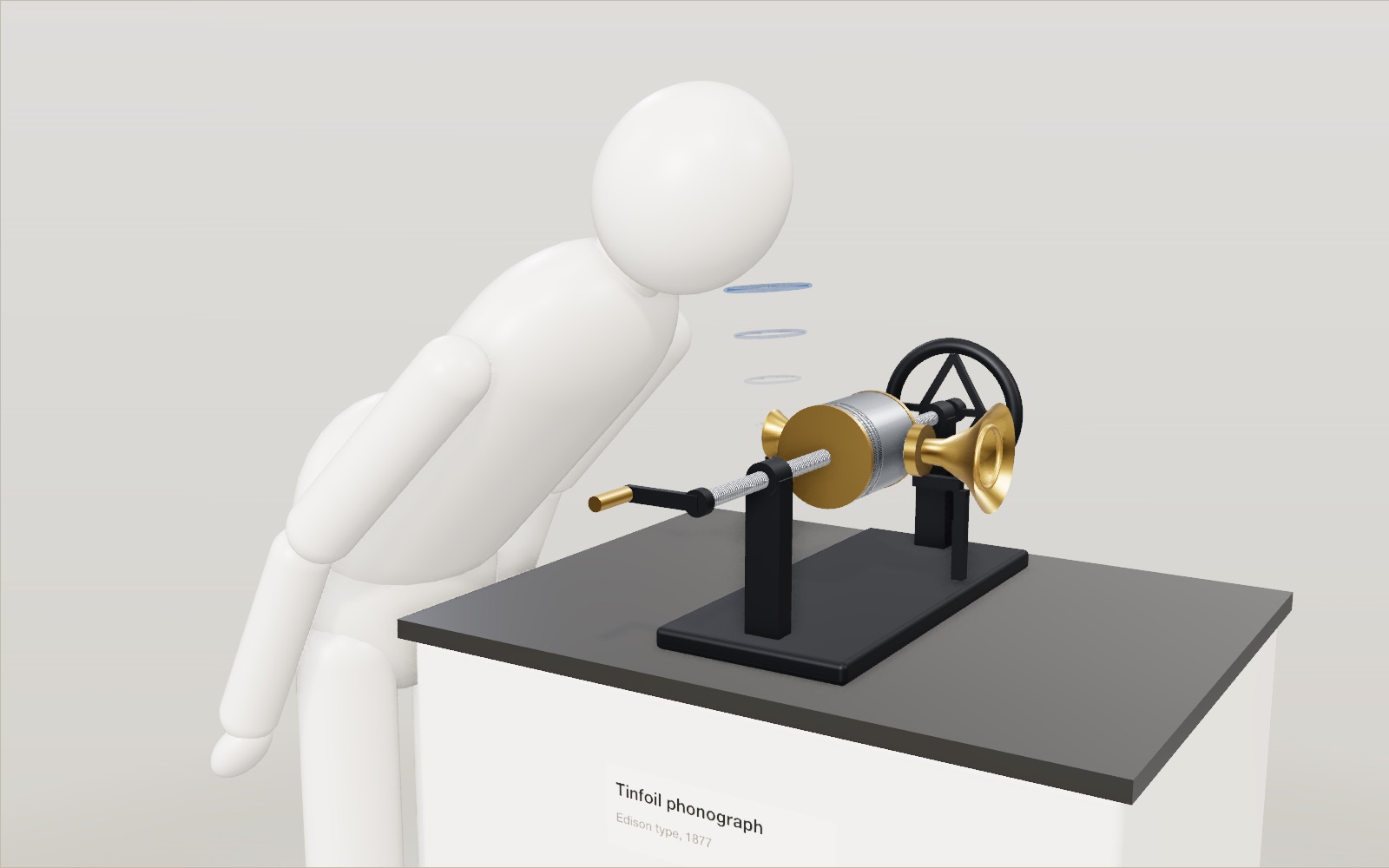
How a phonograph works: from tinfoil to cassette and CD
Edison's first phonograph cut a voice into tinfoil in 1877, and the same needle played it back from a groove 2.54 mm apart.
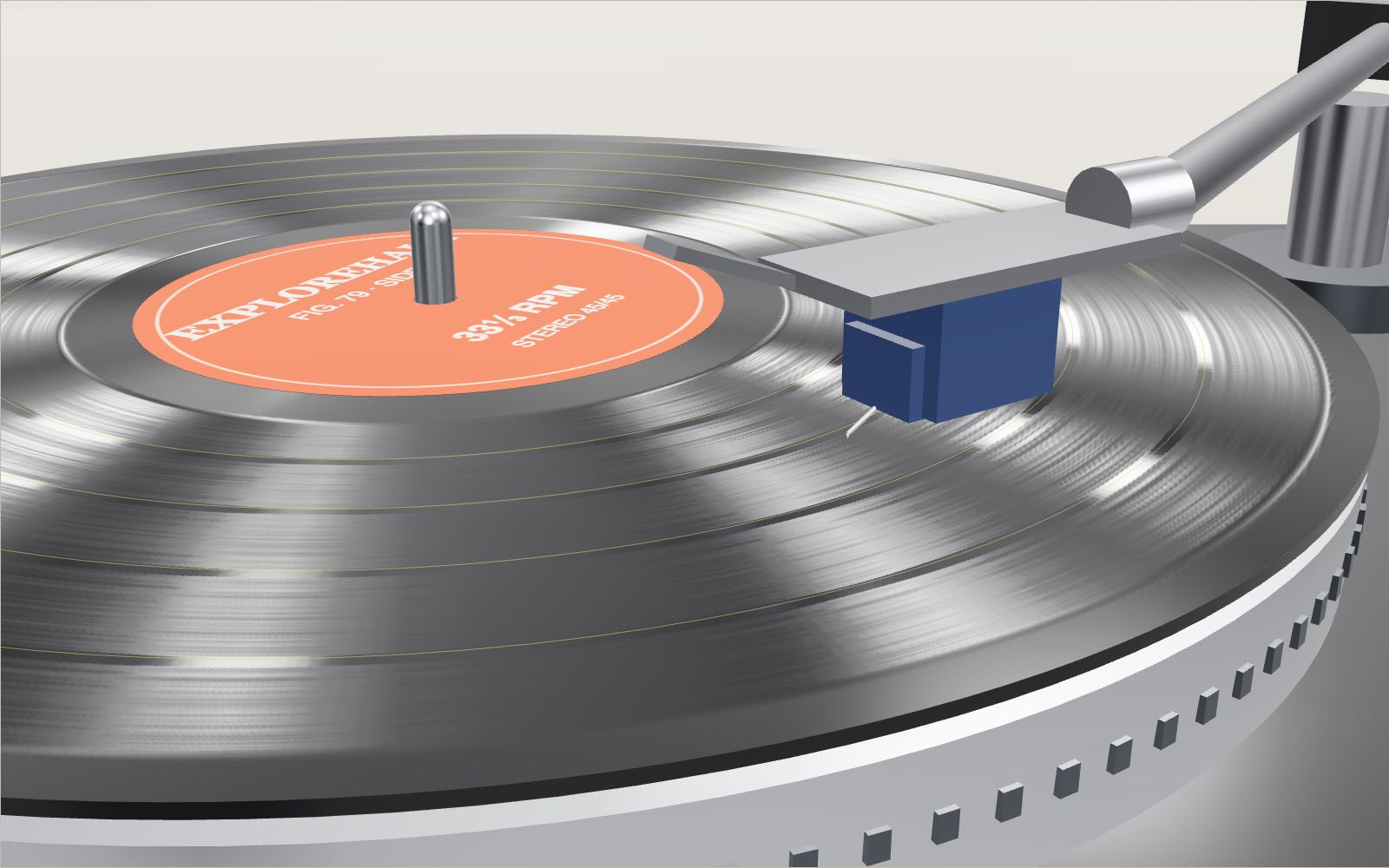
How does a vinyl record work? Grooves, stereo and RIAA
At the outer edge of an LP the groove slides under the stylus at half a metre per second, and by the last song it has slowed to 21 centimetres.
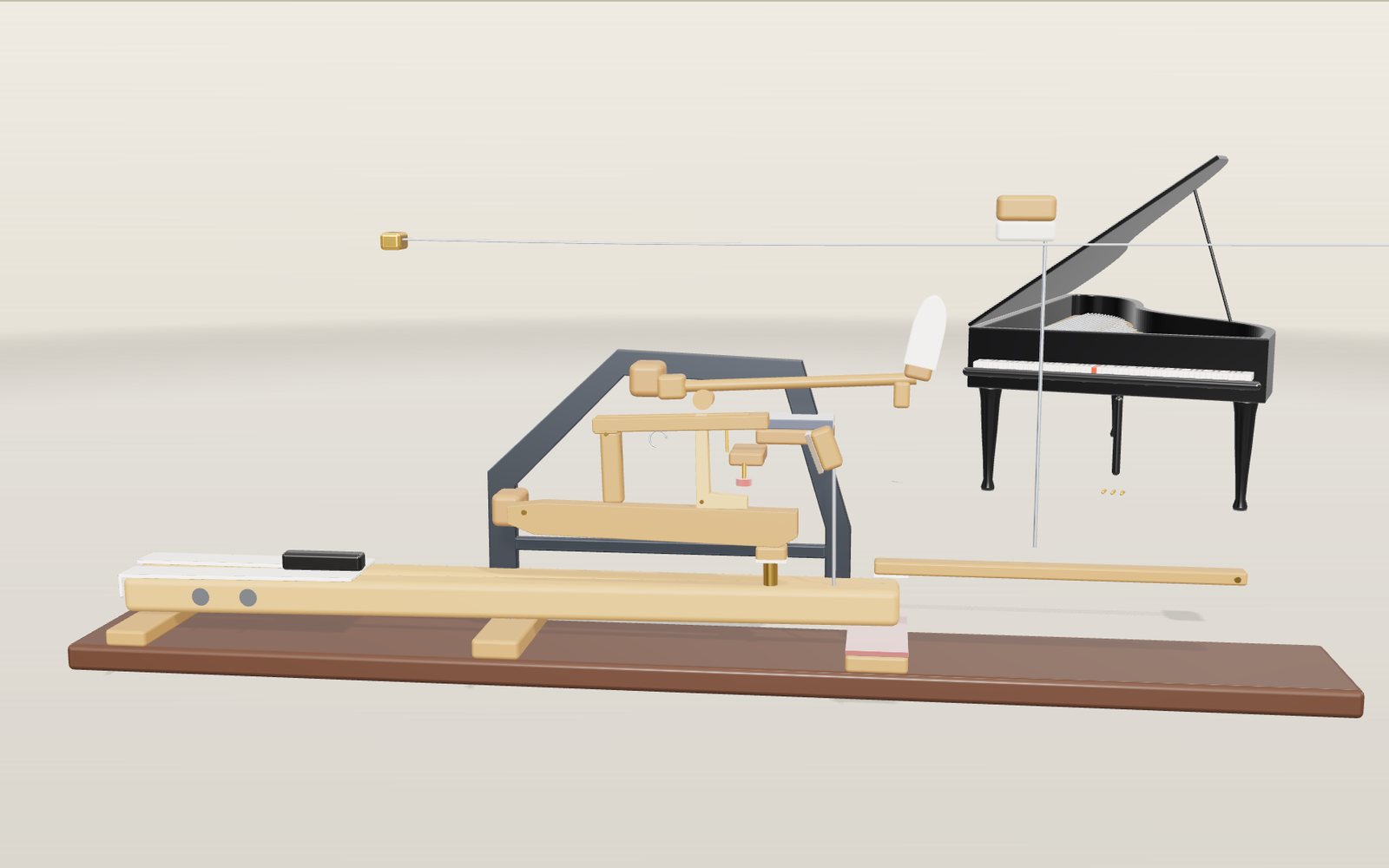
How a piano works: the grand action and equal temperament
Press a key 10 millimetres and a felt hammer flies to the string, hits it and falls away before it can stop the note.
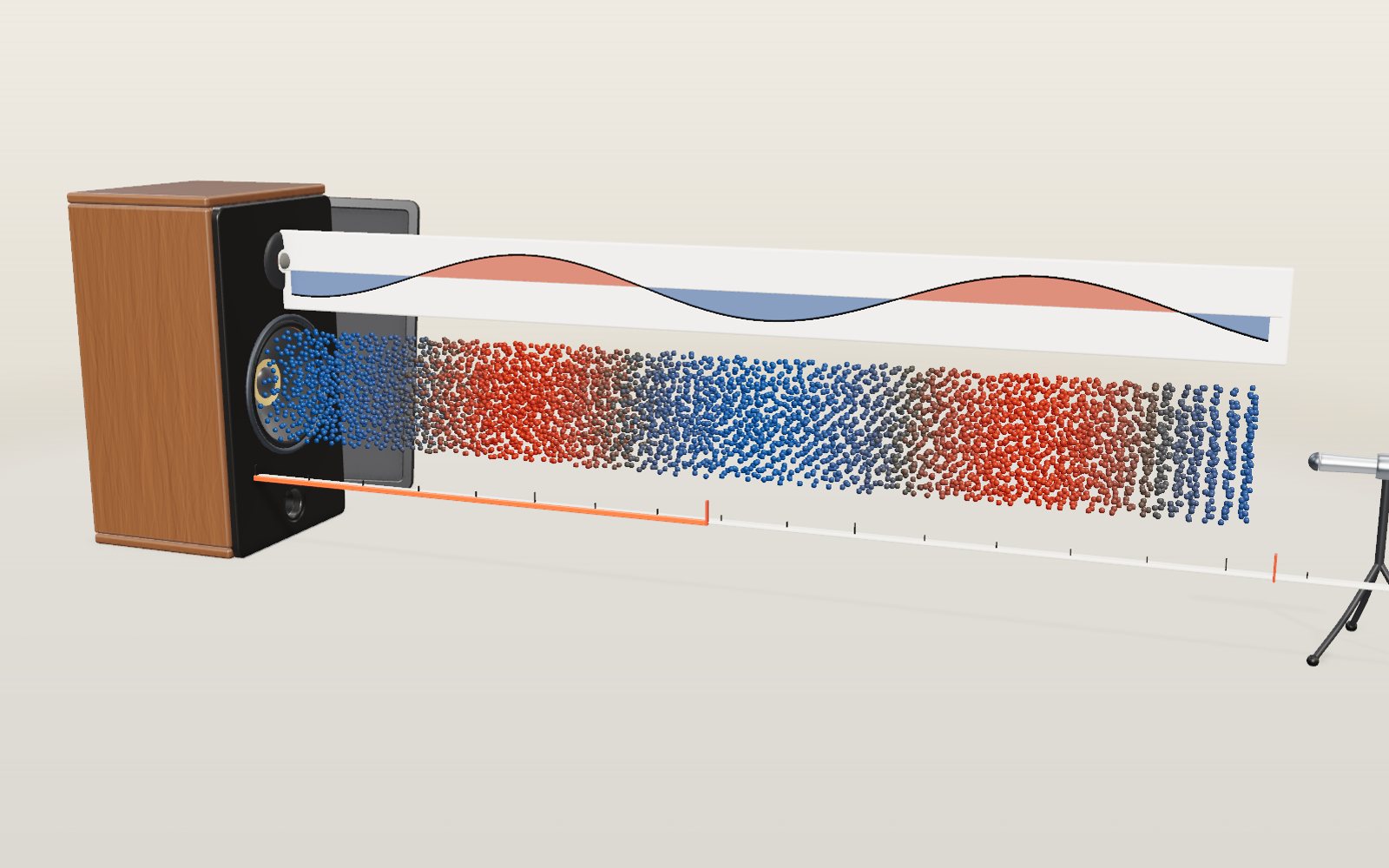
What sound looks like: sound waves, frequency and decibels
A 440 Hz tone packs the air into dense layers 78 centimetres apart, yet even at 94 dB each bit of air moves less than a thousandth of a millimetre.

How do bats see with sound? Echolocation explained
An echo from a moth 1 m away comes back to a bat in under 6 thousandths of a second, and that delay is how the bat knows the distance.
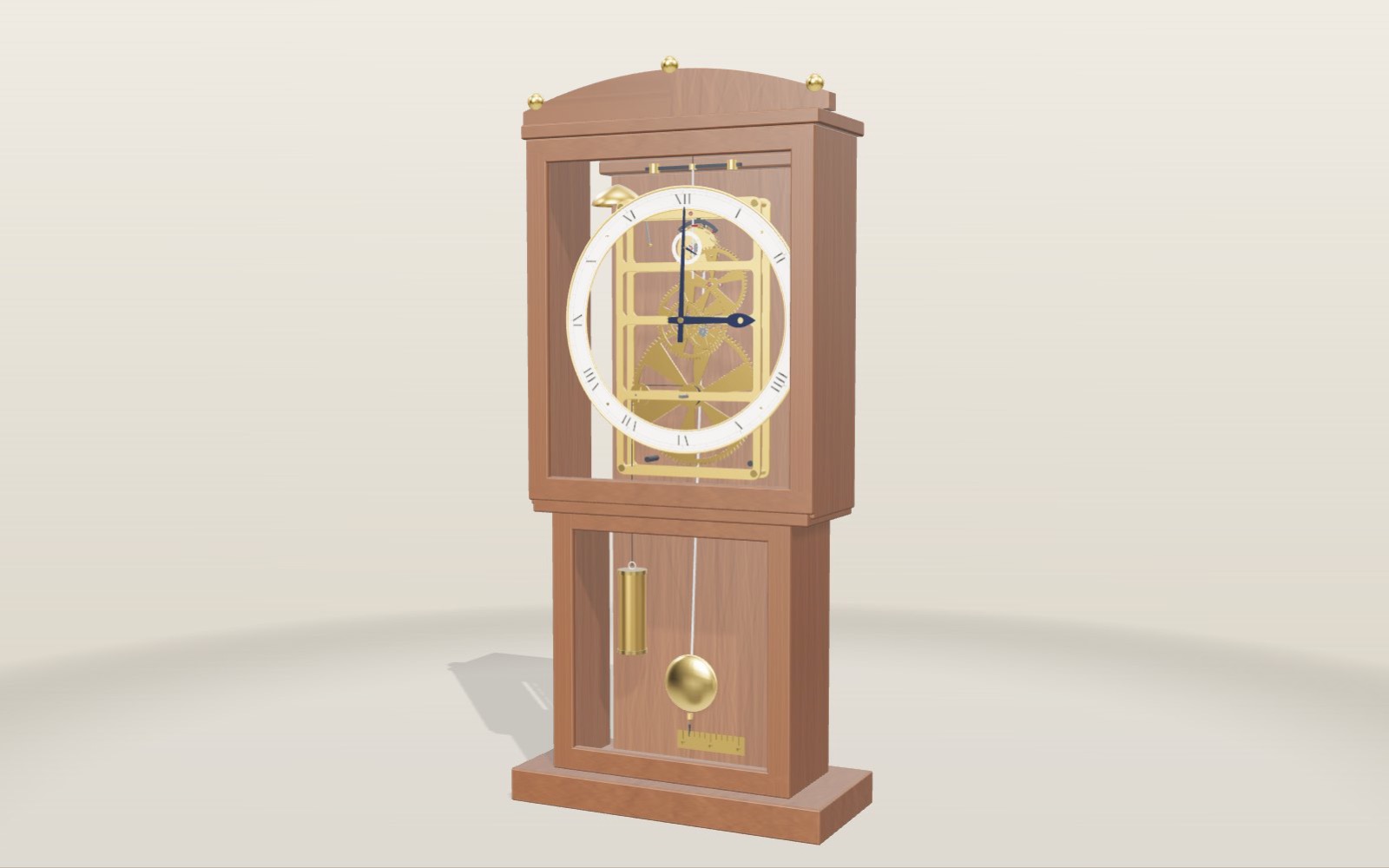
How a pendulum clock works, and why its length sets the time
A pendulum clock counts seconds with one rod 99.4 cm long. Change its length, its temperature and its place on Earth, swap four escapements and see how many seconds a day each costs.