Loading the model
This device cannot show the 3D model. You can read the guide steps below as text.
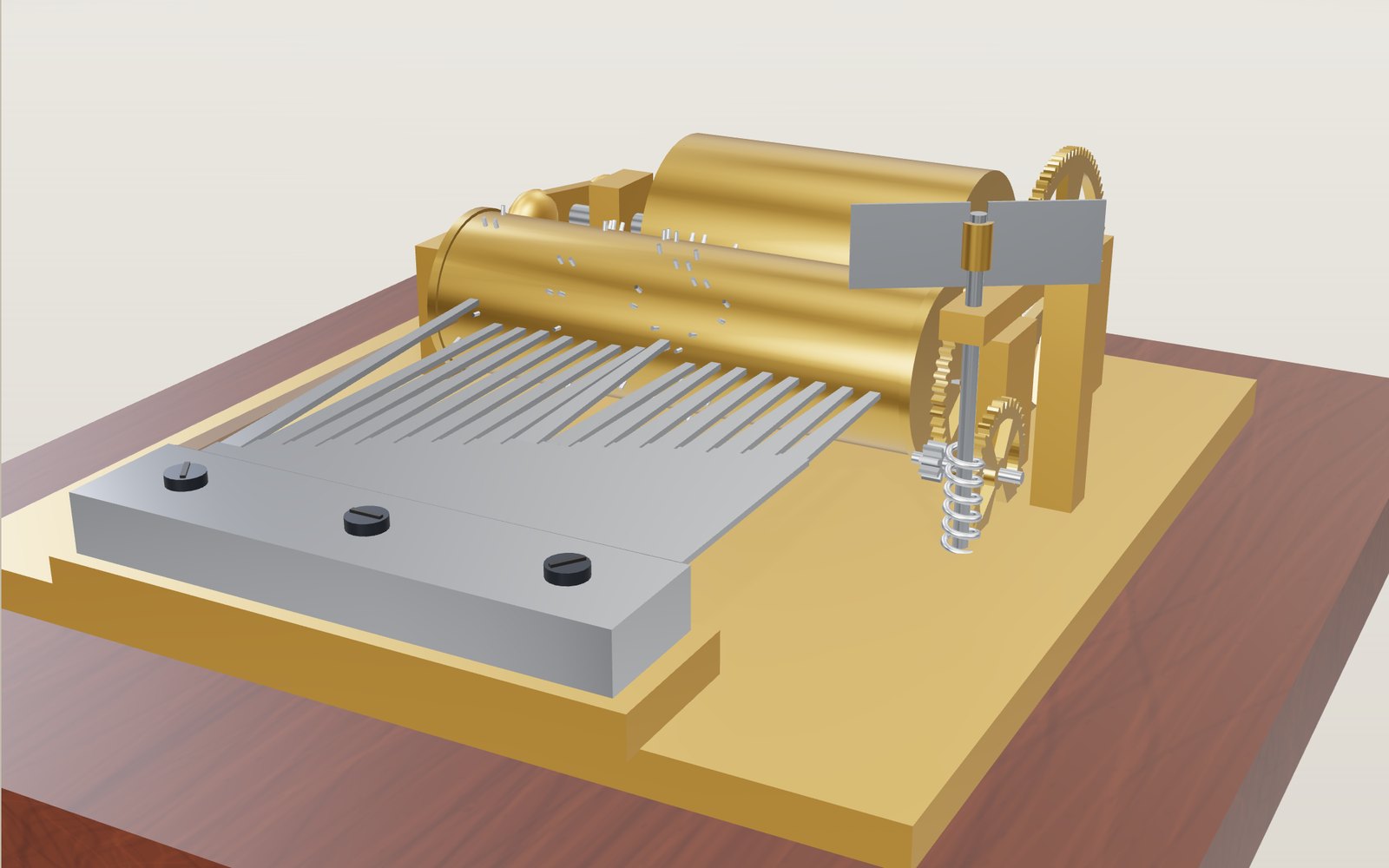
1 / 14 The whole movement Spring at the back, cylinder in the middle, comb at the front, fan on the right. It is playing silently. Press Play in Controls or tap any tooth to hear it.
Drag to turn. Scroll or pinch to zoom.
Guide Parts Controls
01 The whole movement Spring at the back, cylinder in the middle, comb at the front, fan on the right. It is playing silently. Press Play in Controls or tap any tooth to hear it.
02 The spring stores the music The barrel is see-through here. Winding coils the steel ribbon tight around the arbor, and as it unwinds the barrel wheel drives the cylinder. In this model one full wind lasts six turns of the cylinder, about 1 minute 48 seconds.
03 Pins are the score Each pin is one note. Read the drum like a page: around it is time, along it is pitch. One turn holds 32 beats of Ode to Joy, with 46 pins.
04 Shorter tooth, higher note Each tooth is a tiny diving board. Its pitch rises with thickness and falls with the square of its length, so the 13.2 mm F6 tooth sounds more than two octaves above the 30.6 mm C4 tooth.
05 One pluck at 1/200 speed A pin lifts the tip of a tooth and slips off. At normal speed the tooth would swing hundreds of times a second. Slowed 200 times, an E5 tooth swings about 3 times a second, so you can count the swings as they die away.
06 The fan keeps time Without a brake the spring would race through the tune. The gears turn a two-vane fan 225 times for each turn of the cylinder, and air drag on the vanes rises with the square of the speed. Try the Fan vane size control.
07 Two tunes, one cylinder The second track's pins sit half a tooth to the side. The cylinder has just moved 1.05 mm, so the first set slips between the teeth and the second set lines up. Switch back with the Track control.
08 Lead under the bass Lead weights are on. Extra mass at the tip lowers a tooth's pitch, so with 0.04 g fixed under it the C4 tooth needs only 22.2 mm instead of 30.6 mm. Makers began doing this between 1820 and 1830.
09 The box makes it loud The comb on its own pushes very little air. Screwed to the bedplate and the wooden box, it shakes a much larger surface. Switch off Sounding box in Controls and listen: the model plays quieter and thinner.
10 The disc box In 1885 Symphonion of Leipzig made the first music box that plays a disc. The disc carries the same tune as your cylinder track. A steel disc is cheap to stamp and changes in seconds.
11 Star wheels Each projection on the disc turns a star wheel a sixth of a turn, and the next point plucks the tooth below. Star wheels hit harder than cylinder pins, so disc boxes use bigger, thicker teeth.
12 The orchestrion The same idea at the size of a wardrobe. A pinned barrel, 18 open pipes from 65.6 cm down to 12.3 cm, bellows and a drum. Tap a pipe to hear it.
13 Keys open the pipes As the barrel turns, a pin lifts a key, and a rod opens the valve under one pipe. The key falls when the pin has passed, so the note is as long as the pin.
14 Pin your own tune Open Controls and scroll down to the grid. Every square you tap puts a pin on this cylinder, and the machine plays it on the next turn. The lab also has four small tasks and 29 tunes to load.
Comb One piece of hardened steel cut into 18 teeth, tuned from C4 (30.6 mm) to F6 (13.2 mm). Tap a tooth to hear it and to pick it for Tooth length and Tooth thickness. Lead weights Small weights under the seven bass teeth. Turn on Lead weights: the bass teeth get shorter but keep their pitch, and they ring longer. Cylinder A brass drum 13 mm across and 40 mm long. Fully wound, it turns once every 16 seconds and carries two tracks: Ode to Joy (46 pins) and Frère Jacques (48 pins). Pins Short steel pins. Their position around the drum is the timing; their position along it is the pitch. The pin editor in Controls rewrites them. Cylinder wheel 50 teeth. The spring drives it, and it in turn drives the governor. Spring barrel A drum that holds the mainspring. See inside makes it clear. Mainspring A coiled steel ribbon. Winding tightens it; as it relaxes, it turns the barrel. Barrel wheel 78 teeth on the barrel, meshing with the cylinder wheel. Winding key Turns the arbor at the centre of the spring. Drag Spring wound to see it turn. Governor train An 8-leaf pinion and a 36-tooth worm wheel that step the speed up for the fan. Worm and fan The fan turns 225 times for each turn of the cylinder, about 844 rpm at full wind. Air drag on its two vanes holds the tempo steady. Bedplate The cast base. The comb is screwed to it hard, because a loose comb sounds dull. Sounding box The wooden box under the bedplate. It turns the small vibration of the comb into audible sound. Switch it off to hear the difference. Tune disc A steel disc 15.5 inches (394 mm) across, like a Polyphon disc. It carries the same tune as the cylinder track you are on and turns once in 16 seconds. Projections Small tabs punched from the disc and bent down, one for every note. Each turns a star wheel as it passes. Star wheels Six-pointed brass wheels in a row under the disc. A projection turns one by a sixth of a turn, and the next point plucks a tooth. Disc comb Teeth 0.6 mm thick, so they are longer than the cylinder comb's: the C4 tooth is 43.2 mm. Star wheels pluck harder, so disc boxes are louder. Cabinet An orchestrion case 1.72 m tall, drawn at 0.3 scale. Barrel, keys, pipes, bellows and drum all sit inside it. Pinned barrel A wooden barrel 0.8 m long with brass pins. It works like the music-box cylinder, but its pins lift keys instead of plucking teeth. Keys and trackers 18 keys ride on the barrel. A pin lifts a key, and a thin rod pulls open the valve under one pipe. Pipes 18 open flue pipes. An open pipe sounds when it is about half a wavelength long, L = v / 2f: 65.6 cm for C4, 12.3 cm for F6. Bellows Leather bellows that keep the windchest full of air. Tap a pipe to hear it. Drum A drum and beater. In this model it strikes on the first beat of every bar.