FIG. 14Old Machines
Morse telegraph: key it yourself, step by step
On 24 May 1844 a key in the US Capitol pressed dots and dashes into a paper tape in Baltimore, about 40 miles (64 km) away.
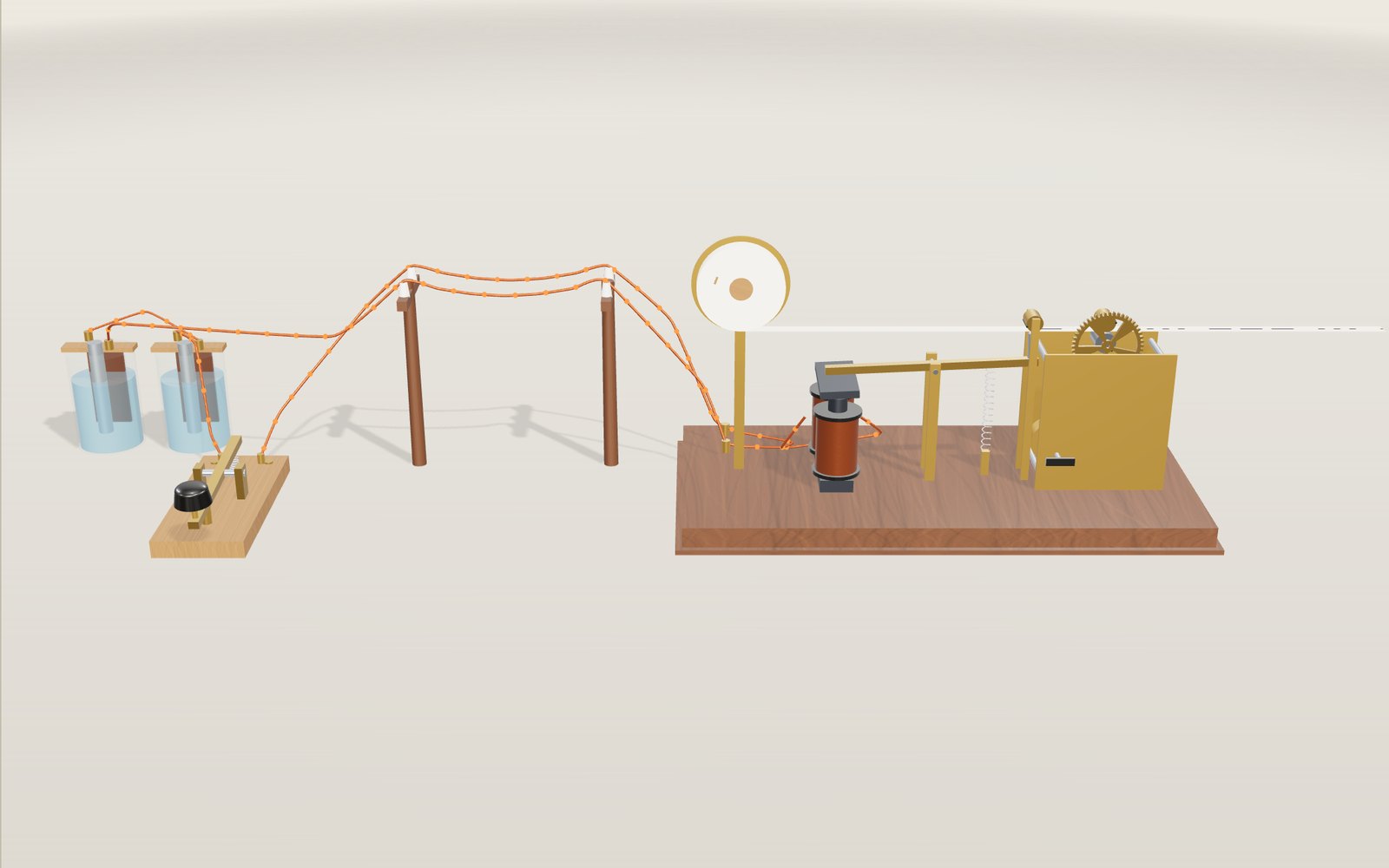
This device cannot show the 3D model. You can read the guide steps below as text.
1 / 19 A telegraph in one roomThe key on the left and the register on the right are joined by a wire on two poles. In 1844 the same kind of line ran about 40 miles (64 km) from Washington to Baltimore. The model is sending SOS. Click the model, then hold Space to key yourself. The bar at the top of the stage opens six more scenes.
Drag to turn. Scroll or pinch to zoom.
What happens when you press a telegraph key
A telegraph key looks like a small brass lever with a black knob. Press it and nothing moves on your side of the line. Somewhere else, at the far end of a wire, a lever jumps and a steel point presses a groove into a moving strip of paper. Hold the key a little longer and the groove gets longer. That is the whole idea of the Morse telegraph: the sender controls how long a current flows, and the receiver turns that time into a length you can see.
The first scene above puts both ends on one bench. The key and battery sit on the left, the line runs over two poles, and the receiver on the right is a register: an electromagnet, a lever with a stylus, and a paper tape pulled by clockwork. You can press the key with the Space bar (click the model first), with the mouse on the 3D knob, or with the round KEY button on a touch screen. The model times each press, prints it on the tape and decodes it into letters.
Seven scenes in one exhibit
The bar along the top of the stage opens six more scenes. Each one is built the first time you pick it, so the page does not load them all at once. The key, the Send box, the paper strip and the readout stay the same in every scene, so you can key the same letters and see how each kind of telegraph treats them.
- Register (1844): the bench described above.
- Sounder (about 1855): the same signal as two clicks, read by ear.
- Relay (1835 to 1846): a long line on poles, a battery whose size you set, and a relay that switches a local battery onto the sounder at the far end. A meter shows the current.
- Undersea cable (1858 and 1866): the first Atlantic cable cut open, and William Thomson's mirror galvanometer, which turned a tiny current into a spot of light moving along a scale.
- Needle telegraph (1837): Cooke and Wheatstone's board, where two of five needles point at one of twenty letters.
- Wireless (1901 to 1912): a ship's spark transmitter with an induction coil, a spark gap and an aerial.
- Korea (1884 to 1891): a map of the first Korean lines with poles, pulses running along them, and the Korean code.
Under the controls there is a lab: a speed calculator, a converter for the three codes, the numbers behind the relay and cable scenes, receiving practice by ear, eight tasks and a list of 63 cases with their sources.
The circuit: battery, key, line and magnet
An electric telegraph needs a closed loop. In the model the current leaves the copper side of a two-cell battery, goes to the frame of the key, and stops there while the key is up. Pressing the knob tips the lever on its pivot and brings two metal contacts together. Now the loop is closed. The current runs along the line wire to the receiver, goes round the coils of the electromagnet, comes back on the second wire and returns to the zinc side of the battery.
Turn on Current in the controls and press the key: orange beads move around the loop only while the key is down. When you let go, a small spring under the back of the lever lifts it, the contacts part, and the beads stop.
This on and off switching is all the line can carry. There is no voltage level for A and another for B. The only thing the sender can change is timing, which is why Morse code is built from short and long pulses and the silences between them.
How the register writes on paper
At the receiving end the current passes through two coils wound on iron cores. While current flows, the cores become a magnet and pull a soft iron plate, the armature, down onto their pole faces. The armature is fixed to a lever on a pivot, so when the magnet pulls one end down, the other end rises. A blunt steel stylus on that end pushes up into the paper tape, which is pressed against a grooved roller above it. The result is a raised line in the paper. When the current stops, a return spring pulls the lever back and the stylus drops away.
This is the arrangement Morse's own receiver used. The Library of Congress describes it as an electromagnet with a stylus on the end of an arm: when the magnet worked, the stylus made a dent in a paper tape that clockwork moved past it, and the tape was read afterwards by the operator.
The tape has to move at a steady speed, otherwise a long press and a short press would leave the same mark. In the model a wound spring drives a gear train and a pair of feed rollers, and a small fan on the fastest arbor acts as a governor. The tape stops a few seconds after the last press, as if the operator had let the clockwork run down. See inside makes the clockwork plates clear so you can watch the gears turn.
Reading by ear: the sounder
Early operators found they did not need the paper. The armature clicked as it moved, and they learned to write down the dots and dashes by ear. The instrument built for this is the sounder. A drawing of the Morse sounder in George Prescott's history of 1860, reproduced by the Smithsonian Institution Archives, shows one "widely used on telegraph lines after ca. 1855".
A sounder has the same parts as a register without the paper: two coils, an iron armature on a brass lever, and a spring. The difference is at the free end of the lever. It sits between two stop screws. When the current starts, the magnet pulls the lever down onto the lower stop with a click. When the current stops, the spring throws it up against the upper stop with a second, slightly different click. The operator does not hear a long or short sound. He hears two clicks, and the time between them is the dot or the dash.
The Sounder scene shows this, with an open wooden box behind the instrument. Resonator boxes like this one made the clicks louder, so that in a busy office each operator could pick out his own sounder. Turn on Sound and key a few letters: the model plays a sharp click when the lever goes down and a lighter one when it comes back up. Listen to SOS and you will hear six clicks for the first S, close together, then six spread out for the O.
Dots, dashes and the spaces between them
International Morse code is defined by the International Telecommunication Union in Recommendation ITU-R M.1677-1. It does not fix a dot length in milliseconds. It fixes ratios, using the dot as the unit:
| Element | Length |
|---|---|
| Dot | 1 unit, key down |
| Dash | 3 units, key down |
| Gap between dots and dashes inside one character | 1 unit, key up |
| Gap between characters | 3 units, key up |
| Gap between words | 7 units, key up |
The edges of the paper tape in the model carry a tick every unit and a longer tick every five, so you can measure your own keying against the rule. A dot should cover one tick, a dash three.
Here is SOS sent as three letters. S is three dots, O is three dashes:
S: 1 + 1 + 1 + 1 + 1 = 5 units
gap between letters  = 3 units
O: 3 + 1 + 3 + 1 + 3 = 11 units
gap between letters  = 3 units
S                    = 5 units
total                = 27 units
Speed: words per minute and the word PARIS
Operators measure speed in words per minute, and the usual reference word is PARIS. Sent with the standard spacing, PARIS takes 43 units, and the 7 unit gap that follows brings it to 50. One word per minute is then 50 units per minute, so the length of one unit in milliseconds is:
unit (ms) = 60,000 / (50 × WPM)
          = 1200 / WPM
At 20 words per minute a dot lasts 60 ms. The model starts at 8 words per minute, where a dot is 150 ms and a dash 450 ms. The Speed slider goes from 5 words per minute (240 ms dots) to 40 (30 ms dots). The tape in the model always moves 6 mm per unit, so the marks keep the same proportions at any speed, and only the tape speed changes: 40 mm a second at 8 words per minute.
The four words sent in 1844, WHAT HATH GOD WROUGHT, take 189 units in International Morse code. At 8 words per minute that is about 28 seconds. In American Morse, which the 1844 line used, they take 171 units, about 26 seconds at the same speed.
The speed calculator in the lab does this for any text. Type a sentence and it counts the units in the code you have picked, converts them to seconds at the current speed, and shows how many PARIS words the text is worth. The task "PARIS at 20 WPM" checks the other direction: it times your own keying from the first press of P to the last of S and turns the 43 units into a speed.
How the model reads your keying
Human keying is never exact. A dot might last 1.3 units and a dash 2.6. The decoder in the model therefore uses the midpoint between the lengths in the rule:
- A press shorter than 2 units is a dot. Anything longer is a dash.
- A silence longer than 2 units ends the character, and the dots and dashes so far are looked up in the table.
- A silence longer than 5 units also ends the word, so the next letter starts after a space.
The readout shows each step. Keying shows the dots and dashes of the character you are in the middle of, followed by the letters that still fit. Last press gives the length of your last press in milliseconds and in units. If your timing does not match any code, the decoder writes a question mark.
The thresholds are tied to the Speed slider. If your dots keep coming out as dashes, lower the speed so each unit is longer.
For American Morse the decoder splits presses at 2, 4.5 and 7.5 units (dot, dash, long dash, longer dash) and treats a silence of 1.5 to 2.5 units as the space inside a spaced letter. If the letter with that space is not in the table, it reads the two halves as two letters, which is the mistake a tired operator could make. For the Korean code it uses the international timing, collects the letters and puts them back together into syllables, so ㅇ ㅏ ㄴ ㄴ ㅕ ㅇ comes out as 안녕.
The Send box does the opposite job. Type a word and press Send, and the model keys it for you using the exact spacing of the code you picked. The paper tape then shows what perfect timing looks like next to your own marks.
Why a long line needs a relay
The bench has a line less than a metre long. A real line was tens or hundreds of kilometres of wire, and every kilometre added resistance. The Relay scene and the line calculator in the lab show what that does, with Ohm's law: current = voltage / resistance.
The numbers are model values, chosen to be round and typical rather than taken from one line:
- Each cell is a Daniell cell of 1.1 V with 1 ohm of resistance inside it. John Frederic Daniell's original cell of 1836 is in the Science Museum Group collection.
- The line is iron wire 4.2 mm thick, with the earth as the return path. Iron has a resistivity of about 9.7 × 10⁻⁸ ohm metres, which gives 7.0 ohms per kilometre.
- A sounder put straight on the line has a coil of 20 ohms and needs 30 mA to pull its lever firmly.
- A relay has a coil of 150 ohms, wound with many turns of fine wire, and closes at 5 mA.
With 20 cells the battery gives 22 V. On a 60 km line with a sounder at the end, the resistance is 20 + 420 + 20 = 460 ohms and the current is about 48 mA, enough for the sounder. Make the line longer and the current falls. The sounder stops working at about 99 km, where the current drops to 30 mA. Divide the 22 V by 30 mA, take away the 20 ohms of the cells and the 20 ohms of the coil, and divide by 7.0 ohms per kilometre:
km = (22 / 0.030 − 40) / 7.0
   ≈ 99 km
Adding cells helps, but slowly, because each cell also adds its own resistance: 60 cells (66 V) reach about 303 km. The answer used on real lines was the relay. Because it closes at 5 mA, the same 20 cells work a relay up to about 604 km away. The relay does not pass the line current on. It closes a contact in a second circuit at the far station, with its own local battery and sounder, so a weak current on the long line switches a strong current in the short one. A line of 1,000 km with 20 cells needs one relay between two sections.
In the Relay scene you can try this. The meter shows the line current, with red ticks at 5 mA and 30 mA. Turn Relay off and the far sounder sits on the line itself. At 300 km the current is about 10 mA, so with the relay in the line the sounder clicks, and with the relay out nothing arrives and the paper strip stays blank. Real lines also lost current through wet insulators, so in rain they worked over shorter distances than these figures.
The idea came from Joseph Henry. By 1835 he had shown in the lecture hall that an electromagnetic telegraph worked, and the Smithsonian Institution Archives describe how his "intensity" to "quantity" relay became, with some changes, Morse's way of joining a local receiving circuit to a long-distance line. Leonard Gale showed Morse how a relay could boost the signal. Morse's patent on the receiving magnet and local circuit was granted in 1846, and it was at the centre of his lawsuits against rival systems; the US Supreme Court dealt with the main circuit and local circuit in O'Reilly v. Morse in its December 1853 term. Later lines used repeaters, which the Smithsonian describes as instruments that strengthened the pulses on a line so a message could go further.
The Atlantic cable and the law of squares
Under the sea there are no poles and no relays. In 1858 a single cable joined Valentia in Ireland to Newfoundland. The description of it printed in 1867 lists its parts, and the Undersea cable scene shows them in a cut-away drawn many times life size:
- a conductor of 7 copper wires twisted together, weighing 107 lb per nautical mile;
- three coverings of gutta-percha, a natural latex, weighing 261 lb per nautical mile;
- a serving of hemp soaked in tar;
- armour of 18 strands, each of 7 iron wires, laid in a spiral.
See inside makes the outer layers clear, and Take apart pulls them along the cable.
The ships Agamemnon and Niagara met in mid-ocean, joined their halves and sailed for home. According to the Science Museum, Agamemnon reached Ireland on 5 August 1858 and Niagara reached Newfoundland later the same day, and Queen Victoria and President Buchanan exchanged greetings. Edward Bright, writing in 1866, says the cable worked for a month. A fault about 270 miles from Valentia let current leak out, and the strong currents used to drive signals through made it worse: at first the currents of 50 large cells, later a power equal to 500 cells.
Why did a cable need so much? A long cable is a wire wrapped in insulation and surrounded by sea water. It stores charge along its whole length, like a very long capacitor, and the charge has to flow in and out through the resistance of the copper. A sharp pulse sent in at one end comes out at the other as a slow, low swell. William Thomson worked this out in 1855: the time a pulse spreads over grows with the resistance and capacitance per length, and with the square of the length. Double the length of a cable and its top speed falls to a quarter.
The cable scene uses this rule with one figure for each cable. Bright wrote that the new cable of 1865 and 1866 was "capable of passing seventeen words per minute", while the 1858 cable "could only transmit three or four". The model takes 17 and 3.5 words per minute over the 1,670 nautical miles (about 3,093 km) from Ireland to Newfoundland and scales them:
WPM = 17 × (3,093 / km)²
So the 1866 cable carries about 41 words per minute over 2,000 km and about 10 over 4,000 km, and 20 words per minute needs a cable shorter than about 2,850 km. The thinner 1858 cable manages only about 8 words per minute over 2,000 km.
The stage passes your keying through two smoothing stages with the cable's time constant and reads a letter when the received signal crosses half way. A graph above the paper strip shows what was sent and what arrived. Set the 1858 cable at full length, key at 8 words per minute, and the pulses run into each other: the decoder misses letters, exactly the problem the operators had.
The receiver is Thomson's mirror galvanometer. Bright describes a steel magnet and mirror weighing about one grain together, hung on a silk thread inside a coil. A lamp shines through a slit onto the mirror, and the reflected spot moves along a scale. A current far too weak to move a sounder turns the mirror slightly, and the long light beam makes that small angle into a movement the eye can follow. The Science Museum Group has the galvanometer used at the Newfoundland end of the 1858 cable, made by James White in Glasgow. In 1858 a clerk held down the key of a recording instrument while the spot moved, so the paper copied the light.
The successful cable followed in 1866. The Great Eastern sailed on 13 July and reached Heart's Content, Newfoundland, on 27 July. The crew then went back for the cable lost in 1865, hooked its end at the end of August, and on 2 September received an answer from Ireland. Bright adds two details. For three months a message of 20 words cost £20, reduced to £10 on 1 November 1866. And once both cables were joined into a loop of 3,700 miles, a thimble holding a little acid, zinc and copper sent signals round in little more than a second. By 1902, says the Science Museum, a cable from Canada to New Zealand completed a network that went right round the globe.
Cooke and Wheatstone's five-needle telegraph
Morse was not first. In 1837 William Cooke and Charles Wheatstone demonstrated a telegraph in England, and the Science Museum Group holds a large five-needle instrument from that year. It needed no code. Five magnetic needles stand in a row across a diamond-shaped board with twenty letters. To send a letter, the operator pressed keys that sent current through two of the five lines; the two needles swung in opposite directions, and their ends pointed at one letter where their lines cross.
The geometry is simple. Put the needles one spacing apart. A needle tilted 45 degrees to the right and one tilted 45 degrees to the left meet above the row at a point halfway between them, as high as half the distance between them. Neighbouring needles meet just above the row (H, I, K, L), needles two apart meet higher (E, F, G), and the outermost pair meets at the top (A). Tilt the same pairs the other way and they meet below the row (M to Y). Ten pairs above and ten below give twenty letters. C, J, Q, U, X and Z had no place, so senders spelled around them.
A Science Museum curator wrote in 2014 that the layout was Wheatstone's idea: no knowledge of a code was needed, and the dial was big enough for a crowd to watch. In 1839 an instrument like this opened the world's first public telegraph service, 13 miles (21 km) along the Great Western Railway from Paddington to West Drayton. The needle task asks you to spell DRAYTON, letter by letter.
The board has a cost the picture hides: each needle has its own coil and its own line wire, so five needles mean several wires between the stations.
Wireless telegraphy, CQD and SOS
Radio kept the key and the code and dropped the wire. In the Wireless scene each press drives an induction coil, which turns the low voltage of a battery into a voltage high enough to jump between two brass balls. The spark sets the aerial ringing, and a burst of radio waves goes out for as long as the key is down. The receiving operator hears it in headphones as a rasping buzz, long or short.
On 12 December 1901, at Signal Hill in Newfoundland, Guglielmo Marconi and his assistant George Kemp heard the Morse letter S, three dots, sent from Poldhu in Cornwall. Their aerial was a wire held up by a kite. The IEEE milestone that marks the event notes that the signals were too weak to work a recording instrument; Marconi heard them through a telephone earpiece.
Ships soon carried wireless, and each company had its own distress call. The Marconi company used CQD: CQ, already the land-line call to all stations, with D for distress. SOS began in German radio regulations in 1905 and was adopted internationally at the Berlin radiotelegraph conference of 3 October to 3 November 1906. It is a single run of three dots, three dashes and three dots, with no letter gaps. People read it as S O S because three dots happen to be S and three dashes O.
On 15 April 1912 the Titanic, call sign MGY, sent CQD MGY. ITU News tells how John Phillips kept sending CQD, as Marconi operators were still told to, and on Harold Bride's suggestion added the new SOS. The disaster changed the rules. The London conference later in 1912 set a wavelength of 600 metres (about 500 kHz) for distress calls and three minutes of radio silence at 15 and 45 minutes past every hour. The Safety of Life at Sea convention of 1914 required every ship carrying more than 50 passengers to have a radio.
The decoder in the model treats SOS the same way the regulations do. Key it with letter gaps and you get S, O, S. Key nine elements without stopping and the whole run is decoded as SOS.
SOS stayed the distress signal until satellite systems and voice calls took over. The ITU gives the end of its official use as 1 January 1998, and the night before, the timber ship MV Oak sent SOS in the Atlantic; its crew turned out to be safe in lifeboats. The Global Maritime Distress and Safety System became fully effective on 1 February 1999, according to the International Maritime Organization.
International Morse code and the older American code
The code most of the model uses is not the one Morse and Vail sent in 1844. Their alphabetic code, which Alfred Vail extended from Morse's numbers to letters, became known as American Morse or railroad Morse. Vail tried to give the shortest codes to the commonest letters, and he estimated letter frequency by counting the type in a newspaper's type cases in Morristown, New Jersey. That is why E is a single dot.
The code was revised in Europe, and the regulations of the International Telegraph Convention signed in Paris on 17 May 1865 made Morse code and Morse instruments the standard for telegrams between countries. The ITU still maintains the international version, which covers A to Z, the accented É, the figures 0 to 9 and a set of punctuation marks. It has no upper and lower case. The first edition of Recommendation M.1677, approved on 3 May 2004, also gave the commercial at sign @ a code: A and C run together, .--.-.
American Morse survived on North American land lines. It differs in three ways, which the Code control lets you hear and see:
- Spaced letters. C, O, R, Y and Z contain a wider gap. O is dot, space, dot. William Pierpont's book on radio-telegraphy warns that a careless sender could make C O R Y Z sound like IE, EE, EI, II and SE.
- Long dashes. L is one long dash and the figure 0 an even longer one.
- Different letters. J, P, Q, X and most figures have other codes. American J is the international C.
There was no fixed timing for American Morse. Pierpont quotes a working standard from the telegrapher Jim Farrior: dot 1 unit, normal space 1, the special space inside a letter 2, dash 3, L 6, zero 9, letter space 3 and word space 6. The model uses these numbers, so WHAT HATH GOD WROUGHT takes 171 units in American Morse against 189 in International. The task on American code asks you to key one L that the decoder reads as a long dash.
The code table in the model switches with the Code control. As you key, every character whose code begins with what you have sent so far is shaded, and the exact match turns red.
Korean telegraph lines and Korean Morse code
The first telegraph line on Korean soil was not Korean. In 1884 Japan laid a submarine cable from Busan to Nagasaki for its own purposes. The Korean government had been trying to bring in the telegraph, and in the autumn of 1884 it sent Kim Hak-u to Japan to study it. The Encyclopedia of Korean Culture says that he devised a method for sending Korean letters as signs.
On 28 September 1885 the Hanseong Telegraph Office opened in Seoul and the line to Incheon began work. It was set up by the Qing to run the west line, with branch offices in Incheon, Pyongyang and Uiju; the staff were Chinese, and Korean students trained with them. On 18 October 1885 the line reached Uiju, completing Incheon to Seoul to Uiju, and through China it connected Korea to Europe.
The Korean government then built its own lines. It set up its own telegraph bureau on 13 March 1887. The south line from Seoul to Busan opened on 9 June 1888, with branch offices in Gongju, Jeonju, Daegu and Busan, and in June 1891 the north line reached Wonsan; it was meant to go on through Hamgyeong to Vladivostok. In the Sino-Japanese War of 1894 the Japanese army took over the west and north lines, which were returned by 1896.
For the south line the bureau published telegraph rules in 1888. They set charges by language, distance and number of characters, allowed Morse code in Korean, Chinese characters and English, and put government telegrams first.
Korean Morse code gives a sign to each of the 14 basic consonants and 12 basic vowels used in it. The table is printed today in the rules for operating radio stations, table 1. The commonest vowel ㅏ has a single dot and ㅓ a single dash. ㅑ, ㅕ and ㅜ are two, three and four dots. The consonants ㄷ, ㄱ, ㄴ and ㄹ are -···, ·-··, ··-· and ···-. Many of the signs are International letters: ㄱ is L, ㄴ is F, ㅁ is M.
Hangul is written in syllable blocks, but the code sends letters, so 안녕 goes as ㅇ ㅏ ㄴ ㄴ ㅕ ㅇ, 57 units. There are no signs for double consonants or compound vowels; ㄲ is sent as ㄱ ㄱ and ㅘ as ㅗ ㅏ. Because every Korean syllable begins with a consonant (ㅇ in front of a vowel sound), the receiver can put the blocks back together without much doubt. The converter in the lab shows the split for any Korean text, and the Korea scene switches the code to Korean and sends pulses along the line you pick on the map.
Q codes, CQ and Morse today
Morse operators built a shorthand. Q codes are three-letter groups with fixed meanings, listed by the ITU in Recommendation M.1172. QRS asks the other station to send more slowly; the case for it in the lab lowers the speed. CQ, a general call to all stations, came from land-line telegraphy, according to ITU News.
International rules for amateur radio changed in 2003. Until July 2003 the Radio Regulations generally required anyone seeking an amateur licence to show that they could send and receive Morse. Countries could then drop the test, and in its order FCC 06-178 the US Federal Communications Commission removed the Morse examination for every amateur licence.
Morse also survives in aviation. The Federal Aviation Administration's Aeronautical Information Manual says the only positive way to identify a VOR radio beacon is its Morse code identifier, and that a beacon under maintenance may send T E S T instead.
The last telegrams
Telegram services closed one after another. Western Union in the United States ended its telegram service in 2006. India's state telegram service sent its last message on 14 July 2013, when it still carried about 5,000 telegrams a day. The German post office stopped on 1 January 2023.
In Korea, KT ended its international telegram service on 8 April 2018 and its 115 telegram service on 15 December 2023, 138 years after the line of 1885. By then, Yonhap reported, a caller dictated the message by telephone, it went by telex to a post office near the receiver, and a messenger delivered it. Because every word cost money, senders cut out every word they could.
The last commercial maritime Morse message from North America, sent by Globe Wireless on 12 July 1999, closed with the same four words as the first message of 1844.
How the model differs from real equipment
The model is small, and some parts are simplified:
- The bench line is less than a metre long. The 1844 line ran about 40 miles (64 km). The Relay and Cable scenes show long lines with model numbers, not the values of one historical line.
- The line model leaves out leakage over wet insulators and the earth's own resistance, and treats each cell as 1.1 V and 1 ohm.
- The cable model scales one speed for each cable with the square of the length and uses two smoothing stages. A real cable spreads a pulse in a different shape, and operators later sent alternating currents to help.
- The armature follows the key with a short lag of a few milliseconds so you can see it move.
- The needle board shows a letter as long as you choose. Real operators held the keys only as long as needed.
- The spark sound and the radio rings are pictures of what happens, not a simulation of radio waves.
- The Korean map uses a simplified coastline.
Morse, Vail and the 1844 line
Samuel Morse was a painter who took up the electric telegraph in the 1830s. The machinist Alfred Vail of Morristown, New Jersey, worked with him from September 1837, and his family's Speedwell Ironworks there was where the machine was built and shown in January 1838. Many accounts give Vail a large share of the credit for turning the idea into working instruments. Morse's US patent 1647, granted on 20 June 1840, calls the invention the "American Electro-Magnetic Telegraph".
Congress gave $30,000 in 1843 for an experimental line between Washington and Baltimore, 40 miles away; the Senate passed the bill in the last hours of the session. Morse and Vail finished it in May 1844. On 24 May 1844 Morse sent "What hath God wrought" from the Supreme Court chamber in the Capitol to Vail at the Baltimore and Ohio Railroad's Mount Clare depot in Baltimore. Annie Ellsworth chose the words from the Book of Numbers (23:23). Her father, Patent Commissioner Henry Leavitt Ellsworth, was a friend of Morse.
The Library of Congress says four tapes were produced that day: the outgoing message from Washington, the incoming message in Baltimore, Vail's repeat back from Baltimore and its record in Washington. All but one, Vail's outgoing strip, are accounted for. Annie's tape reached the Library in 1922. The Smithsonian holds a tape of 25 May, a souvenir Vail sent to Morse the next day.
Questions
How long is a dot in Morse code?
There is no fixed length. A dot is one unit and every other length is a multiple of it. At a given speed in words per minute, one unit lasts 1200 divided by the speed in milliseconds, so 60 ms at 20 words per minute and 150 ms at 8.
Why is a dash three dots long?
The recommendation fixes the ratio at 3 to 1. The gap between the two lengths leaves room for uneven keying: the decoder in the model splits them at two units, so a dot can run almost twice its proper length before it is read as a dash.
Why do the gaps matter as much as the tones?
The same dots and dashes can mean different things depending on the spaces. Three dots with one unit gaps are S. Three dots with three unit gaps are E E E. Seven units of silence end a word.
Did Morse's first telegraph make sounds or marks?
It made marks. The register embossed dots and dashes into moving paper tape. Operators soon noticed that the armature's clicks carried the same information and began writing messages down by ear. The sounder came into wide use on the lines after about 1855.
What was the first message sent on the Washington to Baltimore line?
The official opening message on 24 May 1844 was "What hath God wrought", sent by Morse from the Capitol to Baltimore.
Is SOS three letters?
In the regulations it is a single unbroken signal of three dots, three dashes and three dots. People write it as SOS because that is how the run reads if you add letter gaps.
Who invented Morse code, Morse or Vail?
Both names appear in the record. Morse's first plan sent only numbers to be looked up in a codebook. Vail extended the code to letters. The modern international code comes from later European revisions adopted under the 1865 Paris convention.
Why did long lines need relays?
The current that reaches the end of a line falls as the line gets longer, because the wire adds resistance. A relay closes at a much smaller current than a sounder needs and switches a local battery onto the sounder. In the model 20 cells work a sounder up to about 99 km and a relay up to about 604 km.
Why were the first Atlantic cables so slow?
A cable stores charge along its length, so each pulse comes out spread over time, and the spreading grows with the square of the length. Pulses sent too quickly run together. Bright gave 3 or 4 words per minute for the 1858 cable and 17 for the cable of 1866.
How did the five-needle telegraph show letters without a code?
Two needles swing in opposite directions and their ends point at the letter where their lines cross on a diamond board. Twenty letters fit; C, J, Q, U, X and Z were left out.
What does American Morse sound like?
It has shorter, tighter characters than International Morse, with a gap inside C, O, R, Y and Z, a long dash for L and a longer one for zero. Pick American in the Code control and send CORY to hear it in the Sounder scene.
Is there Morse code for Korean?
Yes. Each basic Hangul letter has a sign, and syllables are sent letter by letter. Korean sources credit Kim Hak-u, and the 1888 telegraph rules allowed Korean Morse. The table is still printed in the rules for operating radio stations.
Is Morse code still used?
Radio amateurs still use it, aviation beacons identify themselves with it, and many people learn it as a skill. It is no longer the official maritime distress system, and in many countries it is no longer required for an amateur licence.
Can I hear the code in the model?
Yes. Turn on Sound in the controls. The register, cable and Korea scenes play a tone while the key is down, the sounder and relay scenes play clicks, and the wireless scene plays a spark. Pitch sets the tone, and Noise adds hiss. The sound stays off until you turn it on.
Terms
- Key: the switch the sender presses. A straight key closes the circuit for as long as it is held down.
- Register: the receiving instrument that records signals on paper tape.
- Sounder: a receiving instrument that turns each pulse into two clicks, read by ear.
- Relay: a sensitive electromagnet switch that lets a weak line current close a local circuit.
- Local circuit: the short circuit at the receiving station with its own battery and sounder.
- Armature: the soft iron plate that the electromagnet pulls.
- Stylus: the blunt point that presses the mark into the tape.
- Gutta-percha: a natural latex used to insulate early submarine cables.
- Mirror galvanometer: a meter in which a weak current turns a tiny mirror and moves a spot of light along a scale.
- Law of squares: the rule that the time a pulse spreads in a cable grows with the square of the cable's length.
- Unit: the length of one dot. Every other element and gap is a whole number of units.
- WPM: words per minute, measured with the 50 unit word PARIS.
- Prosign: a signal sent as one run without letter gaps, such as SOS.
- American Morse: the code used on North American land lines, with spaced letters and long dashes.
- Q code: a three-letter group with a fixed meaning, such as QRS (send more slowly).
Sources
- International Telecommunication Union, Recommendation ITU-R M.1677-1: International Morse code (October 2009). https://www.itu.int/rec/R-REC-M.1677-1-200910-I/en (checked 16 October 2026)
- International Telecommunication Union, Recommendation ITU-R M.1677-0 (approved 3 May 2004, with the commercial at). https://www.itu.int/rec/R-REC-M.1677-0-200405-S/en (checked 18 October 2026)
- International Telecommunication Union, Recommendation ITU-R M.1172: Miscellaneous abbreviations and signals (Q code). https://www.itu.int/rec/R-REC-M.1172-0-199510-I/en (checked 18 October 2026)
- International Telecommunication Union, The 1865 International Telegraph Conference (Paris convention of 17 May 1865; its regulations required Morse code and its instruments). https://www.itu.int/en/history/Pages/ITUBorn1865.aspx (checked 17 October 2026)
- International Telecommunication Union, International Radiotelegraph Conference (Berlin, 1906) (3 October to 3 November 1906; first International Radiotelegraph Convention). https://www.itu.int/en/history/Pages/RadioConferences.aspx?conf=4.36 (checked 17 October 2026)
- ITU News, Pioneers' Page: Sending out an SOS, 2006 (CQD, SOS from German regulations of 1905 and Berlin 1906, Titanic MGY, London 1912, SOLAS 1914, MV Oak, end of official use 1 January 1998). https://www.itu.int/itunews/manager/display.asp?lang=en&year=2006&issue=06&ipage=pioneers&ext=html (checked 18 October 2026)
- Library of Congress, First telegraph message, 24 May 1844 (Samuel F. B. Morse Papers; four tapes, Mount Clare depot, Annie Ellsworth, 1922). https://www.loc.gov/item/mcc.019/ (checked 18 October 2026)
- Library of Congress, Invention of the Telegraph (register with stylus and clockwork tape, Gale and Henry's relay, $30,000 and forty miles). https://www.loc.gov/collections/samuel-morse-papers/articles-and-essays/invention-of-the-telegraph/ (checked 18 October 2026)
- Smithsonian National Museum of American History, "What Hath God Wrought" Telegraph Message (the souvenir tape of 25 May 1844; si.edu answers scripted requests with a 403 check). https://americanhistory.si.edu/collections/object/nmah_713485 (checked 17 October 2026)
- Smithsonian National Museum of American History, Telegraph Sounder. https://americanhistory.si.edu/collections/search/object/nmah_1367427 (checked 18 October 2026)
- Smithsonian, Williams telegraph repeater (NMAH). https://www.si.edu/object/williams-telegraph-repeater:nmah_706360 (checked 18 October 2026)
- Smithsonian Institution Archives, Joseph Henry: Inventor of the Telegraph? (Henry's relay, Morse's 1846 patent on the receiving magnet and local circuit, the sounder after about 1855). https://siarchives.si.edu/oldsite/siarchives-old/history/jhp/joseph20.htm (checked 18 October 2026)
- Google Patents, US1647A, S. F. B. Morse, granted 20 June 1840. https://patents.google.com/patent/US1647A/en (checked 18 October 2026)
- O'Reilly v. Morse, 56 U.S. 62, December Term 1853, Legal Information Institute, Cornell Law School (main circuit and local circuit). https://www.law.cornell.edu/supremecourt/text/56/62 (checked 17 October 2026)
- Jeremy Norman, HistoryofInformation.com, Morse Transmits the First Message by Morse Code (Vail with Morse from September 1837; counting type in a Morristown newspaper's cases). https://www.historyofinformation.com/detail.php?id=471 (checked 17 October 2026)
- Science Museum Group, Cooke and Wheatstone 5-needle telegraph, 1837 (object 1963-215). https://collection.sciencemuseumgroup.org.uk/objects/co33374/cooke-and-wheatstone-5-needle-telegraph-1837 (checked 18 October 2026)
- Science Museum Group, Cooke and Wheatstone five-needle telegraph (object 1876-1272; first public telegraph service 1839, Paddington to West Drayton, 13 miles). https://collection.sciencemuseumgroup.org.uk/objects/co32899/cooke-and-wheatstone-five-needle-telegraph (checked 18 October 2026)
- Science Museum Blog, Revealing the real Cooke and Wheatstone telegraph dial (2014; twenty letters, layout by Wheatstone). https://blog.sciencemuseum.org.uk/revealing-the-real-cooke-and-wheatstone-telegraph-dial/ (checked 18 October 2026)
- Science Museum Group, Original Daniell cell (1836, object 1949-295). https://collection.sciencemuseumgroup.org.uk/objects/co6782/original-daniell-cell (checked 18 October 2026)
- Science Museum Group, Mirror galvanometer for the transatlantic telegraph, 1858 (Newfoundland end, made by James White, Glasgow). https://collection.sciencemuseumgroup.org.uk/objects/co6228/mirror-galvanometer-for-the-transatlantic-telegraph-1858 (checked 18 October 2026)
- Science Museum, How perseverance laid the first transatlantic telegraph cable (5 August 1858; Great Eastern 13 and 27 July 1866; 2 September 1866; 1902 round the globe). https://www.sciencemuseum.org.uk/objects-and-stories/how-perseverance-laid-first-transatlantic-telegraph-cable (checked 18 October 2026)
- atlantic-cable.com, Descriptions of the cables of 1858, 1865 and 1866 (1867; conductor, gutta-percha, armour, 1,670 nautical miles, 2,400 fathoms). https://atlantic-cable.com/Article/1867CableTech/index.htm (checked 18 October 2026)
- Edward B. Bright, The Atlantic Telegraphs, read 6 December 1866, on atlantic-cable.com (a month of service, fault about 270 miles from Valentia, 50 and 500 cells, seventeen against three or four words per minute, mirror galvanometer, £20 for twenty words, the thimble battery, shore ends of twenty tons per mile). https://atlantic-cable.com/Article/1866Bright/index.htm (checked 18 October 2026)
- ETHW (IEEE), Milestones: Reception of Transatlantic Radio Signals, 1901. https://ethw.org/Milestones:Reception_of_Transatlantic_Radio_Signals,_1901 (checked 18 October 2026)
- International Maritime Organization, Search and Rescue and the GMDSS (1999; GMDSS fully effective 1 February 1999). https://wwwcdn.imo.org/localresources/en/OurWork/Safety/Documents/GMDSSandSAR1999.pdf (checked 18 October 2026)
- AV Media Matters mailing list, American Institute for Conservation archive, Last Maritime Morse Code Transmission (Globe Wireless, 12 July 1999). https://cool.culturalheritage.org/byform/mailing-lists/av/1999/08/msg00000.html (checked 17 October 2026)
- Federal Communications Commission, FCC 05-143 (Morse requirement in the Radio Regulations until July 2003). https://docs.fcc.gov/public/attachments/FCC-05-143A1.pdf (checked 18 October 2026)
- Federal Communications Commission, FCC 06-178, Report and Order (Morse examination removed for all amateur licences). https://docs.fcc.gov/public/attachments/FCC-06-178A1.pdf (checked 18 October 2026)
- Federal Aviation Administration, Aeronautical Information Manual, chapter 1 section 1 (VOR identification by Morse code). https://www.faa.gov/air_traffic/publications/atpubs/aim_html/chap1_section_1.html (checked 18 October 2026)
- William G. Pierpont, The Art and Skill of Radio-Telegraphy, chapter 20: American Morse code (spaced letters, long dashes, Farrior's timing). https://www.qsl.net/ng3p/haminfo/pierpont/c20.htm (checked 18 October 2026)
- morsecode.world, American Morse Code (chart of letters and figures). https://morsecode.world/american/morse.html (checked 18 October 2026)
- 국가법령정보센터, 무선국의 운용 등에 관한 규정 (article 4 and table 1: Morse code, Korean section). https://www.law.go.kr/LSW/admRulLsInfoP.do?admRulSeq=2100000262854 (checked 18 October 2026)
- Academy of Korean Studies, Encyclopedia of Korean Culture: 전신 (telegraph). https://encykorea.aks.ac.kr/Article/E0049512 (checked 18 October 2026)
- Academy of Korean Studies, Encyclopedia of Korean Culture: 한성전보총국 (Hanseong Telegraph Office). https://encykorea.aks.ac.kr/Article/E0061753 (checked 18 October 2026)
- Academy of Korean Studies, Encyclopedia of Korean Culture: 전보장정 (telegraph rules of 1888). https://encykorea.aks.ac.kr/Article/E0069016 (checked 18 October 2026)
- Academy of Korean Studies, Encyclopedia of Korean Culture: 김학우 (Kim Hak-u). https://encykorea.aks.ac.kr/Article/E0010939 (checked 17 October 2026)
- 한겨레, 박상준, 비명에 간 구한말 '전신선' 개척자 김학우, 2018 (Kim Hak-u and the Korean telegraph code in the 1888 rules). https://www.hani.co.kr/arti/science/future/865800.html (checked 17 October 2026)
- National Institute of Korean History, 우리역사넷, 전화의 보급 (palace telephone 1896, Seoul to Incheon 1902). https://contents.history.go.kr/mobile/km/view.do?levelId=km_004_0060_0020_0010 (checked 18 October 2026)
- 부산일보, [이 주일의 역사] 국내 첫 전신선 개통(1885.9.28), 2010 (Busan to Nagasaki cable of 1884). https://www.busan.com/view/busan/view.php?code=20100927000062 (checked 18 October 2026)
- 연합뉴스, 138년 만에 역사 속으로…KT, 내달 전보 서비스 종료, 15 November 2023 (KT 115 telegram ends 15 December 2023; international telegram ended 8 April 2018; Western Union 2006; Germany 1 January 2023). https://www.yna.co.kr/view/AKR20231115028500017 (checked 18 October 2026)
- Christian Science Monitor, India to end state-run telegram service. Stop. (14 June 2013). https://www.csmonitor.com/World/Asia-South-Central/2013/0614/India-to-end-state-run-telegram-service.-Stop (checked 18 October 2026)
- Calculations on this page and in the lab: unit = 1200 / WPM; SOS 27 units; PARIS 43 + 7 units; WHAT HATH GOD WROUGHT 189 units (International) and 171 (American); 안녕 57 units; line km = (n × 1.1 / I − n − coil) / 7.0; cable top speed = 17 × (3,093 / km)². The same numbers were worked through by hand for the three code tables, the decoder round trips, the Hangul split and compose, the line and cable numbers and the needle geometry.
More exhibits
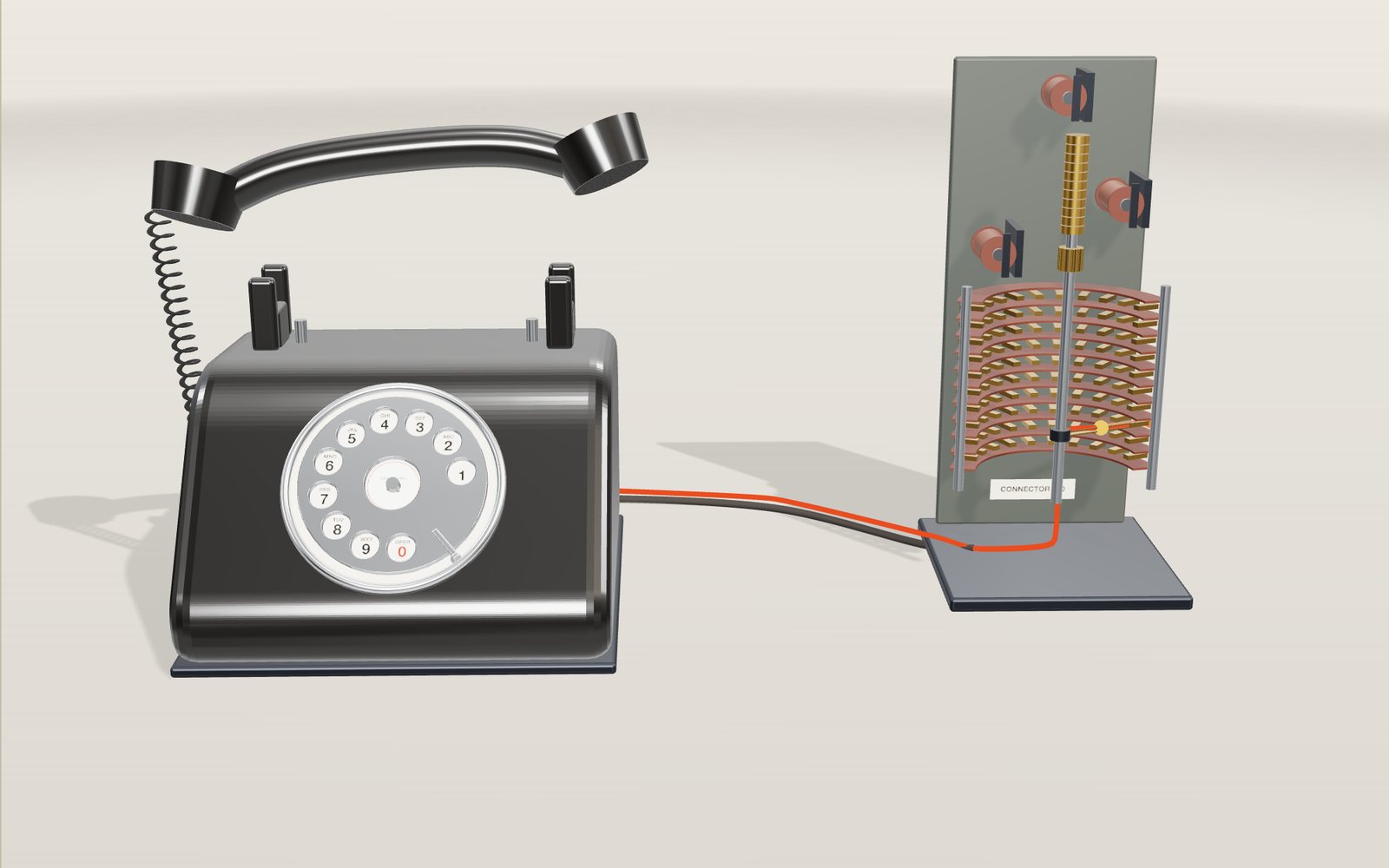
How a rotary phone works: the dial, its pulses and the exchange
A rotary dial sends each digit as short breaks in the line current, ten to a second, and dialling 0 takes ten of them.
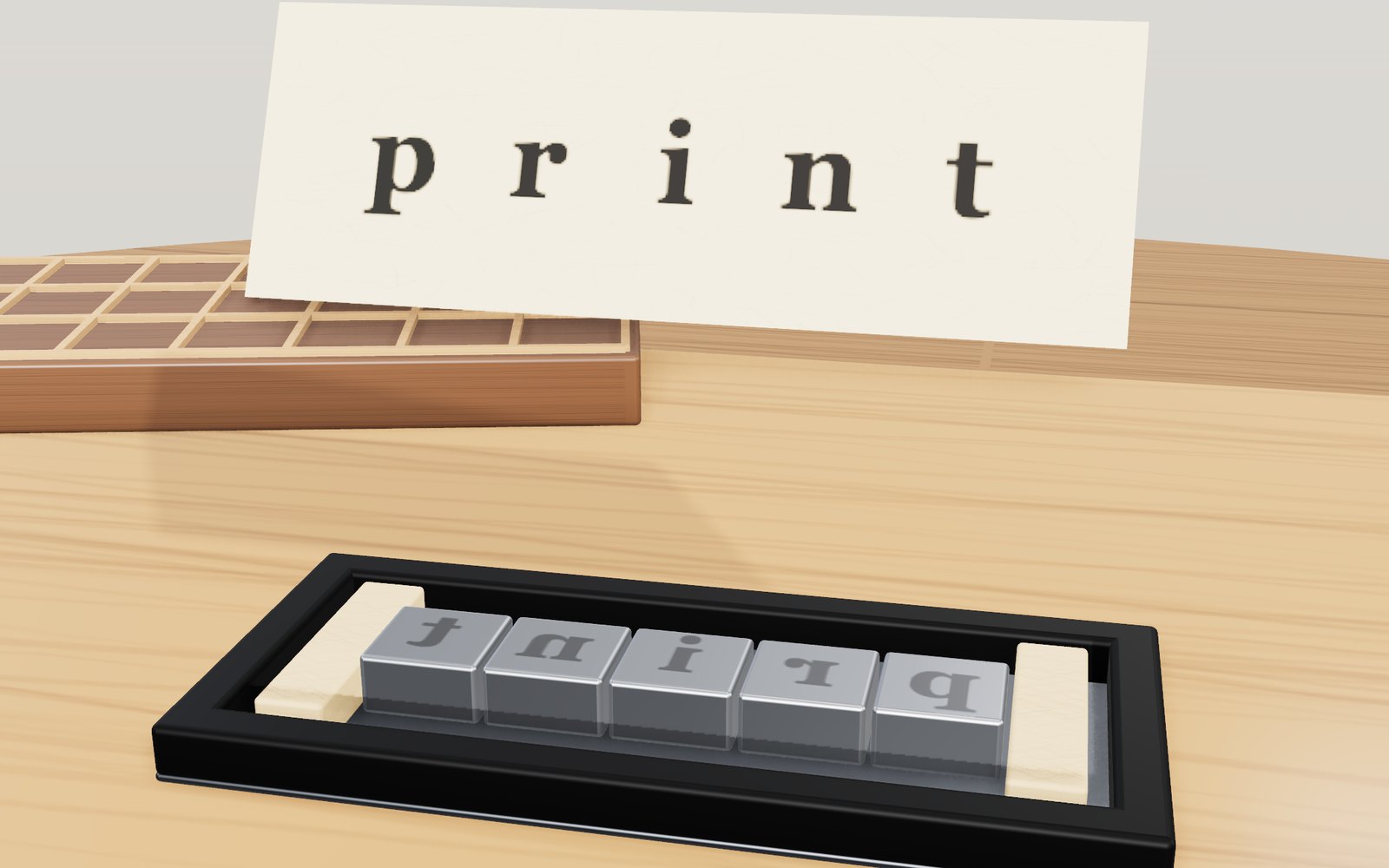
Movable type and the printing press
A piece of type carries its letter back to front. Ink it, press paper on it, turn the sheet over, and the letter reads the right way round.
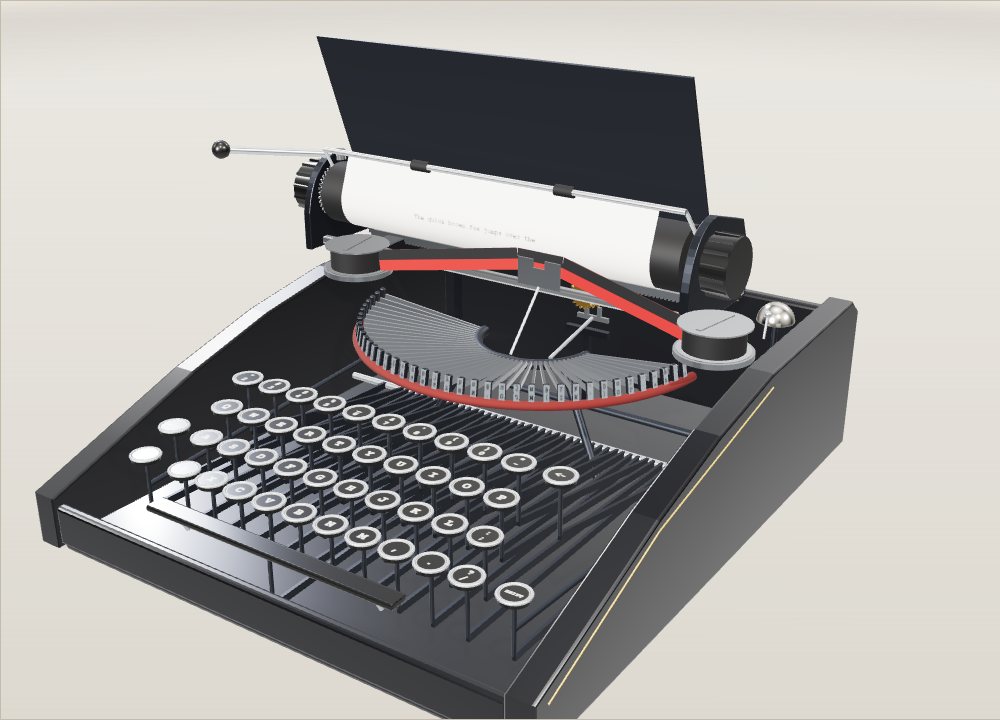
How a typewriter works: inside a manual typewriter
On a pica typewriter every letter, space and full stop moves the carriage the same 2.54 mm to the left.
Braille, semaphore and fingerspelling: how the codes work
A braille dot is 1.5 mm across, and six of them in a 2 by 3 grid give 64 patterns that Korean, English, Japanese and music braille all share.
Writing systems of the world: Hangul and 22 more scripts
The 1446 book that announced Hangul says ㄱ draws the tongue root closing the throat. Here it stands beside 22 other scripts, from clay wedges to Braille.
How a QR code is read
Cover 30 % of a QR code with your hand and a phone still reads it. Cover one corner and it does not.