FIG. 107Old Machines
Movable type and the printing press
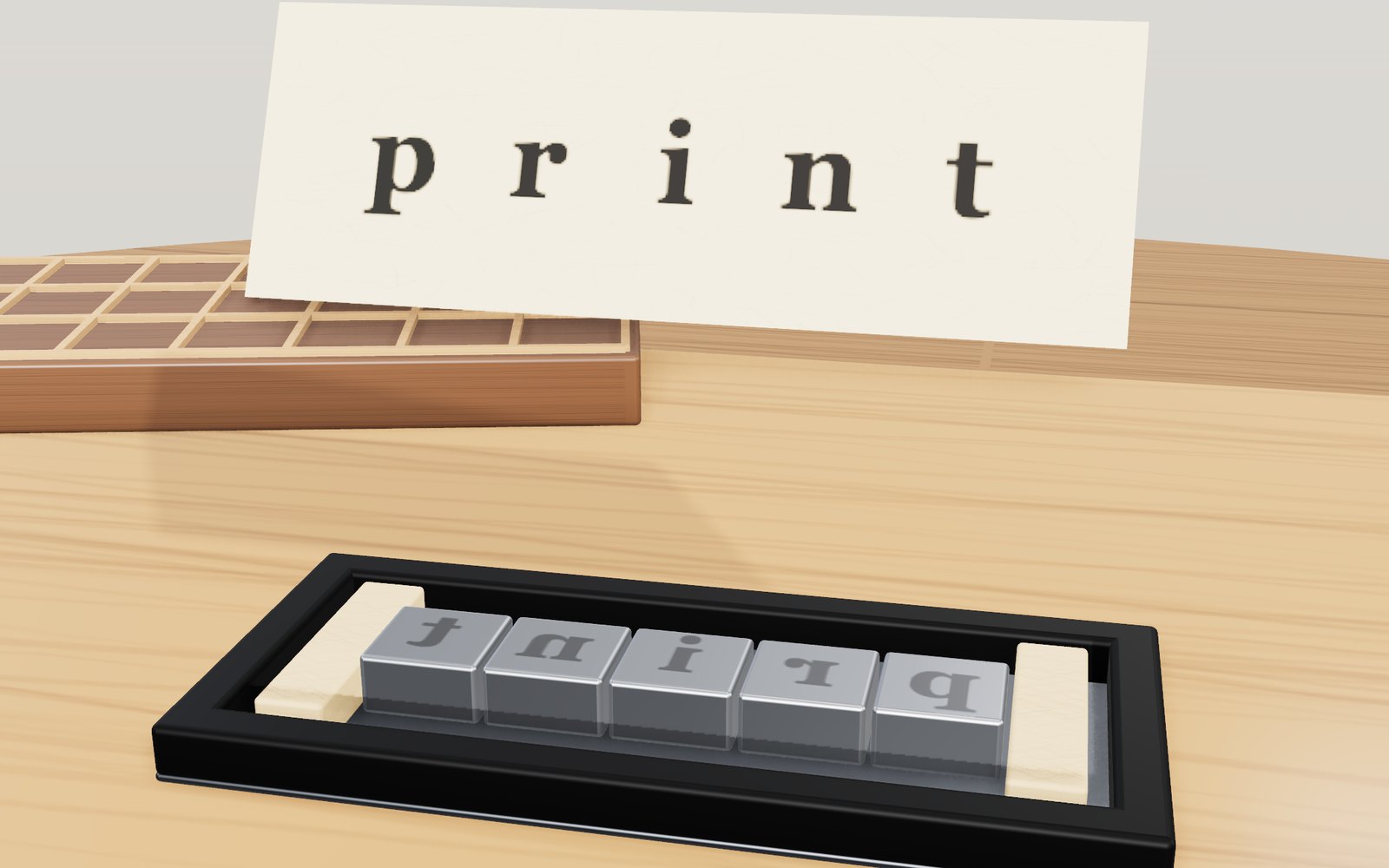
A piece of type carries its letter back to front. Ink it, press paper on it, turn the sheet over, and the letter reads the right way round.
This device cannot show the 3D model. You can read the guide steps below as text.
1 / 20 Type cut back to frontThis forme spells a word in big display type. Look at the faces: every letter is cut in mirror image. The roller is about to ink them.
Drag to turn. Scroll or pinch to zoom.
Why a piece of type is a mirror image
Press a rubber stamp on paper and the letters come out the right way round, although the stamp itself, if you turn it up and look, shows them reversed. Printing with type works the same way. A piece of type is a small block of metal with one letter standing up on its end, and that letter is cut back to front. Ink the raised letter, lay paper on it, press, and lift the sheet: the paper has been turned over on the type, so the reversed letter turns back again and reads normally.
The first bench on the stage does this with your own name. Type a name or a short word and the stage sets it in big display type, 23.3 mm high, in a chase (the iron frame that holds type tight). Look at the faces from above and every letter is reversed. The roller inks only the raised faces, a sheet of hanji is laid face down, a pad rubs it, and the sheet is lifted and held up to you. The same code draws the type and the print, and a check program runs it for many words, across and down, to make sure that a forme set in mirror image always prints a sheet that reads. If you switch on Mirror, a standing glass behind the type shows what the paper will show.
Everything else in this exhibit is a variation on that one idea. Woodblock printers cut a whole page back to front in one board. Goryeo and Joseon founders cast bronze type one character at a time and fixed them in a frame. In Mainz, Johannes Gutenberg's workshop cut each letter back to front on a steel punch and cast as many copies as it needed. Centuries later a steam press rolled sheets over a moving forme, and a Linotype cast a whole line back to front in one bar of metal.
The stage has nine stations, one shown at a time. Use the Station control or the list under the controls. Each station runs its process in a loop; the Process step control stops it at any step, and Print runs one full cycle from the inking. 13 small things are hidden on the benches. Click them to collect them.
Woodblocks first: one board, one page
Before movable type, a page was printed from a board on which the whole page had been carved in relief, every character reversed. The largest set of such boards to survive is the Tripitaka Koreana at Haeinsa Temple. The Korea Heritage Service lists 81,258 boards, carved between 1237 and 1248 after the earlier set of the Buddhist canon was burned in the Mongol invasion of 1232. A board is about 70 cm long and 24 cm wide, 2.6 to 4 cm thick, and weighs 3 to 4 kg. Together they hold 1,496 titles in 6,568 volumes. The set was added to the UNESCO Memory of the World Register in 2007.
Each side of a board carries 23 lines of 14 characters, and both sides are carved, so one board holds about 640 characters (23 x 14 x 2 = 644). Across all the boards that comes to about 52 million characters. The Korea Heritage Service compares that with the Annals of the Joseon Dynasty, about 54 million characters, and adds two figures that are hard to picture: laid flat in one pile, the boards would stand about 3,200 m high, and they weigh about 280 tonnes.
The woodblock station shows one board of this kind with a pattern of brush-like strokes in place of the text, 23 lines by 14. Brush ink on, lay paper face down, rub the back with a pad, lift: one board prints one page as many times as you like. Switch on Stack the boards and a pile of 100 boards rises beside the mannequin, about 3.9 m. The whole collection would be over 800 times taller.
A woodblock suits a book that will be printed again and again. Its weakness is that every page needs its own board, and a board can print nothing else. Carving a book of a few hundred pages means carving a few hundred boards before the first copy exists.
Why movable type
Movable type turns that around. Instead of carving a page, a printer keeps a stock of single characters, each on its own small block, sets them in a frame to make a page, prints it, then takes the frame apart and uses the same type for the next page. Nothing is carved for one book. The same set can print a ritual code this month and a book of poems the next.
What it costs is the stock. A page in Latin letters uses a few dozen different characters again and again. A page in Han characters can use hundreds of different ones, and a book thousands. A set of type for Han characters therefore has to hold many thousands of sorts (different characters) and many copies of the common ones, and every one of them has to be the same height so that the page prints evenly. Hold that against the 290 different characters of the 42-line Bible type and you can see why the two traditions grew so differently.
Metal type needs more than casting. The Encyclopedia of Korean Culture points out that three things had to come together: casting the type, a sticky material to hold the type in the frame (beeswax), and an oily ink that clings to metal. The master artisan Lim In-ho, who holds the national title for metal type casting, prints with ink made from oil soot because it takes well on metal.
The first records in Korea
The earliest surviving metal-type book is Jikji of 1377, but written records go back further. Two are accepted.
The first is a woodblock edition of a Buddhist text, Nammyeongcheon hwasang song jeungdoga. A note at the end, by the military ruler Choe I, says the book was hard to find and was therefore recut on wood in 1239 from an edition printed with cast type. Since the court moved from Gaegyeong to Ganghwa Island in 1232, the encyclopedia concludes that metal type was already in use in Gaegyeong in the early 13th century.
The second is a note by the scholar Yi Gyu-bo. When the court fled to Ganghwa, the officials left behind the 50-volume state ritual code, Sangjeong yemun. Using the one copy Choe I had brought, the government printed 28 copies with cast type and gave them to the offices. No copy survives.
The encyclopedia also lists theories that it rejects: an origin in the 11th century read into a phrase in an inscription, a date of 1102 built on a misunderstanding of a word for melting metal, and a date in the middle of the 12th century based on a misread owner's seal. The stage keeps to the two records above.
Casting bronze type in beeswax
Jikji's type were cast by the beeswax method, the encyclopedia says, the way temples had long cast bronze. Each character starts as a model cut back to front in a stick of beeswax. The models are stuck on wax branches round a central wax rod, the whole tree is packed in fine clay with a cup at the top, and the mould is heated so that the wax runs out and leaves its shape in the clay. Bronze, copper with tin, is then poured into the cup at 1,100 to 1,200 °C. When the metal has cooled the clay is broken, a bronze tree comes out, and each piece of type is cut off and filed square. The Korea Heritage Agency's account of Lim In-ho's work describes these steps, and the casting station follows them.
Because every wax model is cut by hand and lost in the casting, no two pieces of type are exactly alike, even for the same character. That shows on the pages of Jikji, as a later section explains. The beeswax itself comes from honeycomb. Lim In-ho keeps native bees for it and takes the wax once a year; a honeycomb lies on the bench, one of the hidden finds.
Try the Metal temperature control. Pour below about 1,000 °C and the metal sets in the cup before it runs in. Between 1,000 and 1,100 °C it runs but freezes before it fills the thin strokes, and the tree comes out with type missing. Inside the 1,100 to 1,200 °C band every type fills. The shape of the curve and the warning above 1,200 °C are the model's own; the band itself is the artisan's figure.
Sand casting, and the argument about Goryeo
Joseon's state foundry cast type another way. A wooden model character is pressed into fine sand packed in a frame, a second frame of sand is closed over it, channels are cut, and the bronze runs into the hollows. The model is not lost, so the same character can be cast again and again and comes out the same shape. Comparing Gyemi-ja prints of 1403 with Jikji, the encyclopedia says, casting had moved from beeswax to sand: the type are more even and the same character looks the same.
Set Casting method to sand moulds and the casting station changes: wooden models instead of wax, two sand frames instead of clay, and a bronze tree whose branches lie in one plane. Which method Goryeo used is not settled for every case. The UNESCO nomination for Jikji argues that only beeswax casting explains its type, and a restorer who tried both methods in 1996 chose beeswax. Other researchers argue that sand casting was used in Goryeo too, above all for type made by the central offices. The stage marks the method as debated and shows both.
One Goryeo type survives, a single bronze piece with the character bok, recorded as found in a tomb at Gaegyeong and kept at the National Museum of Korea. Its back is hollowed into an oval. The encyclopedia explains why: wax filled the hollow and set hard, holding the type still in the forme, and the hollow saved bronze. Gyemi-ja type were made pointed at the back instead, so that they pushed into the wax.
Jikji, 1377
Jikji is a Buddhist anthology compiled by the monk Baegun. The metal-type edition was printed at Heungdeok Temple outside Cheongju in the seventh month of 1377, and the place and date are printed at the end of the book. Only volume II survives. It was collected in Korea in the late 19th century by Victor Collin de Plancy, the first French envoy, bought at auction in Paris in 1911 by Henri Vever, and given to the National Library of France in 1953, where it is kept today.
The UNESCO nomination describes the book: 39 leaves printed on both sides, 24.6 cm by 17.0 cm, bound with five stitches. The cover and first page were lost and later restored. Each page has 11 lines of 18 to 20 characters; the count varies because the type are not all the same size. Two sizes of type were used, medium for the text and small for notes, and the small ones sometimes stand in where a medium character was missing. The shapes of repeated characters show that two formes were used in turn, one being set while the other was printed. The Jikji station has a second forme on the bench for this reason, filling up as the first one prints.
A woodblock edition was cut at Chwiam Temple in 1378, a year later. Copies are held at the National Library of Korea and at the Jangseogak of the Academy of Korean Studies, and another came to light at Bulgapsa Temple in 1997. Because of them the text of the lost volume I is known.
Jikji's age was not recognised at once. Maurice Courant listed it in his Bibliographie coréenne of 1901. Park Byeong-seon, a researcher at the National Library of France, first saw it about 1967, and in 1972 her study showing that it was printed with metal type was presented at the library's BOOKS exhibition. On 4 September 2001 Jikji volume II was entered on the UNESCO Memory of the World Register. A scientific study found that its paper is hanji made from paper mulberry grown in Korea, and in 2023 the library showed the book to the public for the first time in about 50 years.
What the pages of Jikji show
The UNESCO nomination and the encyclopedia list what a reader sees on Jikji's pages, and each point says something about how it was made.
- The ink is uneven: some characters are black, some faint. The surface of the forme was not level.
- Characters lean and lines are not straight. The type stood in soft wax and moved.
- The same character looks different in different places on one page, but the same type return on other pages. Each type was modelled by hand.
- Some characters are printed upside down.
- One character was left out in casting; a circle was drawn in its place and the character written beneath it by hand.
- Specks and stray metal show on some characters, and near the end one forme lost a piece of type.
The Jikji station reproduces several of these. The pattern on its type is not text; it stands in for characters. Turn up Pressure and the type tilt in the wax as the pad goes over, so the print comes out crooked. Look on the print for the hand-drawn circle and on the forme for the upside-down type and the empty slot. A bound book with five red stitches lies beside the forme.
Joseon's type foundry: three or four sheets, then twenty, then forty
The Joseon state set up a type foundry in 1403 and cast its first type, Gyemi-ja, over several months. The National Institute of Korean History describes the trouble with it. The type moved during printing and tilted, so wax had to be melted and poured in again and again to fix them; a lot of wax was used and only three or four full sheets came off in a day.
In 1420 a new type, Gyeongja-ja, was cast smaller and more regular, and the frame was made flatter and stronger so that the type fitted it closely. The type no longer moved, no wax was needed during printing, and a day's work rose to about 20 sheets, four to five times as many.
In 1434 the court cast Gabin-ja, about 200,000 large and small type in two months, under Yi Cheon with Jang Yeong-sil, Yi Sun-ji and others. The type and the frame were made square and level and the gaps were packed with bamboo and wood instead of wax, a fully assembled forme. A day's work doubled again to about 40 sheets. The Annals record the casting in the seventh month of 1434. Gabin-ja served for about 140 years before it was recast; the encyclopedia dates the second casting to 1573 or 1580 (two views), and the design was cast six times in all.
The Gabin-ja station shows the assembled frame. Bamboo strips go in beside each column, square type drop in, and the pad no longer moves them. Switch Type held by to the beeswax bed and the frame becomes a forme of the Gyemi-ja kind: the type tilt and the readout drops from about 40 sheets a day to three or four. Lead type came too: Byeongjin-ja of 1436 is noted as the first lead type in Korea.
Hangul in metal
Hunminjeongeum, the Korean alphabet, was promulgated in 1446, twelve years after Gabin-ja was cast. The first metal type for Hangul were cast about 1447, the Korea Heritage Service says, for two books printed in the new script: Seokbo sangjeol, a life of the Buddha, and Worin cheongang jigok, songs written by King Sejong himself. In both, Hangul type stand beside Han type. They are sometimes called "Hangul type used with Gabin-ja", but the article points out that the name is wrong: Gabin-ja were cast in 1434, before Hangul existed.
Hunminjeongeum has 28 letters, 17 consonants and 11 vowels. A Korean type case does not hold letters, though. It holds syllable blocks, each a combination of an initial consonant, a vowel and sometimes a final consonant. With the modern letters there are 19 x 21 x 28 = 11,172 possible blocks, so a set of Hangul type is closer to a set of Han characters than to an alphabet. The name tool under the controls counts this for your own name: how many pieces of type, how many different blocks, and how many letters those blocks are built from.
The Gabin-ja station sets a Hangul word in its first column. On the name bench Hangul and Latin both work, across or down.
Mainz: punch, matrix and hand mould
In Mainz the problem was different. Latin script needs few characters, but a book needs many copies of each, all exactly the same height and width. The Gutenberg Museum describes the method. The text was broken into its elements: small and capital letters, punctuation, ligatures and the abbreviations used by scribes. For each, a letter was cut back to front into the end of a steel pin, the punch. The punch was struck with a hammer into a block of softer metal, usually copper, leaving the letter sunk the right way round: the matrix. The matrix was filed square and to an even depth.
To cast a letter, the matrix closed one end of a channel between the two halves of the hand casting instrument. Metal was poured in at the top, the halves were opened, and the letter came out with a jet of metal on its foot. Each letter had a break point, so that when the jet was snapped off every piece of type had the same height. The museum calls the hand mould the most important part of the invention: it made it possible to cast the quantities needed, quickly.
The metal was an alloy of lead, tin and other additives that cooled fast and stood up to the pressure of the press. Later type metal is well documented. A printers' primer of 1918 gives lead five parts, antimony two, tin one, and a 1930 study at the US Bureau of Standards found stereotype and Linotype metals solidifying at around 240 °C. The hand-mould station pours between 280 and 360 °C, a model range a little above that. Lead alloy at that temperature does not glow; it pours like liquid silver.
The station runs one letter per cycle: punch, strike, fit, pour, open, break off the jet, and into the composing stick. After a few cycles the stick holds a word, back to front. A heap of broken-off jets lies on the bench.
The 42-line Bible
Gutenberg's best-known book is a Latin Bible in two volumes, 1,282 pages with 42 lines to a column and two columns to a page. The Gutenberg Museum says it was made with the help of about 20 workers and that 290 different characters were cast for it. The date rests on a note of 1455 in the binding of one copy in Paris, and the Library of Congress gives the publication as about 1455.
How many were printed is an estimate, and the institutions do not agree on the details. The figure of about 180 copies comes from a single letter written in 1455 by Enea Silvio Piccolomini, who had seen sample sheets at Frankfurt. The Gutenberg Museum divides them into 150 on paper and 30 on parchment; the Library of Congress says 145 and 35; Cambridge University Library says about 45 on parchment. The number that survive differs too. The Gutenberg Museum counts 49, two of them in its own collection; the British Library's census counts 48, of which 20 are complete, and the Library of Congress says 21 are complete. The difference comes from how single volumes and fragments are counted.
Cambridge University Library gives three more figures: about 16,000 pieces of type were needed, nearly 50,000 sheets of paper, and some three years of work. The heading in red at the start of each book was planned as part of the print and then given up. In two copies, the one in Munich and one in Vienna, a printed table survives that was meant as a pattern for writing the red headings in by hand. It is pinned to an easel at the press station.
The Library of Congress is careful about one phrase. The 42-line Bible is not "the first printed book"; the library calls it the first book printed with movable metal type in Western Europe, because metal type had been used in Korea nearly a century before.
The wooden press
The Gutenberg Museum describes the press as a spindle press with special fittings for transferring the image evenly from the forme to the paper or parchment. Before it, prints were made by rubbing, as on the Korean benches. The press station builds a wooden screw press of this kind at full size, about 2 m tall, with a 1.7 m mannequin beside it.
One cycle goes like this. While the bed is out, two leather ink balls dab ink over the forme. A sheet is laid on the tympan, a hinged frame covered with parchment, and the frisket, a mask that keeps the margins clean, is folded over it. Tympan and frisket fold down onto the forme. The rounce, a handle at the side, winds the bed in under the platen. The pressman pulls the bar, the screw turns a little, and the platen presses the sheet onto the type. The bed is wound out, the tympan opened, and the printed sheet hung up to dry.
The sheet is folded onto the forme from the end, not from the side, so here the forme is the print turned top to bottom rather than left to right. Either way the paper is turned over once on the type, and the check program tests both. The Library of Congress notes that from the 1440s the mechanics of the press were practically unchanged for 300 years. Even the first all-iron press, built in England about 1800 and named after the Earl of Stanhope, made about 200 pulls an hour, each pull one side of a sheet. The iron Washington hand press of 1829 printed at best 250 impressions an hour, according to Robert Hoe's history of 1902.
The forme on the stage carries your word as a heading in a blackletter face, above two columns of 42 lines of stroke pattern. The face is an open-licence font in the Mainz style, not a copy of the 42-line Bible type.
Korea and Mainz side by side
Jikji was printed in 1377 and the 42-line Bible was finished by 1455, 78 years later. Placing them side by side shows how differently the same idea was used.
- Korean type were bronze, cast by beeswax or in sand at 1,100 to 1,200 °C. Mainz type were a lead alloy cast in a hand mould at a few hundred degrees.
- A Korean set had to hold thousands of different characters. The Mainz Bible type had 290.
- Korean printers rubbed the paper onto the forme by hand. Mainz used a screw press.
- Korean formes were held by beeswax and later by an assembled frame with bamboo packing. Mainz formes were locked in a chase.
- Both needed an ink that would cling to metal.
The stage does not claim that one led to the other. Whether knowledge of printing travelled between East Asia and Europe is a separate question that the sources here do not settle.
Ink and paper
Type is only half of printing. The other half is what goes on it and what it goes onto, and here too Korea and Mainz differ.
The Encyclopedia of Korean Culture counts an oily ink among the three things metal printing needed, because ink has to cling to the face of the type and come off cleanly onto paper. Lim In-ho's notes describe ink made from oil soot, chosen because it takes well on metal, a proof pulled on hanji, corrections made, and then the print run. The Gabin-ja books, the encyclopedia adds, have ink that is deep black and glossy, which is part of why they are counted among the finest Korean printing.
Korean paper is hanji, made from the bark of the paper mulberry. A scientific study of Jikji itself found that its paper is hanji made from paper mulberry that grows in Korea. For the exhibition at UNESCO in Paris in 2023, two facsimiles of Jikji were made on new hanji: one copying the book as it is now, the other as it may have looked when it was printed.
In Mainz the 42-line Bible was printed on paper made from a pulp of linen rags, as Cambridge University Library describes it, and some copies on vellum, treated calfskin. On the stage the benches use a hanji texture with long fibres and the press uses a smoother rag paper.
The Ink and Pressure controls work on every printing station. Too little ink and the print is faint and speckled; too much and the strokes spread; too little pressure leaves patches, and pressing very hard on a wax-bed forme tilts the type. One of the tasks starts with both set badly and asks for a print at 90% or better.
Steam and cylinders
Presses stayed hand-worked into the 19th century. The change came with the steam-powered cylinder press of Friedrich Koenig and Andreas Bauer. Koenig & Bauer, the firm they founded, says their first press printed 800 sheets an hour, more than twice a manual press, and that the double-cylinder steam press built for The Times of London printed 1,100 sheets an hour. It was first used on the night of 28 to 29 November 1814, and readers learned of it from that day's paper. Robert Hoe's history of 1902 gives 800 sheets an hour for the two Times machines, so even here the sources differ.
In a press of this kind the forme lies on a bed that runs to and fro under a turning cylinder. On the forward stroke a sheet held by grippers on the cylinder is rolled over the inked type; on the return the bed passes under the ink rollers. The cylinder station shows that motion as a concept model, a single cylinder that waits during the return stroke. At normal speed it prints one sheet every 3.3 s, which is about 1,100 an hour.
Speeds kept rising. R. Hoe & Company built type-revolving presses in the 1840s with the type locked round a central cylinder; the Library of Congress gives 2,000 sheets an hour for each feeder, and Hoe's own history gives about 8,000 an hour for a four-feeder machine. The New-York Tribune began printing on a web rotary press in 1875 at 14,000 copies an hour.
A line at a time: the Linotype
Presses had become fast, but type was still set by hand, one letter at a time. Ottmar Mergenthaler's Linotype changed that. The Library of Congress describes how it worked: the operator typed on a keyboard, each key released a brass matrix from a magazine, the matrices lined up into a line with spacebands between the words, and the machine cast the whole line as one bar of type metal, the slug. The matrices were then lifted and returned to their channels. The New-York Tribune, one of whose backers was the publisher Whitelaw Reid, tried the first machines in 1886, and by 1889 it ran 42 of them.
The first two columns of the Linotype keyboard spell etaoin shrdlu. Operators ran a finger down those keys to mark a line with a mistake so that the slug would be thrown out; now and then it reached print anyway. A documentary about the day the New York Times stopped casting type in 1978 is called Farewell Etaoin Shrdlu.
The Linotype station casts your word as a slug. Its letters are back to front, like every other forme in this exhibit, and the slug goes to the galley with the others.
Counting type
The lab under the controls puts the counts side by side on a logarithmic scale, with the source on each line:
- about 52 million characters on the Tripitaka boards, and 81,258 boards;
- about 200,000 Gabin-ja type cast in 1434;
- about 30,000 Jikji type remade by the Cheongju Early Printing Museum between 2011 and 2015 by the beeswax method;
- about 16,000 characters in Jikji volume II, an estimate from 39 leaves, two sides, 11 lines and 19 characters (the actual count per line is 18 to 20);
- about 16,000 pieces of type for the 42-line Bible, 1,282 pages and 290 different characters;
- 11,172 possible Hangul syllable blocks and the 28 letters they are built from.
The restoration figures are worth a moment. Lim In-ho, the Korea Heritage Agency says, recast over 5,000 Jikji type by the beeswax method, more than 100 at a pour, and the Cheongju Early Printing Museum's project remade about 30,000.
How long a sheet takes
The lab also compares speeds, and here the units need care. The Korean figures are full sheets per day, rubbed by hand: three or four for Gyemi-ja, about 20 for Gyeongja-ja, about 40 for Gabin-ja. The press figures are impressions per hour, one side of a sheet each: about 200 for the iron Stanhope press of about 1800, 250 at best for the Washington press, 1,100 for Koenig's steam press, about 8,000 for a four-feeder Hoe press and 14,000 for the Tribune's web press of 1875.
To put days and hours on one scale the lab takes a working day as 10 hours, a model value. Type a number of sheets and it shows how long each method would take. The comparison is rough, since a Korean sheet and a European sheet are not the same thing, but the jump from hand to steam is clear at any scale.
Where to see them
The real things can be seen in a few places, and each place adds something the stage cannot.
- The Cheongju Early Printing Museum stands on the site of Heungdeok Temple, where Jikji was printed. Its metal type education hall holds casting demonstrations at 10:00, 13:30 and 15:00 on Fridays, Saturdays and Sundays, and visitors can try printing.
- The National Library of Korea holds a copy of the 1378 woodblock edition of Jikji, and its collection of books printed with metal type is the subject of its 2021 film on how many such books survive.
- The Tripitaka Koreana boards are kept at Haeinsa Temple in Hapcheon, in its Beopbojeon and Sudarajang halls.
- The Gutenberg Museum in Mainz owns two copies of the 42-line Bible and shows a reconstructed press.
- The Library of Congress has one of the three complete copies printed on vellum. The British Library has two copies, one on paper and one on vellum. The Harry Ransom Center in Austin has kept its complete paper copy on view since 1978.
What the model simplifies
- The type on the old formes carry a pattern of brush-like strokes, not text, so no book is copied onto the stage. Only your own word and a few single characters are real.
- The fonts are open-licence faces (a Myeongjo face for Hangul and Han characters, a blackletter for Latin at the Mainz stations). They are not copies of Goryeo, Joseon or Mainz type.
- The name bench uses display type far larger than book type, so the faces can be read.
- The casting temperatures for bronze follow the artisan's figure of 1,100 to 1,200 °C; the curves, the failure thresholds and the pouring range for lead alloy are model values.
- The print quality from Ink and Pressure is a simple model: too little ink prints faint, too much blots, too little pressure leaves patches.
- The screw press, the cylinder press and the Linotype are built to the model's own proportions. The cylinder press and the Linotype are concept models.
- Speeds are shown as the sources state them; the stage runs at 1,100 sheets an hour only on the cylinder station at normal speed.
Questions
Why is the text on type back to front?
Because printing turns the paper over on the type. The ink sits on the raised face, the paper is pressed onto it face down and then lifted and turned over, so whatever was on the type comes out mirrored. A letter cut back to front comes out the right way round.
What is the oldest book printed with metal type?
The oldest surviving one is Jikji volume II, printed at Heungdeok Temple in Cheongju in 1377 and kept at the National Library of France. Records describe earlier metal-type printing in Korea, in Gaegyeong before 1232 and the 28 copies of Sangjeong yemun, but those books do not survive.
Was Gutenberg's Bible the first printed book?
No. Woodblock printing is far older, and Korea printed with metal type before Mainz. The Library of Congress calls the 42-line Bible the first book printed with movable metal type in Western Europe.
How many years separate Jikji and the Gutenberg Bible?
Jikji was printed in 1377 and the 42-line Bible was finished by 1455, so 78 years.
How was Korean metal type made?
Jikji's type were cast in bronze by the beeswax method: characters cut in wax, stuck on a wax tree, packed in clay, wax melted out, bronze poured in at 1,100 to 1,200 °C, clay broken. Joseon's state type were cast in sand moulds from wooden models. Which method Goryeo used is debated.
Why do the characters in Jikji look uneven?
The type were held in soft beeswax, so they moved and tilted while the paper was rubbed, and each wax model was cut by hand, so the same character does not look the same twice on a page. The book also has upside-down characters and a missing character added by hand.
Why does only volume II of Jikji survive?
Only one copy of the metal-type edition is known, and it has volume II only. Its text, and that of volume I, is known from the woodblock edition of 1378, held at the National Library of Korea and elsewhere.
What is the Tripitaka Koreana?
A set of 81,258 woodblocks of the Buddhist canon at Haeinsa Temple, carved from 1237 to 1248. Each board has 23 lines of 14 characters on each side, about 52 million characters in all. It is a National Treasure and on the UNESCO Memory of the World Register.
If woodblocks worked, why make movable type?
A woodblock prints one page and nothing else, so a book needs one board per page. Movable type can be taken apart after a page is printed and used for the next page and the next book.
How fast could early Korean printers work?
The National Institute of Korean History gives three or four sheets a day for Gyemi-ja (1403), about 20 for Gyeongja-ja (1420) and about 40 for Gabin-ja (1434). Each improvement held the type more firmly.
What was Gabin-ja?
Type cast in 1434 under King Sejong, about 200,000 pieces in two months, with a square, assembled frame that used bamboo and wood instead of wax. It printed about 40 sheets a day, and its design was cast six times in all.
When was the first Hangul metal type made?
About 1447, for Seokbo sangjeol and Worin cheongang jigok, beside Han type. The Korea Heritage Service notes that it should not be called part of Gabin-ja, which was cast before Hangul existed.
How did Gutenberg make his type?
A letter was cut back to front on a steel punch, struck into copper to make a matrix, and the matrix placed in a hand mould. Molten lead alloy was poured in, the mould opened, and the jet broken off at a fixed point so every piece had the same height.
How many Gutenberg Bibles are there?
About 180 were printed, a figure from a single letter of 1455. The Gutenberg Museum counts 49 surviving; the British Library's census counts 48, of which 20 are complete.
What did a steam press change?
Speed. Koenig and Bauer's double-cylinder press printed The Times at 1,100 sheets an hour in 1814, against about 200 pulls an hour for the best iron hand press of the time. Later presses reached thousands of copies an hour.
What is a Linotype slug?
A whole line of type cast as one bar of metal. The operator typed the line, the machine lined up brass matrices and cast the slug, and the matrices went back to be used again.
Terms
- Type (sort): a small block with one character standing up on its end, cut back to front.
- Forme: type set and locked up for printing one page or one side of a sheet.
- Chase: the frame that holds a forme tight.
- Woodblock: a board with a whole page carved in relief.
- Beeswax casting: casting from models cut in wax, which is melted out of a clay mould.
- Sand casting: casting in moulds of fine sand pressed with wooden models.
- Punch: a steel bar with a letter cut back to front on its end.
- Matrix: a block with a letter sunk into it, the mould for the face of a piece of type.
- Hand mould: the two-part instrument in which a piece of type is cast against a matrix.
- Jet: the stub of metal left on the foot of a cast type, broken off.
- Composing stick: a hand tray in which a compositor sets type into lines.
- Tympan and frisket: the hinged frames that hold the sheet and mask its margins on a hand press.
- Platen: the flat block that presses the sheet onto the forme.
- Slug: a line of type cast in one piece by a Linotype.
- Hanji: Korean paper made from paper-mulberry bark.
Sources
- UNESCO Memory of the World Register, nomination form: Buljo jikji simche yojeol (vol. II), Republic of Korea (PDF). https://media.unesco.org/sites/default/files/webform/mow001/korea_buljo_jikj_simch_yo_jeol.pdf (checked 20 October 2026)
- UNESCO Memory of the World Register, nomination form: Printing woodblocks of the Tripitaka Koreana and miscellaneous Buddhist scriptures (PDF). https://media.unesco.org/sites/default/files/webform/mow001/korea_tripitaka.pdf (checked 20 October 2026)
- Korea Heritage Service (국가유산청), 《직지심체요절》의 진면모를 밝힌 박병선 박사, 10 April 2009. https://www.khs.go.kr/cop/bbs/selectBoardArticle.do?bbsId=BBSMSTR_1008&nttId=5794 (checked 20 October 2026)
- Korea Heritage Service, 민족의 의지, 목판에 새기다 팔만대장경. https://www.khs.go.kr/cop/bbs/selectBoardArticle.do?bbsId=BBSMSTR_1008&nttId=79466 (checked 20 October 2026)
- Korea Heritage Service, 기록 문자로서의 한글 그리고 한글 금속활자의 가치, 29 September 2021. https://www.khs.go.kr/cop/bbs/selectBoardArticle.do?bbsId=BBSMSTR_1008&nttId=80509 (checked 20 October 2026)
- Korea Heritage Service, 직지의 날 유네스코에서 선보인 『직지』와 한지, 1 December 2023. https://www.khs.go.kr/cop/bbs/selectBoardArticle.do?bbsId=BBSMSTR_1008&nttId=87377 (checked 20 October 2026)
- Korea Heritage Service, National Heritage Portal, 국보 합천 해인사 대장경판. https://www.heritage.go.kr/heri/cul/culSelectDetail.do?ccbaCpno=1113800320000 (checked 20 October 2026)
- Korea Heritage Agency (국가유산진흥원), 금속활자장 임인호, 26 January 2021. https://www.kh.or.kr/brd/board/696/L/menu/314?brdType=R&thisPage=1&bbIdx=110627 (checked 20 October 2026)
- Encyclopedia of Korean Culture (Academy of Korean Studies), 금속활자. https://encykorea.aks.ac.kr/Article/E0007871 (checked 20 October 2026)
- Encyclopedia of Korean Culture, 갑인자. https://encykorea.aks.ac.kr/Article/E0000932 (checked 20 October 2026)
- Encyclopedia of Korean Culture, 훈민정음 28자모. https://encykorea.aks.ac.kr/Article/E0074518 (checked 20 October 2026)
- National Institute of Korean History, 우리역사넷, 신편 한국사 27, (1) 관주활자. https://contents.history.go.kr/mobile/nh/view.do?levelId=nh_027_0030_0020_0010_0010 (checked 20 October 2026)
- National Institute of Korean History, Annals of the Joseon Dynasty, 세종실록 16년 7월 2일. https://sillok.history.go.kr/id/kda_11607002_001 (checked 20 October 2026)
- National Library of Korea, Korean metal type printing. https://www.nl.go.kr/EN/contents/EN31902000000.do (checked 20 October 2026)
- National Library of Korea, 금속활자로 인쇄한 책이 얼마나 전해질까?, 15 October 2021. https://www.nl.go.kr/NL/contents/N50603000000.do?id=40282&schM=view (checked 20 October 2026)
- Cheongju Early Printing Museum (청주고인쇄박물관). https://www.cheongju.go.kr/jikjiworld/index.do (checked 20 October 2026)
- Cheongju Early Printing Museum, 밀랍주조법: 고려의 금속활자 제작 방법 (Google Arts & Culture). https://artsandculture.google.com/story/swXBLlcmUdziWQ?hl=ko (checked 20 October 2026)
- National Folk Museum of Korea, Encyclopedia of Korean Folk Culture, 금속활자. https://folkency.nfm.go.kr/topic/detail/9869 (checked 20 October 2026)
- Gutenberg Museum Mainz (City of Mainz), Gutenberg's invention. https://www.mainz.de/en/microsite/gutenberg/erfindung/ (checked 20 October 2026)
- Gutenberg Museum Mainz (City of Mainz), Gutenberg's masterpiece, the 42-line Bible. https://www.mainz.de/en/microsite/gutenberg/bibel/ (checked 20 October 2026)
- Library of Congress, The Gutenberg Bible (Bibles collection exhibition). https://www.loc.gov/exhibits/bibles/interactives/gutenberg/index.html (checked 20 October 2026)
- Library of Congress Research Guides, The Gutenberg Bible at the Library of Congress: related resources. https://guides.loc.gov/gutenberg/resources (checked 20 October 2026)
- British Library, Gutenberg Bible. https://www.bl.uk/collection-items/gutenberg-bible (checked 20 October 2026)
- Incunabula Short Title Catalogue (British Library, CERL), Biblia latina, 42-line Bible, ib00526000. https://data.cerl.org/istc/ib00526000 (checked 20 October 2026)
- Bayerische Staatsbibliothek, Münchener DigitalisierungsZentrum, Gutenberg Bible. https://www.digitale-sammlungen.de/en/gutenberg-bible (checked 20 October 2026)
- Cambridge University Library Special Collections, First Impressions: The Gutenberg Bible, 12 November 2016. https://specialcollections-blog.lib.cam.ac.uk/?p=13354 (checked 20 October 2026)
- Harry Ransom Center, The University of Texas at Austin, The Gutenberg Bible. https://www.hrc.utexas.edu/gutenberg-bible/ (checked 20 October 2026)
- Library of Congress, Headlines & Heroes, Printing Newspapers 1400-1900, 21 April 2022. https://blogs.loc.gov/headlinesandheroes/2022/04/printing-newspapers-1400-1900/ (checked 20 October 2026)
- Library of Congress, Headlines & Heroes, The Linotype: The Machine that Revolutionized Movable Type, 8 June 2022. https://blogs.loc.gov/headlinesandheroes/2022/06/the-linotype-the-machine-that-revolutionized-movable-type (checked 20 October 2026)
- Koenig & Bauer, On the 250th Birthday of Friedrich Koenig, 16 April 2024. https://www.koenig-bauer.com/en/newsroom/online-magazine-world/article/on-the-250th-birthday-of-friedrich-koenig-inventor-businessman-visionary (checked 20 October 2026)
- R. Hoe, A Short History of the Printing Press, New York 1902 (Project Gutenberg). https://www.gutenberg.org/files/63545/63545-h/63545-h.htm (checked 20 October 2026)
- A. A. Stewart, Type (Typographic Technical Series for Apprentices no. 1), 1918 (Project Gutenberg). https://www.gutenberg.org/files/36372/36372-h/36372-h.htm (checked 20 October 2026)
- NIST, Bureau of Standards Journal of Research vol. 5 (1930), Properties of lead-bismuth, lead-tin, type metal and fusible alloys (PDF). https://nvlpubs.nist.gov/nistpubs/jres/5/jresv5n5p1085_A2b.pdf (checked 20 October 2026)
More exhibits
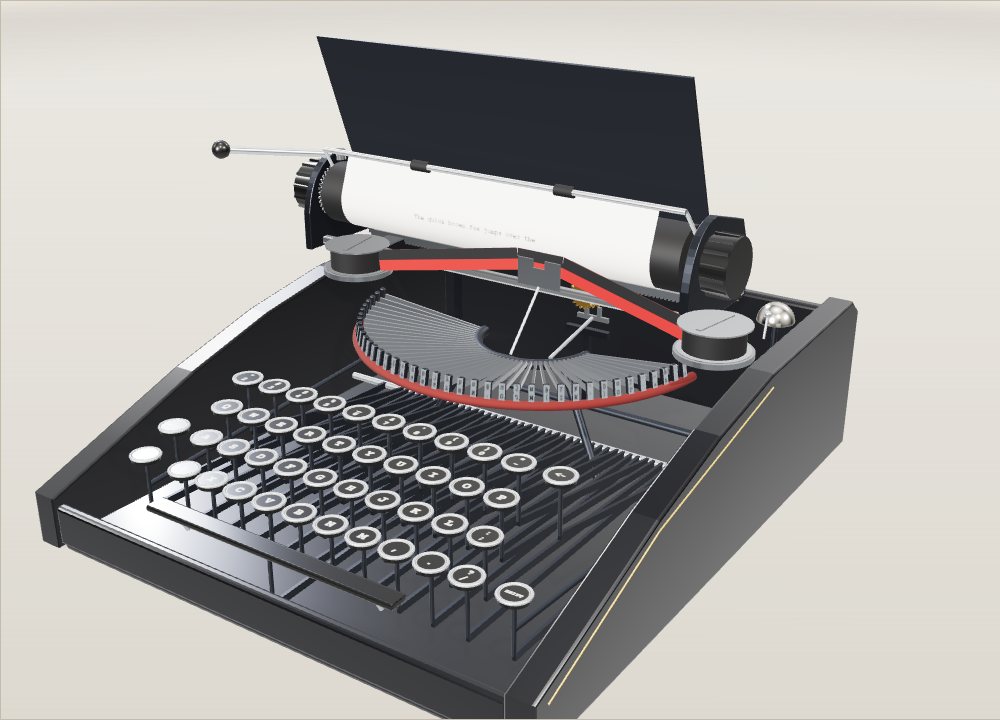
How a typewriter works: inside a manual typewriter
On a pica typewriter every letter, space and full stop moves the carriage the same 2.54 mm to the left.
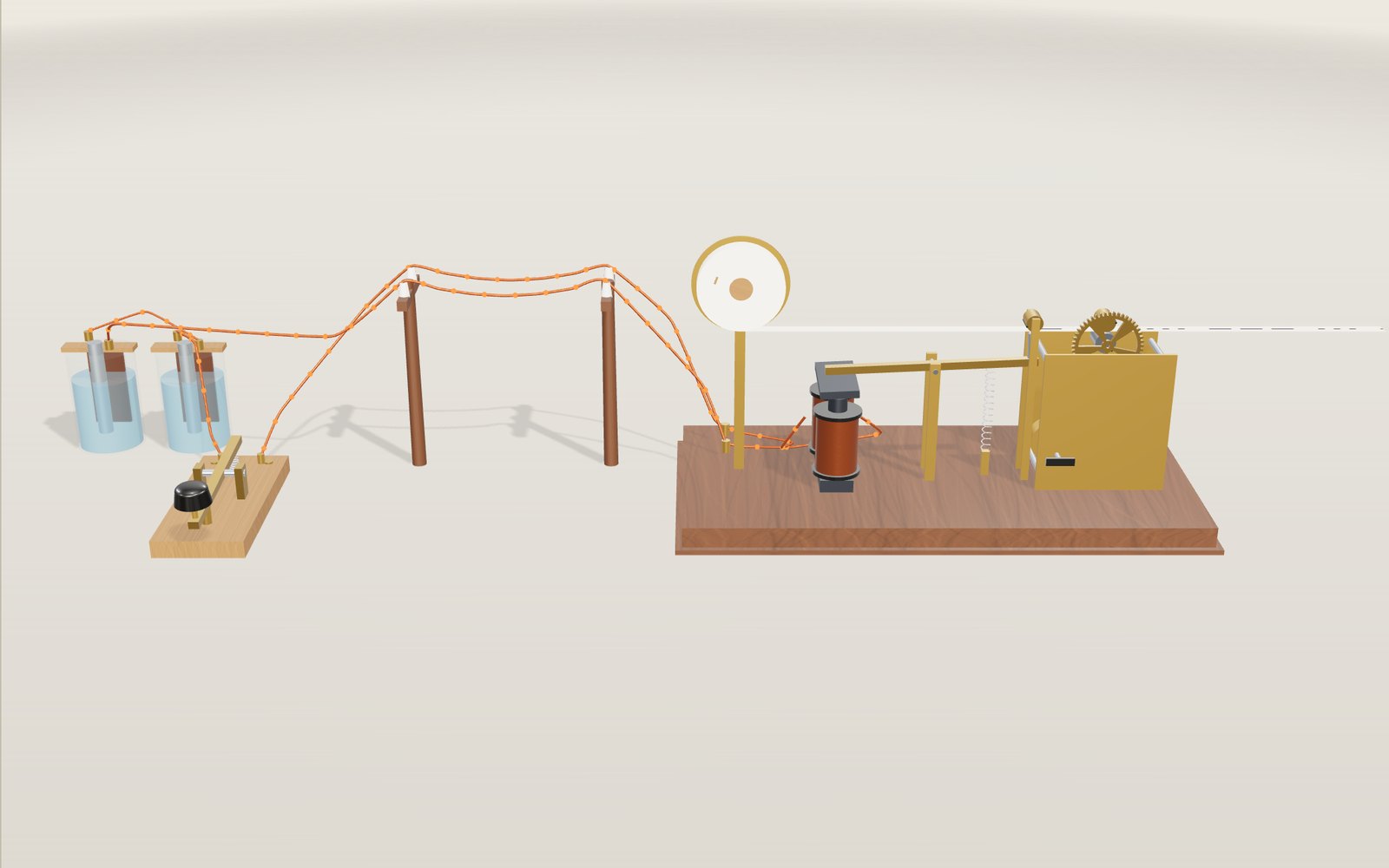
Morse telegraph: key it yourself, step by step
On 24 May 1844 a key in the US Capitol pressed dots and dashes into a paper tape in Baltimore, about 40 miles (64 km) away.
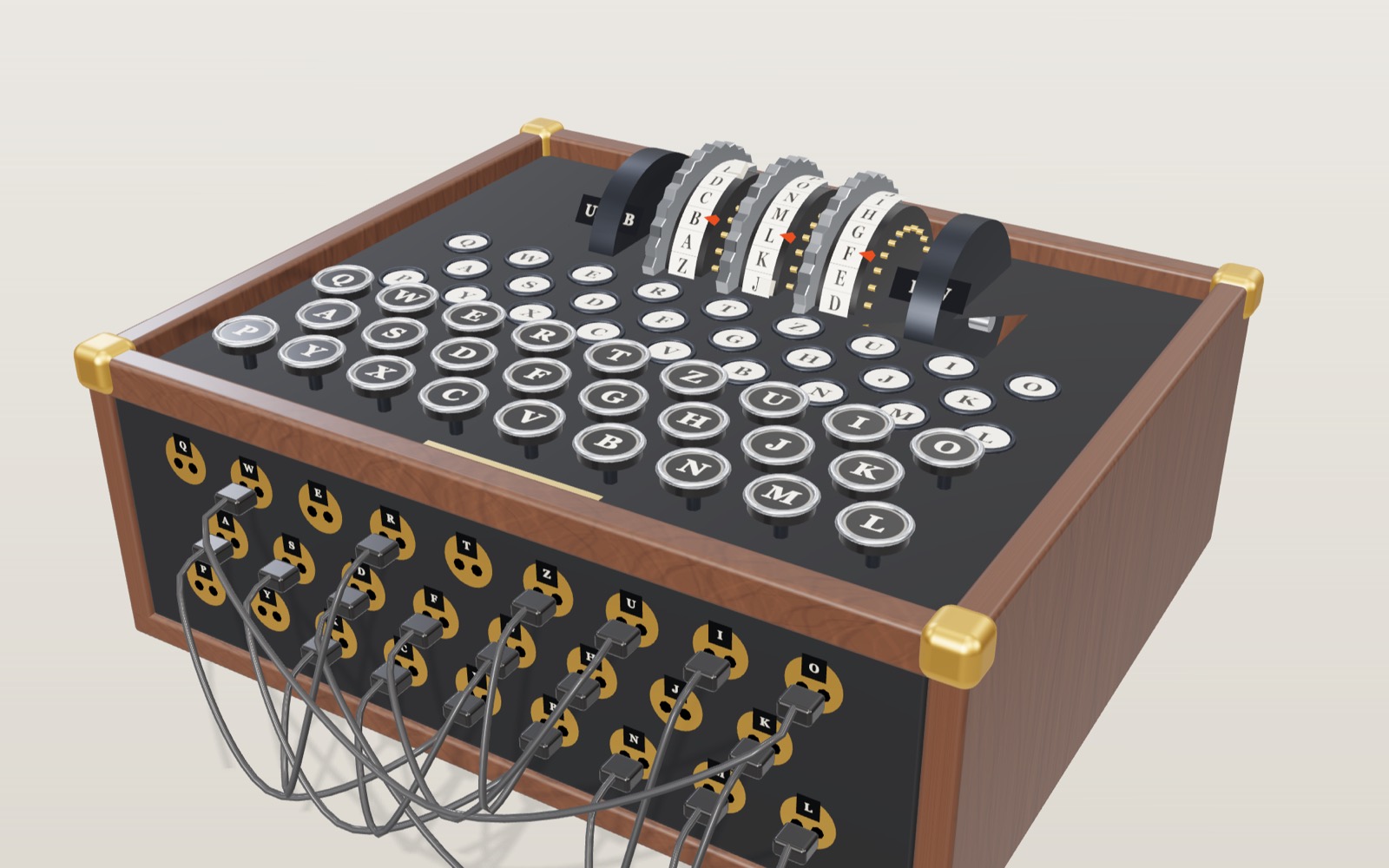
How the Enigma machine worked: rotors, reflector and plugboard
Press A five times on an Enigma set to I-II-III and AAA and the lamps light B, D, Z, G, O.
Braille, semaphore and fingerspelling: how the codes work
A braille dot is 1.5 mm across, and six of them in a 2 by 3 grid give 64 patterns that Korean, English, Japanese and music braille all share.
Writing systems of the world: Hangul and 22 more scripts
The 1446 book that announced Hangul says ㄱ draws the tongue root closing the throat. Here it stands beside 22 other scripts, from clay wedges to Braille.
How a QR code is read
Cover 30 % of a QR code with your hand and a phone still reads it. Cover one corner and it does not.