FIG. 18Follow Along
Writing systems of the world: Hangul and 22 more scripts
The 1446 book that announced Hangul says ㄱ draws the tongue root closing the throat. Here it stands beside 22 other scripts, from clay wedges to Braille.
This device cannot show the 3D model. You can read the guide steps below as text.
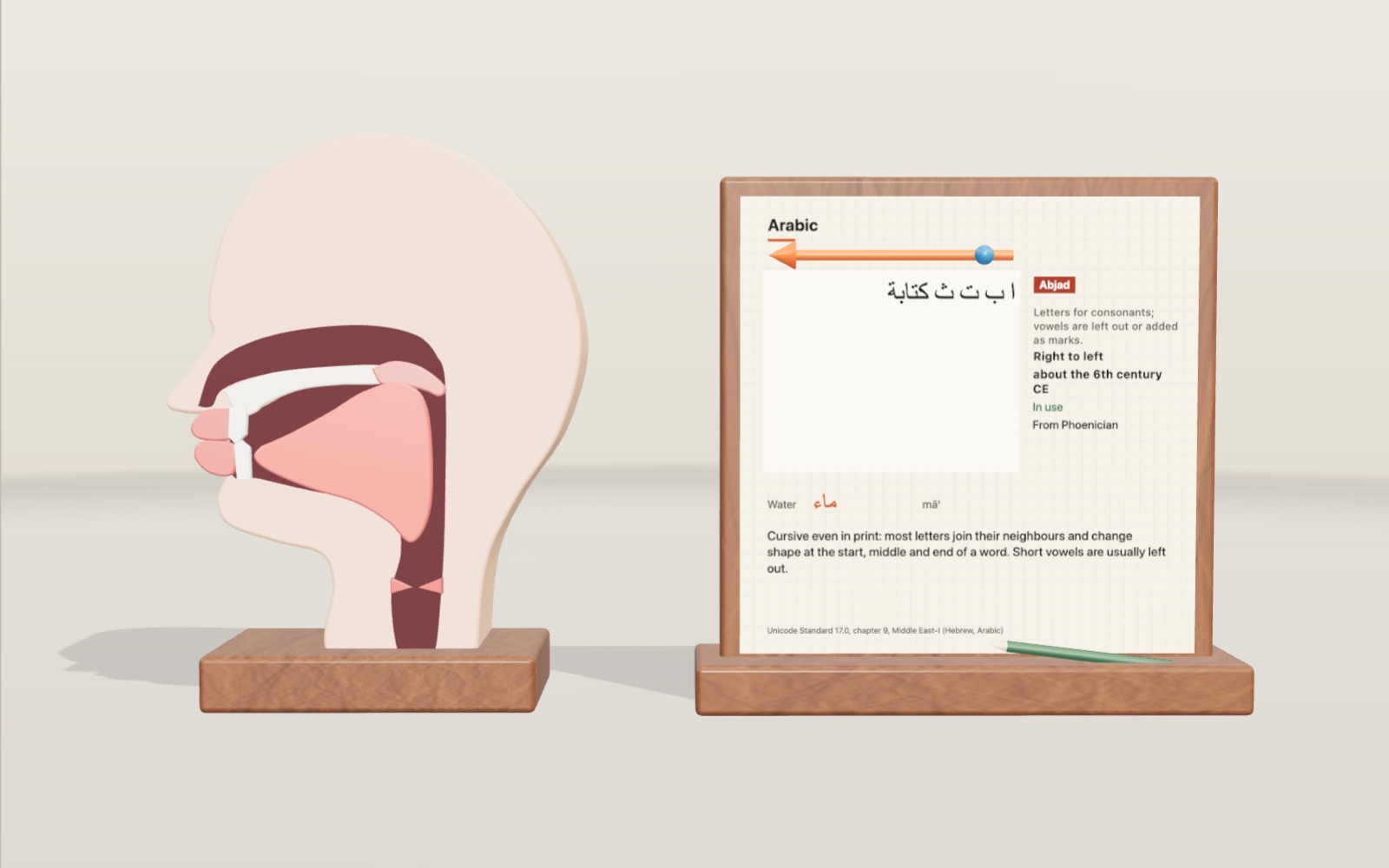
1 / 19 A section of the head, and a writing boardOn the left is a head cut down the middle; on the right is a board to write on. The tongue, lips and soft palate move for each consonant, and the letter itself appears over the section in orange.
Drag to turn. Scroll or pinch to zoom.
What the model shows
Say the Korean word for river, gang, slowly. At the start the back of your tongue presses up against the roof of your mouth and holds the air for a moment. The letter that writes that sound is ㄱ, and according to the book that announced the alphabet in 1446, its shape is a picture of exactly that movement.
On the left of the stage is a head cut down the middle, the way an anatomy atlas shows it: lips, front teeth, the bony hard palate, the soft palate hanging behind it, the tongue, and the throat down to the vocal folds. Pick one of the five basic consonants and the tongue, the lips and the soft palate move to the position for that sound, while the letter itself appears over the section as an orange tube. Turn on Airflow to see where the breath goes: stopped behind the tongue for ㄱ, out through the nose for ㄴ and ㅁ, squeezed through a narrow gap for ㅅ.
On the right is a writing board with twelve pages. Six follow Hangul: the five basic letters, the letters made by adding strokes, the vowels, a syllable builder, stroke order with tracing, and a table of Greek and Cyrillic capitals. Six more widen the view to other scripts: a card for each of 23 writing systems, the word for water in 22 of them, your name in 13, kana beside the kanji they came from, Chinese characters at three periods, and five writing materials shown in 3D in place of the head. The Hangul, Greek, Cyrillic, kanji and kana letters you can trace are not typeset. Each is drawn from a list of strokes stored as coordinates, in the order and direction a hand would write them, which is also what lets the board check your own strokes. The other scripts are set in type, with small font files for the rare ones.
Five letters drawn from the mouth
The Greek alphabet was adapted from the Phoenician one, and Latin was derived from Greek, so their letter shapes were inherited and reshaped over a long time. With Hangul the reasoning survives on paper. The book is called Hunminjeongeum, "the proper sounds for the instruction of the people", and the copy with the full commentary, the Haerye, explains how each letter was made.
The consonants start from five basic shapes, each a picture of the organ that does the main work for that sound. The National Institute of Korean Language summarises them like this:
| Letter | Group in 1446 | What the shape shows |
|---|---|---|
| ㄱ | molar sound | the back of the tongue touching the soft palate |
| ㄴ | tongue sound | the tongue tip touching the gum just behind the upper teeth |
| ㅁ | lip sound | the two lips closed |
| ㅅ | tooth sound | a tooth |
| ㅇ | throat sound | the throat |
The original wording for ㄱ is 象舌根閉喉之形, "it copies the shape of the tongue root closing the throat". Face the head to the left, as the model does, and the match is easy to see. The tongue runs back along the roof of the mouth, then drops down at the back: a horizontal line that turns down, which is ㄱ. For ㄴ the tongue tip stands up against the gum at the front and the body of the tongue runs back from it: a vertical line that turns right.
ㅁ is the closed mouth seen from the front, a square. ㅅ is a pointed tooth. ㅇ is the open throat, a circle, and it is also the only basic letter that today stands for no sound at all at the start of a syllable. In 우유 (milk) both ㅇ letters only fill the initial position.
Adding strokes for stronger sounds
Five letters cannot write a language, so the rest were built from them. The rule is simple: a sound made at the same place but more strongly gets one more stroke. ㄴ becomes ㄷ, and ㄷ becomes ㅌ. ㅁ goes to ㅂ and then ㅍ, ㅅ to ㅈ and then ㅊ, ㅇ to ㆆ and then ㅎ. The molar group only has one step, ㄱ to ㅋ.
On the board's second page each row shows one of these families, with the strokes that are new drawn in orange. Run Play and the rows take turns, each letter drawing itself after the one before.
Three letters do not fit the pattern. ㆁ (a velar nasal, written today with plain ㅇ at the end of a syllable), ㄹ and ㅿ were given their own shapes instead of an extra stroke. The 1446 book calls them letters of a different form.
There is a second way the system grows. Writing a plain letter twice side by side gives the tense consonants ㄲ, ㄸ, ㅃ, ㅆ and ㅉ. The National Institute of Korean Language points out that the three-way contrast between plain, aspirated and tense sounds (ㄱ, ㅋ, ㄲ) is reflected straight in the shapes: one extra stroke for aspiration, a doubled letter for tension.
Vowels from heaven, earth and person
The vowels follow a different idea. Three basic letters stand for the three elements of East Asian philosophy: a round dot · for heaven, a flat line ㅡ for earth, and an upright line ㅣ for a person standing between them.
Every other basic vowel is a combination. Put the dot above ㅡ and you get ㅗ; below it, ㅜ. Put it to the right of ㅣ and you get ㅏ; to the left, ㅓ. Two dots instead of one give ㅛ, ㅠ, ㅑ and ㅕ, which are the same vowels with a short y sound in front. In the 1446 printing the dot really was a round dot. Over time it became the short stroke we write today, and the board's vowel page shows both forms one above the other.
Longer vowels are built by joining letters again: ㅗ with ㅏ gives ㅘ, ㅜ with ㅓ gives ㅝ. ㅐ and ㅔ were also two-part vowels when the alphabet was made, which is why they look like ㅏ and ㅓ with an extra ㅣ. The dot vowel itself is no longer used, because the sound it wrote has disappeared from the language.
How letters stack into a syllable
An alphabet usually puts letters in a row. Hangul has separate letters for consonants and vowels, but it writes them in blocks, one block per syllable. The word for honeybee, kkulbeol, is not written ㄲㅜㄹㅂㅓㄹ in a line but as two blocks, 꿀벌.
A block has up to three positions: the initial consonant, the vowel and the final consonant. Where each goes depends on the vowel. With an upright vowel such as ㅏ the initial sits to its left; with a flat vowel such as ㅗ it sits on top; with a combined vowel like ㅘ it fits into the corner. A final always goes underneath. On the syllable page the three positions are outlined in three colours, and every choice redraws the block.
The numbers, worked out
Modern spelling uses 19 initial consonants, 21 vowels and 27 finals, 16 of them single letters and 11 of them clusters such as ㄺ. Counting "no final" as a choice gives 28 possibilities for the last position.
The Unicode Standard encodes every possible block as its own character and puts them in a fixed order, so the code of any syllable can be calculated:
code = 0xAC00 + (initial × 21 + vowel) × 28 + final
For 한, the initial ㅎ is number 18, the vowel ㅏ is number 0 and the final ㄴ is number 4. So the code is 44032 + (18 × 21 + 0) × 28 + 4 = 54620, written U+D55C. The same arithmetic gives the total: 19 × 21 × 28 = 11,172 syllables. The board shows this sum for whatever block you build, and the readout in the corner shows the character your computer finds at that number.
Stroke order, and how the board checks you
Hangul is written top to bottom and left to right, one stroke at a time. The order used on the board follows that general rule: in ㄹ the top hook comes first, then the middle bar, then the bottom corner, and in 한 the letters go initial, vowel, final. Teaching materials differ on a few letters (ㅈ is sometimes taught as two strokes and sometimes as three), so treat the order here as one common version.
When you draw on the board, your stroke is resampled to 32 points evenly spaced along its length, and so is the stroke the board expects. The board then takes the average distance between matching points. If it is under 7.5 % of the width of the writing square (6 % for a whole syllable), the stroke counts. If your stroke only fits when one of them is reversed, you drew it the wrong way. If it fits a later stroke better than the current one, you skipped ahead. For the circle in ㅇ the board also tries every starting point, so it can tell a circle drawn from the wrong place from one drawn the wrong way round. Missed strokes flash red and fade, and the readout tells you which of these happened.
Greek and Cyrillic side by side
The last page sets twelve Greek capitals beside the Cyrillic letters used for the same sounds. The Unicode Standard describes Cyrillic as a script developed in the ninth century on the basis of Greek, and many pairs still share a shape: Α and А, Γ and Г, Π and П, Φ and Ф. Others moved apart. Δ became Д with feet, Λ became Л, and the sound of Σ is written С. A few pairs look the same but read differently in Latin letters, such as Ρ and Р, both an r.
Each pair is drawn stroke by stroke, Greek first in blue, then Cyrillic in red. Greek and Cyrillic capitals have no single official stroke order, so the order here is simply a natural one for a right-handed writer.
What the model leaves out
The head is a diagram, not a scan. The tongue outline has thirteen control points and moves between five fixed shapes, while a real tongue changes shape continuously. The soft palate swings on one hinge, and the throat shows only the epiglottis and the vocal folds.
The match between the letter and the organ is the 1446 explanation, not a measurement. For ㄱ the book says "tongue root" while modern descriptions usually name the back of the tongue against the soft palate, and the model shows the second. Researchers also note that some letters, such as ㅂ and ㅍ, are hard to explain by added strokes alone. The letters on the board are drawn in a plain, even-width style so the strokes are easy to follow. Handwriting and brush lettering curve and taper in ways that this style does not show.
A short history
King Sejong completed the 28 letters in the winter of 1443. The Hunminjeongeum Haerye was printed from woodblocks in the ninth lunar month of 1446. It has 33 leaves: four of the king's own text, with his preface and the sound of each letter, and 29 of commentary written by eight scholars of the Hall of Worthies, led by Jeong In-ji. The commentary is divided into sections on making the letters, on initials, vowels and finals, on putting letters together, and on examples of use.
A copy was found in 1940 in a family house in Andong. It was designated a National Treasure on 20 December 1962 and is held by the Kansong Art Museum in Seoul. It was inscribed on UNESCO's Memory of the World register in October 1997. Of the original 28 letters, four are no longer used in standard spelling: the dot vowel, ㆆ, ㆁ and ㅿ. That leaves the 24 basic letters taught today.
Twenty-three scripts, sorted by how they work
Press 23 scripts and the board turns into a comparison card. The list runs from cuneiform, pressed into clay in Uruk around 3200 BCE, to Braille, published in Paris in 1829. Each card gives the type of the script, the direction it is written, the earliest date its source gives, whether it is still in daily use, the script it grew out of where that is known, a sample, the word for water, and a short description. The bar under the controls changes the script one step at a time, and the directory below the stage lists all 23 with filters.
The colour badge names the type, and the type is the first thing to look at, because it tells you what a single sign stands for.
An alphabet has separate letters for consonants and vowels. Greek was the first script in the list to do this; Latin, Cyrillic, Armenian and Georgian followed the same idea, and so did the runes. An abjad writes consonants and leaves most vowels out. Phoenician had 22 consonant letters and nothing else. Hebrew and Arabic still work this way: the reader supplies the vowels from knowledge of the language, and points or small marks can be added for children, for scripture or for unusual words. The Unicode Standard puts it plainly for Hebrew: vowel points are usually omitted except in liturgical texts.
An abugida gives every consonant letter a built-in vowel and changes it with a mark. In Devanagari, क is ka; add the sign ि and it becomes कि, ki; add the virama and the vowel disappears. Thai, Tibetan and Bengali come from the same Brahmi family and work in the same broad way. Ethiopic is an abugida with a different look: each consonant has seven forms, one per vowel order, and the extra strokes and loops are attached to the base sign. ለ, ሉ, ሊ, ላ are le, lu, li, la.
A syllabary has one sign per syllable with no visible parts. Japanese kana and Sequoyah's Cherokee are the two in this exhibit. Cherokee has 85 signs today; the first version had 86. Kana has 46 basic signs in each of its two sets.
A logosyllabic script mixes signs for whole words with signs for sounds. Cuneiform, Egyptian hieroglyphs, Chinese characters and Maya all belong here, which is also why they have hundreds or thousands of signs. Many Chinese characters combine a part that hints at the meaning with a part that hints at the sound.
Hangul gets its own label, featural alphabet, because its shapes record how the sound is made: the place of the tongue or lips in the five basic consonants, an extra stroke for a stronger sound, and the dot, line and upright for vowels. Braille is labelled a dot code. Six raised dots in two columns give 64 patterns, and the Unicode Standard notes that no pattern has a fixed meaning: each language assigns its own.
Which way the line runs
Most of the scripts on the board run left to right, but not all. When the comparison card is open, an orange arrow stands in front of the board and a blue bead runs along it in the direction of writing.
Phoenician, Hebrew and Arabic run right to left. Arabic adds a second difficulty: it is cursive even in print, so most letters join to the next one, and a letter has different shapes at the start, in the middle and at the end of a word. Egyptian hieroglyphs could run either way, and the signs of people, birds and animals face the beginning of the line. A reader meets the signs face to face. On the board the hieroglyph line runs right to left, so each sign is drawn mirrored to look right. Turn on Other direction and the line runs left to right, and the signs turn round to face the new start.
Mongolian runs top to bottom, and the columns follow each other from left to right. That is unusual; Chinese, Japanese and Korean books set vertically run their columns from right to left. With vertical text the arrow points down and a short second arrow under the sample shows which way the columns move. The board draws Mongolian the way type engines do: the line is shaped horizontally and turned a quarter turn clockwise, which is how Mongolian fonts are designed to be used.
Other direction works for every script. It is not a real way of writing any of them. It is there to show what changes. Latin set right to left is still readable but every word looks wrong; Arabic set letter by letter in the other direction loses its joins, which shows how much of the Arabic shape lives in the connections between letters rather than in the letters themselves.
The same word in 22 scripts
One word puts the word for water side by side in 22 scripts, each in the main language that script writes today or wrote when it was in use, with a Latin transliteration underneath. English water sits next to Russian вода, Hindi पानी, Thai น้ำ, Amharic ውሃ and Cherokee ᎠᎹ. Cuneiform writes Sumerian a with one sign, 𒀀. The hieroglyph is three rippling lines of water. Braille writes water as five cells.
Seen together, the 22 tiles show the types at a glance. The logosyllabic scripts need one or two signs for the whole word. The alphabets need four or five letters. The abjads write m-y-m in Phoenician and Hebrew without the vowels. Maya is left out of this page because its signs are not yet in Unicode; the Maya card shows Maya numerals instead, which are encoded: a dot is one, a bar is five, and a shell is zero.
Writing your name in other scripts
Your name respells a name in 13 scripts. Type it in Latin letters or in Hangul. The tool first turns the name into a short list of sounds. Hangul is romanized letter by letter with the Revised Romanization table, so 마주환 becomes majuhwan. Latin letters are read with a small table of digraphs: sh, ch, th, ph, ng, ee, oo, and a few more. Then each script spells those sounds its own way.
How it spells them shows the type of the script. Katakana and Ethiopic need a sign for each consonant and vowel together, so Maria is マリア in katakana and ማሪያ in Ethiopic. Devanagari writes the consonant with a vowel sign, मारिया, and uses the virama on a consonant with no vowel. Arabic and Hebrew write the consonants and use the long-vowel letters for the vowels, the usual way foreign names are spelled in those scripts, and Hebrew switches to the final forms ם, ן, ף, ץ at the end of a word. Greek and Cyrillic are almost letter for letter. Braille spells the Latin letters with a capital sign in front.
The board says it clearly: this is a respelling from a rule table, and real spellings often differ. A Korean name romanized without the sound-change rules can look odd; Kim may be written Gim by the official table. Names have customary spellings in each country that no table predicts. The tool is meant to show how the scripts work, not to produce a name for a passport.
Kana from kanji, and Chinese characters over time
Kana from kanji shows 15 kana beside the Chinese characters they came from. Hiragana grew out of cursive forms of whole characters: あ from 安, い from 以, か from 加. Katakana took a part of a character: ア is the left side of 阿, イ the left side of 伊, エ is 江 without its water radical. The pairs follow the table in a Kansai University paper that cites Morioka's illustrated dictionary of kana origins. One of the tasks below asks you to match six of them.
Han over time draws six characters at three stages: the shape on Shang oracle bones from about 1300 to 1050 BCE, the small seal shape, and regular script. The sun starts as a circle with a mark inside and ends as a rectangle with a bar. Water starts as a winding river with drops on both sides; in regular script the river is the hooked middle stroke and the drops became the strokes on either side. The oracle-bone and seal drawings are simplified versions made for this model, so they show the idea of each shape rather than any one inscription.
Stroke order with a brush
The stroke-order page now has a second row: eight Chinese characters and twelve kana. A brush follows the pen as the order plays, and Rewind stroke order lets you drag through the strokes by hand, forward and back. 水 has four strokes: the hooked middle, the left part, the short stroke at the upper right, and the long sweep to the lower right. 木 starts with the bar, then the upright, then the two falling strokes. In 山 the middle comes first, then the left side with the bottom in one stroke, then the right side.
You can trace any of these on the board. The same matching test as for Hangul decides whether each stroke is in the right place, in the right direction and in the right order. Turn Brush off to see the strokes at the plain pen width.
What people wrote on
Materials replaces the head with five objects, one at a time, and the board explains each.
The clay tablet is the oldest. Cuneiform began as bookkeeping for rations of bread and beer in cities like Uruk, and the British Museum describes it as in use for more than 3,000 years. A scribe pressed the end of a cut reed into wet clay; every press leaves a wedge, which is why the signs are clusters of wedges and why cuneiform has so few curves. The model's tablet has seven ruled lines of wedge clusters and a reed beside it.
The papyrus roll comes from Egypt. Strips of the papyrus stem were laid in two layers at right angles, pressed and dried, and the sheets were glued into a roll. The model shows a sheet with columns of hieroglyphs in black and red ink and the rest of the roll at the side.
Bamboo slips carried Chinese writing long before paper. A text was written top to bottom on narrow strips and the strips were tied side by side with cord. The Tsinghua University collection of Warring States slips, from 475 to 221 BC, holds more than 70 texts, over 60 of which had been lost for more than 2,000 years. Vertical columns running right to left, the old direction of Chinese books, follow naturally from a bundle of slips.
The parchment codex is animal skin folded into pages and bound at the spine. Codex Sinaiticus, a Greek Bible written in the fourth century, is one of the earliest surviving examples; the British Library catalogues it as one parchment codex. Its text is in capitals with no spaces between words, as the model's pages show.
Movable metal type is the last. One character is cast on each metal block, the blocks are set in a frame, inked and pressed onto paper. On the type itself every character is a mirror image, and the model shows the faces reversed. UNESCO records that Jikji was printed with movable metal type at Heungdeok-sa temple in Cheongju in July 1377; its second volume is held by the National Library of France.
When a country changes its script
The case list below the stage includes several changes of script. On 1 November 1928 Türkiye passed Law 1353, which replaced the Arabic script with Latin letters for Turkish; the Official Gazette printed it on 3 November. Indonesian and Malay, once written in Arabic script, now use Latin letters, and Azerbaijani moved from Cyrillic to a Latin alphabet based on Turkish. Vietnamese is written in a Latin alphabet with many diacritics, chữ Quốc ngữ, whose spelling grew from the work of missionaries; the dictionary of Alexandre de Rhodes printed in Rome in 1651 used it.
Other changes kept the script but trimmed it. Japan's jōyō kanji table of 2010 lists 2,136 characters for general use, and the four Hangul letters dropped from modern spelling left the 24 basic letters taught today. New scripts keep appearing too: Sequoyah completed the Cherokee syllabary in 1821, and within a few years the Cherokee Council used it for the bilingual Cherokee Phoenix. James Evans designed syllabics for Algonquian languages in the late 1830s, and Inuktitut speakers use them today.
Putting every script into one standard
Every letter on the 23 cards except Maya is a Unicode character. Unicode 17.0, released on 9 September 2025, holds 159,801 characters. Its new CJK Extension J block added 4,298 ideographs and took the number of encoded Han characters past 100,000. Hangul syllables are a special case: rather than listing 11,172 blocks one by one, Unicode places them in an order that a formula reproduces, and the syllable page shows that formula working.
Scripts with shaping rules need more than a list of characters. Arabic letters must join, Devanagari consonants must combine with vowel signs and with each other, Mongolian letters change by position, and Thai vowel signs sit above, below, before or after their consonant. The board leaves that work to the browser's text engine. For the rare scripts most devices do not carry, the exhibit loads small subsets of Noto fonts under the SIL Open Font License, about 116 KB in all, containing only the characters drawn here.
Try it yourself
Below the controls are seven tasks. Pick the three scripts in a list that run right to left. Choose which of four scripts writes only consonants. Build 닭, chicken, in the syllable builder; its final is the double consonant ㄺ, and the Unicode arithmetic gives U+B2ED. Match six kana to the kanji they came from. Pick the oldest of five scripts. Trace 水 in stroke order. Type a name of two or more syllables and read its Ethiopic spelling. Finished tasks keep their tick on your device.
Questions
Why does ㄱ look like the back of the tongue?
The 1446 commentary says ㄱ copies the shape of the tongue root closing the throat. Seen from the side with the face to the left, the tongue runs back under the palate and turns down at the back, which is the horizontal and vertical of ㄱ.
Is ㅇ silent?
At the start of a syllable it is. It only fills the initial position, as in 우유. At the end of a syllable it is pronounced as a nasal, as at the end of gang. In 1446 that nasal had its own letter, ㆁ, which later merged with ㅇ.
How many syllables can Hangul write?
Unicode encodes 19 × 21 × 28 = 11,172 precomposed syllable blocks. Most of them never appear in real words, but every one can be built on the board.
What happened to the four letters that are no longer used?
The dot vowel fell out of use because the sound it wrote disappeared. ㆆ, ㆁ and ㅿ are also gone from modern standard spelling, which uses 24 basic letters.
Is the stroke order fixed?
The general rule, top to bottom and left to right, is shared by all teaching materials. A few letters are taught slightly differently, so the board accepts only the order it shows and tells you when you go out of turn.
Why do Greek and Cyrillic letters look alike?
Cyrillic was developed in the ninth century on the basis of the Greek alphabet, and many capitals kept the Greek shape. The Unicode Standard notes that the earliest surviving Cyrillic texts are Old Church Slavonic manuscripts from the tenth century, and that the details of how the script developed have been lost.
How does the board decide a stroke is wrong?
It compares 32 evenly spaced points on your stroke with 32 on the expected one. An average gap under 7.5 % of the square counts as a match. The same test run backwards, or against later strokes, tells it whether you reversed the stroke or skipped ahead.
Can I trace a syllable I built myself?
Yes. Build a block on the syllable page and press "Trace this one". The board writes it with the initial, vowel and final in order.
Which is the oldest writing system?
Of the scripts here, cuneiform and Egyptian hieroglyphs are the oldest, both from around 3200 BCE. The board dates cuneiform to the accounts of Uruk, following the British Museum. In the task that asks for the oldest of five, cuneiform is the answer because hieroglyphs are not among the choices.
What is the difference between an abjad and an abugida?
An abjad writes consonants and leaves vowels out or adds them as optional marks, as Hebrew and Arabic do. An abugida also starts from consonants, but every consonant carries a vowel, and a mark changes that vowel; Devanagari क is ka and कि is ki. In an abjad you cannot tell the vowel from the letters alone; in an abugida you always can.
Why do some scripts run right to left?
The direction was settled long ago and carried on from parent to child script. Phoenician ran right to left, and Hebrew and Arabic kept that direction. Greek writing went through a period of changing direction from line to line before settling on left to right, and Latin and Cyrillic inherited that. The board shows each script in its usual direction, and Other direction shows what it looks like the other way.
Why are the hieroglyphs turned around?
Hieroglyphs of people and animals face the start of the line. Unicode stores them facing left, the way a left-to-right line needs them. The board writes the line right to left, so it mirrors each sign to keep it facing the start.
Why is Maya missing from the water page?
The Maya signs are not encoded in Unicode yet, so there is no standard way to type or store them. Only the Maya numerals are encoded. The Maya card draws those numerals instead of letters.
Is my name spelled correctly?
Probably not exactly. The tool respells sounds with a rule table, one script at a time. It does not know the customary spelling of a name in a given country, and a Hangul name is romanized without sound-change rules. The result shows how each script builds a word; it is not a translation.
Terms
- Initial, vowel, final (choseong, jungseong, jongseong): the three positions in a Hangul syllable block.
- Basic letter: one of the five consonants drawn from the speech organs, or one of the three vowels ·, ㅡ and ㅣ.
- Added stroke (gahoek): an extra stroke that turns a letter into one for a stronger sound at the same place.
- Different-form letter: ㆁ, ㄹ and ㅿ, which were given their own shapes instead of an added stroke.
- Soft palate: the muscular back part of the roof of the mouth. Lowered, it lets air out through the nose.
- Haerye: the commentary part of the 1446 book, which explains how the letters were made and used.
- Precomposed syllable: a whole Hangul block encoded as one Unicode character.
- Abjad: a script that writes consonants and leaves most vowels out, such as Hebrew and Arabic.
- Abugida: a script in which every consonant letter carries a vowel that marks can change, such as Devanagari and Ethiopic.
- Syllabary: a script with one sign per syllable, such as kana and Cherokee.
- Logosyllabic: a script that mixes signs for words with signs for sounds, such as cuneiform and Chinese characters.
- Codex: a book of folded pages bound at the spine, as opposed to a roll.
- Movable type: one cast block per character, set in a frame for printing and reused.
- Transliteration: writing the letters of one script with the letters of another.
Sources
- Korea Heritage Service, National Heritage Portal, Hunminjeongeum (National Treasure). https://www.heritage.go.kr/heri/cul/culSelectDetail.do?ccbaCpno=1111100700000 (checked 16 October 2026)
- Korea Heritage Service, Memory of the World in Korea: Hunminjeongeum Haerye. https://www.heritage.go.kr/heri/html/HtmlPage.do?pageNo=4_4_2_1&pg=%2Funesco%2FMemHeritage%2FMemHeritage_01.jsp (checked 16 October 2026)
- National Institute of Korean Language, About Hangeul, essay by Kang Chang-seok on the limits of the design principles (ㅁ, ㅂ and ㅍ). https://www.korean.go.kr/hangeul/short/004g.html (checked 16 October 2026)
- National Institute of Korean Language, About Hangeul: the letters (19 initials, 21 vowels, 27 finals). https://www.korean.go.kr/hangeul/principle/001.html (checked 16 October 2026)
- National Institute of Korean Language, About Hangeul: consonants. https://www.korean.go.kr/hangeul/principle/002.html (checked 16 October 2026)
- National Institute of Korean Language, About Hangeul: vowels. https://www.korean.go.kr/hangeul/principle/003.html (checked 16 October 2026)
- National Institute of Korean Language, online Q&A on the design of ㄱ and ㆁ in the Haerye. https://www.korean.go.kr/front/onlineQna/onlineQnaView.do?mn_id=&pageIndex=1&qna_seq=336058 (checked 16 October 2026)
- National Institute of Korean Language, Hunminjeongeum Explained in Plain Language (modern Korean and English translations of the Haerye). https://www.korean.go.kr/front/etcData/etcDataView.do?etc_seq=693&mn_id=46&pageIndex=3 (checked 16 October 2026)
- Unicode Consortium, The Unicode Standard 16.0, chapter 3, section 3.12, Conjoining Jamo Behavior. https://www.unicode.org/versions/Unicode16.0.0/core-spec/chapter-3/ (checked 16 October 2026)
- Unicode Consortium, The Unicode Standard 16.0, chapter 7, Europe I (Greek and Cyrillic). https://www.unicode.org/versions/Unicode16.0.0/core-spec/chapter-7/ (checked 16 October 2026)
- Unicode Consortium, code charts Greek and Coptic and Cyrillic. https://www.unicode.org/charts/PDF/U0370.pdf and https://www.unicode.org/charts/PDF/U0400.pdf (checked 16 October 2026)
- Unicode Consortium, Unicode 17.0.0 (159,801 characters, CJK Extension J). https://www.unicode.org/versions/Unicode17.0.0/ (checked 18 October 2026)
- Unicode Standard 17.0, chapter 7, Europe-I (Latin, Greek, Cyrillic, Armenian, Georgian). https://www.unicode.org/versions/Unicode17.0.0/core-spec/chapter-7/ (checked 18 October 2026)
- Unicode Standard 17.0, chapter 8, Europe-II (Linear A, Runic). https://www.unicode.org/versions/Unicode17.0.0/core-spec/chapter-8/ (checked 18 October 2026)
- Unicode Standard 17.0, chapter 9, Middle East-I (Hebrew, Arabic). https://www.unicode.org/versions/Unicode17.0.0/core-spec/chapter-9/ (checked 18 October 2026)
- Unicode Standard 17.0, chapter 10, Middle East-II (Phoenician). https://www.unicode.org/versions/Unicode17.0.0/core-spec/chapter-10/ (checked 18 October 2026)
- Unicode Standard 17.0, chapter 11, Cuneiform and Hieroglyphs. https://www.unicode.org/versions/Unicode17.0.0/core-spec/chapter-11/ (checked 18 October 2026)
- Unicode Standard 17.0, chapter 12, South and Central Asia-I (Devanagari, Bengali). https://www.unicode.org/versions/Unicode17.0.0/core-spec/chapter-12/ (checked 18 October 2026)
- Unicode Standard 17.0, chapter 13, South and Central Asia-II (Tibetan, Mongolian). https://www.unicode.org/versions/Unicode17.0.0/core-spec/chapter-13/ (checked 18 October 2026)
- Unicode Standard 17.0, chapter 16, Southeast Asia-I (Thai). https://www.unicode.org/versions/Unicode17.0.0/core-spec/chapter-16/ (checked 18 October 2026)
- Unicode Standard 17.0, chapter 18, East Asia (Han, Hiragana and Katakana, Hangul). https://www.unicode.org/versions/Unicode17.0.0/core-spec/chapter-18/ (checked 18 October 2026)
- Unicode Standard 17.0, chapter 19, Africa (Ethiopic). https://www.unicode.org/versions/Unicode17.0.0/core-spec/chapter-19/ (checked 18 October 2026)
- Unicode Standard 17.0, chapter 20, Americas (Cherokee, Canadian Aboriginal Syllabics). https://www.unicode.org/versions/Unicode17.0.0/core-spec/chapter-20/ (checked 18 October 2026)
- Unicode Standard 17.0, chapter 21, Notational Systems (Braille). https://www.unicode.org/versions/Unicode17.0.0/core-spec/chapter-21/ (checked 18 October 2026)
- British Museum, How to write cuneiform. https://www.britishmuseum.org/blog/how-write-cuneiform (checked 18 October 2026)
- The Metropolitan Museum of Art, Heilbrunn Timeline, The Origins of Writing. https://www.metmuseum.org/essays/the-origins-of-writing (checked 18 October 2026)
- British Museum, Everything you ever wanted to know about the Rosetta Stone. https://www.britishmuseum.org/blog/everything-you-ever-wanted-know-about-rosetta-stone (checked 18 October 2026)
- British Museum, Hieroglyphs resources. https://www.britishmuseum.org/hieroglyphs-resources (checked 18 October 2026)
- Smithsonian National Museum of Asian Art with Smarthistory, Oracle Bone, Shang Dynasty (S2012.9.445). https://smarthistory.org/oracle-bone/ (checked 18 October 2026)
- Israel Antiquities Authority, The Leon Levy Dead Sea Scrolls Digital Library. https://www.deadseascrolls.org.il/ (checked 18 October 2026)
- UNESCO Memory of the World, Hunminjeongum Manuscript. https://www.unesco.org/en/memory-world/hunminjeongum-manuscript (checked 18 October 2026)
- UNESCO Memory of the World, nomination form, Hunmin Chongum (Hangul Day set in 1946). https://media.unesco.org/sites/default/files/webform/mow001/republic_of_korea_hunmin_chongum.pdf (checked 18 October 2026)
- UNESCO Memory of the World, Baegun hwasang chorok buljo jikji simche yojeol (vol. II). https://www.unesco.org/en/memory-world/baegun-hwasang-chorok-buljo-jikji-simche-yojeol-volii-second-volume-anthology-great-buddhist-priests (checked 18 October 2026)
- UNESCO Memory of the World, The King Ram Khamhaeng Inscription. https://www.unesco.org/en/memory-world/king-ram-khamhaeng-inscription (checked 18 October 2026)
- US National Library of Medicine, Native Voices timeline, 1821: Sequoyah's syllabary. https://www.nlm.nih.gov/nativevoices/timeline/270.html (checked 18 October 2026)
- US National Park Service, Kennesaw Mountain, Cherokee Language. https://www.nps.gov/kemo/learn/historyculture/cherokeelanguage.htm (checked 18 October 2026)
- New York Public Library, Cherokee syllabary developed by Sequoyah (85 characters, originally 86). https://www.nypl.org/events/exhibitions/galleries/beginnings/item/15807 (checked 18 October 2026)
- American Foundation for the Blind, Louis Braille online museum, Books in Braille (1829). https://afb.org/about-afb/history/online-museums/life-and-legacy-louis-braille/braille-nvents-his-code/books (checked 18 October 2026)
- Resmî Gazete (Official Gazette of Türkiye), issue 1030, 3 November 1928, Law 1353 on the Turkish letters. https://www.resmigazete.gov.tr/arsiv/1030.pdf (checked 18 October 2026)
- Dinh-Hoa Nguyen, Alexandre de Rhodes' dictionary (1651), Papers in Linguistics 19 (1986). https://doi.org/10.1080/08351818609389247 (checked 18 October 2026)
- Agency for Cultural Affairs, Japan, Jōyō kanji table (2,136 characters, 2010). https://www.bunka.go.jp/kokugo_nihongo/sisaku/joho/joho/kijun/naikaku/kanji/ (checked 18 October 2026)
- Saxon State and University Library Dresden (SLUB), Codex Dresdensis, digital copy. https://digital.slub-dresden.de/werkansicht/dlf/2967/1 (checked 18 October 2026)
- Saturno, Stuart and Beltrán, Early Maya writing at San Bartolo, Guatemala, Science 311 (2006). https://doi.org/10.1126/science.1121745 (checked 18 October 2026)
- Kansai University, Wakumon 34, table of hiragana and katakana source characters (after Morioka 2006). http://www2.kansai-u.ac.jp/shkky/wakumon/no-34/03lihong.pdf (checked 18 October 2026)
- British Library, Codex Sinaiticus, Add MS 43725 (parchment codex, 4th century). https://searcharchives.bl.uk/catalog/032-002169711 (checked 18 October 2026)
- Tsinghua University, Tsinghua bamboo slips (Warring States, 475 to 221 BC). https://www.tsinghua.edu.cn/en/info/1245/14429.htm (checked 18 October 2026)
- Noto fonts (Cuneiform, Egyptian Hieroglyphs, Phoenician, Runic, Ethiopic, Tibetan, Mongolian, Cherokee), SIL Open Font License 1.1, subsets in this exhibit. https://github.com/notofonts (checked 18 October 2026)
- Calculations on this page: syllable codes from 0xAC00 + (L × 21 + V) × 28 + T; stroke matching on 32 resampled points per stroke.
More exhibits
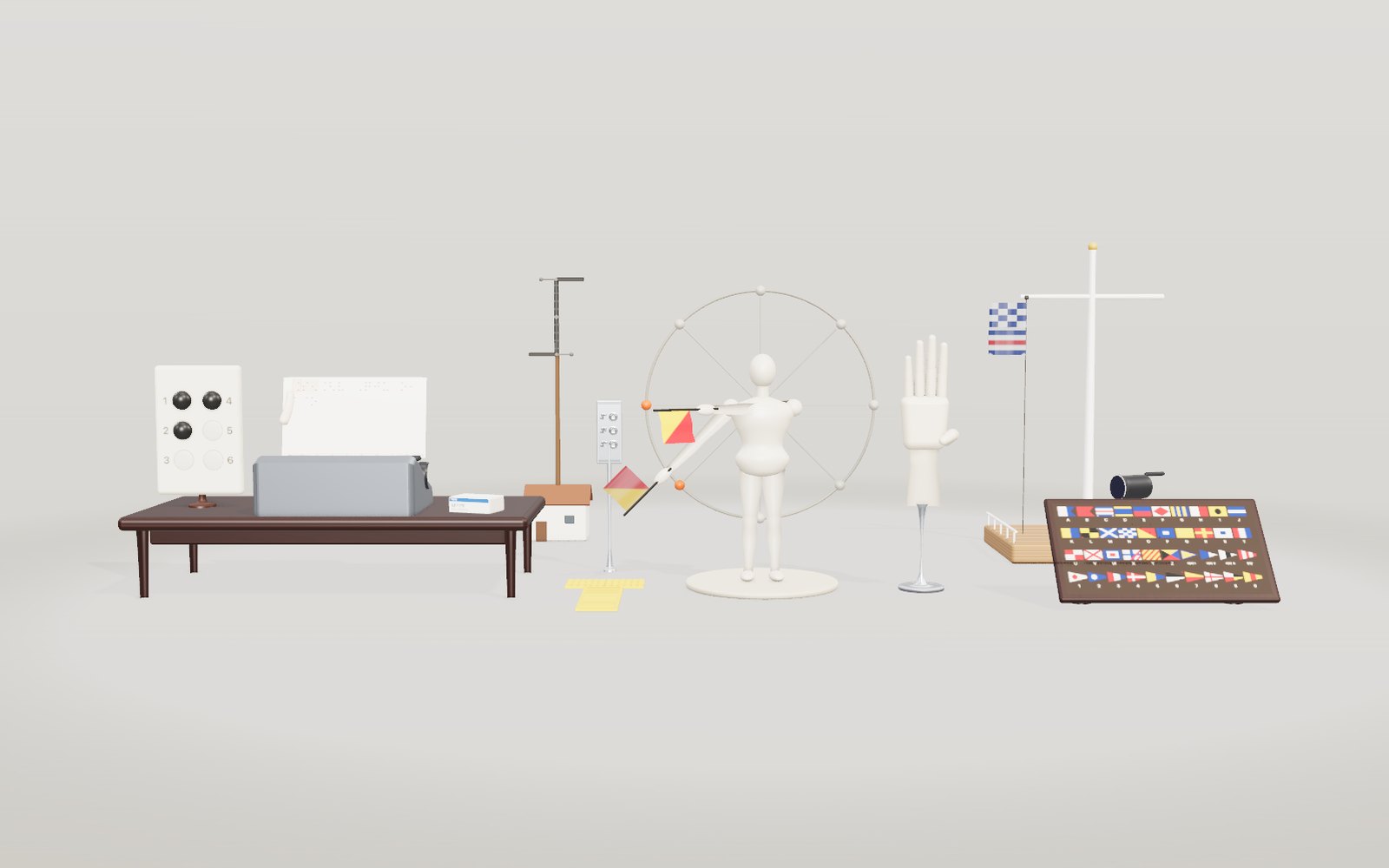
Braille, semaphore and fingerspelling: how the codes work
A braille dot is 1.5 mm across, and six of them in a 2 by 3 grid give 64 patterns that Korean, English, Japanese and music braille all share.
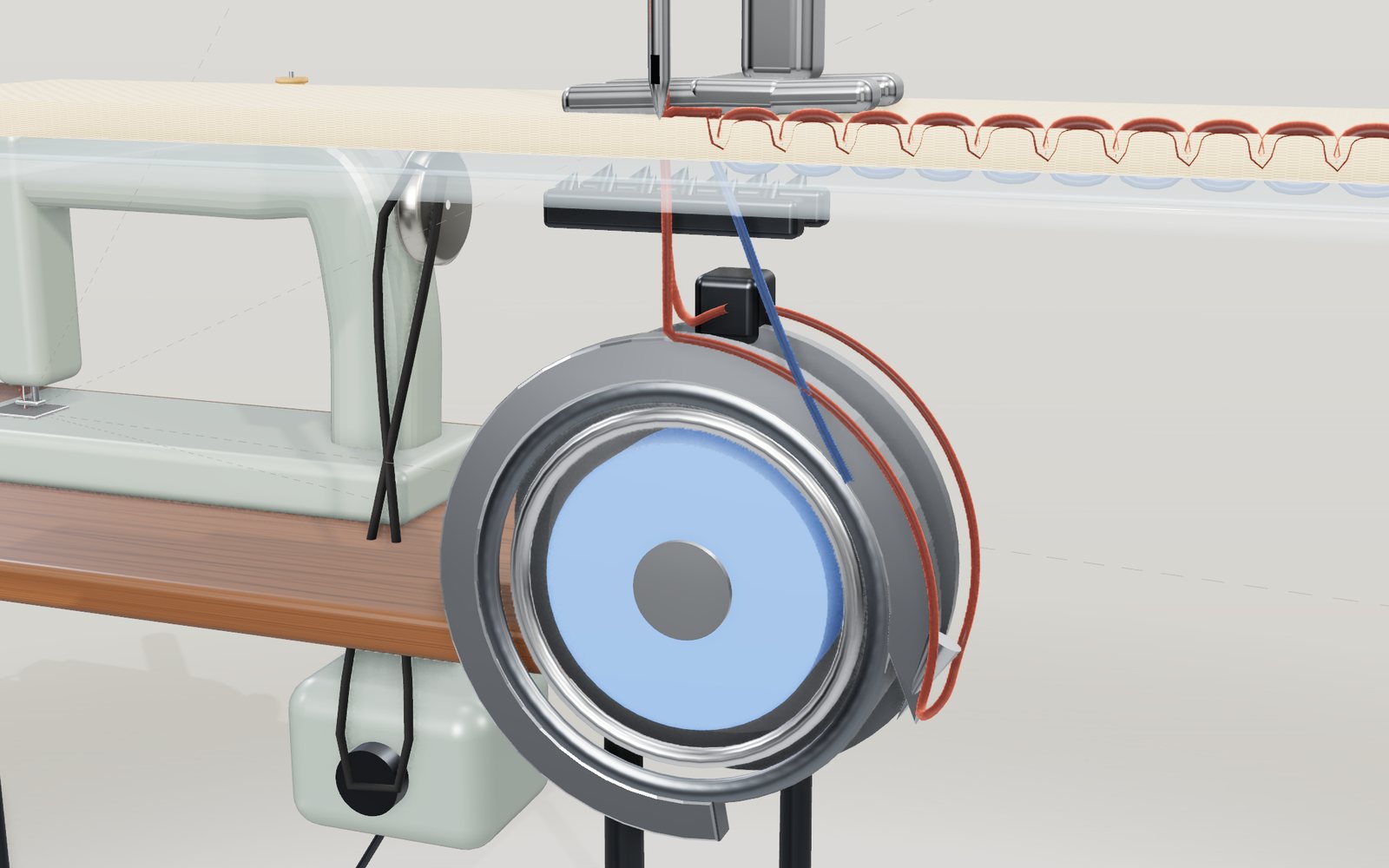
How a sewing machine makes a stitch
A sewing machine needle never goes through the cloth: at every stitch the hook drags its thread right round the bobbin instead.
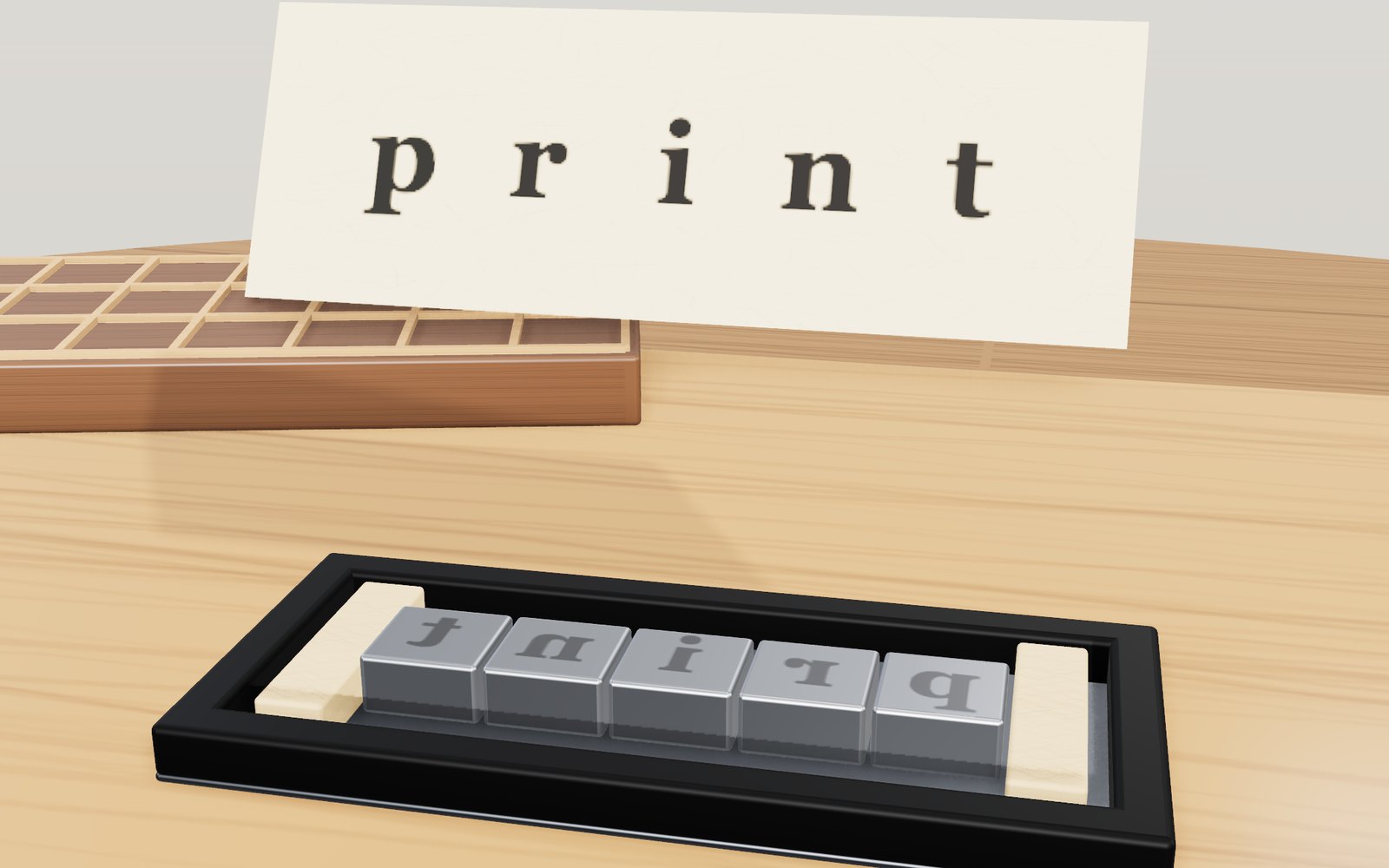
Movable type and the printing press
A piece of type carries its letter back to front. Ink it, press paper on it, turn the sheet over, and the letter reads the right way round.
How a typewriter works: inside a manual typewriter
On a pica typewriter every letter, space and full stop moves the carriage the same 2.54 mm to the left.
How a 3D printer works, layer by layer
A 20 mm cube printed in 0.2 mm layers is exactly 100 layers, each drawn by a nozzle 0.4 mm wide.
Origami: 20 models to fold step by step and unfold
A crane uses about 30 folds, a cup six; every flat-folded point you make has mountains and valleys that differ by exactly two.