Loading the model
This device cannot show the 3D model. You can read the guide steps below as text.
1 / 19 A section of the head, and a writing board On the left is a head cut down the middle; on the right is a board to write on. The tongue, lips and soft palate move for each consonant, and the letter itself appears over the section in orange.
Drag to turn. Scroll or pinch to zoom.
Guide Parts Controls
01 A section of the head, and a writing board On the left is a head cut down the middle; on the right is a board to write on. The tongue, lips and soft palate move for each consonant, and the letter itself appears over the section in orange.
02 ㄱ is the back of the tongue When the back of the tongue rises against the soft palate, the air is stopped. The 1446 commentary says ㄱ shows the tongue root closing off the throat. The blue beads show the airflow.
03 Tongue tip, lips, teeth and throat ㄴ is the tongue tip on the upper gum, ㅁ the mouth, ㅅ a tooth and ㅇ the throat. For ㄴ and ㅁ the soft palate drops and the air leaves through the nose.
04 A stroke for a stronger sound Add one stroke to ㄴ and you get ㄷ; add another and you get ㅌ. The new strokes are drawn in orange. ㆁ, ㄹ and ㅿ break the pattern and were given their own shapes.
05 Vowels from heaven, earth and person The round ·, the flat ㅡ and the upright ㅣ are the base. In 1446 ㅗ was a dot sitting on a line; today the dot has become a short stroke.
06 Letters stacked into one syllable Pick an initial, a vowel and a final. With an upright vowel the initial sits to its left, with a flat vowel it sits on top. The board works out the Unicode number of the block.
07 Trace it stroke by stroke First the stroke order plays. Draw on the board with a mouse or a finger and the animation stops; each stroke is checked for direction and order. The view stays still while you write.
08 Greek and Cyrillic Greek and Cyrillic capitals for the same sound stand side by side. Some pairs share a shape, like Γ and Г; others drifted apart, like Δ and Д.
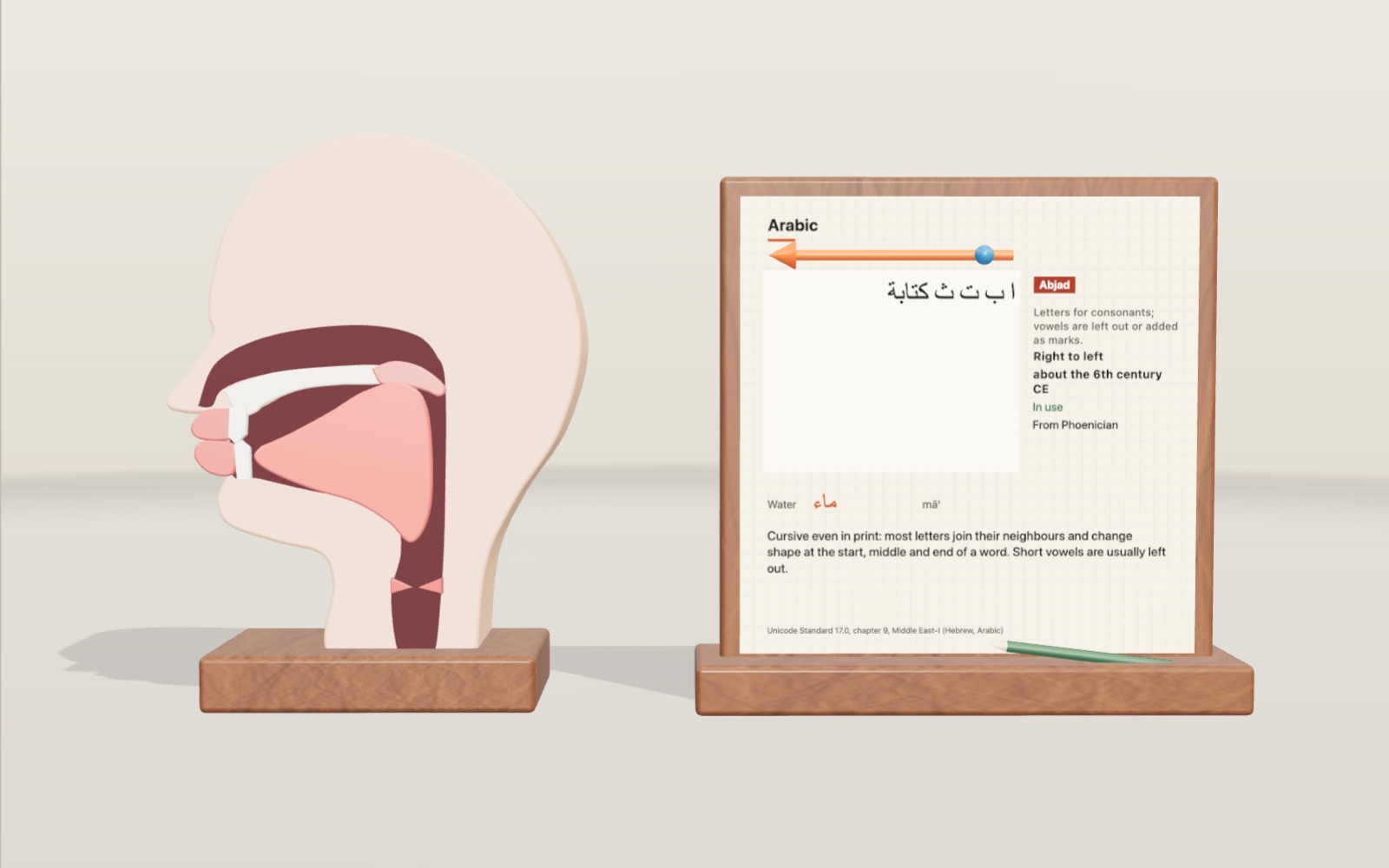
09 23 scripts on one board Press 23 scripts to change the board to the comparison view. Arabic is an abjad: letters for consonants, written right to left and joined even in print. The orange arrow in front of the board shows the direction of writing.
10 Columns that move to the right Mongolian runs top to bottom, and each new column starts to the right of the last. The arrow turns to point down, and a short arrow under the sample shows which way the columns go.
11 Hieroglyphs face the start of the line Signs of people and animals look toward the beginning of the line, so a reader meets their faces. Turn on Other direction and the line runs the other way: the signs turn round with it.
12 One consonant, seven vowels In Ethiopic each consonant has seven forms, one for each vowel. The base sign gets a small stroke or loop: ለ le, ሉ lu, ሊ li, ላ la. This is an abugida.
13 The same word in 22 scripts The word for water, written in the main language of each script, with the Latin transliteration underneath. Cherokee ᎠᎹ, ama, is two syllable signs.
14 Your name in 13 scripts Type a name in Latin letters or Hangul. A rule table turns it into sounds and spells the sounds with each script. Real spellings in each country can differ, and the board says so.
15 Kana drawn from kanji Hiragana あ is the cursive form of 安, katakana ア is the left part of 阿. Six pairs are waiting in the Try it section below.
16 Han characters over three periods Water starts as a wavy river with drops on oracle bones, becomes a balanced seal shape, and ends as the four strokes of regular script. The old shapes here are simplified drawings.
17 Stroke order with a brush 水 has four strokes: the hooked middle, the left part, the short right stroke and the long sweep. The brush follows the pen; drag Rewind to step back and forth through the strokes.
18 Clay and a reed Cuneiform is pressed, not drawn. A cut reed leaves a wedge each time it touches wet clay, which is why every sign is a cluster of wedges.
19 Metal type, faces reversed Movable type carries each character as a mirror image. Inked and pressed onto paper, the column reads the right way round. Jikji was printed this way in 1377.
ㄱ, molar sound Drawn from the tongue root closing off the throat. ㅋ is the same letter with one more stroke. ㄴ, tongue sound The tongue tip touching the upper gum. ㄷ and ㅌ grow out of it. ㅁ, lip sound The shape of the mouth. ㅂ and ㅍ grow out of it. ㅅ, tooth sound The shape of a tooth. ㅈ and ㅊ grow out of it. ㅇ, throat sound The shape of the throat. ㆆ and ㅎ grow out of it. Added strokes A stronger sound at the same place in the mouth gets one more stroke: ㄴ, ㄷ, ㅌ. Heaven, earth, person The round ·, the flat ㅡ and the upright ㅣ combine into the other vowels. Syllable block Initial, vowel and final share one square. Unicode encodes 11,172 such blocks. Stroke order Top to bottom, left to right. Draw on the board and each stroke is checked for direction and order. Greek capitals Twelve capitals set beside the Cyrillic letters for the same sound. Cyrillic capitals The Unicode Standard describes Cyrillic as a ninth-century script based on Greek. 23 scripts 23 scripts from cuneiform to Braille, each with its type, direction, date and the word for water. One word The word for water in 22 scripts, side by side. Your name A name respelled in 13 scripts from a rule table. Kana from kanji 15 kana with the kanji each was drawn from. Han over time Six characters as oracle-bone, seal and regular shapes. Writing materials Clay tablet, papyrus, bamboo slips, parchment codex and metal type. Direction arrow Points the way the line runs; a short arrow shows which way the columns go. Brush Follows the pen while the stroke order plays.