FIG. 34Follow Along
Braille, semaphore and fingerspelling: how the codes work
A braille dot is 1.5 mm across, and six of them in a 2 by 3 grid give 64 patterns that Korean, English, Japanese and music braille all share.
This device cannot show the 3D model. You can read the guide steps below as text.
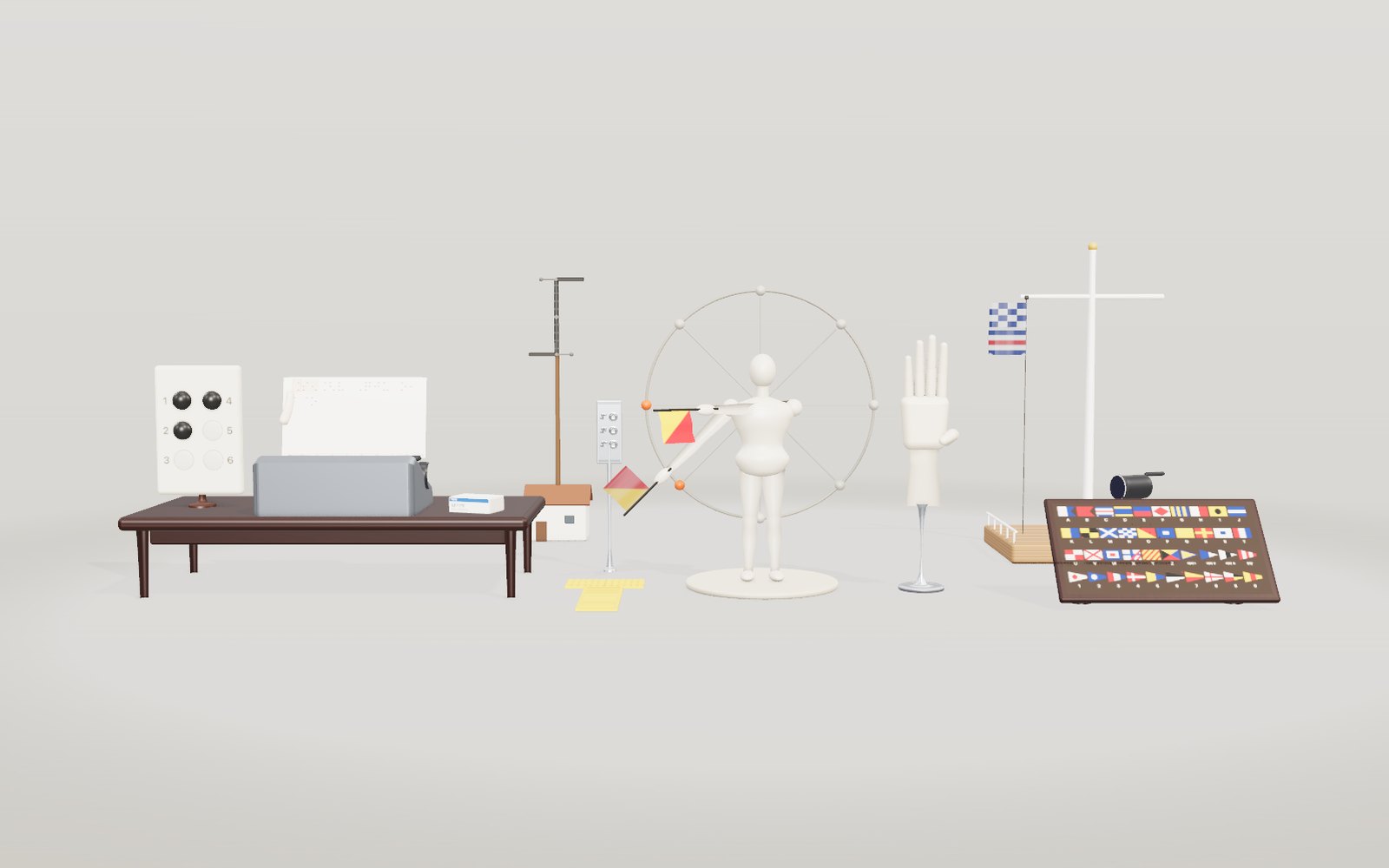
1 / 20 Eleven ways to pass letters by touch, eye and handBraille on the table, a signaller and a fingerspelling hand in the middle, a Chappe tower, sea flags and a signal lamp on the right. Pick a system at the top; the panel reads the code back.
Drag to turn. Scroll or pinch to zoom.
What the model shows
Braille carries letters in raised dots read by a fingertip, while semaphore carries them in the positions of hand-held flags. The exhibit converts text into both codes and reads the result back.
Run a fingertip over a lift button and you may feel a short row of bumps beside the number. That is braille, and every symbol in it comes from one small grid of six dots. This exhibit puts eleven ways of passing letters side by side. Six are read by touch, four by eye from a distance, and one with the hands.
On the left of the stage is a walnut table. A large braille cell stands on it with dots you can press, next to a brailler modelled on the Perkins Brailler and a sheet of paper that rises out of the machine with the embossed text on it. The same table holds a medicine box with its name in braille on the lid. In front of it, yellow tactile paving leads to a lift button panel. In the middle, a faceless mannequin signals words with two hand flags, and a large hand beside it shapes the letters of Korean fingerspelling. On the right are the flag board of the International Code of Signals, a ship's mast with a hoist and a signal lamp, and a small Chappe telegraph station.
The buttons at the top choose a system. Each one turns text into its own code, and the panel under the buttons reads that code back, so you can check that it goes both ways. The table below lists the systems and the source each one is built from.
| System | Read by | Built from |
|---|---|---|
| Korean braille | touch | Korean Braille Regulations, 2024 |
| English braille, grade 1 | touch | Rules of Unified English Braille, 2024 |
| English braille, grade 2 (whole words) | touch | Rules of Unified English Braille, sections 10.1 to 10.3 |
| Japanese braille | touch | table in the Korean rules, appendix 1 |
| Numbers and maths | touch | Korean rules, sections 40 to 48 |
| Music braille | touch | Korean rules, Western music chapter 1 |
| Flag semaphore | eye | Scouting America and museum booklets |
| Korean fingerspelling | eye, hands | National Institute of Korean Language, 2016 |
| International Code of Signals flags | eye | Pub. 102 |
| Morse by signal lamp | eye | Pub. 102 |
| Chappe telegraph | eye | ETHW and the Musée des arts et métiers |
Six dots, numbered 1 to 6
A braille cell is three dots high and two dots wide. The dots are numbered so that people can talk about patterns without drawing them: dots 1, 2 and 3 run down the left column, and dots 4, 5 and 6 run down the right. The letter k in English braille, for example, is dots 1 and 3. The National Institute of Korean Language puts the count plainly: six dots that can each be raised or flat give 2⁶ = 64 patterns, and leaving out the blank cell, 63 of them are used for letters and symbols.
Sixty-three is not many. Korean needs 14 basic consonants, 21 vowels and a set of finals, English needs 26 letters, and both need capitals, numbers and punctuation. Japanese, music and maths each need their own sets too. Braille gets around this in two ways. The same pattern means different things in different systems and positions, and a few cells act as signs that change how the next cells are read.
Press dots 1, 2 and 4 on the large cell and the panel lists the meanings of that one pattern: ㅋ when it starts a Korean syllable, f in English, and e in Japanese. The panel also gives the Unicode code point. Braille patterns in Unicode start at U+2800, and the number of the pattern is simply the dots added up as bits (dot 1 = 1, dot 2 = 2, dot 3 = 4, dot 4 = 8, dot 5 = 16, dot 6 = 32), so dots 1, 2 and 4 are U+280B.
How big a braille dot is
The dots have to be large enough to feel and close enough that a whole cell fits under one fingertip. Since a 2020 amendment, the Korean braille rules fix the physical size:
| Measurement | Korean rule (2024) | US Library of Congress, Specification 800 | Perkins Brailler output |
|---|---|---|---|
| Dot height | 0.4 to 0.9 mm | 0.019 in (about 0.48 mm) | 0.5 mm |
| Dot base diameter | 1.5 to 1.6 mm | 0.057 in (about 1.45 mm) | 1.4 mm |
| Centre to centre within a cell | 2.3 to 2.5 mm | 0.092 in (about 2.34 mm) | 2.3 mm |
| Cell to cell (paper, stickers) | 5.5 to 6.9 mm | 0.245 in (about 6.22 mm) | 6 mm |
| Line to line | at least 10.0 mm | 0.400 in (about 10.16 mm) | 10 mm |
The Korean rule allows a wider gap between cells on harder materials: up to 7.3 mm on PVC and 7.6 mm on aluminium or stainless steel. The embossed sheet in the model uses values from the middle of the Korean ranges, a dot 1.5 mm across, 2.4 mm between dots, a cell pitch of 6.0 mm and a line pitch of 10.0 mm, with a millimetre ruler printed along the bottom edge. A cell with all six dots fills a patch about 3.9 mm wide and 6.3 mm tall, roughly the pad of a fingertip.
The Dot height slider runs over the Korean range, 0.4 to 0.9 mm. It changes how strongly the dots catch the light on the sheet and how far the domes stand out on the large cell. Real size moves the camera until 1 mm on the sheet spans 3.78 screen pixels, which is true size on a screen of 96 pixels per inch; phones and many laptops have denser screens, so there it is only close. The reading practice in the panel below is drawn in CSS millimetres for the same reason.
Writing braille: a brailler and a slate
The American Foundation for the Blind compares the two common tools with pencil and typewriter. The pencil is the slate and stylus: a template with rows of cell-shaped holes and a pointed stylus pushed into the paper over each hole. The dot bulges out on the other side of the sheet, so the writer works on the back of the page in mirror image. Turn on Back of the sheet to see what that side looks like: the dots become pits and the text runs backwards.
The typewriter is the braillewriter. Unlike a typewriter with fifty keys, it has six dot keys, a space bar, a line spacer and a backspace, and the keys for one cell are pressed together. The Perkins Brailler, designed by David Abraham at the Perkins School for the Blind and in production from 1951, is the best known. The model keeps its layout: line key, dots 3, 2 and 1 under the left hand, the space bar, dots 4, 5 and 6 under the right hand, then backspace. Press keys on the model, use the 1 to 6 buttons, or focus the key row and press F, D, S and J, K, L together on a keyboard, as many braille notetakers do. Releasing the keys embosses the cell.
Korean braille spells syllables out
Printed Hangul stacks letters into square blocks. Korean braille does not. The rules say Korean braille is written unstacked: initial, vowel and final come one after another. 한 becomes three cells, ㅎ (dots 2-4-5), ㅏ (1-2-6) and final ㄴ (2-5). Watch the reading finger move along 한글 점자 and the panel names each cell as it passes.
Consonants have two sets of cells, one for the start of a syllable and one for the end. ㄱ is dot 4 as an initial and dot 1 as a final, and the reader knows which is which from position. The National Institute of Korean Language explains why that works: every vowel cell has a dot in the top row and in the bottom row and in both columns, initials always use the right column and finals the left. A reader can therefore find the vowel at the middle of each syllable by touch. The check that runs with this exhibit tests the rule against every vowel, initial and final cell in the encoder.
A tense consonant such as ㄲ or ㅆ is written with the tense sign, dot 6, in front of the plain one. The initial ㅇ, which has no sound, is simply not written, so 아버지 begins straight away with the vowel ㅏ. Some vowel pairs would read as a different vowel if they stood side by side, and the rules add a separator, dots 3-6, to keep them apart: 아예 is ㅏ, separator, ㅖ.
Abbreviations, and a spelling exception
Writing every letter takes space, so the rules list abbreviations. Eleven syllables ending in ㅏ get short forms: 가 and 사 have cells of their own, and in 나, 다, 마, 바, 자, 카, 타, 파 and 하 the vowel ㅏ is simply left out. Fifteen more cover common vowel and final pairs: 억, 언, 얼, 연, 열, 영, 옥, 온, 옹, 운, 울, 은, 을, 인 and 것. These combine with an initial in front, so 운 inside 운동장 is one cell, and 순 is ㅅ plus the 운 cell.
Seven conjunctions get word abbreviations of two cells each, dot 1 plus a second cell: 그래서, 그러나, 그러면, 그러므로, 그런데, 그리고 and 그리하여. Dot 1 is the final ㄱ, which can never start a syllable, so at the start of a word it can only mean one of these. The abbreviation is used even when other letters follow, as in 그래서인지, but not when other letters come before, as in 오그리고.
Leaving out ㅏ creates puzzles, and the rules solve each one with a written exception. If the next syllable begins with a vowel, the ㅏ is written after all: 나이 is ㄴ, ㅏ, ㅣ, because ㄴ followed by ㅣ would read as 니. 팠 is always spelled with its ㅏ. And after ㅅ, ㅆ, ㅈ, ㅉ or ㅊ, the syllable 성 is written with the cell for 영, which is why 정성 takes only four cells.
The encoder behind the sheet follows these rules, and its tests compare it with 240 examples printed in the 2024 rule book, words, numbers, sums and short sentences. Every one comes out cell for cell as printed.
Numbers and maths in Korean braille
The numeric indicator, dots 3-4-5-6, turns the first ten letter shapes into digits: a is 1, b is 2 and j is 0. A comma inside a number is dot 2 and a decimal point is dots 2-5-6, and neither needs a new indicator, so 3.14 is four cells after the indicator. A hyphen or any other mark does end the number, so the next digit takes the indicator again, as in a telephone number.
The rule that surprises most readers is section 44. After a number, Hangul follows without a space, as in print. But seven initials, ㄴ, ㄷ, ㅁ, ㅋ, ㅌ, ㅍ and ㅎ, share their cells with the digits 3, 9, 5, 6, 8, 4 and 0, and the abbreviation 운 is the digit 7. If one of those came straight after a number it would read as another digit, so a blank cell goes in: 1년 is ⠼⠁⠀⠉⠡. 1가 needs no gap because 가 has its own cell. Type 2026년 and the space appears.
The maths mode adds the operators of section 45: plus is dots 2-6, minus dots 3-5, times dots 1-6, divide two cells of dots 3-4, equals two cells of dots 2-5, and greater and less than are doubled plus and minus cells. The number after each sign takes the numeric indicator again, so 5+7=12 is ⠼⠑⠢⠼⠛⠒⠒⠼⠁⠃. Fractions are written denominator first with a fraction sign between: 3/4 becomes 4, sign, 3.
For mathematics beyond a line of arithmetic, many readers in the United States use the Nemeth Code, first shared in 1952 by Abraham Nemeth, a mathematics professor who was blind. The model only names it; the maths mode here follows the Korean rules.
English braille: grade 1 and grade 2
The English station follows Unified English Braille, the code of the International Council on English Braille. The American Foundation for the Blind notes that it became the main code for reading material in the United States in 2016. Grade 1, also called uncontracted braille, spells every letter. Dot 6 before a letter makes a capital, and two of them make the whole word capitals, as in ⠠⠠⠎⠕⠎ for SOS. The numeric indicator works as in Korean. If one of the letters a to j comes straight after a digit, it would be read as another digit, so the grade 1 indicator, dots 5-6, goes in front of it: 3b is ⠼⠉⠰⠃, while 3m needs none.
Grade 2, contracted braille, is what most English books use. The American Foundation for the Blind counts 180 contractions, including 75 shortforms. The model covers only the part that works on whole words: 23 alphabetic wordsigns where a single letter stands for a word (b for but, l for like, x for it), 6 strong wordsigns (child, shall, this, which, out, still) and 5 strong contractions (and, for, of, the, with). A word counts as standing alone when spaces, hyphens or dashes surround it. A single letter standing alone, such as x, then needs the grade 1 indicator so that it is not read as a word.
That is quite fair and very just comes out exactly as printed in the rules, because fair and is are not contracted. Most sentences are different. Real grade 2 also shortens groups of letters inside words, ch, st, ing, er and many more, and the panel marks the words it would shorten further.
Japanese braille
Japanese braille writes kana by sound. The vowels a, i, u, e and o use dots 1, 2 and 4 in the top four positions, and each consonant row adds its own combination of dots 3, 5 and 6, so ka, ki, ku, ke and ko all share the ka-row dots. Voiced sounds such as ga and da take a dot-5 cell in front of the plain kana, and pa-row sounds a dot-6 cell. The small ya, yu and yo after a consonant have no cells of their own: kya is a dot-4 prefix and the ka cell, kyu the prefix and the ku cell, kyo the prefix and the ko cell.
The Korean rule book prints the full table in its appendix on foreign braille, and the encoder is built from it: 48 plain cells, 25 voiced sounds, 36 combinations with small ya, yu and yo, and four punctuation marks. The checks prove those patterns from the table itself. Japanese braille was adopted on 1 November 1890 at the Tokyo school for the blind and deaf, from a 6-dot system by the teacher Ishikawa Kurazō; Japan now marks that date as braille day. The converter writes kana as typed, while real Japanese braille also has rules for spaces between words and for particles written by sound.
Music braille
Louis Braille played the cello and the organ, and his 1829 book already covered music. In music braille one cell carries both pitch and length. Dots 1, 2, 4 and 5 give the note name, C to B, and dots 3 and 6 the value: no extra dot for an eighth note, dot 6 for a quarter, dot 3 for a half and both for a whole note. So a quarter-note C and an eighth-note C are different cells. Rests have their own cells, a dot 3 after a note makes it dotted, and a blank cell is a bar line.
There are seven octaves, and an octave mark goes before a note only when it is needed: before the first note, before a note that leaps a sixth or more, and before a fourth or fifth that crosses into a new octave. Steps of a second or third never need one. The test melody in the checks is an example line printed in the Western music chapter of the Korean rules, and the encoder places its octave mark exactly where the book does. Use the note buttons to write a tune; the Example button loads the same line.
Braille in public places
Braille is not only for books. Korean law sets out where it must appear in buildings: on room name signs at 1.5 m height, on the floor buttons of lifts for disabled people, which sit 0.8 to 1.2 m above the floor, on handrails at the ends of stairs, and on hot and cold taps. The lift panel in the model shows floor numbers beside each button, written with the numeric indicator.
Medicines followed in 2024. Since 21 July 2024, designated medicines in Korea must carry braille, together with a code that a phone turns into speech or sign-language video. The box on the table has its name embossed on the lid.
Tactile paving is the floor version. Seiichi Miyake devised the tiles in 1965 and the first were laid in Okayama, Japan, in 1967. The international standard ISO 23599 now describes attention patterns and guiding patterns. In Korea the standard tile is 0.3 by 0.3 m and yellow. A warning tile has 36 raised domes 0.6 cm high, and a guiding tile has 4 raised bars 0.5 cm high. Warning tiles go 0.3 m in front of stairs, lifts and toilets that blind people need to find, and where guiding lines start, cross or turn. In the model, guiding tiles lead to two warning tiles in front of the lift panel.
Flag semaphore: two arms, eight directions
Semaphore swaps touch for distance. The Scouting America pamphlet on signs and codes describes it like this: the signaller holds a flag in each hand and points each arm in one of eight directions, like positions on a clock face. Two directions out of eight give the letters. The first group, A to G, keeps one flag pointing down while the other moves round; H to N hold one arm low; O to S hold one arm straight out. Charts are drawn as you see the sender, so the signaller's right arm appears on your left, and the mannequin stands the same way. Turn on Signaller from behind to see the poses as the signaller feels them.
The model plays a word letter by letter. A word ends with the rest position, both flags crossed low in front of the body, and a double letter such as the LL in HELLO is split by a rest so the receiver sees two letters. There is a numeral sign: after it, A to I and K are read as 1 to 9 and 0. In this model the J position switches back to letters. The pamphlet notes that navy signallers spell numbers out in words to avoid mistakes. Watch the orange markers on the dial: they show the two directions each letter uses.
Korean fingerspelling
Korean Sign Language is a language of its own. The Korean Sign Language Act of 2016 calls it the official language of deaf Koreans. Fingerspelling, 지문자, is the part that spells Hangul letters, used for names and words without a sign. The National Institute of Korean Language's handshape dictionary of 2016 classifies every handshape by which fingers are extended, bent or touching, and lists which handshape each letter uses.
That list shows how the system is built. ㄱ and ㄴ share one handshape, thumb and index finger extended, and so do ㄷ and ㅅ with index and middle fingers. The vowels ㅏ, ㅓ, ㅗ, ㅜ and ㅡ all use the index finger alone, and ㅑ, ㅕ, ㅛ and ㅠ use the same two fingers as ㄷ. The dictionary gives them the same handshape, so the difference lies in where the hand points and how it moves, which its videos show. ㅂ is four fingers together, ㅎ the thumb alone, ㅣ the little finger.
The hand in the model takes each handshape exactly as the dictionary describes it, joint by joint. Its direction is simplified to up, down, left, right or towards you, so compare it with the videos in the online Korean Sign Language Dictionary before using it. Back of the hand turns it so you see what the signer sees.
The Chappe telegraph
Long before electric telegraphs, France sent messages across the country by towers. Claude Chappe and his brothers built a mast with a long beam, the regulator, and two shorter arms, the indicators, turned by ropes and pulleys. The regulator could be flat or upright, and each indicator could take seven positions 45 degrees apart; the eighth, carrying straight on from the regulator, was not used. That makes 2 × 7 × 7 = 98 positions. Six were kept for service signals and 92 carried the code.
From 1795 the code used two signals per entry. The first gave a page in a book of 92 pages and the second a line on that page, 8,464 entries in all. The first line, Paris to Lille with 15 stations, sent its first telegram on 15 August 1794: Le Quesnoy had been retaken. Stations stood about 10 to 15 km apart. They worked badly in bad weather and not at all at night, and lanterns were tried without success; electric telegraphs replaced them from the 1840s. The model's buttons set the regulator and both arms and number the 98 positions in a simple order. That numbering is the model's own, not Chappe's table.
Sea flags: one flag, one sentence
The International Code of Signals is meant for safety at sea, especially when two crews do not share a language. A full set has 26 alphabet flags, 10 numeral pennants, 3 substitutes and an answering pennant, 40 in all, and the board in the model shows every one. Hoisted on its own, each letter flag is a complete, urgent message. A few from the US edition of the Code, Pub. 102:
| Flag | Meaning when flown alone |
|---|---|
| A | I have a diver down; keep well clear at slow speed. |
| O | Man overboard. |
| V | I require assistance. |
| W | I require medical assistance. |
| K | I wish to communicate with you. |
| N and C together | I am in distress. |
Only R has no single-letter meaning in the current Code. Tap any flag on the board and it goes up the mast, with its meaning in the panel. Hoisted together, flags are read from the top down.
Numbers use the numeral pennants, and between numerals the answering pennant is the decimal point. A ship may carry only one set, so a hoist like 1100 has a problem: there is only one 1 and one 0. The substitutes solve it. The first substitute repeats the uppermost flag of the class just above it, the second the second, and the third the third. 1100 is therefore 1, first substitute, 0, third substitute, and L 2330 is L, 2, 3, second substitute, 0, because the second substitute counts only the numerals. Each substitute may appear once in a hoist. Turn on Substitutes to watch the model swap them in.
Morse by signal lamp
The same Code lists Morse by flashing light. Pub. 102 sets the timing in units: a dot is one unit, a dash three, the gap inside a letter one, between letters three and between words seven. It takes forty letters a minute as the standard rate for a lamp. The model counts an average letter as ten units including gaps, so at 40 letters a minute one unit lasts 0.15 s. The Lamp speed slider runs from 20 to 60 letters a minute, and Dusk dims the stage so the flashes stand out.
Single letters by lamp keep their flag meanings, so K, dash dot dash, says "I wish to communicate with you". A decimal point by lamp is AAA. The Morse table matches the one in the morse telegraph exhibit, where the same code is sent by key and sounder.
How the stage is drawn
Every object is built in code, with no model files. The mannequin is one mesh of smooth turned shapes with ball joints, bent by a skeleton of three bones, so the whole figure costs one draw. The hand works the same way with 16 bones. Its finger joints are balls, so no pose shows a seam. The embossed text on the sheet is not geometry at all: the dots are painted into a height map at the Korean proportions and turned into a normal map, so the light rakes across them as it would across paper. The flags are cloth that waves in the vertex shader, and the 40 flags of the board share one texture.
On a fast device the stage adds soft shadows and ambient occlusion, which darkens the creases between keys, fingers and tiles. On a slow device both are left out and the sheet uses a smaller map. Measured on the same laptop, the whole stage draws in fewer calls than the three stations of the earlier version did.
What the model leaves out
The Korean encoder covers letters, abbreviations, word abbreviations, numbers, the decimal point and four punctuation marks, but not old letters, Roman letters inside Korean text or the rest of the punctuation. English grade 2 stops at whole words. Japanese ignores word spacing and particle rules, and music covers single notes, rests and octave marks without chords, ties or key signatures. Fingerspelling has simplified directions and no movement. The semaphore signaller moves smoothly between letters, while a real signaller snaps from one position to the next. Flag colours are plain screen colours, not a dyed-cloth standard, and the ship, the tower and the paving are drawn at different scales from the table.
A short history
Louis Braille was born in Coupvray, France, on 4 January 1809. Books at the Paris school for the blind were printed in raised print letters, a method first used there in 1786. In 1821 Charles Barbier showed the school his night writing, 12 dots read by touch, and from 1824 Braille reduced it to the 6-dot cell. His book of 1829 covered words and music, and a maths code followed in 1838. Other systems competed for decades: Moon type in 1845, New York Point from 1868. The United Kingdom chose English Braille in 1916 and the United States in 1919.
In Korea, the National Institute of Korean Language traces braille teaching to 1894, when the American missionary Rosetta Sherwood Hall adapted the four-dot New York Point system. Park Du-seong, a teacher at the Jesaengwon school for blind children, began work on a Korean six-dot system in 1920, formed a braille research committee with his students in 1923, and announced Hunmaengjeongeum on 4 November 1926. Teachers at the Seoul school for the blind set the abbreviations in 1947. The government issued the Korean Braille Regulations in 1997, revised them in full in 2006 and 2017, added the physical sizes in 2020 and issued the current revision on 29 January 2024.
Signals at a distance came first. The Chappe line from Paris to Lille opened in 1794. At Trafalgar in 1805 Nelson's signal needed 12 hoists of numeral flags from Popham's code, and the word "duty" had to be spelled letter by letter. The National Museum of the Royal Navy notes that from 1866 a two-arm semaphore with hand flags became the fastest signal between nearby ships. The International Code of Signals began as a British Board of Trade draft in 1855, with 70,000 signals made from 18 flags, published in 1857. It was revised at Madrid in 1932, adopted in its present form in 1965, and Pub. 102 came into force on 1 April 1969.
Questions
How do you read the dot numbers?
Dots 1, 2 and 3 go down the left column and dots 4, 5 and 6 down the right. Patterns are written as dot numbers, so the Korean initial ㄴ is dots 1-4 and the English letter d is dots 1-4-5.
Why does the same cell mean different things?
There are only 63 patterns. Korean uses position to tell them apart, so dot 4 is ㄱ at the start of a syllable and dot 1 is ㄱ at the end. Indicators change the cells after them: after the numeric indicator, a to j are digits.
Is Korean braille the same as Hangul written in dots?
No. Hangul stacks letters into blocks, while Korean braille writes them in a row. It also leaves out the silent initial ㅇ, uses abbreviations such as 가, 은 and 것, and adds a separator where two vowels would run together.
Why is there a space in 1년 but not in 1가?
After a number, the initials ㄴ, ㄷ, ㅁ, ㅋ, ㅌ, ㅍ, ㅎ and the abbreviation 운 would read as digits, so the rules put a blank cell in front of them. 가 has its own cell, which is not a digit, so it follows the number directly.
What does grade 1 mean in English braille?
It is braille in which every letter is spelled out, also called uncontracted braille. Most English books use grade 2, contracted braille, where common words and letter groups such as and, the and ing have short forms of their own.
How big is a real braille dot?
The Korean rules set a base diameter of 1.5 to 1.6 mm and a height of 0.4 to 0.9 mm. The US Library of Congress specification for its books asks for 0.057 inch, about 1.45 mm, with a height of 0.019 inch.
Why does a slate write braille backwards?
The stylus pushes the paper down into the slate, so each dot rises on the far side. The writer works on the back of the page, so the text must be punched as a mirror image for it to read the right way round on the front.
Which arm is which in semaphore charts?
Charts show the signaller as you see them, face to face, and so does this model. The signaller's right arm is on your left. Signaller from behind shows the other view.
How do you send numbers in semaphore?
Send the numeral sign first. After it, A to I mean 1 to 9 and K means 0; in this model the J sign returns to letters. The Scouting America pamphlet adds that navy signallers spell numbers out in words to avoid mistakes.
Does every sea flag have a single-letter meaning?
Every letter except R does in Pub. 102. C means yes and N means no; A warns that a diver is down; O means someone has fallen overboard.
Why does a ship need substitute flags?
A ship may carry only one set of 40 flags, so it cannot show the same flag twice in one hoist. A substitute stands for the first, second or third flag of the class just above it, so 1100 becomes 1, first substitute, 0, third substitute.
Is Korean fingerspelling the same as Korean Sign Language?
No. Korean Sign Language has its own words and grammar. Fingerspelling spells Hangul letter by letter and is used inside signing for names and words that have no sign.
Terms
- Cell: the 3 by 2 space for six dots that makes one braille symbol.
- Initial, vowel, final (초성, 중성, 종성): the three positions in a Korean syllable. Korean braille writes them one after another.
- Abbreviation (약자): a cell, or two, that stands for a whole syllable or a vowel and final pair, such as 가 or 운.
- Word abbreviation (약어): two cells for one of seven Korean conjunctions such as 그리고.
- Numeric indicator (수표): dots 3-4-5-6. The letters a to j after it are the digits 1 to 0.
- Grade 1 indicator: dots 5-6, used in UEB when a letter a to j follows a digit or a single letter stands alone in grade 2.
- Wordsign: in English grade 2, one cell standing for a whole word, such as l for like.
- Octave mark (길표): a cell before a note that fixes its octave in music braille.
- Brailler: a braille typewriter with six dot keys pressed together for each cell.
- Slate and stylus: a template and a point for writing braille by hand, one dot at a time.
- Tactile paving: floor tiles with domes (warning) or bars (guiding) that can be felt underfoot or with a cane.
- Semaphore: signalling letters with two hand flags held in eight directions.
- Fingerspelling (지문자): handshapes for the letters of an alphabet, used within sign language.
- Hoist: a group of flags raised together on one halyard and read from the top.
- Substitute: a flag that repeats the first, second or third flag of its class in the same hoist.
Sources
- National Institute of Korean Language, 2024 revised Korean Braille Regulations (Ministry of Culture, Sports and Tourism notice 2024-5): Korean braille, numbers and maths (sections 18 and 40 to 48), physical sizes, appendix 1 (Japanese braille table) and Western music chapter 1. https://www.korean.go.kr/front/etcData/etcDataView.do?mn_id=&etc_seq=710&pageIndex=1 (checked 19 October 2026)
- National Institute of Korean Language, About braille (64 patterns, the vowel, initial and final dot rule, Park Du-seong, history to 2024). https://www.korean.go.kr/front/page/pageView.do?page_id=P000302 (checked 19 October 2026)
- International Council on English Braille, Rules of Unified English Braille, third edition 2024, sections 2.6, 5.7, 6 and 10.1 to 10.4. https://iceb.org/wp-content/uploads/2025/10/Rules-of-Unified-English-Braille-2024.pdf (checked 19 October 2026)
- International Council on English Braille, Unified English Braille. https://iceb.org/ueb.html (checked 19 October 2026)
- American Foundation for the Blind, What Is Braille? (Louis Braille's birth, slate and stylus, braillewriter, contractions). https://www.afb.org/blindness-and-low-vision/braille/what-braille (checked 19 October 2026)
- Perkins School for the Blind, The history of braille (2025). https://www.perkins.org/history-of-braille/ (checked 19 October 2026)
- Perkins School for the Blind, How the evolution of the brailler expanded braille literacy. https://www.perkins.org/how-the-evolution-of-the-brailler-expanded-braille-literacy/ (checked 19 October 2026)
- Perkins Brailler Store, Perkins Brailler (dot height, diameter, spacing; bell). https://brailler.perkins.org/pages/perkins-brailler (checked 19 October 2026)
- Library of Congress, National Library Service for the Blind and Print Disabled, Specification 800: Braille Books and Pamphlets, section 3.2. https://www.loc.gov/nls/wp-content/uploads/2019/09/Spec800.11October2014.final_.pdf (checked 19 October 2026)
- Korea, Enforcement Rule of the Act on Guarantee of Promotion of Convenience of Persons with Disabilities, the Aged and Pregnant Women, annex 1, amended 11 December 2023 (tactile paving, braille signs, lift buttons). https://www.law.go.kr/LSW/flDownload.do?flSeq=162950009&bylClsCd=110201 (checked 19 October 2026)
- Ministry of Food and Drug Safety, amendment notice on braille and voice or sign-language codes on medicines. https://www.mfds.go.kr/brd/m_207/view.do?seq=14992 (checked 19 October 2026)
- Victoria and Albert Museum, Tactile paving slab, Seiichi Miyake. https://collections.vam.ac.uk/item/O1360400/tactile-paving-slab-tile-miyake-seiichi/ (checked 19 October 2026)
- ISO 23599:2019, Assistive products for blind and vision-impaired persons: Tactile walking surface indicators. https://www.iso.org/standard/76106.html (checked 19 October 2026)
- Japan Braille Library, History of braille. https://www.nittento.or.jp/about/kids/braillehistory.html (checked 19 October 2026)
- University of Tsukuba Special Needs Education School for the Visually Impaired, monument to the founding of Japanese braille. https://www.nsfb.tsukuba.ac.jp/kinenhi/kinenhi.html (checked 19 October 2026)
- Scouting America, Signs, Signals, and Codes merit badge pamphlet (semaphore). https://filestore.scouting.org/filestore/Merit_Badge_ReqandRes/Pamphlets/Signs%20Signals%20Codes.pdf (checked 19 October 2026)
- National Museum of the Marine Corps, Semaphore Flag Alphabet activity booklet. https://www.usmcmuseum.com/uploads/6/0/3/6/60364049/nmmc_semaphore_flag_booklet_final_1.pdf (checked 19 October 2026)
- National Museum of the Royal Navy, Signals at Sea, information sheet 104 (archived copy). https://web.archive.org/web/20191026224801/http://www.nmrn-portsmouth.org.uk/sites/default/files/Signals%20at%20sea.pdf (checked 19 October 2026)
- National Institute of Korean Language, Building a handshape-based Korean Sign Language dictionary (2016), table V-1 and appendix 1. https://korean.go.kr/front/reportData/reportDataView.do?mn_id=45&report_seq=907&pageIndex=3 (checked 19 October 2026)
- National Institute of Korean Language, Korean Sign Language Dictionary. https://sldict.korean.go.kr/ (checked 19 October 2026)
- Korea Legislation Research Institute, Korean Sign Language Act (Act No. 13978, 2016). https://elaw.klri.re.kr/kor_service/lawViewMultiContent.do?hseq=60381 (checked 19 October 2026)
- IEEE Engineering and Technology History Wiki, France Builds Visual Telegraph. https://ethw.org/France_Builds_Visual_Telegraph (checked 19 October 2026)
- J.-M. Dilhac, The telegraph of Claude Chappe: an optical telecommunication network for the XVIIIth century. https://ethw-images.s3.us-east-va.perf.cloud.ovh.us/ethw/1/17/Dilhac.pdf (checked 19 October 2026)
- Musée des arts et métiers, Le télégraphe de Chappe, education file. https://www.arts-et-metiers.net/sites/arts-et-metiers/files/2021-10/field_media_document-441-cp-telegraphe_de_chappe.pdf (checked 19 October 2026)
- Naval Marine Archive, England expects that every man will do his duty (the Trafalgar hoists). https://navalmarinearchive.com/research/docs/england_expects_signalflags.html (checked 19 October 2026)
- National Geospatial-Intelligence Agency, Pub. 102 International Code of Signals, 1969 edition revised 2020, chapter 1 (flags, substitutes, flashing light, Morse table). https://msi.nga.mil/api/publications/download?key=16694273/SFH00000/Chapter1.pdf (checked 19 October 2026)
- National Geospatial-Intelligence Agency, Pub. 102, preface (history of the Code). https://msi.nga.mil/api/publications/download?key=16694273/SFH00000/Firstmatter.pdf (checked 19 October 2026)
- US Coast Guard copy of Pub. 102 (2005), plate of international flags and pennants. https://www.dco.uscg.mil/Portals/9/NMC/pdfs/examinations/01_international_code_of_signals_pub_102_2005_ed.pdf (checked 19 October 2026)
- United Nations, World Braille Day. https://www.un.org/en/observances/braille-day (checked 19 October 2026)
- Calculations on this page: braille cells from the rule tables (checked against 240 examples printed in the 2024 Korean rules, 27 UEB examples in sections 6 and 10, the Japanese and music tables), Unicode from U+2800 plus the dot bits, real size from 96 pixels per inch, lamp timing from ten units per letter.
More exhibits
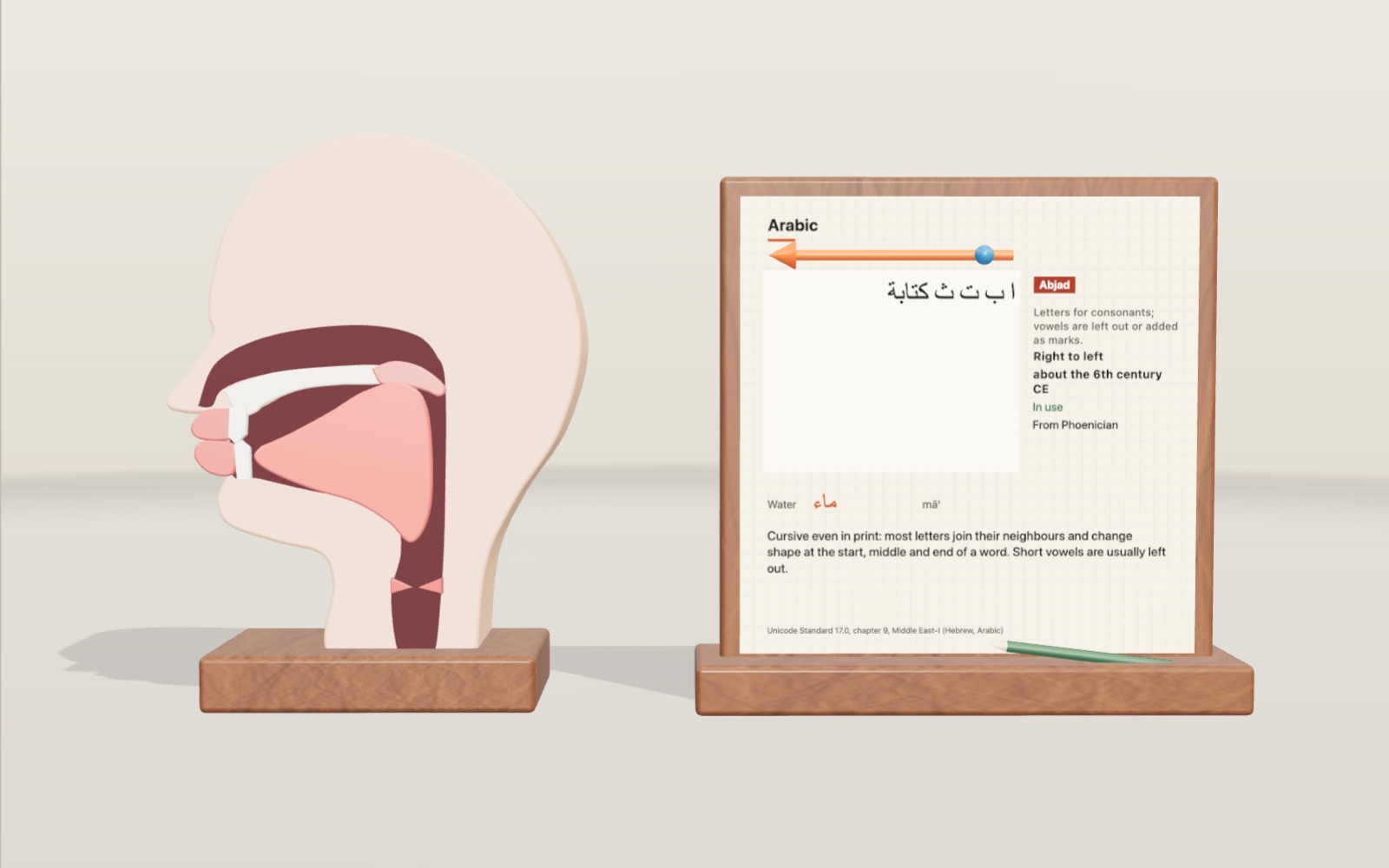
Writing systems of the world: Hangul and 22 more scripts
The 1446 book that announced Hangul says ㄱ draws the tongue root closing the throat. Here it stands beside 22 other scripts, from clay wedges to Braille.
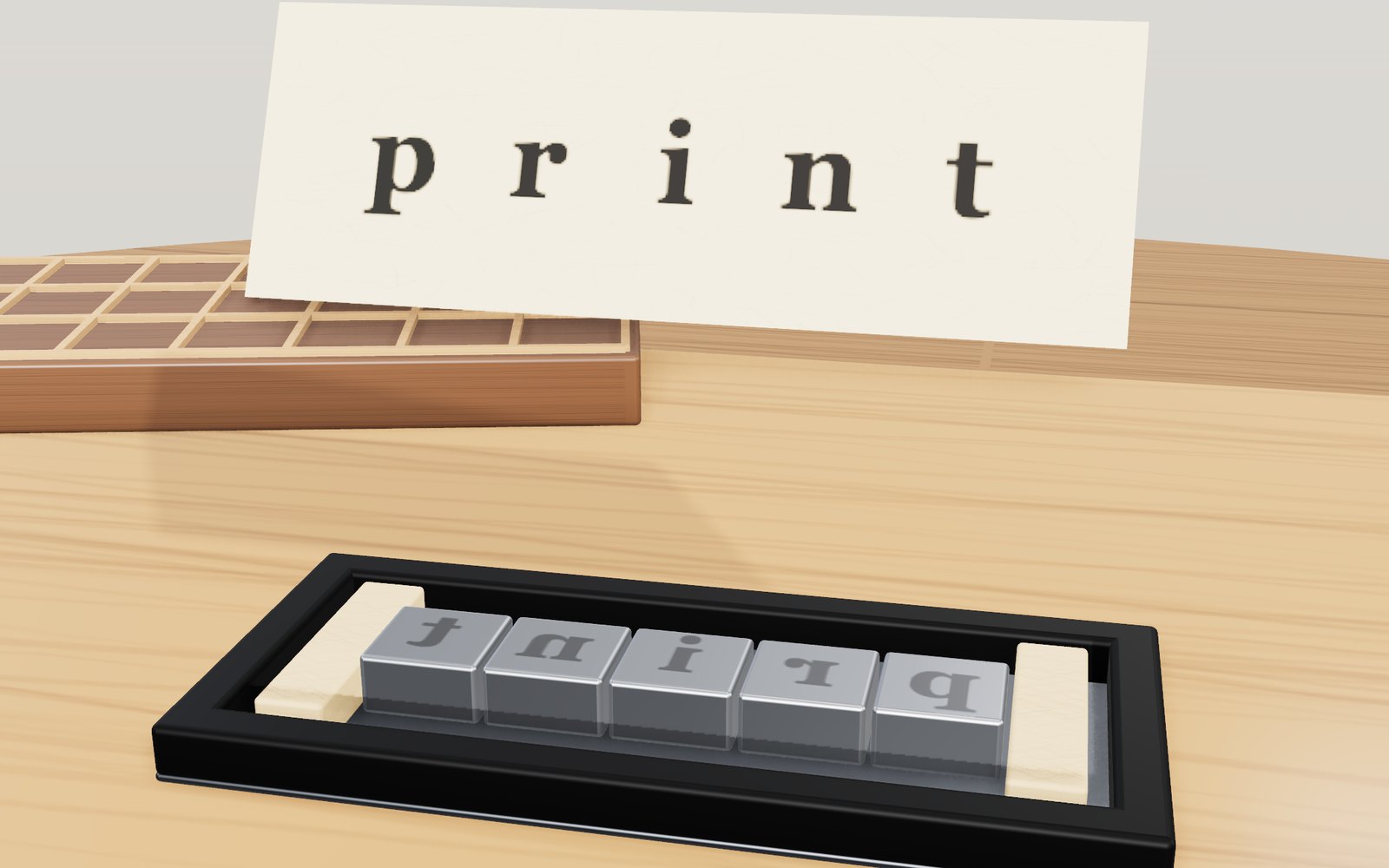
Movable type and the printing press
A piece of type carries its letter back to front. Ink it, press paper on it, turn the sheet over, and the letter reads the right way round.
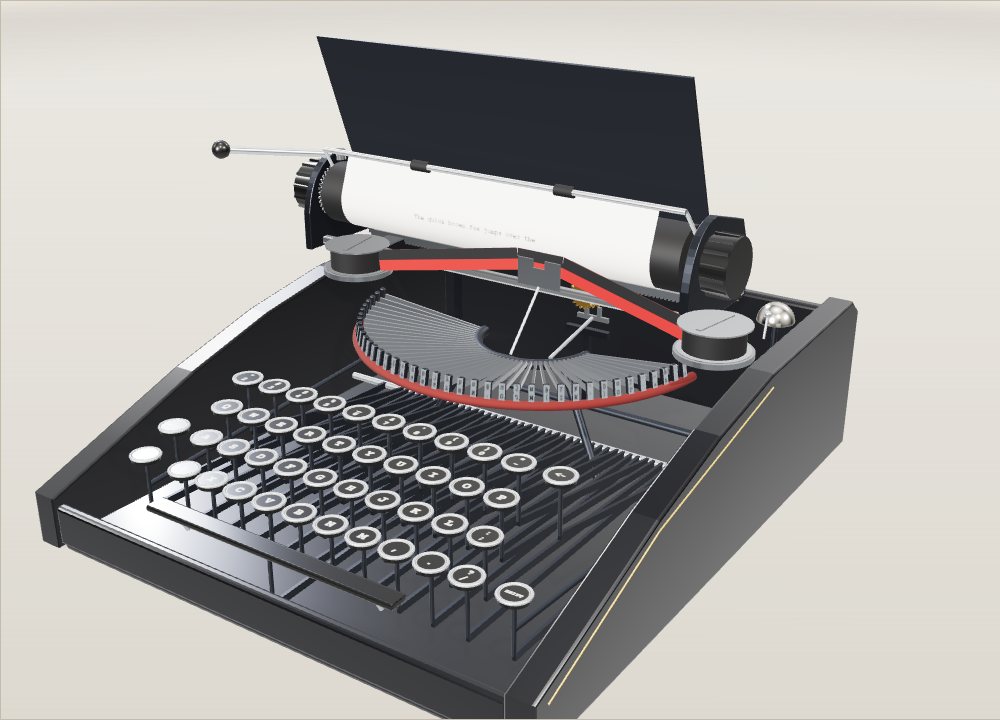
How a typewriter works: inside a manual typewriter
On a pica typewriter every letter, space and full stop moves the carriage the same 2.54 mm to the left.
Morse telegraph: key it yourself, step by step
On 24 May 1844 a key in the US Capitol pressed dots and dashes into a paper tape in Baltimore, about 40 miles (64 km) away.
How a QR code is read
Cover 30 % of a QR code with your hand and a phone still reads it. Cover one corner and it does not.
How a pendulum clock works, and why its length sets the time
A pendulum clock counts seconds with one rod 99.4 cm long. Change its length, its temperature and its place on Earth, swap four escapements and see how many seconds a day each costs.