Loading the model
This device cannot show the 3D model. You can read the guide steps below as text.
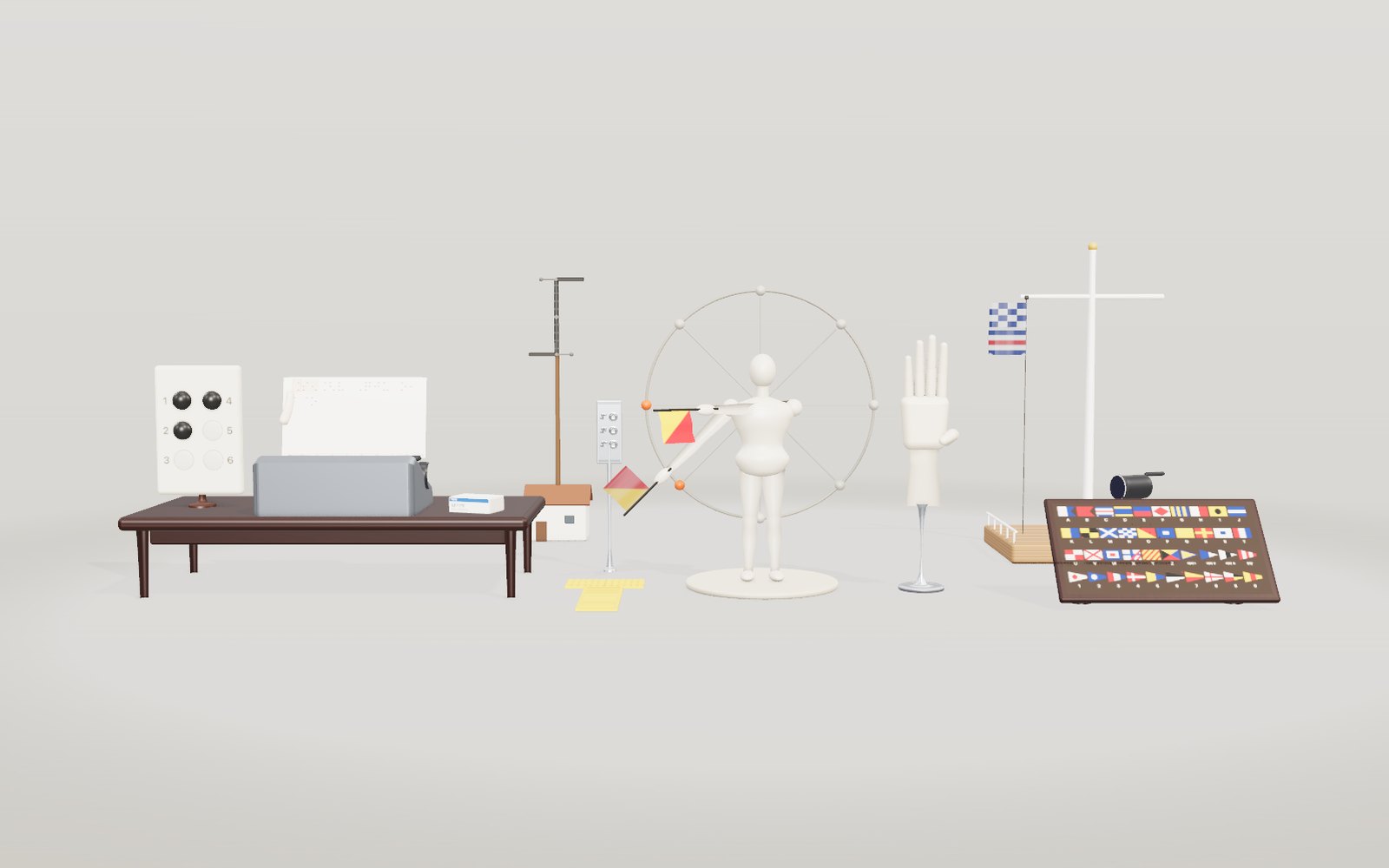
1 / 20 Eleven ways to pass letters by touch, eye and hand Braille on the table, a signaller and a fingerspelling hand in the middle, a Chappe tower, sea flags and a signal lamp on the right. Pick a system at the top; the panel reads the code back.
Drag to turn. Scroll or pinch to zoom.
Guide Parts Controls
01 Eleven ways to pass letters by touch, eye and hand Braille on the table, a signaller and a fingerspelling hand in the middle, a Chappe tower, sea flags and a signal lamp on the right. Pick a system at the top; the panel reads the code back.
02 Six dots, numbered Dot 1 is top left, 2 and 3 run down below it, and 4, 5, 6 make the right column. Every braille symbol on this stage is a choice of these six.
03 Press the dots Press dots on the large cell. Dots 1, 2 and 4 are ㅋ at the start of a Korean syllable, f in English and e in Japanese.
04 The brailler On a Perkins Brailler the six dot keys are pressed together and the cell is embossed at once. On a keyboard, use F D S and J K L in the box below.
05 Korean braille spells the parts Initials, vowels and finals are written one after another. 한 is ㅎ, then ㅏ, then final ㄴ; a silent initial ㅇ is left out.
06 Abbreviations save cells 가, 을 and 운 take one cell each, and 그리고 two. The rules list 26 syllable abbreviations and 7 word abbreviations.
07 Numbers in Korean braille The numeric indicator, dots 3-4-5-6, turns a to j into 1 to 0. Before ㄴ, ㄷ, ㅁ, ㅋ, ㅌ, ㅍ, ㅎ and 운 a space follows the number, so 2026년 keeps its digits clear.
08 Maths on one line Operators sit between numbers, and the number after each one takes the indicator again. A fraction is written denominator first: 3/4 is 4, fraction sign, 3.
09 How big a dot is Dot 1.5 mm across and 0.4 to 0.9 mm high. Try the dot height slider and the real-size view under Controls.
10 English braille, grade 1 Dot 6 before a letter makes a capital, the numeric indicator makes digits. Braille 1829 becomes ⠠⠃⠗⠁⠊⠇⠇⠑ ⠼⠁⠓⠃⠊.
11 English braille, grade 2 Common words shrink to one cell: that is t, and is ⠯, very is v. Here only whole words are contracted; real grade 2 also shortens parts of words.
12 Japanese braille Kana are written by sound. Vowels use dots 1, 2 and 4, consonant rows add 3, 5 and 6, and voiced sounds take a prefix cell.
13 Music in the same cell A note's pitch is in dots 1, 2, 4, 5 and its length in dots 3 and 6. An octave mark goes before the first note and before big leaps.
14 Braille in public places Tactile paving leads to a lift panel with braille numbers; the warning tile sits 0.3 m before it. The medicine box carries its name in braille.
15 A word in semaphore Each letter is two of eight arm directions. HELLO needs a rest between the two L's, and the dial lights the directions in use.
16 Fingerspelling Hangul Each letter has a handshape. ㄱ and ㄴ share one, as do ㄷ and ㅅ, and the vowels ㅏ ㅓ ㅗ ㅜ use one finger pointing different ways.
17 The Chappe telegraph A regulator and two arms on a mast give 98 positions. From 1794 towers about 10 to 15 km apart passed messages across France.
18 One flag, one sentence At sea a single flag is a full message. O means someone has fallen overboard; tap any flag on the board to read its meaning.
19 Numbers and substitutes Numeral pennants spell numbers. A ship carries one of each, so 1100 needs the first and third substitutes to repeat 1 and 0.
20 Morse by lamp The lamp flashes K: dash, dot, dash. The Code's standard rate is 40 letters a minute; try the speed slider and the dusk setting.
Braille table A walnut table at the left of the stage holding the cell, the brailler and the sheet. 6-dot cell Three dots high and two wide. Dots 1, 2, 3 run down the left column and 4, 5, 6 down the right. Raised dots Press a dot on the model, a brailler key or the 1 to 6 keys. The panel lists what the pattern means in each system. Brailler Modelled on the Perkins Brailler: line key, dots 3 2 1, space bar, dots 4 5 6, backspace. Keys pressed together make one cell. Embossed sheet Drawn to the Korean rule's proportions: dot 1.5 mm, spacing 2.4 mm, cell 6.0 mm, line 10.0 mm, with a millimetre ruler. Reading finger Moves one cell at a time while playing; the panel says what each cell is. Medicine box The medicine's name in braille on the lid, as Korean rules require for designated medicines from 2024. Lift buttons Floor numbers in braille beside each button: numeric indicator, then the digit. Tactile paving Two warning tiles of 36 domes 0.3 m before the lift panel, guiding tiles of 4 bars leading to them. Signaller A smooth mannequin with no face, seen as the reader sees the sender: its right arm is on your left. Right arm and flag The arm on your left. In A to C and H to Z it gives the first of the two directions. Left arm and flag The arm on your right. In D to G it moves alone while the other flag points down. Eight directions Each arm points in one of eight directions 45 degrees apart; the two in use light up. Fingerspelling hand An enlarged right hand. Its finger shapes follow the handshape codes of the 2016 Korean dictionary. Chappe station A hut with a mast: the regulator beam turns flat or upright, each indicator to seven positions. Flag board All 40 flags of the International Code: 26 letters, 10 numeral pennants, 3 substitutes, the answering pennant. Mast and yard The hoist hangs from the yardarm and is read from the top down. Hoisted flags Up to eight flags; the cloth moves with the wind setting. Signal lamp Flashes Morse code. Dot 1 unit, dash 3, gap between letters 3, between words 7.