FIG. 15Old Machines
How the Enigma machine worked: rotors, reflector and plugboard
Press A five times on an Enigma set to I-II-III and AAA and the lamps light B, D, Z, G, O.
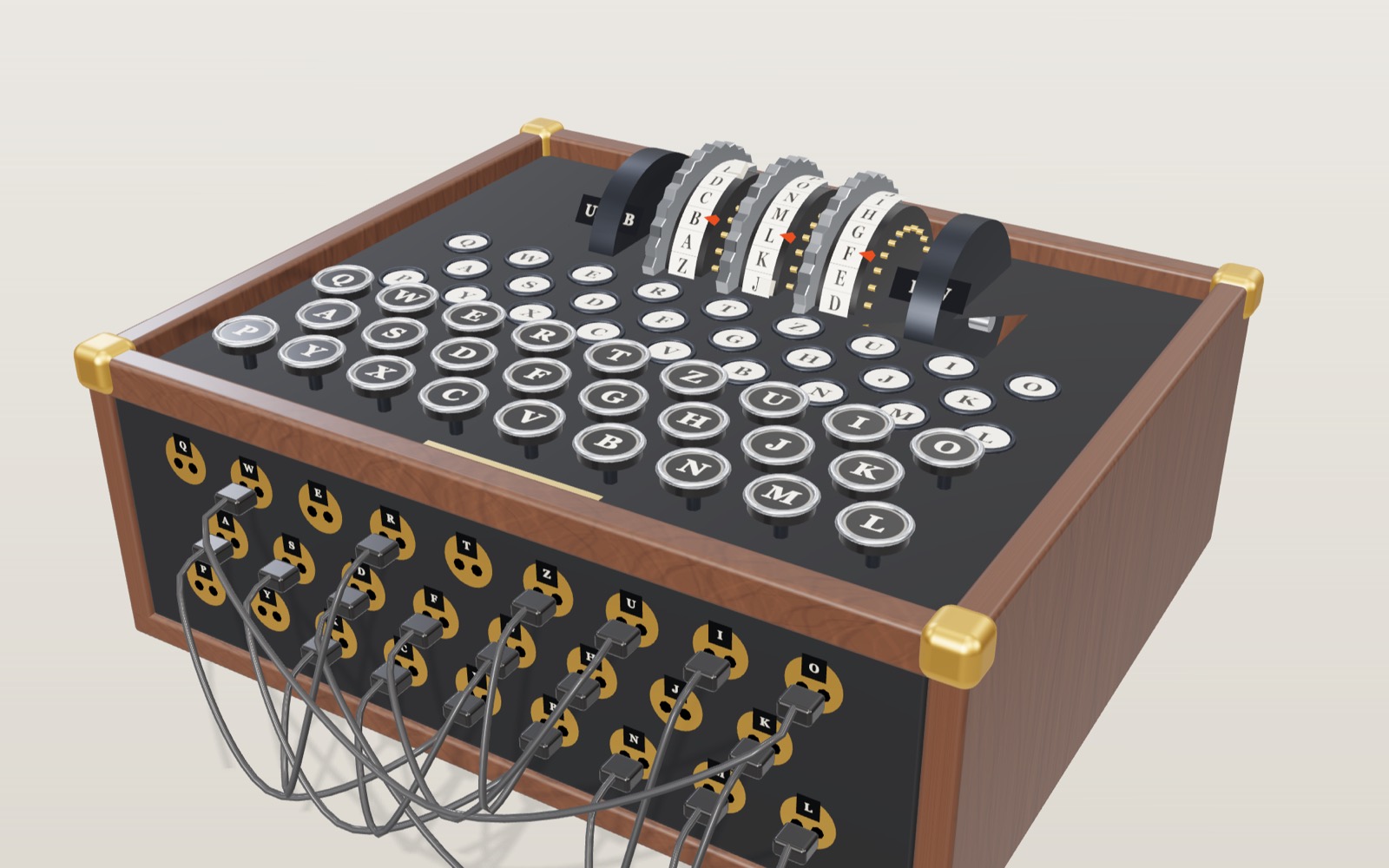
This device cannot show the 3D model. You can read the guide steps below as text.
1 / 10 A real message from 1941The machine is set to rotors II, IV and V, rings B U L, start position B L A and ten plug cables. It is typing a German army message sent on 7 July 1941, and the lamps spell out the plain German text: AUFKLXABTEILUNGXVONX...
Drag to turn. Scroll or pinch to zoom.
What happens when you press a key
How did the Enigma machine work? Each key press sent an electric current through a plugboard, three rotors and a reflector, then back through the rotors and the plugboard to light a lamp with a different letter. The right-hand rotor stepped on every key press, so the wiring changed and the same letter came out differently each time.
A German radio operator in 1941 had a wooden box on the table, about 35 by 29 cm and 16 cm deep in its oak case, weighing around 12 kg. He pressed a key, one small bulb lit up under a lettered window, and a second soldier wrote that letter down. Press the same key again and a different lamp lights. That is the whole user interface of the Enigma I, and the model above works the same way.
This page follows the current from the key to the lamp, part by part, using the real wiring of rotors I to V and reflector B. The cipher in the model is the real one: set it the way the sender did and it reads a message sent from the Russian front on 7 July 1941.
The parts the current passes through
Pressing a key closes a switch. A 4.5 volt battery inside the case pushes current through this chain:
- Keyboard: 26 keys in the German QWERTZ order.
- Plugboard (Steckerbrett): sockets on the front panel. A cable between two sockets swaps those two letters.
- Entry wheel: a fixed disc that passes the current to the rotors. On the Enigma I it is wired straight through, A to A.
- Three rotors, right to left. Each one scrambles the alphabet.
- Reflector: a fixed half wheel that pairs the letters and sends the current back.
- The three rotors again, left to right, along a different path.
- Entry wheel and plugboard again, then one of 26 lamps.
The current crosses a rotor six times on its way, three times in and three times out. If the machine stopped there, it would be a fixed substitution, which a schoolchild with a pencil can solve by counting letters. The trick is that the rotors move.
Why the rotors move before the lamp lights
The key does two jobs in a strict order. The first few millimetres of its travel push a pawl against the right rotor's ratchet and turn that rotor by 1/26 of a turn. Only at the bottom of the stroke does the key close the electrical contact. So the letter is always enciphered with the rotors in their new position.
Turn on See inside and type a few letters. The red and blue wire inside each rotor jumps to a new place with each key press, even when you press the same key, because the rotor has turned and a different internal wire now sits in front of the fixed contact.
Inside a rotor: 26 wires in a scrambled order
A rotor is a thick disc of insulating material. Its right face carries 26 spring-loaded pins and its left face 26 flat contacts. Inside, 26 insulated wires join each pin to one contact. Rotor I, for example, sends A to E, B to K and C to M; the full list is EKMFL GDQVZ NTOWY HXUSP AIBRC J. The model uses the published wiring of all five rotors:
| Rotor | Wiring (what A to Z become) | Notch | In service |
|---|---|---|---|
| I | EKMFL GDQVZ NTOWY HXUSP AIBRC J | Q | 1930 |
| II | AJDKS IRUXB LHWTM CQGZN PYFVO E | E | 1930 |
| III | BDFHJ LCPRT XVZNY EIWGA KMUSQ O | V | 1930 |
| IV | ESOVP ZJAYQ UIRHX LNFTG KDCMW B | J | December 1938 |
| V | VZBRG ITYUP SDNHL XAWMJ QOFEC K | Z | December 1938 |
Around the rim sits a movable alphabet ring with a notch. The ring decides which letter shows in the window, and the ring setting (Ringstellung) decides how far the letters are shifted against the wiring. Changing the ring by one place has the same effect on the wiring as turning the core by one place while the letters stay put.
The reflector, and why no letter becomes itself
Reflector B joins the 26 contacts in 13 pairs: A with Y, B with R, C with U, and so on (YRUHQ SLDPX NGOKM IEBFZ CWVJA T). Current that arrives on A leaves on Y and travels back through the three rotors.
This had two consequences. The good one for the operators: the machine is its own inverse. If A becomes B at some setting, then B becomes A at the same setting, so the same machine and the same procedure decrypt a message. The bad one: a letter can never turn into itself. The return path cannot end where the forward path began, because the reflector never joins a contact to itself. In the model you can type 1,000 letters and you will never see the lamp match the key you pressed. Codebreakers used this to rule out positions of a guessed word (a crib): if the guess put a letter over the same letter in the cipher text, that position was impossible.
Stepping, notches and the double step
The right rotor steps on every key press. When it moves past its notch position (V for rotor III), it carries the middle rotor one step. When the middle rotor moves past its own notch, it carries the left rotor.
The mechanism has a quirk. The pawl that pushes the left rotor rests on the middle rotor's notch, and when it pushes, it also drags the middle rotor along. So the middle rotor steps twice on two consecutive key presses. Tour step 5 shows it with rotors I, II and III starting at ADU:
- ADU becomes ADV (right rotor reaches its notch at V)
- ADV becomes AEW (the middle rotor is carried to E, its own notch)
- AEW becomes BFX (the middle rotor steps again, and takes the left one)
- BFX becomes BFY
Because of the double step, the middle rotor only has 25 distinct positions in the cycle, not 26. The machine repeats after 26 × 25 × 26 = 16,900 key presses. The model's code was run for a full cycle and returns to the start after exactly 16,900 steps.
Following one letter from A to B
Set I-II-III at AAA, no cables, and press A. The right rotor steps first, so the window reads AAB. Then the current goes:
| Stop | Letter |
|---|---|
| Key | A |
| Plugboard | A (no cable) |
| Right rotor (III at B) | C |
| Middle rotor (II at A) | D |
| Left rotor (I at A) | F |
| Reflector B | S |
| Left rotor, back | S |
| Middle rotor, back | E |
| Right rotor, back | B |
| Plugboard and lamp | B |
Type A four more times and the lamps show D, Z, G and O. The string AAAAA becoming BDZGO is the standard test for an Enigma simulator, and the model passes it. With the rings set to BBB instead, the same five keys give EWTYX, another published check that the model's code passes.
How many ways to set the machine
An army operator had to set four things from a daily key sheet. The numbers below are computed, and the formulas are given so you can check them.
- Rotor order: three of five rotors in a chosen order, 5 × 4 × 3 = 60.
- Start positions: 26 × 26 × 26 = 17,576.
- Plugboard with ten cables: choose ten pairs from 26 letters. The count is 26! / (6! × 10! × 2^10) = 150,738,274,937,250. The 6! accounts for the six letters left unplugged, the 10! for the order of the cables, and 2^10 for the two ends of each cable.
Multiplying: 60 × 17,576 × 150,738,274,937,250 = 158,962,555,217,826,360,000, about 1.6 × 10^20, or roughly 2^67. The ring settings of the middle and right rotors change when the turnovers happen, which multiplies the total by up to 26 × 26 = 676 more, to about 1.07 × 10^23.
The plugboard gives most of that number. Ten cables is not even the maximum: eleven cables would give 205,552,193,096,250 pairings. Before January 1939 the army used only six cables, which gives 100,391,791,500.
A large key space is not the same as a strong cipher. The rotors, which look like the clever part, contribute only 60 × 17,576 = 1,054,560 settings. The codebreakers' machines at Bletchley Park attacked exactly that part and dealt with the plugboard by logic.
Encrypting and decrypting are the same action
Type HALLO at I-II-III, AAA with no cables and the lamps light IDBDA. Press Back to start and type IDBDA: the lamps spell HALLO. The button Type the lamps back does this for you. Because of the reflector, the receiver did not need a separate decrypt mode. He set the same rotors, rings, plugs and start position and typed the cipher text.
In wartime use, the start position for each message was itself enciphered. The operator picked three letters (the message key), enciphered them at the day's basic setting, sent the result at the start of the message, and then turned the rotors to his message key. The 1941 message in the first tour step uses message key BLA, rotors II, IV and V, rings B U L and ten cables (AV BS CG DL FU HZ IN KM OW RX). Its first words read AUFKL XABTE ILUNG XVONX KURTI NOWA, where X stands for a space: a reconnaissance unit reporting from Kurtinowa, near Sebezh.
How the model differs from a real machine
- The lid, the lamp filter and the lid window are left off so you can see the rotors.
- The plug cables hang lower than real ones so they do not hide the sockets. Real plugs have two pins of different thickness, which is why one cable swaps both directions.
- The red and blue current path is drawn as a direct line. Inside a real machine, the wires run through the base along a fixed loom.
- The keys of a real machine also switch the lamp circuit, so a pressed key cannot light its own lamp. The model does the same in logic but not in the drawing.
- The case is an Enigma I. When you pick the naval M3 in the lab, the rotors VI to VIII and reflector C are worked out exactly, but the box stays the same. When you pick the M4, the fourth wheel and the thin reflector are computed and named on the reflector tag; the drawing still shows three rotors.
- The travelling light of Follow the current moves at walking pace. Real current crossed the machine in a few nanoseconds.
How Enigma was broken
Arthur Scherbius applied for a patent on a rotor cipher machine on 23 February 1918. The German navy took the machine into service in 1926 and the army added the plugboard in 1928. In December 1932 the Polish mathematician Marian Rejewski worked out the rotor wiring with the theory of permutations. He had help: German manuals and daily key lists that a spy in Berlin, Hans-Thilo Schmidt, had sold to French intelligence. The Poles built their own copies and a device called the cyclometer, and read much German traffic during the 1930s.
On 15 December 1938 the army added rotors IV and V, raising the rotor orders from 6 to 60, and in January 1939 the number of plug cables went up from six. On 26 and 27 July 1939, at Pyry near Warsaw, the Polish Cipher Bureau gave its methods and reconstructed machines to French and British officers. At Bletchley Park, Alan Turing and Gordon Welchman designed the bombe, an electromechanical machine that tested rotor positions against a crib. The first one, named Victory, arrived on 18 March 1940. The second, with Welchman's diagonal board, came on 8 August 1940.
Try it yourself in the lab
Under the controls there is a lab with six tools. None of them is a separate simulation: each one drives the same cipher code as the machine above, the code that is checked against the 1941 message.
Set the machine. Pick a model, three rotors, a reflector, the ring settings and the start position. The plugboard is a row of 26 sockets. Drag from one socket to another to plug a cable, or tap two in turn. Tap a plugged socket to pull its cable out. You can also tap the brass sockets on the front of the 3D machine. Every change resets the tape, because a cipher text only means something together with the setting it was made at.
Follow the current. Turn this on and press a key. The rotors step first, then a small light leaves the key, crosses to its plug socket, swaps if a cable is there, enters the entry wheel and goes through the right, middle and left rotors. In the reflector it turns round and comes back through the left, middle and right rotors by another route, to the plugboard and up to the lamp. The strip at the top of the stage lights each stop as the light passes it. Try it with See inside on: the rotor bodies turn see-through and you can watch the light jump between the contacts.
Double step in slow motion. This sets rotors I-II-III at ADU, slows the rotor movement and presses A three times. The log underneath records which rotors moved on each key: ADU to ADV moves only the right rotor, ADV to AEW moves the right and the middle, and AEW to BFX moves all three. The middle rotor moved on two key presses in a row.
A letter never becomes itself. One button presses A ten thousand times, each time on a fresh random setting with ten random cables, and draws how often each lamp lit. The A bar is always empty. The other 25 bars sit around 400 each, because 10,000 / 25 = 400. In one run on this page they ranged from 343 to 444. That empty bar is the weakness the codebreakers used.
Encrypt and decrypt. Write a message and press Encrypt. Then press Decrypt the result: the same setting turns the cipher text back into your message, and the line says so. Type it on the machine sends the message through the 3D model letter by letter.
How many settings. A table multiplies the parts of the key for each model. You can slide the number of plug cables from 0 to 13 and see the total change. All numbers are exact integers, and the same formulas were also worked through by hand.
Naval machines: three of eight rotors, and then four wheels
The German navy was more careful with Enigma than the army. Its M3 took the same rotors I to V and added three of its own, VI, VII and VIII. These naval rotors have two notches each, at Z and at M, so the next rotor turns over twice per revolution instead of once. With eight rotors to choose three from, there are 8 × 7 × 6 = 336 rotor orders instead of 60. The navy also used reflector C as well as B.
Putting those numbers into the same product as before (336 rotor orders, 2 reflectors, 17,576 start positions, 676 ring settings and ten cables) gives 1,203,537,298,065,206,936,832,000, about 1.2 × 10^24.
In 1942 the U-boat machine changed again. The case had no room for a fourth rotor, so the reflector was made thin and a thin wheel, Beta or Gamma, sat between it and the left rotor. This fourth wheel could be set by hand but never stepped. The British called the new U-boat traffic Shark. The International Spy Museum, which shows a four-rotor machine Germany built for Japan, notes that Shark took nearly a year to break again.
The fourth wheel had a hidden convenience. Set Beta to A with the thin reflector B, and the M4 encrypts exactly like a three-rotor machine with the old reflector B. The same identity holds for Gamma with the thin reflector C. It meant U-boats could still read messages from shore stations that used three-rotor machines. With the fourth wheel free to take 26 positions and two choices of wheel, the M4 count in the lab rises to about 6.3 × 10^25.
Cribs: guessing the plain text
A crib is a piece of plain text you expect to find in a message. Weather reports began with the same German words every day. Units reported in fixed formats, and some sent the same "nothing to report" line night after night.
The first job is to line the crib up with the cipher text. Here the reflector helps the codebreaker. Because no letter can encrypt to itself, the crib cannot sit anywhere a crib letter matches the cipher letter underneath it. Take the first 96 letters of the 1941 message on this page and the true start of its plain text, AUFKLXABTEILUNG, 15 letters long. There are 82 places the crib could start. At 40 of them at least one letter collides, so only 42 remain, and position 0, the right one, is among them. With longer cribs the cut is bigger.
A crib that is lined up gives pairs of letters: plain A became cipher E at step 1, U became D at step 2, and so on. Those pairs are the input of the bombe.
The bombe at Bletchley Park
The Polish bomba of 1938 had worked by spotting the doubled message key at the start of each message. When the Germans stopped doubling the key and added rotors, that approach failed. Alan Turing designed a new machine that worked from cribs instead.
A bombe carried many sets of drums that copied Enigma rotors. For one rotor order it stepped through all 17,576 start positions. At each position it tested whether the letter pairs from the crib could all be true together with some plugboard. Most positions led to a contradiction at once, and the machine moved on. When it stopped, operators wrote down the position and a plugboard guess and checked it by hand on a Typex or Enigma copy.
Gordon Welchman added the diagonal board. It wired in the fact that a plug cable swaps both ways, so if A is plugged to V then V is plugged to A. That cut the false stops sharply. According to The National Museum of Computing, the first bombe, Victory, started work in March 1940, the first with the diagonal board, Agnus Dei, in August 1940, and by the end of the war about 1,676 Wrens and 263 RAF personnel ran 211 bombes. The museum runs a working rebuild.
Once a day key was found, thousands of messages still had to be decrypted. Bletchley Park used British Typex machines adapted to behave like Enigma for that work.
Other rotor machines: Typex and SIGABA
Britain bought two commercial Enigmas in 1928. The Air Ministry then had the teleprinter makers Creed & Company build an improved copy, and the first Typex Mark I machines reached the RAF in early 1937. Typex had five rotors, two of which stayed still while typing, and it printed onto paper tape instead of lighting lamps. The Mark 22 gained a plugboard, which is why it could imitate Enigma. The Imperial War Museums record that the Germans captured at least two Typex machines but never broke it, and it stayed in service until the early 1960s.
The US Army's SIGABA, called ECM by the US Navy, also used wired rotors. Frank Rowlett gave it a stepping motion so tangled that it looked random. The NSA's National Cryptologic Museum notes it was the only machine system of the war never broken by an enemy. From November 1943 adapted ECM and Typex machines worked together as the Combined Cipher Machine, so British and American ships could share messages.
The weak point in Enigma was not that it used rotors. It was the regular stepping, the reflector, and the habits of its operators. The lab's list of 50 machines, people and methods follows that story with a source for each entry.
Why thirteen cables give fewer settings than eleven
Filling every plugboard socket looks like the safest choice. Yet the count falls after eleven cables. To see why, call the number of arrangements with n cables P(n). Comparing two successive values of the factorial formula above cancels almost everything:
P(n + 1) / P(n) = (26 − 2n)(25 − 2n) / (2(n + 1)).
At ten cables, six sockets remain free. Adding an eleventh gives a ratio of 6 × 5 / 22 = 15/11, so the count grows from 150,738,274,937,250 to 205,552,193,096,250. At eleven cables, four sockets remain. The next ratio is 4 × 3 / 24 = 1/2, so twelve cables give 102,776,096,548,125 arrangements. The final ratio is 2 × 1 / 26 = 1/13: thirteen cables leave only 7,905,853,580,625 arrangements. These are counts of possible complete boards, not the number of ways to add a cable to one particular board.
Why divide by n + 1? Each finished board can be reached by removing any one of its n + 1 cables and putting it back. Counting all possible additions without that division would count the same finished board several times. The factor 2 prevents counting the two orientations of one cable separately. A cable joining A to B is the same connection as one joining B to A.
In the settings counter, leave the machine model unchanged and move the cable slider from 10 through 13. All the other factors stay fixed, so the total follows the same rise and fall. This tests a counting assumption, not the time needed to break a message. Eleven cables maximize this particular search space; that alone does not prove that eleven cables give the strongest practical cipher. Cornell University's combinatorics handout derives the underlying formula from choosing sockets and pairing them.
Breaking a message on the bombe stage
Switch on the bombe stage and the Enigma gives way to a model bombe. The front carries 108 drums in three banks. The National Museum of Computing describes the machine this way: each vertical set of three drums does the work of one Enigma's rotors, so the front holds 36 Enigmas. The model's drums turn with the search, and the side drums show the position being tested.
The message on the stage is a made-up U-boat weather report, enciphered with a day key the page keeps hidden until the end. The guess is that it contains WETTERVORHERSAGE, weather forecast, a word the museum names as typical of naval cribs. The first panel slides that crib along the cipher text. Wherever a crib letter stands over the same cipher letter it turns red, and the position is ruled out, because an Enigma never enciphers a letter to itself. Of the first 20 positions, 12 survive. The true one is position 8.
Press "Make the menu here" and the panel draws the menu. Each letter of the crib and the cipher letter under it are joined by a line marked with its place in the message. This crib gives 15 letters, 16 lines and 3 closed loops. The most connected letter, E, becomes the input letter. Loops matter most. A guess about E's plug partner can be followed round a loop and must come back to agree with itself, so every loop is one more test that a wrong guess can fail.
Then the run. For one rotor order the bombe steps through all 17,576 drum positions. At each position it assumes E is plugged to some letter, follows that guess through every scrambler on the menu, and uses Welchman's diagonal board (if E is plugged to w, then W is plugged to e) to spread it further. A wrong guess quickly implies that E is plugged to every letter at once, which is impossible, and the drums move on. The bombe stops only where some guess survives. The model does the same test in full, so its stops are real results of the cipher, not a scripted animation. Each one is then checked the way the checking machine did: if any letter would need two partners it is a false stop. With the true order II-V-III the run stops once, at YIV, and the check passes. The other three orders on the panel give no stop at all.
The stop gives the drum position and the plug partners of every menu letter. Press "Decipher with this stop" and most of the message comes out readable, with a few letters wrong: ANUFDXXWETTERVORHERSAGE. Those errors sit on the three cables whose letters never appeared in the menu. Finding them from the half-readable text is the last step, and it is one of the tasks in the lab.
Two things are simplified. The ring settings are fixed at A, because the bombe finds drum positions and the rings only shift the letters shown in the window. And the model's scramblers step exactly like an Enigma, middle rotor included, instead of copying the bombe's own drum gearing. The museum gives the speed of a real machine: the top drums turned at 97.5 revolutions a minute, so a run without a stop took at least 10.4 minutes. The speed slider runs the model at that pace or up to a thousand times faster.
Lorenz and Colossus: the other German cipher
The German Army High Command did not use Enigma for its most important messages. It used the Lorenz SZ40 and SZ42, attachments that enciphered teleprinter traffic. Bletchley Park called the system Tunny. Teleprinters send each character as five on and off signals, and the Lorenz added five key bits from twelve wheels. Five chi wheels, with 41, 31, 29, 26 and 23 cams, moved with every character. Five psi wheels moved only when the two motor wheels allowed it. A raised cam gives a 1 and a lowered cam a 0, and the key is chi plus psi.
The Lorenz stage shows the twelve wheels with all 501 cams. "One character" moves them by one step. The table shows the chi bits, the psi bits and the key bits they make, and whether the psi wheels moved. The cam patterns on the model are random, and the motor follows the simple SZ40 rule without the later limitation, so treat it as a working diagram, not a copy of one machine.
According to Crypto Museum, an operator sent a long message twice in August 1941 on the same wheel settings and typed it a little differently the second time. From that pair the codebreakers recovered nearly 4,000 key characters, and Bill Tutte worked out the machine's logic by January 1942 without ever seeing one. To set the wheels for each new message fast enough, Tommy Flowers built Colossus, an electronic machine of more than 1,700 valves that read the cipher text from paper tape. The first arrived at Bletchley Park in January 1944. By the end of the war, The National Museum of Computing says, ten Colossi and 550 people had decrypted 63 million characters.
Fifty machines, people and methods
The catalogue in the lab now lists 50 entries, each with its source, and it can be searched and filtered by kind. Entries for machines open a comparison card beside the Enigma I. The card compares how each machine scrambles, its moving parts, its contacts or letters, its years in use and whether it was broken. The Japanese Purple machine used telephone stepping switches instead of rotors, and the US Army's codebreakers rebuilt it in 1940 without ever seeing one, according to the NSA's National Cryptologic Museum. The M-209 was a pocket-sized pin-wheel machine. The Germans could sometimes break one of its messages in about four hours, which was acceptable for orders that lost their value within hours, and it was still in use in the Korean War. The KL-7 of 1952, whose users included South Korea, and the Soviet Fialka of 1956 carried the rotor idea into the Cold War with more rotors and more complicated stepping.
Questions
Can an Enigma letter ever encrypt to itself?
No. The reflector never connects a contact to itself, so the return path always ends on a different letter from the one you pressed. This made cribs easier to place.
Why does the same machine both encrypt and decrypt?
The reflector makes every setting a set of 13 swaps. If A goes to B, then B goes to A at that setting. Typing the cipher text with the same starting setting gives the plain text.
What is the double step?
When the middle rotor reaches its notch, the pawl that turns the left rotor also pushes the middle rotor. The middle rotor moves on two key presses in a row, as in ADV, AEW, BFX.
How many keys did the Enigma I have?
With five rotors, ten cables and 26 start positions per rotor, 158,962,555,217,826,360,000 settings, about 2^67. The ring settings of two rotors add a factor of up to 676.
Why is there a plugboard if the rotors already scramble?
The rotors were the same in every machine and could be captured or worked out. The plugboard changed daily and multiplied the settings by about 150 trillion.
How long before the rotor positions repeat?
For single-notch rotors, 26 × 25 × 26 = 16,900 key presses. The 25 comes from the double step, which skips one middle rotor position.
Can I decrypt a real message here?
Yes. Choose the 1941 message in Settings, or press Play. The machine is set to rotors II, IV and V, rings B U L and start BLA, and the lamps show the German text.
What changed in the naval M4?
A thin reflector made room for a fourth wheel, Beta or Gamma, that is set by hand and never steps. Set to A with the matching thin reflector, it works like a three-rotor machine.
Why did operators type the message key twice?
As a check against radio errors. In the 1930s the army enciphered the three-letter message key twice in a row, so letters 1 and 4, 2 and 5, and 3 and 6 of every message hid the same letter. Rejewski built his attack on that pattern.
Were Typex or SIGABA ever broken?
No enemy is known to have broken either. The NSA calls SIGABA the only machine system of the war never broken, and the Imperial War Museums say the Germans never broke into Typex.
How long would it take to try every setting?
At one billion settings a second, the 1.07 × 10^23 settings of an Enigma I with ten cables would take about 3.4 million years. The codebreakers never tried them all. Cribs and the bombe cut the work down to the 1,054,560 rotor orders and positions, and logic handled the plugboard.
What is a bombe menu?
A drawing of the letter pairs a crib gives. Each pair, a crib letter and the cipher letter under it, is joined by a line marked with its position in the message. The bombe was cabled up to match it. Menus with closed loops give fewer false stops.
What is a false stop?
A drum position where the bombe found no contradiction, though the position is wrong. It was ruled out on the checking machine when some letter turned out to need two plug partners. On the bombe stage the check runs right after every stop.
How long did one bombe run take?
The National Museum of Computing gives at least 10.4 minutes for a full run of 17,576 positions without a stop on its rebuild's gearing. Early in 1943 a run took 16 minutes, and the high-speed Keen machines from March 1943 finished a three-wheel run in a minute and a half.
How was the Lorenz different from Enigma?
Enigma enciphered single letters with rotors and a reflector, and an operator wrote down the lamps. The Lorenz enciphered teleprinter characters as five bits, adding bits from twelve pin wheels, and worked automatically on the line. It was broken with hand methods and then with Colossus, not with bombes.
Terms
- Rotor (Walze): a wired disc that maps 26 contacts on one face to 26 on the other.
- Ring setting (Ringstellung): the offset between the alphabet ring and the rotor's wiring.
- Notch: a cut in the ring that lets the next rotor to the left step.
- Reflector (Umkehrwalze): the fixed wheel that pairs the contacts and returns the current.
- Entry wheel (Eintrittswalze): the fixed wheel between the plugboard and the right rotor.
- Plugboard (Steckerbrett): sockets and cables that swap pairs of letters.
- Message key: the three letters the rotors start at for one message.
- Crib: a guessed piece of plain text, such as a routine word, used to find the key.
- Bombe: the electromechanical machine at Bletchley Park that tested rotor positions against a crib.
- Thin reflector and fourth wheel (Greek wheel): the M4 parts that added a non-stepping wheel, Beta or Gamma, in the space of the old reflector.
- Diagonal board: Welchman's addition to the bombe that used the two-way plug swaps to reject false stops.
- Day key: the setting from the key sheet that every operator in a network used that day.
Sources
- Crypto Museum, Enigma I: battery, rotor orders, model history. https://www.cryptomuseum.com/crypto/enigma/i/index.htm (checked 15 October 2026)
- Crypto Museum, Enigma wiring. https://www.cryptomuseum.com/crypto/enigma/wiring.htm (checked 15 October 2026)
- Dirk Rijmenants, Cipher Machines and Cryptology, Enigma technical details. https://www.ciphermachinesandcryptology.com/en/enigmatech.htm (checked 15 October 2026)
- Crypto Museum, Enigma History (Scherbius's patent application of 23 February 1918, the navy's machine of 1926, the army's plugboard of 1928, Rejewski in December 1932, the extra plug cables of January 1939, the Pyry meeting of July 1939). https://www.cryptomuseum.com/crypto/enigma/hist.htm (checked 17 October 2026)
- Science Museum Group, Three-ring Enigma cypher machine in oak wood transit case, object 1980-1200 (closed 160 × 290 × 350 mm, 11.6 kg). https://collection.sciencemuseumgroup.org.uk/objects/co35752/three-ring-enigma-cypher-machine-in-oak-wood-transit-case (checked 17 October 2026)
- Crypto Museum, Bombe (the first British Bombe, Victory, delivered to Bletchley Park on 18 March 1940; the second, with Welchman's diagonal board, installed on 8 August 1940). https://www.cryptomuseum.com/crypto/bombe/index.htm (checked 17 October 2026)
- Cornell University, Math 135, Plugboard arrangements. https://pi.math.cornell.edu/~kozdron/Teaching/Cornell/135Summer06/Handouts/enigma.pdf (2026-10-23)
- Frode Weierud, CryptoCellar, Breaking German Army Ciphers. https://cryptocellar.org/bgac/ (checked 15 October 2026)
- Bletchley Park Trust, Enigma. https://bletchleypark.org.uk/our-story/enigma/ (checked 15 October 2026)
- Calculations on this page: plugboard count 26! / ((26 − 2n)! × n! × 2^n); total settings 60 × 26^3 × plugboard; cycle length 26 × 25 × 26. The model's cipher was compared with known results: AAAAA → BDZGO, rings BBB → EWTYX, the ADU double step and the full 1941 message.
- Crypto Museum, Typex: Typex Mark 22 used as an Enigma analogue at Bletchley Park. https://www.cryptomuseum.com/crypto/uk/typex/index.htm (checked 17 October 2026)
- Imperial War Museums, TypeX Enciphering Machine, Mark 22 (the 1928 purchase of commercial Enigmas, five rotors, the CCM from November 1943, service into the 1960s). https://www.iwm.org.uk/collections/item/object/30005901 (checked 17 October 2026)
- Science Museum Group, Typex Mk III cypher machine for field use, c. 1945, object 1980-1275. https://collection.sciencemuseumgroup.org.uk/objects/co35754/typex-mk-iii-cypher-machine-for-field-use-c-1945 (checked 17 October 2026)
- National Security Agency, National Cryptologic Museum, SIGABA/ECM. https://www.nsa.gov/History/National-Cryptologic-Museum/Exhibits-Artifacts/Exhibit-View/Article/2719165/sigabaecm/ (checked 17 October 2026)
- National Security Agency, NSA/CSS National Cryptologic Museum unveils new Polish Enigma exhibit (11 December 2007: Rejewski, Zygalski and Różycki, December 1932, the Bomba). https://www.nsa.gov/Press-Room/Press-Releases-Statements/Press-Release-View/Article/1632427/nsacss-national-cryptologic-museum-unveils-new-polish-enigma-exhibit (checked 17 October 2026)
- Jennifer Wilcox, NSA Center for Cryptologic History, Solving the Enigma: History of the Cryptanalytic Bombe (Turing at OP-20-G, December 1942). https://www.nsa.gov/portals/75/documents/about/cryptologic-heritage/historical-figures-publications/publications/wwii/solving_enigma.pdf (checked 17 October 2026)
- The National Museum of Computing, The Turing-Welchman Bombe (Victory in March 1940, Agnus Dei in August 1940, 211 bombes, 1,676 WRNS and 263 RAF personnel). https://www.tnmoc.org/bombe (checked 17 October 2026)
- International Spy Museum, Four Rotor Enigma Machine (the 1942 fourth rotor, Shark, a machine built for Japan). https://www.spymuseum.org/exhibition-experiences/about-the-collection/collection-highlights/four-rotor-enigma-machine (checked 17 October 2026)
- Calculations added in v2: rotors VI to VIII and reflectors A, C, thin B and thin C against the Crypto Museum wiring table; M4 with Beta at A and thin B equals reflector B, Gamma and thin C equals C; 80,000 random letters never encrypt to themselves and always decrypt back; plugboard formula equal to a brute-force count on 6 to 12 letters; M3 total 336 × 2 × 26^3 × 26^2 × plugboard; the crib example (42 of 82 positions survive for AUFKLXABTEILUNG).
- The National Museum of Computing, Bombe History 1: Historical Background (after National Archives HW3/146: runs of 16 minutes in early 1943, Keen high-speed machines from March 1943, 211 machines, 36,002 jobs). https://www.tnmoc.org/bh-1-bombe-historical-background (checked 26 October 2026)
- The National Museum of Computing, Bombe History 10: Bombe Description (three banks, 36 Enigmas of three drums, 17,576 positions, the diagonal board, reflector D). https://www.tnmoc.org/bh-10-bombe-description (checked 26 October 2026)
- The National Museum of Computing, Bombe History 11: Bombe Speed (top drums at 97.5 revolutions a minute, 10.4 minutes a run). https://www.tnmoc.org/bh-11-bombe-speed (checked 26 October 2026)
- The National Museum of Computing, Bombe History 16: Menus and Cribs (WETTER VORHERSAGE, stops, the checking machine, The Ultra Secret in 1974). https://www.tnmoc.org/bh-16-menus-and-cribs (checked 26 October 2026)
- The National Museum of Computing, Colossus (Flowers's eleven months at Dollis Hill, ten Colossi, 550 people, 63 million characters). https://www.tnmoc.org/colossus (checked 26 October 2026)
- Crypto Museum, Lorenz SZ-40/42 (Tunny, the August 1941 message, Tutte by January 1942). https://www.cryptomuseum.com/crypto/lorenz/sz40/index.htm (checked 26 October 2026)
- Crypto Museum, Colossus (over 1,700 valves, delivered 18 January 1944, first message 5 February 1944, Mark II with 2,400 valves on 1 June 1944). https://www.cryptomuseum.com/crypto/colossus/index.htm (checked 26 October 2026)
- Jack Copeland, Colossus: Breaking the German Tunny Code, The Rutherford Journal, University of Auckland (chi wheels of 41, 31, 29, 26 and 23 cams). https://museum.cs.auckland.ac.nz/rutherfordjournal/article030109.html (checked 26 October 2026)
- National Security Agency, National Cryptologic Museum, The Magic of Purple (Purple from 1939, the sixes and twenties, Rosen's analogue, September 1940). https://www.nsa.gov/History/National-Cryptologic-Museum/Exhibits-Artifacts/Exhibit-View/Article/2718925/the-magic-of-purple (checked 26 October 2026)
- Crypto Museum, M-209 (six pin wheels of 17 to 26 segments, about 140,000 made, breaks in about 4 hours, use in the Korean War). https://www.cryptomuseum.com/crypto/hagelin/m209/index.htm (checked 26 October 2026)
- Crypto Museum, TSEC/KL-7 (1952, eight rotors of 36 contacts, users including South Korea). https://www.cryptomuseum.com/crypto/usa/kl7/index.htm (checked 26 October 2026)
- Crypto Museum, M-125 Fialka (1956, ten rotors of 30 contacts). https://www.cryptomuseum.com/crypto/fialka/index.htm (checked 26 October 2026)
- Crypto Museum, Enigma K, NEMA, Hagelin C-38, Kryha and M-94 (catalogue entries). https://www.cryptomuseum.com/crypto/enigma/k/index.htm (checked 26 October 2026)
- Calculations added in v3: the bombe stage's scrambler equals the machine without plugs; 12 of the first 20 crib positions survive; the menu has 15 letters, 16 pairs and 3 loops; a full run on four rotor orders gives one stop, at YIV for II-V-III, whose plug pairs match the key; the three cables off the menu are BF, LP and XU; the twelve Lorenz wheels have 501 cams and 43 × 47 × 51 × 53 × 59 × 37 × 61 × 41 × 31 × 29 × 26 × 23 start positions; the task answers are computed from the cipher.
Course 8 of 8
Old machines, oldest firstMore exhibits
How a QR code is read
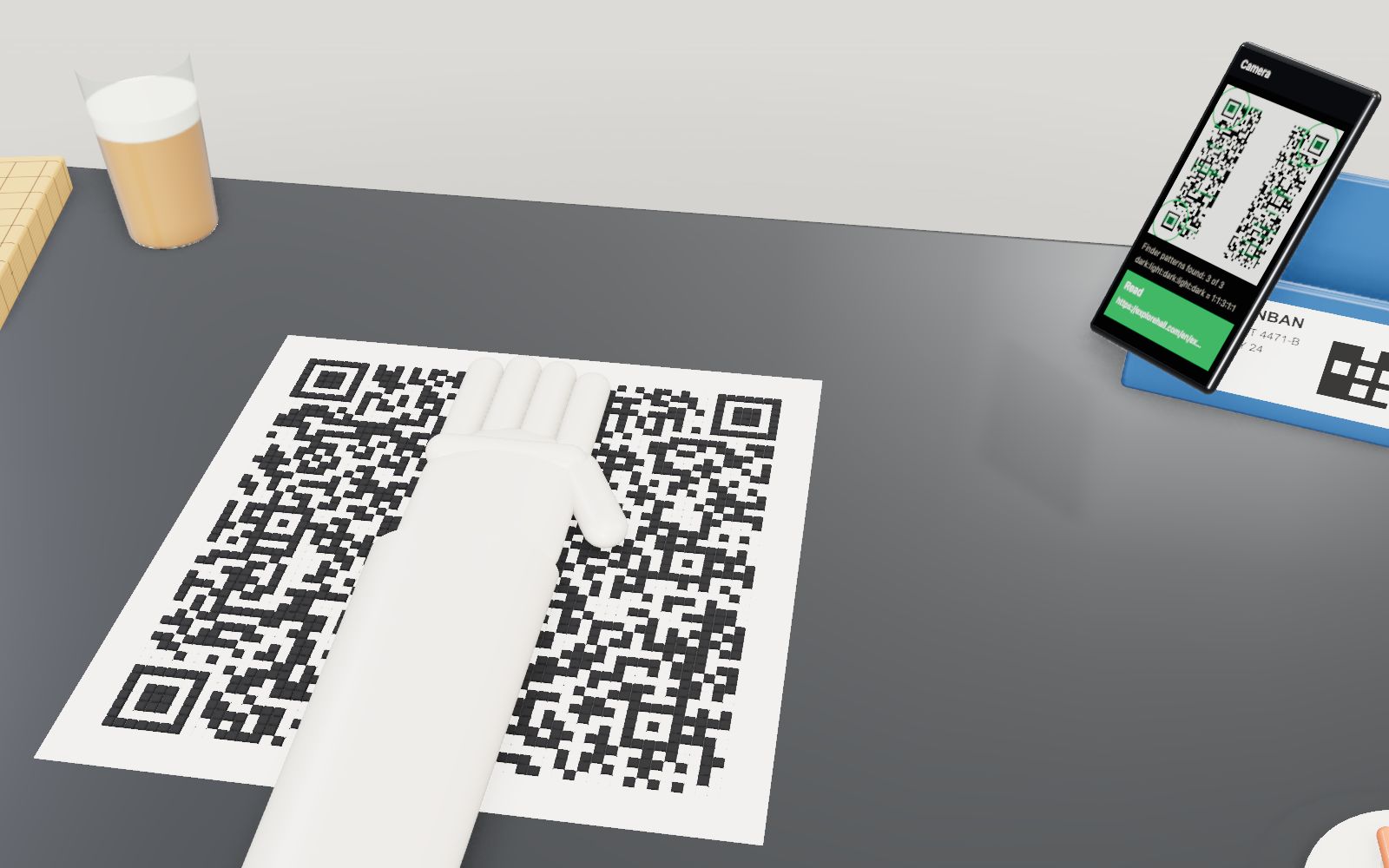
Cover 30 % of a QR code with your hand and a phone still reads it. Cover one corner and it does not.
Movable type and the printing press
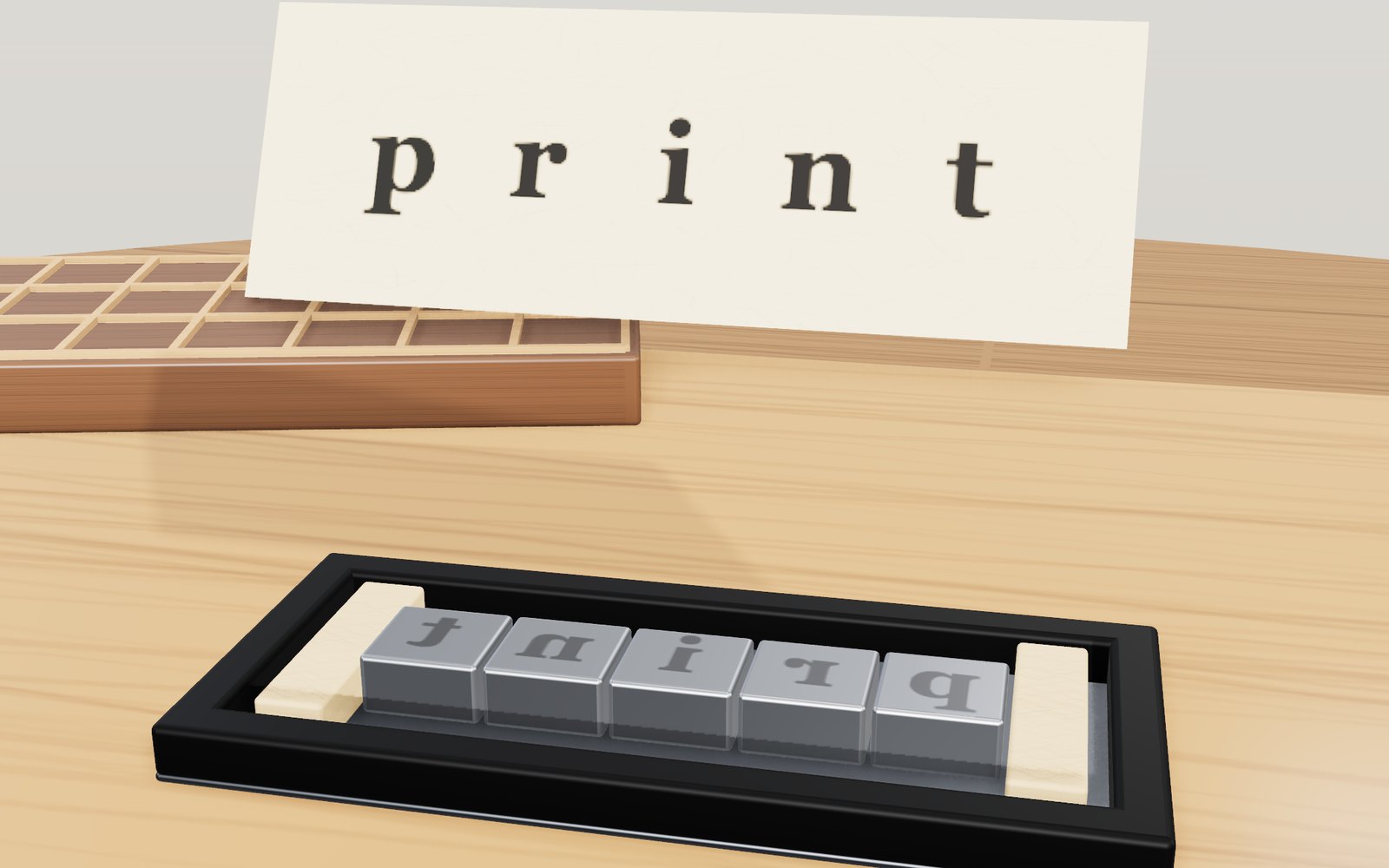
A piece of type carries its letter back to front. Ink it, press paper on it, turn the sheet over, and the letter reads the right way round.
How a typewriter works: inside a manual typewriter
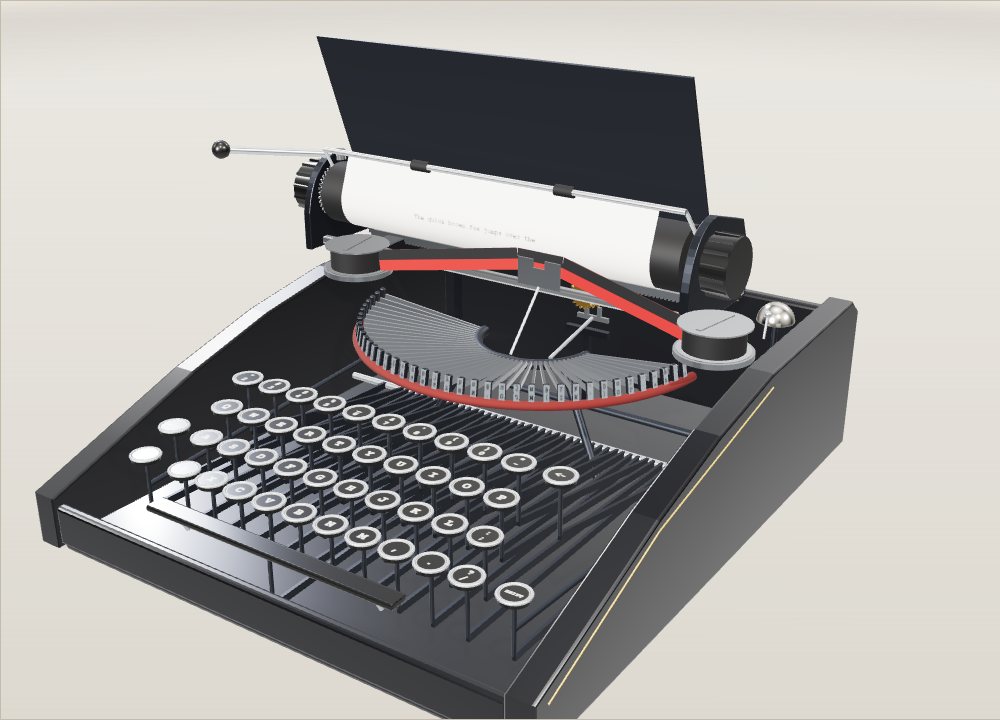
On a pica typewriter every letter, space and full stop moves the carriage the same 2.54 mm to the left.
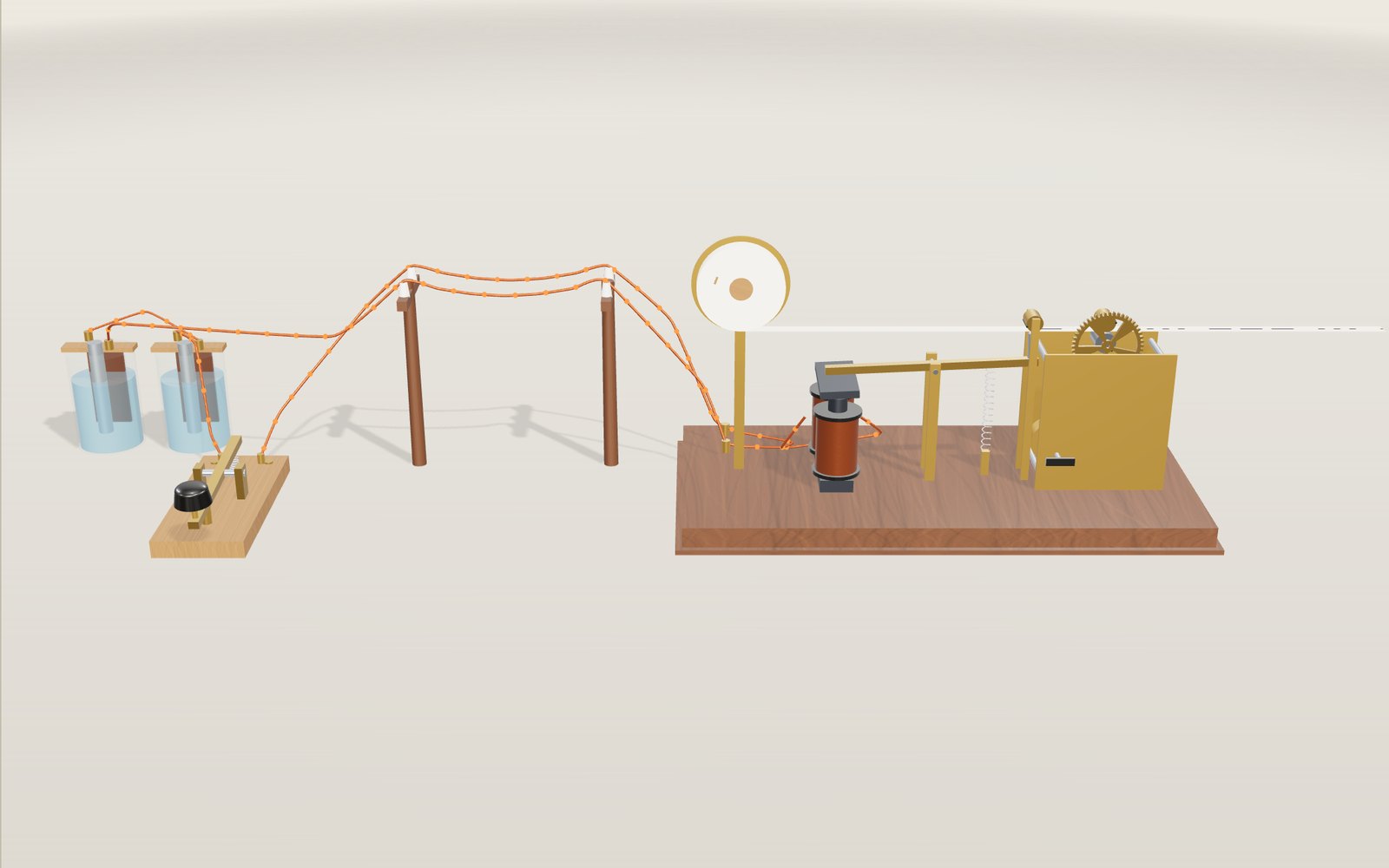
Morse telegraph: key it yourself, step by step
On 24 May 1844 a key in the US Capitol pressed dots and dashes into a paper tape in Baltimore, about 40 miles (64 km) away.
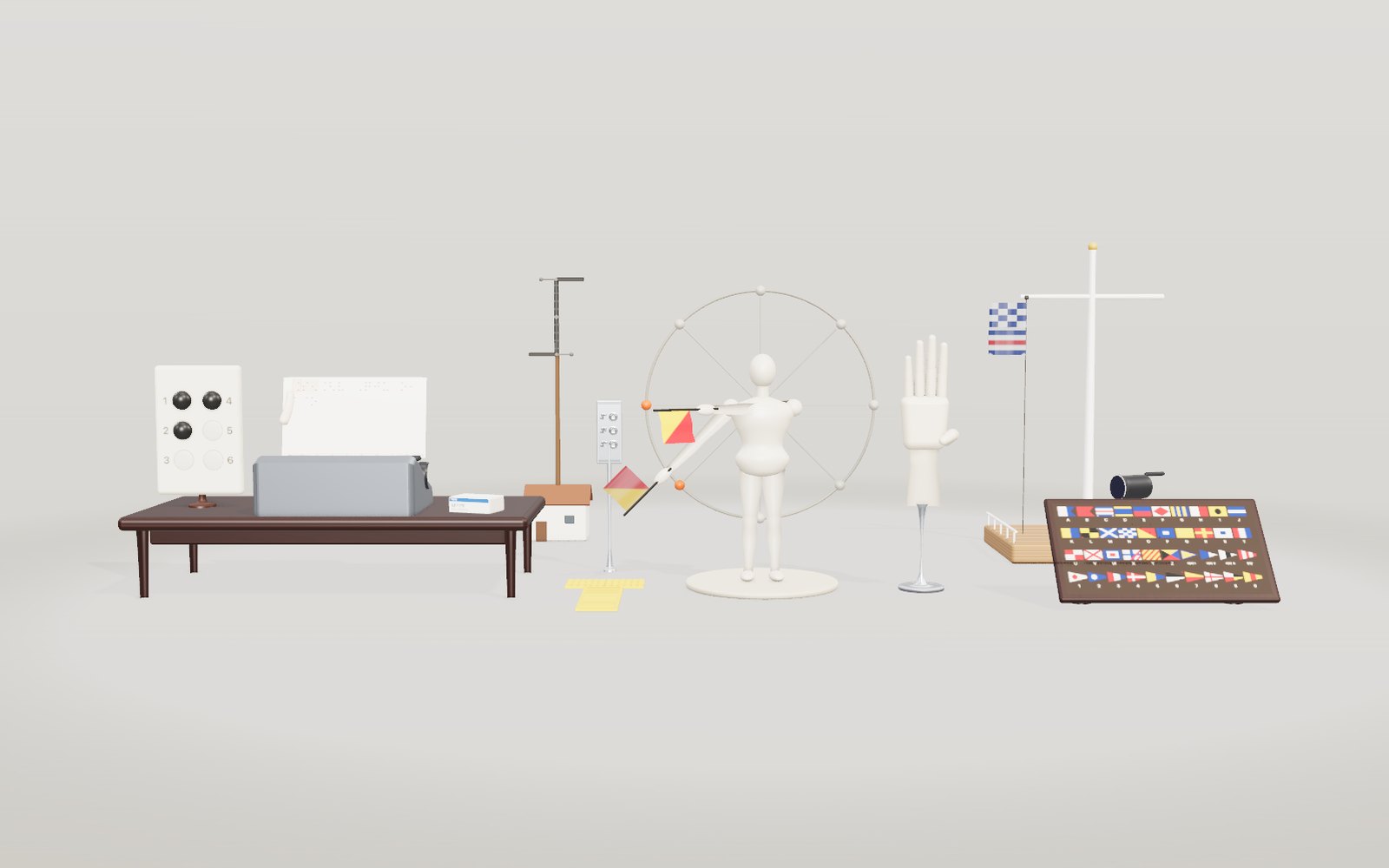
Braille, semaphore and fingerspelling: how the codes work
A braille dot is 1.5 mm across, and six of them in a 2 by 3 grid give 64 patterns that Korean, English, Japanese and music braille all share.
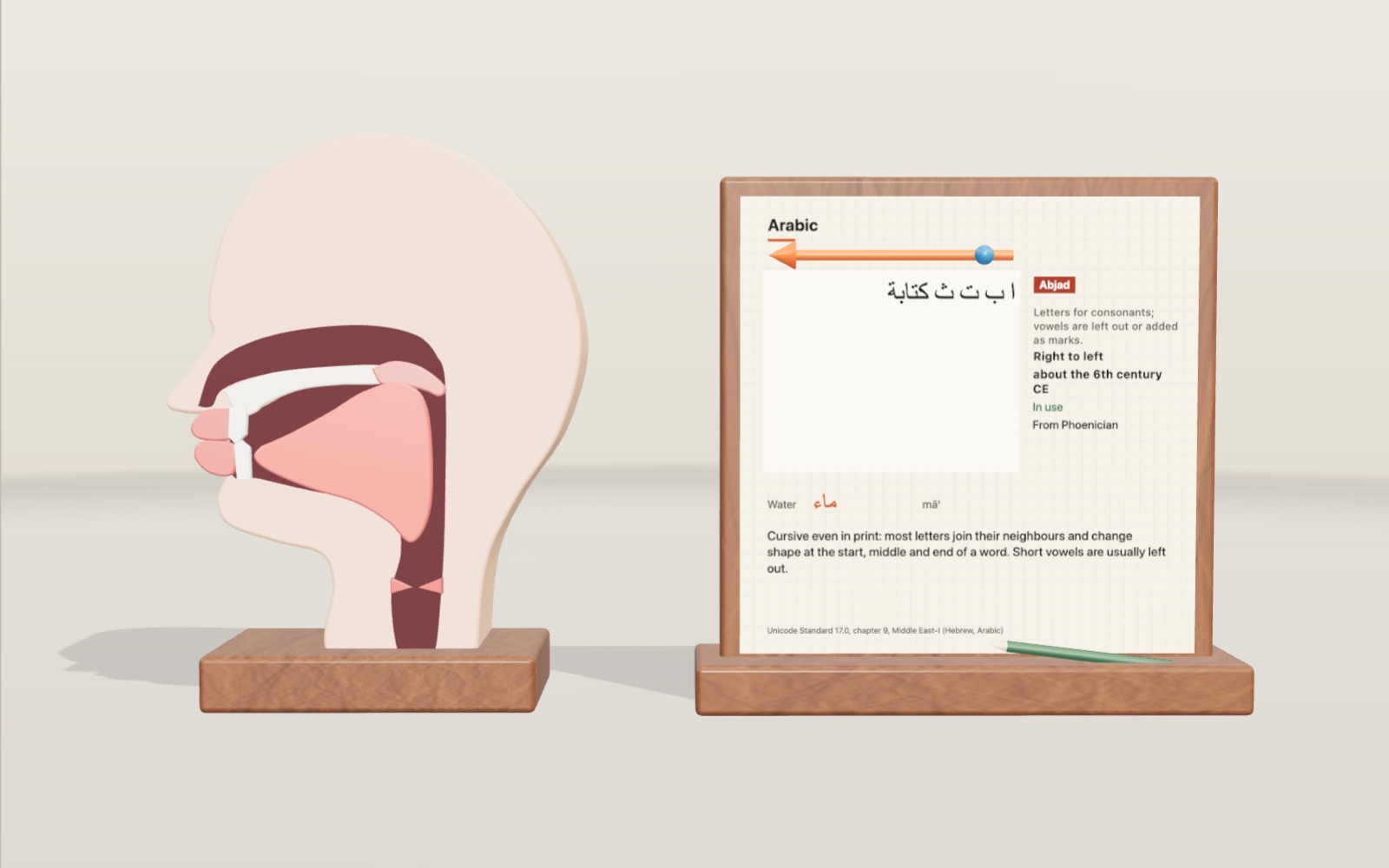
Writing systems of the world: Hangul and 22 more scripts
The 1446 book that announced Hangul says ㄱ draws the tongue root closing the throat. Here it stands beside 22 other scripts, from clay wedges to Braille.
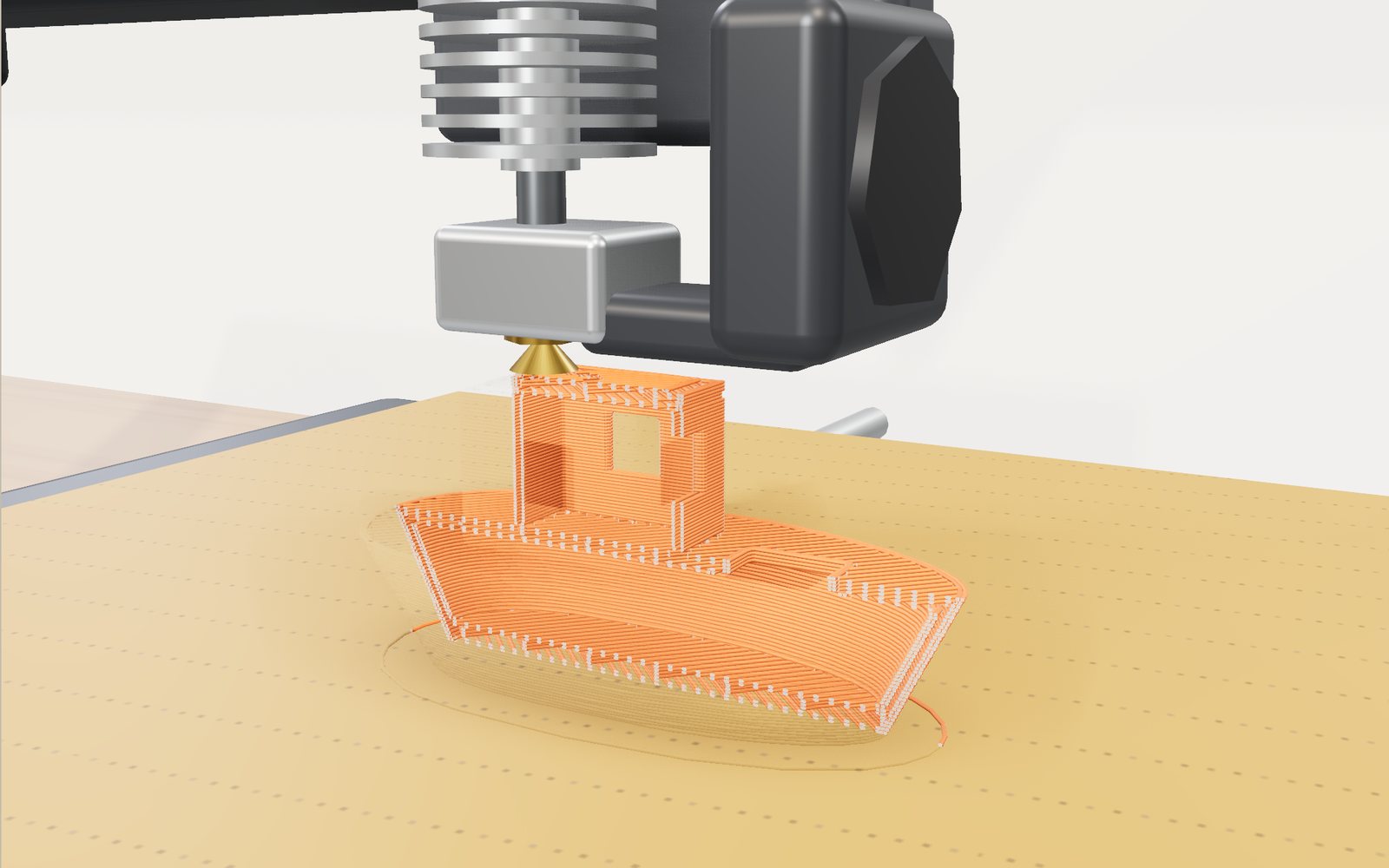
How a 3D printer works, layer by layer
A 20 mm cube printed in 0.2 mm layers is exactly 100 layers, each drawn by a nozzle 0.4 mm wide.
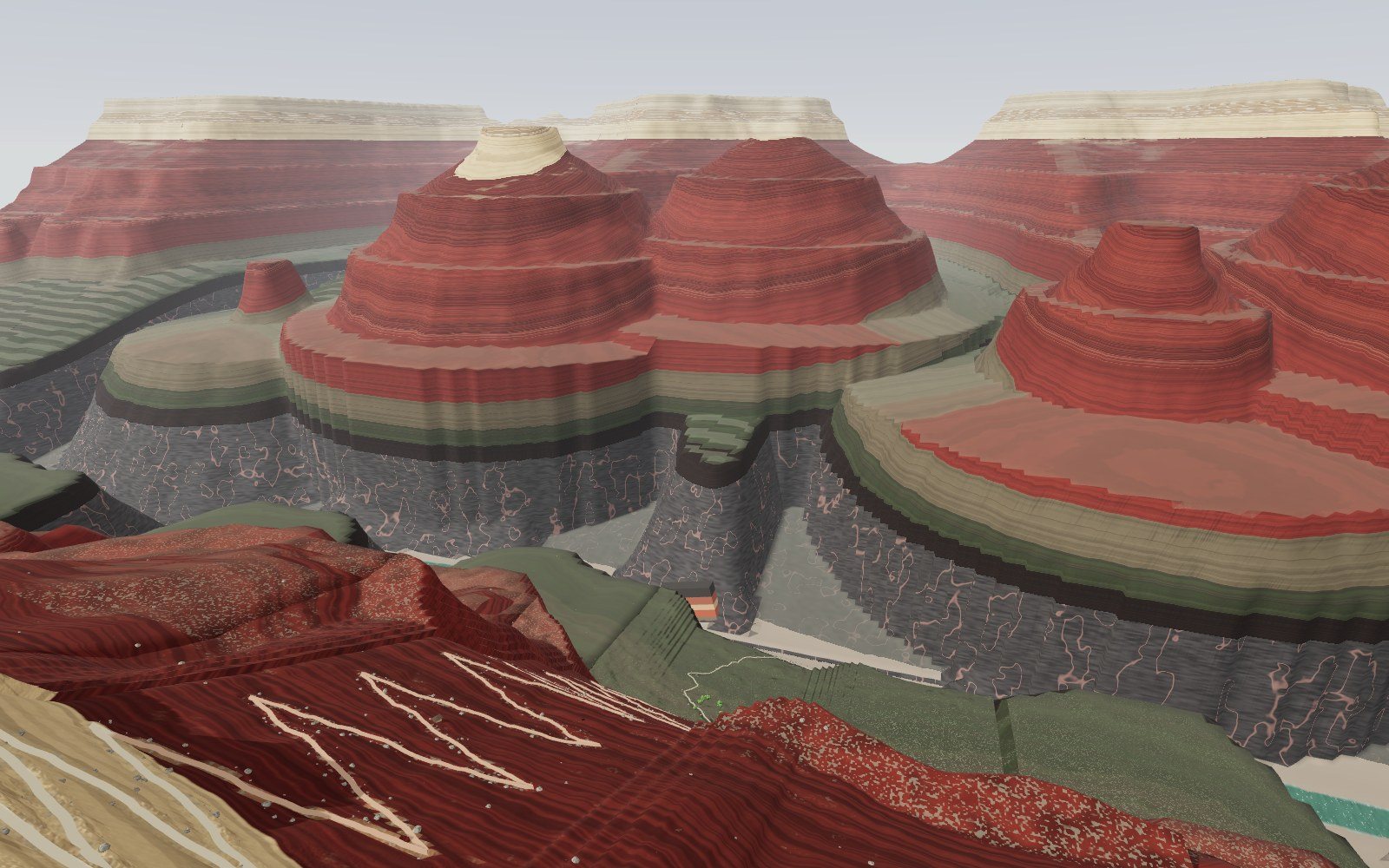
Walk down the Grand Canyon rock layers
Walk 1,360 m down the Bright Angel Trail through 13 rock layers, from a 270-million-year-old sea floor on the rim to 1.75-billion-year-old schist by the river.
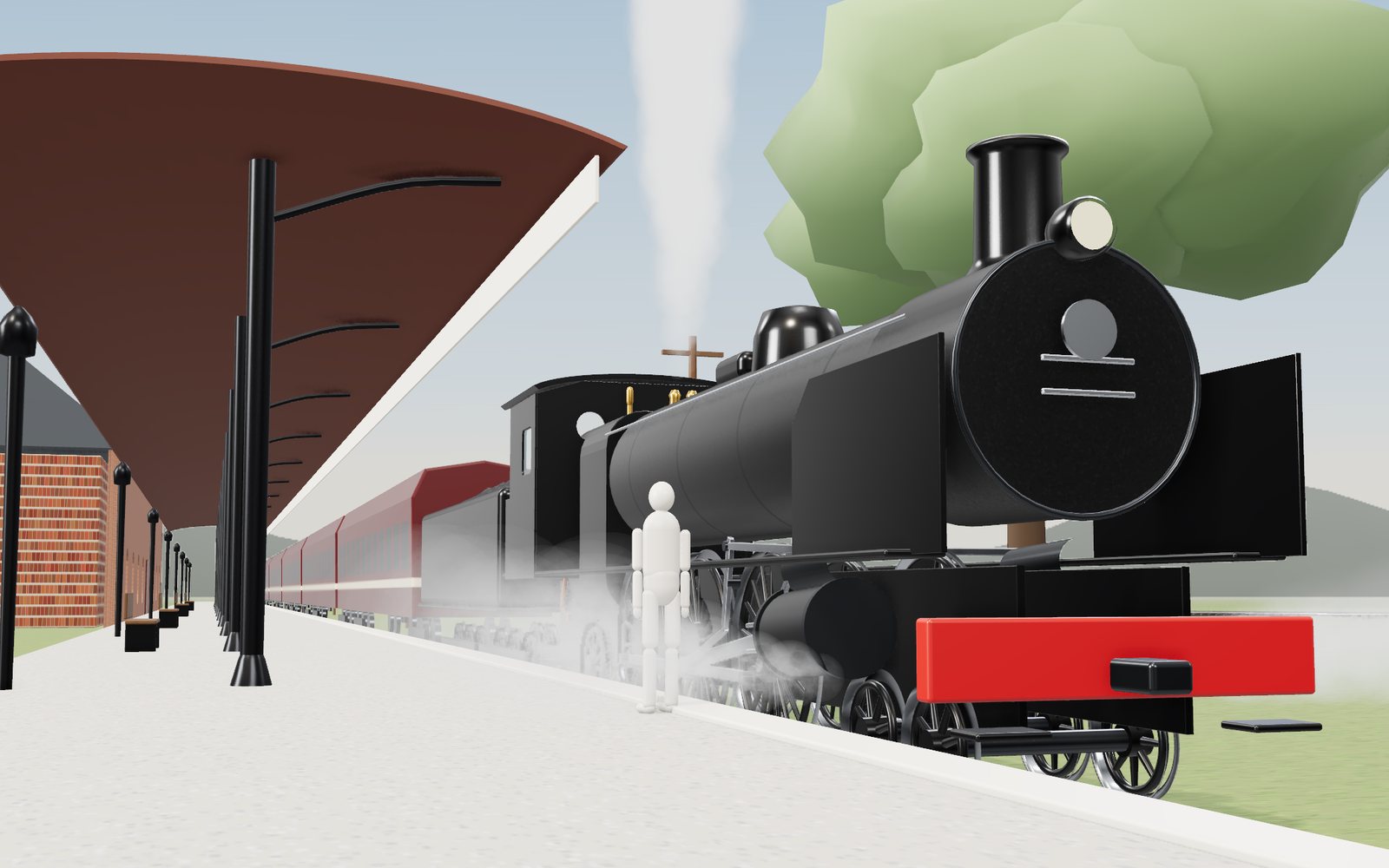
How a steam locomotive works
Mallard's driving wheels are 2.03 m across, taller than most people, and at its record 126 mph they turned almost nine times a second.
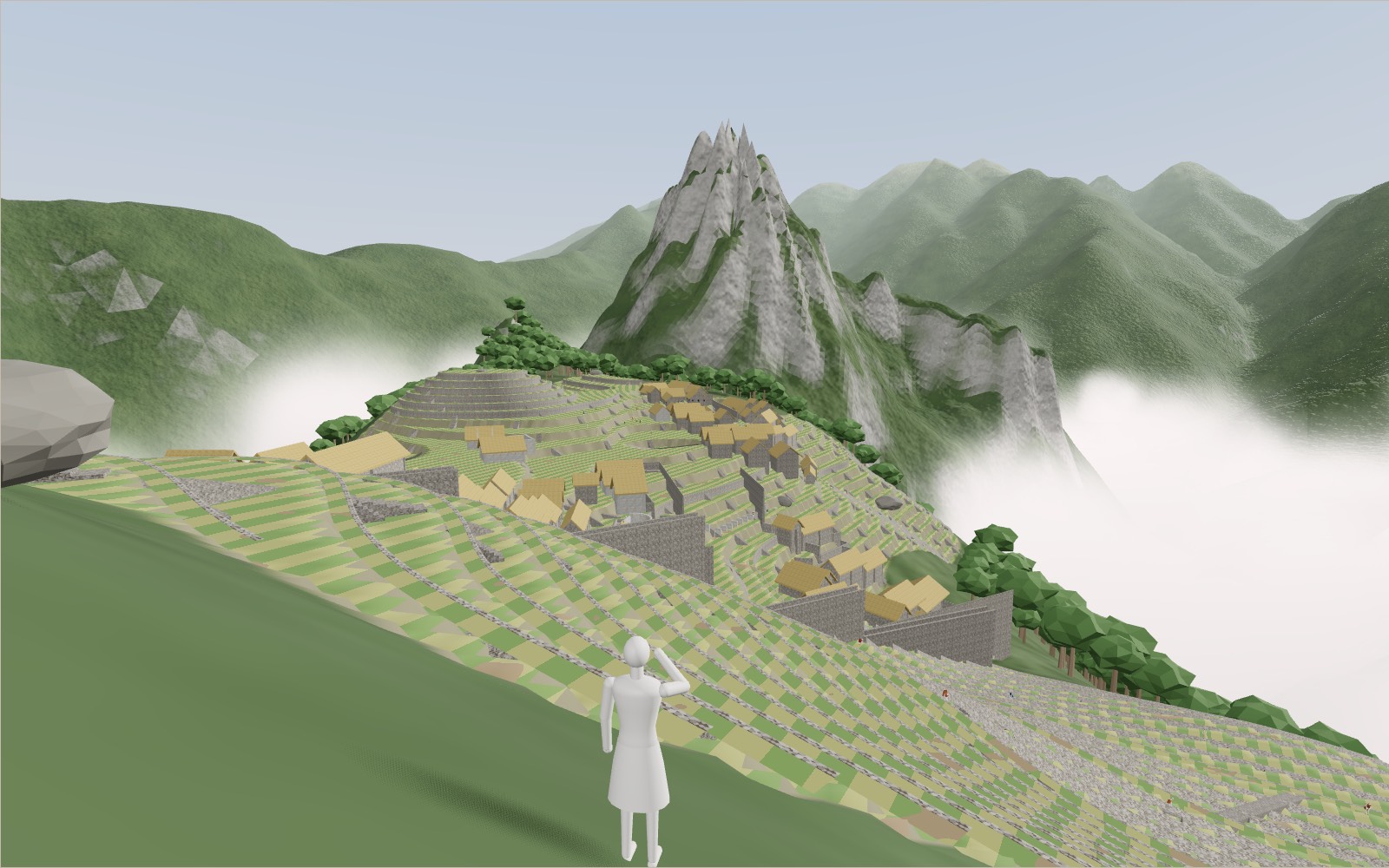
Walk through Machu Picchu
Most of the work that holds Machu Picchu on its ridge, 60 per cent by one estimate, lies under the ground in foundations and drains nobody sees.

Satellites orbiting Earth right now
On 20 October 2026 the public catalogue listed 16,768 working satellites, and two in every three belonged to one company's internet network.
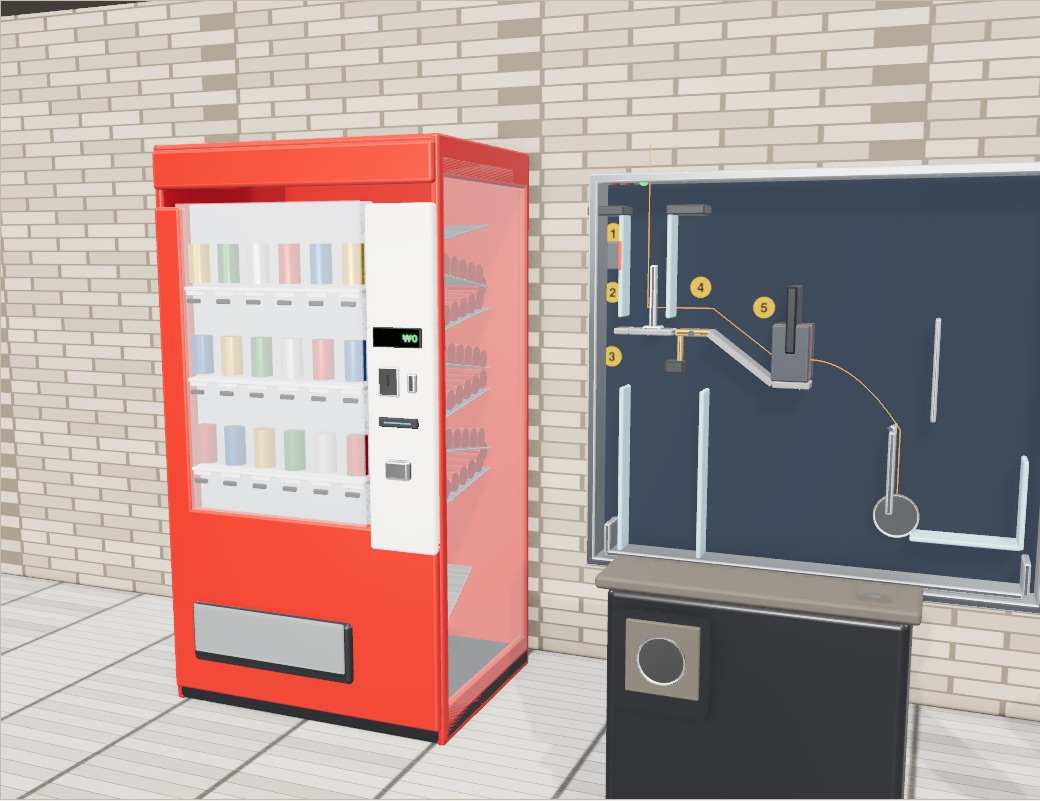
How does a vending machine recognise coins?
A 100 won coin is not attracted to a magnet, yet the magnet inside a vending machine is what tells it from a copper fake.