Loading the model
This device cannot show the 3D model. You can read the guide steps below as text.
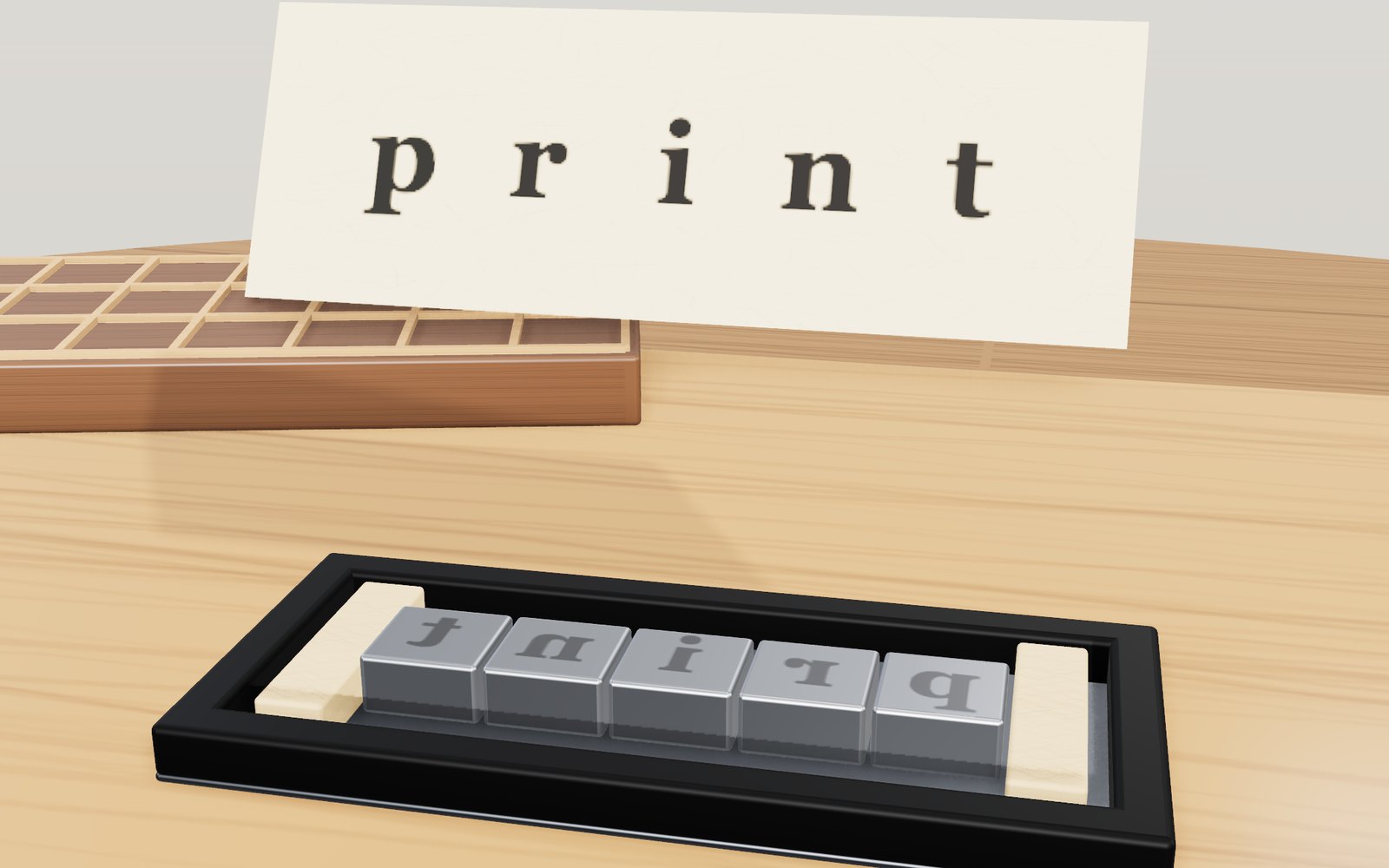
1 / 20 Type cut back to front This forme spells a word in big display type. Look at the faces: every letter is cut in mirror image. The roller is about to ink them.
Drag to turn. Scroll or pinch to zoom.
Guide Parts Controls
01 Type cut back to front This forme spells a word in big display type. Look at the faces: every letter is cut in mirror image. The roller is about to ink them.
02 Print, and it reads Rubbed and lifted, the sheet is turned over, so the mirror image turns the right way round. Press My name to set your own.
03 A mirror behind the type Switch on Mirror and the standing glass shows the faces the way the paper will. The print is the type seen in a mirror.
04 One board, one page A woodblock of the Tripitaka Koreana kind: 23 lines of 14 characters a side, cut on both sides. The pattern here stands in for the text.
05 81,258 boards A pile of 100 boards stands about 3.9 m high beside the mannequin. All of them laid flat would reach about 3,200 m.
06 A tree of wax type For Goryeo type each character was cut in beeswax and stuck on a wax branch. The tree goes into clay and the wax is melted out.
07 Bronze at 1,100 °C Bronze is poured at 1,100 to 1,200 °C. Too cold and the thin strokes do not fill. Try the Metal control.
08 Or sand moulds Joseon state type were cast in sand from wooden models, so the same character came out alike. For Goryeo, which method was used is still argued.
09 The Jikji forme A bronze frame with type held in a bed of beeswax: 11 columns of 18 to 20 characters. Two formes were used in turn.
10 Soft wax, tilted type Press hard and the type lean in the wax, so characters print crooked and ink comes out uneven, as on the pages of Jikji.
11 Things left in On the print there is an upside-down character and a hand-drawn circle where one was missed. Click them.
12 Bamboo instead of wax The 1434 frame packs each column with bamboo. Square type in a square frame do not move, and the work went up to about 40 sheets a day.
13 Hangul in metal The first Hangul type were cast about 1447. Here a word in Hangul stands in the first column.
14 A punch In Mainz each letter started as a steel punch, cut back to front, then struck into copper to make a matrix.
15 The hand mould The matrix closes the bottom of the hand mould, a ladle of lead alloy goes in, the mould opens and a letter drops out.
16 Ink balls Two leather balls dab ink on the forme while the bed is out from under the press.
17 One pull The bar turns the screw and the platen comes down on the tympan. From the 1440s the press hardly changed for 300 years; the first all-iron press, about 1800, made about 200 pulls an hour.
18 Steam, 1814 The bed runs to and fro under a turning cylinder. At normal speed this model prints one sheet every 3.3 s, about 1,100 an hour.
19 A whole line The Linotype lines up brass matrices and casts the line as one bar of metal. Its letters are back to front too.
20 The room The press, the drying line and a 1.7 m mannequin for scale. 13 small things are hidden on the benches; click them.
Display type Big type for the name bench, cut in mirror image, 23.3 mm high. Chase An iron frame that holds the type and the wooden packing tight. Ink roller Rolls ink from the slab onto the raised faces only. Rubbing pad Presses the back of the sheet onto every face. Sheet Hanji on the benches, linen-rag paper at the press. The print side faces the type. Type case Compartments of small type, one sort to each. Woodblock About 70 by 24 cm, cut on both sides (pattern instead of text). End pieces Wooden pieces fitted to both ends of the board. Ink brush Spreads ink over the board or the forme. Rubbing pad A soft pad rubbed over the back of the paper. Stack of 100 boards About 3.9 m high: 3,200 m for all of them. Wax models Characters cut back to front in beeswax (or wooden models for sand casting). Casting tree Branches with a type at each end, round a central rod and cup. Clay mould Fine clay round the wax tree; the wax is melted out of it. Sand moulds Two frames of fine sand pressed with the wooden models. Crucible Holds the molten bronze; tipped with tongs to pour. Furnace Charcoal fire for melting the metal and the wax. Bronze forme frame A bronze frame with its border lines cast on. Beeswax bed Soft wax that holds the type upright. Assembled frame Column rules and a square frame: Gabin-ja, 1434. Bamboo strips Packing between the type instead of wax. Punch Steel, with the letter cut back to front on the end. Matrix Copper, with the letter sunk the right way round. Hand mould Two halves round a channel; the matrix closes one end. Ladle Carries molten lead alloy from the pot to the mould. Composing stick The compositor sets the letters in it one by one. Screw Turns a little and drives the platen down. Bar The pressman pulls it to turn the screw. Platen The flat block that presses the sheet onto the forme. Bed Carries the forme in and out on the rails. Tympan A hinged frame covered with parchment; the sheet lies on it. Frisket A mask that keeps the margins clean. Rounce A handle that winds the bed in and out. Ink balls Leather pads on handles, for dabbing ink on the type. Impression cylinder Rolls the sheet over the forme as the bed passes. Moving bed Runs to and fro under the cylinder with the forme on it. Ink rollers Take ink from the fountain and spread it on the forme. Drive Flywheel and belt from the line shaft (steam engine off stage). Keyboard 90 keys; each releases one matrix. Magazine Sloping channels that hold the brass matrices. Matrices Brass pieces with a letter on the edge, lined up into a line. Mould wheel Holds the mould the line is cast against. Slug One bar of metal carrying a whole line, letters back to front.