Loading the model
This device cannot show the 3D model. You can read the guide steps below as text.
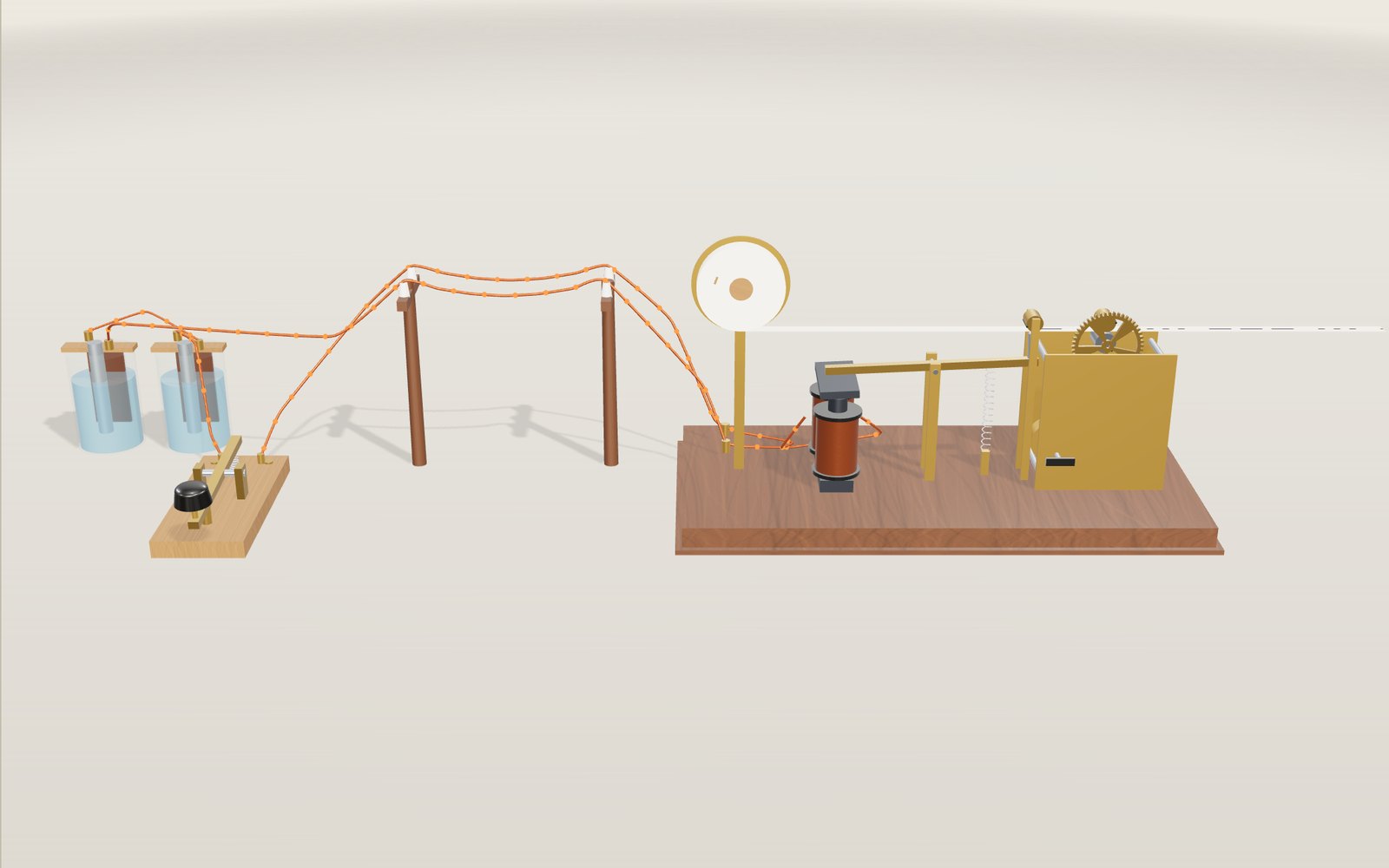
1 / 19 A telegraph in one room The key on the left and the register on the right are joined by a wire on two poles. In 1844 the same kind of line ran about 40 miles (64 km) from Washington to Baltimore. The model is sending SOS. Click the model, then hold Space to key yourself. The bar at the top of the stage opens six more scenes.
Drag to turn. Scroll or pinch to zoom.
Guide Parts Controls
01 A telegraph in one room The key on the left and the register on the right are joined by a wire on two poles. In 1844 the same kind of line ran about 40 miles (64 km) from Washington to Baltimore. The model is sending SOS. Click the model, then hold Space to key yourself. The bar at the top of the stage opens six more scenes.
02 The key is a switch The key is a lever on a pivot. Pressing the knob brings two contacts together and current flows. A spring lifts the lever when you let go. A short press is a dot and a press three times as long is a dash.
03 Battery and line Current leaves the battery, passes the key, runs along the line to the receiver and comes back on the second wire. The orange beads show the current. Here the model sends T, one dash, so the beads move for three units.
04 The electromagnet At the receiver the current goes round two coils. While it flows, the iron cores inside them become a magnet and pull on the iron plate above. See inside makes the coil covers clear. The model sends E, one dot.
05 Lever, stylus and spring The magnet pulls one end of the armature lever down, so the other end rises and the stylus presses into the tape. When the current stops the spring pulls the stylus away. The model sends A, a dot then a dash.
06 A strip of dots and dashes Clockwork pulls the tape past the stylus at a steady speed, so the length of each groove matches how long the key was down. The ticks on the edge are one unit apart. PARIS takes 43 units, and 50 with the space after it.
07 The code table The table lists the letters, figures and punctuation of International Morse code, Recommendation ITU-R M.1677-1. As you key, the letters that still fit your dots and dashes light up. A silence of three units ends the letter.
08 What hath God wrought On 24 May 1844 Samuel Morse sent these four words from the Capitol to Alfred Vail at the Mount Clare depot in Baltimore. The line used Morse and Vail's own code, now called American Morse, so the model sends it that way: 171 units, about 26 seconds at 8 words per minute. The International code needs 189 units.
09 Reading by ear Operators soon found they did not need the paper. A sounder clicks down when the current starts and up when it stops, and the gap between the two clicks is the dot or dash. Turn on Sound to hear it. The open box behind the sounder makes the clicks louder.
10 A long line needs a relay Now the line is 300 km long and the battery has 20 cells. The current that reaches the far end is only about 10 mA, too little to pull a sounder. A relay is a coil of fine wire that closes at 5 mA and switches a local battery onto the sounder. The meter shows the current.
11 Without the relay The same line with the relay taken out. A sounder put straight on the line needs about 30 mA in the model, so nothing arrives and the tape stays blank. Shorten the line or add cells to find where it starts working. Ohm's law gives the answer: current = voltage / resistance.
12 Inside the 1858 cable The first Atlantic cable had a core of 7 copper wires, three coverings of gutta-percha, tarred hemp and 18 strands of iron wire. See inside makes the outer layers clear. The cut-away is drawn many times life size.
13 A spot of light on a scale A long cable stores charge along its length, so a pulse comes out weak and spread out. Thomson's mirror galvanometer turns a tiny current into a visible movement: a lamp shines on a mirror on a silk thread, and the spot moves along a scale. The trace above the tape shows what was sent and what arrived. This is the 1866 cable over 3,090 km.
14 Too fast for the cable The same length with the thinner 1858 cable. Its top speed here is about 3.5 words per minute, so at 8 the pulses run together and the decoder misses letters. The time a pulse spreads grows with the square of the length.
15 The five-needle telegraph Cooke and Wheatstone's board of 1837 needed no code. Two of the five needles swing so that their ends point at one of twenty letters. C, J, Q, U, X and Z are missing. The model spells DRAYTON, the far end of the first public line of 1839. Click a letter or type one.
16 Sparks and radio waves A ship's wireless used the same key and the same code without a wire. Each press drives an induction coil, a spark jumps the gap, and the aerial sends out a radio wave. On 12 December 1901 Marconi heard the letter S from Cornwall in Newfoundland.
17 CQD MGY On 15 April 1912 the Titanic, call sign MGY, sent the Marconi distress call CQD and then the new SOS adopted at Berlin in 1906. Afterwards ships had to keep a radio watch and listen on 600 metres. SOS stayed the distress signal until 1 January 1998.
18 Korea's first lines On 28 September 1885 the Hanseong Telegraph Office opened in Seoul and the line to Incheon began work. It reached Uiju in October, the south line to Busan opened in 1888 and the north line to Wonsan in 1891. The code here switches to Korean.
19 Korean Morse code Korean code gives each basic letter of Hangul a sign, so 안녕 is sent as ㅇ ㅏ ㄴ ㄴ ㅕ ㅇ. The 1888 telegraph rules already allowed Korean, Chinese and English Morse. KT ended the last telegram service in Korea on 15 December 2023, 138 years later.
Key A brass lever on a pivot. Pressing the knob closes the circuit for as long as you hold it. Contacts Two metal points under the lever. A spring lifts the lever and opens them again when you let go. Battery Two jar cells in series, each with a copper plate and a zinc rod in liquid. Line wire Copper wire on porcelain insulators. One wire goes out to the receiver and one comes back. Electromagnet Two coils on iron cores joined by an iron yoke. They pull only while current flows. Armature lever A brass lever with a soft iron plate over the poles. The magnet pulls the plate down and the far end rises. Stylus A blunt steel point on the lever. It presses a groove into the tape from below. Return spring Pulls the lever back when the current stops, so the stylus drops away from the tape. Paper tape A narrow strip from the reel. The ticks along the edges are one Morse unit apart. Rollers A grooved roller sits over the stylus. The feed rollers grip the tape and pull it along. Clockwork A wound spring, a gear train and a fan governor keep the tape moving at a steady speed. Key The same lever key. It closes the circuit to the sounder while you hold it. Sounder coils Two upright coils on an iron yoke. Current turns their cores into a magnet. Sounder lever A brass bar with an iron plate. The magnet pulls it down onto the anvil with a click. Stop screws The lower stop gives the down click, the upper stop the up click. The time between them is the dot or dash. Resonator box An open wooden box that makes the clicks louder, so a busy office could hear its own sounder. Battery Two jar cells for the short line to the sounder. Line battery Up to 60 cells in series, set with the Cells control. More cells push more current down a long line. Line wire One iron wire on poles, with the earth as the return. Every kilometre adds about 7 ohms in the model. Poles Wooden poles with porcelain insulators. On a wet day current leaks across the insulators. Relay A coil of fine wire that closes a contact at a few milliamperes, so a weak line can switch a strong local circuit. Relay switch Puts the relay in the line, or takes it out so the line goes straight to the sounder. Local battery The second battery at the far station. It drives the sounder through the relay contact. Far sounder The receiving sounder. It moves only if enough current reaches it. Current meter Shows the line current in milliamperes. Red ticks mark 5 mA for the relay and 30 mA for a sounder. Copper core Seven copper wires twisted together. In 1858 the copper weighed 107 lb per nautical mile. Gutta-percha Three coverings of a natural latex that kept sea water off the copper. Tarred hemp A soft serving of hemp soaked in tar, padding the core under the iron. Iron armour 18 strands of 7 iron wires each, laid in a spiral to take the strain of laying. Mirror galvanometer A tiny magnet and mirror on a silk thread inside two coils. A weak current turns the mirror a little. Lamp A shaded lamp with a slit. Its beam goes to the mirror and back to the scale. Scale The operator reads the spot of light moving along this scale. Atlantic profile The sea between Ireland and Newfoundland, with the cable on the bottom. Depth drawn about 100 times too large. Letter board A diamond with twenty letters. Lines from each needle meet at the letters. Needles Five magnetic needles. Two at a time swing so that their ends point at one letter. Needle coils A coil behind each needle. The current direction decides which way the needle swings. Sending keys Two rows of five keys. The operator presses two at once to send a letter. Case The mahogany case of the board. Key The operator's key. Each press starts the spark. Induction coil Turns the battery's low voltage into a voltage high enough to jump the gap. Spark gap Two brass balls. The spark across them sends out radio waves. Aerial Wires from the mast down to the radio room. The radio wave leaves from here. Receiver A detector with headphones. The operator listens to the signals of other ships. Map Korea with the lines of 1884 to 1891. The coast is simplified. West line Incheon, Seoul, Pyongyang and Uiju, opened in 1885 and run by the Qing. South line Seoul to Busan through Gongju, Jeonju and Daegu, opened by the Korean bureau in 1888. North line Seoul to Wonsan, opened in 1891. Busan-Nagasaki cable A submarine cable laid by Japan in 1884. Key and tape A key and a paper tape stand, as in a telegraph office.