FIG. 16Old Machines
How a rotary phone works: the dial, its pulses and the exchange
A rotary dial sends each digit as short breaks in the line current, ten to a second, and dialling 0 takes ten of them.
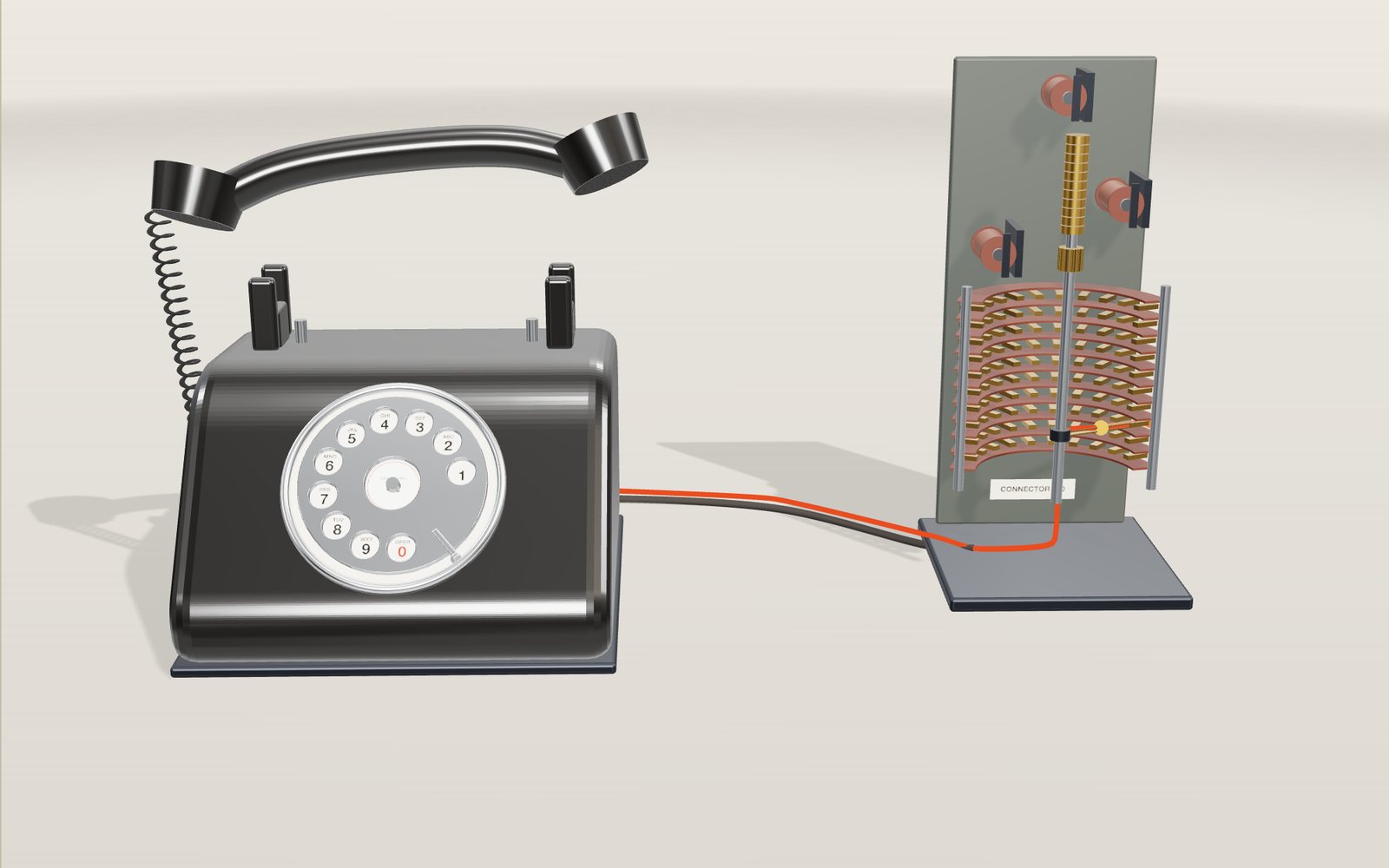
This device cannot show the 3D model. You can read the guide steps below as text.
1 / 16 A telephone and its exchangeOn the left is a desk telephone. On the right is the selector that answers it in the exchange, joined by one pair of wires. The model is dialling line 30. Drag any finger hole round to the metal stop and let go to dial yourself.
Drag to turn. Scroll or pinch to zoom.
What happens when you turn a rotary dial
Put a finger in the hole marked 5, pull the wheel round until your finger hits the metal hook, and let go. The wheel spins back by itself with a soft whirr. That whirr is the telephone talking to the exchange. While the wheel returns, a switch inside it cuts the line current five times, and five short gaps in the current are all the exchange ever receives. There is no tone and no code for "5". The exchange counts.
This page follows that count from your finger to the line you wanted. It starts with the dial: the finger wheel and its stop, the spring and governor that set the return speed, and the pulse contacts. Then it opens the rest of the telephone, with the bell, the hook switch, the carbon transmitter and the receiver. At the far end of the wire stand six ways of finding the called line: an operator at a switchboard, Strowger's step-by-step selector, a crossbar switch with its marker, an electronic exchange run by a stored program, a digital exchange that moves calls between time slots, and the touch-tone receiver that listens for pairs of tones instead of counting gaps.
The Exchange control on the stage swaps between them. The telephone stays the same, and so does the rule that the first digit you dial picks a row of ten lines and the second picks one line in that row. The model telephone is line 42; the number is printed on the card in the middle of the dial.
Why the dial only sends pulses on the way back
The obvious design would send a pulse each time a hole passes a contact as you turn the wheel. A hand does not turn a wheel at an even speed, though, so the pulses would come out bunched or stretched, and the switch at the exchange could miss some of them.
Dials separate winding from sending. Turning the wheel only winds a restoring spring. Only when you let go does the spring drive the wheel back, and only then do the contacts open and close. The Post Office training pamphlet on its dials puts it plainly: the finger plate is turned to the finger stop and then allowed to return unimpeded, and during the return a pulse wheel works the pulse contacts the number of times that matches the digit. The speed of that return no longer depends on your hand, so it can be set in the factory.
Something has to keep the pulse contacts quiet while you wind. In the older Post Office dial that job falls to a slipping cam, a disc held to the pulse wheel by a spring washer. On the way out it lifts the pulse lever clear of the wheel's notches. On the way back it holds the lever up a little longer, for about 220 ms, before the first notch arrives. That pause, the "minimum pause" or "lost motion", plus the time it takes you to wind the next digit, keeps digits at least 420 ms apart, which gives the selectors time to finish moving.
The slipping cam relied on friction, and friction changes with age. A later design replaced it with a stainless steel trigger that rides on the pulse wheel. The trigger dial stretched the pause to about 240 ms and the gap between digits to 440 ms. It also forgave careless fingers: the right number of pulses still comes out if you stop half a hole short of the finger stop or push half a hole past it.
The finger stop decides the digit
The holes in the finger wheel are evenly spaced, 30 degrees apart in the model. Hole 1 sits closest to the finger stop and hole 0 farthest from it, so the wheel turns further for bigger digits. Every hole ends its travel at the same stop, so the distance it covers depends only on which hole you used. That distance is turned back into a count of pulses on the return.
In the model, a hole travels one spacing more than the number of pulses it sends. Hole 3 turns 120 degrees: 90 degrees of cam teeth and 30 degrees of free travel at the end of the return. That last stretch leaves the line closed for a moment, so the exchange can tell where one digit ends and the next begins.
Nothing is printed on the wheel itself. The digits sit on a fixed number plate underneath and show through the holes only while the dial rests. Many dials also carried letters beside the digits so that exchange names could be dialled. The ITU keypad standard E.161 still puts ABC on 2 and WXYZ on 9, which is why the letters live on today's keypads.
Ten pulses a second, in numbers
The Post Office standard speed is ten pulses per second, and each pulse is 66.6 ms of break followed by 33.3 ms of make: a "66.6 break ratio". The model rounds the break share to 66 percent. From those figures:
- pulse period = 1 / 10 s = 100 ms
- break = 0.66 × 100 ms = 66 ms
- make = 100 ms − 66 ms = 34 ms
- digit 0 = 10 pulses, so from the start of the first break to the end of the last one: 9 × 100 ms + 66 ms = 966 ms
The model dial returns at 300 degrees per second, because one cam tooth passes every 30 degrees and ten teeth must pass each second. The strip at the bottom of the stage draws the loop current against a 100 ms grid, and the line under it reports the length of the last break and make. The model measures them from its own timing, and at the default setting they come out at 66 ms and 34 ms.
Real dials drifted a little from these figures. The governor is set for 10 pulses a second, and for maintenance the Post Office accepted anything between 9 and 11. The Pulse rate slider goes much further, from 3 to 14, and the Break share slider runs from 50 to 80 percent, so that you can push the dial past what the exchange will put up with. The next section shows what happens then.
A whole number takes a while. The number 999 is 27 pulses, 2.6 seconds of pulsing, and about 3.4 seconds once the two 420 ms pauses between digits are added. The Pulse timing box in the lab does this sum for any number you type.
What the exchange makes of a fast or slow dial
The exchange does not see your dial. It sees a relay at its end of the line that pulls in while current flows and falls back when the current stops. Each fall-back is one pulse. That relay has its own speed limits, and the model gives its exchange two simple ones, labelled as model values because real exchanges differed by type and country:
- A make shorter than 25 ms is not seen. The relay has no time to pull in again, so the breaks on either side of the short make run together into one long break.
- A break longer than 200 ms is taken as the caller hanging up. A second, slow relay holds the call only while breaks stay short, and when it lets go the exchange clears the call.
Try it with the sliders. At 14 pulses a second and a 66 percent break, each period is 71.4 ms, the break is 47.1 ms and the make is 24.3 ms. That make is just under 25 ms, so every break after the first one merges with it. Dial 5 and the breaks run together for 4 × 71.4 ms + 47.1 ms = 333 ms, longer than 200 ms, and the exchange clears the line. Dial 2 at the same speed and the run lasts 71.4 + 47.1 = 118.5 ms, so the call survives but the exchange counts one pulse instead of two.
Now go the other way. At 3 pulses a second the period is 333 ms and the break is 0.66 × 333 ms = 220 ms. That is too long for the model's hold relay on the very first pulse, so the call is cleared before any digit arrives. At 4 pulses a second the break is 165 ms and the model still counts correctly, even though a real exchange would by then be well outside the 9 to 11 range the Post Office kept to.
Two of the tasks in the lab ask you to produce each failure on purpose. The strip shows the evidence: the gaps in the loop current stretch or crowd together, and the status line says what the exchange concluded.
Spring, governor and cam inside the dial
Switch on See inside and the case turns clear. Behind the number plate sit the parts that keep time.
The flat spiral spring is wound by the wheel and drives it home. On its own it would snap the wheel back far too fast, and faster still on a long pull. A centrifugal governor slows it. The governor is driven from a gear on the main spindle; as it spins, the weights on its wings fly outwards and press against the inside of a cup, and the friction limits the speed. That is why you feel resistance if you try to hurry the wheel home with your finger. A one-way clutch in the governor drive lets the wheel turn freely while you wind it, so the governor only brakes the return.
In the model, a gear on the dial shaft drives a small pinion, and the pinion spins a cup holding two weights. The cam turns with the wheel. Its twelve teeth are spaced 30 degrees apart, the same as the finger holes, so one tooth passes the contacts for every hole spacing. On the return each tooth pushes the pulse contacts apart once. Those contacts sit in series with the telephone line, so opening them stops the current in the whole loop, all the way to the exchange.
Real dials also have off-normal springs that close as soon as the wheel leaves its rest position. The Post Office pamphlet gives two reasons: the pulsing circuit then does not include the resistance of the transmitter, and the pulses are not heard as clicks in the receiver.
Dialling with the hook
The pulse contacts are nothing more than a switch in series with the line. The hook switch under the handset is another one. Pressing it breaks the loop just as a pulse does, so a quick press and release is one pulse as far as the exchange is concerned.
The lab has a Hook button that does exactly that. Lift the handset, then press Hook three times, quickly, and wait. The model treats a pause of 0.4 seconds as the end of a digit, so after three presses it counts a 3 and the selector climbs three levels. Hold the button down too long and the break passes 200 ms; the model's exchange takes that as a hang-up and clears the call. A human hand finds it hard to keep each press under that limit and also release for at least 25 ms, which is one reason the dial exists.
Inside the rest of the telephone
The dial is only the part of the telephone that talks to the switches. Turn on See inside and pick the new parts in the parts list to see the rest.
The ringer. Under the body sit two gongs, a hammer and a pair of coils. To ring a telephone the exchange sends an alternating current down the line, and a Bell System survey from 1965 still refers to telephone sets with "standard 20-cycle ringers". In the model the armature between the coils rocks once per cycle, and the hammer strikes one gong and then the other. Switch on Ring to watch it, and turn on Slow motion to see the hammer move five times slower. The Post Office Telephone No. 332 of 1937 carried its bell inside the case; the earlier table sets, the 162 and 232, needed a separate bell set.
The hook switch. The two plungers in the cradle rest under the handset. Lift the handset and they rise, a spring set closes, and the loop current starts. The exchange answers with dial tone. In the model, lifting the handset while the bell is ringing also stops the ringing, because the hook switch takes the bell off the line and puts the speech circuit on.
The speech network. Next to the dial sit an induction coil and a capacitor. The coil joins the transmitter and the receiver to the two line wires and keeps your own voice from sounding too loud in your ear. The capacitor blocks the steady line current from the bell but lets the alternating ringing current through.
The carbon transmitter. The mouthpiece holds a capsule of carbon granules behind a thin diaphragm. Sound pushes the diaphragm, the granules pack tighter, their resistance falls, and the steady current through them rises. When the diaphragm springs back, the resistance rises again. The current in the line ends up varying with the pressure of your voice. Thomas Edison filed his "Speaking-telegraph" patent on 27 April 1877, and it was granted only on 3 May 1892. In the model the diaphragm and grains move once a call has been answered.
The receiver. The earpiece reverses the trick. A ring magnet pulls on an iron diaphragm with a steady force. The varying line current runs through two small coils on the magnet's pole pieces, adding to that pull or taking from it, so the diaphragm moves in step with the current and moves the air in front of your ear.
Strowger's two-motion switch
Almon B. Strowger filed a patent application for an automatic telephone exchange on 12 March 1889. It was granted on 10 March 1891 as US patent 447,918. The first automatic exchange opened in La Porte, Indiana, in 1892. It came about in an odd way: in 1890 the Bell company had sued the subscribers of a manual exchange in the town for patent infringement, and a court ordered their telephones shipped to Chicago and burned. La Porte went about two years without service. Strowger's exchange then gave the town room for 99 customers, and 75 signed up. An artist's view of the exchange shows 80 switches on one wall and as many wet-cell batteries on the other.
The heart of the design is a two-motion stepping switch. A shaft carries a contact arm, the wiper, inside a bank of contacts arranged in ten rows of ten. Pulses on one magnet raise the shaft row by row. Pulses on a second magnet turn it, one contact per pulse. Ten rows times ten contacts gives 100 choices, and a pawl holds the shaft at each step. When the call ends, a release magnet frees the pawls. A spring turns the shaft back to its starting angle, and only then does it drop to the bottom.
On the stage, the first digit you dial lifts the shaft. The grid beside the strip shows the same thing as a column of blocks. When the first digit is finished, the selector waits. The second digit drives the rotary magnet, and the wiper swings across the row. Dial 3 and then 0 and the wiper ends on level 3, contact 10, which is line 30. The orange light on that contact blinks while the line rings.
The switch at La Porte did not stay the same for long. In the autumn of 1894 the company replaced it with the Zither switch designed by A. E. Keith, which did not work well. In June 1895 a third design by Keith and the brothers John and Charles Erickson went in, and its mechanism became the basis of Strowger switches that stayed in use for about 85 years. The same three men filed the patent for a "Calling device for telephone-exchanges" on 20 August 1896; it was granted on 11 January 1898.
From one selector to a city exchange
One selector serves 100 lines, which was enough for La Porte. Larger exchanges put group selectors in front of the final selector, which is called the connector. Each extra digit steps a group selector that picks a block of lines, and the last two digits work the connector exactly as in the model. Every added stage multiplies the number of reachable lines by ten, so a step-by-step exchange could grow one stage at a time. Smith and Campbell's textbook Automatic Telephony (1921) explains the hundred-line switch in exactly these terms: tens first, then units.
The first automatic telephones had no dial. Smith and Campbell describe push-buttons on the subscribers' sets, replaced by a calling device in 1896. The Bell System, which had built its business on operators, came to step-by-step switching later: the first step-by-step exchange it installed itself went into service at Norfolk, Virginia, on 8 November 1919, built by the Automatic Electric Company. Western Electric's own panel switch went into service in Omaha in 1920.
Before dials: the operator's switchboard
Pick Operator switchboard in the Exchange control. The first telephone exchange opened on 28 January 1878 in New Haven, Connecticut. The exchange ran every line to one place, and with it came the first operators.
On a switchboard each line ends in a jack, and each jack has a lamp. When a caller lifts the receiver the lamp lights. The operator plugs the answering cord into that jack, asks for the number, and plugs the calling cord of the same pair into the jack of the wanted line, then rings it. In the model the lamp of line 42 blinks as soon as you lift the handset, the red plug goes into jack 42 after 0.6 seconds, and the black plug goes into the line you dial. Dialling on a manual board is of course a fiction; in this scene the digits stand for the number you would have asked for.
The lab has a task for this scene: a caller on jack 2 wants line 5, and you have to plug the cords yourself, caller first.
Korea's first telephone line opened on 2 October 1896, from Deoksugung Palace to the superintendent's office in Incheon. The Encyclopedia of Korean Culture records that the palace used a manual magneto switchboard from LM Ericsson of Sweden, with room for 100 lines. Public service followed on 20 March 1902, with telephone offices in Mapo, Dodong, Siheung, Gyeonggyo and Incheon, at 50 jeon for five minutes, paid in advance and not refunded if you hung up early.
Crossbar: the marker reads the whole number first
In a step-by-step exchange the caller's pulses move the switches directly. That makes the exchange simple, and it also means a switch is tied up for the whole time a person takes to dial. A crossbar exchange works differently. A register collects the digits first, and only then does a common controller, the marker, choose a free path and set it up in one go.
The switch itself is a grid. Ten horizontal select bars cross ten vertical hold bars. To make a connection, the marker tilts one select bar, then operates the hold magnet of one vertical bar, which closes the contacts at their crossing point and keeps them closed. The select bar can then go back to rest and be used for another call, while the hold bar keeps the first one connected. On the stage, the first digit picks the row and the second the column, and the crosspoint turns orange.
The crossbar switch is Swedish. Ericsson's history records that G. A. Betulander and Nils Palmgren began testing a selector built on a crossbar switch in 1919, at a test station ordered by Televerket. A crossbar station for Sundsvall went into service in 1926, and Televerket built more than 1,000 such stations over the next 20 years. Bell Laboratories took up the idea after a study trip to Sweden in 1930, and by 1938 two crossbar offices with links and markers were working in New York. The first No. 5 crossbar switch followed at Media, Pennsylvania, on 11 July 1948, and Ericsson installed its first crossbar system with links in Helsinki in 1950.
Electronic switching: a program decides
The marker in a crossbar exchange is already a small computer made of relays. The next step was to make it a real one. Customer trials of an electronic exchange using cold-cathode tubes began at Morris, Illinois, on 17 November 1960. The first No. 1 Electronic Switching System went into service at Succasunna, New Jersey, in May 1965. A 1965 survey in the Bell System Technical Journal calls No. 1 ESS the commercial successor to the Morris trial.
Pick Electronic switching on the stage. The left frame stands for the switching network, a grid of sealed reed contacts in glass that close to make the speech path. The row of lamps on top stands for the scanner, which checks every line again and again for an off-hook signal. The right frame stands for the program store and its memory. When you lift the handset, the scanner stops at line 42. The digits go into memory, shown on the small screen, and once both are in, the program closes three crosspoints in the reed grid, one after another, to join you to the called line.
Electronic exchanges took both kinds of dialling. The same 1965 survey describes rotary and touch-tone telephones connected to the same line, and dial pulses from rotary sets turned into bursts of tone that the control unit could read. The model therefore accepts dial pulses and touch-tone keys in this scene.
In Korea, M10CN electronic exchanges went into the Yeongdong and Dangsan telephone offices in December 1979, the start of electronic switching there.
Digital exchanges and time slots
Every exchange so far has joined two lines with a piece of metal: a cord, a wiper, a crosspoint, a reed. A digital exchange does not. It measures each voice and turns it into numbers. ITU-T G.711 samples a voice 8000 times a second and codes each sample in 8 bits, so one call is 8000 × 8 = 64,000 bits per second. Many calls then share one path by taking turns. Under ITU-T G.732, a 2048 kbit/s stream is divided into frames of 125 microseconds, and each frame holds 32 time slots of 8 bits: 32 × 8 × 8000 = 2,048,000 bits per second. Slot 0 is kept for alignment.
Joining two lines means copying the bytes in the caller's slot into the slot of the called line, frame after frame. On the stage the wheel shows the 32 slots of one frame, slowed from 125 microseconds to two seconds per turn. Slot 0 is dark. Lift the handset and the caller's slot turns blue; dial a number and the called line's slot turns orange, while small cubes carry bytes from one coder through the wheel to the other.
Ericsson and Televerket developed the AXE switching system together in the 1970s, and Western Electric installed the first No. 5 ESS local office switch in 1982. Korea built its own: the time-division exchange TDX, from the institute that is now ETRI, opened a pilot unit on 25 April 1984 and went into commercial use on 14 March 1986. TDX-1 used hundreds of 8-bit Z-80 microprocessors that talk to each other and work as one computer.
Touch-tone: two tones for every key
Pulse dialling is slow and it only works while the call is being set up. Once the line is through, a dial has nothing more to say. Touch-tone dialling sends tones instead, and tones can travel through the whole connection.
The first field trial of touch-tone calling started at Findlay, Ohio, on 1 November 1960. The Bell System introduced the service to customers on 18 November 1963, and Carnegie and Greensburg, Pennsylvania, were the first places to get it. Customers paid an extra $1.50 a month to try the new telephones. The first sets had ten buttons; the star and pound keys arrived about five years later.
Each key sends two tones at once, one from a low group and one from a high group. ITU-T Q.23 gives the frequencies:
| 1209 Hz | 1336 Hz | 1477 Hz | 1633 Hz | |
|---|---|---|---|---|
| 697 Hz | 1 | 2 | 3 | A |
| 770 Hz | 4 | 5 | 6 | B |
| 852 Hz | 7 | 8 | 9 | C |
| 941 Hz | * | 0 | # | D |
So 5 is 770 Hz plus 1336 Hz, and 0 is 941 Hz plus 1336 Hz. The fourth column, 1633 Hz, carries four extra keys, A to D, which home telephones normally leave out. A separate recommendation, Q.24, sets how exchange receivers recognise these pairs. The receiver on the stage has one filter for each of the eight frequencies; a digit is accepted only when exactly one low and one high filter respond. A voice or a whistle rarely produces exactly such a pair, and none of the tones is close to a whole-number multiple of another, so harmonics of one tone do not land on a second.
Pick Touch-tone signalling and press the keys on the stage or in the lab. With Sound on you hear each pair; the bars on the receiver show which two filters respond, and the register shows the stored digits. In the older scenes the model's exchanges count pulses only and ignore the tones, as a step-by-step exchange without a tone receiver would.
Telephones people kept
Telephones changed shape less often than exchanges, and some designs lasted for decades. A few with dated records:
- The Post Office table telephone No. 162 was introduced in 1929, with its bell in a separate bell set.
- The No. 232 followed in 1934. The Science Museum Group's ivory example shows why colours became possible: plastics such as urea formaldehyde could be mixed with pigments.
- The No. 332 came in on 14 June 1937 with its bell inside the case. For manual exchange areas it had a dummy plate in place of the dial, and when the exchange became automatic a dial was fitted. The Science Museum Group holds a black 332 made in England in 1938.
- The Ericsson DBH 1001 Bakelite telephone of 1931 came from a collaboration of Elektrisk Bureau of Oslo, LM Ericsson and Televerket. Cooper Hewitt describes it as the design that set the shape of the plastic telephone.
- The Ericofon put dial and handset in one piece. After a trial series in 1954, more than 2.5 million were made at Karlskrona between 1956 and 1982, in 30 colours but never in black. Only about 20 percent went to Sweden.
The model telephone on the stage is not a copy of any one of these. It has the sloping front and Bakelite body of the 1930s sets, with the bell inside.
Korea's exchanges, from the palace line to TDX
Korean records give a clear run of dates for every type of exchange on the stage:
- 1896: the palace line, on a 100-line Ericsson magneto switchboard.
- 1902: public telephone offices and local switching at the Hanseong office from 6 June, on boards of 10 and 50 lines.
- 1908: common-battery switchboards at the Gyeongseong post office, when its magneto board ran out of room.
- 1935: the first automatic exchange, a Siemens Strowger type F, at the Najin post office in March, and an NEC Strowger type A at the Gyeongseong central telephone office in October.
- 1960: an EMD exchange at the Yongsan telephone office in August.
- 1962: a 300-line Strowger exchange built with Korean technology at the Seoul central telephone office in December.
- 1979: M10CN electronic exchanges at Yeongdong and Dangsan in December.
- 1983: the last manual common-battery exchanges withdrawn on 22 December.
- 1986: TDX in commercial use from 14 March.
The National Archives of Korea notes that 10 million telephone lines were supplied in 1987, about one for every household, and that the count passed 20 million in 1993.
Dial tone and ringing in the model
Lift the handset and the hook switch closes the loop. Current flows and the trace in the strip jumps up. With Sound on, the model plays dial tone as the ITU-T list of national tones gives it for the United States, a steady mix of 350 Hz and 440 Hz. The tone stops at the first break. Once the second digit has landed, the model plays the ringing tone the caller hears, 440 Hz plus 480 Hz, two seconds on and four seconds off. After six seconds the called line answers, the ringing tone stops, and the transmitter in your handset starts to move. Sound starts only after you switch it on.
The Ring control does the opposite job: it rings this telephone. The model sends a 20 Hz ringing current in the same two-on, four-off rhythm, the hammer swings between the gongs, and with Sound on you hear the bell. Lift the handset to answer.
The Call route control draws the path of the call as a thin orange line, from the telephone along the floor cord into whichever exchange is showing. A bead runs along it as far as the call has got: to the exchange when you lift the handset, further with each digit, and all the way to the called line when it rings. The lab shows the same route as a row of named stages.
How the model differs from a real telephone
- The telephone is wired straight to one 100-line selector or its stand-in. A real exchange reaches the final switch through line finders and group selectors, and through links in a crossbar office.
- Real selectors carry three banks of contacts, one above the other, for the different wires of each line. The model has one.
- The model's exchange limits, a make of at least 25 ms and a break of at most 200 ms, are round model values. Real exchanges had their own timing, which differed by type and country.
- The dial runs at an ideal, perfectly steady speed. Real governors needed cleaning and adjustment as they wore.
- The gear ratio to the governor, the size of the cam and the number of spring turns were chosen to be easy to see, not copied from a drawing.
- The ringer, network, transmitter and receiver are simplified shapes. The crossbar, electronic and digital scenes show the idea of each exchange, not a full office: one switch, one marker, one reed grid, one frame of time slots.
- Pulse counting follows the common code in which digit n sends n pulses and 0 sends ten.
Questions
Why does 0 send ten pulses?
A pulse count of zero would be no signal at all, and the exchange could not tell it from a pause. So 0 sends ten pulses and sits after 9 on the dial. The Post Office pamphlet states it directly: there are ten interruptions when 0 is dialled. In the model 0 lifts the selector to level 10 or turns the wiper to contact 10.
Why are the pulses sent on the way back and not while I turn the wheel?
Because your hand does not move at a steady speed and a spring with a governor does. The slipping cam or trigger keeps the pulse contacts idle while you wind and adds a pause of about 220 to 240 ms before the first pulse.
What happens if I let go before reaching the finger stop?
The dial returns from wherever you released it and sends fewer pulses. In the model, letting go of hole 5 halfway sends one or two pulses, and the selector steps that many times. The later trigger dial tolerates an error of half a hole either way.
How long is one pulse?
At ten pulses per second, 100 ms. With the Post Office break ratio of 66.6 percent, the line is open for 66.6 ms and closed for 33.3 ms in each pulse. The model rounds this to 66 ms and 34 ms.
Can you dial by tapping the hook switch?
Yes. Each press breaks the loop like one pulse. The Hook button in the lab lets you try; three quick presses and a pause send a 3. Hold it too long and the exchange takes the break for a hang-up.
What happens if a dial runs too fast or too slow?
In the model, a make shorter than 25 ms lets two breaks run together, so the exchange counts fewer pulses, and a break longer than 200 ms clears the call. The Post Office kept dials between 9 and 11 pulses a second so that neither happened.
Who invented the automatic telephone exchange?
Almon B. Strowger patented his automatic exchange in 1891, and the first one opened in La Porte, Indiana, in 1892. Keith and the Erickson brothers redesigned the switch in 1895, and that design was used for about 85 years.
Why don't I hear the clicks in the earpiece?
Real dials have off-normal springs that close as soon as the dial leaves rest. They keep the transmitter out of the pulsing circuit and stop the pulses being heard as clicks in the receiver.
Why does a touch-tone key send two tones?
A single tone is easy to produce by accident with a voice or a whistle. A key sends one tone from a group of four low frequencies and one from a group of four high ones, and the receiver accepts a digit only when exactly one of each is present.
What does the marker in a crossbar exchange do?
It is the common controller. It reads the whole number from a register, finds a free path, tilts one select bar and closes one hold magnet, then moves on to the next call. The caller's pulses never move the switch directly.
How does a digital exchange connect two people?
It samples each voice 8000 times a second, codes each sample in 8 bits and puts it in a time slot of a 125 microsecond frame. Connecting a call means copying the bytes from the caller's slot to the called line's slot in every frame.
Why did the bell stop when the handset was lifted?
The hook switch takes the bell off the line and connects the speech circuit. The exchange sees current flowing, knows the call has been answered and stops sending the ringing current.
How long can a telephone number be?
Under ITU-T E.164 a full international number, country code included, has at most 15 digits. Dialled with a rotary dial at 10 pulses a second, 15 zeros would take more than 14 seconds of pulsing alone.
When did Korea get automatic exchanges?
In March 1935 a Siemens Strowger type F went into the Najin post office, and in October an NEC Strowger type A went into the Gyeongseong central telephone office. Korean-built Strowger equipment followed in 1962 and the Korean digital exchange TDX in 1986.
Terms
- Pulse dialling: sending each digit as a train of short interruptions in the line current. Also called loop-disconnect or decadic dialling.
- Break and make: the parts of a pulse when the line is open (break) and closed (make).
- Break ratio: the share of each pulse period taken by the break. The Post Office used 66.6 percent.
- Minimum pause: the delay between letting go of the dial and the first pulse, about 220 ms on the slipping cam dial.
- Finger stop: the fixed hook that ends the wheel's travel.
- Governor: the centrifugal brake that keeps the return speed steady.
- Off-normal springs: contacts that close as soon as the dial leaves rest.
- Strowger switch: an electromechanical step-by-step selector that moves up and then round under pulse control.
- Connector: the final selector, which picks the called line from the last two digits.
- Crossbar switch: a grid of select and hold bars whose crossing points make connections.
- Marker: the common controller of a crossbar exchange.
- Stored program control: an exchange run by a computer program, as in No. 1 ESS.
- Time slot: one of the 32 eight-bit places in a 125 microsecond PCM frame.
- DTMF: dual-tone multi-frequency signalling, the touch-tone code of ITU-T Q.23.
- Ringer: the bell of a telephone, worked by alternating ringing current.
- Carbon transmitter: a microphone in which sound changes the resistance of carbon granules.
Sources
- British Telephones, How does a BPO dial work? (Post Office Telecommunications Educational Pamphlet, Telephones 5/1: 10 pulses per second, 66.6 ms break and 33.3 ms make, ten interruptions for 0, centrifugal governor with free-wheel clutch, 9 to 11 pulses per second for maintenance, slipping cam with a minimum pause of about 220 ms and an inter-digit pause of at least 420 ms, trigger dial with 240 ms and 440 ms and a tolerance of half a hole, off-normal springs, coin-box dial). https://www.britishtelephones.com/howdial.htm (checked 18 October 2026)
- British Telephones, GPO Telephone No. 332 (introduced 14 June 1937, bell inside, Nos. 162 and 232 with external bell sets, No. 162 of 1929, dummy plate on CB versions). https://www.britishtelephones.com/t332.htm (checked 18 October 2026)
- Google Patents, US447918A, Automatic telephone-exchange, A. B. Strowger (filed 12 March 1889, granted 10 March 1891). https://patents.google.com/patent/US447918A/en (checked 18 October 2026)
- Google Patents, US597062A, Calling device for telephone-exchanges, A. E. Keith, J. Erickson and C. J. Erickson (filed 20 August 1896, granted 11 January 1898). https://patents.google.com/patent/US597062A/en (checked 18 October 2026)
- Google Patents, US174465A, Improvement in telegraphy, A. G. Bell (filed 14 February 1876, granted 7 March 1876). https://patents.google.com/patent/US174465A/en (checked 18 October 2026)
- Google Patents, US474230A, Speaking-telegraph, T. A. Edison (filed 27 April 1877, granted 3 May 1892). https://patents.google.com/patent/US474230A/en (checked 18 October 2026)
- Vintage Telephone Systems (calling315.com), Strowger's First Exchange, drawing on Bruce Johnson's 2021 article for the La Porte County Historical Society (1890 lawsuit, 75 customers out of 99, eighty switches, the Zither switch of 1894, the Keith and Erickson switch of June 1895). https://www.calling315.com/switches/strowgers-first-exchange (checked 18 October 2026)
- Arthur Bessey Smith and Wilson Lee Campbell, Automatic Telephony, second edition, McGraw-Hill 1921, Internet Archive (100-line selection by tens and units; push-buttons replaced by a calling device in 1896). https://archive.org/details/automatictelepho00smit (checked 17 October 2026)
- Bell System Memorial, Bell System History (first exchange in New Haven on 28 January 1878, the first operators). https://memorial.bellsystem.com/bellsystem_history.html (checked 18 October 2026)
- TelephoneWorld, Telephone Switch Timeline (Norfolk 1919, Omaha panel 1920, No. 5 crossbar at Media 1948, Findlay touch-tone trial 1960, Morris 1960, No. 5 ESS 1982). https://telephoneworld.org/telephone-switching-systems/telephone-switch-timeline/ (checked 18 October 2026)
- TelephoneWorld, Western Electric/Lucent Modern Telephone Switching Systems (No. 1 ESS at Succasunna, May 1965). https://telephoneworld.org/telephone-switching-systems/western-electric-lucent-modern-telephone-switching-systems/ (checked 18 October 2026)
- W. H. C. Higgins, A Survey of Bell System Progress in Electronic Switching, Bell System Technical Journal 44(6), July-August 1965 (No. 1 ESS as successor to Morris; 20-cycle ringers; rotary and touch-tone sets on one line; dial pulses turned into tone bursts). https://vtda.org/pubs/BSTJ/vol44-1965/articles/bstj44-6-937.pdf (checked 18 October 2026)
- Ericsson history (Centre for Business History), C.-F. Helgesson, Crossbar switch: from concept to success (Betulander and Palmgren 1919, Sundsvall 1926, New York 1938, Helsinki 1950). https://www.ericsson.com/en/about-us/history/products/the-switches/the-crossbar-switch--from-concept-to-success (checked 18 October 2026)
- Ericsson history, The Ericsson story (500-switch 1923, AXE with Televerket). https://www.ericsson.com/en/about-us/history (checked 18 October 2026)
- Ericsson history, L. Brunnström, Ericofon (trial series 1954, Karlskrona 1956 to 1982, 2.5 million, 30 colours, never black). https://www.ericsson.com/en/about-us/history/products/the-telephones/the-ericofon--cobra-1956-1954 (checked 18 October 2026)
- Cooper Hewitt, Smithsonian Design Museum, C. Trope, Phone Finds Its Iconic Form (Ericsson DBH 1001). https://www.cooperhewitt.org/2015/11/30/phone-finds-its-iconic-form/ (checked 18 October 2026)
- Science Museum Group Collection, Post Office 332 telephone, 1938 (1983-517) and 232 telephone, 1934-1957 (2004-134). https://collection.sciencemuseumgroup.org.uk/objects/co33712/post-office-332-telephone-1938 (checked 18 October 2026)
- EDN, Touch Tone Phones Are Invented, November 18, 1963. https://www.edn.com/tone-dialing-telephones-are-introduced-november-18-1963 (checked 18 October 2026)
- TribLIVE, Greensburg, Carnegie made phone history as the first cities with touch-tone phones (17 November 2019: $1.50 a month, star and pound keys five years later). https://archive.triblive.com/local/regional/greensburg-carnegie-made-phone-history-as-the-first-cities-with-touch-tone-phones (checked 18 October 2026)
- ITU-T Recommendation Q.23, Technical features of push-button telephone sets, and Q.24, Multifrequency push-button signal reception. https://www.itu.int/rec/T-REC-Q.23/en (checked 18 October 2026)
- ITU-T Recommendations G.711, Pulse code modulation of voice frequencies, and G.732, Characteristics of primary PCM multiplex equipment operating at 2048 kbit/s. https://www.itu.int/rec/T-REC-G.711/en (checked 18 October 2026)
- ITU-T Recommendations E.161, Arrangement of digits, letters and symbols on telephones, and E.164, The international public telecommunication numbering plan. https://www.itu.int/rec/T-REC-E.164/en (checked 18 October 2026)
- ITU-T, Supplement 2 to the E-series: Various tones used in national networks, January 1994 (United States: dial tone 350 + 440 Hz continuous; ringing tone 440 + 480 Hz, 2.0 s on and 4.0 s off). https://www.itu.int/rec/dologin_pub.asp?lang=e&id=T-REC-E.300SerSup2-199401-W!!PDF-E&type=items (checked 17 October 2026)
- National Archives of Korea, 기록으로 만나는 대한민국: 장거리 자동전화(DDD) 개통 (2 October 1896, 20 March 1902, 50 jeon for five minutes, 10 million lines in 1987, 20 million in 1993). https://theme.archives.go.kr/next/koreaOfRecord/tellephone.do (checked 18 October 2026)
- Academy of Korean Studies, Encyclopedia of Korean Culture, 전화교환기 (Ericsson board of 1896, Hanseong 1902, common battery 1908, Najin and Gyeongseong 1935, EMD 1960, Korean Strowger 1962, M10CN 1979, end of common battery 1983, TDX). https://encykorea.aks.ac.kr/Article/E0049765 (checked 18 October 2026)
- ETRI, 전전자교환기 TDX (pilot unit 25 April 1984, commercial use 14 March 1986, Z-80 processors). https://www.etri.re.kr/45th/sub05_3.html (checked 18 October 2026)
- Calculations on this page: period = 1 / pulse rate, break = break share × period, make = period − break, digit 0 = 9 × 100 ms + 66 ms = 966 ms, 999 = 27 pulses = 2.6 s of pulsing; at 14 pulses per second and 66 percent, break 47.1 ms and make 24.3 ms; at 3 pulses per second, break 220 ms; G.711 64,000 bit/s; G.732 32 × 8 × 8000 = 2,048,000 bit/s. The pulse counter and the exchange limits were checked in a browser and against these figures.
More exhibits
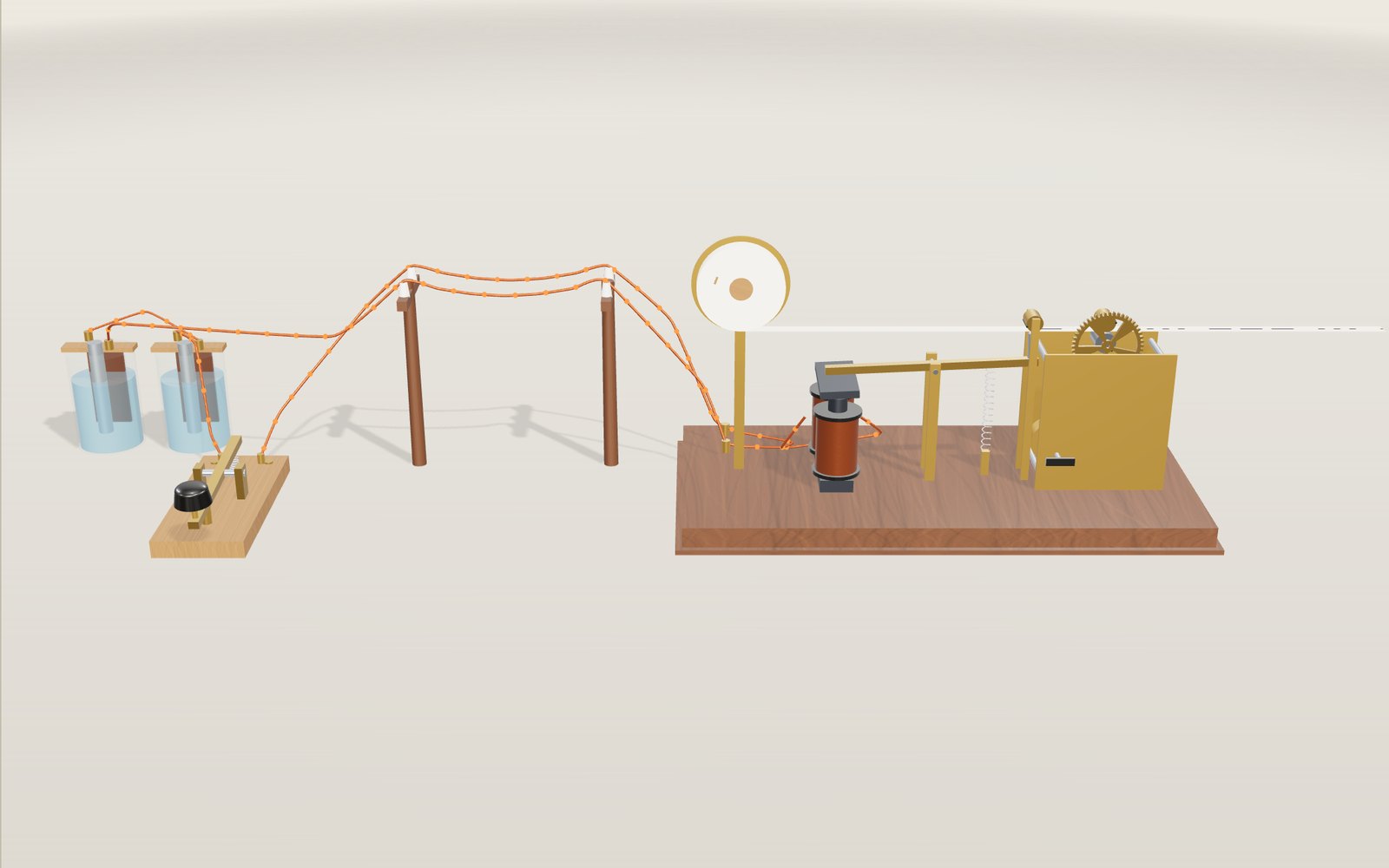
Morse telegraph: key it yourself, step by step
On 24 May 1844 a key in the US Capitol pressed dots and dashes into a paper tape in Baltimore, about 40 miles (64 km) away.
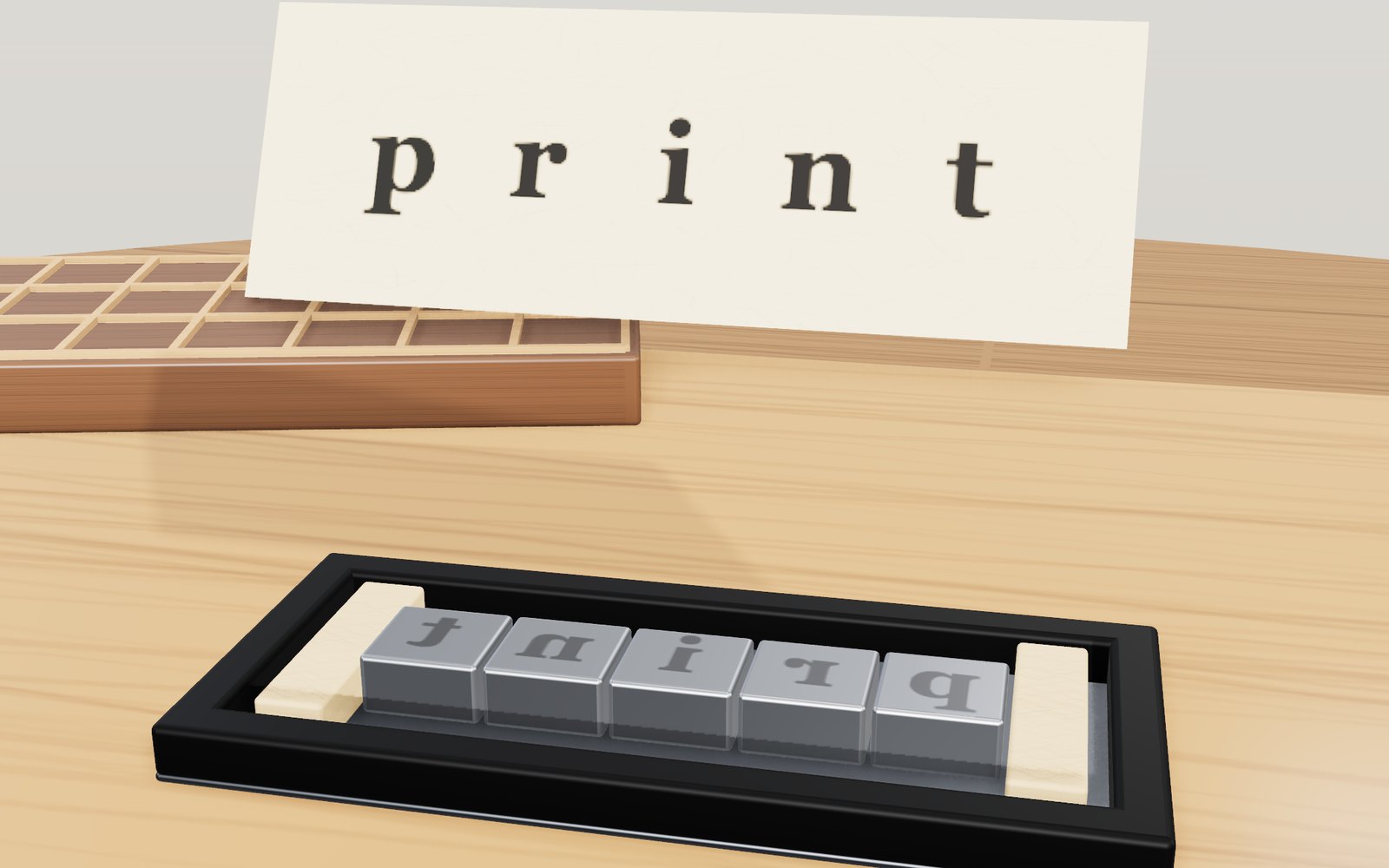
Movable type and the printing press
A piece of type carries its letter back to front. Ink it, press paper on it, turn the sheet over, and the letter reads the right way round.
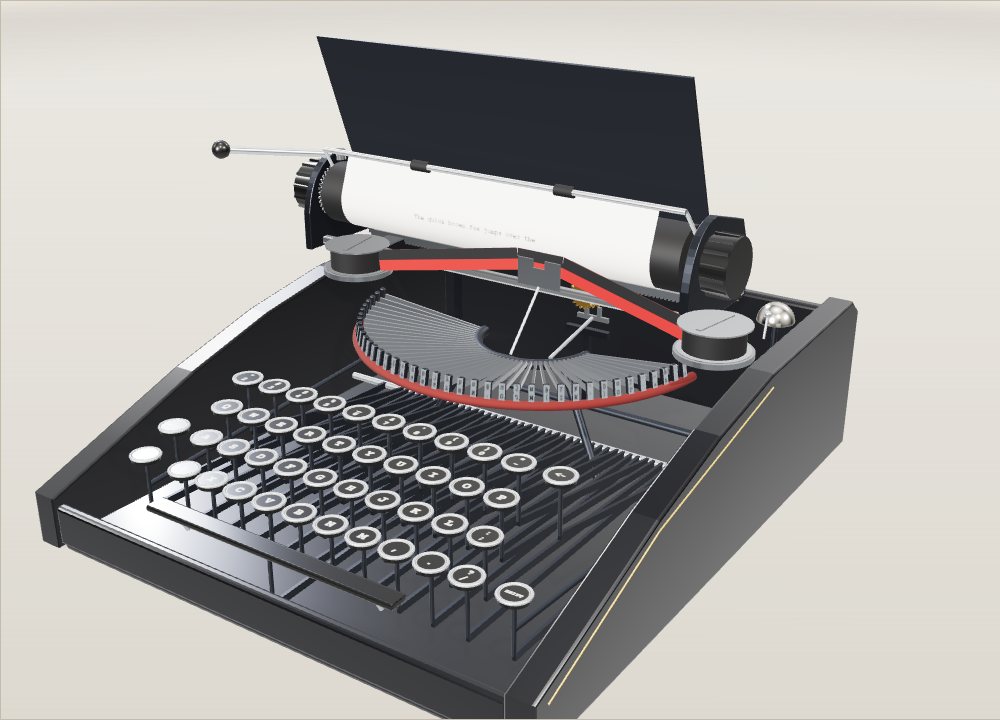
How a typewriter works: inside a manual typewriter
On a pica typewriter every letter, space and full stop moves the carriage the same 2.54 mm to the left.
Braille, semaphore and fingerspelling: how the codes work
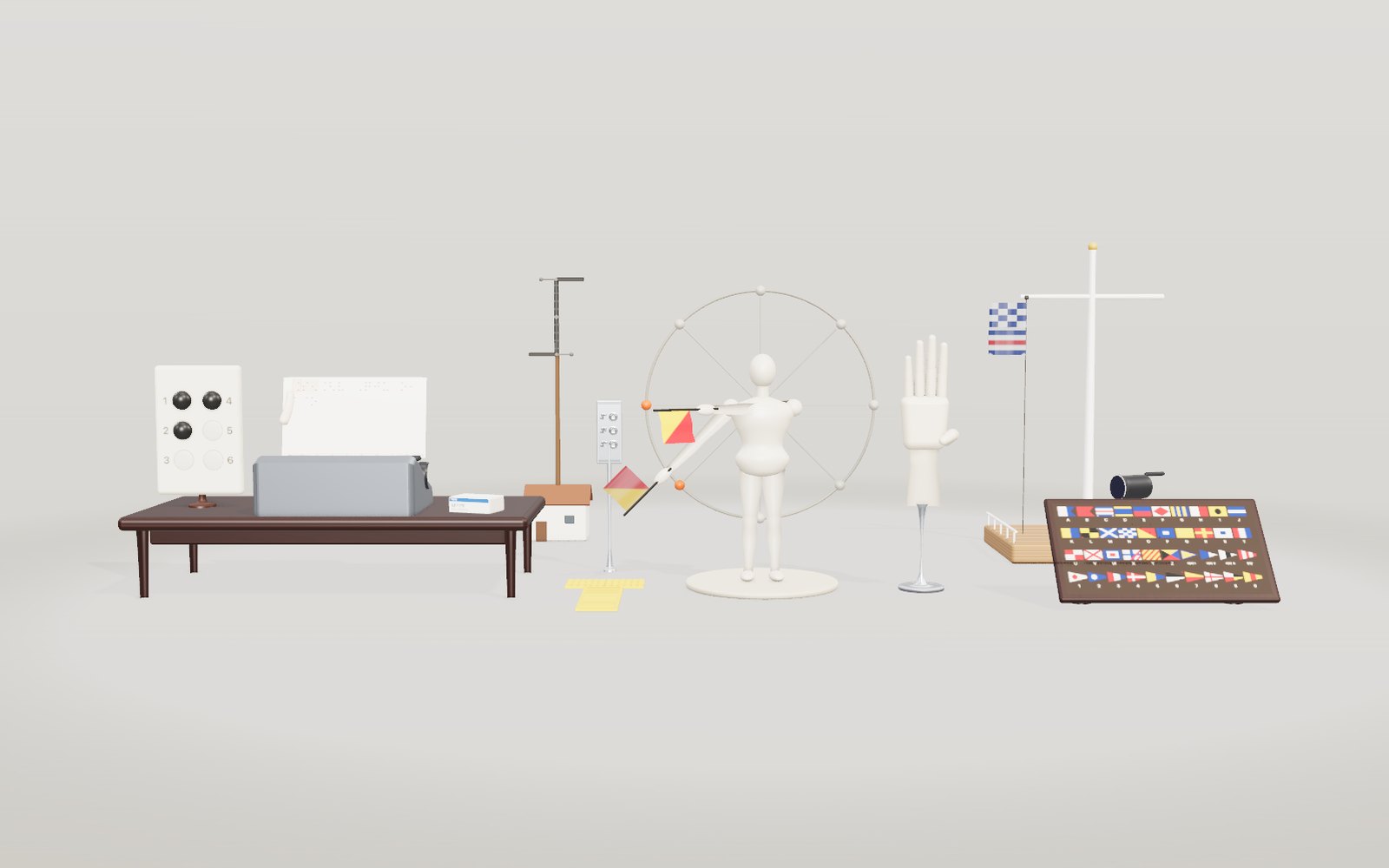
A braille dot is 1.5 mm across, and six of them in a 2 by 3 grid give 64 patterns that Korean, English, Japanese and music braille all share.
Writing systems of the world: Hangul and 22 more scripts
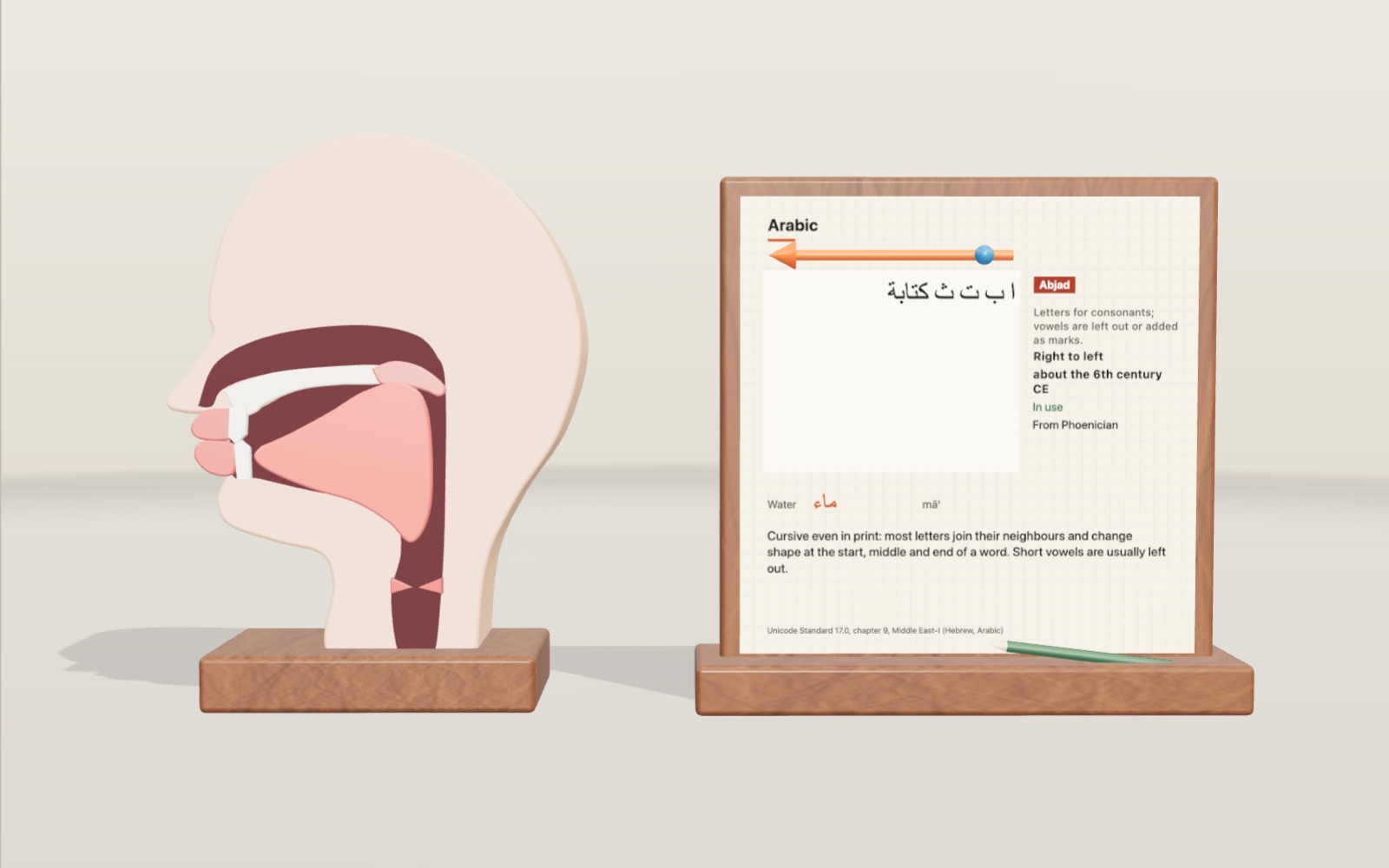
The 1446 book that announced Hangul says ㄱ draws the tongue root closing the throat. Here it stands beside 22 other scripts, from clay wedges to Braille.
How a QR code is read
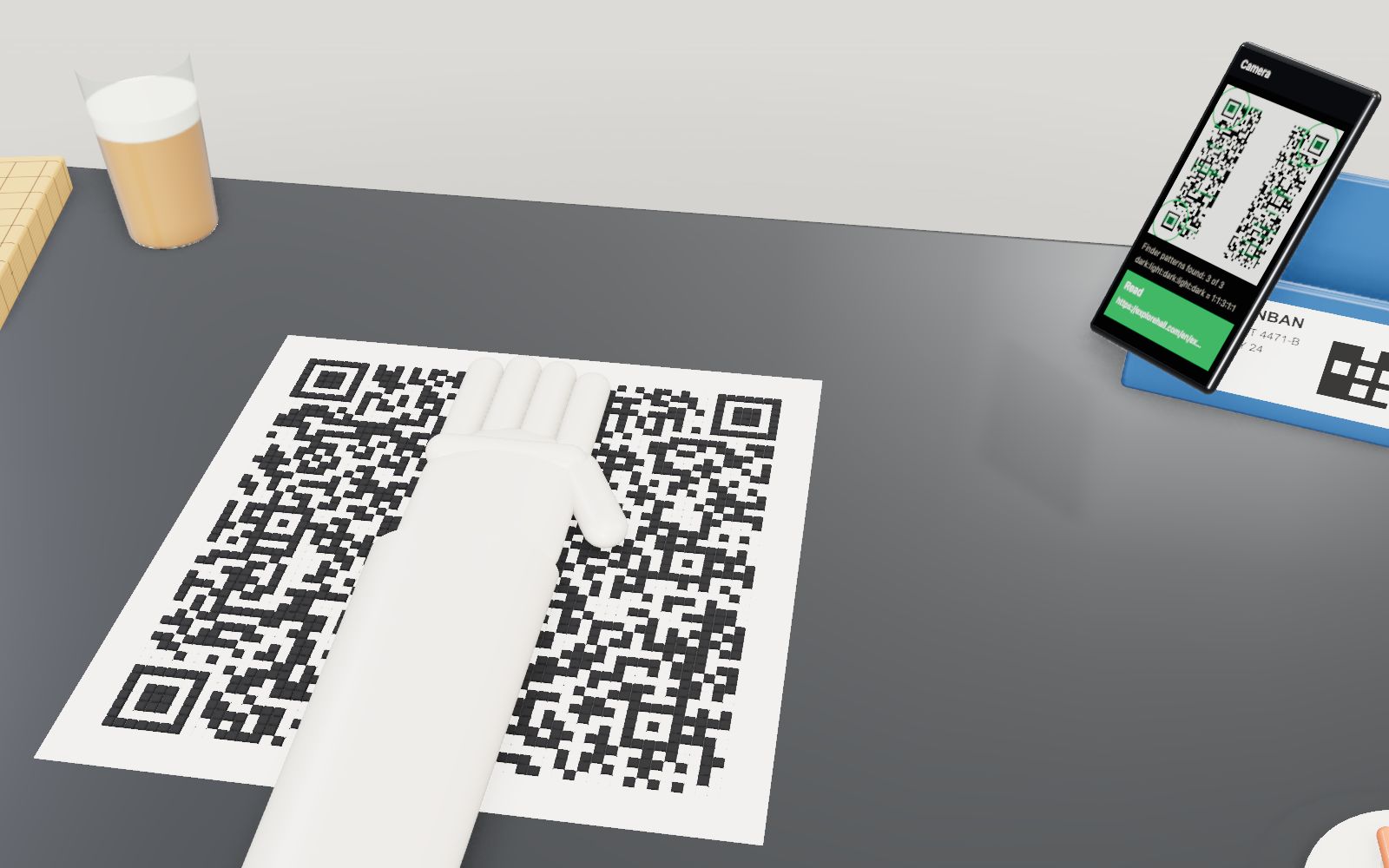
Cover 30 % of a QR code with your hand and a phone still reads it. Cover one corner and it does not.
How a phonograph works: from tinfoil to cassette and CD
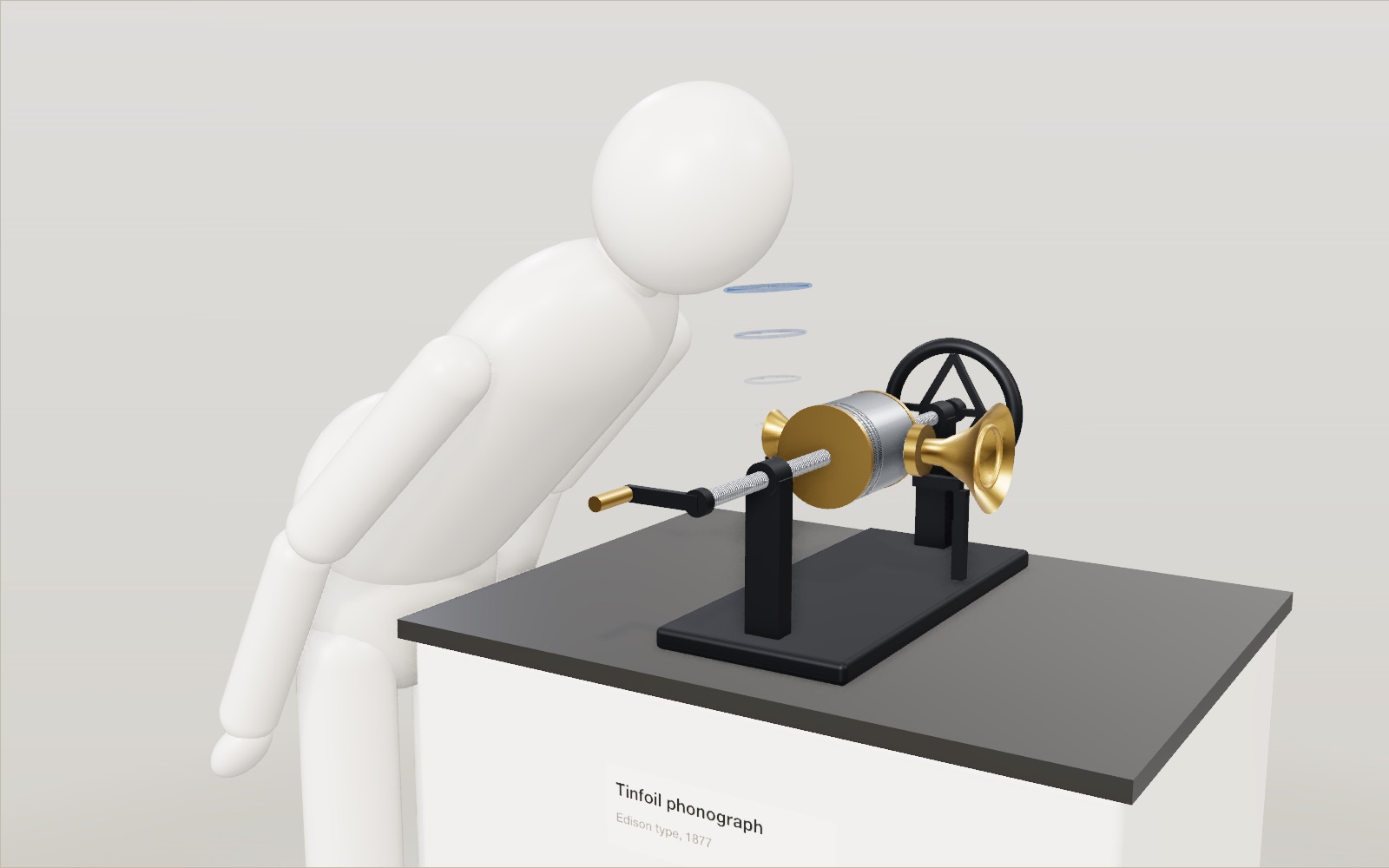
Edison's first phonograph cut a voice into tinfoil in 1877, and the same needle played it back from a groove 2.54 mm apart.
Walk down the Grand Canyon rock layers
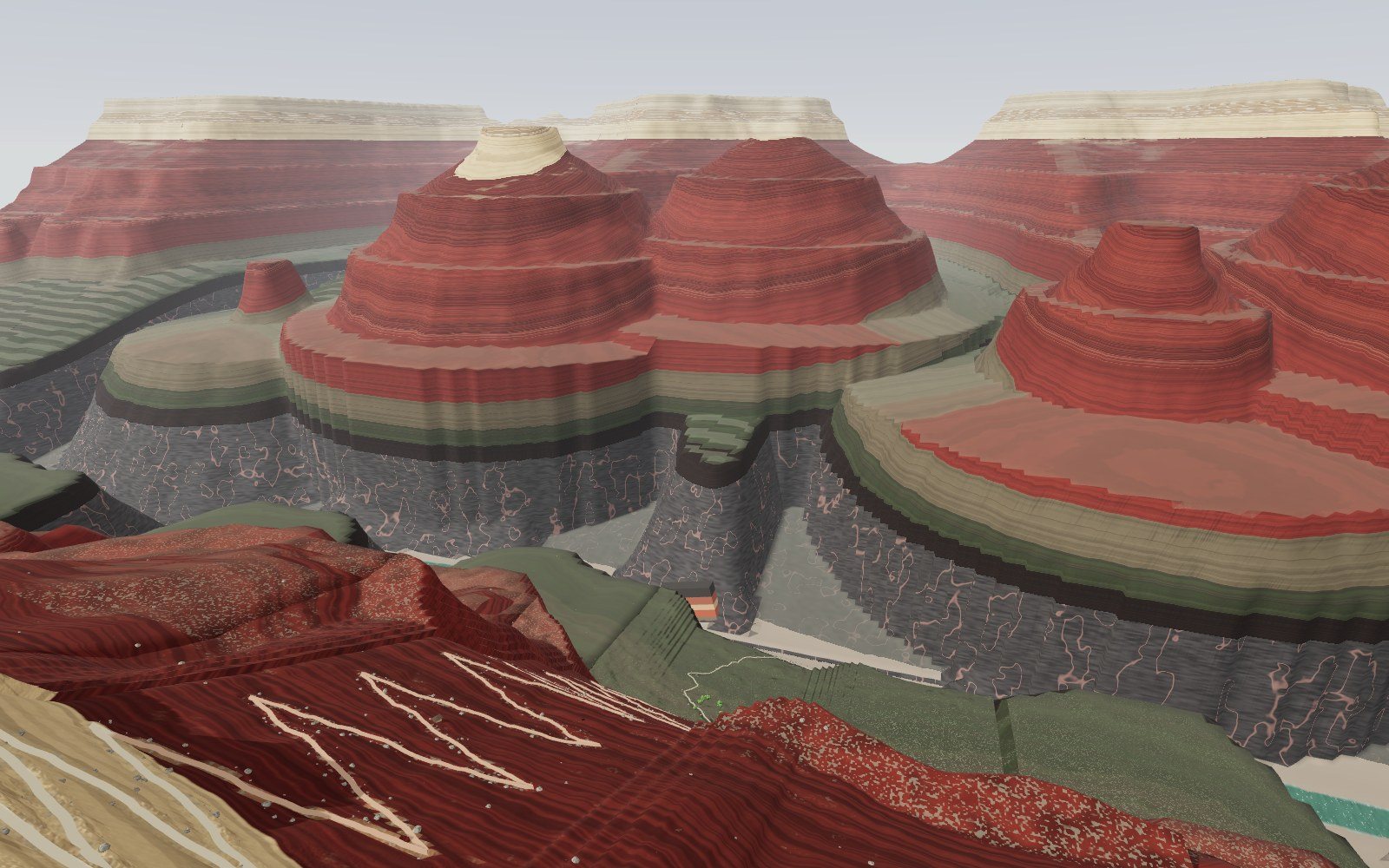
Walk 1,360 m down the Bright Angel Trail through 13 rock layers, from a 270-million-year-old sea floor on the rim to 1.75-billion-year-old schist by the river.
How lightning and thunder work
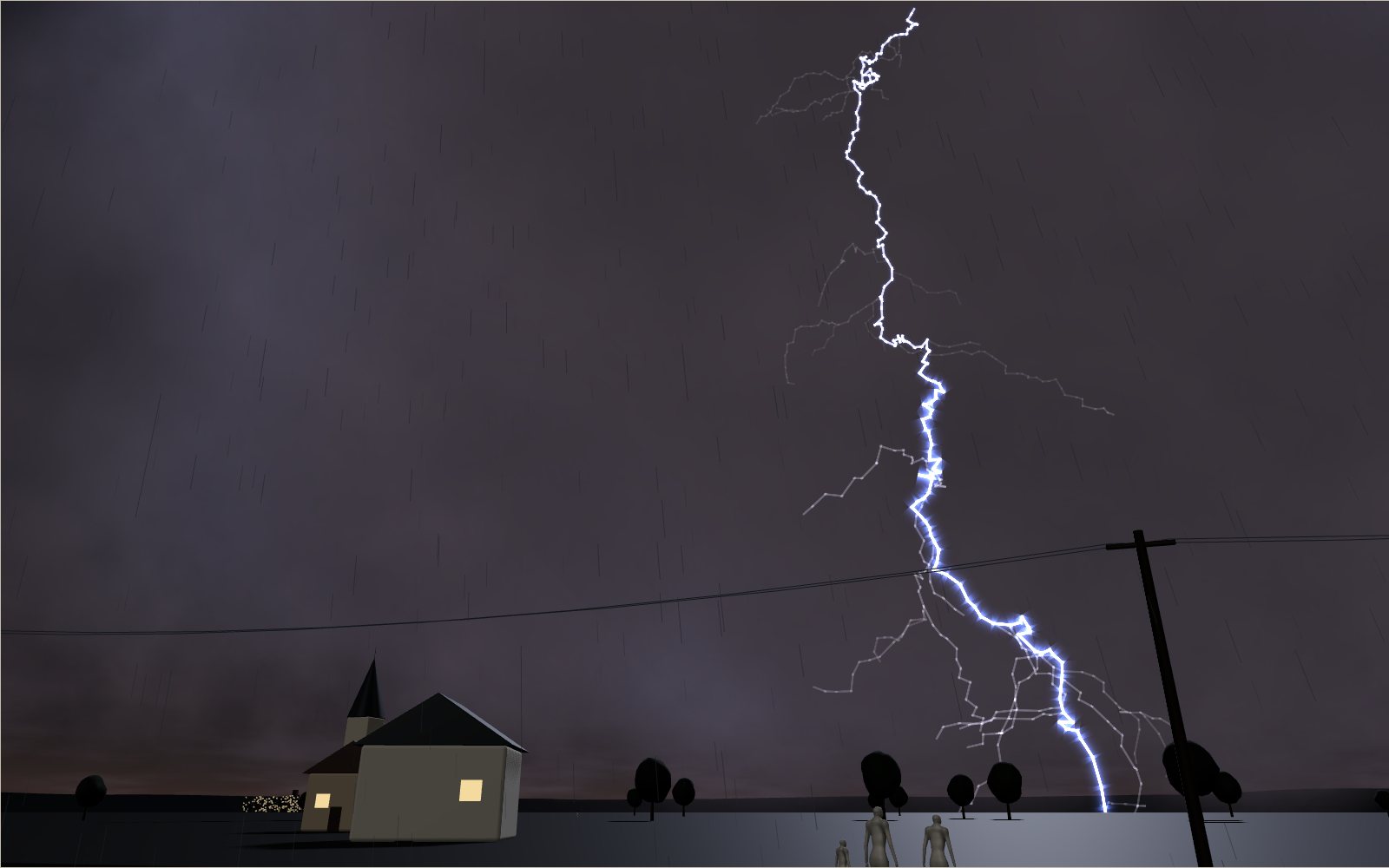
A lightning channel heats the air to about five times the temperature of the Sun’s surface, and its thunder needs about 3 seconds to cover each kilometre to you.
How a steam locomotive works
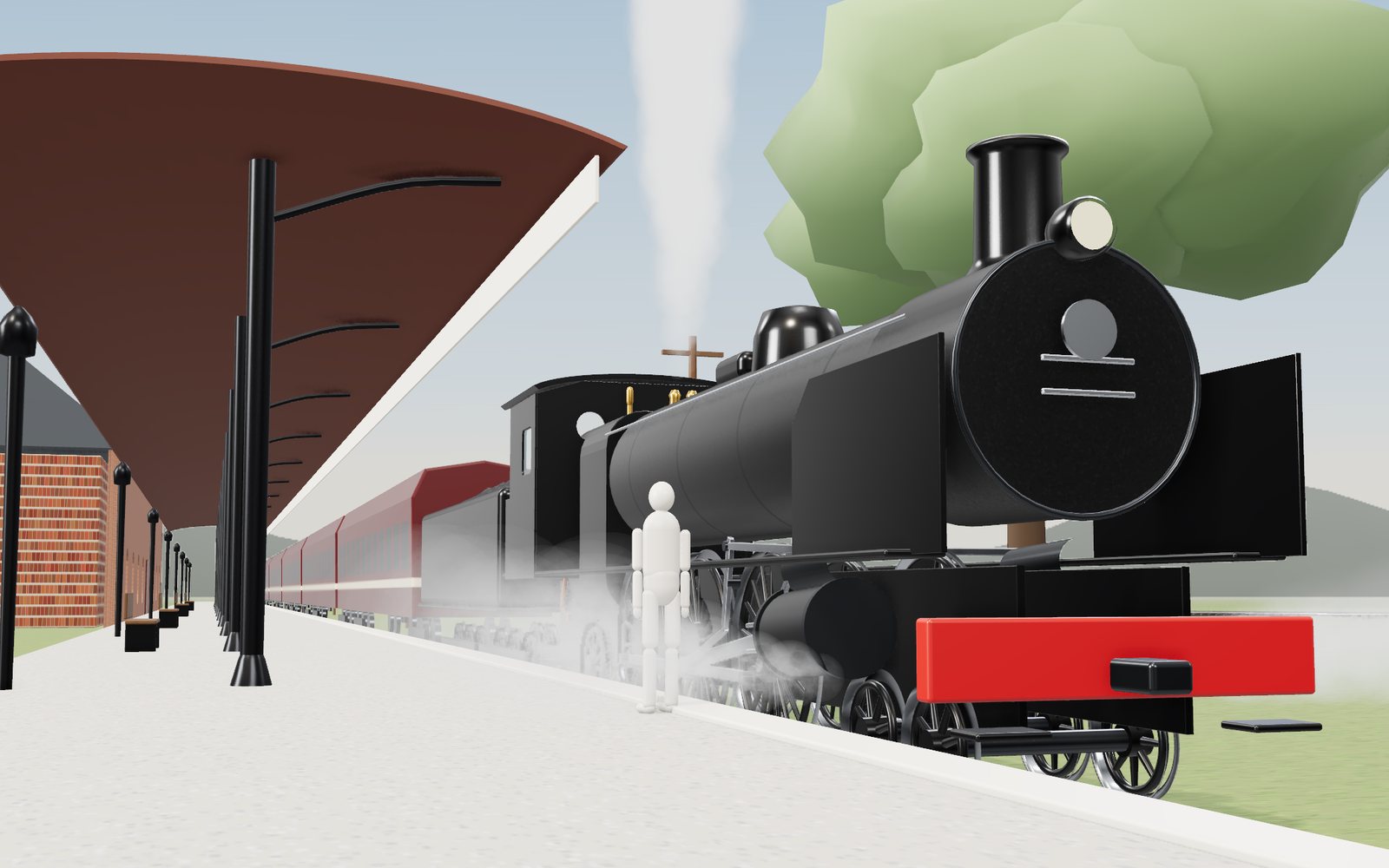
Mallard's driving wheels are 2.03 m across, taller than most people, and at its record 126 mph they turned almost nine times a second.
Walk through Machu Picchu
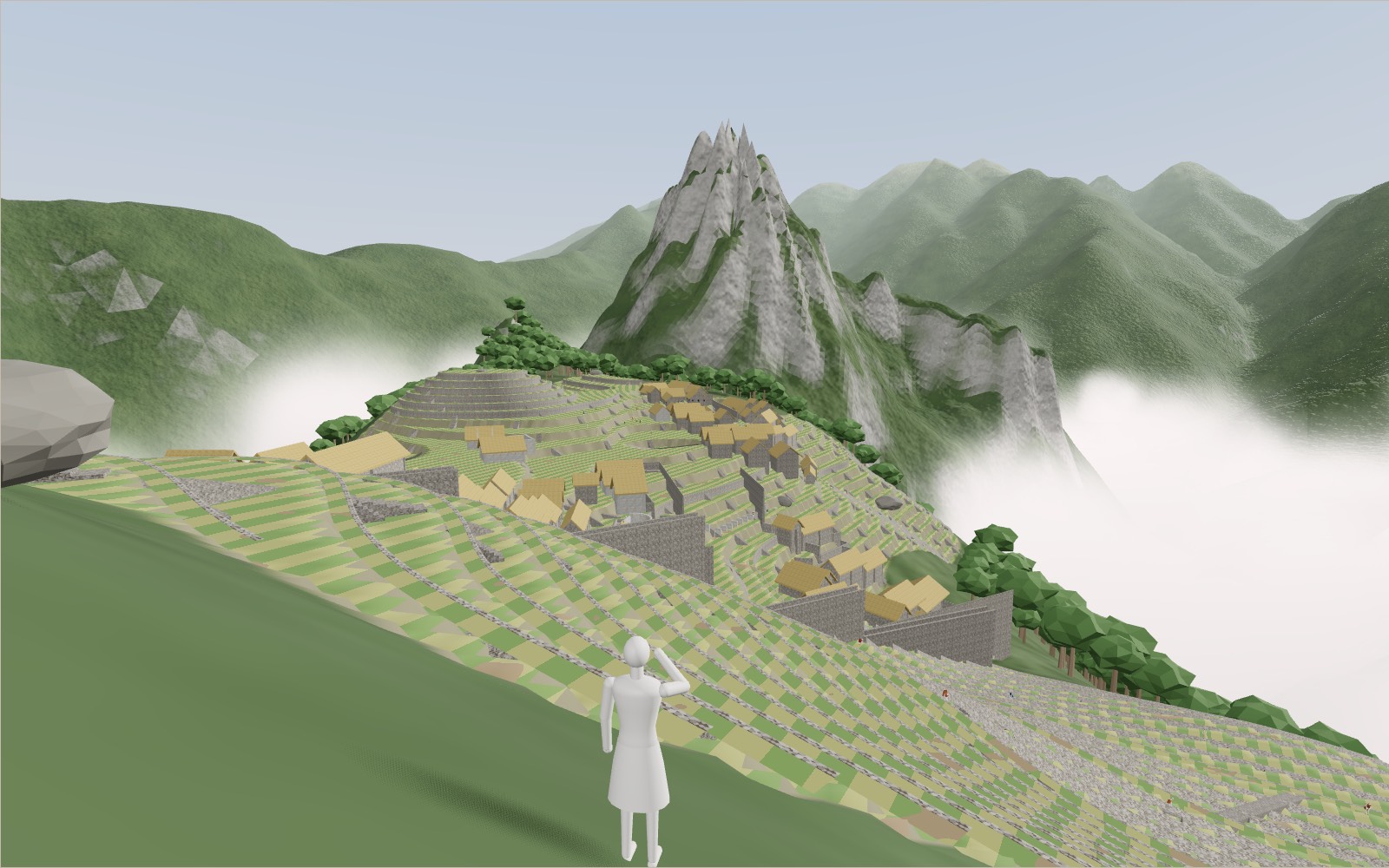
Most of the work that holds Machu Picchu on its ridge, 60 per cent by one estimate, lies under the ground in foundations and drains nobody sees.

Satellites orbiting Earth right now
On 20 October 2026 the public catalogue listed 16,768 working satellites, and two in every three belonged to one company's internet network.