Loading the model
This device cannot show the 3D model. You can read the guide steps below as text.
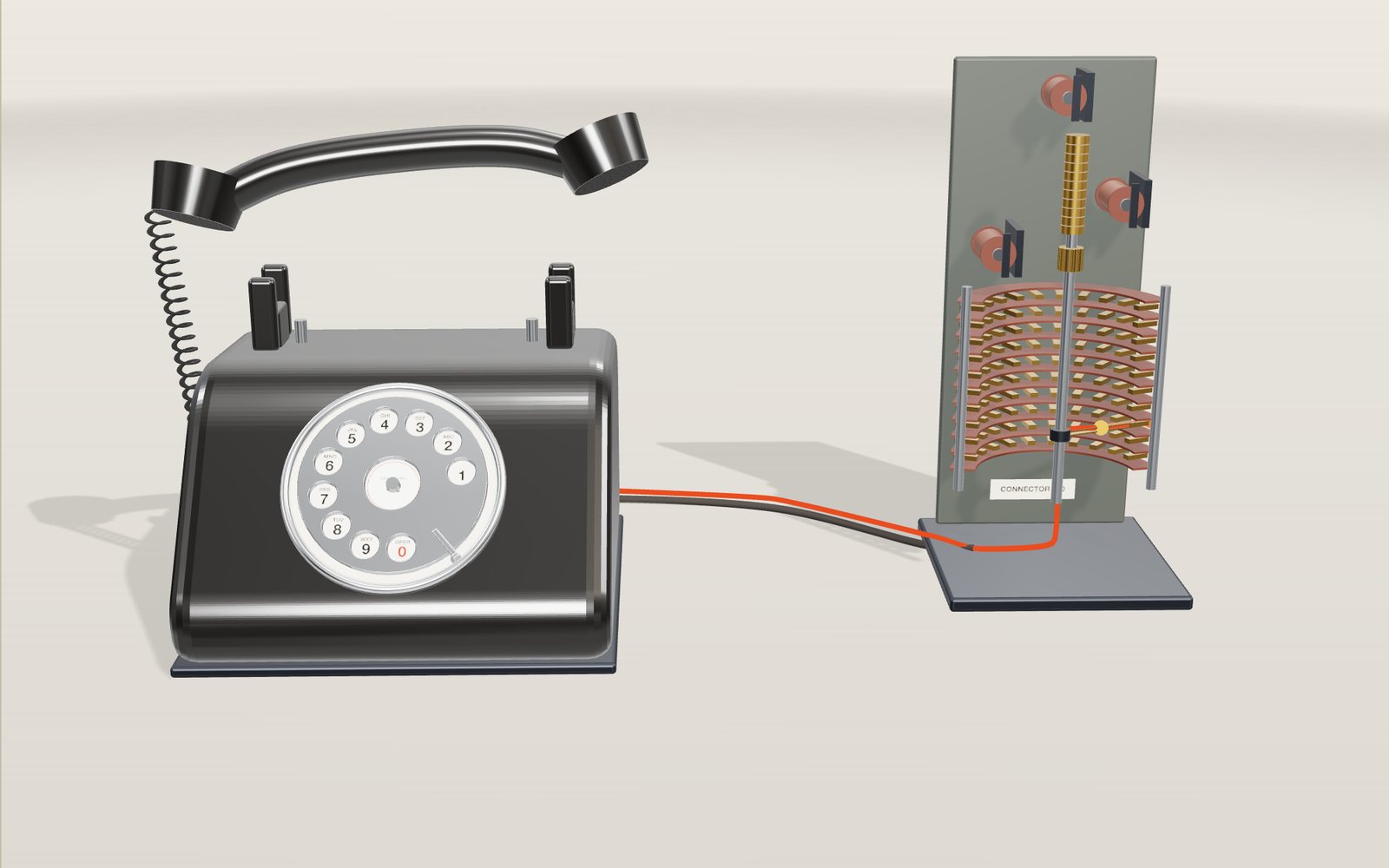
1 / 16 A telephone and its exchange On the left is a desk telephone. On the right is the selector that answers it in the exchange, joined by one pair of wires. The model is dialling line 30. Drag any finger hole round to the metal stop and let go to dial yourself.
Drag to turn. Scroll or pinch to zoom.
Guide Parts Controls
01 A telephone and its exchange On the left is a desk telephone. On the right is the selector that answers it in the exchange, joined by one pair of wires. The model is dialling line 30. Drag any finger hole round to the metal stop and let go to dial yourself.
02 Ten holes in a wheel The finger wheel turns over a fixed number plate, so each digit shows through its hole only while the dial is at rest. The holes are 30 degrees apart. Hole 1 sits nearest the stop and hole 0 farthest from it, so 0 needs the longest turn.
03 The finger stop Your finger meets the curved hook at lower right and the wheel can go no further. In the model, hole 3 travels 120 degrees: three steps that will become pulses and one extra step that leaves a gap before the next digit.
04 Spring and governor Turning the wheel winds a flat spiral spring. When you let go, the spring drives the wheel home through a gear and a small pinion. The pinion spins a cup with two weights that swing out and rub as the speed rises, so the wheel always comes back at the same rate.
05 Cam and pulse contacts A cam with twelve teeth turns with the wheel. On the way back each tooth pushes the contacts apart once, and the line current stops for a moment. The model is dialling 3, so the contacts open three times. The orange bands in the strip below are the breaks.
06 Ten pulses a second At ten pulses a second each pulse takes 100 ms. The British Post Office standard puts the break at 66 % of that, so the current stops for 66 ms and flows for 34 ms. Digit 0 sends ten pulses and takes a full second. The readout times every break and make as it happens.
07 The selector climbs In the exchange, each break in the current fires the vertical magnet once and the shaft rises one level. Three pulses, three levels. The grid at the bottom shows the same climb as a column of blocks.
08 Two digits pick one of 100 lines After the first digit the selector waits. The pulses of the second digit go to the rotary magnet, which turns the wiper one contact at a time. Level 3, contact 10 is line 30, and the selector rings it. Hang up and the release magnet lets the shaft turn home and drop.
09 The bell inside the base With See inside on you can see the ringer under the body. The exchange sends an alternating current of 20 Hz, the armature rocks, and the hammer strikes one gong and then the other on every cycle. Lift the handset and the hook switch disconnects the bell.
10 A voice becomes a current The mouthpiece holds a capsule of carbon granules behind a thin diaphragm. When you speak, the diaphragm presses the granules together and their resistance falls, so the steady line current rises and falls in step with the sound.
11 The current becomes a voice again In the earpiece a ring magnet holds an iron diaphragm under a steady pull. The varying current in the two coils adds to that pull or takes from it, the diaphragm moves, and you hear the other person.
12 Before dials: the operator On a manual switchboard every line ends in a jack with a lamp. Lift the handset and lamp 42 lights; the operator plugs one cord into it, asks for the number and plugs the other cord into the wanted line. In this model the number you dial stands for the number you would have asked for.
13 Crossbar: the whole number first A crossbar exchange does not move a switch for each pulse. A register collects the digits, then a marker picks one select bar and one hold bar, and their crossing point closes. The first digit picks the row, the second the column.
14 Electronic switching In the No. 1 ESS a stored program does the thinking. A scanner checks the lines, the digits go into memory, and the program closes glass reed contacts to make the path. Rotary pulses and touch-tones both work.
15 Digital: calls take turns A digital exchange samples each voice 8000 times a second and puts every sample in a time slot. Joining two lines means copying the caller's slot into the called line's slot. The wheel shows 32 slots slowed down from 125 microseconds to 2 seconds.
16 Touch-tone keys A push-button set sends two tones for each key, one for its row and one for its column. The tone receiver hears which two of its eight filters respond and stores the digit. Turn on Sound and press the keys in the lab to hear the pairs.
Body A hollow Bakelite case. See inside makes it clear so the dial mechanism behind the plate shows. Handset Earpiece and mouthpiece on one handle. Lifting it closes the line loop and the exchange answers with dial tone. Cradle and hook switch Two forks hold the handset. The plungers beside them rise when it is lifted and close the loop. Finger wheel A chrome wheel with ten holes 30 degrees apart, turning over a fixed plate printed with the digits. Finger stop A fixed hook at lower right. It sets how far each hole can travel, and so it sets the digit. Main spring A flat spiral spring. Turning the wheel winds it, and it drives the wheel home when you let go. Governor A gear, a pinion and a spinning cup with two flyweights. The faster it turns, the harder the weights rub, so the return speed stays steady. Pulse cam Twelve teeth, one for every 30 degrees of wheel travel. Each tooth opens the contacts once on the way back. Pulse contacts Two leaf springs in series with the line. When the cam pushes them apart, the current stops. Selector shaft and wiper A shaft in the exchange. It climbs one level per pulse of the first digit, then turns its wiper one contact per pulse of the second. Contact bank Ten levels of ten brass contacts, one position for each of 100 lines. Real selectors stack three such banks. Stepping magnets The vertical magnet lifts the shaft, the rotary magnet turns it and the release magnet lets it fall home. Ringer Two gongs, a hammer and a pair of coils under the body. The ringing current from the exchange rocks the armature, and the hammer strikes one gong and then the other with every cycle. Induction coil and capacitor The speech network. The coil links the transmitter and receiver to the line and keeps your own voice from sounding too loud in the earpiece; the capacitor lets the ringing current reach the bell. Carbon transmitter A capsule of carbon granules behind a thin diaphragm in the mouthpiece. Sound presses the diaphragm, the granules pack tighter, their resistance falls and the line current rises and falls with your voice. Receiver A ring magnet, two small coils on pole pieces and an iron diaphragm in the earpiece. The varying line current strengthens and weakens the magnet's pull, and the diaphragm moves the air. Operator's switchboard One hundred jacks, one per line, each with a lamp. Lifting a receiver lights the caller's lamp; the operator answers by plugging in a cord. Cord pair and keys The answering plug goes into the caller's jack, the calling plug into the wanted line. The lever keys let the operator talk, listen and ring. Crossbar switch Ten horizontal select bars and ten vertical hold bars. Tilting one select bar and then closing one hold magnet makes one crosspoint out of a hundred. Marker The common controller. It stores the whole number first, finds a free path and then works the bars, instead of letting each pulse move a switch. Reed network and scanner Glass reed contacts in a grid form the speech path; the lamps on top stand for the scanner that checks every line for an off-hook signal. Program store Memory cards and lamps for the stored program. The program reads the digits, decides on a path and closes the reeds. Time-slot wheel The 32 slots of one PCM frame, shown going round once every two seconds instead of every 125 microseconds. The exchange copies the caller's slot into the called line's slot. Codecs Each line has a coder that samples the voice 8000 times a second and turns each sample into 8 bits, and a decoder that turns them back. Push-button set A touch-tone telephone with four rows and four columns of keys. Each key sends one row tone and one column tone together. Tone receiver Eight filters, one per DTMF frequency. A digit is accepted when exactly one low tone and one high tone are heard.