Loading the model
This device cannot show the 3D model. You can read the guide steps below as text.
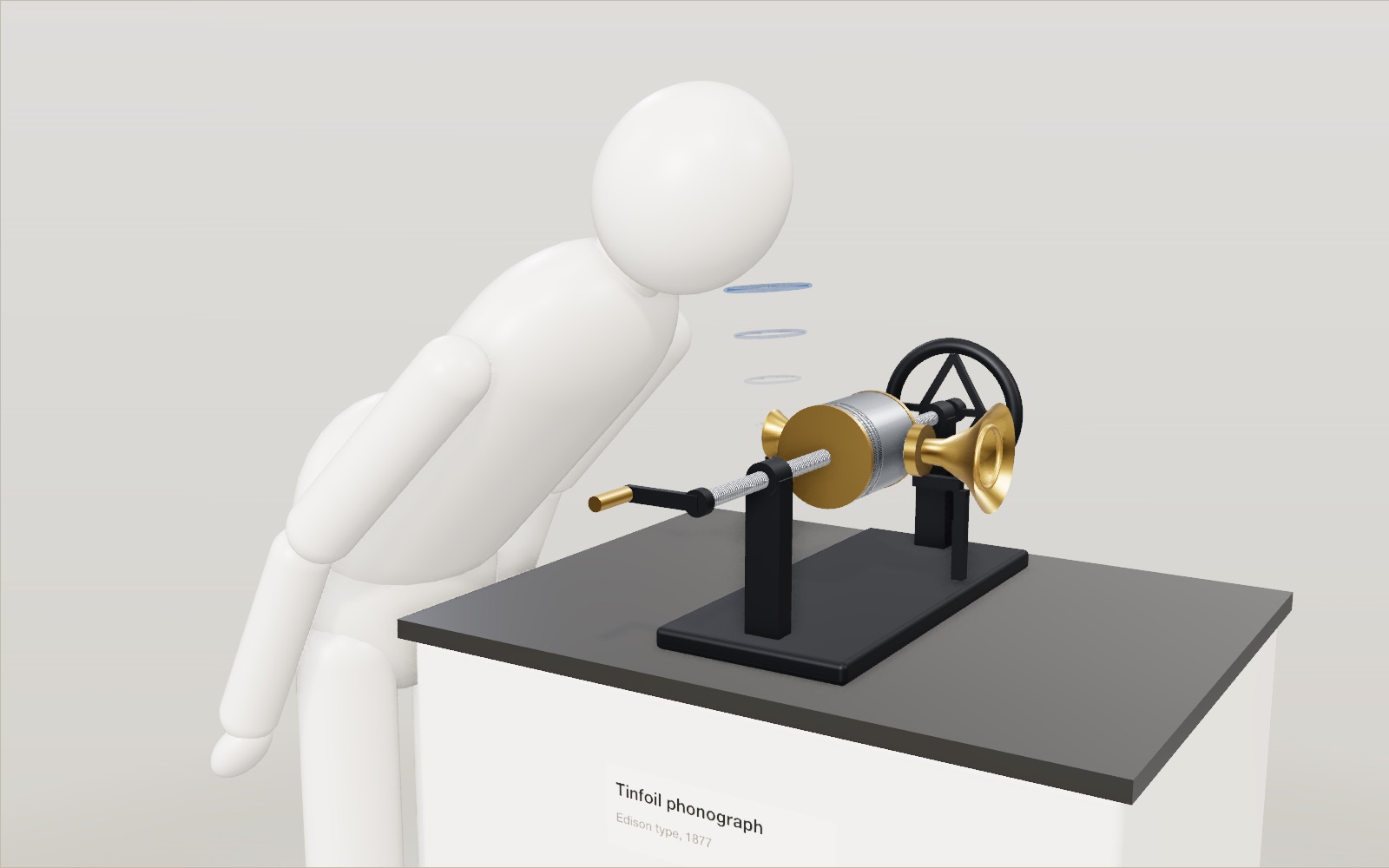
1 / 14 A voice cut into tinfoil The mannequin speaks into the mouthpiece. The needle presses the sound into the foil while the drum turns, then the drum goes back and the same groove speaks again.
Drag to turn. Scroll or pinch to zoom.
Guide Parts Controls
01 A voice cut into tinfoil The mannequin speaks into the mouthpiece. The needle presses the sound into the foil while the drum turns, then the drum goes back and the same groove speaks again.
02 Needle and diaphragm A thin diaphragm moves with the air pressure. The needle on it digs deeper when the pressure rises and shallower when it falls.
03 Hill and dale Under the microscope the groove's depth goes up and down with the sound. The view shows the actual length of groove and the milliseconds it holds.
04 A wax cylinder From 1902 Edison's moulded cylinders turned at 160 rpm. A spring motor and a governor keep the speed steady.
05 Same speed all the way A cylinder has the same circumference at both ends, so the groove passes the stylus at 0.47 m/s from start to finish.
06 A flat disc Berliner's gramophone used a flat disc with a spiral groove. Discs could be pressed from a metal stamper by the thousand.
07 Side to side On a disc the groove keeps a constant depth and swings sideways. The needle swings with it and rocks the diaphragm.
08 Speed changes pitch Play a 78 at 43 % of its speed and every frequency drops by the same factor: 12 × log₂(0.43) = -14.6 semitones.
09 Electrical recording From 1925 a microphone and amplifier cut the record. At home a pickup, valves and a loudspeaker played it back.
10 Three heads On tape the sound is magnetism. The erase head wipes, the record head magnetizes and the playback head reads.
11 Magnets on tape Tiny oxide particles point north or south with the signal. At 19.05 cm/s one wave of 1 kHz takes 190.5 µm of tape.
12 Capstan and pinch roller A cassette moves 4.76 cm/s. The capstan sets the speed and the pinch roller presses the tape against it.
13 Pits and a laser A CD stores numbers. At 1.2 to 1.4 m/s the laser reads pits 0.83 to 3.56 µm long, and each edge between pit and land is a 1.
14 How much fits A side of tinfoil held well under a minute; a CD holds 74 minutes. The table under the controls works out each one.
Cast-iron base A heavy iron base with two uprights. It keeps the drum steady while you turn the crank. Foil drum A brass drum with a spiral groove, wrapped in a sheet of tinfoil. The needle presses the sound into the foil over the groove. Feed screw The shaft is a screw with 10 threads per inch. Each turn moves the drum 2.54 mm sideways, so the needle draws a spiral. Flywheel A heavy wheel on the shaft. It evens out the speed of a hand on the crank, which matters because pitch follows speed. Crank Turned by hand. Edison's first machine had no motor, so every recording and playback ran at the speed of the person turning it. Recording mouthpiece You speak into it. A thin diaphragm behind it moves with the air pressure and pushes the needle into the foil. Playback horn A second diaphragm with a lighter needle rides the groove. The bumps move the diaphragm and the horn makes the sound louder. Stylus A steel point fixed to the diaphragm. Pressed in deeper or shallower, it leaves a groove whose depth follows the sound. Case An oak case holding the spring motor. Turn on See inside to look at the spring barrel and the governor. Wax cylinder About 2 3/16 in (55.6 mm) across. Moulded cylinders from 1902 turned at 160 rpm with 100 grooves per inch. Mandrel The slightly tapered metal core that holds the cylinder. The taper lets a cylinder slide on and grip without glue. Reproducer A diaphragm with a stylus that rides the groove. The stylus moves up and down with the hill-and-dale groove. Feed screw A screw behind the cylinder that carries the reproducer along at exactly the groove pitch, so the stylus never has to steer. Horn A cone that matches the small diaphragm to the air of the room. The wider the mouth, the better the low notes come out. Winding crank Winds the spring. One winding plays a few cylinders. Spring motor A coiled steel spring in a brass barrel. It drives the mandrel through gears. Governor Three weights on springs. When the speed rises they fly out and rub on a brake, which keeps the speed steady. Cabinet A wooden box with the spring motor inside. Turn on See inside to see it. Turntable A felt-covered metal plate that turns the disc. Speeds were not fixed until 1925; this one turns at 78.26 rpm. Shellac disc A 10-inch disc of shellac compound. The groove wiggles side to side and plays for about 3 minutes. Soundbox A mica diaphragm with a steel needle. The needle swings sideways in the groove and rocks the diaphragm. Tone arm A hollow arm that carries the soundbox and leads the sound to the horn. The groove pulls it toward the centre. Flower horn A large painted horn. With no electricity, the horn is the only amplifier. Winding crank Winds the spring motor. Spring motor Berliner worked with Eldridge Johnson's machine shop to fit spring motors, so the disc turned at an even speed. Cabinet A walnut cabinet with the amplifier and loudspeaker inside. Turn on See inside. Platter A heavy plate turned by an electric motor through a gear: 3,600 ÷ 46 = 78.26 rpm. 12-inch record Cut from a microphone signal. A 12-inch side plays 4 to 5 minutes. Pickup A magnet and coil turn the needle's movement into a small voltage. No horn is needed. Pickup arm Carries the pickup across the record. The groove steers it. Valve amplifier Valves (vacuum tubes) make the pickup's few millivolts large enough to drive a loudspeaker. Loudspeaker A paper cone moved by a coil in a magnet. It does the horn's job with electricity. Motor An electric motor that keeps an exact speed, unlike a spring that runs down. Deck The top plate that holds the reels, heads and capstan in line. Supply reel A 7-inch reel holding 1,800 ft (548.6 m) of tape. At 19.05 cm/s that is 48 minutes. Take-up reel Winds up the played tape. It turns faster at first, when its pack is small. Tape A plastic ribbon 6.3 mm wide coated with tiny iron oxide particles that can be magnetized. Erase head Comes first. A strong high-frequency field scrambles whatever was on the tape before. Record head An electromagnet with a narrow gap. The current from the microphone magnetizes the tape passing the gap. Playback head The magnetized tape passing its gap makes a small voltage in the coil. Separate heads let you listen while recording. Capstan A steel pin turned at an exact speed. It, not the reels, sets the tape speed. Pinch roller A rubber roller that presses the tape against the capstan so it cannot slip. Level meter Shows how strongly the tape is being magnetized. Too high and the sound distorts. Recorder A small battery recorder with piano keys, the kind introduced with the cassette in 1963. Cassette shell 100.4 × 63.8 × 12 mm. The tape never leaves the shell, so it needs no threading. Hubs Two hubs 42.5 mm apart. One gives tape, the other takes it up. Tape 3.81 mm wide, moving at 4.76 cm/s. A C60 holds 30 minutes per side on 85.7 m of tape. Record and play head One head does both jobs in a simple recorder. It reaches through the window in the front of the shell. Erase head Wipes the tape just before it reaches the record head. Capstan A thin steel shaft turning at an exact speed, 4.76 cm/s at the tape. Pinch roller Presses the tape against the capstan. Player A top-loading CD player. Turn on See inside for the board with the converter chip. Lid Closed, it keeps out light and dust. The laser is safe because it only works with the lid shut. Compact disc 120 mm across. A single spiral track 1.6 µm wide runs from the centre outward, about 5.8 km long. Spindle motor Changes speed so the track always passes the laser at 1.2 to 1.4 m/s: about 500 rpm at the centre, 214 at the edge. Laser sled Carries the laser and lens outward along two rails as the disc plays. Objective lens Focuses the infrared laser to a spot about a micrometre across through the disc's plastic. Converter board Turns 44,100 numbers per second per channel back into a voltage for the amplifier.