Loading the model
This device cannot show the 3D model. You can read the guide steps below as text.
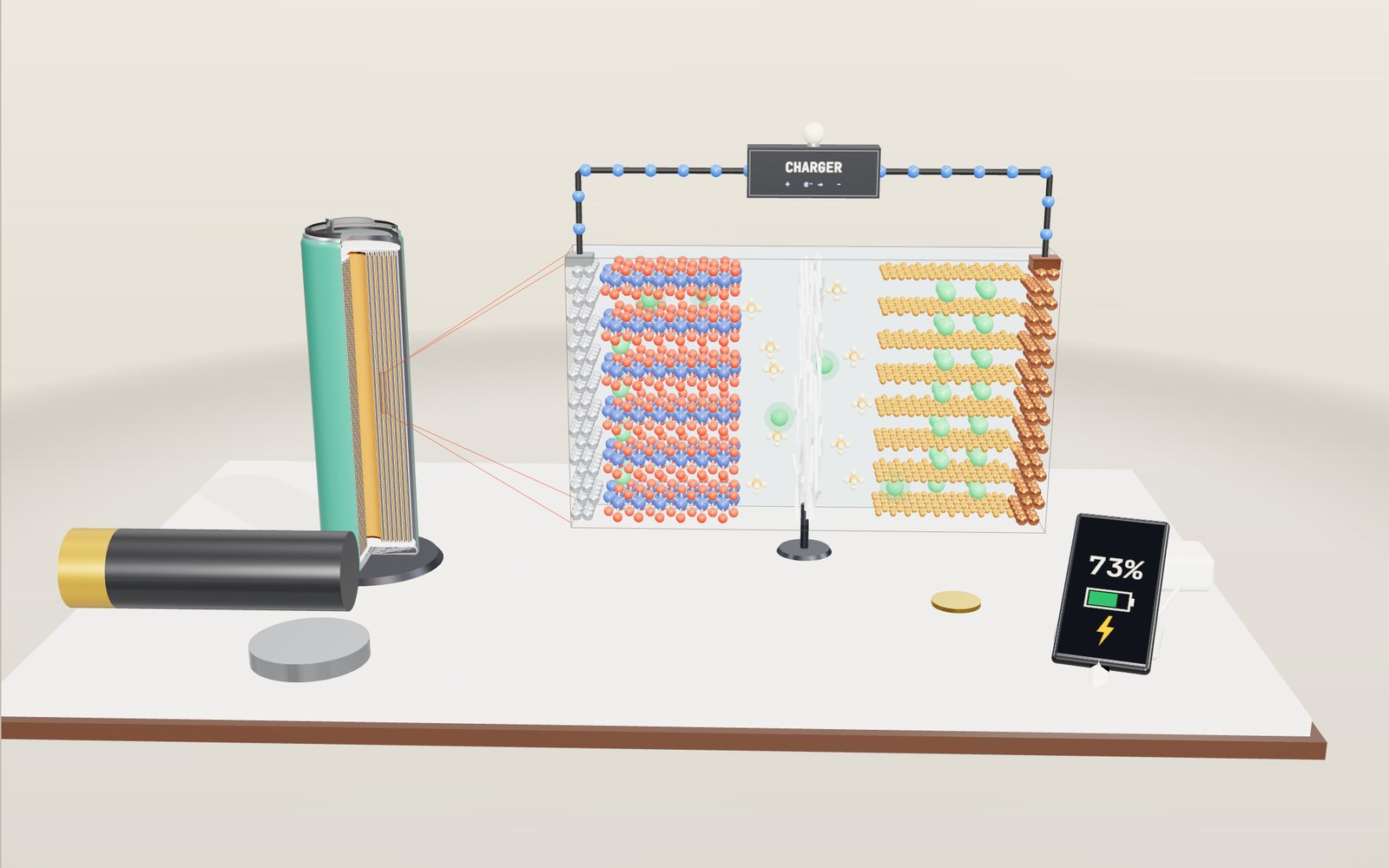
1 / 8 An 18650 cell, cut open The name gives the size: 18 mm across and 65 mm tall. A quarter of the can is cut away so you can see the rolled layers inside. On the right, a tiny piece of those layers is drawn at the size of atoms, and the red lines show where it comes from.
Drag to turn. Scroll or pinch to zoom.
Guide Parts Controls
01 An 18650 cell, cut open The name gives the size: 18 mm across and 65 mm tall. A quarter of the can is cut away so you can see the rolled layers inside. On the right, a tiny piece of those layers is drawn at the size of atoms, and the red lines show where it comes from.
02 A long sandwich, rolled up Inside the can is a long strip of thin layers wound around a hollow core: cathode on aluminium foil, a separator, anode on copper foil and a second separator. The cut face shows the spiral. Rolling the strip packs a large electrode area into a small can.
03 The cathode is a layered oxide At 0 % charge all 40 green lithium balls sit in the cathode, in the gaps between sheets of cobalt and oxygen atoms. John Goodenough reported this lithium cobalt oxide in 1980, and its layers let lithium slide out and back without the crystal falling apart.
04 Graphite stores the lithium when charged Now the cell is at 100 %. Every lithium ball has moved into the graphite on the right and sits between two sheets of carbon. Lithium in graphite is at a much higher energy than lithium in the oxide, and that difference is what the cell gives back as voltage.
05 Charging: ions one way, electrons the other The charger pulls electrons out of the cathode and pushes them through the wire into the graphite. To keep the charge balanced, lithium ions leave the oxide, cross the electrolyte and the separator, and slip between the carbon sheets. Watch the voltage climb towards 4.20 V.
06 Discharging runs it backwards With a lamp in the circuit, electrons flow from the graphite through the lamp to the cathode, and the ions go back into the oxide. Under a 1.6 A load the voltage sits 0.08 V below the open-circuit value. At 3.00 V the device stops drawing current.
07 Series adds volts, parallel adds amp-hours This pack is 10s4p: ten groups in series, four cells in each group. Ten in series give 36 V nominal and 42 V when full. Four in parallel give 4 × 3.2 = 12.8 Ah. The 40 cells hold about 461 Wh at the nominal 3.6 V.
08 When heat starts feeding itself At 220 °C the cell is past the point of no return. Near 120 °C the protective film on the graphite starts to break down and the cell heats itself. Around 135 °C the separator pores close and the current stops. Hotter still, the film shrinks, the cathode gives off oxygen and the reactions run away.
Steel can and sleeve The nickel-plated steel can is the negative terminal, and the plastic sleeve insulates it. Switch on See inside to look through it. Top cap The positive button. Underneath it a gasket seals the can, and a vent disc opens if the gas pressure inside climbs too high. Layered oxide cathode Sheets of cobalt (blue) and oxygen (red) with lithium between them, as in LiCoO₂. NMC and NCA cathodes share this layered shape. Aluminium foil The cathode paste is coated on both sides of this foil. It collects the current and carries it to the top cap. Graphite anode Flat sheets of carbon hexagons stacked on top of each other. Lithium slips in between the sheets when the cell is charged. Copper foil The graphite is coated on copper foil, which is joined to the bottom of the can by a short tab. Separator A plastic film full of tiny pores. Ions get through it, but the two electrodes can never touch. Electrolyte A lithium salt, LiPF₆, dissolved in carbonate solvents. The orange and cream clusters are PF₆⁻ ions. The liquid carries ions, not electrons. Lithium ions Each green ball stands for 80 mAh of charge, about 1.8 × 10²¹ real ions. The model has 40 of them. Outside circuit Electrons (blue) can only take the wire. The box is a charger while charging and a lamp while discharging. Battery pack Copies of the same cell joined by nickel strips. Series columns add voltage; parallel rows add capacity.