Loading the model
This device cannot show the 3D model. You can read the guide steps below as text.
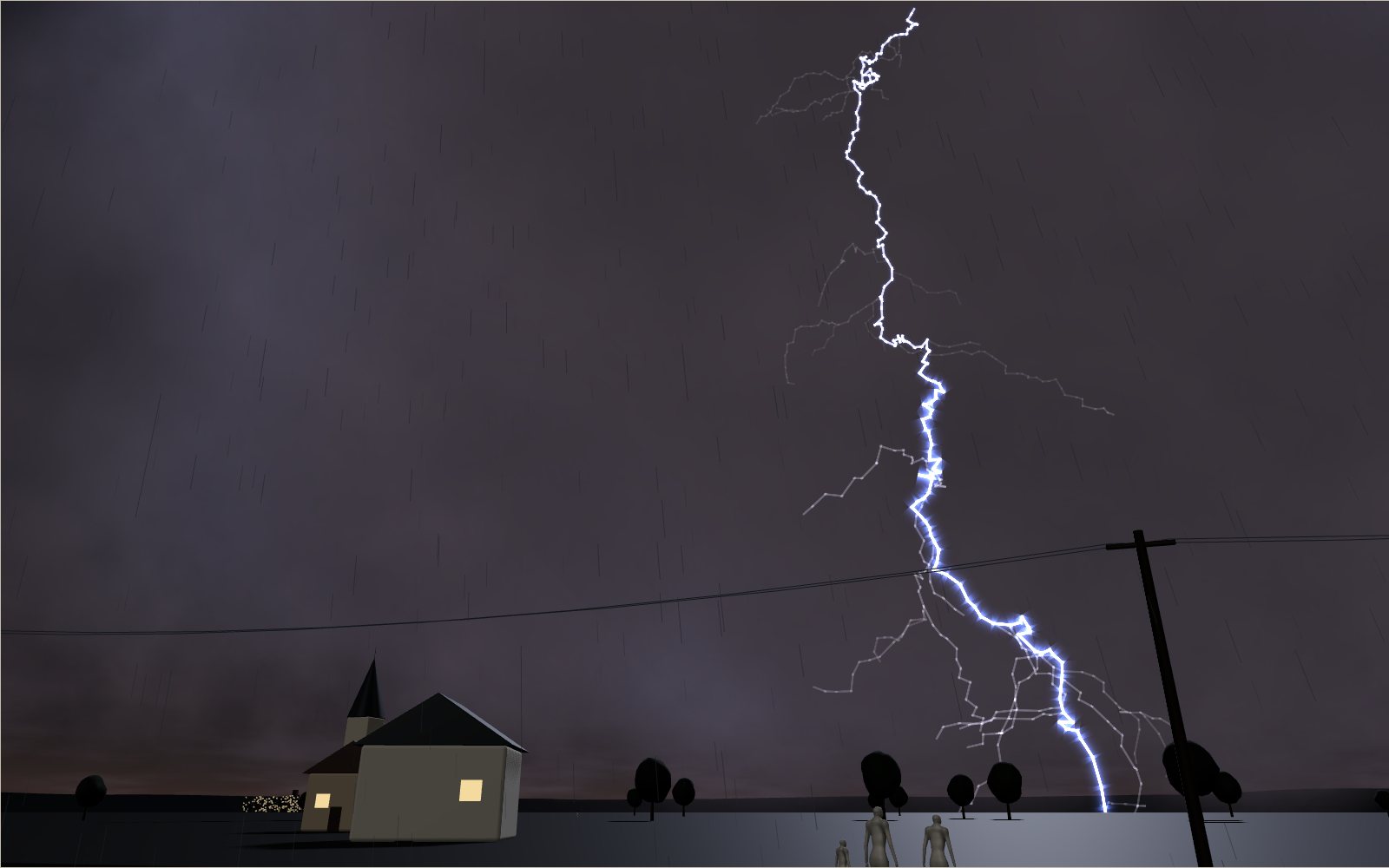
1 / 19 A storm 3.4 km away This is a small town at night with a thunderstorm 3.4 km away, at true size. Watch the channel come down, then count. The thunder takes about 10 seconds to arrive. Drag to look around; the buttons along the top open six more scenes.
Drag to turn. Scroll or pinch to zoom.
Guide Parts Controls
01 A storm 3.4 km away This is a small town at night with a thunderstorm 3.4 km away, at true size. Watch the channel come down, then count. The thunder takes about 10 seconds to arrive. Drag to look around; the buttons along the top open six more scenes.
02 Three seconds a kilometre Light reaches you in about 11 millionths of a second. Sound travels about 343 m a second at 20 °C, so every 3 seconds between flash and thunder is about a kilometre. The counter in the middle does the sum for each strike.
03 Close At 800 m the thunder comes in under 3 seconds and starts with a sharp crack. The channel air can reach about 27,800 °C, roughly five times the Sun’s surface.
04 Seen but not heard At 18 km with a little background noise, the thunder never reaches you. People call this heat lightning, but it is just a distant storm. The readout gives the distance thunder carries in this noise.
05 The church spire Tall, pointed and on its own, the spire is the most likely target in town. Its lightning rod gives the current a path down to the ground. Strikes that come close land on the rod.
06 Inside the cloud The storm cut in half. Heights are real; the particles are drawn thousands of times larger. Rings mark 0, −10, −20 and −40 °C, which move up when the ground is warmer.
07 Charge builds up Graupel falls through rising ice crystals. Where it is colder than about −10 °C, graupel takes negative charge and the ice positive; the ice carries it to the top. When the main negative charge is full, the cloud flashes.
08 One flash, slowed down The stepped leader comes down from the cloud base in steps of about 50 yards. The stage shows it up to 500 times slower, so a descent of a few tens of milliseconds takes about 10 seconds.
09 Streamers rise When the leader is about a hundred yards above the ground, the rod, the tree, the pole and even the person send up streamers. At ×100,000 you can see which one connects.
10 The return stroke Once connected, the bright return stroke climbs the channel at about 110,000 km/s. Then a dart leader runs down the same path and another stroke follows, which is why lightning flickers.
11 Kinds of lightning Two storm cells seen from about 200 km away. This is a positive flash from the anvil: one stroke, a long current, often far from the rain. The buttons along the bottom show ten more kinds.
12 Above the clouds Red sprites flare 50 to 90 km up for a few milliseconds above strong positive flashes. They were first caught on camera by chance in 1989. Here they are slowed about 100 times.
13 A bolt from the blue This one leaves the side of the storm, travels through clear air and comes down where the sky looks blue, as far as 10 to 15 miles from the storm.
14 A lightning rod The sphere around the leader tip is its striking distance, about 41 m at 30 kA. The first thing inside it is struck. With the rod up, that is nearly always the rod.
15 Without the rod With the rod taken down, the leader finds the chimney, the tree, the car or the ground. The rings on the ground show the current spreading out, the most common way people are hurt.
16 Why thunder rumbles Every piece of the channel sends out sound at once, but the pieces are at different distances from you. The nearest arrives first, the farthest tens of seconds later. The trace adds them up.
17 44 a second Each dot is one flash. Satellites count 44 ± 5 a second over the whole Earth, about ten times as many over land as over the sea. The glow is a model, not the satellite grid.
18 Hotspots The glow is brightest over Africa and the northern Andes. The top spot is Lake Maracaibo in Venezuela, at about 233 flashes per square kilometre a year. The buttons below fly to the records.
19 Stay safe If you can hear thunder, you are close enough to be struck. Go indoors or into a hard-topped car, keep off corded phones and plumbing, and wait 30 minutes after the last thunder. The full rules are under the stage.
Thundercloud A cumulonimbus at true size: base about 1.5 km up, top about 12 km, with an anvil spreading downwind. Lightning channel The path of the flash, several kilometres long but only 1 to 2 inches (2.5 to 5 cm) across where the current flows. Town Houses at true size, so the storm can be judged against them. Lit windows are the only light between flashes. Church with a rod The tallest building nearby. A lightning rod on the spire and a conductor give strikes a path to the ground. People for scale Smooth mannequins 1.7 m tall, going indoors. Your own height in the lab below resizes them. Ice crystals Small, light ice carried up by the updraft. After bouncing off graupel they take positive charge to the top of the cloud. Graupel Soft hail, a quarter of a millimetre to a few millimetres across, grown from frozen droplets. Shown here thousands of times larger. Upper positive charge Positive charge carried up on ice crystals, high in the cloud and in the anvil. Main negative charge Negative charge on graupel in the middle of the cloud, where it is colder than about −10 °C. Lower positive charge A small positive region below, where graupel charges positive in slightly warmer air. Freezing level The 0 °C height. It moves with the ground temperature at 6.5 °C for every kilometre. Stepped leader The faint path that grows down from the cloud in steps of about 50 yards, at about 200 km/s on average. Upward streamer A spark that rises from a tall object to meet the leader. Many objects send one; only one connects. Return stroke The bright wave of current that runs from the ground back up the channel at about 110,000 km/s. Anvil The flat top of the storm, spread out at the top of the troposphere. Positive flashes often start here. Red sprite Red light 50 to 90 km up, lasting less than 16 ms, over a strong positive flash. Blue jet A blue cone that rises from the cloud top at about 100 km/s and ends at 40 to 50 km. Elves A thin ring of red light at 75 to 105 km that spreads 100 to 300 km wide in under a millisecond. Tall tower A 660 m mast. Tall structures start upward flashes that branch up into the cloud. Air terminal The rod on the ridge, 11.7 m above the ground. It is meant to be the first thing the leader reaches. Down conductor A copper strip from the rod to the ground at the corner of the house. Ground rod A metal rod driven into the ground, where the current spreads out into the soil. Rolling sphere A sphere with the striking distance as its radius, rolled over the house. Whatever it touches can be struck. Car A hard-topped metal car. The shell carries the current around the people inside. Tall tree A 16 m tree near the house. Standing under it is one of the most common ways people are hurt. Sound fronts Each ring is where the sound from one piece of the channel has reached on the ground. You The listener, at the distance set by the Distance control. Shock zone The first 10 yards or so around the channel, where the expanding air is a shock wave rather than sound. Earth The globe, with a glow where lightning is most frequent (a model) and a dot for every flash, 44 a second. Lightning hotspots The ten places with the most lightning per square kilometre, led by Lake Maracaibo in Venezuela. Lightning mapper A GOES satellite in geostationary orbit, 35,800 km up, mapping lightning over whole continents.