Loading the model
This device cannot show the 3D model. You can read the guide steps below as text.
1 / 8 Pre-crease the square Two diagonals from the coloured side, two midlines from the white side. Each fold opens again, and the creases are all the next move needs. The bar under the model steps one move at a time.
Drag to turn. Scroll or pinch to zoom.
Guide Parts Controls
01 Pre-crease the square Two diagonals from the coloured side, two midlines from the white side. Each fold opens again, and the creases are all the next move needs. The bar under the model steps one move at a time.
02 Collapse into the square base The centre rises, the four corners come together underneath, and the sheet flattens into a square with 1/4 of its area. Two corners stay on the faces and two fold inside.
03 Kite folds and the front petal fold Three crease-and-unfold moves set up the petal fold. Then the bottom corner of the top layer lifts while both sides swing in.
04 Back petal fold: the bird base The same moves on the back give the bird base, also called the crane base. Many other models start from this shape.
05 Narrow the lower flaps The lower edges fold to the centre on both sides, so the two lower points get thin enough for a neck and a tail.
06 Neck, tail and head Three inside reverse folds. Each thin point turns about its folded edge and slides in between the layers of the body.
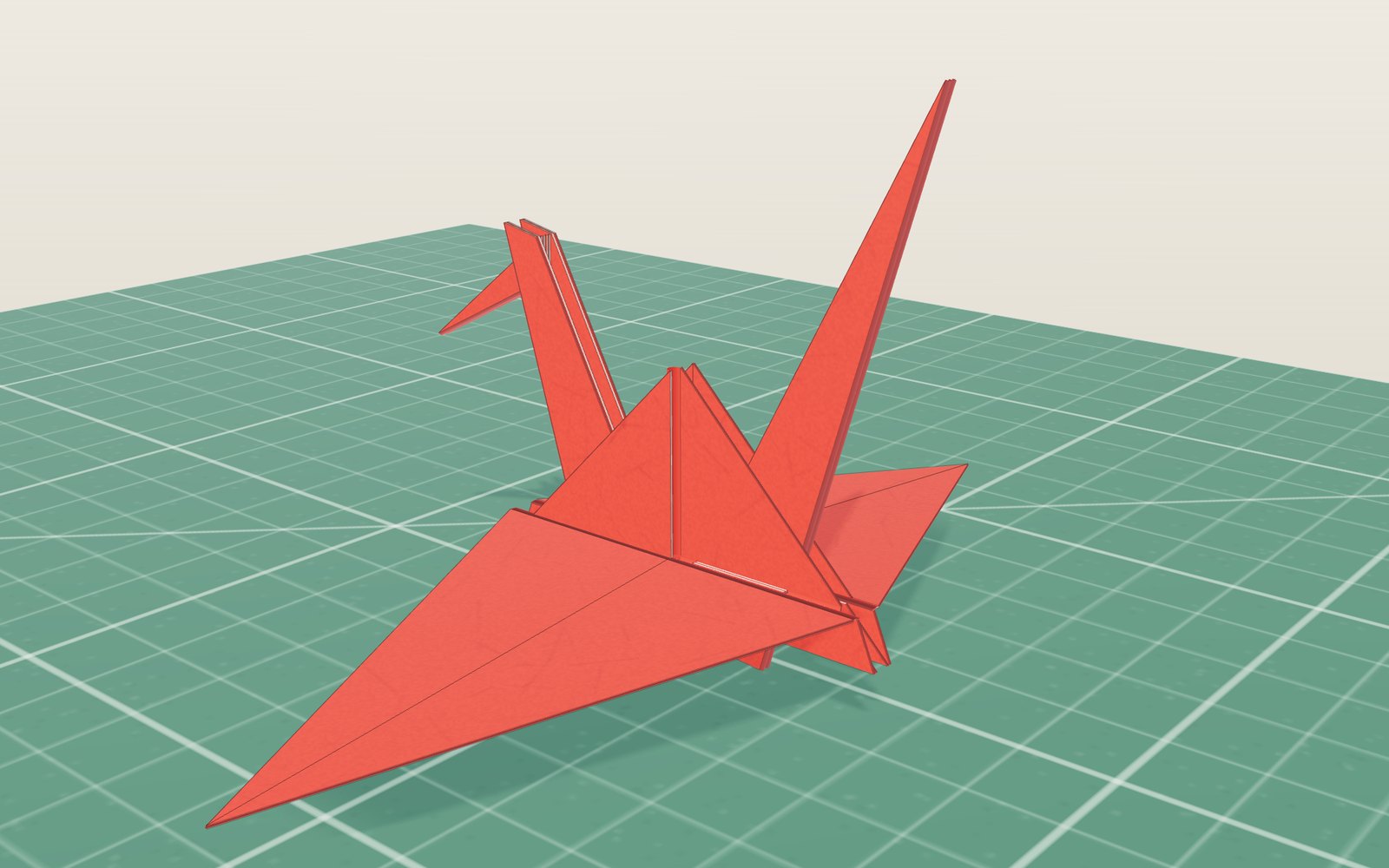
07 Wings down and spread The bird stands up, both wings fold down and then lift out level. This is the finished crane.
08 Unfold to see the crease pattern The model rewinds to the flat square and draws every crease the crane used, mountain and valley, as seen from the coloured side.
Corner A (head) One corner of the square. It ends up as the tip of the beak after two reverse folds. Corner B (front wing) The corner on the front face of the square base. The front petal fold lifts it, and it becomes the tip of one wing. Corner C (tail) The corner opposite A. It goes inside the square base and comes out as the tail. Corner D (back wing) The corner on the back face. It becomes the tip of the other wing. Centre of the sheet Where all the first creases cross. On the finished crane it sits on the back, between the wings. Head The last small inside reverse fold, made near the end of the neck. Neck One narrowed lower flap of the bird base, reverse folded up between the layers of the body. Tail The other lower flap, reverse folded up on the opposite side. Front wing The front petal flap of the bird base, folded down beside the body. Back wing The back petal flap, folded down on the far side. Body The square in the middle of the sheet bounded by the four petal hinges. The neck, tail and wings all hinge from it. Diagonal creases The first two folds. In the square base two of them stay folded inside and two lie flat on the faces. Midline creases The two folds made from the white side. They become the outer edges of the square base. Kite creases Eight creases from the corners to the midlines, each at 22.5 degrees to a diagonal. The petal folds and the narrowing use them. Petal hinges A small square around the centre. Its sides are the hinges of the two wings and the two legs.