FIG. 85Senses
Why should you switch doors in the Monty Hall problem?
After the host opens a door with a goat, the door you did not pick hides the car in two games out of three.
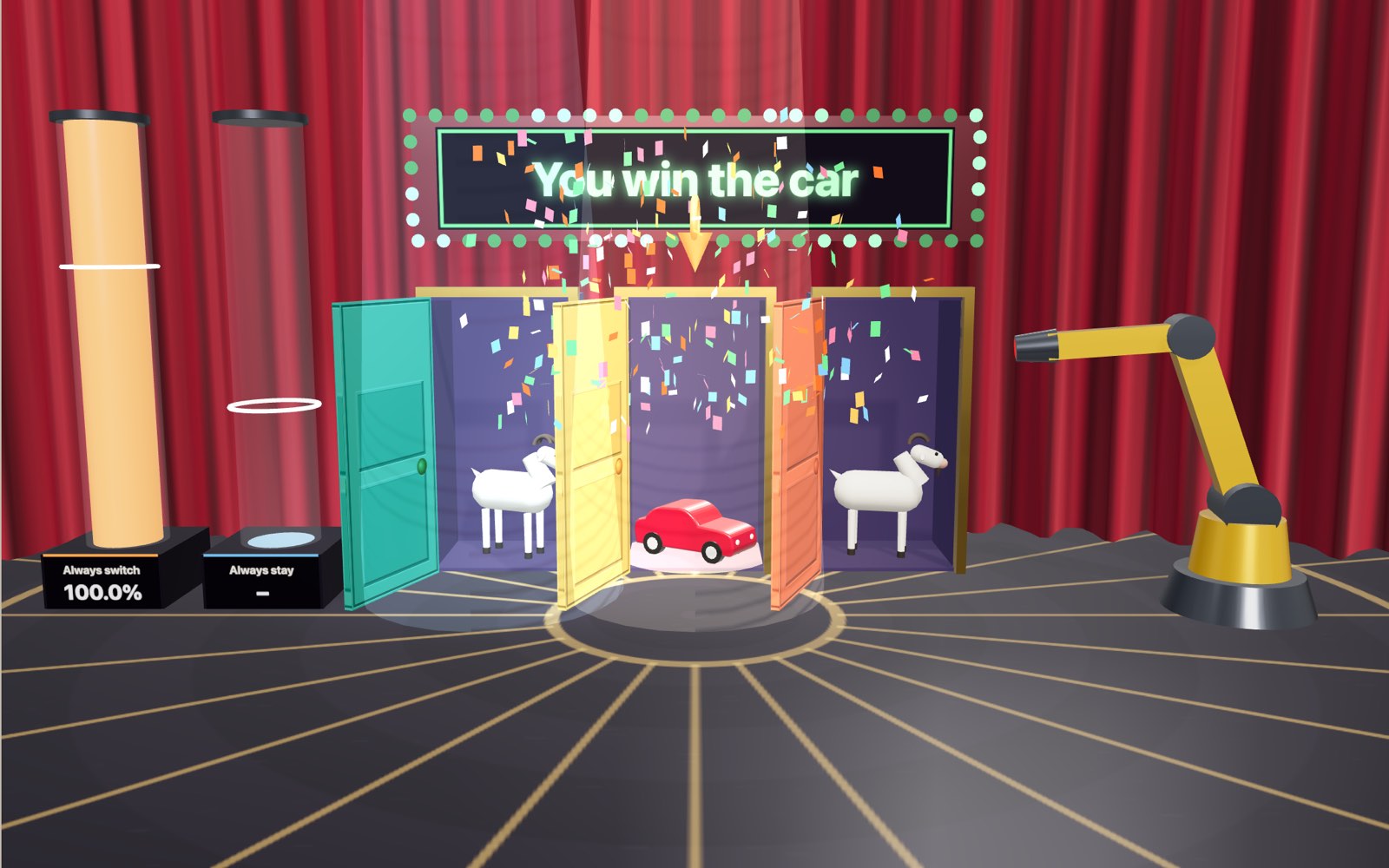
This device cannot show the 3D model. You can read the guide steps below as text.
1 / 8 Three doors and one carA car is behind one door and goats are behind the other two. Nobody on stage knows more than you yet, so each door has one chance in three. Tap a door to play, or follow these steps.
Drag to turn. Scroll or pinch to zoom.
A question in a Sunday magazine
Why should you switch doors in the Monty Hall problem? Switching wins two games out of three because the host always reveals a goat and never opens your chosen door. On 9 September 1990 a reader asked Marilyn vos Savant, in her Ask Marilyn column in Parade magazine, about a game show. You face three doors. Behind one is a car, behind the other two are goats. You pick a door, say number 1. The host, who knows what is behind every door, opens another door, say number 3, and shows a goat. Then he asks whether you would like to switch to door 2. Is it to your advantage to switch?
She answered yes: switching wins two times in three. Thousands of letters followed, and many professional mathematicians insisted she was wrong. Jeffrey Rosenthal of the University of Toronto collected some of the phrases they used, among them "you are utterly incorrect" and "you are the goat". The argument ended in classrooms. She asked school maths classes to play the game with paper cups and pennies, and they reported back, with some astonishment, that she was right.
The puzzle has a simple answer and a stubborn wrong one, and the difference between them comes down to one detail: what the host knows. This exhibit lets you play the game with 3 to 100 doors, run ten thousand games in a couple of seconds, and change the host until the answer changes too.
How to use the stage
Tap a door to pick it. The robot arm on the right plays the host: it points a laser at each door it opens, and the doors swing out to show a goat in a lit booth. When only your door and one other remain closed, two buttons appear. Switch moves your pick to the other door, Stay keeps it. The door you end on opens and the bulbs flash green for a car or red for a goat.
Under the stage the three buttons jump straight to 3, 10 or 100 doors. In the Controls pane the Host slider changes what the host knows and how he behaves, Chances puts the probability of the car over each closed door, and See behind doors makes the doors transparent so you can watch the car. The section under the sliders plays many games at once, keeps a record of the games you played by hand during this visit (nothing is saved), and shows the Bayes table for the game in front of you.
Why your first pick stays at one in three
When you pick a door, the car is behind it in one game out of three. That much nobody disputes. The disagreement starts when a door opens. Many people feel that two doors are left, so each must now be one half.
Follow the host instead of the doors. He has to open a door that is not yours and does not hide the car. If your door hides the car, he can open either of the other two. If your door hides a goat, he has no choice at all: one of the other doors has the car, so he must open the one with the second goat.
Now look at the games in which you picked a goat. That happens two times in three. In every one of them the host's forced move leaves the car behind the only other closed door, and switching wins. In the one game in three where you picked the car, switching loses. So switching wins in two games of three and staying in one.
The host's action tells you nothing new about your own door, because he would have opened a goat door whatever was behind it. It tells you a lot about the door he skipped. He did not leave that door closed at random; in two games of three he was forced to.
A hundred doors make it obvious
A version with many doors helps a lot of people. Imagine 100 doors. You pick one. The host, who knows where the car is, opens 98 of the other doors, every one showing a goat, and leaves a single door closed. Should you stay with your door or move to the one he carefully avoided?
Your door had one chance in a hundred when you picked it, and nothing has happened to it since. The other 99 doors together held 99 chances in a hundred. The host has removed 98 of them without ever touching the car, so the whole 99/100 now sits on the one door he left. Press the 100 doors button and play a few games: the wall opens row by row, and the door left standing among all those goats looks just as suspicious as it should.
The general rule is easy to read off. With n doors and a host who opens every door except yours and one other, staying wins 1/n of the time and switching wins (n − 1)/n. For 3 doors that is 1/3 against 2/3, for 10 doors 10% against 90%, and for 100 doors 1% against 99%. The table at the bottom of the Controls pane lists all seven door counts for whichever host you have chosen.
Counting every case
If arguments do not convince you, count. Number the doors 1, 2 and 3 and suppose you always pick door 1 (by symmetry the other choices give the same result). The car is equally likely to be behind any door, and when the host has a choice he picks either door with equal chance.
| Car behind | Chance | Host opens | Staying wins | Switching wins |
|---|---|---|---|---|
| Door 1 | 1/6 | Door 2 | yes | no |
| Door 1 | 1/6 | Door 3 | yes | no |
| Door 2 | 1/3 | Door 3 | no | yes |
| Door 3 | 1/3 | Door 2 | no | yes |
The first two rows share the one third in which the car is behind your door. Staying wins with probability 1/6 + 1/6 = 1/3, switching wins with 1/3 + 1/3 = 2/3.
The table also answers the sharper version of the question, the one the reader actually asked: you have seen the host open door 3. Only rows 2 and 3 are possible now. Row 2 has probability 1/6 and row 3 has 1/3, so among the games that look like yours the car is behind door 2 twice as often as behind door 1. The conditional answer is again 2/3.
Bayes' rule at the moment of the offer
The same counting is usually written with Bayes' rule, which says how a probability should change when new evidence arrives. List every place the car could be, write down the chance before the evidence (the prior), multiply by the chance of seeing exactly this evidence if that were true (the likelihood), and then divide each product by their total.
You picked door 1 and the host opened door 3:
| Car behind | Before | Chance he opens door 3 | Product | After |
|---|---|---|---|---|
| Door 1 (yours) | 1/3 | 1/2 | 1/6 | 1/3 |
| Door 2 | 1/3 | 1 | 1/3 | 2/3 |
| Door 3 | 1/3 | 0 | 0 | 0 |
The products add up to 1/2, the overall chance of seeing the host open door 3. Dividing by it gives the last column. The table in the Controls pane is built the same way for the game on the stage, and it changes with the number of doors and the host. For n doors with the knowing host, the products are 1/(n(n − 1)) for your door and 1/n for the door he left, which gives 1/n against (n − 1)/n.
The middle column is where the host lives. Change his rule and the likelihoods change, and with them the answer.
What the host knows decides the answer
The classic answer depends on three facts about the host: he always opens doors, he always shows goats because he knows where the car is, and he always offers the switch. Take any of them away and the numbers move. The Host slider has five settings.
Knows (classic). The case above: stay 1/n, switch (n − 1)/n.
Doesn't know. Rosenthal calls this one Monty Fall: the host slips on a banana peel and pushes open a door at random, which happens to show a goat. With three doors, a random door other than yours hides the car one time in three. Those games are spoiled. In the games that remain, your door and the other closed door are equally likely, so staying and switching both win half the time. On the stage, games where the arm reveals the car end with a message and are not counted, and a run of many games reports how many were thrown out. With 100 doors and a host who opens 98 at random, only 2 games in 100 survive, but in those the answer is still one half.
Why the difference, when the doors on the stage look exactly the same at the moment of the offer? Because the evidence is different. A knowing host who shows 98 goats has done something he could always do. A blind host who happens to show 98 goats has done something very unlikely, unless the car was behind one of the two doors he did not touch. Both of those doors gain together and equally. In the Bayes table the likelihood of the blind host's move is the same, 1/(n − 1), whether the car is behind your door or the other one, so the posteriors come out equal.
Favourite door. Rosenthal's Monty Crawl is a host who knows where the car is, but when he has a choice he always opens the lowest-numbered goat door, because he is tired and it is the nearest. On the stage this is a slider: the chance that the host, when free to choose, leaves the lowest-numbered other door closed. Averaged over all games nothing changes, and switching still wins 2/3 of the time. But the door he leaves now carries information. With three doors and a host who always leaves the lower door shut, seeing him leave the higher door shut means he had no choice: the car is behind it, and switching wins every time. Seeing him leave the lower door shut means only 1/2. For a general preference p the two answers are 1/(1 + p) and 1/(2 − p), and switching is never worse than staying.
Offers only to winners. If the host offers the switch only when your first pick is the car, an offer is bad news. Switching whenever offered never wins.
Offers only to losers. The opposite: he offers only when you picked a goat, so switching when offered wins every time. Both of these show that the rule the host follows matters more than anything you see on the stage.
Ten thousand games
The run buttons play 100, 1,000 or 10,000 games in a few seconds. Each game deals the car, makes a random first pick and lets the host act, then scores three players on the same deal: one always switches, one always stays, and one flips a coin. The bars give the share each player won, with a thin mark at the exact value. The lower graph follows the win rates as the games pile up, on a logarithmic scale of games.
After 10 games the lines can be anywhere. That is not a fault of the simulation; with so few games, chance alone moves the share of wins by 15 percentage points or more. The typical spread of a win rate p measured over N games is the square root of p(1 − p)/N. For p = 2/3 that is about 4.7 percentage points at 100 games, 1.5 at 1,000 and 0.47 at 10,000. So after ten thousand games the switch line sits within a percentage point of 66.7% almost every time.
The coin flipper always lands near one half with the classic host. Half the time he switches and wins 2/3, half the time he stays and wins 1/3. That is the number intuition gives for the whole game, and it is the right answer to a different question: how often you win if you treat the two closed doors as equal.
Counting every arrangement of car, pick and host move for 3, 4, 5 and 10 doors and every host gives the exact probabilities. Playing 100,000 counted games for each of the seven door counts and five hosts puts every strategy within half a percentage point of the exact value, in all 292 cases. The Bayes table for the favourite-door host also agrees with simulated games, for example 83.1% of 40,014 games against the exact 5/6 when the host prefers the low door with p = 0.8 and leaves the high one shut.
Why intuition says one half
Psychologists have studied this puzzle for decades because so many careful people get it wrong and stay wrong after being told. Most people choose to stay with their first guess, even though switching doubles the chance of winning.
Several explanations have been tested. Krauss and Wang (2003) found that people solved the problem far more often when it was told in natural frequencies, counting games instead of quoting chances, and from the host's point of view. Burns and Wieth (2004) argued that the trouble lies in the causal structure. Where the car is and which door you picked are independent, but both decide which door the host opens, so knowing his choice links them, which people do not expect. When the game was told as a competition, which makes those causes easier to see, more people got it right.
Herbranson and Schroeder (2010) tried pigeons. Three response keys in a test chamber served as the doors and grain was the prize. Over many trials the pigeons adjusted how often they switched until they came close to the best strategy; human volunteers given the same practice did not. The birds had no theory of probability, only the experience of what paid off, which is what the run buttons give you.
A short history
The structure is older than the game show. Joseph Bertrand's probability textbook of 1889 included the box paradox: three boxes hold two gold coins, two silver coins, and one of each. You take a gold coin from a random box. The chance that the other coin in that box is gold is 2/3, not 1/2, because the two-gold box is twice as likely as the mixed box to give you gold. In 1959 Martin Gardner's Mathematical Games column in Scientific American posed the problem of three prisoners, one of whom is to be pardoned. A prisoner who learns that another will be executed keeps his own chance of 1/3, while the third prisoner's rises to 2/3. It is the three doors with prisoners in place of goats.
The game show version appeared in 1975, in a letter to the editor of The American Statistician by the biostatistician Steve Selvin, who named it after Monty Hall, the host of a real American television game show. In 1990 the Parade column made it famous.
The argument did not end with the classrooms. Some statisticians pointed out that the question as printed does not say whether the host always opens a door, or how he chooses when he has a choice, and that the unconditional answer (switching wins 2/3 of all games) and the conditional one (switching wins 2/3 of the games in which he opened door 3) need different arguments. Richard Gill of Leiden University has written that the puzzle can be read as several different mathematical problems, which is one reason it has kept producing papers. The stage separates those readings with the Host slider.
What the model simplifies
The car is placed at random and the host's random choices are fair coin flips, as in the standard problem. A real host could put the car where contestants rarely look, or offer the switch only when it suits him, and then no fixed answer applies.
The robot arm opens doors one after another for the animation. In the mathematics the order does not matter; only which door is left closed counts. With the blind host the arm opens doors in a random order, so the car may appear part way through.
The many-games runner uses a fast pseudo-random generator seeded from the clock, so two runs never give exactly the same numbers. All three players are scored on the same deal, which is why the switch and stay bars always add up to 100% with the classic host: in every counted game exactly one of the two closed doors has the car.
The record of your own games lives only in the open page. Reloading clears it.
Calculating the probability of the evidence
Let C1 mean that the car is behind door 1 and H3 mean that the host opens door 3 and offers a switch. Assume you chose door 1, the car was placed uniformly, the host always avoids the car, and he chooses fairly when both other doors contain goats. Bayes' rule is P(C1 | H3) = P(H3 | C1) × P(C1) / P(H3). The denominator is not merely the chance that door 3 contains a goat. It is the chance of this particular host action under the stated rules.
For your door the numerator is (1/2) × (1/3) = 1/6. For door 2 it is 1 × (1/3) = 1/3. Door 3 contributes zero. Therefore P(H3) = 1/6 + 1/3 = 1/2, and P(C1 | H3) = (1/6)/(1/2) = 1/3. Similarly P(C2 | H3) = (1/3)/(1/2) = 2/3. Berkeley's treatment emphasizes this distinction between learning that a door has no prize and learning that a host selected it to reveal no prize. Alvarado's discussion likewise follows the dependence between the car, the first choice and the reveal.
A useful check is to imagine 600 independent games with the same first choice. About 200 begin with the car behind each door. Of the first 200, about 100 show door 3; of the second 200, all 200 do; of the last 200, none do. You now have about 300 matching observations, with 100 cars behind your door and 200 behind the other door. These are expected counts, not a guarantee about any particular batch of 600 games.
Why discarded games matter
Now let the host choose an unselected door blindly. Keep the first choice fixed at door 1 and consider only occasions when he opens door 3 and shows a goat. If the car is behind door 1, the chance of that observation is 1/2. If the car is behind door 2, it is also 1/2. The two surviving numerators are both 1/6, their sum is 1/3, and each posterior is 1/2. The same visible goat has produced a different calculation because a different process selected it.
There is another way to count this without naming the opened door. Among 600 games, about 200 start with your door correct; all 200 survive a blind reveal. About 400 start with your door wrong; only about 200 survive, because the host has a 1/2 chance of exposing the car. Thus roughly 400 games count: staying wins 200 and switching wins 200. Dividing switch wins by all 600 attempted games would instead give 1/3. That number answers a different question, one that includes spoiled games as failures. Always state the denominator.
With 100 doors, your original choice is correct in 1/100 of attempts, and those attempts always survive. If it is wrong, the blind host must leave the car as the single unselected closed door, which has probability 1/99. The surviving wrong-first-choice share is (99/100) × (1/99) = 1/100. Both groups therefore contribute equally: 2/100 of attempts survive and switching wins 1/2 of those survivors. This is not the knowing host's 99/100 result.
What a simulation's error means
For independent classic games, the number of switching wins has a binomial distribution with p = 2/3. The standard error of the observed proportion is sqrt(p × (1 − p) / N). At N = 1,000 this is 0.0149, or 1.49 percentage points. An approximate 95% sampling range is the expected proportion plus or minus 1.96 standard errors: about 66.67% ± 2.92 percentage points, or 63.75% to 69.59%. This is the sense in which a thousand games have roughly a three-percentage-point margin, not a promise that every run falls inside it.
The San José State notes explain this normal approximation for a proportion. Multiplying N by 4 halves the standard error; multiplying it by 100 makes the error about ten times smaller. A run of 10,000 is therefore more stable than 1,000, but it is not ten times more precise. The result also assumes independent, correctly generated games. Repeating a programming mistake does not make it disappear.
On this stage both strategies use the same deal. Their results are paired, not two independent samples: when switching wins, staying loses. With the blind host, use Games counted for N rather than all attempts. With 100 doors, 1,000 attempted blind reveals yield only about 20 counted games on average, much too few for the three-percentage-point statement above.
An experiment to try on the screen
Choose 3 doors and Knows (classic), then make a prediction before pressing Run 1,000. Compare Always switch with the exact mark, as well as with the previous run. Change only the host to Doesn't know and repeat. Read the void count alongside the counted total. Finally choose 100 doors: with the classic host the switching rate should approach 99%, whereas the blind host keeps only a small fraction of attempts. These comparisons isolate the host's rule rather than changing several assumptions unnoticed.
The pigeon study and later psychological reviews distinguish learning which action pays from explaining why it pays. A visitor can learn to press Switch through feedback without being able to reconstruct the likelihood column. After the experiment, explain why the blind host discards more wrong-first-choice games than right-first-choice games. That explanation, rather than a lucky winning streak, is the test of understanding. Li's comparison with data analysis makes a related point: the order and selection procedure matter, even when the final display offers two possibilities.
Puzzle stages: the same question on other tables
The Puzzles button on the stage opens 17 stages. Eight of them stay on the doors and only change the host's rules or the number of doors; nine move to a round felt table, where boxes, coins, people or envelopes take the place of the doors. Every stage has a Play once button for a single game and a Run button for 100,000 games (1,000,000 for the two puzzles where few runs meet the condition). The readout on the left shows the exact value next to the share the runs produced.
Hosts with other rules
Monty Fall is the host who slips and opens a door at random. When that door happens to show a goat, staying and switching each win 1/2, because games where he would have shown the car are thrown out and those are exactly the games where switching would have won. Monty Crawl always leaves the lowest-numbered other door shut when he has a choice. If you pick door 1 and he opens door 2, he had no choice, so the car is behind door 3 and switching wins every time. If he opens door 3, switching wins only 1/2. Averaged over both, always switching still wins 2/3. Grinstead and Snell work the in-between case: a host who opens the higher-numbered door 3 times in 4 when he can gives a switcher 4/7 after he opens door 3.
Monty from Hell and Angelic Monty decide whether to offer a switch at all. Monty Hall told a reporter in 1991 that on the real show he was never obliged to make an offer. A host who offers only when your first pick is the car turns switching into a guaranteed loss; a host who offers only when you picked a goat turns it into a guaranteed win. The offer itself is the evidence.
One door opened out of many
The Other doors left shut slider changes how many doors the host leaves closed besides yours. With 5 doors and only one goat door opened, three other doors stay shut. Staying wins 1/5. A switch to one of the three, chosen at random, wins (5 − 1) / (5 × 3) = 4/15, about 26.7%. In general, with n doors and k of them opened, switching wins (n − 1) / (n (n − 1 − k)), and this is always more than 1/n. When k = n − 2 the formula gives the familiar (n − 1)/n: 2/3 for three doors and 99/100 for a hundred.
Two players
The Two players stage keeps a score for each of two people who take turns on the same doors. If one always stays and the other always switches, after 30 games each the expected scores are 10 and 20 cars. A short match can still go the wrong way; the gap of 10 cars has a spread of about 3.7 cars each side.
Boxes, prisoners and children
Bertrand's box has three boxes holding two gold coins, two silver coins, and one of each. Draw a coin at random and see gold: the three gold coins were equally likely to be the one you drew, and two of them sit in the box of two golds, so the other coin is gold with chance 2/3, not 1/2. The three prisoners puzzle is the doors in another costume. The guard who names B for execution plays the host; A keeps 1/3 and C rises to 2/3.
The two children puzzles show how much the wording matters. A family with two children, at least one a boy, has two boys with chance 1/3: of the four equally likely families (boy boy, boy girl, girl boy, girl girl) the last is ruled out and one of the three left has two boys. Told instead that the older child is a boy, the chance is 1/2. Told that a son was born on a Tuesday, it is 13/27: of the 196 equally likely pairs of sex and weekday, 27 include a Tuesday boy and 13 of those have two boys.
Birthdays
With 23 people at the table the chance that two share a birthday is 50.7%; with 22 it is 47.6%, and with 57 it is 99.0%. The number that matters is the count of pairs: 23 people make 253 pairs, and each pair has a chance of 1 in 365 to match. The People slider runs from 2 to 70; the matching people light up gold after each game.
A positive test
The test table shows 1,000 people. With 1 sick person per 1,000 and 5% false positives among the healthy, about 50 healthy people test positive along with the 1 sick person, so a positive result means disease with chance 1 in 51, about 2.0%. In a 2014 survey, 14 of 61 doctors and students gave that answer. A second, independent positive test raises the chance to about 28.6%, still under one half. The two test sliders change the share of sick people and the false positive rate.
Coins with no memory
After 5 heads in a row the next toss is heads with chance 1/2; on the stage only 1 run in 32 begins with five heads, which is why that puzzle runs a million times. The streak test is subtler. Toss 4 coins and record the share of heads among the tosses that follow a head. Averaged over all 16 sequences that have a head early enough to count, that share is 17/42, about 40.5%, not 50%. Miller and Sanjurjo showed in 2018 that the 1985 test for a hot hand in basketball used this kind of average, so a real streak effect could look like none at all.
Two envelopes
In the envelope stage the smaller amount is 10, 20 and so on up to 100, and the other envelope holds twice as much. Switching gives you more in half the games and changes the amount by 0 on average. The argument that the other envelope is worth 1.25 times yours on average treats the amount you hold as fixed in both cases, which it cannot be.
The probability tree
The Probability tree toggle puts the tree on the stage, and the Controls pane always shows it. Each branch from the dot is one place the car (or the coin, or the illness) could be, as thick as its chance. It splits into the evidence you saw and the evidence you did not see. Cutting the branches that did not happen and rescaling the rest so they add up to 1 is Bayes' rule. MIT's course on mathematics for computer science teaches the doors with exactly this four-step tree. When Andrew Vazsonyi showed the problem to Paul Erdős in 1995, the mathematician accepted the answer only after a computer played the game 100,000 times, and still asked for a reason; the tree is that reason.
The Sleeping Beauty problem: count wakings or count coin tosses
Adam Elga posed this puzzle in the journal Analysis in 2000 (volume 60, pages 143 to 147). Researchers put you to sleep on Sunday and toss a fair coin. On Heads they wake you once, on Monday. On Tails they wake you twice, on Monday and on Tuesday, and a drug erases the memory of the first waking before the second. Each time you wake, you cannot tell which day it is. How confident should you be that the coin landed Heads?
Elga answered 1/3. If you learned that it is Monday, Heads and Tails would be equally likely, and Tails on Monday and Tails on Tuesday feel exactly alike from the inside, so the three situations, Heads Monday, Tails Monday and Tails Tuesday, share your confidence equally. David Lewis replied in the same journal in 2001 (volume 61, pages 171 to 176) that the answer is 1/2: waking up tells you nothing you did not already know on Sunday. People who give 1/3 are called thirders, people who give 1/2 halfers, and the question is still argued in journals.
The link to the doors is the protocol. In Monty Hall, a goat behind the opened door means different things depending on whether the host knew where the car was. The button “Sleeping Beauty: same evidence, another protocol” in the puzzle lab on this page opens that case, Monty Fall, on the stage. In Sleeping Beauty, the same waking means different things depending on whether you count per waking or per experiment.
A problem to try: at every waking you guess the coin and win 1 dollar if you are right. Over 1,000 runs, with about 500 Heads and 500 Tails, always guessing Tails wins about 1,000 dollars, two for each Tails run; always guessing Heads wins about 500. Per waking, Tails is right two times in three, the thirders' number. Per run, Tails is right half the time, the halfers' number.
Questions
Does the host opening a door really change anything?
It changes nothing about your own door, which keeps its 1/3. It changes the other unopened door from 1/3 to 2/3, because the host was forced to avoid the car and in two games of three that forced him to leave the car's door closed.
Why isn't it 50:50 when two doors are left?
Two outcomes are not always equally likely. The two doors got to be the last ones standing in different ways: yours because you picked it, the other because the host had to skip it. Counting all games shows the second way happens twice as often with the car behind it.
What if the host opened a door at random and it happened to show a goat?
Then staying and switching each win half of the counted games. Set the Host slider to Doesn't know and run 10,000 games to see it, with about one game in three thrown out because the car was shown.
Does it matter which door I pick first?
No. Every door has the same 1/n chance when you pick it, and the host's rule is the same whichever you choose. The favourite-door host is the exception: his numbering preference can make some offers more telling than others.
Is switching ever worse than staying?
With the knowing host who always offers, never. With a host who offers only when you picked the car, yes: switching then always loses. That is why the puzzle needs the host's rule spelled out.
How many games do I need to play to see the difference?
With a handful of games luck dominates. After about 100 games switching is usually well ahead; by 1,000 the gap of about 33 percentage points is clear in nearly every run, because random wobble at that size is around 1.5 points.
Why do 100 doors make it easier to understand?
The host's knowledge does almost all the work. Opening 98 goat doors without ever touching the car is something only a knowing host does reliably, so the one door he avoided stands out. The numbers 1/100 and 99/100 are also far apart, which makes the gap easier to feel than 1/3 and 2/3.
Did the real game show work like this?
The puzzle borrows the name of a real host, but the fixed rules (always open a goat door, always offer the switch) are part of the puzzle, not a record of how any show was run. Gill and Rosenthal both stress that the answer depends on those rules.
Is this the same as the three prisoners problem?
Yes, in structure. The guard who names another prisoner to be executed plays the host, the prisoner who asks plays the contestant. The asker stays at 1/3 and the unnamed prisoner rises to 2/3. The list under the stage has more puzzles built the same way.
Does a 1,000-game run guarantee an error below 3%?
No. For independent classic games, about ±2.92 percentage points is an approximate 95% sampling range around 2/3. Some runs fall outside it. Counted games, not attempts, determine the uncertainty when the blind host can expose the car.
What changes when the host opens only one of many doors?
Your door stays at 1/n, and the rest of the chance spreads over the other doors still shut. With 5 doors and one opened, each of the three shut doors holds 4/15, so a switch at random still beats staying, though it wins less often than not.
Why is Bertrand's box 2/3 and not 1/2?
Because you saw a gold coin, and the box with two golds offers two ways to show gold while the mixed box offers one. Count coins, not boxes: two of the three gold coins have a gold partner.
How many people do I need for a shared birthday?
23 people give 50.7%, the first group size above one half. 57 people give 99.0%. Try the People slider and run 100,000 tables to see the share settle on the exact value.
If a test is 95% accurate, why is a positive result usually wrong?
Because the disease is rare. Among 1,000 people with 1 case, the 5% false positives add about 50 healthy positives to the 1 true one. Raise the sick count with the slider and the answer climbs quickly.
Are my challenge answers and game counts sent anywhere?
No. The challenges you solve and the totals of games you played by hand are kept in this browser on this device only. The Forget my games button clears the totals.
What is the answer to the Sleeping Beauty problem?
There are two defended answers. Adam Elga (2000) argued that on waking you should give Heads a probability of 1/3, because two of the three possible wakings follow Tails. David Lewis (2001) argued for 1/2, because waking adds no information about a fair coin. The numbers agree with each other once you say what you count: per waking, Heads comes up one time in three; per experiment, one time in two.
Terms
- Prior: the chance of each possibility before the new evidence.
- Likelihood: the chance of seeing exactly this evidence if a given possibility were true. Here, the chance the host would open the doors he opened.
- Posterior: the chance after the evidence, prior times likelihood, divided by the total of those products.
- Conditional probability: the chance of an event among only the cases where something else has happened, such as the host having opened door 3.
- Law of large numbers: the share of wins in many independent games settles close to the true probability as the number of games grows.
- Natural frequencies: stating chances as counts ("20 of 30 games") instead of fractions, which makes many probability problems easier.
Sources
All addresses were checked on 2026-10-17.
Jeffrey S. Rosenthal (University of Toronto), Monty Hall, Monty Fall, Monty Crawl. Math Horizons, September 2008, 5 to 7. Includes the dates of the Parade columns and the three-card problem. https://probability.ca/jeff/writing/montyfall.pdf
Richard D. Gill (Leiden University), The Three Doors Problem...-s, 2010, on the history from Bertrand's box and the three prisoners to Selvin's 1975 letter. https://arxiv.org/abs/1002.3878
Richard D. Gill, The One and Only True Monty Hall Paradox (Leiden University). https://pub.math.leidenuniv.nl/~gillrd/montyhall3.pdf
Steve Selvin, letter to the editor, The American Statistician 29 (1975), as described by Gill above.
Marilyn vos Savant, Ask Marilyn, Parade, 9 September 1990 and following columns, as cited by Rosenthal and Gill above.
Stefan Krauss and X. T. Wang, The psychology of the Monty Hall problem: discovering psychological mechanisms for solving a tenacious brain teaser. Journal of Experimental Psychology: General 132 (2003). https://psycnet.apa.org/doi/10.1037/0096-3445.132.1.3
Bruce D. Burns and Mareike Wieth, The collider principle in causal reasoning: why the Monty Hall dilemma is so hard. Journal of Experimental Psychology: General 133 (2004). https://psycnet.apa.org/doi/10.1037/0096-3445.133.3.434
Walter T. Herbranson and Julia Schroeder, Are birds smarter than mathematicians? Pigeons perform optimally on a version of the Monty Hall Dilemma. Journal of Comparative Psychology 124 (2010), 1 to 13. https://pmc.ncbi.nlm.nih.gov/articles/PMC3086893/
Stanford Encyclopedia of Philosophy, Bayes' Theorem. https://plato.stanford.edu/entries/bayes-theorem/
Plus magazine (University of Cambridge), Myths of maths: The Monty Hall problem. https://plus.maths.org/myths-maths-monty-hall-problem
The sources for each puzzle in the list under the stage are linked from its card.
Philip B. Stark, University of California, Berkeley, The Let’s Make a Deal problem. https://www.stat.berkeley.edu/~stark/SticiGui/Text/montyHall.htm
San José State University, Inference for a Proportion. https://www2.sjsu.edu/faculty/gerstman/StatPrimer/conf-prop.htm
Rafael C. Alvarado, University of Virginia, What’s So Hard about the Monty Hall Problem?. https://arxiv.org/html/2405.00884v1
University of Illinois, Data Science Discovery, The Monty Hall Problem. https://discovery.cs.illinois.edu/learn/Prediction-and-Probability/The-Monty-Hall-Problem/
Ben Lowery, Lancaster University STOR-i, The Monty Hall problem and its generalisations: Part 1. https://www.lancaster.ac.uk/stor-i-student-sites/ben-lowery/2022/03/the-monty-hall-problem-and-its-generalisations-part-1
Jingyi Jessica Li, How the Monty Hall problem is similar to the false discovery rate in high-throughput data analysis, Nature Biotechnology (2023). https://pmc.ncbi.nlm.nih.gov/articles/PMC11078861/
Elisabet Tubau et al., Reasoning and choice in the Monty Hall Dilemma, Frontiers in Psychology (2015). https://pmc.ncbi.nlm.nih.gov/articles/PMC4379739/
Charles M. Grinstead and J. Laurie Snell, Introduction to Probability (Dartmouth College), Example 4.6 on the Monty Hall problem and the host who favours one door; the birthday problem in chapter 3. https://math.dartmouth.edu/~prob/prob/prob.pdf
Eric Lehman, F. Thomson Leighton and Albert R. Meyer, Mathematics for Computer Science, chapter 14, the four step method (MIT OpenCourseWare). https://ocw.mit.edu/courses/6-042j-mathematics-for-computer-science-fall-2010/resources/mit6_042jf10_chap14/
John Tierney, Behind Monty Hall's Doors: Puzzle, Debate and Answer?, The New York Times, 21 July 1991 (copy at MIT CSAIL). https://people.csail.mit.edu/carroll/probSem/Documents/Monty-NYTimes.pdf
Andrew Vazsonyi, Which Door Has the Cadillac?, Decision Line, 1999 (copy at Occidental College). https://sites.oxy.edu/lengyel/M372/Vazsonyi2003/vazs30_1.pdf
Arjun K. Manrai and others, Medicine's uncomfortable relationship with math, JAMA Internal Medicine (2014). https://pmc.ncbi.nlm.nih.gov/articles/PMC4955674/
Tanya Khovanova, Martin Gardner's mistake (the boy born on a Tuesday), arXiv 2011. https://arxiv.org/abs/1102.0173
Peter Taylor and Kaye Stacey, Gardner's two children problems and variations, Australian Mathematics Teacher (2014). https://files.eric.ed.gov/fulltext/EJ1093232.pdf
Joshua B. Miller and Adam Sanjurjo, Surprised by the hot hand fallacy? A truth in the law of small numbers, Econometrica (2018). https://arxiv.org/abs/1902.01265
Barry Nalebuff, Puzzles: the other person's envelope is always greener, Journal of Economic Perspectives 3 (1989). https://www.aeaweb.org/articles?id=10.1257/jep.3.1.171
Persi Diaconis and Frederick Mosteller, Methods for studying coincidences, Journal of the American Statistical Association (1989), copy at UC Berkeley. https://www.stat.berkeley.edu/~aldous/157/Papers/diaconis_mosteller.pdf
Adam Elga, Self-locating belief and the Sleeping Beauty problem, Analysis 60(2), 143 to 147 (2000), author's copy at Princeton University. https://www.princeton.edu/~adame/papers/sleeping/sleeping.pdf
David Lewis, Sleeping Beauty: reply to Elga, Analysis 61(3), 171 to 176 (2001). https://doi.org/10.1093/analys/61.3.171
Eric W. Weisstein, Sleeping Beauty Paradox, MathWorld, Wolfram Research (halfers and thirders, Elga 2000, Lewis 2001). https://mathworld.wolfram.com/SleepingBeautyParadox.html
More exhibits
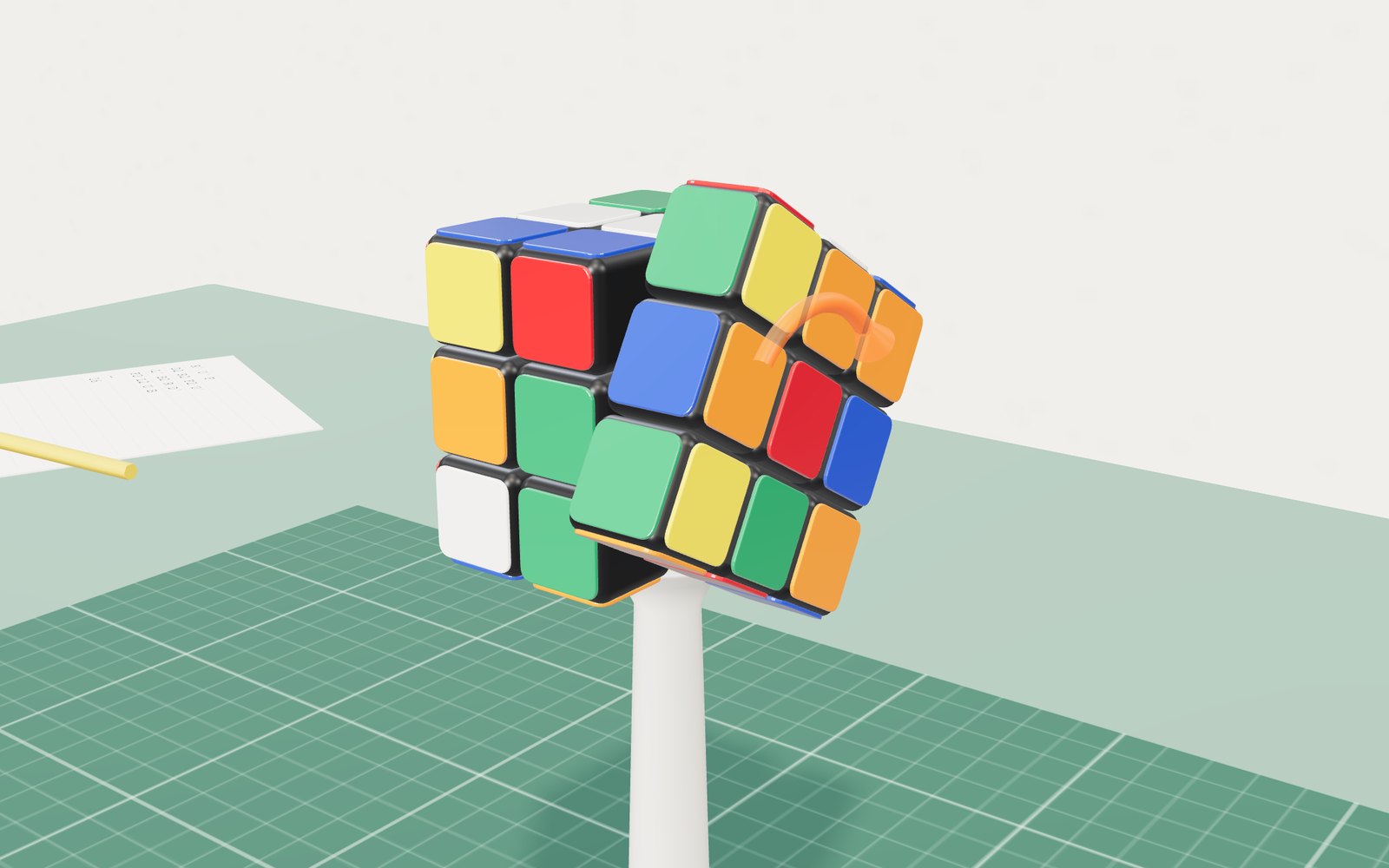
How to solve a 3×3 cube, step by step
A 3×3 cube has 43,252,003,274,489,856,000 positions, and every one of them can be solved in 20 moves or fewer.
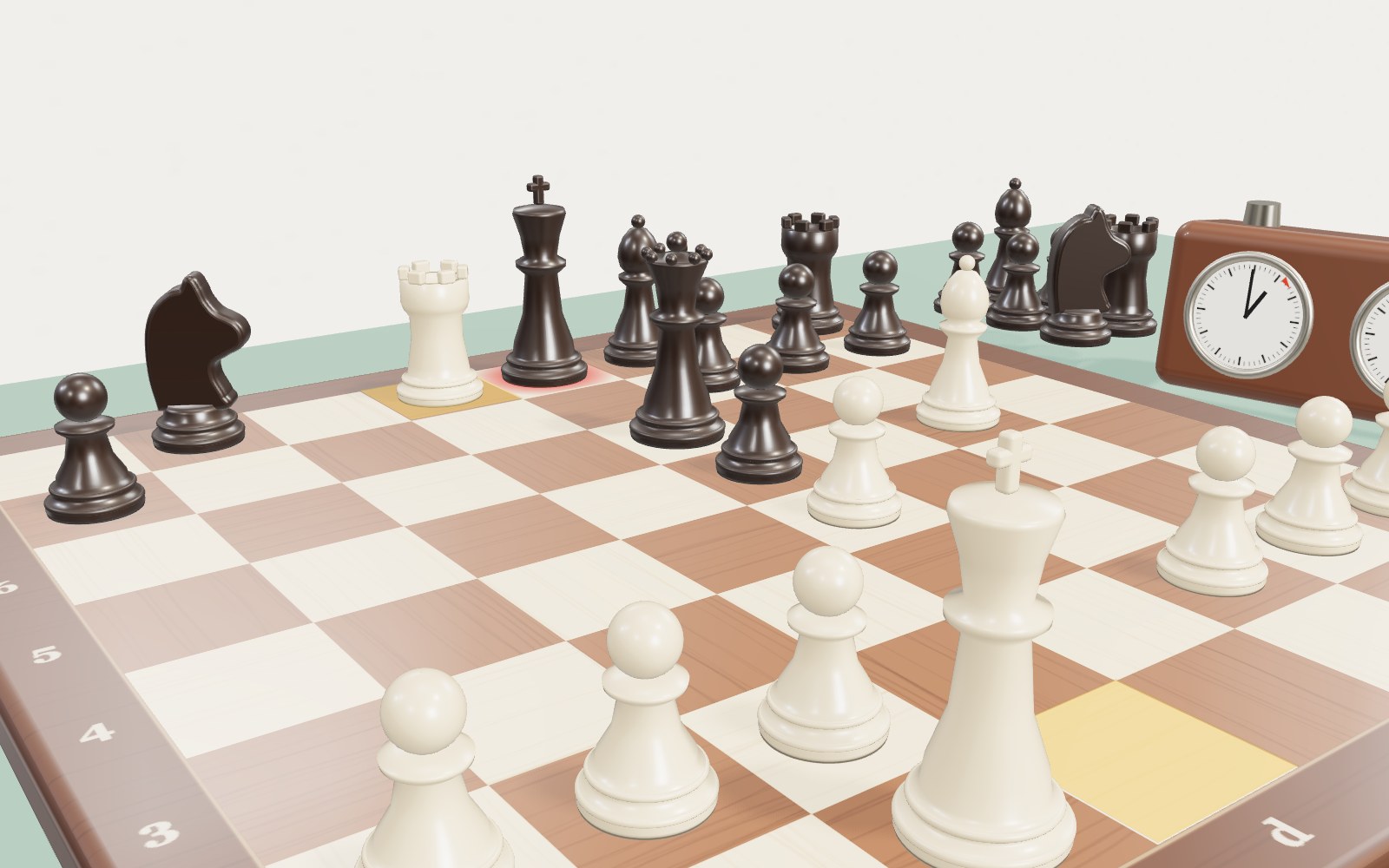
How to play chess, step by step
After just four moves by each side there are 84,998,978,956 possible games.
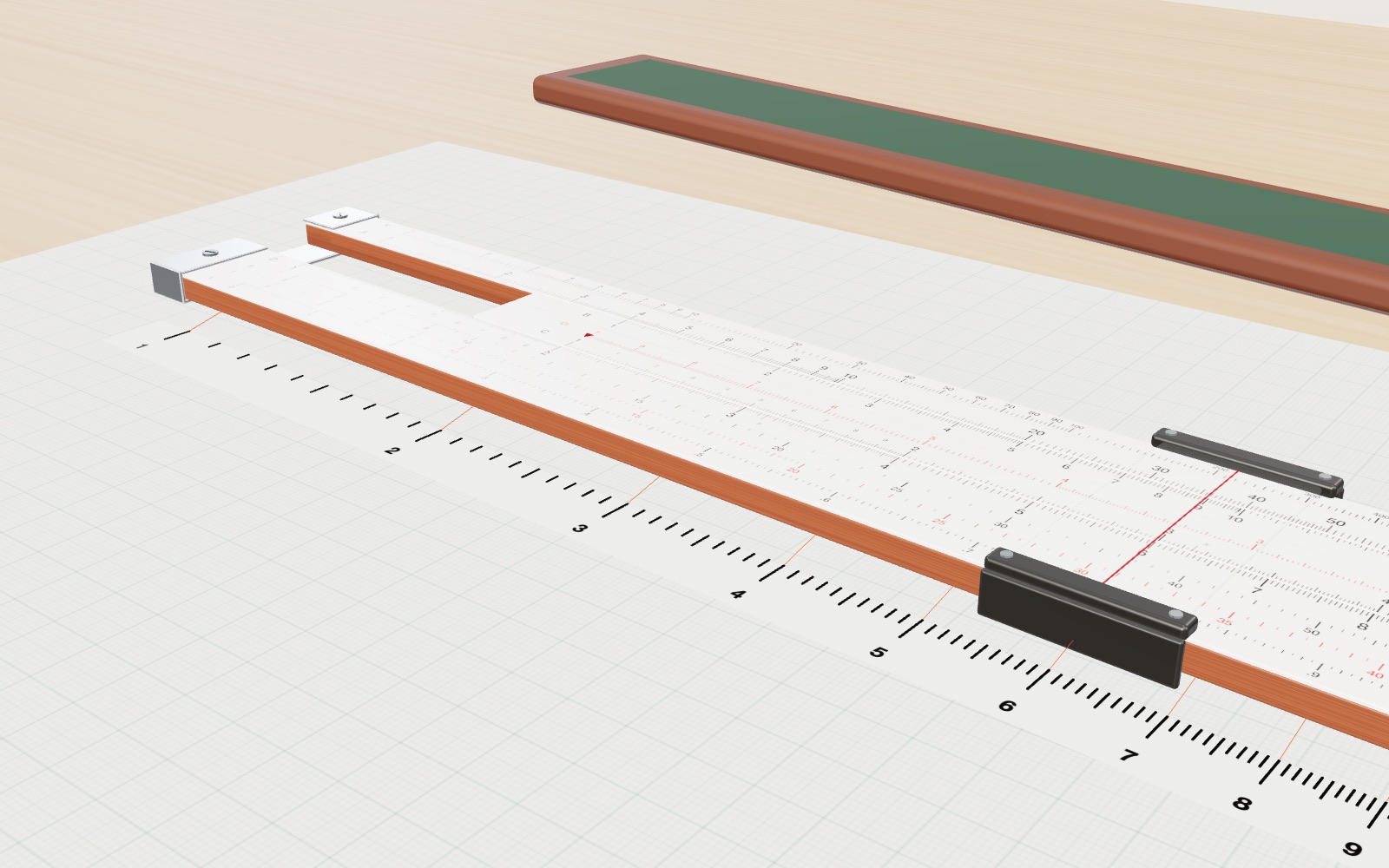
Slide rule: how to use one, with an interactive model
On a 25 cm slide rule the 2 sits 75.3 mm from the 1, because 250 × log 2 = 75.3, and laying two such lengths end to end multiplies the numbers.
Bicycle gears: which gear makes climbing a hill easier
In a 50 by 11 gear one turn of the pedals moves a road bike 9.57 metres; in 34 by 32 it moves 2.24 metres.
Origami: 20 models to fold step by step and unfold
A crane uses about 30 folds, a cup six; every flat-folded point you make has mountains and valleys that differ by exactly two.
Actual size: see real objects at true scale on your screen
A T. rex tooth was about 30 cm long with its root, longer than most laptop screens are wide. A blue whale would take more than a hundred.