Loading the model
This device cannot show the 3D model. You can read the guide steps below as text.
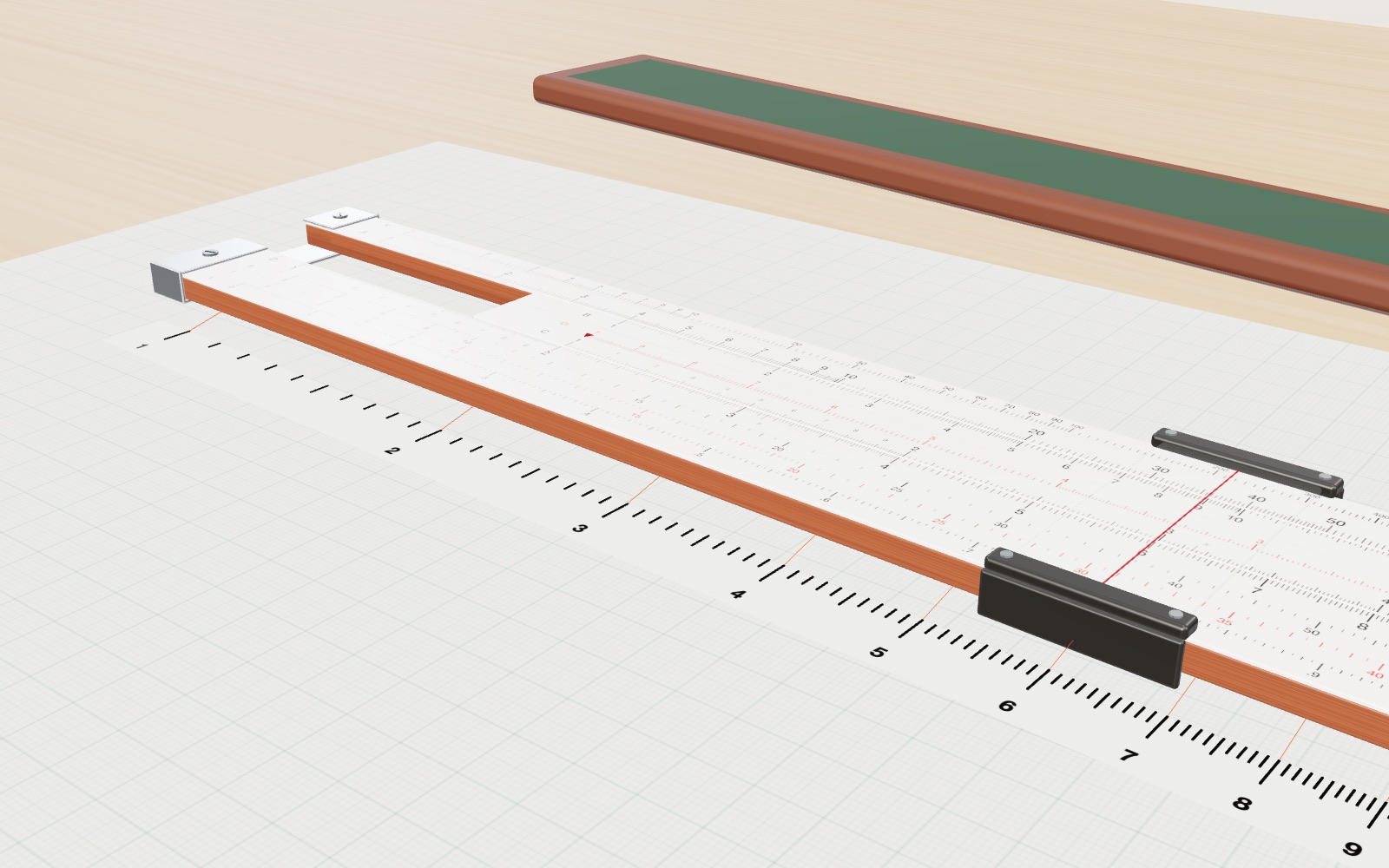
1 / 15 A ruler for multiplying This is a 25 cm Mannheim-type rule with nine scales. Drag the slide or the cursor on the model, or use the sliders under Controls. The box in the corner shows every scale under the hairline and the product you have set up.
Drag to turn. Scroll or pinch to zoom.
Guide Parts Controls
01 A ruler for multiplying This is a 25 cm Mannheim-type rule with nine scales. Drag the slide or the cursor on the model, or use the sliders under Controls. The box in the corner shows every scale under the hairline and the product you have set up.
02 Why the 2 is so far from the 1 Each number sits at a distance proportional to its logarithm. log 2 = 0.301, so 2 is 30.1% of the way along, 75.3 mm on this rule. The L scale under D reads that logarithm directly: 0.301.
03 2 × 3 The left index of C is over 2 on D. Slide the hairline to 3 on C and D shows 6 underneath. The rule has added the length for log 2 to the length for log 3, and 0.301 + 0.477 = 0.778, which is log 6.
04 Three digits and no more Now 3.14 × 2.72. The exact product is 8.5408, but near 8.5 the D scale is divided every 0.05 and each gap is under 0.7 mm wide. You can judge 8.54 by eye. The fourth digit is out of reach.
05 When the answer runs off the end For 7 × 4 the left index would push 4 past the end of the stock. Use the right index instead: C10 over D7, hairline on C4, and D shows 2.8. The rule never tells you the decimal point, so you write 28 yourself.
06 8.4 ÷ 2.1 Division runs the other way. The hairline is on 8.4 on D and the slide has been moved until 2.1 on C sits under it. The C index now points to 4 on D, because log 8.4 − log 2.1 = log 4.
07 Squares on the A scale A fits two decades into the same length, so every number on A sits above its square root on D. With the hairline on D3, A reads 9. Reading from A down to D gives square roots.
08 Reciprocals on the CI scale CI is the C scale run backwards. With the hairline on C4, the red CI figures show 2.5, which you read as 0.25. Multiplying by a CI value divides by the C value under the same hairline.
09 Cubes on the K scale K squeezes three decades into 25 cm, so each value on K sits above its cube root on D. With the hairline on D2, K reads 8. Reading from K down to D gives cube roots.
10 Sines on the S scale The hairline is on 30 on S. D underneath shows 5, which you read as 0.5, because S is placed at 250 mm × log (10 sin θ). Below 5.74° the sine is smaller than 0.1 and the scale stops.
11 Tangents on the T scale T works the same way for tangents from 5.71° to 45°. The hairline on 20 shows 3.64 on D, so tan 20° = 0.364. Above 45° you use the reciprocal, tan θ = 1 / tan (90° − θ), and the CI scale.
12 Where the marks come from The paper tape on the desk starts with 1 to 10 at equal steps. Watch every mark move to 250 mm × log v. The 2 travels from 27.8 mm to 75.3 mm, and the orange leads end on the same marks on D.
13 A pocket rule like Apollo's Apollo crews carried a 5-inch yellow metal Pickett N600-ES. This 15 cm model uses the same scales shrunk to 0.6 of the length. The answer to 3.14 × 2.72 is the same, but a 0.1 mm slip now costs 0.15 % instead of 0.09 %.
14 A circle has no end On the circular rule D runs once round the fixed ring and C round the inner disc. 7 × 4 needs no change of index: the disc turns until its 1 sits at 7 and the hairline at C4 shows 2.8 on D.
15 The E6B wheel A pilot sets the red 60 arrow under the speed, here 120 knots, and reads distance on the outer scale over the minutes on the inner one. Over 45 minutes the outer scale shows 90 nautical miles.
Stock The fixed body in two halves. The upper half carries K and A, the lower half D, S, T and L. Slide The middle strip, which runs in a groove between the two halves. It carries B, CI and C. Cursor A clear window in a black frame that rides over the whole rule, so you can read across scales that do not touch. Hairline The red line on the cursor window. Every value in the reading box is taken under it. D scale 1 to 10 on the stock. Answers to multiplication and division are read here. C scale The same 1 to 10 scale on the slide. Moving C along D adds two logarithms as lengths. CI scale C printed backwards in red. Under the hairline it shows 1/x of the C reading. A scale Two copies of 1 to 10 in the same 25 cm, so A shows the square of the D value beneath it. B scale The slide's copy of A, for squares and square roots worked against the slide. L scale An evenly divided 0 to 1 scale. Under the hairline it gives the common logarithm of D. Indexes The 1 at each end of C, marked with a red wedge. You set one of them over the first number. End brackets Aluminium bridges screwed to both halves of the stock. They hold the groove width that sets how stiffly the slide runs. K scale Three copies of 1 to 10 in the same 25 cm, so K shows the cube of the D value under the hairline. S scale Angles from 5.74° to 90°, placed so that D below shows 10 × the sine of the angle. T scale Angles from 5.71° to 45° in red. D shows 10 × the tangent of the angle. Log tape A paper strip on the desk marked 1 to 10 at equal steps. Build the scale moves each mark to its place on D. Circular rule A 10 cm dial with D on the fixed ring and C on the inner disc that turns. It has no ends, so no answer runs off. E6B flight computer A pilot's circular rule. The outer ring is distance or fuel, the inner disc is minutes, and the 60 arrow marks speed per hour.