FIG. 28Senses
Sundial: interactive model, how to read the time
In Seoul a sundial reads about half an hour behind the clock, because the city lies 8° west of the meridian that sets Korean time.
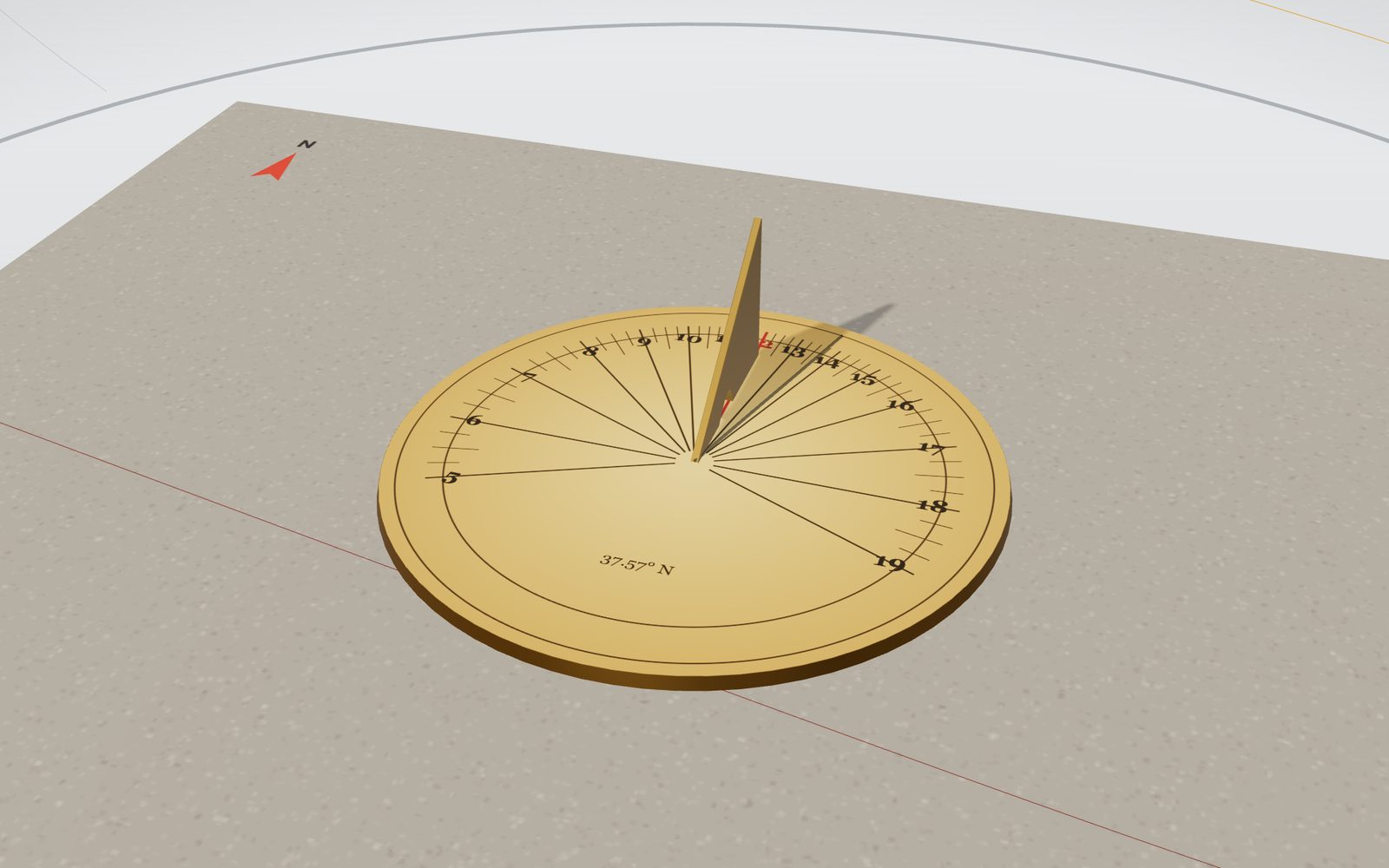
This device cannot show the 3D model. You can read the guide steps below as text.
1 / 15 Eight sundials on one stoneThe slab holds one sundial at a time, a plain stick in front and the Sun’s path in the sky above. One light stands where the Sun is for the place, date and clock time you pick. Choose a dial under Controls. Drag to turn. Scroll or pinch to zoom.
Drag to turn. Scroll or pinch to zoom.
What the model shows
If you set a garden sundial in Seoul and compare it with your phone, the sundial will almost never agree. On 16 October 2026, when the phone says 12:00, the shadow points to about 11:42. Nothing is wrong with the dial. It is telling a different kind of time, and the gap can be worked out to the minute.
The model puts one sundial at a time on a stone slab, with a plain upright stick in front and the Sun's path drawn across the sky above. There are eight dials to choose from: a horizontal garden dial, a dial painted on a south wall, an equatorial dial, the angbuilgu bowl of Joseon Korea, a ring dial, a folding pocket dial, a noon cannon and an analemmatic dial on the ground. A single light plays the Sun. Its direction comes from the place, date and clock time you choose, using the solar position formulas published by the NOAA Global Monitoring Laboratory. The shadows on screen are cast by that light, a thin dark line marks the computed shadow of each gnomon, and the readout shows the numbers behind them.
The page opens on today's date in Seoul at 37.57° N. Under Controls you can move to any of 44 places, from Tromsø inside the Arctic Circle to Auckland, switch on summer time, turn a dial away from north, or cut a dial for the wrong latitude and see how far it goes wrong. Below the controls are seven tasks, a table of hour-line angles, a chart of the equation of time, the analemma for the chosen clock time, and 38 sundials and turning points from history, each with its source.
A stick and its shadow
The oldest sundial is a stick in the ground. Its shadow points away from the Sun, and its length depends only on how high the Sun stands. Picture the stick of height H, its shadow of length S on level ground, and the ray of sunlight that grazes the top of the stick. These make a right triangle, and the angle at the shadow's tip is the Sun's altitude h. So
S = H ÷ tan h
At 9:00 on 16 October in Seoul the Sun is 24.9° high. tan 24.9° = 0.464, so a 1 m stick casts a 2.15 m shadow. At noon the Sun has climbed to 44.0° and the same stick casts 1.04 m. At noon on the winter solstice the shadow is 1.80 m long, and at noon on the summer solstice only 0.25 m. Turn on the sun ray in the controls and you can see the triangle: yellow for the light, red for the shadow.
The thin brown curve on the ground is the path the shadow's tip takes over the whole day. Near the equinoxes it is almost a straight line running east to west; in summer and winter it bends into a curve (a hyperbola, in fact). Egyptian shadow clocks and obelisks used exactly this kind of shadow more than three thousand years ago.
A stick shows the time roughly, but its shadow at 9:00 points in a different direction in June than in December. That happens because the Sun's daily path is a tilted circle, and its height changes through the year. To read the hour the same way all year, the stick has to be tilted.
Why the gnomon leans at the latitude
The Sun appears to turn around the sky once a day, about an axis that is simply the Earth's own axis seen from the ground. That axis points at the celestial pole, close to Polaris. From any place on Earth the pole stands above the northern horizon at an angle equal to the latitude. In Seoul it is 37.57° up.
Now tilt the stick so it lies along that axis, pointing north and rising at 37.57°. As the Sun turns about the axis at 15° an hour, the shadow of the tilted edge turns about the same line at the same steady rate, whatever the date. In summer and winter the Sun takes a higher or lower path, but it is the same kind of circle around the same axis, so the shadow direction at a given solar time does not change with the season.
That slanted edge is called the style, and the triangular plate that holds it up is the gnomon. Move the latitude slider and watch the model: at 20° the gnomon lies low, at 60° it stands steep. Every dial in the model is re-cut for the latitude you pick, as a dial maker would do for a customer in another city. Five of the eight dials use such a polar style: the horizontal dial, the wall dial, the equatorial dial, the angbuilgu pin and the string of the pocket dial. They all read the same thing, the angle the Sun has turned about the Earth's axis, and they differ only in the surface the shadow falls on.
Hour lines on a flat plate
The style's shadow turns evenly, 15° an hour, but it falls on a flat horizontal plate that is tilted relative to the turning. So the hour lines on the plate are not 15° apart. For a horizontal dial at latitude φ, the angle θ between the noon line and the hour line t hours from noon is
tan θ = sin φ · tan(15° · t)
For Seoul, sin 37.57° = 0.610. One hour from noon gives θ = 9.3°, two hours 19.4°, three hours 31.4°, four hours 46.6° and five hours 66.3°. At six hours, tan 90° is infinite and θ is 90°: the 6:00 and 18:00 lines run straight east and west. The lines crowd together near noon and spread out towards morning and evening, which is exactly what you see on the model's dial. At the equator sin φ = 0 and every line would squeeze into the noon line, which is why horizontal dials are not made there. At the pole sin φ = 1 and the lines are evenly spaced, like a clock face. The table under Controls gives the angles for whatever latitude the dial is cut for.
The model does not use the formula to draw the dial. It works out the shadow directly: a point on the style, the direction of the Sun, and the plane of the plate give the point where the shadow lands. Compared with the formula above at six latitudes from 10° to 65° and in the southern hemisphere, that projection agrees to a millionth of a degree.
A dial on a south wall
Turn the plate up on end, face it due south, and you have the vertical dial found on church towers and house fronts. The style still has to lie along the Earth's axis, so on a wall it leaves the wall pointing down and outwards, at the celestial pole below the southern horizon. In Seoul it makes 90° − 37.57° = 52.43° with the wall. A short stay holds it in place.
Because the plate now stands at a right angle to the horizontal one, the cosine takes the place of the sine:
tan θ = cos φ · tan(15° · t)
In Seoul one hour from noon gives 12.0°, three hours 38.4° and five hours 71.3°. The lines are wider apart than on the flat dial, and they stop at 6:00 and 18:00, because outside those hours the Sun is behind the wall from spring to autumn. In the southern hemisphere the same dial goes on a north wall. The Tower of the Winds in Athens, built in the first century BCE, carried sundials on its marble walls; so do many old churches, which is why the vertical dial is probably the kind most people have walked past without noticing.
The equatorial dial
If the plate is tilted until it lies in the plane of the Earth's equator, the style stands at right angles to it and the turning of the shadow is no longer distorted. Every hour line is exactly 15° from the next, like the hour hand of a 24-hour clock. This is the simplest dial to draw and the one that best shows what all the others are doing.
There is a catch. A plate in the plane of the equator is lit on its upper face only while the Sun is north of the equator, from the March equinox to the September equinox. For the rest of the year sunlight reaches only the lower face, so the hours must be marked on both sides, and the rod must pass right through the plate. Near the equinoxes the Sun shines along the plate and the shadow grazes its edge. The readout tells you which face holds the shadow. Chinese and Korean equatorial dials are made this way; the Sejong-era portable dials hyeonju-ilgu and cheonpyeong-ilgu had equatorial hour plates, and the giant Samrat Yantra of Jaipur is an equatorial dial whose triangular gnomon wall rises 22.6 m.
Why the sundial disagrees with your watch
A sundial shows local apparent solar time: 12:00 is the moment the Sun crosses the meridian and stands due south. A watch shows standard time, which is the same across a whole country. Two separate corrections link them.
The first is longitude. The Standard Time Act sets Korean time by the meridian at 135° E. The Earth turns 360° in 24 hours, so 1° of longitude is 4 minutes. Seoul lies at 126.98° E, 8.02° west of 135°, so the Sun crosses Seoul 4 × 8.02 = 32.1 minutes after it crosses 135° E. This part never changes.
The second is the equation of time. The Earth's orbit is an ellipse and its axis is tilted, so the Sun does not cross the meridian at exactly the same clock time every day. Over 2026 the difference between apparent and mean solar time runs from −14.3 minutes around 14 February to +16.4 minutes around 1 November. It passes through zero four times a year, around 15 April, 13 June, 1 September and 25 December.
Put together:
sundial time = clock time − 32.1 min + equation of time
On 16 October the equation of time is +14.5 minutes, so at 12:00 by the clock the dial reads 12:00 − 32.1 + 14.5 = 11:42. On 11 February it is −14.2 minutes and the dial reads 11:14. The Sun crosses the meridian over Seoul at 12:18 in mid-October and at 12:46 in mid-February. The chart under Controls draws both curves through the year: the grey one is the equation of time alone, the orange one is what a sundial at the chosen place shows against its clock.
Places, time zones and summer time
The longitude correction depends on where a place sits inside its time zone, and time zones follow borders more than meridians. A few of the 44 places in the model show how large the gap can get.
Kashgar, in the far west of China, lies at 75.99° E, but all of China keeps UTC+8, the time of the 120° E meridian. The longitude correction there is 4 × (75.99 − 120) = −176 minutes, close to three hours. On 16 October the Sun crosses Kashgar's meridian at 14:41 by the clock. Madrid lies at 3.70° W yet keeps Central European Time, UTC+1, so its correction is −74.8 minutes; in summer, when the clocks move forward another hour, a sundial in Madrid on 21 June runs more than two hours behind the clock, with the Sun on the meridian at 13:16 standard time, 14:16 by the summer clock. Nepal chose UTC+5:45, a zone that sits almost on Kathmandu, so its correction is only −3.7 minutes.
South Korea itself kept UTC+8:30 from 1954 to 1961, the time of 127.5° E, which runs almost through Seoul. A Seoul sundial was then only about 2 minutes behind the clock before the equation of time. London, on the Greenwich meridian, has a correction of −0.5 minutes, so there the sundial and the clock agree on the four days the equation of time passes zero.
The summer time switch adds one hour to the clock and nothing to the Sun. The readout then lists −60 minutes as a third correction. Places south of the equator keep summer time from about October to April, so the switch does not follow the hemisphere for you; turn it on yourself when you want to compare a summer clock.
A dial cut for the wrong latitude
A dial is drawn for one latitude. Take it somewhere else and the style no longer lies along the Earth's axis, and the hour lines no longer match the turning of the shadow. The control "Dial made for" changes the latitude the dial is cut for while the place stays where it is.
The size of the error depends on the hour. At noon every horizontal dial is right, because the noon line runs north to south at any latitude. At 15:00 true solar time, a horizontal dial cut for Seoul reads 6.5 minutes slow in Busan and 28.3 minutes fast in London; at 9:00 in London it reads 28.3 minutes slow. Pliny the Elder tells of the first public sundial in Rome, brought from Catania in Sicily in 263 BCE. Catania lies near 37.5° N and Rome at 41.9° N, so at 15:00 that dial would have read about 10.6 minutes fast, and the Romans followed it for 99 years. The case list under Controls sets this up for you.
Turning a dial away from north does something similar. "Dial turned" rotates the slab under the dial. The row "This dial reads" then shows what the shadow points to and how far it is off. A horizontal dial in Seoul turned 14° reads more than half an hour wrong in the afternoon. Real dials are set with a compass and then checked against the Sun at noon, because a compass needle points to magnetic north, a few degrees away from true north.
The angbuilgu: a sundial shaped like the sky
The angbuilgu (앙부일구, 仰釜日晷) takes its name from its shape: a cauldron (釜) facing up (仰) to the sky. According to the Korea Heritage Service, the first ones were made in 1434, the 16th year of King Sejong, by Jang Yeong-sil, Yi Cheon, Kim Jo and others. The Annals of the Joseon Dynasty record that in the tenth month of that year one was set up at Hyejeonggyo Bridge and one in front of Jongmyo Shrine, by the road, where people gathered. The inscription says the hours were drawn as animal figures so that people who could not read could tell the time.
No angbuilgu from Sejong's reign survives. The ones we have were made in the later Joseon period. A pair at the National Palace Museum of Korea, designated Treasures in 1985, measures 35.2 cm and 24.3 cm across. Three more, at the National Palace Museum, Gyeongju National Museum and the Sungshin Women's University Museum, were designated Treasures in 2022. Their latitude inscription, 37° 39′ 15″ for the height of the north pole at Hanyang, was first used in 1713, so they date from after that year.
The inside of the bowl is half of a sphere. If you put a point at the centre of that sphere, its shadow always falls exactly opposite the Sun, so the inside of the bowl becomes a small, upside-down copy of the sky. The pin (영침, yeongchim) carries that point. It is fixed to the south wall, at the place where the celestial pole below the horizon would meet the bowl, and it points at the north celestial pole, so it is parallel to the gnomon of the horizontal dial. Its tip ends at the very centre of the hemisphere. In the model the red dot inside the bowl is the tip's shadow.
Reading the date from the bowl
Lines run across the bowl in two directions. The lines running north to south are hour lines; the Heritage Service describes seven of them on the 1985 Treasures, and lines every 15 minutes on the 2022 ones. Because the whole pin lies along the Earth's axis, its whole shadow falls along one hour line.
The 13 lines running east to west are the solar term lines (절기선). Each marks the declination of the Sun on a pair of the 24 solar terms, from the winter solstice to the summer solstice. At noon on the winter solstice the Sun is only 29.0° high in Seoul, so the tip's shadow lands on the outermost line, nearest the rim. At the summer solstice the Sun climbs to 75.9° and the shadow sits on the innermost line. One reading gives both the hour and the season. The lines are close together near the solstices because the Sun's declination barely changes there, and wide apart near the equinoxes, when it changes by about 0.4° a day. Two terms share each line, one in spring and one in autumn: ipchun and ipdong, for example, or the two equinoxes.
The flat rim stands for the horizon. On the real bowls it is inscribed with the 24 solar terms and the 24 directions; the model draws the 24 directions, starting with 子 at north. The cross-shaped base of the 1985 pair has grooves that can be filled with water to check that the dial is level.
The ring dial reads the Sun's height
Every dial so far reads the Sun's turning about the axis and must be set to north. The ring dial does not care about north. It hangs from a shackle, so it turns by itself until the Sun lies in the plane of the ring. A small hole on the sunward side lets in a beam that crosses the ring and lands on hour marks inside.
What the spot measures is the Sun's altitude. The hole and the spot both lie on the circle of the ring, so the angle between the beam and the ring follows the inscribed angle rule of geometry: each degree the Sun climbs moves the spot two degrees round the ring. That doubling makes a pocket-sized ring readable. Since the Sun stands at the same height at 9:18 and at 14:42 on a symmetric day, a ring dial cannot tell morning from afternoon, and its hour curves are labelled with two numbers, 9 and 15, 10 and 14. The height of the Sun at a given hour also changes with the season, so the hole slides across the ring by month, and the hour marks become curves across the band. The Science Museum Group keeps a plain brass ring with a sliding hole made for latitude 50°; Royal Museums Greenwich keeps a more elaborate universal ring dial of about 1635 by Elias Allen, 64 mm across.
A pocket dial with a string
Before pocket watches were cheap, travellers carried folding dials. A diptych dial is two hinged leaves, often of ivory or wood, with a small compass in the lower leaf. Open it to a right angle and a string stretched between the leaves becomes a style. The string's angle to the lower leaf is set by where it passes through the two leaves, so a dial made for Nuremberg would rise at 49.45°.
The pocket dial is two dials in one. The lower leaf is a horizontal dial and the upper leaf is a vertical dial, and the same string casts its shadow on both; in the model the dark lines mark where the two shadows fall, and they should show the same hour. The user first turns the dial so the compass needle lies on its mark. The Metropolitan Museum of Art has a diptych by Hans Tröschel the Elder of Nuremberg from about 1598 and notes that such dials were used to set mechanical clocks.
The noon cannon
A noon cannon turns a sundial into an alarm. A small cannon is laid along the meridian with a burning lens above its touch hole. The lens sits on an arc centred on the hole and is tilted for the season, so that the focus reaches the touch hole only when the Sun crosses the meridian. In the model the bright dot is the focus. As the clock runs, it moves across the barrel and falls into the hole at true noon. In Paris on 21 June that is 12:52 by the standard clock, because Paris lies 2.34° E inside a zone set for 15° E.
In 1786 a watchmaker named Rousseau set such a cannon in the garden of the Palais-Royal in Paris. From May to October, on sunny days, the lens lit the fuse at true noon and people set their watches by the bang. Paris changed from true solar time to mean time in 1826, France adopted the Paris meridian in 1891 and Greenwich time in 1911, and the cannon no longer fired at clock noon. Small cannon dials were sold for gardens in the 18th and 19th centuries.
The analemmatic dial: you are the gnomon
An analemmatic dial is laid out on the ground. Hour stones sit on an ellipse, and a strip along the meridian carries the dates. A person stands on the strip at today's date, and the shadow of their body points to the hour. In the model a pole stands in for the person.
The geometry is the reverse of the usual one. The gnomon is vertical, not tilted, so to keep the reading right all year it must move north and south with the seasons. With M the half-width of the ellipse, the hour stone for t hours from noon lies M sin(15° · t) east of the centre and M sin φ cos(15° · t) north of it, and the gnomon stands M tan δ cos φ north of the centre, where δ is the Sun's declination. In the model M = 42 cm, so at Brou, 46.20° N, the ellipse is 30.3 cm deep and the gnomon travels 12.6 cm either side of the centre between the solstices. On 16 October it stands 4.4 cm south of the centre. Placing the gnomon for five declinations and five latitudes, its shadow passes through the correct hour stone to within 0.05°.
The church of Brou near Bourg-en-Bresse has what is thought to be the first analemmatic dial in France, and probably in the world; Vaulezard, who described the design in 1644, is counted as its inventor. Many school playgrounds now have one.
The analemma in the sky
Switch on Analemma and the model draws where the Sun stands at one clock time, say 12:00, on every day of the year. The result is a lopsided figure of eight. Its height comes from the declination, which swings 23.44° either side of the equator. Its width comes from the equation of time: when the Sun runs ahead of the clock it lies west of the meridian at clock noon, when it runs behind it lies east. The southern loop, around December, is the larger one because the Earth moves fastest near perihelion in early January.
The chart under Controls draws the same figure flat, altitude against azimuth. Move the clock and the figure moves with it; at 9:00 or 15:00 it leans over. Some equatorial dials carry an analemma on the plate so that the noon shadow shows mean time. Royal Museums Greenwich holds one by Johann Michael Vogler from the early 18th century that may be the earliest known dial to do so.
The formulas used
The model follows NOAA's general solar position calculations. With the day of the year N (1 January = 1) and the hour in UTC, the fractional year in radians is
γ = 2π/365 × (N − 1 + (hour − 12)/24)
The equation of time in minutes and the declination in radians are
EoT = 229.18 × (0.000075 + 0.001868 cos γ − 0.032077 sin γ − 0.014615 cos 2γ − 0.040849 sin 2γ)
δ = 0.006918 − 0.399912 cos γ + 0.070257 sin γ − 0.006758 cos 2γ + 0.000907 sin 2γ − 0.002697 cos 3γ + 0.00148 sin 3γ
True solar time in minutes is clock minutes + EoT + 4 × longitude − 60 × time zone, and the hour angle is that divided by 4, minus 180°. Then
cos z = sin φ sin δ + cos φ cos δ cos(hour angle)
gives the zenith angle z, and the altitude is 90° − z. The clock time of solar noon is 720 − 4 × longitude − EoT + 60 × time zone, in minutes. At noon the altitude simplifies to 90° − abs(φ − δ).
For the dials, the direction to the Sun is written as a vector, and each shadow is a projection: the shadow of a point P on a plane through O with normal n falls at P − s · (n · (P − O)) ÷ (n · s), where s is the direction to the Sun. The same few lines draw the hour lines of the horizontal, wall, equatorial and pocket dials, place the angbuilgu's dot, and aim the cannon's focus.
Numbers you can check
The Korea Astronomy and Space Science Institute publishes the time the Sun crosses the meridian (남중 시각) for Seoul, at 126°59′ E, 37°34′ N. The NOAA formulas for the same place were compared with the institute's 2026 table.
| Date (2026) | NOAA formula | KASI table | Difference | Noon altitude 90° − abs(φ − δ) |
|---|---|---|---|---|
| 11 February | 12:46:15 | 12:46:16 | −1 s | 38.0° |
| 20 March | 12:40:20 | 12:39:38 | +42 s | 51.8° |
| 21 June | 12:33:19 | 12:33:50 | −31 s | 75.9° |
| 16 October | 12:17:31 | 12:17:44 | −13 s | 44.0° |
| 3 November | 12:15:42 | 12:15:38 | +4 s | 37.7° |
| 21 December | 12:29:44 | 12:29:59 | −15 s | 29.0° |
The largest gap is 42 seconds, in line with NOAA's own note that these short series are good to about a minute. No sundial can be read that finely. In 59 further checks, the equation of time agrees with published extremes, and the solstice declinations, sunrise and sunset in Seoul, the midnight Sun in Tromsø, every dial's geometry come out right; each of the tasks can be solved.
Try it yourself
The tasks under Controls set the model up and turn green when you get there. "Read the shadow in Seoul" hides the numbers and asks for the time on the horizontal dial; one of the answers is the clock time, which is wrong by about half an hour. "The longest noon shadow" keeps the clock on solar noon while you move the date; the answer is the winter solstice, when a 1 m stick in Seoul casts 1.80 m. "Read the solar term on the angbuilgu" asks which of the 13 lines the dot sits on.
"When sundial and clock agree" moves you to London, and "Turn the dial back to north" starts with a dial 14° off. "Fire the noon cannon" puts you in Paris on 21 June; set the clock near 12:52. "No shadow at noon" starts in Singapore in January: the noon Sun passes within 0.5° of overhead there around 24 March and 20 September, because Singapore lies only 1.29° north of the equator.
What the model simplifies
Each place uses its standard time zone, and summer time is a manual switch. Dials are re-cut whenever the latitude changes, unless you set "Dial made for" yourself. The gnomon plate is drawn thin, while real gnomons are thick and need two noon lines, one for each face. Refraction, which lifts the Sun by about half a degree near the horizon, is ignored, and the Sun is treated as a point, so the shadows have sharper edges than real ones. The ring dial is drawn 30 cm across so that its scale can be seen; real ones fit in a hand. The noon cannon's lens is set for the date automatically. The angbuilgu's animal pictures and its solar term inscriptions are left out, and the analemmatic dial uses a pole instead of a person.
Questions
Why does a sundial in Seoul run about half an hour behind?
Korean Standard Time is set for 135° E, and Seoul is at 126.98° E. The Sun reaches Seoul's meridian 32.1 minutes later than it reaches 135° E. The equation of time then adds or removes up to about 16 minutes, depending on the date.
Why must the gnomon tilt by the latitude?
The Sun's daily motion is a turn about the Earth's axis. A style parallel to that axis throws a shadow that turns evenly about the same line all year. The axis rises above the northern horizon at an angle equal to the latitude, so the style must too.
How long is the shadow of a 1 m stick?
S = 1 m ÷ tan h, where h is the Sun's altitude. At 45° the shadow equals the stick. In Seoul it is 0.25 m at noon on the summer solstice and 1.80 m at noon on the winter solstice.
What is the equation of time?
It is the difference between sundial time and mean solar time. It comes from the Earth's elliptical orbit and the tilt of its axis. In 2026 it ranges from about −14.3 minutes in mid-February to +16.4 minutes at the start of November.
Can I use a sundial built for Seoul in Busan?
Only after corrections. Busan is further east, so its longitude correction is −23.7 minutes instead of −32.1. It is also further south, so at 15:00 a horizontal dial cut for Seoul reads about 6.5 minutes slow there. A sundial is cut for one latitude; the angbuilgu inscriptions name the latitude of Hanyang.
Why is the angbuilgu bowl-shaped?
With the pin's tip at the centre of a hemisphere, the tip's shadow falls exactly opposite the Sun. The bowl then works as a map of the sky, so both the hour and the Sun's declination, and with it the solar term, can be read from one point.
Why are the hour lines of an equatorial dial evenly spaced?
Its plate lies in the plane of the equator, at right angles to the style, so the shadow turns in the plate's own plane at 15° an hour. On a horizontal or vertical plate the same turning is seen at a slant, which squeezes some angles and stretches others.
Why does a ring dial not need to face north?
It hangs freely and turns until the Sun lies in its plane, and it measures only the Sun's height. The price is that it gives the same reading at 9:00 and 15:00, and it needs the date set by sliding the hole.
Does a sundial work in the southern hemisphere?
Yes, but it must be built the other way round. The style points to the south celestial pole, the shadow turns anticlockwise, and a wall dial goes on a north-facing wall. Pick Sydney or Buenos Aires and the model turns the dial for you.
Why does the noon cannon fire only at true noon?
The lens is tilted for the season so that its focus lands on the touch hole only when the Sun stands on the meridian. Ten minutes later the focus has moved several millimetres along the barrel and the powder no longer catches.
Does a sundial work at night or under clouds?
No. It needs direct sunlight. Joseon also kept water clocks such as the Jagyeongnu, which did not depend on the Sun.
Can a sundial show summer time?
Only if it is built for it. Some modern dials carry a second set of numbers one hour on, and the dolphin dial at Greenwich has swappable rims for Greenwich Mean Time and British Summer Time. An ordinary dial keeps showing solar time.
Terms
- Altitude: the Sun's angle above the horizon, from 0° at the horizon to 90° overhead.
- Azimuth: the compass direction of the Sun, measured from north through east, so south is 180°.
- Declination (δ): the Sun's angle north or south of the celestial equator, from −23.44° to +23.44° over the year.
- Gnomon: the part of a sundial that casts the shadow. Its slanted edge is the style.
- Polar style: a style parallel to the Earth's axis, used by most fixed dials.
- Hour angle: how far the Sun has turned from the meridian, 15° per hour, negative in the morning.
- Equation of time: apparent solar time minus mean solar time, in minutes.
- Analemma: the figure of eight traced by the Sun at one clock time over a year.
- Standard meridian: the line of longitude a time zone is set by; 135° E for Korea.
- Solar term: one of 24 points that divide the Sun's yearly path into 15° steps of ecliptic longitude.
- Angbuilgu: the concave hemispherical sundial of Joseon Korea, first made in 1434.
Sources
- NOAA Global Monitoring Laboratory, "General Solar Position Calculations". https://gml.noaa.gov/grad/solcalc/solareqns.PDF (checked 2026-10-18)
- NOAA Global Monitoring Laboratory, "NOAA Solar Calculator". https://gml.noaa.gov/grad/solcalc/ (checked 2026-10-18)
- Korea Astronomy and Space Science Institute, "Monthly sunrise and sunset", Seoul, 2026 (meridian transit times). https://astro.kasi.re.kr/life/pageView/6 (checked 2026-10-16)
- Korea Heritage Service, "Angbuilgu" (Treasure). https://www.heritage.go.kr/heri/cul/culSelectDetail.do?ccbaKdcd=12&ccbaAsno=08450000&ccbaCtcd=11 (checked 2026-10-18)
- Korea Heritage Service, Digital Heritage Service, "Angbuilgu (2022-1)". https://digital.khs.go.kr/heri/heriDetail.do?ctptNo=1121121590000&ctptUid=13914999238081009081 (checked 2026-10-16)
- Korea Heritage Service, Digital Heritage Service, "Ganpyeong-ilgu and Honggae-ilgu". https://digital.khs.go.kr/heri/heriDetail.do?ctptUid=13903520027128000002&ctptNo=1121108410000 (checked 2026-10-18)
- National Institute of Korean History, Annals of the Joseon Dynasty, Sejong 16 (1434), 10th month, 2nd day. https://sillok.history.go.kr/id/kda_11610002_004 (checked 2026-10-18)
- National Institute of Korean History, History of Korean Culture vol. 15, "The world's only concave sundial, the angbuilgu" (position of the pin). https://contents.history.go.kr/mobile/km/view.do?levelId=km_015_0040_0040_0010 (checked 2026-10-16)
- Academy of Korean Studies, Encyclopedia of Korean Culture, "Sundial" and "Cheonpyeong-ilgu". https://encykorea.aks.ac.kr/Article/E0062628 (checked 2026-10-18)
- Korea Ministry of Government Legislation, "Standard Time Act". https://www.law.go.kr/법령/표준시에관한법률 (checked 2026-10-16)
- IANA, Time Zone Database (zones and history for Asia/Seoul, Asia/Shanghai, Europe/Madrid, Asia/Kathmandu). https://www.iana.org/time-zones (checked 2026-10-18)
- François Blateyron, Shadows, "Plane sundials with a polar style" (hour-line formulas). https://www.shadowspro.com/en/classic-sundial.html (checked 2026-10-18)
- François Blateyron, Shadows, "The analemmatic sundial". https://www.shadowspro.com/en/analemmatic-sundial.html (checked 2026-10-18)
- NIST, "A Walk Through Time: Early Clocks". https://www.nist.gov/pml/time-and-frequency-division/popular-links/walk-through-time/walk-through-time-early-clocks (checked 2026-10-18)
- Pliny the Elder, Natural History 7.60, Perseus Digital Library, Tufts University. https://www.perseus.tufts.edu/hopper/text?doc=Plin.+Nat.+7.60 (checked 2026-10-18)
- jantarmantar.org, "Renderings of the Samrat Yantra". https://www.jantarmantar.org/gallery/renderingsSamrat/index.php (checked 2026-10-18)
- Science Museum Group, "Ring sundial with adjustable pinhole gnomon" (1987-1051). https://collection.sciencemuseumgroup.org.uk/objects/co68/ring-sundial-with-adjustable-pinhole-gnomon (checked 2026-10-18)
- Royal Museums Greenwich, "Universal equinoctial ring dial" by Elias Allen (AST0207). https://www.rmg.co.uk/collections/objects/rmgc-object-10369 (checked 2026-10-18)
- Royal Museums Greenwich, "Equinoctial dial" by Johann Michael Vogler (AST0368). https://www.rmg.co.uk/collections/objects/rmgc-object-10530 (checked 2026-10-18)
- Royal Museums Greenwich, "Dolphin equinoctial dial" (AST0248). https://www.rmg.co.uk/collections/objects/rmgc-object-10410 (checked 2026-10-18)
- The Metropolitan Museum of Art, "Portable diptych sundial", Hans Tröschel the Elder. https://www.metmuseum.org/art/collection/search/188849 (checked 2026-10-18)
- Europa Star, "At the stroke of noon: the history of the Palais Royal cannon clock" (April 2024). https://www.europastar.com/the-watch-files/time-machines/1004114230-at-the-stroke-of-noon-the-history-of-the-palais.html (checked 2026-10-18)
- Calculations on this page: the NOAA formulas above for 2026.
More exhibits
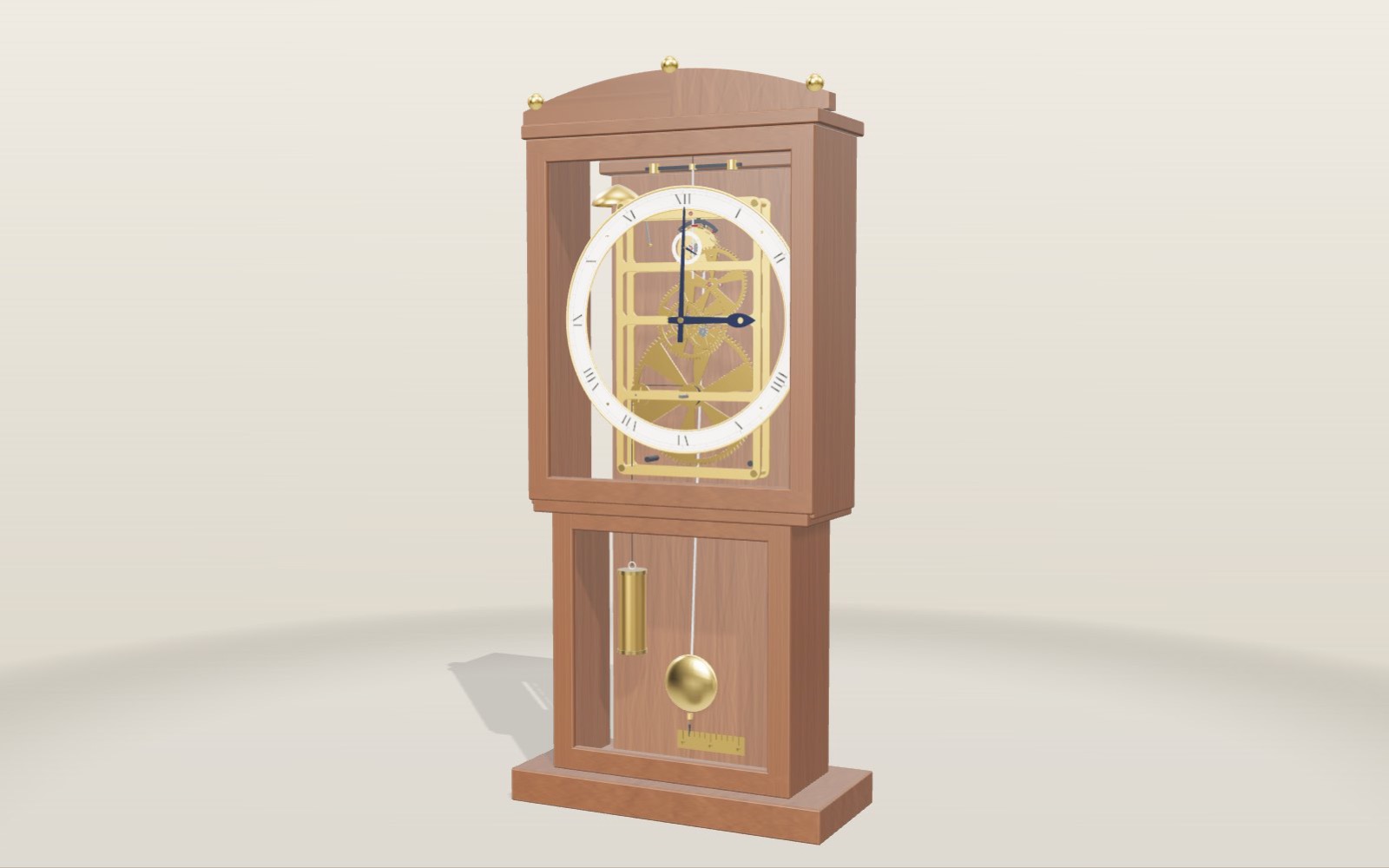
How a pendulum clock works, and why its length sets the time
A pendulum clock counts seconds with one rod 99.4 cm long. Change its length, its temperature and its place on Earth, swap four escapements and see how many seconds a day each costs.
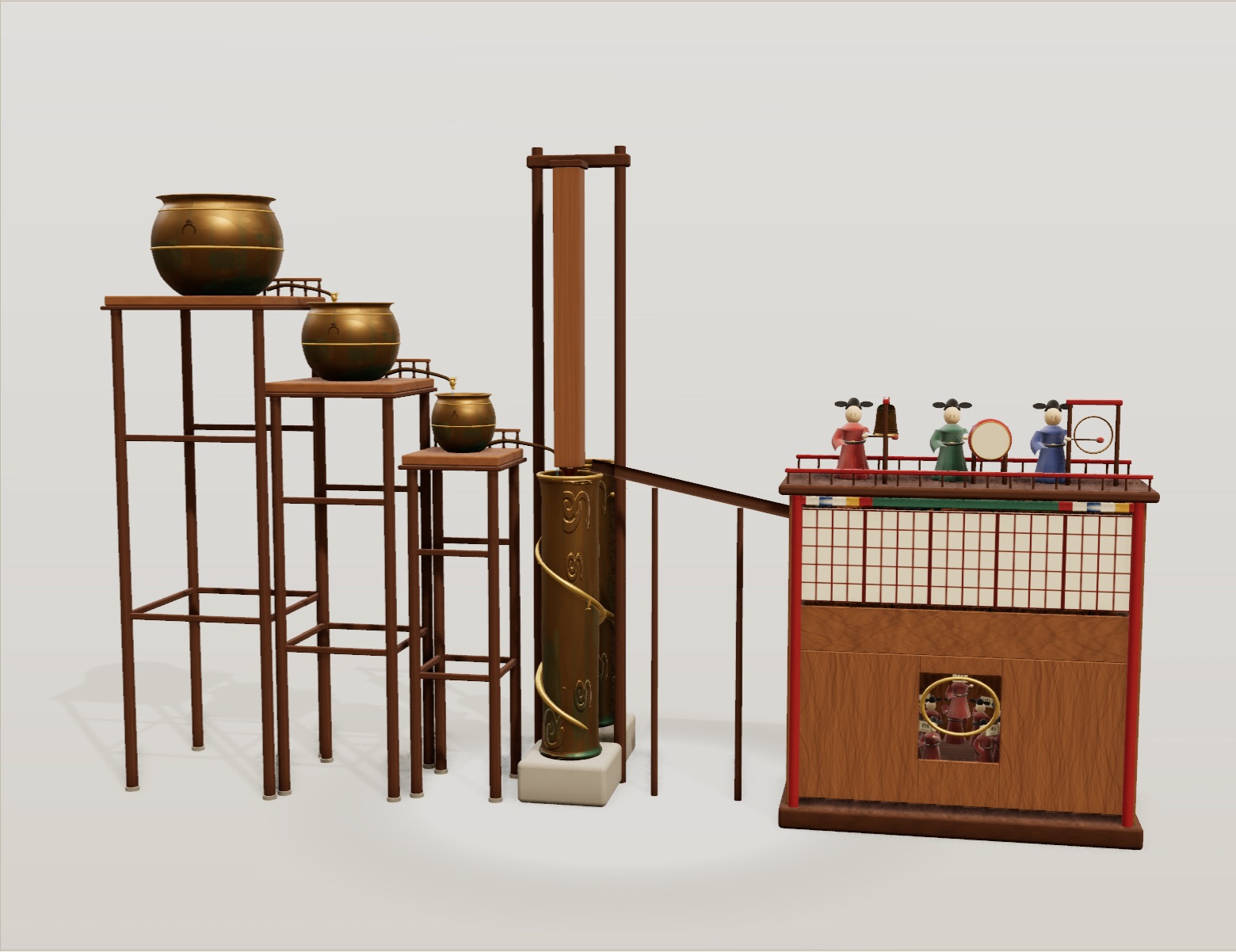
How the Jagyeokru water clock works
In 1434 a float rising in a bronze vessel in Seoul began to drop small balls that set wooden figures striking a bell, a drum and a gong.
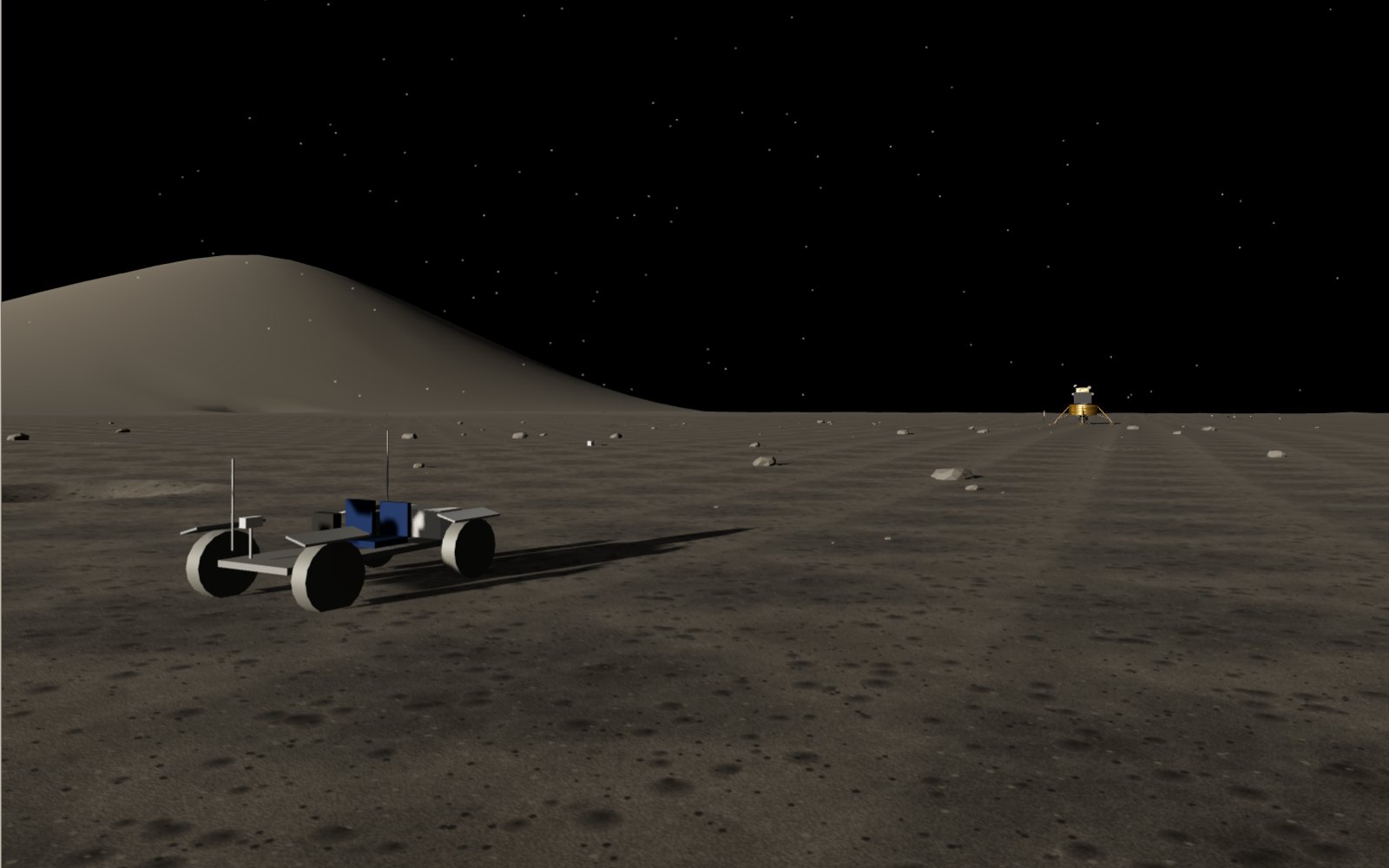
Walk the Apollo landing sites
Standing on the Moon with your eyes 1.6 m up, the horizon is only about 2.4 km away. All six Apollo landing sites are here, from Tranquility Base to Taurus-Littrow.
How GPS works: why your phone needs four satellites
A GPS signal takes about 70 thousandths of a second to fall 20,200 km to your phone, and a millionth of a second of error moves you 300 m.
How does a mechanical watch work without a battery?
A balance wheel the size of a fingernail swings eight times a second, and each swing lets the gears move on by half a tooth.
How film cameras and instant cameras work
At 1/1000 of a second a camera shutter never uncovers the whole frame at once: a narrow slit sweeps across the film instead.