Loading the model
This device cannot show the 3D model. You can read the guide steps below as text.
1 / 15 Eight sundials on one stone The slab holds one sundial at a time, a plain stick in front and the Sun’s path in the sky above. One light stands where the Sun is for the place, date and clock time you pick. Choose a dial under Controls. Drag to turn. Scroll or pinch to zoom.
Drag to turn. Scroll or pinch to zoom.
Guide Parts Controls
01 Eight sundials on one stone The slab holds one sundial at a time, a plain stick in front and the Sun’s path in the sky above. One light stands where the Sun is for the place, date and clock time you pick. Choose a dial under Controls. Drag to turn. Scroll or pinch to zoom.
02 A stick’s shadow At 9:00 on 16 October in Seoul the Sun is 24.9° high. A stick of height H throws a shadow H ÷ tan 24.9° = 2.15 H long, so a 1 m stick casts a 2.15 m shadow. At noon the same stick casts 1.04 m. The brown curve is where the tip goes all day.
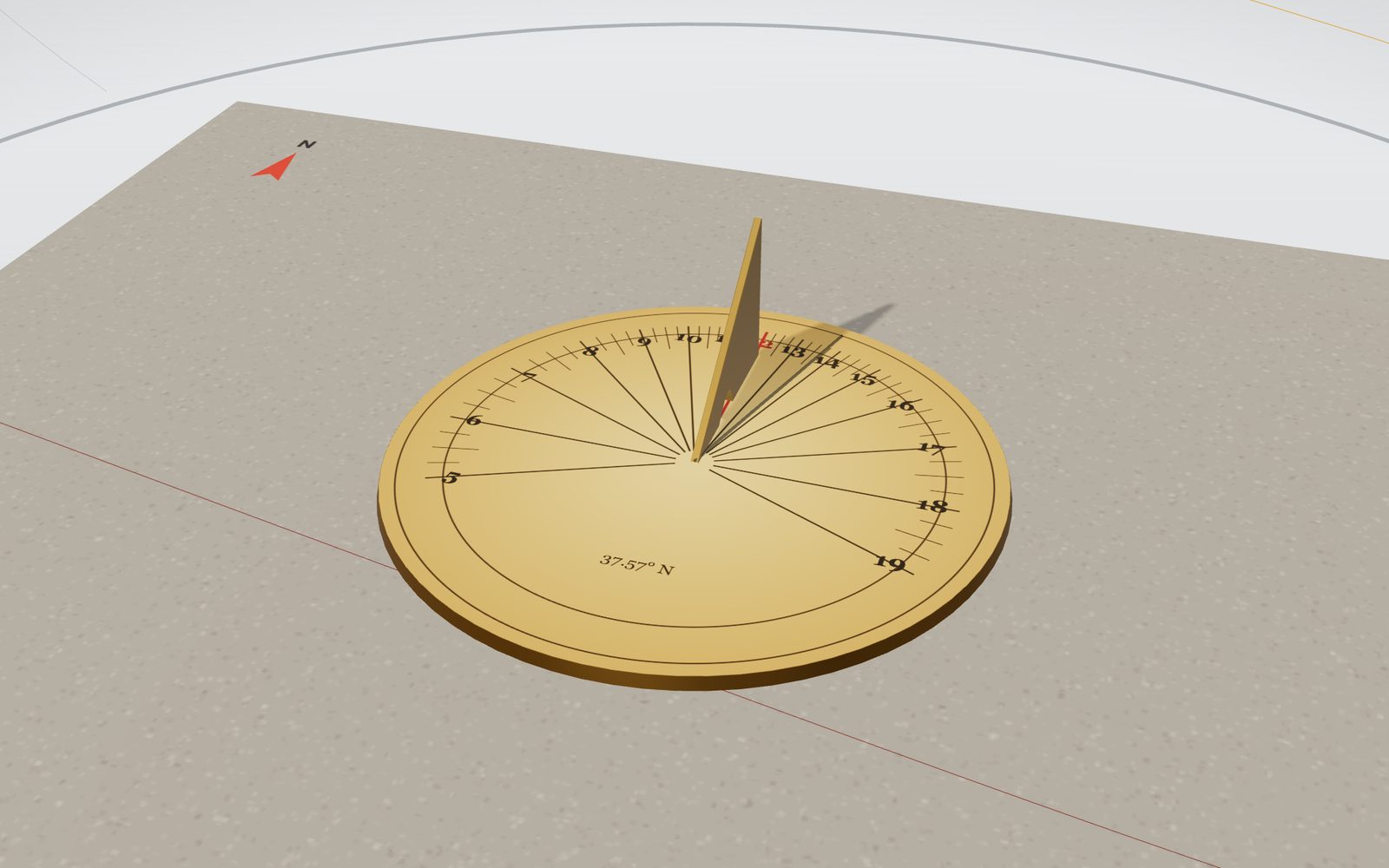
03 Why the gnomon leans at the latitude Seen from the side, the top edge of the gnomon rises 37.57° from the plate, the latitude of Seoul. That makes it parallel to the Earth’s axis. The Sun turns around that axis at 15° an hour, so the edge’s shadow sweeps around evenly through the day.
04 Hour lines are not evenly spaced The shadow turns evenly around the slanted edge, but the plate is flat. The angle of each hour line from noon is tan θ = sin φ · tan(15° · t): 9.3° for one hour, 31.4° for three, 66.3° for five, then 90° at 6 and 18.
05 Clock noon is not sundial noon Korean time is set for the 135° E meridian, but Seoul is at 126.98° E. The Sun crosses Seoul 4 × 8.02 = 32.1 minutes later. On 16 October the equation of time takes 14.5 minutes back off, so at 12:00 by the clock the dial reads 11:42.
06 The equation of time and the analemma On 11 February the dial runs 14.2 minutes slow on top of the 32.1 minutes, so it reads 11:14 at clock noon and the Sun crosses the meridian at 12:46. The purple figure of eight in the sky is the Sun at 12:00 by the clock on every day of the year.
07 A dial on a south wall On a wall facing due south the style points down at the pole below the horizon, at 90° − 37.57° = 52.43° to the wall. The hour lines follow tan θ = cos φ · tan(15° · t): 12.0° for one hour, 38.4° for three.
08 The equatorial dial Tilt the plate until it lies in the plane of the equator and the hour lines become 15° apart. On 21 June the Sun is north of the equator and lights the upper face; after the September equinox the shadow moves to the lower face.
09 The angbuilgu pin The pin starts on the south wall and points to the celestial pole, parallel to the gnomon of the flat dial. Its tip sits at the centre of the hemisphere, so the tip’s shadow, the red dot, always lands opposite the Sun. Read the hour from the north-south lines.
10 Reading the date from the bowl At noon on the winter solstice the Sun is only 29.0° high and the dot reaches the outermost of the 13 cross lines. At the summer solstice it climbs to 75.9° and the dot sits on the innermost one. The lines bunch up near the solstices, when the Sun’s height changes slowly.
11 A ring dial reads the Sun’s height The ring turns itself towards the Sun. Light through the hole lands on the inside, and by the inscribed angle rule the spot moves 2° round the ring for every 1° of Sun height. That is why 9:00 and 15:00 share one curve.
12 A pocket dial with a string Open the two leaves and the string becomes a gnomon at the latitude angle. Its shadow shows the same time on the horizontal leaf and the vertical leaf. Travellers set it north with the little compass.
13 The noon cannon Paris, 21 June. The lens is tilted for the season so that its focus reaches the touch hole only when the Sun crosses the meridian, at 12:52 by the clock. Move the clock and watch the bright dot.
14 Your shadow as the gnomon On an analemmatic dial you stand on the date line. On 16 October at Brou the Sun is south of the equator, so the gnomon stands 4.4 cm south of the centre in the model, and its shadow points to the hour stone.
15 Dials south of the equator In Sydney the Sun crosses the meridian in the north, 79.5° high at the December solstice. The gnomon points south, the dial turns round, and the shadow moves anticlockwise. Pick any of the 44 places under Controls.
Stone slab A level base. Every dial here reads true only when it sits level and its noon line faces true north, the direction of the Earth’s axis, not the compass needle. North mark Points to true north. In the southern hemisphere the dials turn round, because their gnomons must point to the south celestial pole. Upright stick A plain vertical rod 16 cm tall. Its shadow length is height ÷ tan(Sun altitude), the oldest way of measuring the Sun. The thin brown curve is the path of its shadow tip over the day. Sun ray and shadow Yellow: the ray towards the Sun and the one grazing the stick tip. Red: the shadow on the ground and its tip. Sun path in the sky Orange: the Sun’s path today. Grey: the paths at the June solstice, the equinoxes and the December solstice. Purple: the analemma, the Sun at one clock time through the year. Horizontal dial plate Hour lines fan out from the foot of the gnomon. Their angles follow tan θ = sin φ · tan(15° · t), so they bunch up near noon. Gnomon The triangular plate whose top edge, the style, rises at the latitude angle. That edge is parallel to the Earth’s axis and points at the celestial pole. South wall dial A dial painted on a wall that faces due south. Its hour lines follow tan θ = cos φ · tan(15° · t) and only cover 6:00 to 18:00, because the Sun is behind the wall outside those hours. Wall style A rod that leaves the wall pointing down at the celestial pole below the horizon, at 90° − φ to the wall. A short stay holds it. Equatorial disc A stone disc set parallel to the equator. The hour lines are 15° apart. From the March to the September equinox the Sun lights the upper face; for the rest of the year the lower one. Polar rod A rod through the centre of the disc along the Earth’s axis. Its shadow turns 15° an hour on whichever face is lit. Angbuilgu bowl A hemisphere, 40 cm across here, with a black inner face. The larger bronze bowl at the National Palace Museum is 35.2 cm across. Horizon ring The flat rim stands for the horizon. Real bowls carry the 24 solar terms and the 24 directions here; the model shows the 24 directions. Legs and cross base Four legs on a cross-shaped base. On the bowls at the National Palace Museum the cross has grooves for water to check that the dial is level. Hour lines Lines running north to south inside the bowl. Thick lines every two hours, thin ones every 15 minutes. Solar term lines 13 lines across the hour lines, one for each pair of the 24 solar terms. The winter solstice line is the outermost, the summer solstice line the innermost. Pin (yeongchim) Fixed on the south wall and aimed at the celestial pole. Its tip sits at the centre of the hemisphere. The red dot is the tip’s shadow. Ring dial A brass ring 30 cm across here (real ones fit in a hand). It hangs from its shackle and turns to face the Sun. Light through the hole lands on hour curves inside. Hanging arm Stands in for the hand that holds a ring dial by its shackle so that it hangs plumb. Diptych leaves Two hinged leaves with a compass in the lower one. The lower leaf is a horizontal dial, the upper leaf a vertical dial, both read from one string. String gnomon Stretched between the leaves at the latitude angle when the dial is open. Its shadow (dark lines) shows the same time on both faces. Noon cannon A small bronze cannon laid along the meridian on a marble dial. Its touch hole is the target of the focused sunlight. Burning lens A lens on an arc centred on the touch hole. It is set for the season so that its focus, the bright dot, reaches the touch hole only at true noon. Hour ellipse Hour stones on an ellipse, M sin(15° · t) east of centre and M sin φ cos(15° · t) north. Here M = 42 cm. Upright gnomon Where a person would stand. It moves along the date line to M tan δ cos φ north of centre, and its shadow points to the hour stone. Date line A strip along the meridian marked with the first of each month: January to June on the east side, July to December on the west.