FIG. 47How It Works
How does a mechanical watch work without a battery?
A balance wheel the size of a fingernail swings eight times a second, and each swing lets the gears move on by half a tooth.
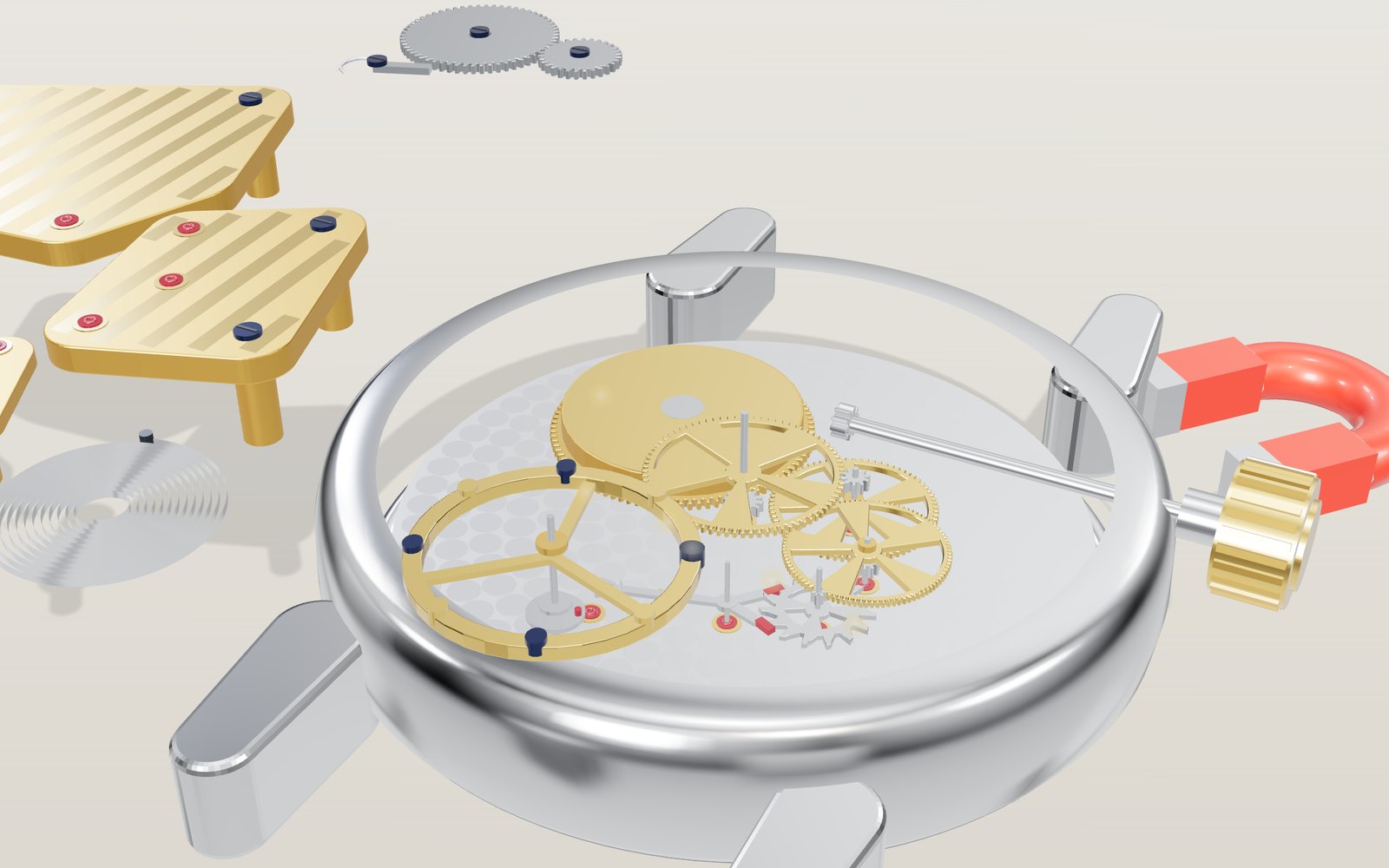
This device cannot show the 3D model. You can read the guide steps below as text.
1 / 10 The whole movementThis is a hand-wound movement about 26 mm across, seen from the back with its bridges on. Drag to turn it over, and scroll or pinch to zoom.
Drag to turn. Scroll or pinch to zoom.
What is inside a mechanical watch
A mechanical watch needs no battery: a wound spring stores the energy, and a balance wheel swinging back and forth 8 times a second lets it out in equal steps. Hold a mechanical watch to your ear and you hear a fast, even ticking, much quicker than a wall clock. Where does that sound come from, and why is it so regular? This exhibit opens up a complete hand-wound movement and follows the energy from your fingers on the crown to the steps of the seconds hand.
The model is a time-only movement about 26 mm across, the size of a common men's wristwatch calibre. Seen from the back, with the bridges on, it shows the parts in the order the energy passes through them. The crown winds a coiled mainspring inside the barrel. The barrel drives a chain of wheels called the going train. At the end of the train the escape wheel is held and released by the pallet fork, and the pallet fork is worked by the balance wheel, which swings back and forth on its hairspring.
A few numbers come from public references and are the same as in real watches: the common beat rates of 21,600 and 28,800 vibrations per hour. The 15-tooth escape wheel, a barrel that turns about once every 8 hours, a mainspring that gives about 40 hours on 5 turns, the tooth counts of the wheels, the balance's inertia and the shape of the amplitude curve are model values, chosen to make the arithmetic work and the motion easy to see. The text says which is which.
Where the energy comes from: the mainspring
A wristwatch cannot hang a weight on a cord the way a pendulum clock does, because it is worn on a moving arm and turned in every direction. It stores its energy in a long ribbon of spring steel instead, coiled inside a drum called the barrel.
When you turn the crown, the stem turns a small winding pinion. That pinion drives the crown wheel, which drives the ratchet wheel sitting on top of the barrel arbor. Turning the arbor wraps the inner end of the spring tightly around it. A small spring-loaded pawl, the click, drops into the ratchet teeth so the arbor cannot slip back. In the exhibit, move the Mainspring wound slider up and you can watch the crown spin, the ratchet advance and the coils inside the barrel pull in toward the arbor.
The outer end of the spring is hooked to the barrel wall. The spring tries to unwind, so it turns the barrel itself, and teeth cut around the barrel's rim drive the rest of the watch. The model's spring runs for about 40 hours on a full wind (a model value). That leaves a margin of about 16 hours if you wind it at the same time each day and are a little late.
Gears that turn hours into seconds
The barrel turns slowly. In this model it has 96 teeth driving a 12-leaf pinion on the centre wheel, so the centre wheel turns 8 times for each turn of the barrel. The centre wheel turns once an hour, which puts the barrel at one turn every 8 hours.
From the centre wheel the train speeds up. The centre wheel's 80 teeth drive a 10-leaf pinion on the third wheel (8 to 1), and the third wheel's 75 teeth drive a 10-leaf pinion on the fourth wheel (7.5 to 1). Multiply those and the fourth wheel turns 60 times an hour, once a minute, so it can carry a small seconds hand. Its 96 teeth then drive a 6-leaf pinion on the escape wheel, another 16 to 1.
Without anything to stop it, the mainspring would spin this train in a fraction of a second and the hands would race round the dial. The rest of the movement exists to let the train move only in small, evenly spaced steps.
How the lever escapement lets the train move half a tooth
The escape wheel in a modern watch has 15 teeth with flattened ends, called club teeth, and it is made of steel. Next to it pivots the pallet fork. One end of the fork carries two synthetic ruby pallets, the entry pallet and the exit pallet. The other end is a forked slot that faces the balance.
Most of the time a tooth of the escape wheel rests against one pallet and the wheel is locked. The fork leans against a banking pin and stays still. Meanwhile the balance swings freely, touching nothing.
As the balance swings back through its centre, a small ruby pin on its roller, the impulse pin, enters the slot of the fork and knocks it across. That pulls the pallet off the tooth: the unlocking. The tooth slides along the slanted face of the pallet and pushes the fork the rest of the way, and the fork in turn pushes the impulse pin. This push, the impulse, puts back the little energy the balance lost to friction on its last swing. The wheel then turns freely for a moment until another tooth lands on the other pallet. That landing is the tick you hear.
On the next swing the same thing happens in mirror image. Each swing moves the escape wheel by half a tooth, 12 degrees on a 15-tooth wheel. Choose the "One beat in slow motion" step and the exhibit runs 50 times slower than life, so you can follow the pin entering the fork, the fork flicking over, and the wheel jumping forward.
Why the balance wheel keeps time
The balance wheel is a small, heavy ring on a staff. The hairspring is a flat spiral: its inner end is fixed to the staff and its outer end to a stud on the balance cock. Turn the balance and the spring winds up and pushes back. The further you turn it, the harder it pushes, in proportion to the angle, which is Hooke's law for a twisting spring.
A wheel and a spring like that make a torsion pendulum. Its period is
T = 2π√(I/κ)
where I is the moment of inertia of the balance and κ (kappa) is the stiffness of the hairspring, the torque per radian of twist. Because the restoring torque is proportional to the angle, the period does not depend on how far the balance swings, at least in the ideal case. That property is called isochronism, and it is the reason a watch keeps nearly the same rate whether the balance is swinging widely just after winding or a little less widely at the end of the day.
In this model the balance swings 300 degrees each way from its resting position when the spring is fully wound (a model value). That is more than a full turn and a half from one extreme to the other, four times a second.
The numbers, worked out
Watchmakers count the beats, the single swings in one direction. A movement at 28,800 vibrations per hour (vph) makes 28,800 ÷ 3,600 = 8 beats a second. Two beats make one full oscillation, so the frequency is 4 Hz and the period is 0.25 s.
The seconds hand moves once per beat, so on this watch it jumps 8 times a second, 6° ÷ 8 = 0.75° per step. At 21,600 vph it makes 6 steps of 1°, and at 36,000 vph it makes 10 steps of 0.6°. Move the Beat rate slider and the readout shows the change. The model swaps the fourth wheel to escape pinion ratio when you do this, so the hands keep time; a real movement is cut for one frequency only.
The escape wheel releases one tooth per full oscillation: two half-tooth steps. At 4 Hz that is 4 teeth a second, and a 15-tooth wheel turns 4 × 60 ÷ 15 = 16 times a minute. The fourth wheel turns once a minute, so the gearing between them has to be 16 to 1, which is the 96/6 used here.
For the balance itself the model uses I = 1.0 × 10⁻⁹ kg·m² (10 mg·cm²), a model value in the right range for a balance of this size. For 4 Hz the hairspring stiffness must be κ = I(2πf)² = 1.0 × 10⁻⁹ × (8π)² ≈ 6.32 × 10⁻⁷ N·m per radian. Putting that back into T = 2π√(I/κ) gives 0.250 s. As a ring of radius 4.6 mm, that inertia corresponds to a rim of about 47 mg.
The formula also shows why watches are so sensitive. Frequency goes as √(κ/I), so a 1% stiffer hairspring raises the frequency by about 0.5%, and the watch gains about 431 seconds a day. One second a day is an error of 11.6 parts per million.
Over a full wind the train counts a lot of beats. One turn of the barrel is 8 × 60 × 16 = 7,680 turns of the escape wheel, or 7,680 × 15 × 2 = 230,400 beats, exactly 8 hours at 28,800 vph. Five turns give 1,152,000 beats, the 40-hour reserve. In a year the balance swings 252,288,000 times.
The same figures were worked through by hand and match every number quoted here.
Why a watch can be shaken and a pendulum clock cannot
The pendulum clock in this museum keeps time with a 99.4 cm rod that swings once a second. Its restoring force is gravity, so the clock has to stand still and upright. Tilt it and the beat goes lopsided; carry it about and the pendulum is thrown off its swing.
A balance wheel replaces gravity with the hairspring's torque. The spring pushes back by the same amount however the watch is held, and a well-made balance is poised: its centre of mass lies on the axis of the staff, so a linear jolt pushes on the pivot rather than turning the wheel. That is why a watch keeps running on a wrist that is swinging, typing or upside down.
It is not perfect. A tiny poise error, or the difference in friction between a pivot lying on its end and a pivot lying on its side, changes the rate from one position to another. Watchmakers adjust a good movement in several positions, dial up, crown down and so on, to keep those differences small. Hard knocks are taken by spring-mounted settings around the balance jewels, which let the fragile staff move and then return.
The other difference is speed. The seconds pendulum gives one beat a second; this balance gives 8. For a disturbance of fixed duration, increasing frequency makes the disturbance occupy a larger fraction of a cycle, not a smaller one. Its effect on timekeeping also depends on the phase of the balance when it arrives, the impulse and the oscillator's stored energy. Frequency alone does not specify shock resistance.
Jewels and the friction problem
Every arbor turns in two holes, one in the plate and one in a bridge, and the steel pivots are only 0.1 millimetre or so across. In soft brass holes they would wear oval within a few years. Nicolas Fatio de Duillier and the Debaufre brothers patented a way of piercing jewels for watch bearings in London in 1704. Today they are synthetic ruby: very hard, very smooth, and able to hold a drop of oil in place.
The exhibit's time-only movement is fully jewelled with 17 jewels. The balance has two pivot jewels, two cap jewels and the impulse jewel. The pallet fork has two pivot jewels and the two pallets. The escape, fourth, third and centre wheels have two pivot jewels each. The barrel is not jewelled, because it turns too slowly for friction to matter much. An automatic movement adds jewels for its winding rotor.
Power reserve and what happens as the spring runs down
A coiled spring does not push evenly. It is strongest when fully wound and weakest near the end. As the torque falls, the impulse at each beat gets smaller and the balance swings less widely. In the model the amplitude starts at about 300° each way and falls toward 140° in the last hours; those are model values, but the trend is the one every watch shows.
Drag the Mainspring wound slider down and watch the readout. Below a few hours the amplitude drops fast. When it falls below half the lift angle (the angle the balance needs to work the fork, 50° in this model), the impulse pin can no longer unlock the escapement, and the watch stops with plenty of motion still left in the balance. The power reserve indicator on the bridge, a small hand over a 0 to 40 hour scale, shows the same figure.
Because a real balance is not perfectly isochronous, the rate drifts a little as amplitude falls. That is one reason good watches keep the amplitude high by running on the flatter middle of the spring's torque curve, and why winding at the same time each day helps them keep a steady rate.
What the model simplifies
The model is drawn larger than life, with thicker parts and wider gaps so you can see them move. The wheel tooth counts are a consistent model train, not those of a particular calibre. The balance's inertia, the lift angle and the amplitude curve are model values. When you change the beat rate, the model behaves as if a different escape pinion had been fitted so the hands still keep time. The amplitude also responds to winding faster than a real balance would, so that you can see the effect without waiting for hours.
The daily error under temperature, position, magnetism and the regulator is also a model. Two figures in it are public: a plain steel hairspring loses about 11 s a day for every 1 °C, and ISO 764 tests magnetic resistance at 4,800 A/m, about 6 mT. The size of the heavy spot on the balance, the strength of the magnet, the friction in upright positions and the alloy and silicon figures are model values chosen to show the direction and rough size of each effect.
How the watch escapement came about
The first portable clocks were driven by a mainspring but regulated by a balance with no spring, so their rate depended on how hard the spring pushed. Adding a balance spring in the second half of the 17th century changed that. Christiaan Huygens introduced the spiral balance spring in 1675. Even the first balance-spring watches were far better timekeepers than anything before them.
The lever escapement was invented by the English clockmaker Thomas Mudge in 1754, and the watch he made for Queen Charlotte in 1770 appears to be the first to use it. Because the balance swings free of the escapement for most of each beat, the lever escapement became the standard, and almost every mechanical watch made today uses it.
The common beat rates today are 21,600, 28,800 and 36,000 vph.
A day of beats and a five-second error
At 28,800 vph the balance makes 28,800 × 24 = 691,200 beats in a day. There are half as many complete oscillations, 345,600. The distinction matters when comparing a watch specification with an experiment in physics: the watchmaker's vibration is a half-cycle, whereas hertz counts complete cycles. A label of 4 Hz and a label of 8 beats per second describe the same oscillator, not competing measurements.
Suppose a watch gains 5 seconds over a reference day of 86,400 seconds. Its fractional rate error is 5 ÷ 86,400 = 0.00005787, or about 57.87 parts per million (ppm). This is a rate comparison, not a claim that every individual tick has exactly the same error. With a steady error, the gain after 7 days would be 35 seconds. Resetting the hands removes the accumulated offset but does not adjust the rate; the next day the watch would gain again. Regulation changes the oscillator's rate, while setting changes what time the hands display.
The gear train does not correct a fast balance. Its tooth ratios count the escapement's releases without knowing what a reference second is. In the model, the centre-to-fourth ratio is (80 ÷ 10) × (75 ÷ 10) = 60. One centre-wheel revolution per hour therefore gives 60 fourth-wheel revolutions per hour, hence one per minute. The final 96 ÷ 6 = 16 ratio supplies the escape wheel with its required speed at 4 Hz. A different ratio would give a systematic hand-speed error even if the oscillator were perfect.
Power reserve is another kind of measurement. The model's 5 usable barrel turns at 8 hours per turn give 40 hours. After 24 hours, 16 hours remain in this simplified accounting. This does not mean the stored energy falls at a perfectly constant rate or that amplitude is proportional to hours left. A reserve indicator estimates running time from the winding state, while the balance responds to the torque actually delivered. Real designs vary: Grand Seiko lists approximately 72 hours for its 4 Hz 9S65 and approximately 80 hours for its 5 Hz 9SA5. Higher frequency alone therefore cannot predict a movement's reserve; spring capacity and the efficiency of the whole mechanism matter.
Temperature, position and chronometer testing
A balance spring is an elastic material, not a mathematical constant. Temperature changes its stiffness and changes the dimensions of the balance. Lubricants and escapement behaviour also affect the result. Modern alloys and silicon components reduce some sensitivities, but a low rate measured at room temperature cannot establish the behaviour at every temperature. Seiko's care guidance explicitly identifies temperature, magnetism and position as influences on mechanical accuracy.
Position changes which parts of the balance staff bear the load. Dial up, dial down and crown down need not give identical rates. A spring may also breathe less symmetrically in a vertical position. A useful adjustment must therefore consider several orientations rather than merely slowing a fast watch in one convenient position. A real wrist changes position throughout the day; its daily result combines those conditions with its winding history.
COSC's traditional mechanical chronometer certification uses ISO 3159. Its published procedure describes 15 days of testing in 5 positions and at 3 temperatures, 8°C, 23°C and 38°C. The familiar mean daily rate limit is −4 to +6 seconds per day for the usual full-size category. It is not the only pass criterion: variation between days, differences between positions, temperature response and rate resumption are also checked. The quoted range is not a promise that every observed day on every wrist lies inside it.
Do not confuse that traditional label with COSC's separate Excellence certification, whose finished-watch protocol has different requirements. Nor is a chronometer a chronograph: the former describes tested timekeeping performance, while the latter is a mechanism for measuring intervals. Grand Seiko publishes another standard of its own, testing movements for 17 days in 6 positions. Comparisons need the actual test conditions, rather than the smallest advertised daily number. The exhibit now shows temperature, the six test positions and a magnet with model values, but it does not run the full COSC procedure.
What a tourbillon can average
Breguet received the tourbillon patent on 26 June 1801. In this mechanism a rotating carriage carries the balance and escapement assembly. A traditional one-minute carriage takes a movement through successive vertical orientations even when the pocket watch itself stays in one place. That can average some position-dependent errors over the rotation, rather than requiring the owner to turn the watch by hand.
Imagine an intentionally simplified example in which opposite vertical orientations produce equal gains and losses. Spending equal time in each can bring their mean closer to zero. Actual errors need not be equal or cancel exactly, and changing the carriage's orientation does not abolish gravity. A single-axis tourbillon also does not turn every possible wrist position into every other one. Its result depends on adjustment and the error pattern of the movement around it.
Tourbillons add moving mass and mechanical work. They do not remove temperature sensitivity, dirty oil or a badly regulated oscillator. Their visible rotation is evidence of a mechanism, not proof that the completed watch is more accurate than a well-adjusted conventional movement. The Science Museum records a four-minute tourbillon made for George III in 1808, a useful reminder that not all carriages rotate once per minute. The balance in this exhibit stays on a fixed support; there is no tourbillon control hidden in the parts view.
The quartz change began before cheap digital watches
Seiko released the Quartz Astron on 25 December 1969. It had an analogue dial and a battery-powered quartz oscillator, so the quartz transition was not simply a change from hands to glowing digits. Seiko's technical history gives the original oscillator frequency as 8,192 Hz and its advertised accuracy as ±5 seconds per month. Later quartz watches commonly adopted 32,768 Hz. Applying that later frequency to the first Astron would rewrite the specification of the historical object.
Quartz changes both the regulator and the way its cycles are counted. Electronics divide a high-frequency signal, and a stepping motor can advance the hands at much longer intervals than the crystal's own vibrations. A once-per-second tick does not mean the crystal vibrates once a second. Conversely, a smoothly moving hand does not prove there is a balance spring inside the case. Hand motion is the output chosen by the designer, not a direct view of the oscillator.
The 1969 launch was an expensive early product, not instant proof that every mechanical factory was obsolete. Seiko describes further work on reliability and mass production after the launch. The subsequent spread of quartz changed the economics of accurate timekeeping, often called the quartz crisis from the Swiss industry's perspective. It did not make gears unnecessary: analogue quartz watches still need a train between motor and hands. What disappeared was the need for a mainspring-powered balance and escapement as the regulator in that type of watch.
Experiments with the displayed movement
Start in the 3D view. Drag the crown and watch the barrel lid turn see-through while the mainspring tightens around the arbor; the power reserve hand climbs towards 40 hours. Press and hold the balance wheel: the seconds hand stops with it, and the Daily error panel freezes. Flick it as you let go and it restarts at whatever swing your flick gave it, then settles back to the amplitude the mainspring can keep up.
Next change one condition at a time and read the Daily error panel, which runs a day every 20 seconds next to an exact clock. Set Temperature to 38 °C with a steel Hairspring and the difference grows by minutes a day; switch to the Elinvar type or silicon and it almost stops. Choose Crown down in Position and the watch stands up: let the mainspring down and the error from the heavy spot shrinks to nothing near 220° amplitude, then changes sign. Drag the red magnet against the case and the coils of a steel hairspring pull together; after you take it away the watch still gains until you press Demagnetise. The Regulator moves the index on the balance cock by up to 60 s a day either way.
Take apart lets you lift the parts out by hand, in the order a watchmaker would: the bridges before the balance, the balance before the pallet fork. If the spring is still wound when the pallet fork comes out, the train runs away. The challenges under the controls collect these experiments, and the movement list compares this oscillator with Harrison's H4, quartz and the caesium clock. The figures on the stage remain model values; they cannot tell you how a particular watch will run.
Questions
What does 28,800 vph mean?
It means the balance makes 28,800 single swings, or beats, every hour. That is 8 beats a second, or 4 complete back-and-forth oscillations a second, so the frequency is 4 Hz and one oscillation takes 0.25 s.
Why does the seconds hand of a mechanical watch glide instead of ticking once a second?
It does not really glide. It moves once per beat, so at 28,800 vph it makes 8 small steps of 0.75° every second. The steps are too small and quick for the eye to separate, which is why it looks like a sweep. A quartz watch's stepping motor usually moves the hand once a second instead.
Is a higher beat rate always better?
A higher beat rate gives finer seconds-hand steps, but energy consumption and wear also depend on balance inertia, amplitude, escapement design and lubrication. A higher frequency does not automatically mean better accuracy or faster wear. Common choices include 21,600, 28,800 and 36,000 vph; compare complete movements rather than frequency alone.
Why are there jewels in a watch?
The pivots are tiny and turn for years without stopping, so they need a bearing surface that is hard, smooth and holds oil. Synthetic ruby does all three. The jewels are worth very little as gems; they are there to reduce friction and wear.
Can I overwind a hand-wound watch?
When the mainspring is fully wound, the crown simply stops turning, and forcing it further can break the spring. Automatic movements use a slipping bridle at the outer end of the spring, so it slips round the barrel wall instead of winding any tighter.
Why does a watch stop before the spring is completely let down?
The balance must swing far enough to carry the impulse pin into the fork and unlock the pallet. When the spring is weak, the impulses shrink, the amplitude falls, and below that point the escapement stays locked even though some energy is left in the spring.
Does a mechanical watch need a battery?
No. All of the energy comes from the mainspring, wound either by hand through the crown or, in an automatic watch, by a rotor that swings as the wrist moves.
Does a five-second daily error mean one bad tick?
No. A gain of 5 seconds in 86,400 seconds is an average rate error of about 57.87 ppm. It may accumulate across many beats; a timing record is needed to distinguish a steady rate from an isolated disturbance.
Does a tourbillon cancel gravity?
No. It rotates the regulator to average some positional errors. It does not remove gravity or guarantee better accuracy in every orientation.
Did the first Astron use the modern quartz frequency?
No. The 1969 Quartz Astron used 8,192 Hz. The common later frequency is 32,768 Hz, and neither figure describes how often its seconds hand must move.
Terms
- Balance wheel: the weighted ring that swings back and forth and sets the rate.
- Hairspring (balance spring): the flat spiral spring that returns the balance to centre; its stiffness is κ.
- Beat: one swing of the balance in one direction. Two beats make one oscillation.
- vph: vibrations (beats) per hour. 28,800 vph = 8 beats per second = 4 Hz.
- Escape wheel: the last wheel of the train, released half a tooth at a time.
- Pallet fork: the lever between the escape wheel and the balance, with two ruby pallets.
- Impulse pin: the ruby pin on the balance roller that works the fork.
- Lift angle: the angle through which the balance is connected to the fork during each beat.
- Amplitude: how far the balance swings from its resting position, in degrees.
- Isochronism: keeping the same period whatever the amplitude.
- Power reserve: how long the watch runs on a full wind.
- Barrel: the toothed drum that holds the mainspring.
Sources
Fondation Haute Horlogerie, Frequency (21,600, 28,800 and 36,000 vibrations per hour, 3, 4 and 5 Hz). https://www.hautehorlogerie.org/en/watches-and-culture/watchmaking-knowledge/encyclopedia/frequency
Royal Collection Trust, Queen Charlotte's Lever Watch and Pedestal (Mudge invented the lever escapement in 1754; this watch of 1770 appears to be the first to use it). https://www.rct.uk/collection/63759/queen-charlottes-lever-watch-and-pedestal
Fondation Haute Horlogerie, Christiaan Huygens (1675, invention of the balance spring). https://www.hautehorlogerie.org/en/watches-and-culture/watchmaking-knowledge/encyclopedia/christiaan-huygens
Fondation Haute Horlogerie, Nicolas Fatio de Duillier (with the Debaufre brothers, patent for pierced jewel bearings, 1704). https://www.hautehorlogerie.org/en/watches-and-culture/watchmaking-knowledge/encyclopedia/nicolas-fatio-de-duillier
Bartosz Ciechanowski, Mechanical Watch (interactive explanation of the movement). https://ciechanow.ski/mechanical-watch/
Calculations on this page: beat rates, step angles, train ratios, κ from T = 2π√(I/κ) and rate sensitivity, computed with the exhibit's own model values. All links checked on 16 October 2026.
COSC certifications. https://www.cosc.swiss/cosc-certifications
COSC chronometer procedure. https://www.cosc.swiss/certified-chronometer
COSC FAQ. https://www.cosc.swiss/cosc-faq
Breguet tourbillon patent. https://www.breguet.com/en/breguet-house/1801-1823/patent-granted-completely-new-type-regulator-called-tourbillon
Science Museum, Breguet display. https://www.sciencemuseum.org.uk/about-us/press-office/abraham-louis-breguet-display
Grand Seiko Standard. https://www.grand-seiko.com/instructions/html/GS_9S_en/AGFISYlmvxdvqd
Seiko, factors influencing accuracy. https://www.seikowatches.com/us-en/customerservice/faq/mechanical-2
Seiko, the 1969 Quartz Astron. https://www.seikowatches.com/uk-en/products/astron/special/story_qa50th_1
Grand Seiko mechanical calibres. https://www.grand-seiko.com/us-en/collections/movement/mechanical
Seiko quartz technology. https://www.seikowatches.com/au-en/customerservice/knowledge/quartz-knowledge
Europa Star, Temperature variations (a plain steel balance spring loses about 11 s a day per °C). https://www.europastar.com/watch-knowledge/1004082411-temperature-variations.html
R. E. Gould, Comparative performance of watches with elinvar and with steel hairsprings, Journal of Research of the National Bureau of Standards 12 (1934). https://nvlpubs.nist.gov/nistpubs/jres/12/jresv12n4p451_A2b.pdf
ISO 764:2020, Horology: magnetic resistant watches. https://www.iso.org/standard/70610.html
METAS-N001, requirements for the Master Chronometer certification. https://www.metas.admin.ch/dam/en/sd-web/NKx8QlSER-dy/metas_n001_v_1_2-e.pdf
Royal Museums Greenwich, Harrison's timekeepers and the longitude problem. https://www.rmg.co.uk/stories/time/harrisons-clocks-longitude-problem
NIST, Second: the past. https://www.nist.gov/si-redefinition/second-past
Grand Seiko, Spring Drive. https://www.grand-seiko.com/us-en/collections/movement/springdrive
More exhibits
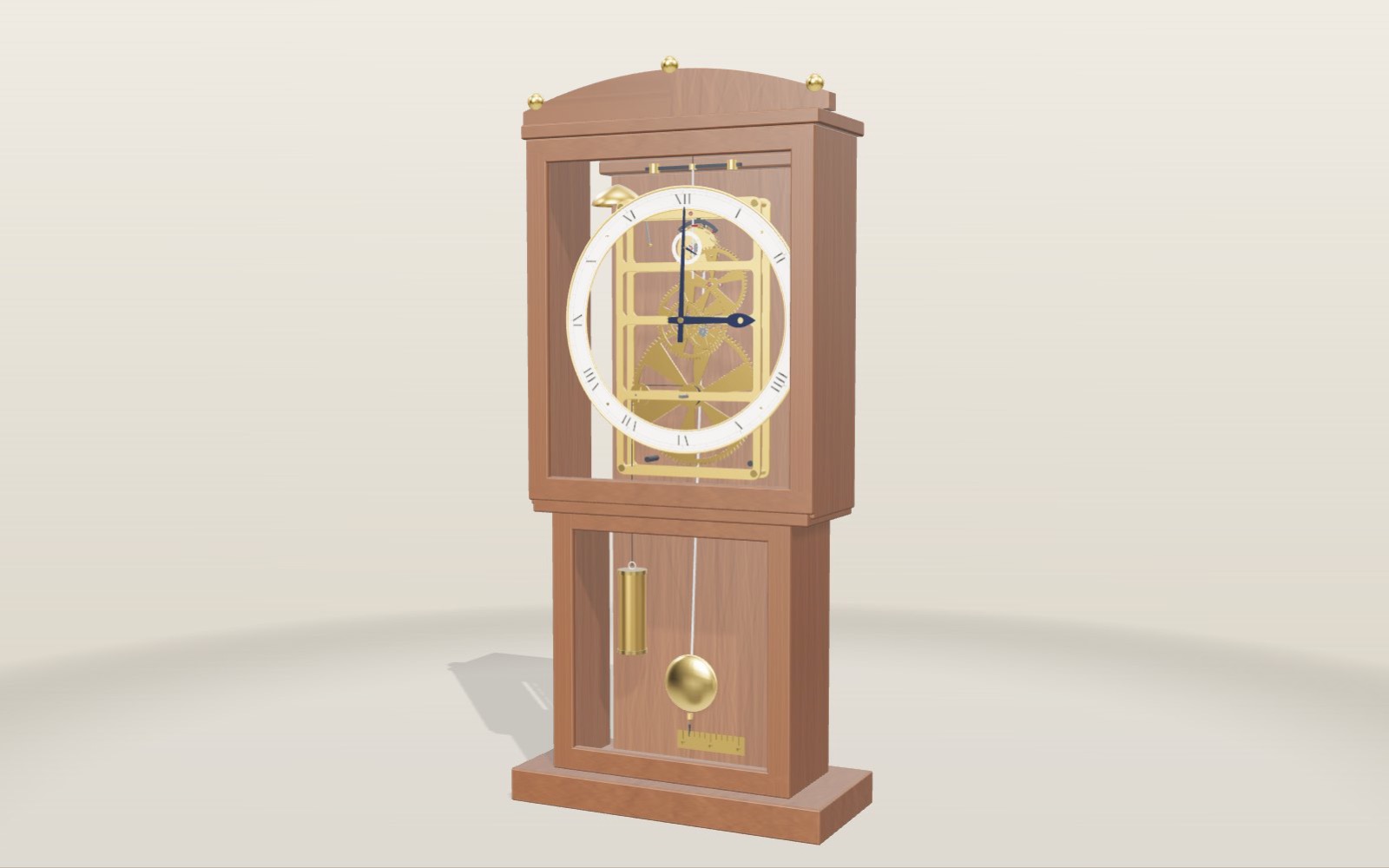
How a pendulum clock works, and why its length sets the time
A pendulum clock counts seconds with one rod 99.4 cm long. Change its length, its temperature and its place on Earth, swap four escapements and see how many seconds a day each costs.
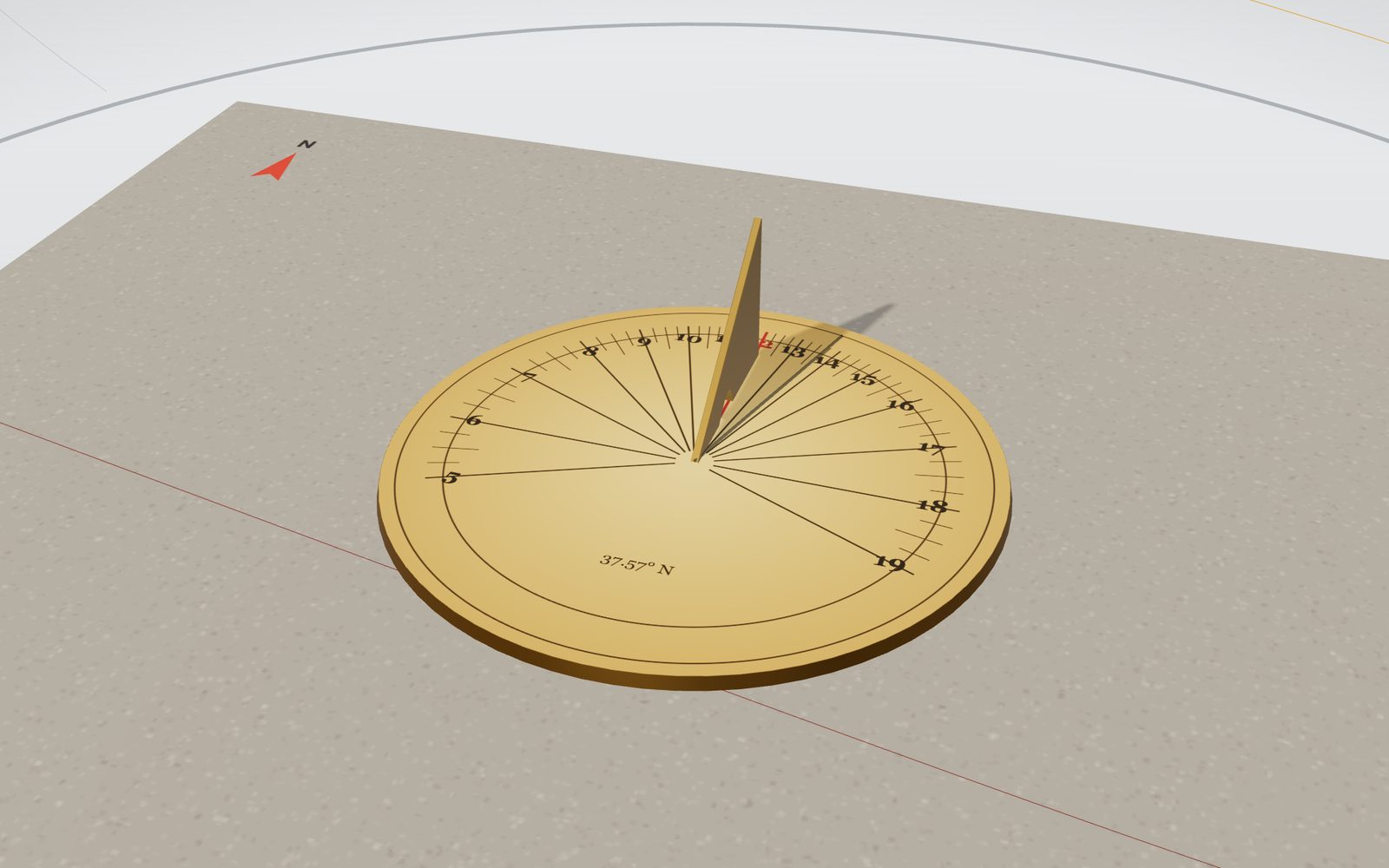
Sundial: interactive model, how to read the time
In Seoul a sundial reads about half an hour behind the clock, because the city lies 8° west of the meridian that sets Korean time.
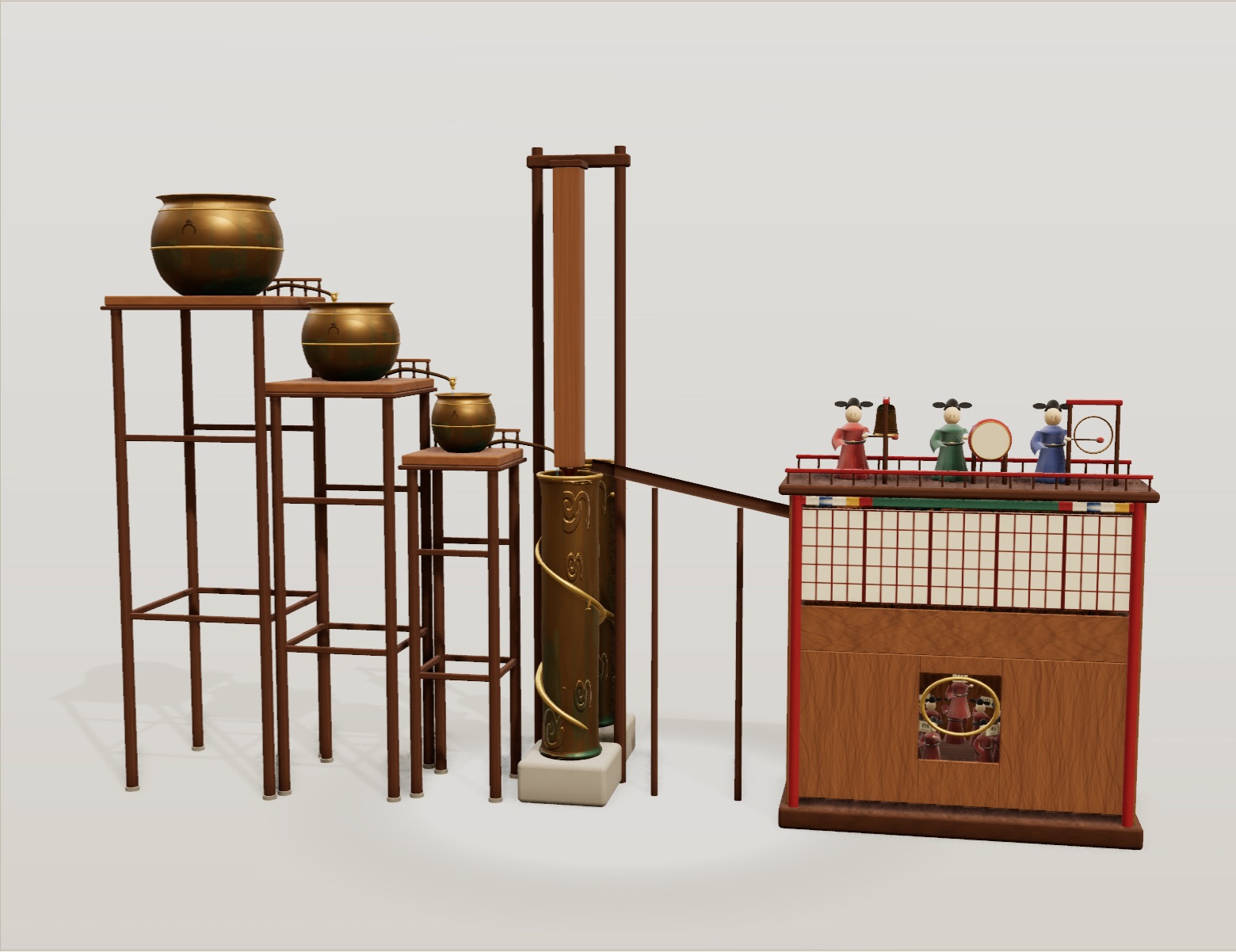
How the Jagyeokru water clock works
In 1434 a float rising in a bronze vessel in Seoul began to drop small balls that set wooden figures striking a bell, a drum and a gong.
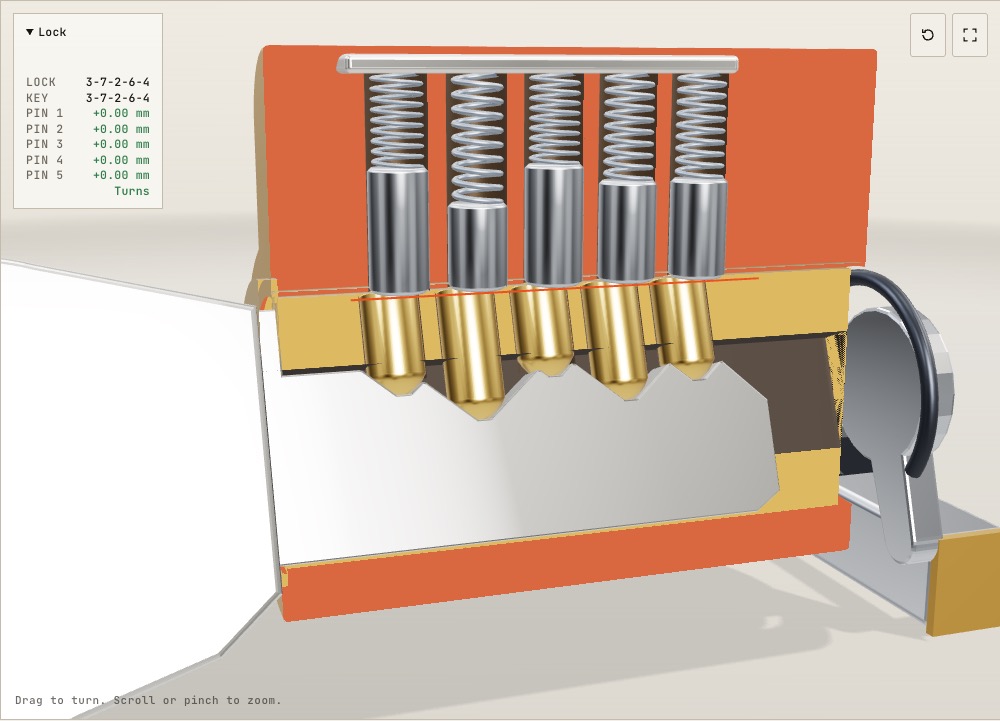
How does a pin tumbler lock work inside? A 3D cutaway
On a common Schlage key one cut depth differs from the next by 0.381 mm, and that small step is enough to keep a wrong key from turning.
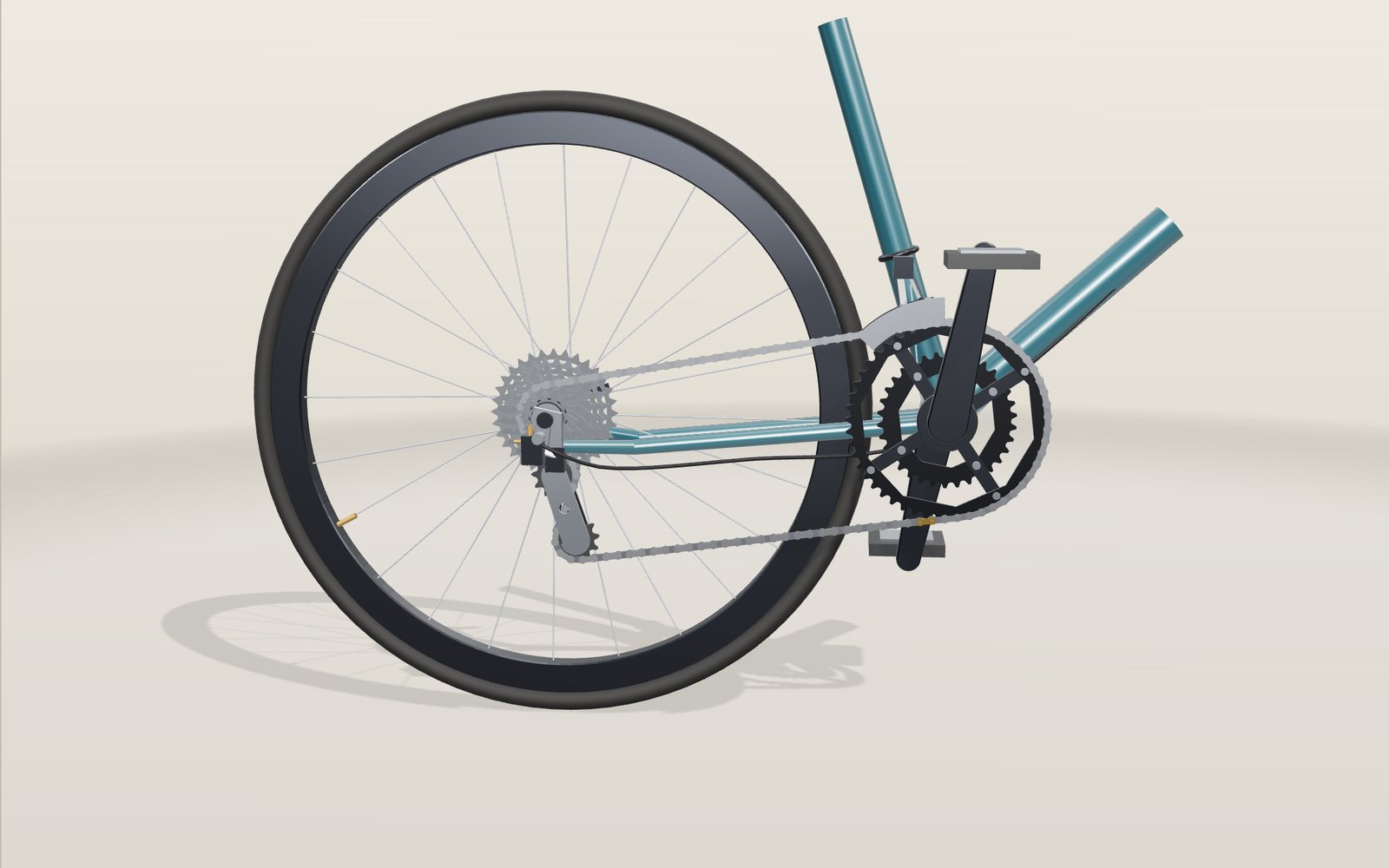
Bicycle gears: which gear makes climbing a hill easier
In a 50 by 11 gear one turn of the pedals moves a road bike 9.57 metres; in 34 by 32 it moves 2.24 metres.
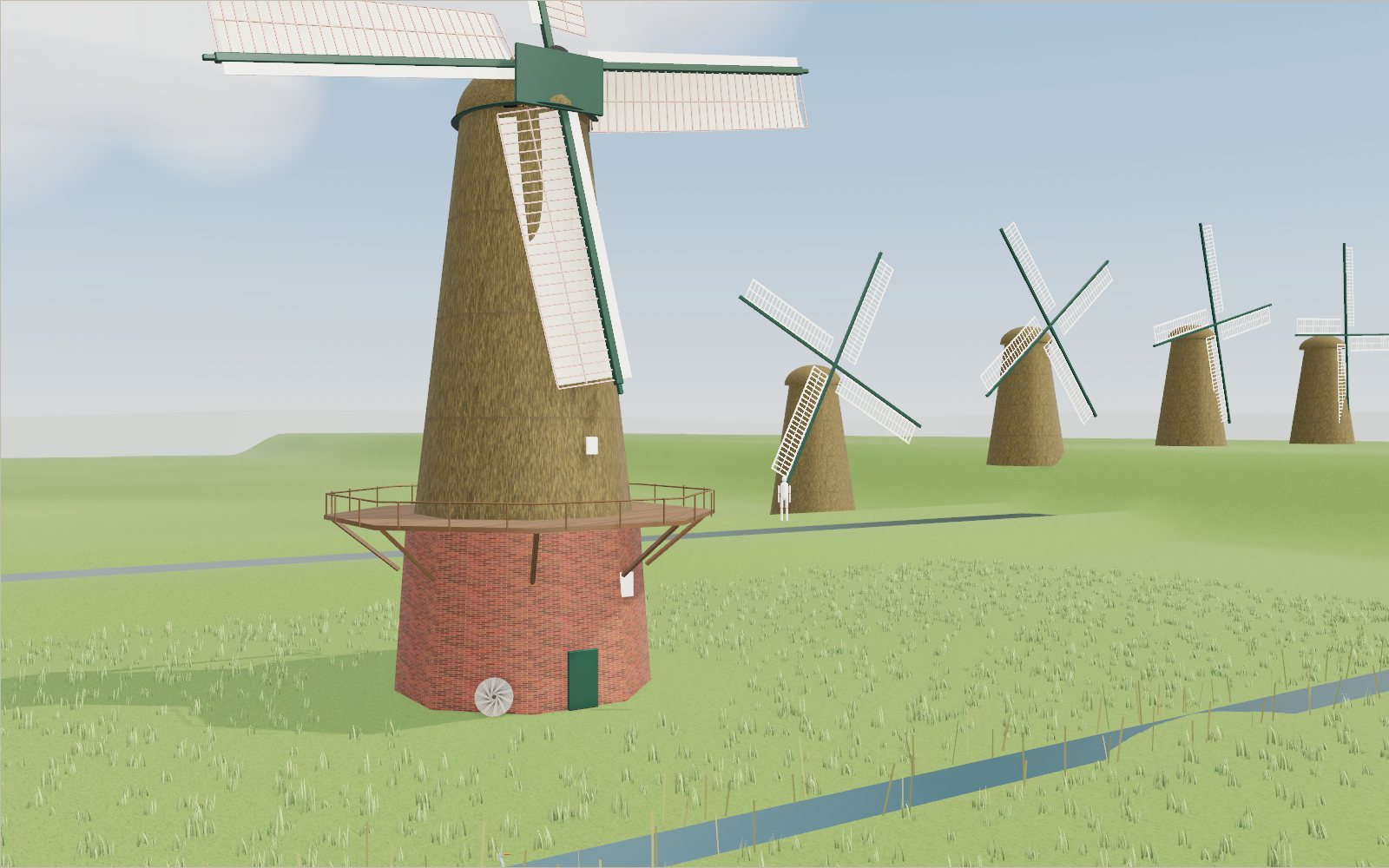
How windmills and watermills work
The sails of a Dutch mill are as wide as an eight-storey building is tall, and at 7 m/s they still take only about a fifth of the wind.