Loading the model
This device cannot show the 3D model. You can read the guide steps below as text.
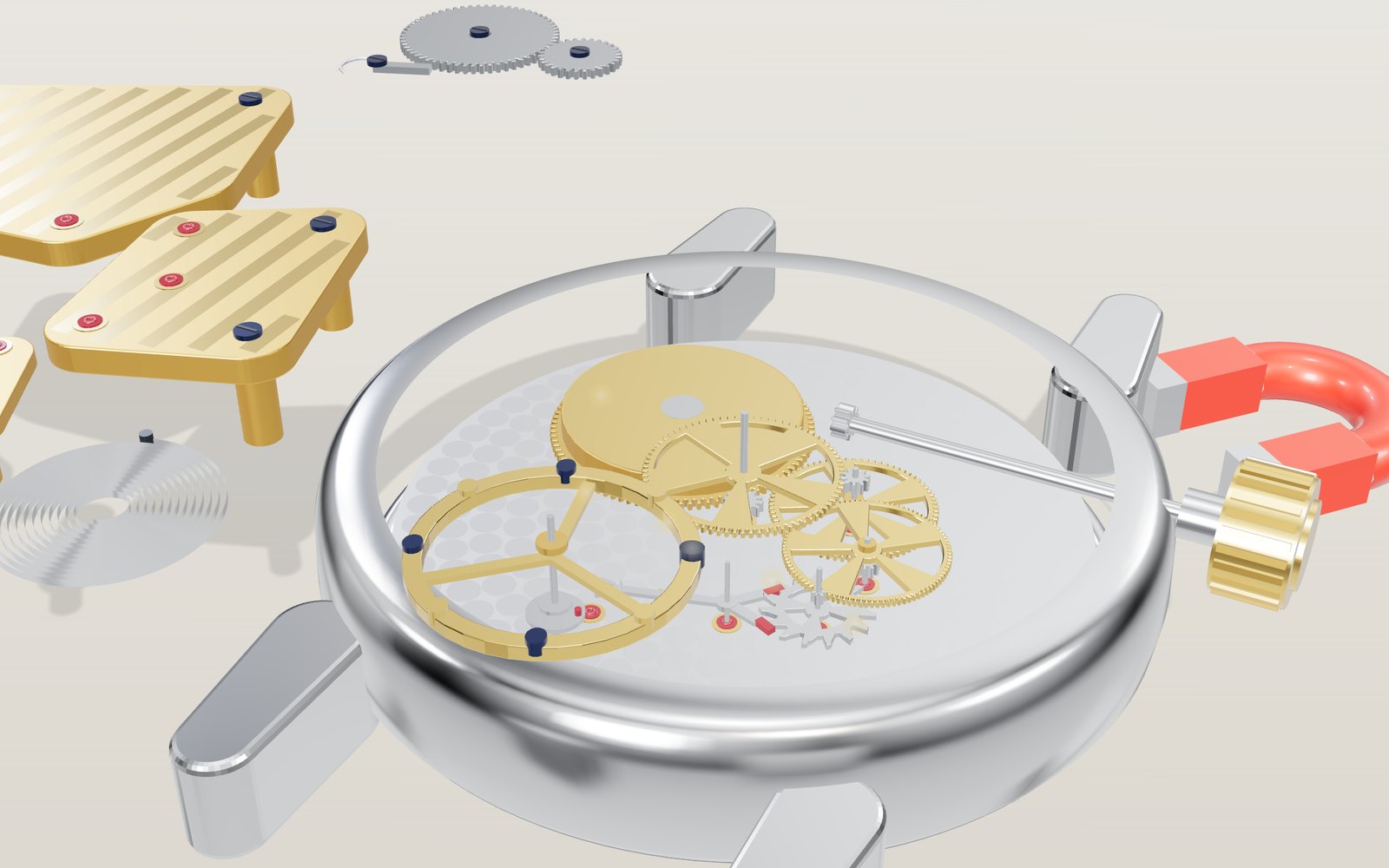
1 / 10 The whole movement This is a hand-wound movement about 26 mm across, seen from the back with its bridges on. Drag to turn it over, and scroll or pinch to zoom.
Drag to turn. Scroll or pinch to zoom.
Guide Parts Controls
01 The whole movement This is a hand-wound movement about 26 mm across, seen from the back with its bridges on. Drag to turn it over, and scroll or pinch to zoom.
02 Winding through the crown Turning the crown spins the winding pinion on the stem. It drives the crown wheel, which turns the ratchet on top of the barrel arbor. A small click lets the ratchet go only one way. Try the Mainspring wound slider in Controls.
03 The mainspring stores the energy Inside the barrel a coiled steel spring is wound tight around the arbor. As it lets down, it turns the barrel and its 96 teeth drive the centre pinion. One barrel turn lasts 8 hours here, and five turns make the 40-hour reserve.
04 The going train The centre wheel turns once an hour, the third wheel in between, and the fourth wheel once a minute with the small seconds hand on its arbor. Each wheel drives a pinion of 10 or 12 leaves on the next one.
05 One beat in slow motion This step runs 50 times slower. The balance's ruby pin enters the fork and flicks the pallet fork across. The locked tooth is released, slides along the pallet face, pushes the balance and the next tooth lands on the other pallet. That landing is the tick.
06 Balance wheel and hairspring The balance and its hairspring are the timekeeper. Their period is T = 2π√(I/κ), so a stiffer spring or a lighter wheel beats faster. At 28,800 vph that is 4 swings a second and 8 steps of the seconds hand.
07 The dial side Turned over, the plate carries the dial. The minute hand sits on the centre arbor and the small seconds hand on the fourth wheel, moving in eight small steps each second.
08 Heat and cold A steel hairspring gets weaker as it warms, about 11 s a day slower for every 1 °C. At 38 °C this watch loses minutes a day. Switch the Hairspring control to the Elinvar type or silicon and watch the Daily error panel settle.
09 Gravity in different positions Crown down, the watch stands on its edge. Pivots now rub on their sides, the swing gets smaller, and a slightly heavy spot on the balance changes the rate. Try all six positions with the Position control.
10 A magnet nearby Drag the red magnet towards the case. Above about 6 mT the coils of a steel hairspring pull together and the watch races ahead. Take the magnet away: steel stays magnetised until you press Demagnetise.
Crown and stem Turn it to wind. The stem's winding pinion turns the crown wheel. Crown wheel and ratchet Carry the winding to the barrel arbor. The click stops the ratchet from slipping back. Barrel and mainspring 96 teeth (model). One turn every 8 hours; five turns of spring give 40 hours. Going train Centre wheel (1 turn per hour), third wheel and fourth wheel (1 turn per minute, small seconds). Escape wheel 15 club teeth, steel. It moves half a tooth at each beat. Pallet fork The lever of the lever escapement. Two ruby pallets lock the wheel; the fork kicks the balance. Balance wheel The oscillator. 10 mg·cm² in the model, swinging about 270° to 300° each way. Hairspring A flat spiral that pulls the balance back to centre. Its stiffness κ sets the rate. Jewel bearings Synthetic ruby pivots: 17 jewels in this layout, counting the pallets and impulse pin. Bridges and balance cock Hold the top pivots. See inside makes them transparent. Power reserve indicator Shows how many hours are left in the mainspring. Dial and hands On the other side of the plate. Set to your local time when the page opened.