Loading the model
This device cannot show the 3D model. You can read the guide steps below as text.
1 / 11 A park at life size You start in the Late Jurassic, next to Brachiosaurus. Your eyes are 1.6 m above the ground and the person by its front legs is 1.7 m tall. On a computer you walk with WASD and run with Shift; on a phone you push the joystick, and all the way to run. The field guide button jumps to any of the 172 animals.
Drag to turn. Scroll or pinch to zoom.
Guide Parts Controls
01 A park at life size You start in the Late Jurassic, next to Brachiosaurus. Your eyes are 1.6 m above the ground and the person by its front legs is 1.7 m tall. On a computer you walk with WASD and run with Shift; on a phone you push the joystick, and all the way to run. The field guide button jumps to any of the 172 animals.
02 Stegosaurus and a person This Stegosaurus has the size of Sophie at the Natural History Museum in London. The person next to it is 1.7 m tall, lower than the tallest plates.
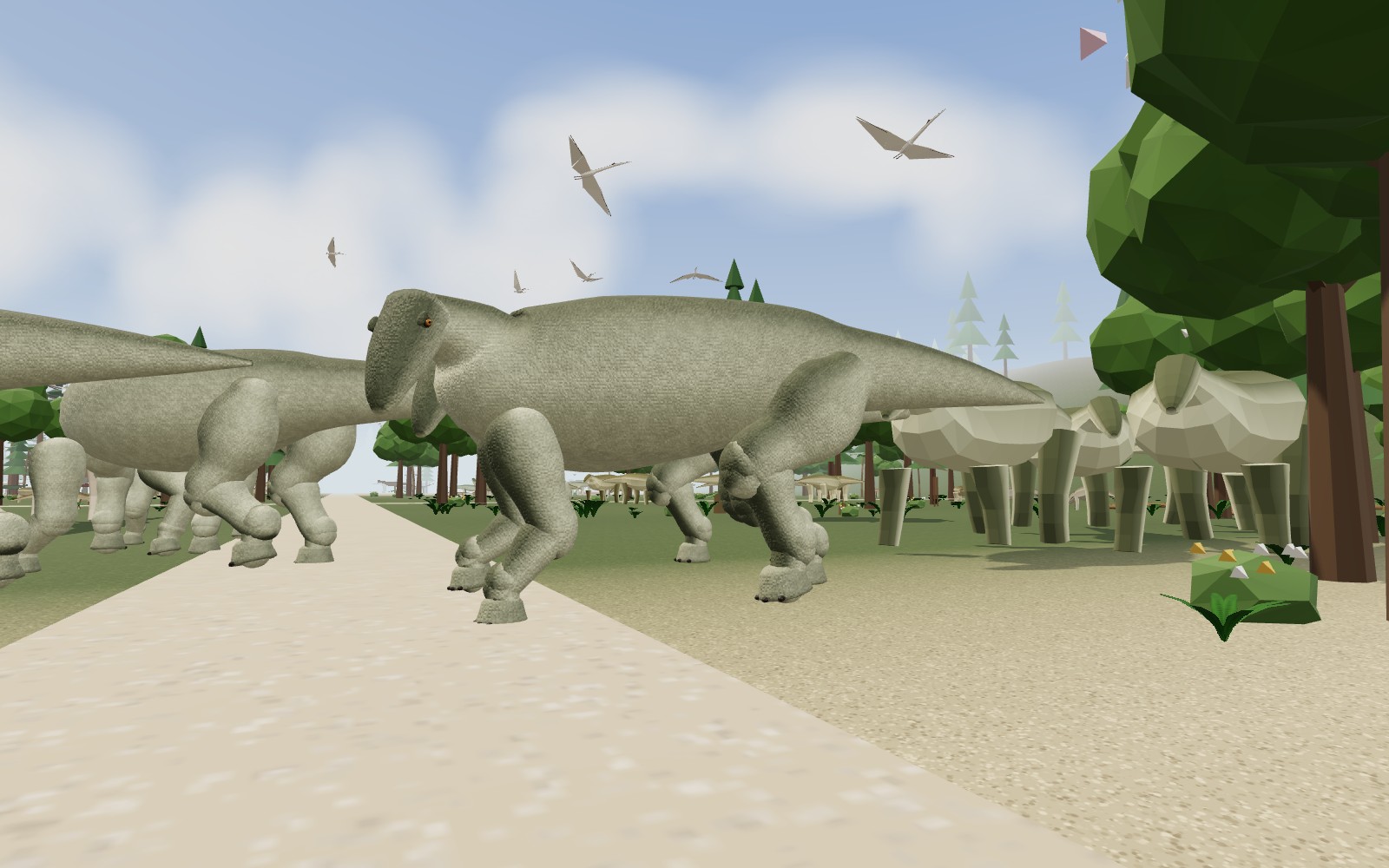
03 Diplodocus at the river A herd of Diplodocus walks a loop that crosses the river and stops to drink. At 26 m it is longer than Brachiosaurus but weighs about a third as much.
04 How far apart in time? The board on the road puts the park on one time line. Stegosaurus and T. rex are about 80 million years apart, more than the time between T. rex and us. That is why each age has its own fenced area.
05 The first dinosaurs The Triassic area is dry and open, with no flowers and no grass. Plateosaurus walked on its hind legs and was one of the first large plant-eaters.
06 Older than any dinosaur Dimetrodon in the Permian corner is not a dinosaur. It died out about 40 million years before the first dinosaurs and is closer to mammals than to reptiles.
07 Tyrannosaurus rex Its hips are 4 m off the ground, more than twice the height of the person standing nearby. The model is scaly, because fossil skin from tyrannosaurs shows scales.
08 Triceratops It lived in the same place and at the same time as T. rex. The head carries a bony frill and three horns, and it was close to a quarter of the animal's length.
09 Velociraptor is small The real Velociraptor was about the length of a person lying down, and most of that is tail. Quill knobs on its arm bones show it had feathers.
10 The Cretaceous sea From the beach you can see Mosasaurus, a giant sea lizard, not a dinosaur. The sea is split by age like the land, so it never meets the Jurassic plesiosaurs.
11 Above the park Flying high shows the whole Late Cretaceous area. Pteranodon is a pterosaur, a flying reptile, and not a dinosaur. Use the travel buttons or keys 1 to 4 to walk, run, drive or fly.
Dimetrodon (not a dinosaur) Not a dinosaur. It is closer to mammals than to reptiles and died out about 40 million years before the first dinosaurs. Eoraptor One of the earliest dinosaurs known. It weighed about 10 kg, as much as a small dog. Herrerasaurus An early meat-eater from the Ischigualasto rocks of Argentina, among the first large predatory dinosaurs. Coelophysis A slim, fast hunter. Hundreds of skeletons were found together at Ghost Ranch in New Mexico. Plateosaurus Walked on its hind legs, with a long neck and grasping hands. Dozens of skeletons come from Germany and Switzerland. Riojasaurus A heavy early relative of the giant sauropods. About 20 skeletons have been found, adults and young. Thecodontosaurus Found near Bristol and named in 1836, one of the first dinosaurs ever named. Ichthyotitan (not a dinosaur) A giant ichthyosaur known only from two jawbones found on English beaches. Scaled up from relatives, it was about 25 m long. Dilophosaurus Two thin bony crests ran along the top of its head. There is no fossil evidence for the neck frill shown in films. Scelidosaurus An early armoured dinosaur with rows of bony studs along its back, found on the Dorset coast. Massospondylus Nests of its eggs, some with embryos inside, have been found in South Africa. Heterodontosaurus A small plant-eater with three kinds of teeth, including a pair of tusks. Megalosaurus The first dinosaur to be given a scientific name, in 1824, from bones found near Oxford. Huayangosaurus An early stegosaur from Sichuan with small pointed plates and a spike on each shoulder. Stegosaurus The model has the size of Sophie at the Natural History Museum in London, the most complete Stegosaurus skeleton. Large adults reached about 9 m. Brachiosaurus Its front legs were longer than its back legs, so the back sloped up to the shoulders and the head reached about 12 m. Allosaurus The commonest large hunter of the Morrison Formation, with a crest above each eye. Diplodocus Very long but light for a sauropod. Most of its length is a long neck and an even longer, whip-like tail. Apatosaurus A close cousin of Diplodocus with a much thicker neck and heavier body. Camarasaurus The most common sauropod in the Morrison Formation, with a short boxy head and spoon-shaped teeth. Ceratosaurus A hunter with a blade-like horn on its nose and a row of small bony plates down its back. Kentrosaurus An African stegosaur from Tendaguru in Tanzania. Narrow plates over the front half turn into long spikes over the hips and tail. Dryosaurus A light, long-legged plant-eater that probably relied on speed to escape predators. Camptosaurus A heavy plant-eater that could walk on two legs or four, an early relative of Iguanodon. Mamenchisaurus A Chinese sauropod with one of the longest necks of any animal, about half its body length. Archaeopteryx A feathered dinosaur with wings, teeth and a bony tail. Fossils from Solnhofen in Germany show its feathers. Compsognathus One of the smallest dinosaurs, about the size of a chicken. One skeleton has a lizard in its stomach. Plesiosaurus (not a dinosaur) A marine reptile, not a dinosaur, found by Mary Anning at Lyme Regis. It swam with four flippers. Liopleurodon (not a dinosaur) A short-necked pliosaur with a huge head. The largest were probably about 10 m long. Dimorphodon (not a dinosaur) A pterosaur found by Mary Anning in 1828, with a deep head and two kinds of teeth. Rhamphorhynchus (not a dinosaur) A long-tailed pterosaur with a vane at the tail tip. Fossils from Solnhofen show fish in its gut. Pterodactylus (not a dinosaur) The first pterosaur ever named. People often call every pterosaur a pterodactyl, but this is the real one. Iguanodon Had a large spike on each thumb. In 1878 miners in Belgium found more than 30 skeletons in one coal mine. Baryonyx A long-snouted fish-eater with a big claw on each thumb. Fish scales were found where its stomach had been. Deinonychus Its discovery in the 1960s changed the picture of dinosaurs from slow reptiles to active, bird-like animals. Microraptor A small dinosaur with long feathers on both arms and legs. Its feathers had a glossy black sheen, worked out from fossil pigment. Psittacosaurus An early horned dinosaur with a parrot-like beak. One fossil keeps long bristles on its tail. Hypsilophodon A small, quick plant-eater from the Isle of Wight. Utahraptor The largest known raptor, with a big sickle claw on each foot. Sauropelta An armoured dinosaur with long spikes on its neck and shoulders and no tail club. Polacanthus An armoured dinosaur from the Isle of Wight with a solid shield of bone over its hips. Spinosaurus A sail-backed fish-eater that probably spent much of its time in rivers. Its first bones were destroyed in Munich in 1944. Giganotosaurus One of the largest meat-eating dinosaurs, as long as T. rex but with a lower, narrower skull. Argentinosaurus One of the heaviest land animals ever, known from only a few bones, so its size is an estimate. Carnotaurus Had two horns above its eyes and tiny arms, shorter even than those of T. rex. Skin impressions show rows of scales. Saltasaurus A small titanosaur. Bony plates in its skin showed for the first time that some sauropods wore armour. Velociraptor About the length of a person lying down, most of it tail. Quill knobs on a forearm bone show it had long arm feathers. Protoceratops A sheep-sized horned dinosaur with a frill but no real horns. One fossil was buried locked in a fight with a Velociraptor. Oviraptor Its name means egg thief, but later finds showed that relatives sat on their own nests like birds. Gallimimus An ostrich-like dinosaur with a small toothless beak, long neck and long legs built for running. Therizinosaurus A plant-eating theropod with enormous hand claws, the longest of any known animal. Tarbosaurus The Asian cousin of T. rex, very similar in shape but a little smaller. Tyrannosaurus rex The hips stand 4 m high, as on the Field Museum skeleton SUE. Skin impressions from tyrannosaurs show scales. Triceratops Lived in the same place and time as T. rex. Its head was close to a quarter of its length. Ankylosaurus Covered in bony plates, even over its eyelids, with a heavy bone club at the end of its tail. Pachycephalosaurus The bone on top of its head was up to 25 cm thick. Whether it butted heads with rivals is still argued about. Edmontosaurus A duck-billed dinosaur with hundreds of grinding teeth. Mummified fossils keep its skin. Parasaurolophus Its long hollow crest held looping air passages and may have been used to make low calls. Corythosaurus A duck-billed dinosaur with a tall, rounded crest like a helmet. Maiasaura Its name means good mother lizard. Nesting grounds in Montana hold eggs, babies and young of several ages. Styracosaurus A horned dinosaur with one long nose horn and long spikes around the edge of its frill. Euoplocephalus One of the best known armoured dinosaurs, with a tail club and bands of bony plates across its back. Deinosuchus (not a dinosaur) A giant relative of alligators, not a dinosaur. Bite marks on dinosaur bones show that it ate dinosaurs. Mosasaurus (not a dinosaur) A giant marine lizard, not a dinosaur. Length is worked out from skulls, so estimates run from about 11 to 18 m. Pteranodon (not a dinosaur) A toothless fish-eating pterosaur. Its hollow bones had walls about 1 mm thick, so it weighed no more than about 10 kg. Quetzalcoatlus (not a dinosaur) One of the largest flying animals ever, with a wingspan of about 10 m. On the ground it stood as tall as a giraffe. Person for scale A faceless figure 1.7 m tall. One stands by each animal the guide visits. Area sign: Permian corner Early Permian, 286–270 million years ago. Dimetrodon here died out about 40 million years before the first dinosaurs. It is closer to us than to any dinosaur. Area sign: Triassic Late Triassic, 228–201 million years ago. The first dinosaurs. Most were small, and the land was dry and seasonal. There were no flowers and no grass. Area sign: Early and Middle Jurassic 208–160 million years ago. Dinosaurs spread across the land after an extinction at the end of the Triassic. Conifers, cycads, ginkgos and ferns. Area sign: Late Jurassic 155–140 million years ago. The age of giant sauropods. Still no flowering plants: the forest is conifers, ginkgos, cycads and ferns. Area sign: Early Cretaceous 140–94 million years ago. The first flowering plants appear, still small and rare. Most of the forest is the same as in the Jurassic. Area sign: Late Cretaceous: South America and Africa 100–66 million years ago. The southern continents had their own giants. These animals never met T. rex. Area sign: Late Cretaceous: Gobi 85–70 million years ago. Sand dunes and dry scrub in what is now Mongolia. Area sign: Late Cretaceous: North America 83–66 million years ago. Flowering trees and shrubs, palms and conifers. Grass was still rare. T. rex lived here until 66 million years ago. Time chart A board on the road at the Jurassic area that puts the Permian, Triassic, Jurassic and Cretaceous on one line, with you at the end.