Loading the model
This device cannot show the 3D model. You can read the guide steps below as text.
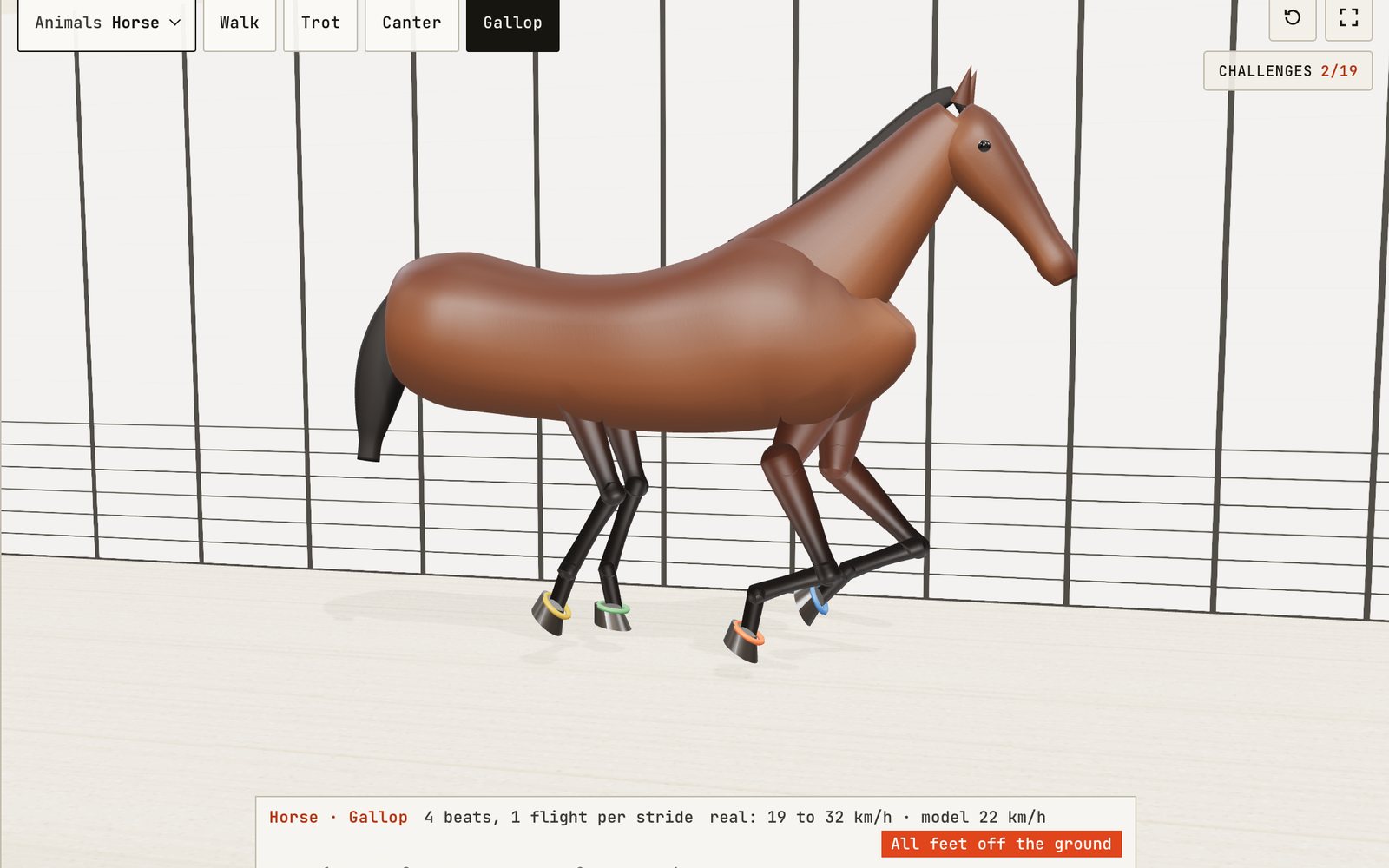
1 / 17 A horse with a body you can see through The horse is built in code: a smooth skin over the main muscle masses of the shoulder, barrel and haunch, with the skeleton inside. It opens at a slow gallop and stops for a moment when all four feet are off the ground. It runs on the spot while the ground slides back under it, so a hoof on the ground stays put on the sand. Choose Animals above the horse to pick one of 52 animals.
Drag to turn. Scroll or pinch to zoom.
Guide Parts Controls
01 A horse with a body you can see through The horse is built in code: a smooth skin over the main muscle masses of the shoulder, barrel and haunch, with the skeleton inside. It opens at a slow gallop and stops for a moment when all four feet are off the ground. It runs on the spot while the ground slides back under it, so a hoof on the ground stays put on the sand. Choose Animals above the horse to pick one of 52 animals.
02 Walk: four beats At the walk each foot lands on its own beat: left hind, left fore, right hind, right fore. Two or three feet are always down, as the diagram under the model shows.
03 Trot: diagonal pairs The trot has two beats. Left fore and right hind land together, then right fore and left hind. Between the pairs there is a short moment with no foot on the ground.
04 Canter: three beats In a right-lead canter the left hind lands first, then the right hind and left fore together, then the right fore. A gap with all feet in the air follows.
05 Gallop: four beats The gallop splits the middle beat of the canter in two, so the hind foot lands just before the diagonal fore foot. Pick another gait at the top of the model to compare the diagrams.
06 All four feet in the air The gallop runs here at a tenth of real speed. The airborne moment comes after the leading fore foot pushes off, and the legs are gathered under the body, not stretched out. Drag Stride position to find the moment yourself.
07 The knee that is really a wrist With See inside on, the skin fades and the skeleton shows. The joint people call a horse's knee is its wrist, and the hock on the hind leg is its ankle. Below them the leg is bone, tendon and hoof with almost no muscle.
08 A planted hoof does not slide With hoof prints switched on, each landing leaves a mark. The hoof stays on its mark until it lifts, because it moves back at exactly the speed of the ground.
09 Muybridge's backdrop In June 1878 Eadweard Muybridge photographed Leland Stanford's horses at Palo Alto against a lined white backdrop. His pictures settled the argument about the airborne moment.
10 The camel paces Switch to the camel. Both legs on one side swing forward together, left pair then right pair, so the body rocks from side to side. Dagg's 1974 study found dromedaries paced routinely and never trotted.
11 A fast elephant keeps a foot down The elephant's fast walk keeps the walking order, and the diagram never shows a gap with no foot down. Elephants measured at up to 6.8 m/s, about 24 km/h, did the same.
12 The giraffe gallops on the ground Adult giraffes filmed from a drone used a rotary gallop between 3.4 and 6.9 m/s, and none of them had all four feet off the ground. Compare its diagram with the horse's gallop.
13 Two flights in every stride The cheetah's gallop has two airborne gaps: one with the legs stretched out after the hind feet push off, and one with them gathered after the front feet leave. Collars on wild cheetahs recorded 25.9 m/s, about 93 km/h.
14 Two legs: walking and running A person walks with one foot always down and runs with two short flights per stride. The change happens at about 2 m/s. Turn on Person 1.75 m to put a standing person beside any animal for scale.
15 The tölt: one foot at a time The Icelandic horse's tölt keeps the walk's order of footfalls but goes much faster, from about 2.9 to 4.7 m/s in one study, with no moment in the air. One or two feet are down at a time, so the rider barely bounces. More breeds and gaits are under Horse breeds and gaits below the stage.
16 A hippo trots, and only trots Hutchinson and Pringle measured 169 strides of 32 hippos. Every one was a trot or close to it, and at the highest speeds the hippos had short moments with all four feet in the air.
17 Six legs: the tripod An ant walks on two alternating tripods: front and hind legs on one side move with the middle leg on the other side, so three feet are always down. The ant is shown 20 times larger, and the slowest playback speed is set because the real legs move too fast to follow.
Body and muscle The skin is lofted over the big muscle masses: shoulder, barrel and haunch. The haunch is the widest part behind, because the hind legs push the horse forward. Neck and head A long neck and heavy head carry a large share of the weight at the front. In the model they move with the trunk. Mane Long hair along the crest of the neck and the forelock between the ears. Tail The tail hair hangs from a short bony dock and swings a little with each stride. Leg muscles and tendons Muscle sits high on the legs. Below the knee and hock there is almost none, only bone and tendon, so the lower leg is light and swings fast. Spine and tail bones The backbone runs from the skull to the tail. The tall spines over the shoulders make the withers, the highest point of the back. Ribs Only 13 pairs are drawn, fewer than a real horse has. They hang from the spine and carry the weight of the gut between the legs. Shoulder blade A horse has no collarbone. The shoulder blade is held to the trunk by muscle alone and slides over the ribs as the foreleg swings. Pelvis Fixed firmly to the spine. The push of the hind legs reaches the body through the pelvis, which is why the hindquarters are called the horse's engine. Upper foreleg Humerus and radius. The elbow between them points backwards. Upper hind leg Femur and tibia. The stifle between them points forwards and matches the human knee. Knee, hock and cannon The horse's knee is a human wrist and the hock is an ankle. The long cannon bone below each one matches a single bone of the palm or the middle of the foot. Pastern and hoof The horse stands on the tip of one toe, and the hoof is its nail. The coloured band on each hoof matches that leg's row in the footfall diagram. Muybridge-style backdrop White boards with lines 21 inches (53 cm) apart and lines 4 inches (10 cm) apart near the ground, as Muybridge set up at Palo Alto in 1878. They move back with the ground.