Loading the model
This device cannot show the 3D model. You can read the guide steps below as text.
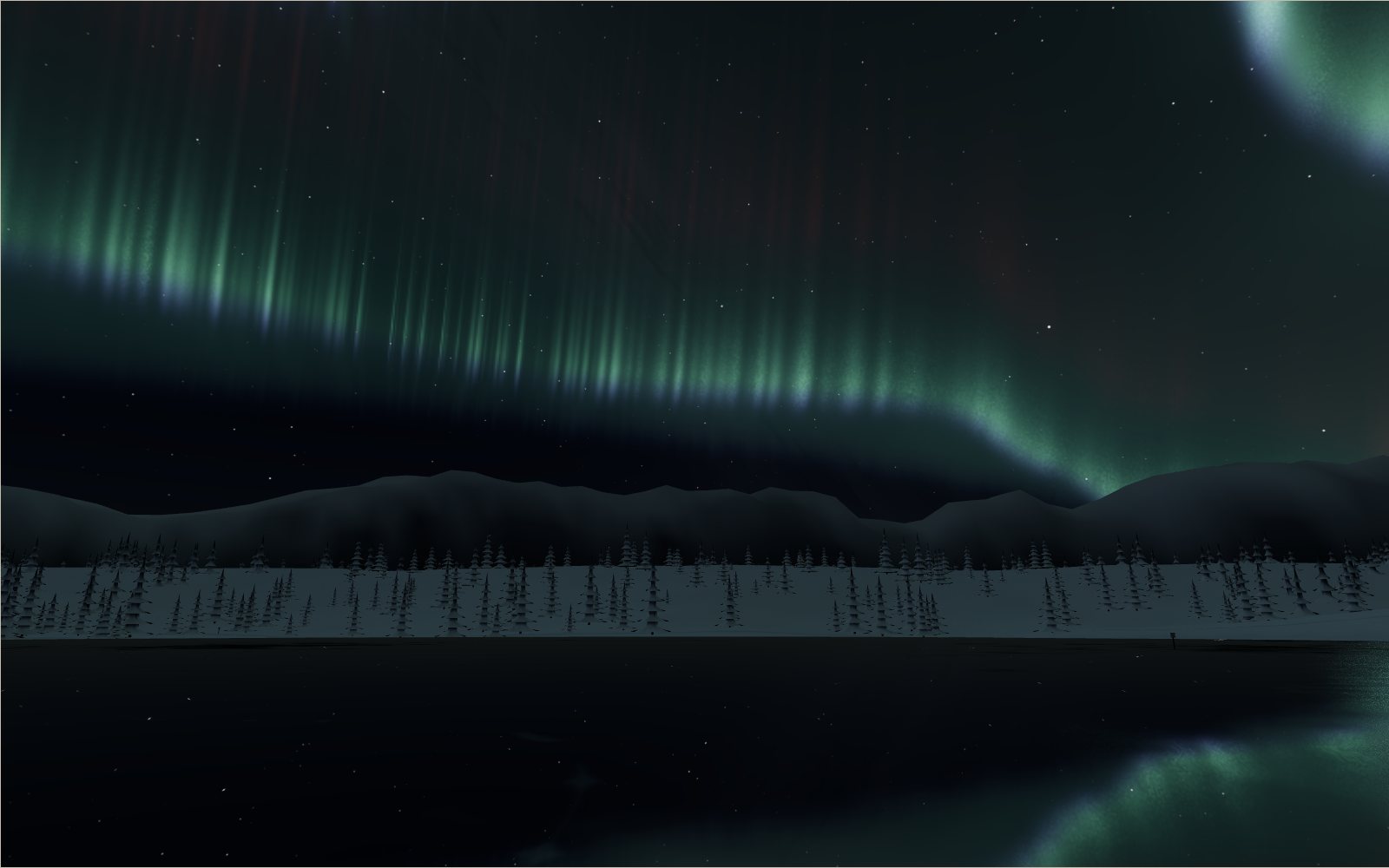
1 / 14 Curtains over the lake An Arctic village at Tromsø's latitude, late on a February evening. A substorm is breaking up overhead and the black ice of the lake shows it again upside down. Drag to look up.
Drag to turn. Scroll or pinch to zoom.
Guide Parts Controls
01 Curtains over the lake An Arctic village at Tromsø's latitude, late on a February evening. A substorm is breaking up overhead and the black ice of the lake shows it again upside down. Drag to look up.
02 A colour for each height The height ruler sets the aurora against things you know. Green oxygen light starts at about 100 km, about nine airliner heights up. The red at the top reaches past the space station's 410 km.
03 Soft electrons give red Turn the electron energy down to 0.2 keV. The electrons stop high, above 200 km, where oxygen can give off its slow red light before it bumps into anything. Green fades, red takes over.
04 A storm moves the oval south At Kp 7 the oval's edge drops to about 53° geomagnetic latitude at midnight. Tromsø, at 67.5°, ends up poleward of the brightest aurora: look south to find it.
05 Under the corona Near magnetic midnight energy stored in the magnetic tail is let go. Right under the breakup the rays seem to meet at one point overhead, because they follow parallel field lines.
06 The lake as a mirror Bare black ice reflects the sky. Where snow has drifted the mirror breaks into white patches, and thin cracks show as pale lines.
07 What the observatory measures During a breakup a current flows about 100 km overhead and the magnetometer's north component dips by hundreds of nanotesla. The all-sky camera beside it photographs the whole sky at once.
08 Eye and camera The shutter is set to the eye: in the dark we see with rods, which give no colour, and faint aurora looks grey. Pick 10 s and take a photo; the camera adds up light for the whole time.
09 Polar night On 21 December at noon in Tromsø the Sun stays about 3° below the horizon. Only a blue twilight lights the south. From the tower you can see how dark midday is.
10 Seen from Korea Seoul lies near geomagnetic latitude 29°. At Kp 9 the oval comes down to about 48°, and only the red top, up to about 475 km, peeks over the northern horizon. On 12 May 2024 cameras in Hwacheon caught exactly that.
11 The southern lights At King Sejong Station in Antarctica the oval lies to the south. In June the Sun barely clears the horizon at noon, and the same storm lights the northern and southern ovals together.
12 Aurora at noon In Svalbard in December the town sits under the day side of the oval while the Sun stays far below the horizon. The aurora shows at lunchtime.
13 The oval from space From space the aurora is a ring round each geomagnetic pole, not a cap over the North Pole. Drag to turn the Earth and find the southern ring; push Kp up to watch both rings grow.
14 Jupiter Jupiter's ultraviolet aurora covers areas bigger than the whole Earth. The bright spot beside the oval is where field lines from the moon Io land. Earth is drawn at the same scale.
Village Twelve log cabins, a wooden chapel with a clock and a sauna by the shore. Warm windows, cold air. Frozen lake Black ice with drifts of snow. Where the ice is bare it reflects the aurora. Spruce forest Snow-laden spruce to the west. The sled trail runs through it. Lookout hill A 34 m hill with a 9 m tower. From the top the whole sky is open. Observatory A dome, a magnetometer hut and an all-sky camera, with two screens showing what they measure. Sled trail A loop of packed snow round the lake. Try it on the sled. Tromsø, Norway 69.7° N. Under the oval on most clear winter nights. Kiruna, Sweden 67.9° N, in Swedish Lapland. Rovaniemi, Finland 66.5° N, on the Arctic Circle. No polar night. Fairbanks, Alaska 64.8° N. High geomagnetic latitude for its geographic latitude. Yellowknife, Canada 62.5° N, under the oval more often than Fairbanks. Reykjavík, Iceland 64.1° N. Under the oval at moderate Kp. Longyearbyen, Svalbard 78.2° N. Often poleward of the night-side oval; aurora at noon in December. Seoul, Korea 37.6° N, geomagnetic latitude about 29°. Only red, only in the biggest storms. Hwacheon, Korea Where red aurora was photographed on 12 May 2024. Hobart, Tasmania 42.9° S. The southern lights, looking south. King Sejong Station 62.2° S, on King George Island off the Antarctic peninsula. Jang Bogo Station 74.6° S, on the Ross Sea side of Antarctica. South Pole 90° S. Months of night, inside the southern oval. People for scale Smooth mannequins at your height. The green light starts about 60,000 times higher. Space view Earth with both ovals, then Jupiter, Saturn and Mars.