Loading the model
This device cannot show the 3D model. You can read the guide steps below as text.
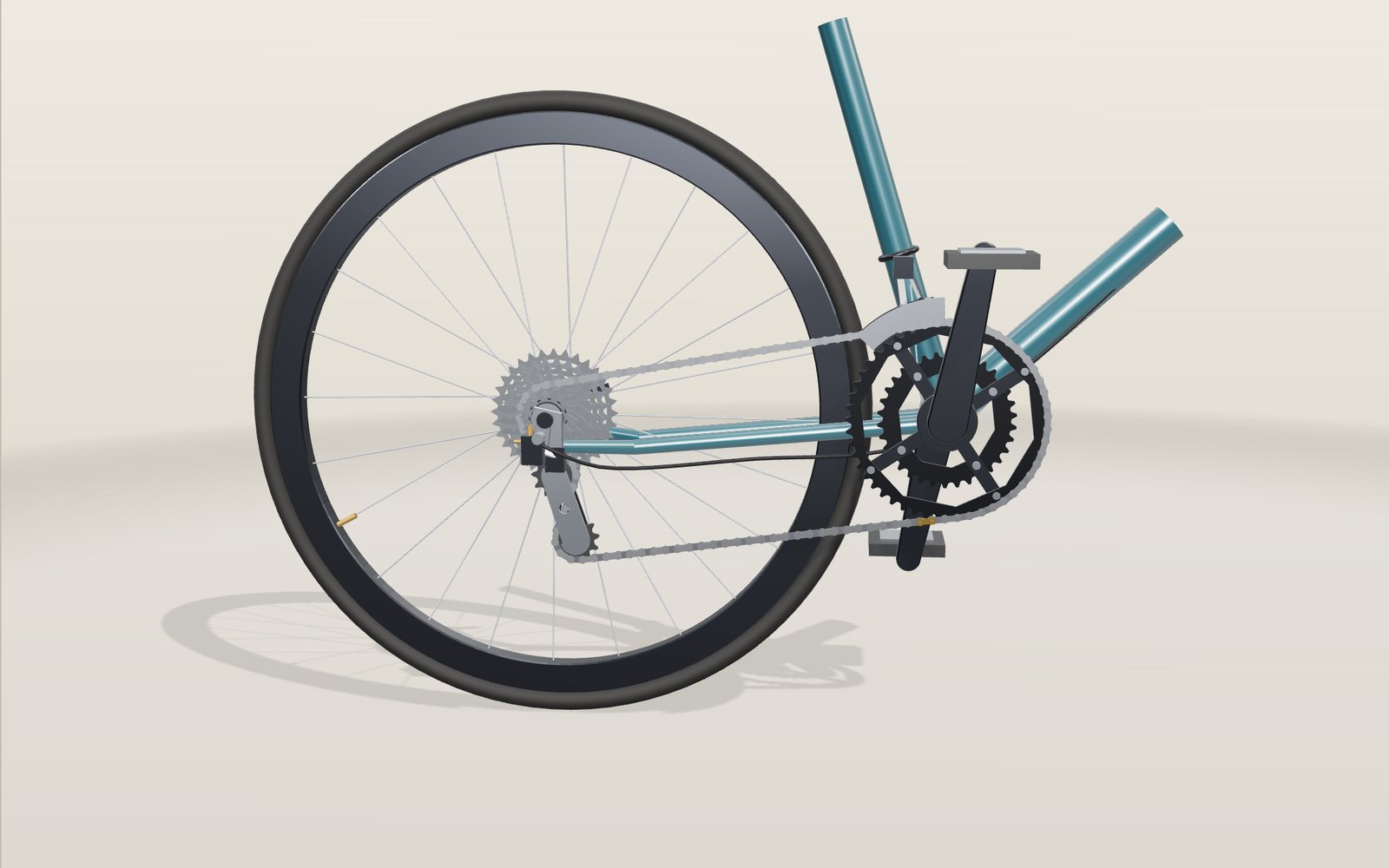
1 / 11 A road bike drivetrain The cranks turn the chainrings, the chain carries the turn back to a cog on the rear wheel. Use the Front and Rear buttons to change gear and watch the numbers in the corner. Under Controls there is a gear table for 26 real drivetrains.
Drag to turn. Scroll or pinch to zoom.
Guide Parts Controls
01 A road bike drivetrain The cranks turn the chainrings, the chain carries the turn back to a cog on the rear wheel. Use the Front and Rear buttons to change gear and watch the numbers in the corner. Under Controls there is a gear table for 26 real drivetrains.
02 Two chainrings A 50-tooth ring for speed and a 34-tooth ring for climbing. Every tooth that passes the top of the ring pulls one link of chain forward.
03 Eleven cogs on the cassette Smaller cogs give harder gears. With 50 teeth in front and 13 at the back the wheel turns 3.85 times for each turn of the pedals.
04 Links on teeth Slowed to 1.8 pedal turns a minute. Each roller drops into a gap between two teeth, 12.7 mm from the next one, on every sprocket and pulley.
05 The rear derailleur Seen from behind and to the side. The parallelogram carries the upper pulley close under the chosen cog. The lower pulley swings on its cage so the chain stays tight on a 25-tooth cog as well as an 11.
06 The front derailleur Seen from above and behind, on the small ring. The cage only moves sideways. Shift to 50 and the inner plate pushes the chain up onto the big ring.
07 Top gear, 50 × 11 Ratio 4.55. One turn of the pedals rolls the wheel 9.57 m, and at 90 turns a minute that is 51.7 km/h.
08 Cross-chaining Big ring with the biggest cog, from above. The chain runs at 3.2° to the sprockets, rubs the derailleur cage and wears faster. The same ratio is available closer to a straight line on the small ring.
09 Shifting, slowed down A shift to the 18-tooth cog at 1.8 pedal turns a minute. The derailleur moves at once, but each link lands on the new cog only after it has passed the upper pulley, so the chain moves across one link at a time as the cassette turns.
10 A 6 % climb At 200 W the model rider holds 13.4 km/h. In 34 × 28 that is 87 pedal turns a minute; in 50 × 11 it would be 23, far too slow to push. The readout shows the cadence each gear needs.
11 Into a headwind Flat road, 20 km/h headwind, still 200 W. Speed drops from 35.9 to 24.6 km/h and the gear that keeps about 90 rpm moves from 50 × 16 to 34 × 16.
Chainrings 50 and 34 teeth, 7.6 mm apart. The big ring has a pitch diameter of 202.3 mm, the small one 137.6 mm. Spider and ring bolts Four arms carry both rings on bolts 110 mm apart (bolt circle diameter). The rings and cranks turn as one piece. Crank arms 172.5 mm from the spindle to the pedal axle. One turn of the cranks turns the rings once. Pedals Where the rider's force goes in. At 90 rpm each pedal passes the bottom of its circle one and a half times a second. Bottom bracket Shell, bearing cups and the 24 mm spindle that joins the two cranks through the frame. Chain plates 108 links of 12.7 mm (1/2 in). Inner and outer plates alternate, so the chain can bend a little sideways. Rollers and pins A roller turns on every pin and rolls into the tooth gaps instead of sliding over the teeth. Quick link A pair of outer plates that open without a chain tool. Shown in gold here. Cassette Eleven cogs: 11, 12, 13, 14, 16, 18, 20, 22, 25, 28 and 32 teeth (Shimano CS-R7000 11-32), 3.85 mm apart in the model. Freehub body Splined shell that carries the cassette. A ratchet inside lets the wheel coast while the cranks stand still. Rear hub Hub shell and spoke flanges. It turns with the wheel; the freehub drives it. Axle and quick release The axle stays still in the dropouts. A cam lever clamps it in place. Rear wheel 700x25c tyre (ETRTO 25-622) on its rim. Rolling circumference 2,105 mm. Spokes 24 spokes, tangential. They carry the drive from the hub to the rim. Rear derailleur body The upper knuckle bolts to the hanger; the lower knuckle carries the cage. A cable pulls it inwards. Parallelogram Two links and four pivots, slanted so that the upper pulley moves down as it moves in. A spring pulls it back out. Derailleur cage 72 mm between the pulley centres. It swings forward to take up slack chain, by 77° in 50 × 32. Derailleur pulleys Two 11-tooth wheels. The upper one guides the chain onto the cog; the lower one keeps it tight. Limit and B screws Two screws stop the derailleur at the smallest and largest cog; the B screw sets the gap under the cog. Derailleur hanger A small replaceable plate. It bends before the frame does if the derailleur is hit. Front derailleur Clamped to the seat tube. Its links move the cage sideways only. Front derailleur cage Two steel plates either side of the chain. The inner plate lifts the chain onto the big ring. Gear cables Steel inner wires in housing. Each click of the lever pulls or releases a set length of cable. Frame tubes Seat tube and down tube, cut short. Chainstays 410 mm from the centre of the bottom bracket to the rear axle. Dropouts Slots that hold the rear axle; the hanger is on the drive side.