Loading the model
This device cannot show the 3D model. You can read the guide steps below as text.
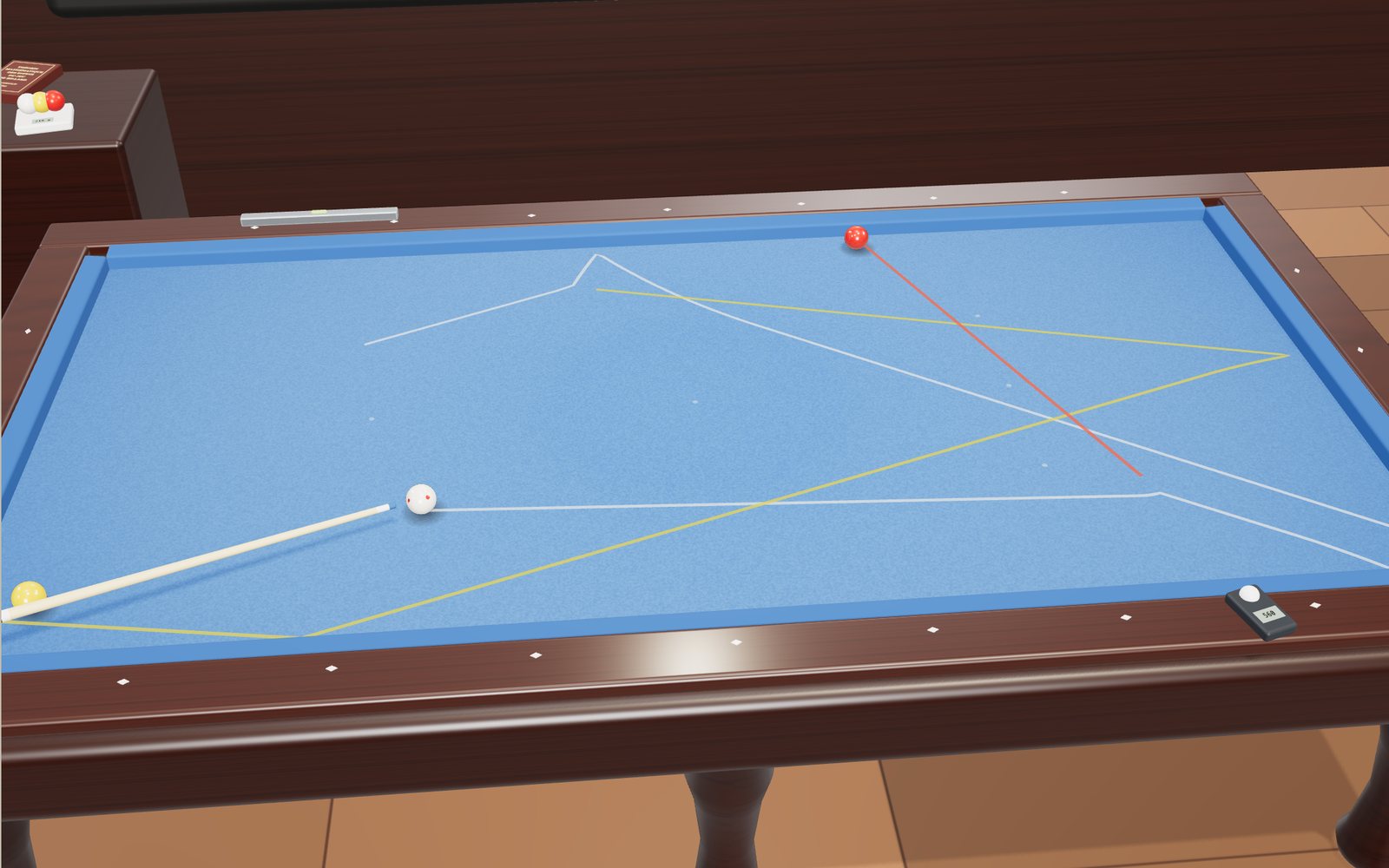
1 / 14 A three-cushion point The cue ball hits the yellow, runs off three cushions and reaches the red. That is one point in three-cushion billiards, and the trails stay on the cloth so you can follow every bounce.
Drag to turn. Scroll or pinch to zoom.
Guide Parts Controls
01 A three-cushion point The cue ball hits the yellow, runs off three cushions and reaches the red. That is one point in three-cushion billiards, and the trails stay on the cloth so you can follow every bounce.
02 Two tables beside a person A carom table is 2.84 by 1.42 m inside the cushions, a 9-foot pool table 2.54 by 1.27 m. The 1.7 m figure stands at the corner; set your own height with Me.
03 Aim at the ghost ball To pot a ball, picture a second ball touching it on the side away from the pocket. That ghost ball is where the cue ball's centre must be at contact.
04 Thickness and cut angle Thickness is the share of the object ball your aim line covers. A full hit is 1, aiming at the edge is a half-ball hit and a cut of 30 degrees.
05 The 90 degree rule A cue ball that slides with no spin at contact leaves along the tangent line, square to the object ball. Real balls part nearer 85 degrees; watch it slowed to a quarter.
06 Sliding, then rolling Struck at its centre, a ball slides first. Friction spins it up until it rolls, after 12/49 of v squared over mu g, at 5/7 of its speed. A ring marks the spot.
07 Follow A tip above centre gives topspin. It survives the contact, so after a full hit the cue ball runs on behind the object ball.
08 Draw A tip below centre gives backspin. After a full hit the cue ball stops for an instant and the spin pulls it back toward you.
09 Side spin at the cushion On a level cue, side spin leaves the path straight. At the cushion it changes the rebound angle, wider with running side and shorter with reverse side.
10 One cushion first When a ball blocks the line, the cue ball can reach the target off a cushion. The rebound is not a mirror image: spin and friction bend it.
11 The diamond system Corner-5 numbers on the rails give arrival = cue number minus first-rail number. It is a rule of thumb for medium speed with running side; compare it with the trail.
12 Curving the ball Raise the cue to 45 degrees and hit off centre. The ball spins about a tilted axis, and cloth friction bends its path round the yellow.
13 Pool: one-shot pot Six pockets, sixteen balls and smaller, lighter balls: 57.15 mm against 61.5 mm. Pot the yellow 1 in one shot and keep the cue ball on the table.
14 Practise on your own Drag on the cloth to aim, set spin on the ball pad and speed in the bar. Tasks with stars, the shot collection and the hidden finds are under the controls.
Cue ball The white ball you strike. Its red training dots show the spin: watch them turn backwards in a draw shot. Yellow ball The second player's cue ball in carom. In three-cushion it is one of the two object balls you must hit. Red ball The third ball. A point needs the cue ball to touch both object balls. Cloth Worsted wool over slate. Ball-cloth sliding friction is about 0.2, rolling resistance about 0.01, twenty times smaller. Cushion Rubber covered in cloth. Its nose is 37 mm high on a carom table, above the ball's centre, so it pushes the ball down as well as back. Diamonds Inlays on the rail cap, L/8 apart on the long rails and W/4 on the short rails. Diamond systems count in these units. Rail cap The wooden top of the frame. The WPA allows 10.16 to 19.05 cm of rail width including the cushion. Cue Tapered wood, about 1.45 m here. The WPA allows any length over 1.016 m and a weight up to 708.75 g. Leather tip Glued to the ferrule. It touches the ball for about a thousandth of a second; past half a radius off centre it tends to slip off. Ghost ball An imagined ball touching the object ball on the far side of its path. Aim the cue ball's centre at it. Pocket Pool tables only: corner mouths 114.3 to 117.5 mm, side mouths 127 to 130.2 mm (WPA). Slate The bed under the cloth: at least 45 mm on a carom table, heated during official events. Spots Fine marks on the cloth where balls are placed to start. The UMB forbids small rings; only a fine cross. Lamp At least 520 lux on every part of the cloth and the light source at least 1 m above it. Person A 1.7 m figure for scale. Me changes it to your height. Trails Every ball leaves a line on the cloth during a shot, so the cushions it touched stay visible.