FIG. 120Follow Along
Billiards angles: aiming, spin and the diamond system, step by step
Two equal balls that meet without spin part at a right angle, and a ball struck at its centre slides for 12/49 of v²/μg before it starts to roll.
This device cannot show the 3D model. You can read the guide steps below as text.
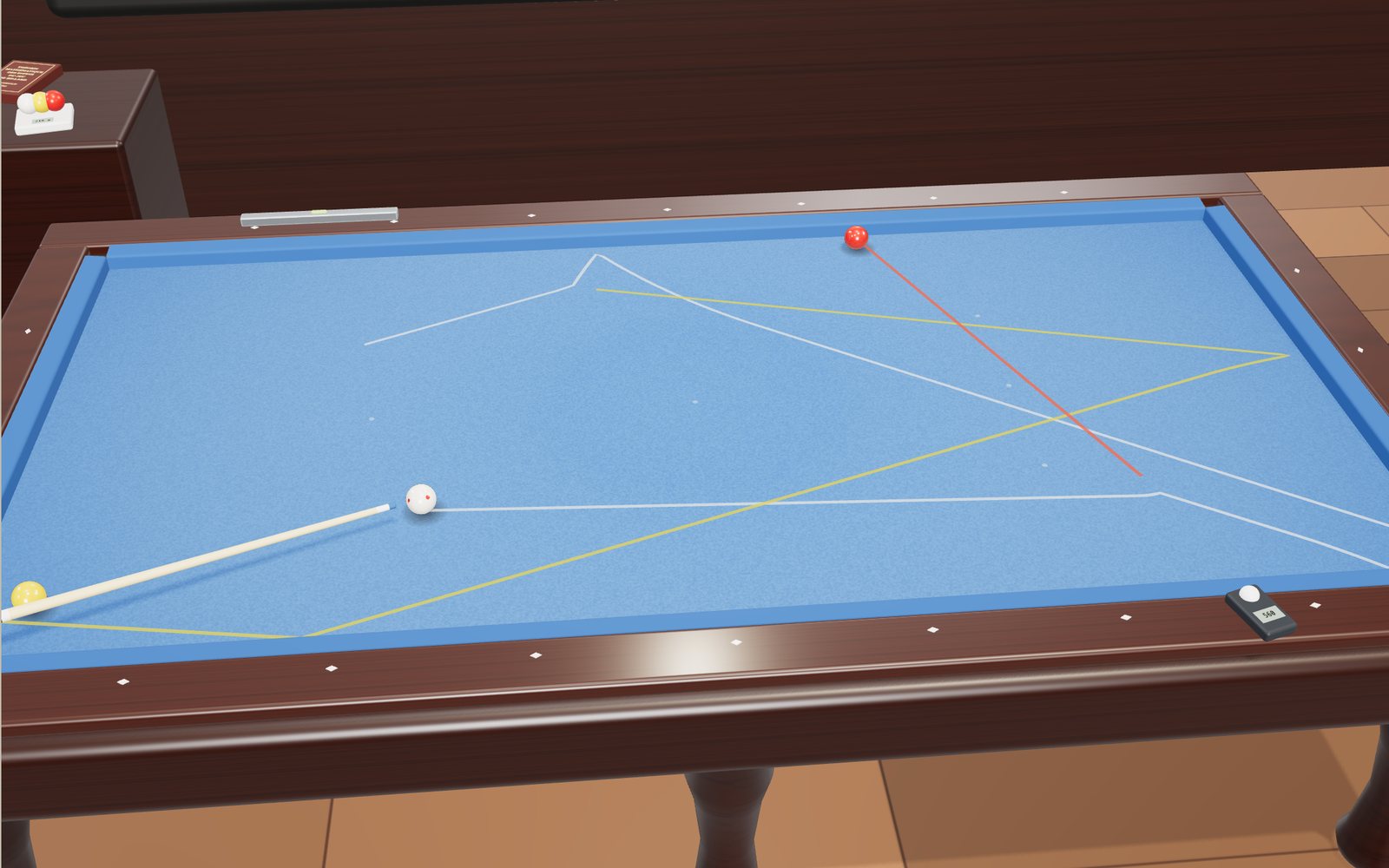
1 / 14 A three-cushion pointThe cue ball hits the yellow, runs off three cushions and reaches the red. That is one point in three-cushion billiards, and the trails stay on the cloth so you can follow every bounce.
Drag to turn. Scroll or pinch to zoom.
Why the ball does not go where you aimed
Watch a good three-cushion player for a few minutes and one thing stands out. The cue ball hardly ever travels in a straight line from the cue to the place it ends up. It glances off one ball, runs down a cushion, comes off at an angle that looks wrong, bends a little on the cloth and arrives at the last ball as if it had been steered. Nothing steers it. Every turn in that path comes from three things: the angle at which two balls meet, the spin the cue put on the ball, and the friction between ball, cloth and cushion.
This page lets you take those three things apart. The table on the stage is built to the sizes in the rule books of the two world bodies: the Union Mondiale de Billard (UMB) for carom and the World Pool-Billiard Association (WPA) for pool. The balls are run by a physics model that keeps track of where each ball is, how fast it moves and how it spins about all three axes, two thousand times a second. When you shoot, what you see is the model working out the shot, not a recording.
In the first seconds a three-cushion point plays itself: the cue ball clips the yellow, runs off three cushions and reaches the red, leaving a line on the cloth behind every ball. Then the guide goes through the ideas that make that shot possible, one at a time, each with a demonstration and a shot for you to try. Aiming with the ghost ball comes first, then thickness and cut angle and the 90 degree rule. After that you see why a ball struck at its centre slides before it rolls, and exactly how far. Follow and draw, side spin at the cushion, the diamond system that three-cushion players use to plan shots off three cushions, curving the ball with a raised cue and potting on a pool table complete the course.
Under the controls there are tasks with stars, a collection of the kinds of shot you have played, tables of the numbers behind the model and a few calculators. Around the table there are thirteen things to find. The text below explains the physics with the numbers the stage uses, so that you can check them.
Two tables, by the rule books
The carom table
Article 11 of the UMB's World Rules of Carom Billiard fixes the table. The playing surface, measured inside the cushions, is 2.84 m long and 1.42 m wide, with 5 mm of tolerance either way. That is exactly two squares side by side, which is why the diamonds on a carom table divide both rails into equal steps: eight along the length and four across, each 355 mm apart. The slate under the cloth must be at least 45 mm thick. The top of the frame stands between 75 and 80 cm above the floor. The cushions are rubber, and their front edge, the nose, is 37 mm high with 1 mm of tolerance.
The same article contains a line that surprises most people: tables for official tournaments must have an electric heater with a thermostat, switched on from the moment the table is set up until the competition ends. The heat drives humidity out of the slate and the cloth, and the rule says why in plain words: to ensure the best possible rolling. A three-cushion ball often travels several metres in a shot, and a damp cloth would take a noticeable share of that away.
Article 12 covers the balls. There are three, they must be rigorously round, between 61 and 61.5 mm in diameter (the English text says "cm", a typing slip; the five-pins rules give the same range in mm) and between 205 and 220 g. In one set the heaviest and lightest ball may differ by no more than 2 g. Article 15 asks for at least 520 lux of light everywhere on the cloth, measured with the meter lying on the cloth, warns that glare starts at 5,000 lux in direct view, and puts the light source at least 1 m above the playing surface.
The pool table
The WPA's Recommended Equipment Specifications describe a 9-foot table with a playing surface of 100 by 50 inches, 2.54 by 1.27 m, again exactly two squares. Rails are 4 to 7.5 inches wide including the cushion. 18 sights, the diamonds, sit flush on the rail cap 12.5 inches (317.5 mm) apart, each 93.7 mm back from the cushion nose. The nose height is given as a share of the ball: 63.5 % of the diameter, give or take 1 %. The slate must be at least an inch thick and flat within 0.508 mm along the length and 0.254 mm across.
Pool balls are smaller and lighter: 57.15 mm in diameter and 156 to 170 g, cast phenolic resin, one white cue ball and fifteen numbered object balls. A carom ball is about 7 % wider and 30 % heavier. The pockets are specified to the millimetre: the corner mouth, measured between the cushion noses where they turn into the pocket, is 4.5 to 4.625 inches (114.3 to 117.5 mm), and the side mouth half an inch wider, 127 to 130.2 mm. The cushion at a corner pocket must be cut at 142 degrees and at a side pocket at 104 degrees.
The WPA also gives a test for how lively the cushions are. With the cue ball on the head spot, shot through the foot spot with a level cue, centre ball and a firm stroke, the ball must travel at least four to four and a half table lengths without jumping. On the stage's pool table a centre-ball shot needs about 6.2 m/s to cover four lengths; at 4 m/s it covers 2.9. That is roughly what "a firm stroke" means in numbers.
The two side by side
On the stage the switch at the top changes the table. The carom table has no pockets, three balls and a heated bed; the pool table has six pockets, smaller balls and green cloth (the WPA allows yellow-green, blue-green or electric blue). The figure beside the table is 1.7 m tall. Put your own height into Me and it changes; the lab also tells you whether you could reach the middle of each table without the rake, using a reach of 0.62 times your height past the rail edge. That ratio is an estimate, not a measurement.
Aiming with the ghost ball
Suppose you want to send an object ball toward a pocket. The object ball will leave along the line through the two centres at the moment of contact, the line of centres, so at contact the cue ball's centre must sit on that line, one ball diameter behind the object ball. Picture a second ball there, touching the object ball on the side away from the pocket. That imaginary ball is the ghost ball, and aiming means sending the cue ball's centre to the ghost's centre.
In numbers: if the object ball is at O and the pocket at P, the ghost's centre G is
G = O − 2R (P − O) / |P − O|
where R is the ball radius. On the stage's ghost lesson the yellow 1 sits at (0.60, 0.28) m from the centre of the pool table, the top right corner pocket is at (1.27, 0.635), and R is 28.6 mm. The ghost comes out at (0.5495, 0.2532). From the cue ball at (−0.55, −0.10) that is 1.155 m away in a direction 17.8 degrees above the long axis, and the stage's stored lesson shot uses exactly that angle. In the model the ball goes in.
The ghost ball is not the point where the balls touch. That contact point is halfway between the two centres, on the surface of the object ball. Players who aim the cue ball's centre at the contact point instead of at the ghost hit the ball too thick and undercut every shot; the gap between the two aiming points is a full ball radius.
Thickness and cut angle
Look along your aim line at the object ball. The share of it that the cue ball will cover is called the thickness, or ball-hit fraction f. A full hit covers all of it (f = 1). Aiming the cue ball's centre at the object ball's edge covers half (f = 1/2). The angle between the aim line and the line of centres, the cut angle φ, follows from the geometry of two equal circles:
f = 1 − sin φ, so φ = asin(1 − f).
A half-ball hit is therefore a 30 degree cut, a quarter-ball hit about 48.6 degrees, an eighth 61 degrees and a sixteenth 69.6 degrees. The table in the lab lists these with what happens to the cue ball afterwards. Thin cuts are hard for a simple reason: near f = 0 a small change in where you aim changes the cut angle a lot. From f = 1/2 to f = 1/4 the cut grows by 18.6 degrees; from 1/8 to 1/16 it grows by 8.6 degrees for a shift of the aim of only 3.8 mm on a carom ball.
On the stage the read-out shows the cut angle and thickness for the current aim line before you shoot, and the aim lines draw three directions from the ghost: the object ball's path (red), the tangent line square to it (blue) and the direction a rolling cue ball would take (yellow).
The 90 degree rule
Hit an object ball with a cue ball that has no spin at the instant of contact, a stun shot, and the two balls part at a right angle. The object ball leaves along the line of centres and the cue ball along the tangent line, square to it. This holds for every cut angle, which makes it one of the most useful facts at the table: you can see where the cue ball will go before you shoot.
The proof uses two conservation laws. Take equal masses m, an incoming velocity v and outgoing velocities v₁ (cue ball) and v₂ (object ball). Momentum: m v = m v₁ + m v₂, so v = v₁ + v₂. Energy, for a perfectly elastic contact with no friction: ½ m v² = ½ m v₁² + ½ m v₂², so v² = v₁² + v₂². Square the first equation: v² = v₁² + v₂² + 2 v₁·v₂. The two together leave v₁·v₂ = 0: either one ball is at rest or the two velocities are perpendicular. The three vectors form a right triangle with v as the hypotenuse, which is also why the object ball's speed is v cos φ and the cue ball's v sin φ.
Real balls are not perfectly elastic. David Alciatore of Colorado State University gives a typical coefficient of restitution of about 0.93 for pool balls and concludes that the 90 degree rule is closer to an 85 degree rule. The balls also rub against each other for the instant they touch, and that friction changes the angle a little more. The model on this page uses a restitution of 0.95 and a ball-ball friction of 0.06, both inside the ranges Alciatore lists (0.92 to 0.98, and 0.03 to 0.08). With those values a stun cut parts at 81.6 degrees for a 15 degree cut, 83.9 for 30, 85.0 for 45, 85.7 for 60 and 86.2 for 75. The check that runs with this page confirms that with restitution 1 and no friction the angle is 90 degrees to within 0.05 for every cut, and that momentum is kept exactly in both cases while energy is kept only in the ideal one.
There is one exception to the rule: a dead-straight stun hit, with no cut. Then the cue ball stops on the spot and the object ball takes its speed, the stop shot. With restitution e the cue ball keeps (1 − e)/2 of its speed, 2.5 % in this model, which is why a real stop shot still creeps forward a centimetre or two.
Sliding first, rolling later: the 12/49 rule
Strike a ball exactly at its centre and it does not roll at first. It leaves the cue sliding, with no spin, and the cloth drags on the bottom of the ball. That friction slows the ball down and, at the same moment, spins it up in the rolling direction. When the spin has caught up with the speed, the bottom of the ball stops slipping on the cloth and the ball rolls.
The arithmetic is short. The friction force is μ m g, where μ is the sliding friction between ball and cloth, about 0.2 (Alciatore lists 0.15 to 0.4; Mathavan, Jackson and Parkin measured 0.178 to 0.245 on a snooker table with a high-speed camera). The ball slows at μ g. The same force acts at a lever arm R about the centre, and the ball's moment of inertia is (2/5) m R², so its spin grows at (5/2) μ g / R. The slip at the bottom of the ball, v − R ω, therefore shrinks at μ g + (5/2) μ g = (7/2) μ g. Starting from v₀ with no spin it reaches zero after
t = 2 v₀ / (7 μ g).
In that time the ball covers v₀ t − ½ μ g t², which works out to
d = 12 v₀² / (49 μ g),
and it is then rolling at 5/7 of its starting speed. At 2 m/s and μ = 0.2 that is 0.29 s and 0.50 m, and the ball rolls on at 1.43 m/s. At 1 m/s it is 0.125 m; at 4 m/s, 2.0 m. On a slower, newer cloth with μ = 0.3 the distance at 2 m/s drops to 0.33 m; on a worn cloth with μ = 0.15 it grows to 0.67 m. Two sevenths of the ball's kinetic energy goes into the cloth during the sliding, whatever the speed.
On the stage the roll lesson shoots a centre-ball shot at 2 m/s and puts a ring where the model says the ball starts rolling. The tag reads 0.50 m against the formula's 0.50 m. The check repeats this at 1, 2 and 4 m/s and compares distance, time and speed with the formulas to within 2 mm and 2 ms. Rod Cross at the University of Sydney has measured how this change from sliding to rolling looks on a felt-covered surface, and the same simple model of a constant sliding friction followed by a much smaller rolling friction is the usual starting point.
The same arithmetic says where to strike for a ball that rolls at once. The spin a cue gives is ω = 5 v b / (2 R²), where b is the height of the tip above centre (Alciatore's TP A.12). Rolling needs ω = v / R, so b = 0.4 R. That point, 70 % of the way up the ball, is the centre of percussion. Hit there and nothing slides.
Follow and draw
Spin from the tip
Move the tip above the centre and the ball leaves with topspin, more than rolling needs if the tip is above 0.4 R. Move it below the centre and the ball leaves with backspin. How far off centre can you go? Alciatore's analysis puts the useful limit at about half the radius. Beyond 0.5 R the tip is likely to slide off the ball during the thousandth of a second they touch, a miscue, even with chalk. The spin pad on the stage draws that limit as a dashed ring and will not let you go past it.
What happens at the object ball
At the contact the balls touch for well under a millisecond and their surfaces are smooth, so almost none of the cue ball's spin is passed on. The cue ball loses most of its speed along the line of centres but keeps nearly all its spin. On a full hit that leaves a cue ball almost at rest, spinning. Topspin then drives it forward behind the object ball, a follow shot; backspin pulls it back toward the player, a draw shot.
On the stage's follow lesson the cue ball is struck at 1.5 m/s with the tip 0.3 R above centre, hits the red full and runs on 0.57 m past the contact. In the draw lesson it is struck at 3 m/s with the tip 0.3 R below centre, and after the full hit it comes back 1.30 m. Backspin wears off on the way to the object ball, which is why a draw shot needs more speed than you might expect: the spin has to survive the trip.
The 30 degree rule and Coriolis's parabola
When the cue ball arrives rolling and hits the object ball at an angle, it leaves along the tangent line but still has its forward spin. The cloth then pulls it round, and it ends up travelling in a direction between the tangent line and the original aim. For a half-ball hit, Alciatore calls the result the 30 degree rule: the cue ball's path turns about 30 degrees away from the aim line, and stays close to 30 for any hit from a quarter to three quarters of the ball. He gives a way to see it with your hand: spread your index and middle fingers in a relaxed V, point one along the aim, and the other shows where the cue ball goes.
Gaspard-Gustave Coriolis worked this out in 1835. For ideal balls, the cue ball's final velocity after the curve settles is 5/7 of its velocity just after impact plus 2/7 of the velocity its spin would give it when rolling. From that, the deflection from the aim line is largest, 33.7 degrees, at a cut of 28.1 degrees. The check that runs with this page finds the maximum of the formula at 33.75 degrees and 28.1 degrees. For thicknesses 3/4, 1/2 and 1/4 the formula gives 27.6, 33.7 and 27.3 degrees; real balls, slightly inelastic, come a little lower, which is where the round number 30 comes from.
Coriolis also showed that the curve between the tangent line and the final direction is a parabola. The friction force from a sliding ball is constant in size and nearly constant in direction while the curve lasts, so the ball moves like a thrown stone under a constant pull. The check fits a parabola to the model's curved path after a half-ball hit and finds a fit with R² above 0.999.
Side spin, squirt, swerve and throw
Side spin alone does not curve the path
Hit the cue ball left or right of centre with a level cue and it spins about the vertical axis. That spin does nothing to the ball's path across the cloth. The bottom of the ball is not slipping sideways, and a spin about the vertical axis cannot push it sideways. It only shows when the ball touches something: a cushion or another ball. On the stage, set the spin pad to full right with the cue level, aim at a long cushion and watch: the path to the cushion is straight.
Squirt
Side spin does change the start of the path, for a different reason. When the tip hits off centre, the ball pushes the end of the cue sideways, and by Newton's third law the cue pushes the ball the other way. The ball leaves a little off the aim line, away from the side you hit. Alciatore's TP A.31 gives the angle from the tip offset b/R and the ratio of the ball's mass to the effective mass of the last few centimetres of the shaft:
tan(squirt) = (5/2)(b/R)√(1 − (b/R)²) / (1 + m_ball/m_end + (5/2)(1 − (b/R)²)).
With a mass ratio of 25, a typical playing cue in this model, half a radius of side gives 2.22 degrees, which is 78 mm off line after 2 m. A low-squirt shaft with a ratio of 40 gives 1.45 degrees; a heavy break cue with a ratio of 15 gives 3.47 degrees. The calculator in the lab works these out, and the Squirt switch turns the effect on and off on the stage.
Swerve
A real cue is never quite level: it has to clear the rail. With the tip off centre and the cue tilted down, part of the impulse pushes the ball into the cloth, and the spin axis tilts. A tilted spin axis means the bottom of the ball does slip sideways, and the cloth bends the path. That is swerve; with a strongly raised cue it becomes a masse, covered further down.
Throw
Friction between the balls also bends the object ball's path. At a cut, the cue ball's surface slides across the object ball's surface during contact, and the friction pushes the object ball a little off the line of centres in the direction the cue ball is moving. Alciatore calls this collision-induced throw and shows it is largest near a half-ball hit and larger at low speed. Side spin adds spin-induced throw, and the same friction passes a little spin to the object ball. In the model a 15 degree stun cut sends the object ball off at 12.3 degrees instead of 15, a throw of about 2.7 degrees. Over a metre that is 47 mm, close to half a pocket.
Cushions: why the rebound is not a mirror
A light ray leaves a mirror at the angle it came in. A billiard ball does not, for three reasons, and the stage lets you see each one.
The first is that the cushion takes speed away from the part of the motion that goes into it but not from the part along it. If the normal speed comes back at e times its value and the speed along the cushion is unchanged, the ball comes off flatter than it came in: tan(out) = e tan(in), with the angles measured from the cushion line. H. Résal noted in 1883 that experiments showed this ratio of normal speeds to be almost independent of the angle of approach, which is what makes a single number useful at all. Alciatore lists 0.6 to 0.9 for pool cushions. Mathavan and colleagues, filming a rolling snooker ball driven straight into the cushion, found it came back at 0.818 of its speed on average.
The second is the height of the nose. On a carom table the nose is 37 mm above the cloth and the ball's centre is 30.75 mm above it, so the cushion touches the ball above its centre. The contact force then points slightly down as well as back, pressing the ball into the cloth, and the friction at the nose acts on a point that is not level with the centre. Mathavan's analysis puts the contact at 7/5 of the radius above the table for snooker and pool. The WPA's 63.5 % nose height is a little lower, 1.27 R. Their numerical model, fitted to experiments, gives a cushion restitution of 0.98 and a ball-cushion friction of 0.14, and is valid up to about 2.5 m/s, above which the cushion squashes too much for a rigid model.
The third is spin. A ball spinning about the vertical axis rubs along the cushion at contact. If the rubbing points backwards relative to the ball's travel along the rail (running side), the friction pushes the ball forward along the cushion and the rebound widens. If it points forwards (reverse side), the rebound shortens. A rolling ball's topspin also rubs against the nose, which is above its centre, and this is why a rolling ball comes off a cushion and then curves: for an instant after the bounce its spin no longer matches its new direction.
In the model, a rolling ball sent into a long cushion at 45 degrees comes off at 38.9 degrees from the cushion line with no side spin, 30.0 degrees with running side and 39.3 with reverse side. At 30 degrees in, the figures are 27.4, 23.4 and 35.4. Sent straight in at 1.2 m/s, a rolling ball comes back at 0.87 of its speed right after the bounce and at 0.49 once its topspin has worn off on the cloth: the topspin keeps driving it toward the cushion for a moment.
The model's cushion is simpler than Mathavan's. It treats the bounce as a single impulse at the nose height, with a restitution of 0.9 for the normal speed and a friction of 0.2 against the slip at the nose, plus the cloth's friction under the ball for the extra push into the cloth. The friction value is higher than Mathavan's 0.14 on purpose: with it, this simplified cushion follows the benchmark tracks of the diamond system below to within half a diamond. Both values are marked as model values in the lab.
The diamond system
Numbers on the rails
Three-cushion players plan shots off three or more cushions with diamond systems: number the diamonds, do a subtraction, aim. The best known is the Corner-5 system, which Alciatore's sheet shows on a pool table and which carom players use with the numbers multiplied by ten. It is a rule of thumb, an empirical formula found by playing, not a law of physics.
On the stage, press Diamonds or switch on Diamond numbers. Three sets of numbers appear on the caps.
- The cue-ball numbers (blue) start at 50 at the far left corner and go 45, 40, 35, 30 along the far long rail and 60, 70, 80 down the left short rail.
- The first-rail numbers (orange) run along the near long rail from 80 at the left corner to 0 at the right, ten per diamond.
- The third-rail numbers (white) run the same way along the far long rail.
Draw a line from the first-rail point you are aiming at back through the cue ball, and read the cue-ball number where that line meets the far long rail or the left short rail. The formula is then
arrival on the third rail = cue-ball number − first-rail number.
From the corner (50), aiming at 30 sends the ball to 20 on the third rail; aiming at 20 sends it to 30. To reach a given arrival A from cue number C, aim at C − A.
When it works and when it does not
The system assumes a particular way of striking the ball: medium speed and running side spin, so that every rebound comes off a little wider than it went in. Burkard Polster and Marty Ross put it plainly in their notes on the diamond system: the rule A − B = C holds only approximately, and its accuracy depends in a complicated way on where the balls are and how the cue ball is struck. Alciatore's sheet comes with corrections: aim lower for low arrival numbers, higher for high ones. Players learn their own corrections for each table, cloth and speed, which is one reason the heated, standardised table matters.
The stage lets you test the formula against the model. Starting from the corner track with a cue ball 30 cm out of the corner, struck at 2.5 m/s with the tip 0.2 R above centre and 0.2 R to the running side, the model's arrivals are 33.1 for a predicted 35, 29.0 for 30, 25.0 for 25, 20.7 for 20 and 16.0 for 15. Every one is within half a diamond of the formula, and the check that runs with this page fails if any of them is not. Change the speed or the spin and the arrivals drift, which is the system's limit made visible.
Inhwan Han analysed carom and three-cushion dynamics with rigid-body mechanics in 2005, splitting the motion into three parts: the ball on the bed, ball-to-ball collisions and the ball against the cushion, each with friction. That kind of model is what lets a simulation like this one be compared with the systems players use.
Curving the ball: masse
Raise the cue steeply and hit the ball off centre, and the impulse has a large downward part. The ball is pressed into the cloth and gets a spin about an axis that is tilted well away from vertical. Alciatore compares this masse spin with the roll of an aircraft about its own length. The bottom of the ball now slips sideways on the cloth, and the friction pushes the ball sideways for as long as the slip lasts. The path curves.
Coriolis found a way to aim it, which Alciatore calls the BAR method: the ball's final direction, once the curve settles, is parallel to the line from the cue ball's resting point to the point on the cloth where the cue is aimed. On the stage's masse lesson the cue is raised 45 degrees, the tip 0.45 R to the left and 0.3 R up, and the ball, struck at 1.6 m/s, bows more than 5 cm off a straight line to get round the yellow and hit the red without touching a cushion. Watch it at a quarter of real speed and the spin is easy to follow on the cue ball's red dots.
Carom and pool, side by side
In three-cushion, defined by UMB Article 83, the cue ball must touch cushions at least three times before it touches the second object ball. It may touch the cushions before the first ball, between the two or both, and the same cushion may count more than once. One-cushion (Article 82) needs a single cushion. A missed point hands the table to the opponent. At UMB World Cups each shot has a limit of 40 seconds with a warning at 30, and each player may take two time-outs per match that add another 40 seconds.
Pool turns the problem round. Instead of reaching two balls with one, you send one ball into a pocket and keep the cue ball out. The physics is the same, but the aims differ. In carom what matters most is where the cue ball goes after the first contact; in pool what matters most is where the object ball goes, with the cue ball's path as the second question. That is why the ghost ball and throw dominate pool coaching while the 90 and 30 degree rules and the diamond systems dominate carom.
The balls differ too. The heavier carom ball carries more energy at the same speed and runs further on a heated cloth. In the stage's first shot the cue ball travels 4.8 m in 7.9 seconds to score, and longer three-cushion shots cover twice that. The pool table's pockets add a geometry problem of their own: a ball rolling along a cushion into a corner pocket meets the pocket's jaws, cut at 142 degrees, and either drops or rattles out.
Mathieu Bouville described position play in carom as a Markov process: the difficulty of a shot depends on the previous shot, because players who can score easily also leave themselves easy next shots. Good players think two shots ahead. The stage leaves that to you.
A short history
The leather cue tip changed the game. Before it, cues ended in bare wood and could not grip the ball well enough to spin it. The tip is credited to François Mingaud, a Frenchman who, in the version Alciatore retells, was held in prison in the early 1800s and fixed a piece of leather to his cracked cue. With a tip that grips, a player could hit off centre without the cue skidding, and side spin became part of the game. Alciatore points out the joke in the name: English, the American word for side spin, was made possible by a Frenchman.
Coriolis watched Mingaud play. In the preface to his 1835 Théorie mathématique des effets du jeu de billard he says he began working on the subject after seeing the effects Mingaud could produce, and that watching Mingaud play let him check that his formulas matched experience. The book covers rolling and sliding on the cloth, the strike of the cue, the collision of two balls with and without friction, and the curved paths. Coriolis measured the friction between two balls at about 0.028 and decided to leave it out at first for being so small. He is the same Coriolis whose name is attached to the force in rotating frames. The University of St Andrews' MacTutor history gives his dates as 1792 to 1843.
H. Résal published a commentary on Coriolis's theory in 1883. Since then the subject has been taken up by engineers and physicists with high-speed cameras: Alciatore's technical proofs, Mathavan, Jackson and Parkin's measurements of cloth and cushion friction for robot snooker players, Han's three-cushion dynamics, Charles Peskin's analysis of three-dimensional collisions with spin and friction, and a 2024 study of how the table's grip on the object ball changes the outcome of a collision between two spinning balls. Filmed at 3,000 frames a second, the tip turns out to touch the ball for about a thousandth of a second.
How the model on this page works
The stage keeps, for every ball, a position, a velocity and a spin vector with three components. Every half millisecond it does the following.
- Cloth. If the bottom of the ball slips on the cloth, friction of 0.2 × m g acts against the slip and changes both the speed and the spin. When the slip reaches zero within the step, the ball switches to rolling. A rolling ball slows at 0.01 × g. Spin about the vertical axis decays at 10 rad/s².
- Balls. When two balls overlap, the step is wound back to the moment of contact. A normal impulse with restitution 0.95 is applied along the line of centres, and a friction impulse of at most 0.06 times it acts against the slip between the two surfaces, including the slip caused by top, bottom and side spin. The friction impulse changes the spins as well as the velocities.
- Cushions. When a ball reaches a cushion, the step is wound back to the contact. The contact is at the nose height above the cloth (37 mm on the carom table, 63.5 % of the ball's diameter on the pool table). The normal speed comes back at 0.9 of its value, friction of at most 0.2 times the normal impulse acts against the slip at the nose, and the cloth's friction acts on the extra push into the cloth.
- Pockets. On the pool table a ball that reaches a cushion line inside a pocket mouth drops.
- The strike. The cue's impulse is applied at the point on the ball the spin pad shows, in the direction of the cue. That sets the speed, all three spin components (TP A.12) and, if Squirt is on, the small launch angle off the aim line (TP A.31). A raised cue tilts the spin axis.
The table of numbers in the lab lists every value with its published range and source. The values used are inside those ranges, except the cushion friction, which is fitted as explained above.
Some things are simplified. Contacts are instantaneous points. The cloth has no nap and the table is perfectly level. Balls do not leave the cloth, so there are no jump shots, and a masse ball's press into the cloth is treated as part of the strike. The pockets are drawn as gaps in the cushions rather than modelled jaws. The diamond numbers are read on the cushion-nose line, not on the diamonds on the cap; players who sight over the diamonds would get slightly different numbers.
The model was tested in more than 850 cases: the 90 degree rule with ideal balls, momentum and energy, the 12/49 distance, Coriolis's 33.7 degrees, the parabola, the cushion behaviour, squirt, the masse curve, five diamond tracks, and a stored shot for every task that the model must solve.
Things to try
- Press Watch on the 90 degree lesson, then change Top or bottom spin in the panel and shoot the same cut. With topspin the cue ball follows the 30 degree direction instead of the tangent line.
- Find the stop shot: in the draw lesson's layout, lower the speed until the backspin has just worn off at the red. The cue ball should stop dead.
- On the roll lesson, change the speed. The ring moves with the square of the speed: double the speed and the ring moves four times as far.
- In Diamonds, aim at 25 and shoot with no side spin. Then put the running side back. Compare the two arrivals with the blue ring.
- Turn on the Pool table and try to pot the 1 in the corner with draw so that the cue ball stays out of the pocket.
- Switch Squirt off and on with full side spin and watch the launch direction shift.
- Set Time to 1/16 and watch the red dots on the cue ball during a draw shot: forward on the way out, backward at the contact, then the ball returns.
Questions
What is the 90 degree rule in billiards?
When a cue ball with no top or bottom spin at contact hits an object ball of the same mass, the two balls leave at right angles: the object ball along the line of centres, the cue ball along the tangent line. It follows from conservation of momentum and energy for equal masses. Real balls part at about 85 degrees because they are not perfectly elastic.
What is the 30 degree rule?
When the cue ball is rolling at contact, its forward spin pulls it round after the hit, and for a half-ball hit it ends up about 30 degrees from the original aim line. The angle stays near 30 degrees for any hit from a quarter to three quarters of the ball. Coriolis showed the largest possible value is 33.7 degrees, at a 28.1 degree cut.
How far does a ball slide before it rolls?
For a centre-ball hit, 12 v² / (49 μ g), where v is the starting speed and μ the sliding friction between ball and cloth. At 2 m/s and μ = 0.2 that is about 0.50 m. The ball then rolls at 5/7 of its starting speed.
Where should I hit the cue ball to make it roll at once?
At 70 % of the ball's height, 0.4 of the radius above centre. That point is the centre of percussion; the ball leaves rolling with no sliding.
What is the ghost ball?
An imagined ball touching the object ball on the side away from where you want it to go. The cue ball's centre must arrive at the ghost's centre, so you aim there, not at the contact point on the object ball.
What does thickness mean?
The share of the object ball covered by the cue ball along your aim line, also called ball-hit fraction. A full hit is 1, aiming at the edge is a half-ball hit (a 30 degree cut). The cut angle is asin(1 − thickness).
Does side spin curve the ball?
Not with a level cue. Spin about the vertical axis does not push the ball sideways on the cloth; it only shows at a cushion or another ball. The ball does leave slightly off the aim line (squirt), and with a raised cue the spin axis tilts and the path curves (swerve and masse).
Why does a ball not bounce off the cushion at the same angle?
Because the cushion takes away part of the speed going into it but not the speed along it, because the nose touches the ball above its centre, and because spin rubs against the nose. Running side widens the rebound and reverse side shortens it.
What is the diamond system?
A family of rules of thumb that turn the diamonds on the rails into numbers. In the Corner-5 system the third-rail arrival equals the cue-ball number minus the first-rail number. It works for medium speed with running side spin; players learn corrections for other conditions.
Why are carom tables heated?
UMB rules require an electric heater with a thermostat under the slate during official events. It removes humidity from the slate and cloth so the balls roll as far and as evenly as possible.
How big are the tables and balls?
Carom: 2.84 by 1.42 m inside the cushions, balls 61 to 61.5 mm and 205 to 220 g (UMB). Pool, 9-foot: 2.54 by 1.27 m, balls 57.15 mm and 156 to 170 g (WPA). Both playing areas are two squares side by side.
What is a masse shot?
A shot with the cue raised steeply and the tip off centre. The ball spins about a tilted axis, its bottom slips sideways, and the cloth bends its path. It is used to curve round a ball in the way.
What is throw?
The small change in the object ball's direction caused by friction between the balls during contact. It is largest near a half-ball hit and at slow speed, and side spin can add or remove it. In the stage's model a 15 degree cut throws the object ball about 2.7 degrees.
What is squirt?
The cue ball leaving slightly off the aim line, away from the side you hit, when you use side spin. The cue's end is pushed sideways and pushes the ball the other way. It depends on how heavy the end of the shaft is: about 2.2 degrees for half a radius of side with a typical cue in this model.
Why does the chalk matter?
It lets the leather tip grip the ball during the thousandth of a second of contact. Without enough grip an off-centre hit slides off, a miscue. Even with chalk, hitting more than half a radius off centre is likely to miscue.
Are the numbers on the stage measured or calculated?
Calculated by the model from the values in the lab's table, which are published measurements or values inside published ranges. Table and ball sizes come from the UMB and WPA rule books. The diamond arrivals are what the model produces, compared with the Corner-5 formula.
Terms
- Cue ball: the ball struck with the cue. In carom each player has one (white or yellow); in pool it is the white ball.
- Object ball: any ball the cue ball is sent to hit.
- Line of centres: the line through the two balls' centres at contact; the object ball leaves along it.
- Tangent line: the line through the contact point square to the line of centres; a stun cue ball leaves along it.
- Ghost ball: the position of the cue ball at contact, one diameter behind the object ball on the line of centres.
- Thickness (ball-hit fraction): the share of the object ball covered along the aim line.
- Cut angle: the angle between the aim line and the line of centres.
- Stun: a cue ball sliding with no top or bottom spin at contact.
- Follow, draw: topspin that carries the cue ball forward after contact; backspin that brings it back.
- Side spin (English): spin about the vertical axis from hitting left or right of centre.
- Running side, reverse side: side spin that widens or shortens the rebound off a cushion.
- Squirt, swerve, throw: the cue ball leaving off the aim line; the cue ball's path curving from a tilted spin axis; the object ball leaving off the line of centres.
- Masse: a shot with a steeply raised cue that curves the cue ball.
- Cushion nose: the front edge of the cushion that touches the ball.
- Diamond (sight): a marker on the rail cap; diamond systems count in these steps.
- Miscue: the tip sliding off the ball during the strike.
Sources
- Union Mondiale de Billard, World Rules of Carom Billiard (Articles 11, 12, 13, 14, 15, 82, 83): http://files.umb-carom.org/public/rules/carom_rules.pdf (checked 2026-10-20)
- Union Mondiale de Billard, World Cup 3-Cushion Rules (time regulation): http://files.umb-carom.org/Public/Rules/UMB_WC_Rules.pdf (checked 2026-10-20)
- Union Mondiale de Billard, World Rules of 5 Pins Billiard (ball diameter in mm): https://files.umb-carom.org/Public/Rules/FIVE%20PIN%20BILLIARD%20RULES.pdf (checked 2026-10-20)
- Union Mondiale de Billard, Official Rules page: https://www.umb-carom.org/sport/rules (checked 2026-10-20)
- World Pool-Billiard Association, Rules page: https://wpapool.com/rules/ (checked 2026-10-20)
- World Pool-Billiard Association, Recommended Equipment Specifications: https://wpapool.com/wp-content/uploads/2024/01/RECOMMENDED-EQUIPMENT-SPECIFICATIONS.pdf (checked 2026-10-20)
- World Pool-Billiard Association, World Pool Rules 2026: https://wpapool.com/wp-content/uploads/2026/01/2026.01.02-WPA-Rules.pdf (checked 2026-10-20)
- D. G. Alciatore, "The Amazing World of Billiards Physics", Colorado State University, 2007: https://billiards.colostate.edu/physics_articles/Alciatore_SCIAM_article_posted_version.pdf (checked 2026-10-20)
- D. G. Alciatore, Pool physics property constants: https://billiards.colostate.edu/faq/physics/physical-properties/ (checked 2026-10-20)
- D. G. Alciatore, Corner-5 System: https://billiards.colostate.edu/resource_files/Corner-5_System.pdf (checked 2026-10-20)
- D. G. Alciatore, TP A.1, half-ball hit: https://billiards.colostate.edu/technical_proofs/new/TP_A-1.pdf (checked 2026-10-20)
- D. G. Alciatore, TP A.3, minimum cue elevation: https://billiards.colostate.edu/technical_proofs/new/TP_A-3.pdf (checked 2026-10-20)
- D. G. Alciatore, TP A.4, post-impact cue ball trajectory: https://billiards.colostate.edu/technical_proofs/new/TP_A-4.pdf (checked 2026-10-20)
- D. G. Alciatore, TP A.5, inelasticity and friction and the 90° rule: https://billiards.colostate.edu/technical_proofs/new/TP_A-5.pdf (checked 2026-10-20)
- D. G. Alciatore, TP A.6, inelasticity and friction and the 30° rule: https://billiards.colostate.edu/technical_proofs/new/TP_A-6.pdf (checked 2026-10-20)
- D. G. Alciatore, TP A.12, cue ball spin and tip offset: https://billiards.colostate.edu/technical_proofs/new/TP_A-12.pdf (checked 2026-10-20)
- D. G. Alciatore, TP A.14, cut angle, speed, spin and throw: https://billiards.colostate.edu/technical_proofs/new/TP_A-14.pdf (checked 2026-10-20)
- D. G. Alciatore, TP A.16, natural roll shots: https://billiards.colostate.edu/technical_proofs/new/TP_A-16.pdf (checked 2026-10-20)
- D. G. Alciatore, TP A.18, distance for stun and natural roll: https://billiards.colostate.edu/technical_proofs/new/TP_A-18.pdf (checked 2026-10-20)
- D. G. Alciatore, TP A.19, masse aiming and curved paths: https://billiards.colostate.edu/technical_proofs/new/TP_A-19.pdf (checked 2026-10-20)
- D. G. Alciatore, TP A.23, ball-hit fraction and cut angle: https://billiards.colostate.edu/technical_proofs/new/TP_A-23.pdf (checked 2026-10-20)
- D. G. Alciatore, TP A.27, spin transfer: https://billiards.colostate.edu/technical_proofs/new/TP_A-27.pdf (checked 2026-10-20)
- D. G. Alciatore, TP A.31, the physics of squirt: https://billiards.colostate.edu/technical_proofs/new/TP_A-31.pdf (checked 2026-10-20)
- S. Mathavan, M. R. Jackson, R. M. Parkin, "A theoretical analysis of billiard ball dynamics under cushion impacts", Proc. IMechE Part C 224(9), 2010, Loughborough University: https://billiards.colostate.edu/physics_articles/Mathavan_IMechE_2010.pdf (checked 2026-10-20)
- S. Mathavan, M. R. Jackson, R. M. Parkin, "Numerical simulations of the frictional collisions of solid balls on a rough surface", Sports Engineering 17, 2014: https://link.springer.com/article/10.1007/s12283-014-0158-y (checked 2026-10-20)
- I. Han, "Dynamics in carom and three cushion billiards", Journal of Mechanical Science and Technology 19, 2005, Hongik University: https://link.springer.com/article/10.1007/BF02919180 (checked 2026-10-20)
- "Collision of two spinning billiard balls and the role of table", arXiv 2402.13258, 2024: https://arxiv.org/abs/2402.13258 (checked 2026-10-20)
- C. S. Peskin, "Collision of Billiard Balls in 3D with Spin and Friction", New York University: https://math.nyu.edu/~peskin/Collision_of_Billiard_Balls_in_3D_with_Spin_and_Friction.pdf (checked 2026-10-20)
- R. Cross, "Rolling motion of a ball spinning about a near vertical axis", University of Sydney: https://www.physics.usyd.edu.au/~cross/PUBLICATIONS/55.%20RollingBall.pdf (checked 2026-10-20)
- G. Coriolis, Théorie mathématique des effets du jeu de billard, Paris, 1835 (Gallica copy hosted by the University of Southampton): https://phyweb.phys.soton.ac.uk/quantum/lectures/cm/Coriolis%20billiards.pdf (checked 2026-10-20)
- G. Coriolis, Théorie mathématique des effets du jeu de billard, 1835, scan at the Internet Archive: https://archive.org/details/theoriemathmati00corigoog (checked 2026-10-20)
- H. Résal, "Commentaire à la théorie mathématique du jeu de billard", Journal de mathématiques pures et appliquées, 1883 (Numdam): http://www.numdam.org/item/JMPA_1883_3_9__65_0.pdf (checked 2026-10-20)
- J. J. O'Connor, E. F. Robertson, "Gaspard-Gustave de Coriolis", MacTutor History of Mathematics, University of St Andrews: https://mathshistory.st-andrews.ac.uk/Biographies/Coriolis/ (checked 2026-10-20)
- M. Bouville, "Position play in carom billiards as a Markov process", arXiv math/0508089: https://arxiv.org/abs/math/0508089 (checked 2026-10-20)
- B. Polster, M. Ross, "Notes on the Diamond System for playing Three-Cushion Billiards", Monash University: https://www.qedcat.com/misc/billiards.pdf (checked 2026-10-20)
More exhibits
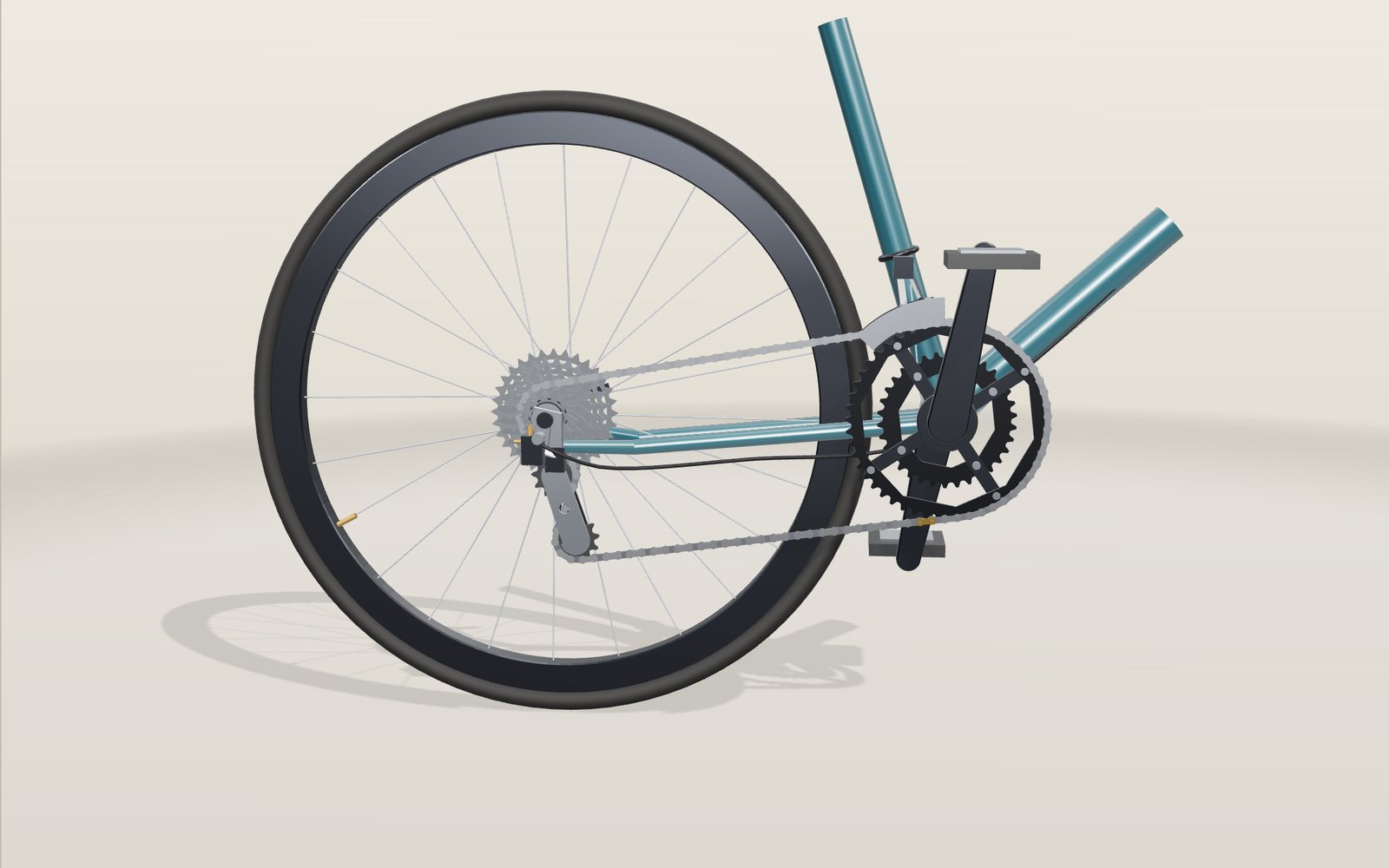
Bicycle gears: which gear makes climbing a hill easier
In a 50 by 11 gear one turn of the pedals moves a road bike 9.57 metres; in 34 by 32 it moves 2.24 metres.
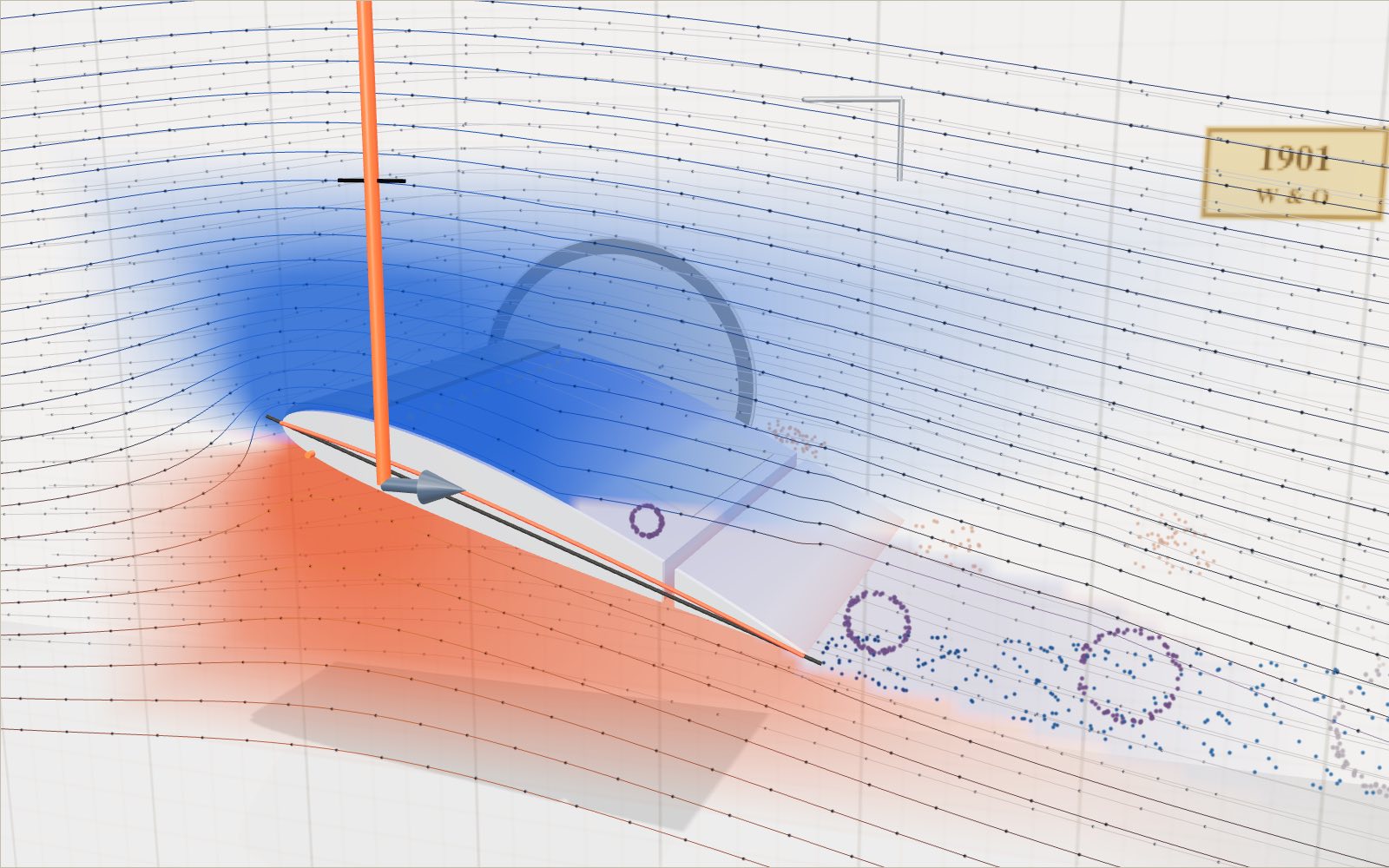
How a wing makes lift, and what changes as the angle grows
Air over the top of a wing reaches the trailing edge first. It does not wait for the air underneath.
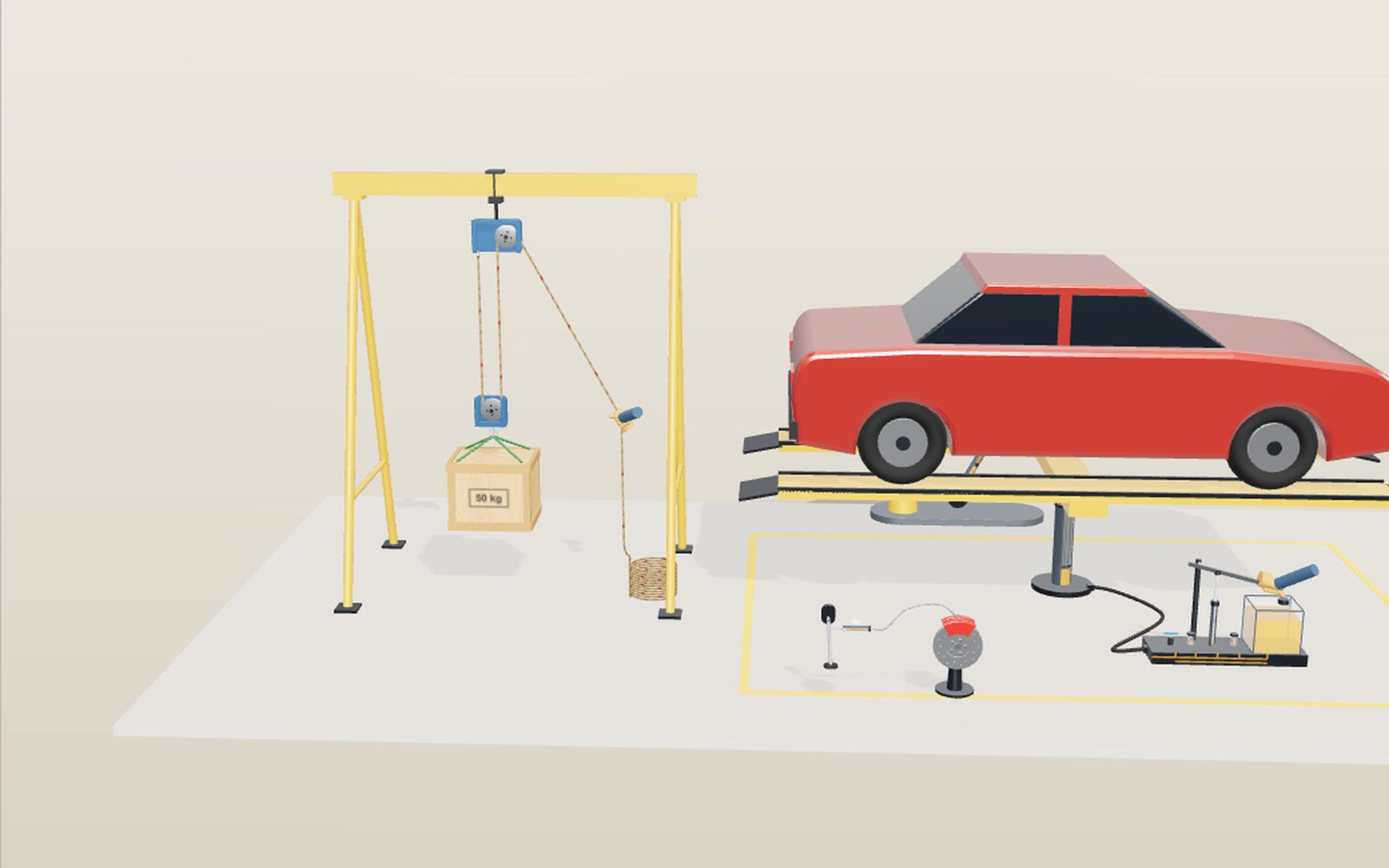
Pulley and hydraulic jack simulator: lift a crate and a car
A 50 kg crate can be lifted with an 82 N pull, as long as you are willing to pull six metres of rope for every metre it rises.
Roller coaster physics: how roller coasters work
A train that creeps over a 42 m lift hill at 3 m/s is doing 99 km/h at the bottom, and nothing but gravity has pushed it.
Origami: 20 models to fold step by step and unfold
A crane uses about 30 folds, a cup six; every flat-folded point you make has mountains and valleys that differ by exactly two.
How to solve a 3×3 cube, step by step
A 3×3 cube has 43,252,003,274,489,856,000 positions, and every one of them can be solved in 20 moves or fewer.