Loading the model
This device cannot show the 3D model. You can read the guide steps below as text.
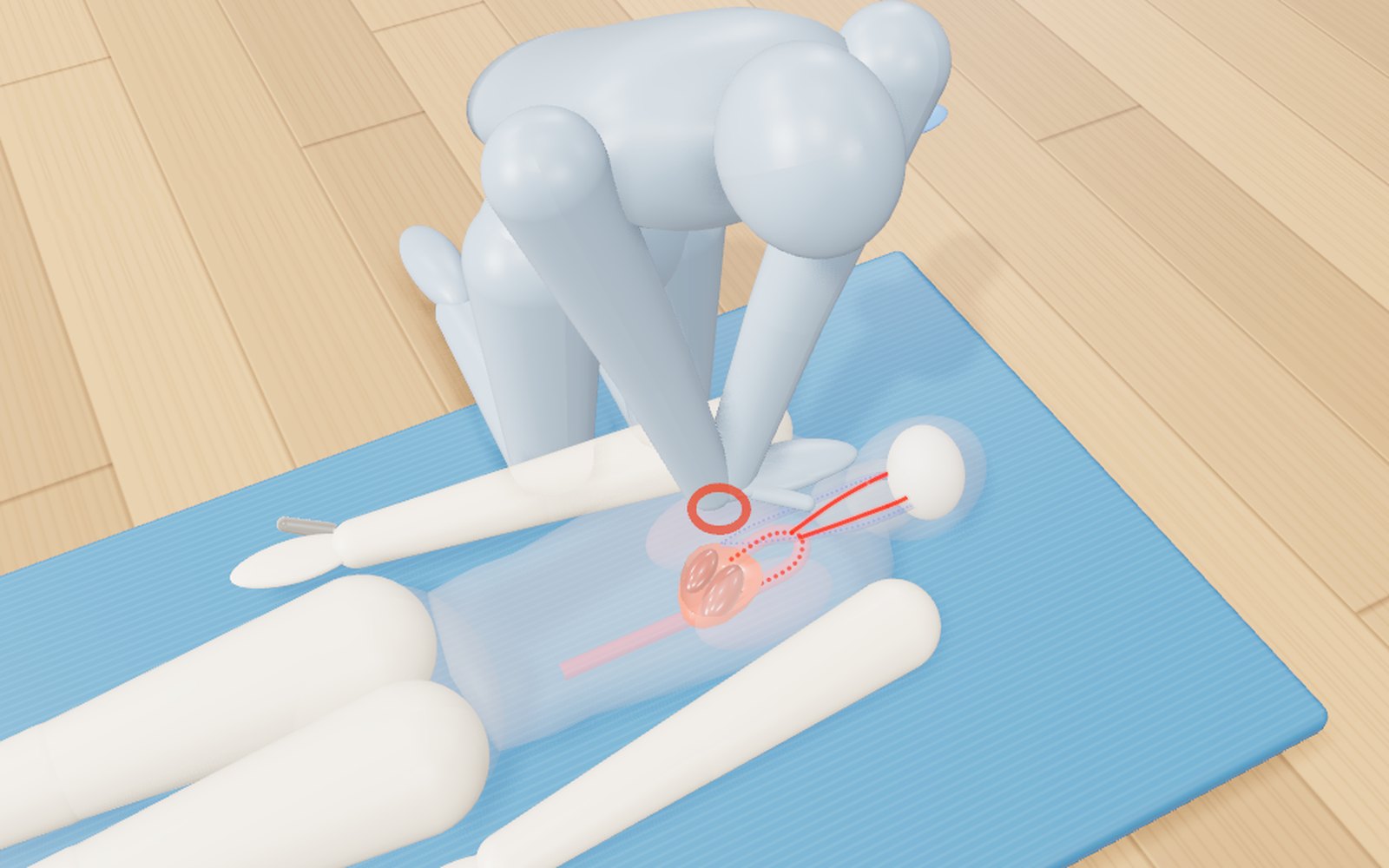
1 / 16 Pressing on the heart With "Inside" on, the chest turns clear. Each push squeezes the heart between the breastbone and the spine, and a pulse of blood runs up the arteries to the brain.
Drag to turn. Scroll or pinch to zoom.
Guide Parts Controls
01 Pressing on the heart With "Inside" on, the chest turns clear. Each push squeezes the heart between the breastbone and the spine, and a pulse of blood runs up the arteries to the brain.
02 Tap and shout Tap both shoulders and ask loudly. No answer and no movement means no response.
03 Call 119 and ask for an AED Point at one person to call, another to fetch an AED. Alone with a phone: speaker on, and keep going.
04 Look at the chest for 10 seconds No breathing, or slow irregular gasps, means cardiac arrest. Bystanders do not feel for a pulse (2025 Korean guideline).
05 Lower half of the breastbone The red ring marks the spot: heel of one hand, the other on top. The 2025 Korean guideline suggests the stronger hand underneath.
06 Every pause costs The concept curve shows brain oxygen climbing during compressions and dropping as soon as they stop. Try the Pause control.
07 Two breaths, if trained Head tilt, chin lift, 1 second per breath until the chest rises. Not trained: keep pushing.
08 Children: 4 to 5 cm At least a third of the chest depth. One hand is enough for a small child; the rate stays 100 to 120.
09 Infants: two thumbs Hands round the chest, both thumbs just below the nipple line, about 4 cm. The two-finger method was dropped in 2025.
10 Pads on bare skin Below the right collarbone and on the left side below the armpit, as drawn on the pads.
11 The AED reads the rhythm Hands off while it analyses. Fibrillation gets a shock; a flat line does not. Then compressions at once.
12 Choking: back blows first Lean the person forward and give up to 5 blows between the shoulder blades. KACPR, AHA and ERC agree in 2025.
13 Then 5 abdominal thrusts From behind, a fist just above the navel, pulled in and up. Alternate 5 and 5.
14 Infants: back and chest, never the belly Face down along your forearm for 5 back blows, then face up for 5 chest thrusts with the heel of one hand.
15 Alone: a chair back Call 119 even without speaking, then thrust with your own fist or over the back of a chair.
16 PASS Pull the pin, aim at the base, squeeze, sweep. Your back to the exit; if it does not go out, leave.
Lower half of the breastbone Where the heel of the hand goes for adults and children (the red ring). Stacked hands Heel of one hand on the chest, the other on top, fingers lifted off the ribs. Heart (cut open) About the size of a fist, behind the lower breastbone. The front half is cut away to show the chambers emptying. Aorta and carotid arteries The main artery leaves the top of the heart; the carotids carry blood up the neck to the brain. Brain Its colour follows the concept oxygen index: grey without flow, pinker during good compressions. Lungs They fill during rescue breaths, so the chest rises. AED Automated external defibrillator: it talks you through each step and decides by itself whether to shock. AED pads Below the right collarbone and on the left side; front and back on infants. Shock button Flashes when a shock is advised. Press only when nobody touches the person. Rescuer Kneeling beside the chest, arms straight, shoulders over the hands. Child (5 years) About 1.1 m tall. 4 to 5 cm, one or two hands. Infant (under 1) About 0.7 m long. Two thumbs, about 4 cm. Just above the navel Where the fist goes for abdominal thrusts. Between the shoulder blades Where the heel of the hand lands for back blows. Safety pin Pulled out first; it also breaks the seal. Nozzle Aimed low, at the base of the fire. Lever Squeezed to let the powder out. Base of the fire The model fire in a metal bin. Powder must reach what is burning. Person for scale An adult 1.7 m tall, standing.