FIG. 101Follow Along
How to do CPR, use an AED, help someone choking and use a fire extinguisher
Push 100 to 120 times a minute, about 5 cm deep: with a bystander doing that, survival in Korea in 2024 was 2.36 times higher.
This device cannot show the 3D model. You can read the guide steps below as text.
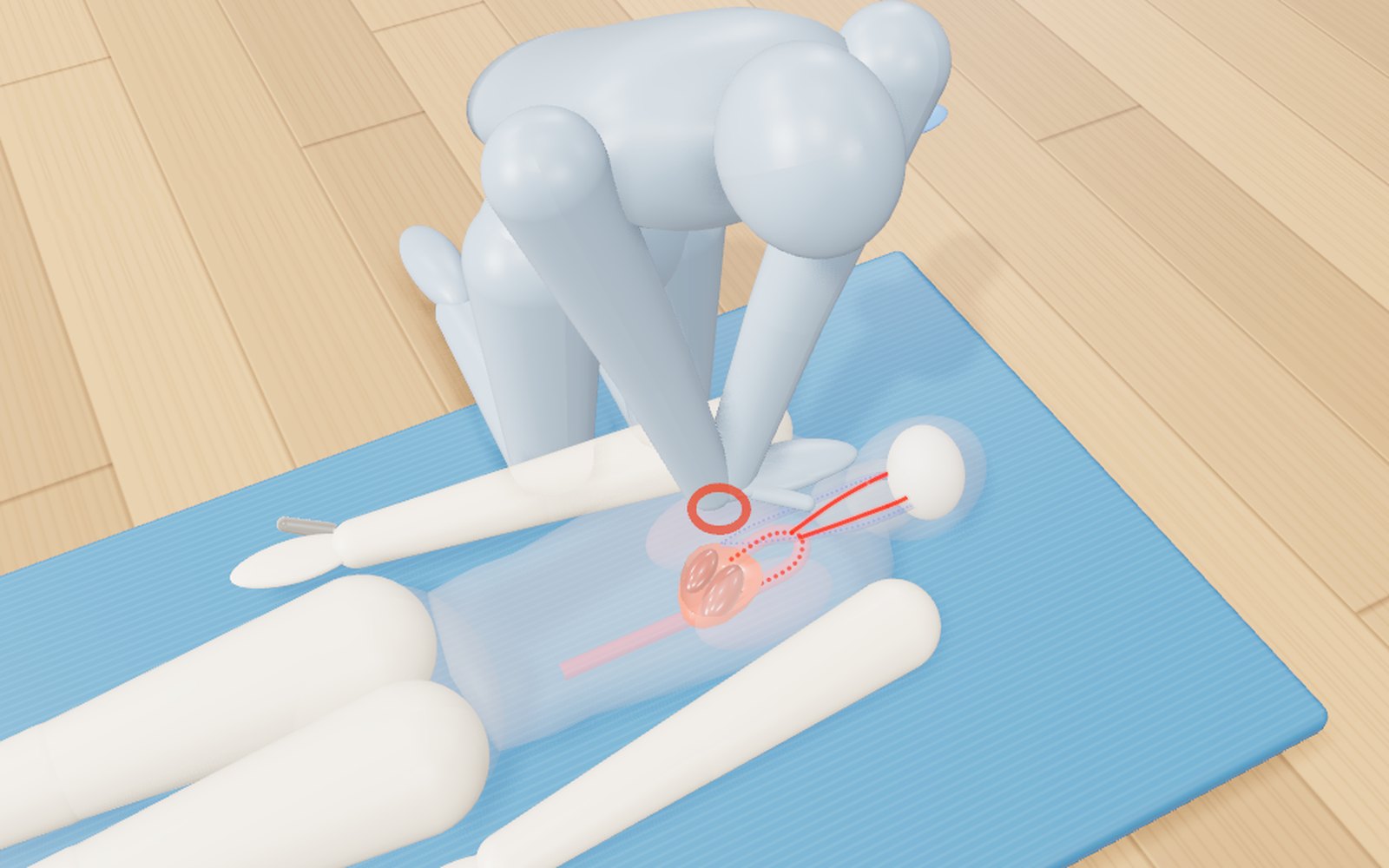
1 / 16 Pressing on the heartWith "Inside" on, the chest turns clear. Each push squeezes the heart between the breastbone and the spine, and a pulse of blood runs up the arteries to the brain.
Drag to turn. Scroll or pinch to zoom.
Call 119 first, and treat this as a picture of a course
This page is not a substitute for a hands-on course, and nothing on it is medical advice. If someone has collapsed in front of you right now, stop reading and call the emergency number: 119 in Korea, 112 in most of Europe, 911 in North America. The dispatcher will tell you what to do and stay on the line while you do it.
What the page does is show, step by step, what the current guidelines describe. Those are the 2025 Korean CPR guideline written by the Korean Association of CardioPulmonary Resuscitation (KACPR) with the Korea Disease Control and Prevention Agency (KDCA), the 2025 guidelines of the American Heart Association (AHA), and the European Resuscitation Council Guidelines 2025 (ERC). The extinguisher steps follow the US Fire Administration, the US Occupational Safety and Health Administration (OSHA) and the Korean Ministry of the Interior and Safety. The year of the guideline is written next to each number on the stage, because these numbers change: the two-finger method for infants, which many people learned at school, was dropped in 2025.
There are five follow-alongs in one small room. Adult CPR on a mat in the middle. The differences for children and infants. Putting on the pads of an automated external defibrillator (AED). Choking, for adults, children, infants and yourself. A fire extinguisher at a burning bin in the kitchen corner. Each one runs as an animation you can pause, step through, slow down or rewind, and the red rings mark where the hands go.
What happens when the heart stops
Sudden cardiac arrest is not the same as a heart attack. In a heart attack a coronary artery is blocked and part of the heart muscle is starved of blood, but the heart usually keeps beating. In cardiac arrest the heart stops pumping. Often its electrical activity has turned into ventricular fibrillation, a fast, disorganised quivering in which the muscle twitches but squeezes nothing out. Blood pressure falls to zero within seconds. The person collapses, stops responding and stops breathing normally.
The brain is the organ that runs short first. It uses a large share of the body's oxygen and keeps very little in reserve. The 2025 Korean guideline puts it plainly: hypoxic brain injury starts about 4 to 5 minutes after the heart stops. An ambulance rarely arrives in 4 minutes. That gap is the whole reason bystander CPR exists. Chest compressions do not restart the heart; they push some blood through the brain and the heart muscle until something else can. The guideline says the same in its chapter on the AED: CPR buys a little time against brain injury, but only an early shock can bring back a heartbeat in fibrillation.
The numbers for Korea in 2024, quoted in chapter 2 of the 2025 guideline from the national survey: 33,034 people had an out-of-hospital cardiac arrest, 64.7 per 100,000 people. 9.2% survived, and 6.3% recovered good brain function. A bystander gave CPR in 30.3% of cases. When a bystander did, survival was 14.4%; when nobody did, 6.1%. That is 2.36 times higher, and for good brain recovery the gap is wider still, 11.4% against 3.5%, 3.26 times. The guideline also gives figures from abroad: in the United States bystander CPR averages 39.2% and survival to discharge 10%; in Japan bystander CPR is 57%.
On the stage, turn on Inside and the chest of the mannequin becomes clear. You see the heart cut open from the front, the aorta leaving its top and the two carotid arteries running up the neck to the brain. With each compression the heart is squeezed between the breastbone and the spine and a pulse of red particles moves toward the brain. When compressions stop, the particles stop too, and the brain fades toward grey. That colour is a concept drawing, explained further down, not a measurement.
The first minute, in order
The order is the part people forget under stress, so the guidelines keep it short. In the 2025 Korean guideline for lay rescuers it runs like this, and the Adult CPR follow-along has one step for each.
First, look around. Traffic, fire, smoke, a live wire, a slippery floor: a second casualty helps nobody. Then check for a response. Tap both shoulders and ask loudly, "Are you all right?" No answer and no purposeful movement means no response.
Next, call. The Korean guideline has put the call before the breathing check since 2020: as soon as there is no response, call 119 and ask for an AED. If other people are around, point at one of them and say "You, call 119," and at another, "You, bring the AED." If you are alone and have a mobile phone, the guideline says to switch on the speaker or hands-free, start CPR at once and let the dispatcher guide you. The 2025 guideline goes further and asks dispatchers to help callers find and use the nearest AED.
Then look at the breathing, for no more than 10 seconds. Look at the chest. No breathing at all, or breathing that is not normal, counts as cardiac arrest. Lay rescuers do not feel for a pulse; studies collected in the guideline show that checking a pulse is slow and unreliable even for professionals. The trap here is agonal breathing: slow, irregular gasps that appear in about 40 to 60% of people in the first minutes of an arrest. They look like breathing. They are a sign to start.
Then start compressions. Heel of one hand on the lower half of the breastbone, in the middle of the chest, the other hand on top, fingers lifted off the ribs. New in 2025, and only a weak recommendation, the Korean guideline suggests putting your dominant hand underneath. Kneel close, straighten your arms and bring your shoulders over your hands, so the push comes from your body weight and not from your elbows. 30 compressions at 100 to 120 a minute, about 5 cm deep, letting the chest come all the way back each time.
If you have been trained in rescue breaths and are willing, give 2 after every 30 compressions: tilt the head back, lift the chin, pinch the nose, seal your mouth over theirs and blow for about 1 second until the chest rises. If you have not been trained or do not want to, keep compressing without breaks. Then repeat until the ambulance crew takes over, an AED arrives or the person starts to move and breathe normally. If they do, roll them onto their side into the recovery position and keep watching their breathing.
Why pressing on the chest moves blood
Before 1960, restarting a heart outside an operating theatre meant opening the chest and squeezing the heart by hand. That year William Kouwenhoven, James Jude and Guy Knickerbocker at Johns Hopkins published "Closed-chest cardiac massage" in JAMA. After long experiments on animals they had found that pressing hard and rhythmically on the lower breastbone moved enough blood to keep the heart and brain alive, and they reported 20 patients treated this way, with 70% surviving long term. The summary ends with a sentence that is still quoted in training: "Anyone, anywhere, can now initiate cardiac resuscitative procedures. All that is needed are two hands."
The heart lies behind the lower half of the breastbone, a little to the left, roughly the size of a fist and about 12 cm long (OpenStax Anatomy and Physiology 2e, section 19.1). Behind it is the spine. When you push the breastbone down about 5 cm, the heart is squeezed between the two and the pressure inside the whole chest rises. Valves let blood leave only forward, so it is pushed out into the aorta and on toward the brain and the heart's own arteries. When you let go and the chest springs back, the pressure falls and blood runs back into the heart from the veins, ready for the next push.
That second half is easy to spoil. If you lean on the chest between pushes, it never comes all the way back, the pressure inside stays up and less blood returns to the heart. The Korean guideline asks rescuers to avoid leaning for exactly that reason. The KACPR textbook also asks for a duty cycle of about 50%: half of each cycle pressing, half releasing. At 110 compressions a minute each cycle lasts 60 / 110 = 0.55 s, so about 0.27 s down and 0.27 s up.
On the stage, the heart in the mannequin flattens front to back with each push and the two dark chambers shrink, then fill again as the chest rises. The adult mannequin's chest is about 21 cm from back to front, so a 5.5 cm push is about a quarter of it.
Rate: 100 to 120 a minute
All three guidelines give the same rate for every age: 100 to 120 compressions a minute. The KACPR textbook explains why there is both a floor and a ceiling. Experiments show at least 80 a minute are needed to keep blood moving, and flow keeps rising up to about 130 to 150. But as the rate rises, compressions get shallower, the heart has less time to refill between pushes and the rescuer tires sooner. When the 2020 and 2025 reviews of the International Liaison Committee on Resuscitation (ILCOR) looked at the studies, three observational studies favoured faster rates, while one randomised trial comparing 100 and 120 a minute found no difference. The range 100 to 120 is the compromise that came out of that.
Most people, untrained, push too fast once adrenaline is running. The 2025 Korean guideline cites studies in which rescuers without a feedback device tended to compress faster than the guideline, and it now recommends feedback devices in training. The Rhythm game on this page is a small version of that idea. Press the pad (or Space or Enter while the pad has focus) and it measures the time between your presses. Your rate is the median of the last six intervals, so one missed beat does not throw it off. The read-out turns green between 100 and 120. A task asks for 30 presses with at least 80% right.
If a beat helps, the metronome on the shelf swings at 110 a minute. People often mention songs at about that tempo; any steady beat between 100 and 120 does the same job.
Depth: about 5 cm, and not over 6
For an average adult, the 2025 Korean guideline gives about 5 cm. The AHA (2025) says at least 5 cm while avoiding more than 6 cm. The ERC (2025) says at least 5 cm but not more than 6 cm. They describe the same band from slightly different angles.
The guideline explains both ends. Several studies found better survival to discharge and more successful defibrillation when compressions were at least 5 cm deep compared with under 4 cm. Above 6 cm, injuries such as rib and breastbone fractures become more likely. But the more common mistake by far is the opposite one: in real cardiac arrests, about 40% of compressions by bystanders or professionals were found to be too shallow. A chest that has not been pushed before is stiffer than people expect, and hands get tired after a minute or two. The AHA notes that depth starts to fall after 90 to 120 seconds of CPR even when the rate holds, which is why two rescuers should swap roughly every 2 minutes.
Children and infants are pushed to at least a third of the chest's front-to-back depth: 4 to 5 cm for a child and about 4 cm for an infant in the 2025 Korean guideline. In the Rhythm game the Patient control switches between an adult, a child and an infant, and the green band on the depth gauge moves with it. Drag down while you press to set the depth, or set it with the Compression depth control and just tap the beat.
Recoil, pauses and the 60% rule
A run of compressions does not reach full effect at once. The pressure that drives blood into the heart muscle builds over a number of pushes and falls away as soon as they stop. That is why the guidelines are so strict about pauses. Every stop for breaths, for placing pads or for a rhythm check should be under 10 seconds, and across the whole resuscitation the hands should be on the chest at least 60% of the time, as high as possible (KACPR 2025, a strong recommendation). This share is called the chest compression fraction.
A worked example with the numbers on the stage. At 110 a minute, 30 compressions take 30 × 60 / 110 = 16.4 s. If 2 breaths take 5 s, the fraction is 16.4 / (16.4 + 5) = 77%. Stretch the pause to 10 s and it falls to 16.4 / 26.4 = 62%, just above the line. A 20 s pause gives 45%.
The small graph on the stage shows this as a concept curve labelled Brain oxygen. It is not a physiological model and its axis is an index from 0 to 100, not a measurement of anything. Its shape follows what the guidelines say in words. During compressions a perfusion value climbs toward a ceiling, about a third of the flow of a beating heart, closing 16% of the gap with each good push. Between pushes in a steady run it hardly falls. If no push comes for 1.2 s it drops quickly, by half in about half a second. The oxygen index rises with perfusion and falls with use, halving in about 17 s without flow. Shallow pushes, incomplete recoil and very fast rates each add less per push. Run steadily for three minutes at 110 a minute and 5.5 cm and the curve settles near 48. Add a 10 s pause after every 30 and the average over the same three minutes falls to about 29. Set the Pause control and watch the green bands, which mark when compressions were happening, open up gaps.
Breaths, or hands only
Lay rescuers of every age give 30 compressions and then 2 breaths, if they have been trained and are willing (KACPR 2025). Each breath takes about 1 second and should make the chest visibly rise, no more. Two rescuers can split the work, one pushing and one breathing, and swap after 5 cycles of 30:2, about every 2 minutes.
If you have never learned rescue breaths, or do not want to give them to a stranger, the guideline says to do compression-only CPR: keep pushing at 100 to 120 a minute without stopping. Out of hospital, studies have found no difference in survival between compression-only CPR and standard CPR for most adults, and both are far better than doing nothing. Breaths matter more in some groups: children, drowning, drug poisoning and arrests that have lasted a long time, where the problem started with a lack of oxygen. For a drowning victim the 2025 Korean guideline asks trained first responders to start with breaths. During an epidemic of an infectious disease, the guideline tells lay rescuers to use compression-only CPR, children included.
On the stage, the Breaths step tilts the head back and lifts the chin; the lungs fill twice and the chest rises a little.
Children and infants are not small adults
The first difference is who counts as a child, and here the guidelines disagree. The 2025 Korean guideline: infant under 1 year, child from 1 to under 8, adult from 8. ERC 2025: child from 1 to 12, and for adolescents of 13 to 18 use the adult technique when in doubt. AHA 2025: child from 1 year to puberty. In practice a rescuer goes by body size.
The rate is the same, 100 to 120. The depth is at least a third of the chest's depth: 4 to 5 cm for a child, about 4 cm for an infant (KACPR 2025). For a small child one hand is enough; ERC 2025 says one or two hands depending on size, and notes that two hands tire the rescuer less.
For infants the method changed in 2025. The 2025 Korean guideline says that lay rescuers and professionals alike, however many there are, should use the two-thumb encircling technique: both hands round the chest, both thumbs side by side on the breastbone just below the line between the nipples (a strong recommendation). If you cannot encircle the chest, or the baby is close to 1 year old, the heel of one hand may be considered, but not as a first choice. The old two-finger technique is gone. The AHA did the same in 2025, citing simulation studies in which two fingers reached less depth; in one registry study it was used rarely and, when used, never met the guideline.
Breaths and the order of things are where the guidelines part. The Korean guideline keeps 30:2 for lay rescuers at every age and starts with compressions. ERC 2025 starts CPR on a child with 5 rescue breaths and then goes on with 30:2, because in children cardiac arrest more often follows breathing trouble. The exhibit marks this as a difference rather than picking a side. Wherever you are, the dispatcher's instructions settle it.
What an AED does
An automated external defibrillator is a box the size of a lunch box that talks. When you switch it on, it tells you what to do. You put two sticky pads on the bare chest. The device reads the heart's electrical rhythm through the pads and decides by itself whether a shock is needed. If it is, it charges and either delivers the shock or asks you to press a flashing button. Most AEDs in Korea are the semi-automatic kind that ask for the button.
The order on the stage follows figure 3-15 of the 2025 Korean guideline: power on, pads, analysis, shock. Put the AED where it does not get in the way of the compressions and switch it on. Open the clothing and wipe off sweat. One pad goes just below the right collarbone; the other goes on the left side of the chest, below the nipple, in the middle of the armpit line. The pictures on the pads show the same spots. This antero-lateral placement is the most common; front-and-back placement works about as well. The pads must not touch each other.
While the AED analyses, nobody touches the person, so that movement does not spoil the reading. If a shock is advised, it charges; check that nobody is in contact, say "stand clear" and press. Straight after the shock, start compressions again at once. Do not wait to see whether the heart has restarted: right after a shock the heart often shows a rhythm that moves no blood for a while, and the next shock works better if compressions continue. If the AED says no shock is advised, also start compressions at once. It will analyse again every 2 minutes. Leave the pads on and keep going until the crew takes over or the person wakes.
What is it reading? The two rhythms an AED treats are ventricular fibrillation and pulseless ventricular tachycardia, a very fast rhythm in which the ventricles beat too fast to fill. A shock passes current through the whole heart at once, stopping the chaotic activity so that the heart's own pacemaker can take over again. A flat line (asystole) is not shocked, whatever films suggest; there is no disorganised activity to stop. The AED screen on the stage draws these shapes so you can see the difference. They are drawn curves, not recordings. In the ECG quiz you decide, as the AED does, whether each one gets a shock.
Two practical notes from the 2025 guideline. There is no need to remove a woman's bra in lay CPR; move it so the pads sit on bare skin away from breast tissue. The guideline notes reports that women receive an AED less often, partly because bystanders hesitate to expose the chest. And for children the guideline suggests that lay rescuers use an AED on any child from 1 year of age with a non-traumatic arrest. Children are shocked with less energy, 2 to 4 J per kg, which child pads or a child key provide. For a 20 kg child that is 40 to 80 J. If there is no child setting, the adult AED is used. On infants and small children the two pads may overlap on the front, so one goes on the front of the chest and one on the back; the ERC uses child mode below about 25 kg, roughly 8 years.
Time is what the AED is fighting. Chapter 3 of the 2025 Korean guideline quotes survival with a shock within 1 minute of up to 90%, falling to 50% at 5 minutes, 30% at 7, 10% at 9 to 11 and 2 to 5% at 12. Yet AEDs in Korean public places are rarely used: an AED reached fewer than 3% of people who arrested in public. Of the public AEDs in one survey, 15.4% could not be used because of expired pads or faults and 44.1% were not reachable 24 hours a day, locked away or inside buildings that close at night.
The portable defibrillator is younger than CPR. Until the 1960s a defibrillator needed mains power. In 1967 Frank Pantridge and John Geddes in Belfast described in the Lancet a mobile intensive care unit, an ambulance with a defibrillator that could run outside the hospital, staffed by junior doctors and nurses.
Choking: back blows, then thrusts
Choking on food or a small object is common and fast. The signs: the person suddenly cannot speak, cough or breathe, often clutches the throat, and may turn blue. The 2025 Korean guideline says to ask "Is something stuck in your throat?" If they cannot speak and nod, treat it as a severe obstruction.
If they are still coughing forcefully, let them. A strong cough is the most effective way to clear the airway, so do not interfere; stay close and encourage it. When the cough becomes weak or stops, act.
For adults and children over 1 year, the 2025 Korean guideline keeps the order it has used since 2020: back blows first. Stand to the side and slightly behind, support the chest with one hand, lean the person well forward, and give up to 5 sharp blows between the shoulder blades with the heel of your other hand. If that does not work, give up to 5 abdominal thrusts, the Heimlich manoeuvre: stand behind, put a fist just above the navel, grasp it with the other hand and pull sharply inward and upward. Then alternate 5 back blows and 5 thrusts until the object comes out or the person becomes unresponsive.
This order is where the guidelines have moved. Henry Heimlich described abdominal thrusts for food choking in JAMA in 1975, and for decades American training taught thrusts alone for adults. The AHA's 2025 guidelines changed that: for conscious adults and children with severe choking, give cycles of 5 back blows followed by 5 abdominal thrusts. They cited a cohort study of 709 people in which back blows were associated with better clearance and fewer injuries than abdominal thrusts, and case reports of fatal injuries from thrusts. The ERC has long taught back blows first. In 2025 the three guidelines agree.
For pregnant people, or anyone your arms cannot get around, give chest thrusts on the lower breastbone instead of abdominal thrusts. If the person becomes unresponsive, lower them to the floor, call 119 if nobody has, and start CPR with compressions; compressions can push the object out. Before each set of breaths, look in the mouth and remove an object only if you can see it. Do not sweep blindly with a finger: it can push the object deeper (KACPR 2025, ERC 2025 First Aid). Anyone who has had thrusts should be checked by a doctor afterwards, because internal injuries can follow (KDCA).
Infants are different. Under 1 year the ribs do not protect the upper abdomen and the liver is relatively large, so abdominal thrusts can injure organs and are not used. Instead, lay the baby face down along your forearm, head lower than the chest, supporting the jaw, and give up to 5 back blows with the heel of your hand. Then turn the baby face up, head still low, and give up to 5 chest thrusts. The 2025 Korean guideline gives these chest thrusts with the heel of one hand, by expert consensus; the AHA's 2025 update says the same. Repeat until the object comes out or the baby stops responding, and then start infant CPR.
If you are alone and choking, call the emergency number anyway. The American Red Cross notes that in the United States an open line leads the dispatcher to send help even if you cannot speak. Then give yourself abdominal thrusts with your own fist above the navel and the other hand over it, or bend over the back of a chair, a table edge or a railing and press your upper abdomen hard against it. MedlinePlus, from the US National Library of Medicine, notes a small study in which thrusts over the back of a chair produced higher pressures than thrusts with your own hands. The Red Cross adds: avoid sharp edges.
The extinguisher: PASS, with the exit behind you
An extinguisher is for a fire that is still small. OSHA's steps start before the extinguisher: raise the alarm and call the fire service, find a safe way out before approaching the fire, and never let the fire or smoke come between you and that way out. Stand with your back to the exit and, outdoors, to the wind.
Then PASS, as taught by the US Fire Administration and OSHA. Pull the pin, which also breaks the tamper seal. Aim low, at the base of the fire, because the agent has to reach what is burning; spraying into the flames above does little. Squeeze the lever slowly and evenly. Sweep from side to side across the base until the fire appears to be out. The Korean Ministry of the Interior and Safety teaches the same four actions in its own words: pull the safety pin, point the hose at the fire with your back to the wind, squeeze the handle hard and spray as if sweeping with a broom. It also adds that children should not use extinguishers but get to safety.
After the fire looks out, back away while still watching it, because it can flare up again; if it does, repeat. If the extinguisher is empty and the fire is still burning, or the fire grows beyond its first stage, leave at once. On the stage, the Fire extinguisher follow-along shows each step, and in the bar under it you can pull the pin, hold Squeeze and drag on the aim pad: up and down sets the height, side to side sweeps. The model fire shrinks fastest when the aim is low and the nozzle sweeps. Its numbers (a 14 s supply of powder, how fast the fire shrinks) are model values, not a fire test.
Burning cooking oil needs its own warning. The ministry's page says it plainly: water poured on burning oil boils over explosively. The frying pan on the stove in the kitchen corner is one of the hidden cards.
Minutes and survival
How much is a minute worth? In 1993 Larsen and colleagues fitted a simple equation to 1,667 witnessed cardiac arrests in ventricular fibrillation from King County, Washington: survival = 67% − 2.3% per minute to CPR − 1.1% per minute to the first shock − 2.1% per minute to advanced care by paramedics. The 67% is what the model gives if all three happened at the moment of collapse. With no treatment at all, the three terms add up to 5.5% per minute, so the model reaches zero after 67 / 5.5 = 12.2 minutes.
Two cases worked out. A bystander starts CPR after 1 minute, an AED delivers the first shock at 4 minutes and paramedics begin advanced care at 8: 67 − 2.3 × 1 − 1.1 × 4 − 2.1 × 8 = 67 − 2.3 − 4.4 − 16.8 = 43.5%. Nobody helps until the paramedics arrive at 8 minutes and do all three: 67 − 18.4 − 8.8 − 16.8 = 23.0%. The bystander roughly doubles the chance. In the If it were now panel you enter your own minutes; it adds them to the current time on your device, so you see the clock time at which brain injury may begin (4 to 5 minutes, KACPR 2025) and the model's survival figure. The chart in the lab draws the model's lines with the Korean guideline's shock-delay figures as dots.
A model like this describes a population of arrests in one region, not your chances or anyone else's. Valenzuela and colleagues (Circulation, 1997) later fitted a logistic model to the same kind of data from two regions and confirmed the main point: the delay to CPR and the delay to the first shock are what count.
Three guidelines, side by side
Korea, the United States and Europe each rewrote their CPR guidelines in 2025, and the exhibit follows all three: the Korean guideline by KACPR with KDCA, the AHA guidelines written with the American Academy of Pediatrics for children, and the ERC Guidelines 2025. The table in the lab puts them next to each other, one row per question, with a link to the source behind every cell. These values were checked again on 27 October 2026. Press a row and the stage jumps to the step it is about.
For adults the three say almost the same thing in different words. All three ask for 100 to 120 compressions a minute at every age. For adult depth KACPR says about 5 cm and not over 6, the AHA says at least 5 cm while avoiding more than 6, and the ERC says at least 5 cm but not more than 6. All three now start adult choking with 5 back blows before 5 abdominal thrusts; for the AHA that order is new in 2025.
Children and infants are where they part. Who counts as a child: under 8 in Korea, up to puberty for the AHA, up to 12 for the ERC. Child depth: all three ask for at least a third of the chest's front-to-back depth, but KACPR then gives 4 to 5 cm and the AHA about 5 cm, while the ERC deliberately gives no centimetre target. The ERC Paediatric Life Support chapter explains why: chest size changes continuously as children grow, the absolute 4 and 5 cm figures can exceed a third of the chest and, in small infants, even half of it, and manikin studies found that aiming for a third gave more adequate compressions than aiming for a number. It also adds that no compression at any age should go deeper than 6 cm.
Infant compressions moved in 2025 in all three. The old two-finger method is gone. KACPR and the ERC use two thumbs encircling the chest; KACPR allows the heel of one hand to be considered when you cannot encircle the chest or the baby is near 1 year old; the AHA lists the heel of one hand and two thumbs encircling side by side. For infant choking, KACPR and the AHA give the 5 chest thrusts with the heel of one hand, and the ERC changed from two fingers to two thumbs encircling.
How to start on a child also differs. KACPR starts with compressions and uses 30:2 for lay rescuers. The ERC starts with 5 rescue breaths, because in children the arrest more often follows a lack of oxygen, and then goes on with 30:2. The AHA gives 30:2 for one rescuer and 15:2 for two. On an AED, KACPR allows use from 1 year with child pads or a child key at 2 to 4 J per kg, the AHA asks for a paediatric attenuator if one is available, and the ERC uses child mode below about 25 kg.
None of this means one guideline is right and the others wrong. They read the same evidence and chose different ways to teach it. If you are in Korea, the Korean guideline and the 119 dispatcher are the ones to follow; anywhere else, follow your local course and dispatcher.
The side cut: centimetres you can see
The rhythm game and the compression steps open a small side cut through the chest. It is drawn as if the mannequin had been sliced down the middle from the neck to the belly and seen from the side: the spine lies on the floor, the heart sits above it, and the breastbone is a bar just under the skin. When you press, the breastbone and the chest wall above it go down by the depth on the gauge, and the heart is squeezed between breastbone and spine. That squeeze is the whole point of compressions.
The ruler beside the cut starts at the resting breastbone and is drawn to the same scale as the chest. The green band is the depth range of the guideline you picked with the Judge by button: KACPR or AHA. For children and infants a dashed blue line marks a third of this mannequin's chest, which is how the ERC states its target. The chest depths of the three mannequins (22, 14 and 10.5 cm) are model values chosen for the drawing, not measurements; real chests differ from person to person, which is exactly why the guidelines describe child depth as a share of the chest. For the adult a third of 22 cm would be more than 7 cm, past the 6 cm limit, which is why adult guidance is a number and not a share.
The cut also shows recoil. While your finger or key is still down, the line under it reads "let the chest come back"; only after you release does the chest return to the top of the ruler. A compression that starts before the chest has come back is counted as incomplete recoil in the game. With a child on the mat, try pressing 5.3 cm under each guideline: under AHA it sits inside the band, under KACPR it is too deep. Then try 4.2 cm. The task Child depth asks for 20 pushes in a row inside the band of the guideline you picked.
How the models on this page work
The mannequins are faceless and smooth on purpose, like the figures in the human evolution exhibit: no eyes, mouth, ears or hair, hands and feet as simple masses. Each limb is a rounded piece on a joint, and a small two-bone solver places hands and feet where a step needs them: the heels of the hands on the lower half of the breastbone, a fist just above the navel, a hand between the shoulder blades. The rescuer's torso tilts at the hips so that the shoulders stay over the hands, and a compression lowers the shoulders by exactly the chosen depth. The patient's chest is reshaped around the breastbone on each push.
Inside, the heart is a blunt cone with two chambers, cut open from the front by a clipping plane that follows the chest. The aorta, the carotid arteries, the jugular veins, the lungs and the brain are simple shapes placed after OpenStax Anatomy and Physiology. Blood particles move along the arteries with every compression and drift back along the veins.
The brain-oxygen curve is the concept model described above, with these parameters: each push closes 16% of the gap to a ceiling of 0.32; perfusion falls at 0.15 per second during a run and at 1.4 per second after 1.2 s without a push; oxygen use is 0.04 per second. The ECG shapes on the AED screen are drawn curves. The fire is a model with growth and suppression rates chosen so that aiming low and sweeping matters. The survival numbers come from the Larsen equation and the Korean guideline's table, as quoted.
Things to try
Play the Rhythm game without the metronome, then with it, and compare your rate. Then set the Patient control to Infant and try to stay inside the narrower depth band.
Turn on Inside and set Pause every 30 to 10 seconds. Watch the green bands in the graph break up and the curve sag after each pause.
Open the Children and infants follow-along and step through two thumbs and the heel of one hand. Then find where the pads go on an infant in the pad quiz.
In the ECG quiz, try to read the rhythm before the AED does. Asystole is the one people get wrong.
Look for the 14 hidden things in the room. Three of them are on the shelf and one is on the stove.
The AHA cells were checked against the published Circulation 2025 guidelines: Part 7 for adults and Part 6 for infants and children. The full-text chapters and their recommendation tables confirm all ten cells. Links in the AHA column use the publication DOI. The child ratios apply to CPR without an advanced airway.
Questions
Can I hurt someone by doing CPR?
Broken ribs and a broken breastbone are possible, especially above 6 cm, and the guidelines accept that risk because the alternative is death. The ERC's 2025 first aid guideline says rescuers should start CPR for presumed cardiac arrest without worrying about causing injury, even if the person might not be in arrest. Nothing on this page is medical advice; a course with an instructor teaches the feel of the right depth.
Do I need to check for a pulse?
No. Lay rescuers do not check the pulse (KACPR 2025). No response and no normal breathing is enough to call 119 and start. Professionals check pulse and breathing together, for no more than 10 seconds.
The person is gasping. Is that breathing?
No. Slow, irregular gasps, called agonal breathing, appear in about 40 to 60% of people early in cardiac arrest. They are a sign to start compressions, not a reason to wait.
How fast and how deep, exactly?
For adults, 100 to 120 compressions a minute, about 5 cm deep and not more than 6 cm, letting the chest come all the way back each time (KACPR 2025, AHA 2025, ERC 2025). For children, 4 to 5 cm; for infants, about 4 cm, in both cases at least a third of the chest's depth.
Do I have to give rescue breaths?
Only if you have been trained and are willing. Otherwise do compression-only CPR without stopping; it is far better than doing nothing. Breaths matter more for children, drowning and long arrests.
Where exactly do my hands go?
The heel of one hand on the lower half of the breastbone, in the middle of the chest, the other hand on top, fingers lifted off the ribs. The 2025 Korean guideline suggests the dominant hand underneath. On an infant, the two thumbs go on the breastbone just below the line between the nipples.
What changed for infants in 2025?
The two-finger technique was removed by both the Korean guideline and the AHA. Infants now get the two-thumb encircling technique, or the heel of one hand if the chest cannot be encircled. For choking, infants still get 5 back blows and 5 chest thrusts, now with the heel of one hand, and never abdominal thrusts.
Can I use an AED on a child?
Yes. The 2025 Korean guideline suggests lay rescuers use an AED on any child from 1 year of age with a non-traumatic arrest. Use child pads or child mode if there is one; if not, use the adult setting. On infants and small children, put one pad on the front of the chest and one on the back.
Can the AED shock someone who does not need it?
It analyses the rhythm itself and only advises a shock for ventricular fibrillation or pulseless ventricular tachycardia. That is why nobody should touch the person during the analysis and why you check that nobody is touching before pressing the button.
Do I have to remove a bra before using the AED?
No. The 2025 Korean guideline says it is not necessary in lay CPR. Move it so the pads stick to bare skin away from breast tissue.
What if the AED says no shock is advised?
Start compressions again at once. A flat line, for example, is not shocked. The AED will analyse again every 2 minutes; leave the pads on and keep going.
Why back blows before the Heimlich manoeuvre?
Because the evidence and the guidelines changed. Korea has put back blows first since 2020. In 2025 the AHA did the same for adults and children, citing a study of 709 people in which back blows cleared obstructions more often with fewer injuries, and the ERC already taught it.
What if the choking person is pregnant or very large?
Give chest thrusts on the lower breastbone instead of abdominal thrusts, after the back blows.
What if I am choking and alone?
Call the emergency number even if you cannot speak. Then give yourself abdominal thrusts with your fist above the navel, or bend over the back of a chair or a railing and press your upper abdomen hard against it. Avoid sharp edges.
When should I not fight a fire with an extinguisher?
When it has grown beyond a small, early fire, when smoke or fire could get between you and the exit, or when the extinguisher runs out before the fire is out. Then leave and let the fire service handle it. Never pour water on burning cooking oil.
Are the numbers on the stage real?
The guideline numbers (rates, depths, ratios, times, survival figures) come from the sources below with their years. The brain-oxygen curve, the ECG shapes, the size of the fire and the powder supply are concept drawings or model values, and they are labelled so on the stage.
Why do the guidelines give different depths for children?
All three ask for at least a third of the chest's front-to-back depth. KACPR (4 to 5 cm) and the AHA (about 5 cm) turn that into a number so it is easier to teach and to check with a feedback device; the ERC 2025 Paediatric Life Support chapter keeps only the third, because a fixed number can be too deep for a small chest, and adds that no compression at any age should exceed 6 cm. Use the table in the lab to see each wording with its source.
Are the centimetres in the side cut real?
The ruler and the depth of each push are drawn to scale, and the bands are the guideline values. The chest depth of each mannequin (22, 14 and 10.5 cm) is a model value chosen for the drawing, not a measurement, so the dashed third-of-the-chest line is only an illustration of the ERC idea.
Terms
- Cardiac arrest: the heart stops pumping blood. Different from a heart attack, where an artery to the heart is blocked.
- CPR: cardiopulmonary resuscitation, chest compressions with or without rescue breaths.
- Compression-only CPR: chest compressions without breaths, for rescuers who have not been trained in breaths or do not want to give them.
- Agonal breathing: slow, irregular gasps in the first minutes of cardiac arrest. A sign to start CPR.
- Recoil: the chest coming all the way back up between compressions.
- Chest compression fraction: the share of resuscitation time spent compressing; at least 60%.
- Duty cycle: the share of each compression cycle spent pressing; about 50%.
- AED: automated external defibrillator, a portable device that reads the heart rhythm and gives a shock if needed.
- Ventricular fibrillation: a chaotic quivering of the ventricles that pumps no blood; treated with a shock.
- Asystole: no electrical activity, a flat line; not treated with a shock.
- Antero-lateral placement: AED pads below the right collarbone and on the left side below the armpit.
- Antero-posterior placement: one pad on the front of the chest and one on the back, used for infants and small children.
- Two-thumb encircling technique: infant compressions with both hands round the chest and both thumbs on the breastbone.
- Back blows: sharp blows with the heel of the hand between the shoulder blades.
- Abdominal thrusts: the Heimlich manoeuvre, a fist just above the navel pulled in and up.
- Recovery position: lying on the side with the top knee bent forward, to keep the airway clear.
- PASS: Pull the pin, Aim low, Squeeze the lever, Sweep side to side.
Sources
- Korea Disease Control and Prevention Agency, "2025 Korean CPR guideline" (download page, posted 2026-01-29): https://www.kdca.go.kr/kdca/2857/subview.do?enc=Zm5jdDF8QEB8JTJGYmJzJTJGa2RjYSUyRjQ5JTJGMzA5OTA4JTJGYXJ0Y2xWaWV3LmRvJTNGcGFzc3dvcmQlM0QlMjZyZ3NCZ25kZVN0ciUzRCUyNmZpbmRPcG53cmQlM0QlMjZmaW5kV29yZCUzRCUyNnJnc0VuZGRlU3RyJTNEJTI2ZmluZFR5cGUlM0QlMjZmaW5kQ2xTZXElM0QlMjZwYWdlJTNEMSUyNg%3D%3D (checked 2026-10-19)
- Korean Association of CardioPulmonary Resuscitation and KDCA, "2025 Korean CPR guideline" (PDF): https://www.kacpr.org/download/2025%EB%85%84%20%ED%95%9C%EA%B5%AD%20%EC%8B%AC%ED%8F%90%EC%86%8C%EC%83%9D%EC%88%A0%20%EA%B0%80%EC%9D%B4%EB%93%9C%EB%9D%BC%EC%9D%B8.pdf (checked 2026-10-19)
- Korean Association of CardioPulmonary Resuscitation, "How to perform CPR": https://www.kacpr.org/page/page.php?category1_code=1247206302&category2_code=1527742406&category_idx=3&page_idx=1118 (checked 2026-10-19)
- KDCA National Health Information Portal, "CPR: treating airway obstruction by a foreign body": https://health.kdca.go.kr/healthinfo/biz/health/gnrlzHealthInfo/gnrlzHealthInfo/gnrlzHealthInfoView.do?cntnts_sn=6227 (checked 2026-10-19)
- National Fire Agency, "How to call 119 for an ambulance": https://www.nfa.go.kr/nfa/safetyinfo/emergencyservice/119emergencydeclaration/ (checked 2026-10-19)
- Safety Korea 24 (Ministry of the Interior and Safety), "CPR action guide": https://www.safekorea.go.kr/safekorea-kor/acts/nacts/action-guide.do?category=cardiopulmonaryResuscitation (checked 2026-10-19)
- Ministry of the Interior and Safety, safety school, "Using an extinguisher and reporting a fire": https://www.mois.go.kr/chd/sub/a06/fire_2/screen.do (checked 2026-10-19)
- American Heart Association, "Part 1: Executive summary, 2025 AHA Guidelines for CPR and ECC", Circulation 2025 (PubMed): https://pubmed.ncbi.nlm.nih.gov/41122893/ (checked 2026-10-19)
- American Heart Association, "Part 7: Adult basic life support, 2025 AHA Guidelines for CPR and ECC", Circulation 2025 (PubMed): https://doi.org/10.1161/CIR.0000000000001369 (checked 2026-10-19)
- American Heart Association and American Academy of Pediatrics, "Part 6: Pediatric basic life support, 2025 Guidelines", Circulation 2025 (PubMed): https://doi.org/10.1161/CIR.0000000000001370 (checked 2026-10-19)
- American Heart Association newsroom, "Updated CPR guidelines tackle choking response, opioid-related emergencies and a revised chain of survival" (2025-10-22): https://newsroom.heart.org/news/updated-cpr-guidelines-tackle-choking-response-opioid-related-emergencies-and-a-revised-chain-of-survival (checked 2026-10-19)
- European Resuscitation Council, "Guidelines 2025" (index): https://www.erc.edu/science-research/guidelines/guidelines-2025/guidelines-2025-english (checked 2026-10-19)
- European Resuscitation Council, "ERC Guidelines 2025 Adult Basic Life Support" (PDF): https://www.erc.edu/media/wrhj5sye/gl2025-04-bls-e.pdf (checked 2026-10-19)
- Smyth M A et al., "European Resuscitation Council Guidelines 2025 Adult Basic Life Support", Resuscitation 2025 (PubMed): https://pubmed.ncbi.nlm.nih.gov/41117574/ (checked 2026-10-19)
- European Resuscitation Council, "The ERC Guidelines 2025 on Resuscitation for Everyone" (PDF): https://www.erc.edu/media/p5ymaeej/gl2025_layperson_book_ipdf-v11-e.pdf (checked 2026-10-19)
- Djakow J B et al., "European Resuscitation Council Guidelines 2025 Paediatric Life Support", Resuscitation 2025 (PubMed): https://pubmed.ncbi.nlm.nih.gov/41117571/ (checked 2026-10-19)
- "European Resuscitation Council Guidelines 2025 First Aid", Resuscitation 2025 (PubMed): https://pubmed.ncbi.nlm.nih.gov/41117568/ (checked 2026-10-19)
- Kouwenhoven W B, Jude J R, Knickerbocker G G, "Closed-chest cardiac massage", JAMA 1960;173:1064 (PubMed): https://pubmed.ncbi.nlm.nih.gov/14411374/ (checked 2026-10-19)
- Pantridge J F, Geddes J S, "A mobile intensive-care unit in the management of myocardial infarction", Lancet 1967;2:271 (PubMed): https://pubmed.ncbi.nlm.nih.gov/4165912/ (checked 2026-10-19)
- Heimlich H J, "A life-saving maneuver to prevent food-choking", JAMA 1975;234:398 (PubMed): https://pubmed.ncbi.nlm.nih.gov/1174371/ (checked 2026-10-19)
- Larsen M P et al., "Predicting survival from out-of-hospital cardiac arrest: a graphic model", Ann Emerg Med 1993;22:1652 (PubMed): https://pubmed.ncbi.nlm.nih.gov/8214853/ (checked 2026-10-19)
- Valenzuela T D et al., "Estimating effectiveness of cardiac arrest interventions: a logistic regression survival model", Circulation 1997;96:3308 (PubMed): https://pubmed.ncbi.nlm.nih.gov/9396421/ (checked 2026-10-19)
- US Fire Administration (FEMA), "Choosing and using fire extinguishers": https://www.usfa.fema.gov/prevention/home-fires/prepare-for-fire/fire-extinguishers/ (checked 2026-10-19)
- OSHA, "Evacuation plans and procedures eTool: Fire extinguisher use": https://www.osha.gov/etools/evacuation-plans-procedures/emergency-standards/portable-extinguishers/use (checked 2026-10-19)
- MedlinePlus (US National Library of Medicine), "Heimlich maneuver on self": https://medlineplus.gov/ency/article/001983.htm (checked 2026-10-19)
- American Red Cross, "Adult and child choking": https://www.redcross.org/take-a-class/resources/learn-first-aid/adult-child-choking (checked 2026-10-19)
- OpenStax, "Anatomy and Physiology 2e, 19.1 Heart anatomy": https://openstax.org/books/anatomy-and-physiology-2e/pages/19-1-heart-anatomy (checked 2026-10-19)
- European Resuscitation Council, "ERC Guidelines 2025 Paediatric Life Support" (PDF), Resuscitation 215 (2025) 110767: https://www.erc.edu/media/03xnpjmj/gl2025-09-pls-e.pdf (checked 2026-10-27)
More exhibits
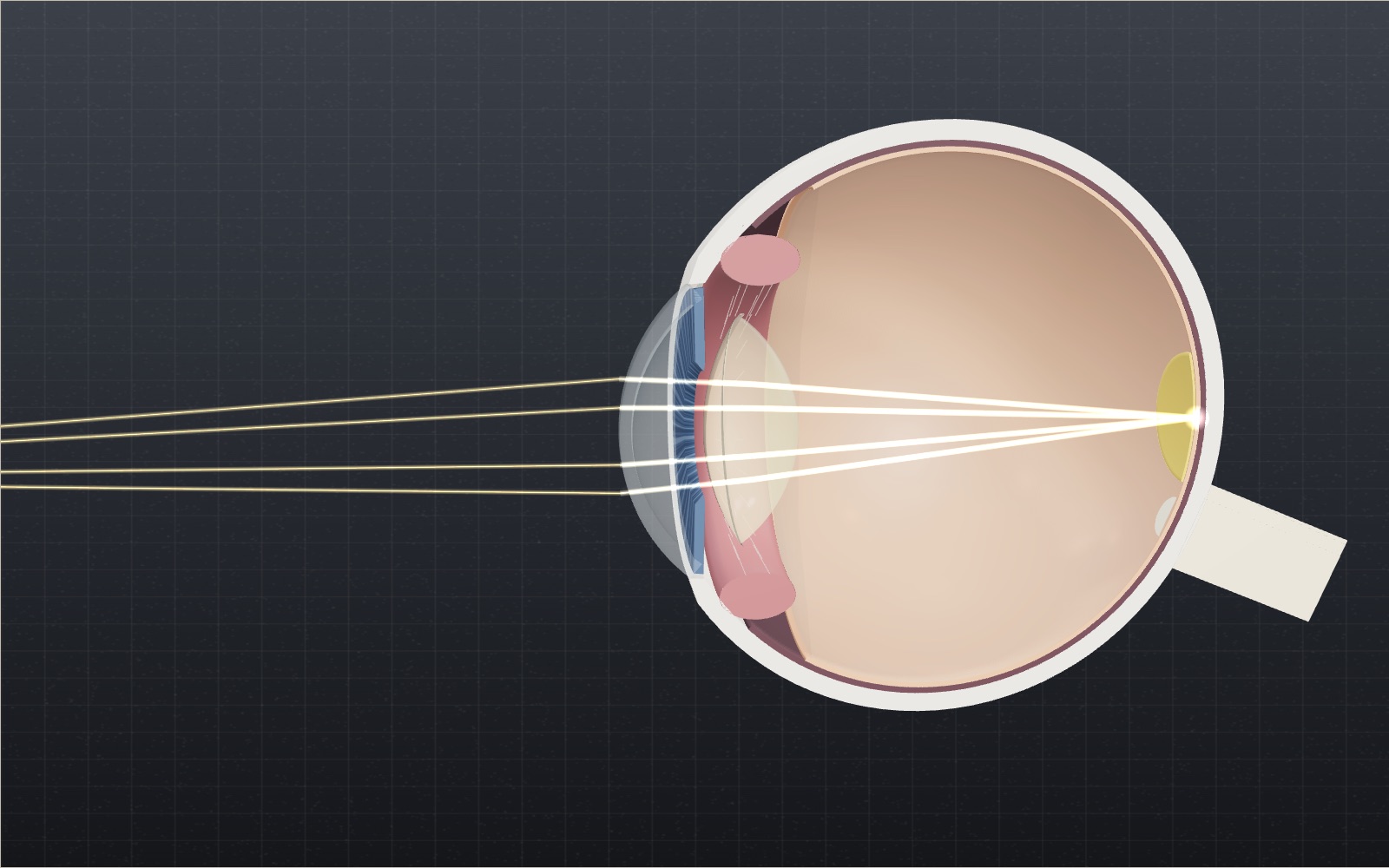
How does the eye focus on near and far objects? Try it in 3D
The cornea supplies about 43 of the eye's 60 dioptres, so why does the small lens behind it get all the credit for focusing?
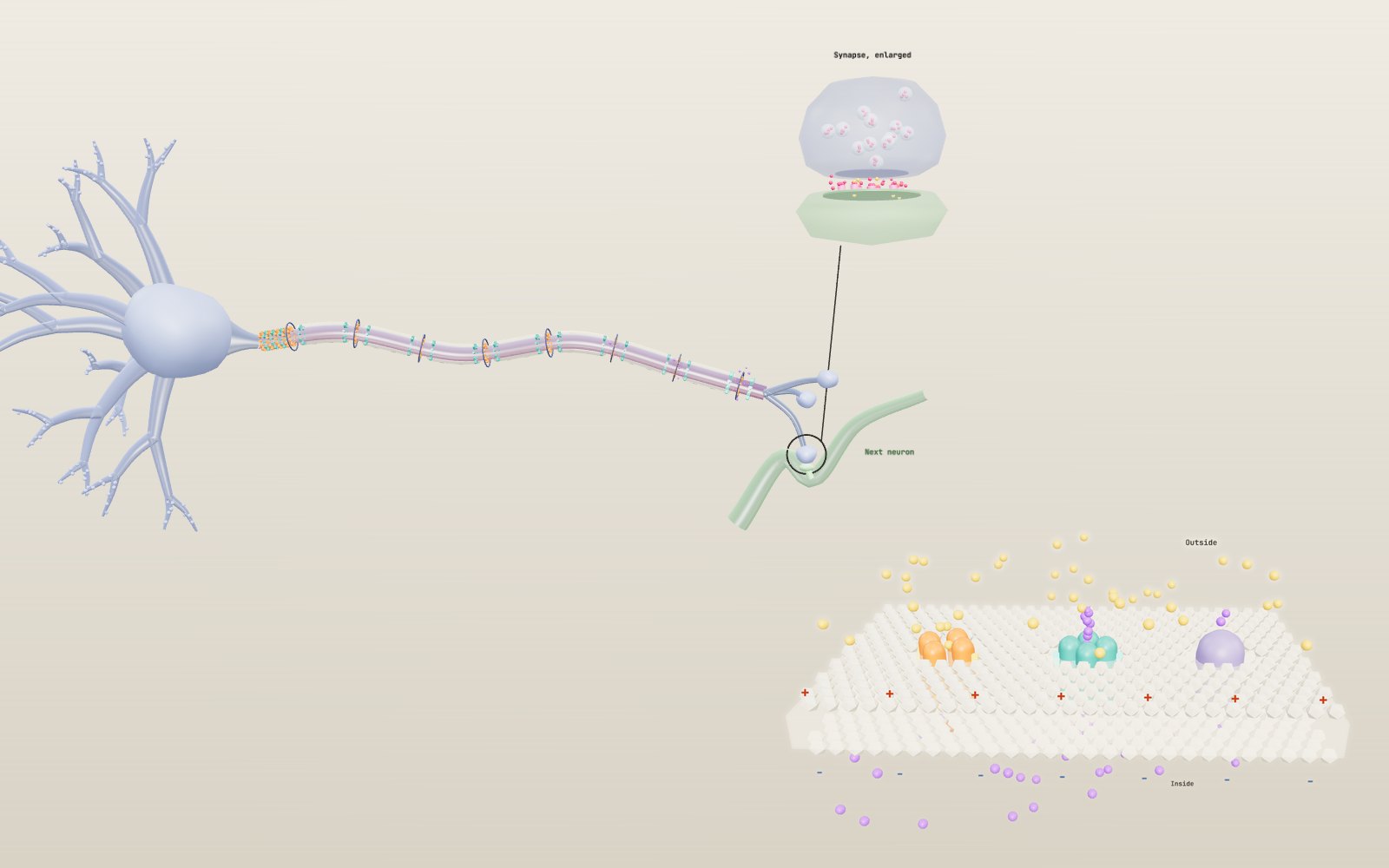
How nerve signals travel
A nerve cell sits at about −70 mV, and when a stimulus lifts it to about −55 mV it fires a spike that is always the same size.
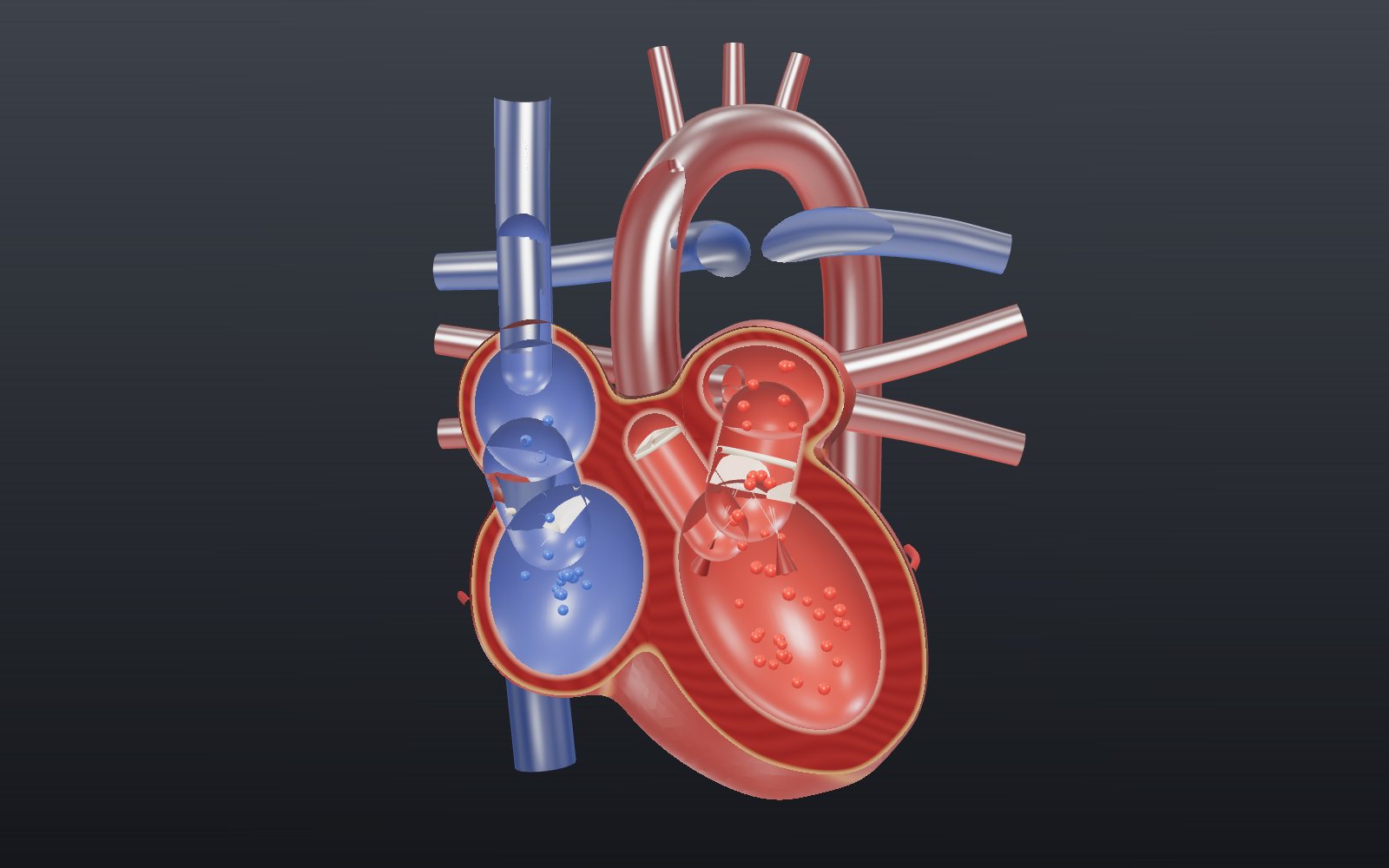
Heart beating: interactive model of the heart, step by step
Your heart pushes out about 70 mL of blood with each beat, and at a resting pace it does that about 108,000 times a day.
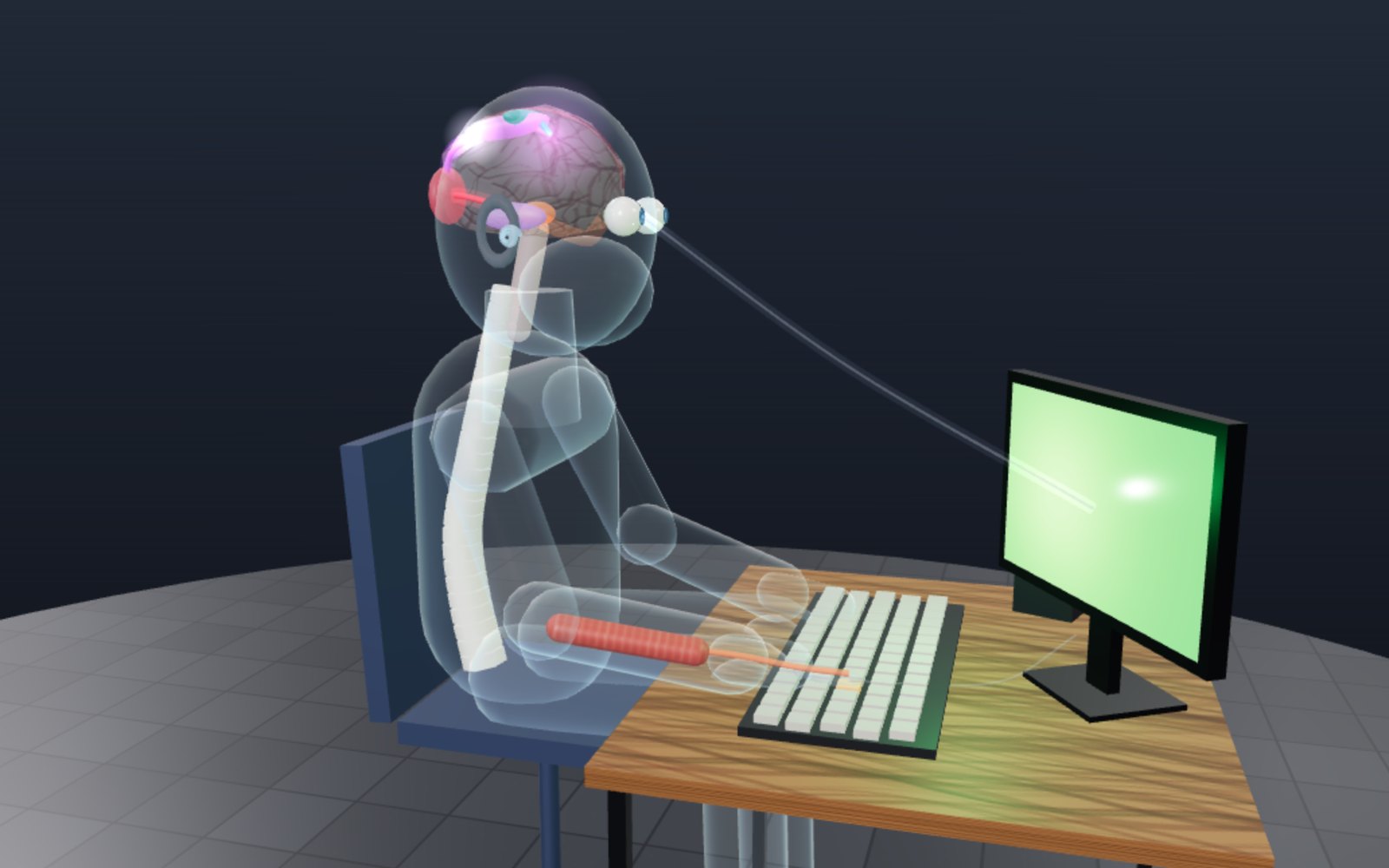
Reaction time test: how many milliseconds do you take?
Light from the screen reaches your eye almost at once, yet your finger moves about a fifth of a second later. Most of that time passes inside your head.
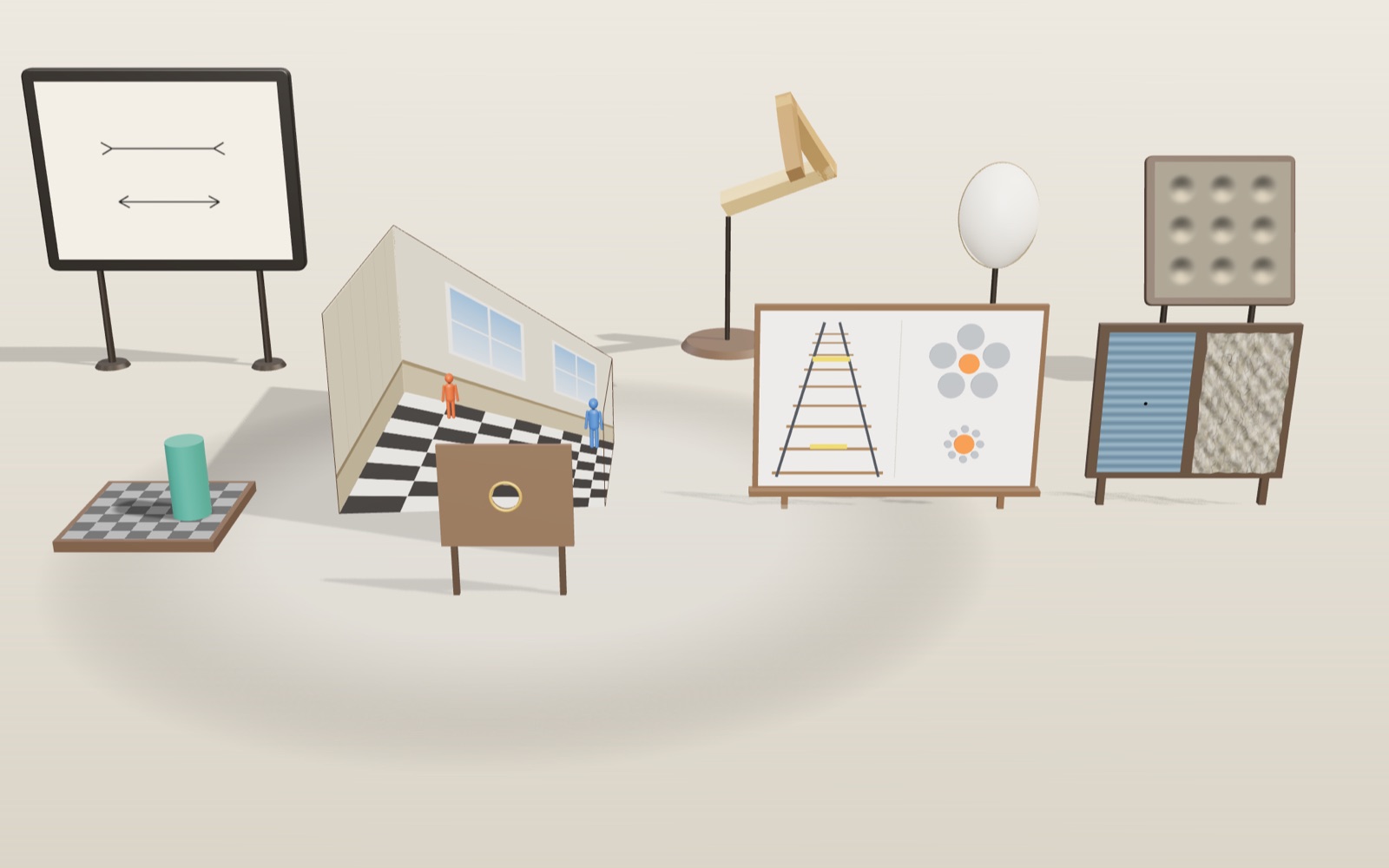
Optical illusions: why equal grey tiles look different
Tile A looks dark and tile B looks light, yet your screen sends the same grey to your eye from both.
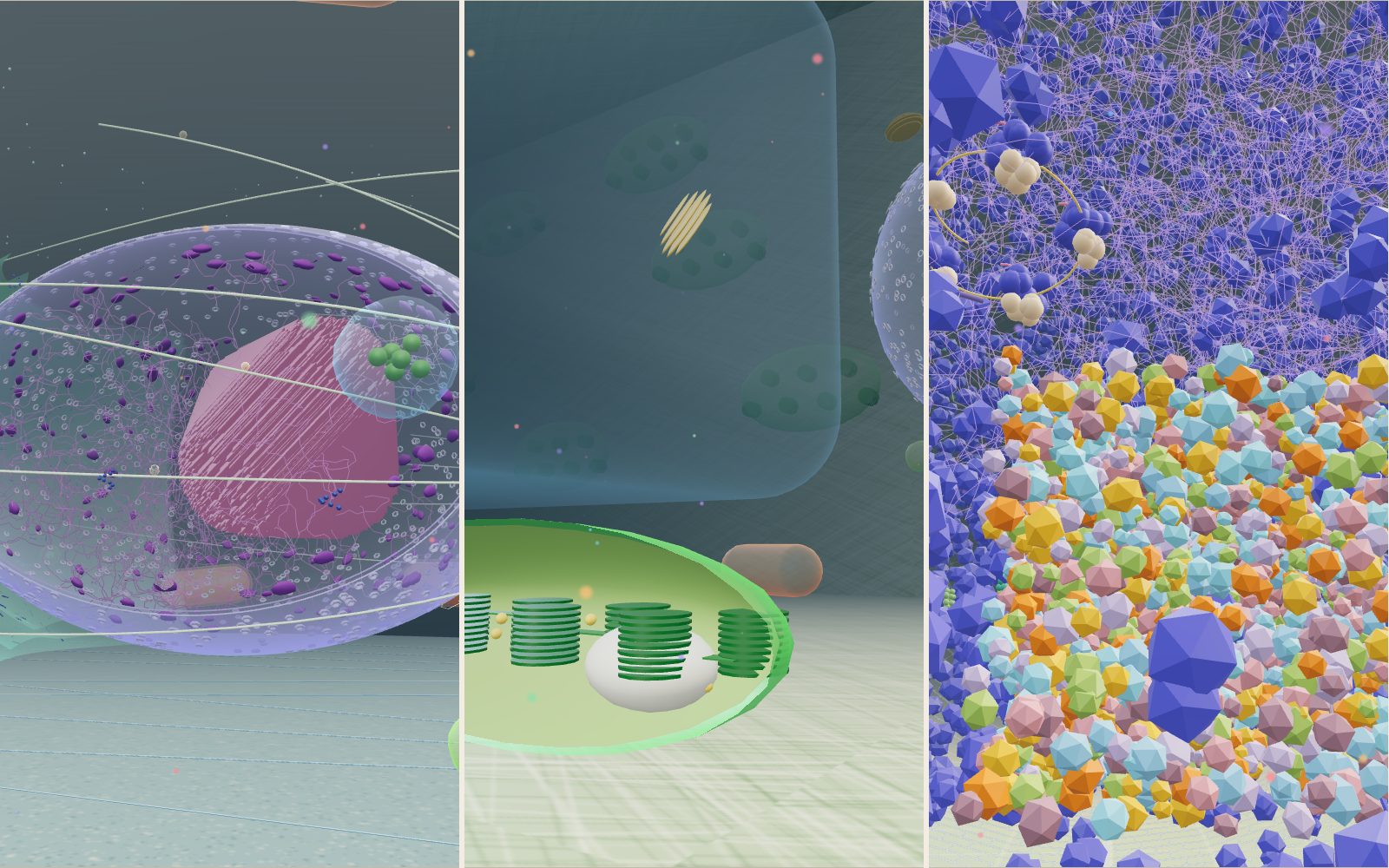
Walk inside a cell: animal, plant and bacterium
Grown a million times, a mitochondrion is about the size of a sofa, a whole E. coli is 2 m long, and the kinesin towing a vesicle past you walks at 0.8 metres per second.