Loading the model
This device cannot show the 3D model. You can read the guide steps below as text.
1 / 9 Ten metres down You start 10 m down in the open Pacific, with sunlight coming through the surface above you. Swim with WASD or the arrow keys, rise with R or Space and sink with F or C. On a phone, use the joystick and the arrows at the bottom right.
Drag to turn. Scroll or pinch to zoom.
Guide Parts Controls
01 Ten metres down You start 10 m down in the open Pacific, with sunlight coming through the surface above you. Swim with WASD or the arrow keys, rise with R or Space and sink with F or C. On a phone, use the joystick and the arrows at the bottom right.
02 Red goes first At 100 m the colour card shows black where the red patch is. Water absorbs long wavelengths fastest, so red is almost gone within 20 m. Only about 11% of the blue light is left here, which is why everything looks blue.
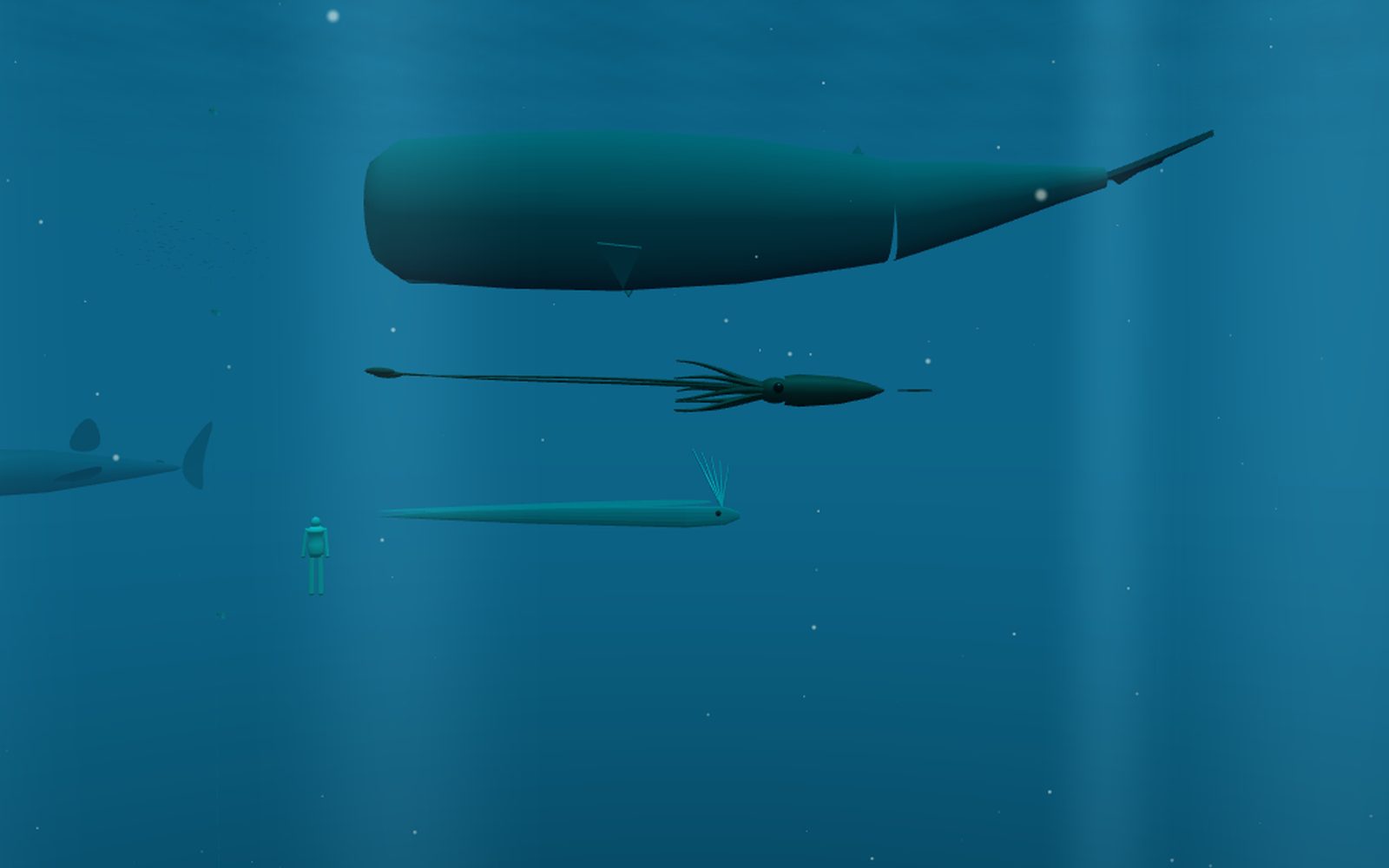
03 The twilight zone at 600 m Sunlight is now far too weak for plants. Lanternfish glow blue, and the lamp has switched on. Compare the 16 m sperm whale with the 12 m giant squid next to it. Sperm whales eat giant squid.
04 A lure in the dark At 1,500 m no sunlight is left at all. This humpback anglerfish is a female at her full size, 18 cm. Turn the lamp off under Controls and only the glowing lure remains.
05 Vents on a ridge at 2,600 m Hot water rises through black-smoker chimneys up to 9 m tall. Tube worms live here without any sunlight, fed by bacteria that make food from chemicals in the vent water. Yeti crabs and vent mussels use the same trick.
06 A whale fall at 2,891 m When a whale dies and sinks, the deep floor gets years of food at once. Sharks and grenadiers strip the flesh, and then bone-eating worms, the red plumes on the skeleton, live on the bones. Open the field guide to visit any animal by name.
07 The abyssal plain at 4,500 m Flat mud covers much of the deep sea floor. The pressure is about 450 times what you feel at the surface, and the water is less than 2 °C. A swimming sea cucumber drifts over the mud.
08 Into the trench Below 6,000 m the sea floor drops into the trench. Snailfish swim along the wall at 8,000 m. No fish has been seen deeper than about 8,300 m.
09 The bottom, about 10,935 m This is the floor of the Challenger Deep. Trieste reached it in 1960 and Deepsea Challenger in 2012. The pressure is more than 1,000 atmospheres, and the readout shows the exact figure.
Colour cards Six colour patches hung on a line at 5, 20, 50, 100 and 200 m. Under sunlight alone, red turns black first, then orange and yellow, and by 200 m only blue is left. Lanternfish Spotted lanternfish, up to 11 cm, with rows of light organs (photophores) along the belly. Their glow is blue, the colour that travels furthest in water. Sperm whale An adult male about 16 m long (NOAA Fisheries gives up to 52 ft). Its usual hunting dives reach about 600 m, and NOAA reports dives to 2,100 m or more in search of giant squid. Giant squid 12 m from fin to the tip of the two long feeding tentacles, with a 2.2 m body (mantle). These sizes are estimates for a large adult. Sperm whales are the giant squid's best-known predator. Deep-sea anglerfish A humpback anglerfish female, up to 18 cm (FishBase); males reach only about 3 cm. The lure on its fishing rod glows because bacteria live inside it. Hydrothermal vents and tube worms Black-smoker chimneys up to 9 m tall on a ridge at 2,600 m. The vent water can pass 400 °C without boiling. Giant tube worms, white tubes with red plumes, grow to 2 m; yeti crabs, vent mussels and scaly-foot snails crowd round them. Whale fall A 14 m whale skeleton on the ridge flank at 2,891 m, the depth where bone-eating worms (Osedax) were first found on a whale in 2002. A carcass feeds scavengers for months, then worms and bacteria live on the bones for years. Swimming sea cucumber Enypniastes, which NOAA researchers nicknamed the headless chicken monster. It lifts off the abyssal plain by pulsing its veil-like flaps. The size in the model, about 25 cm, is an estimate. Hadal snailfish Mariana snailfish swim along the trench wall at 8,000 m; FishBase gives 6,198 to 8,178 m and up to 22.6 cm. The deepest fish ever filmed was a related snailfish at 8,336 m. Trieste The bathyscaphe that took Jacques Piccard and Don Walsh to the Challenger Deep on 23 January 1960, reporting 35,800 ft (10,912 m). The crew rode in the small sphere under the float. Deepsea Challenger James Cameron's one-person submersible, which reached 35,787 ft (10,908 m) on 26 March 2012. It dives upright like a torpedo, with the pilot sphere at the bottom.