Loading the model
This device cannot show the 3D model. You can read the guide steps below as text.
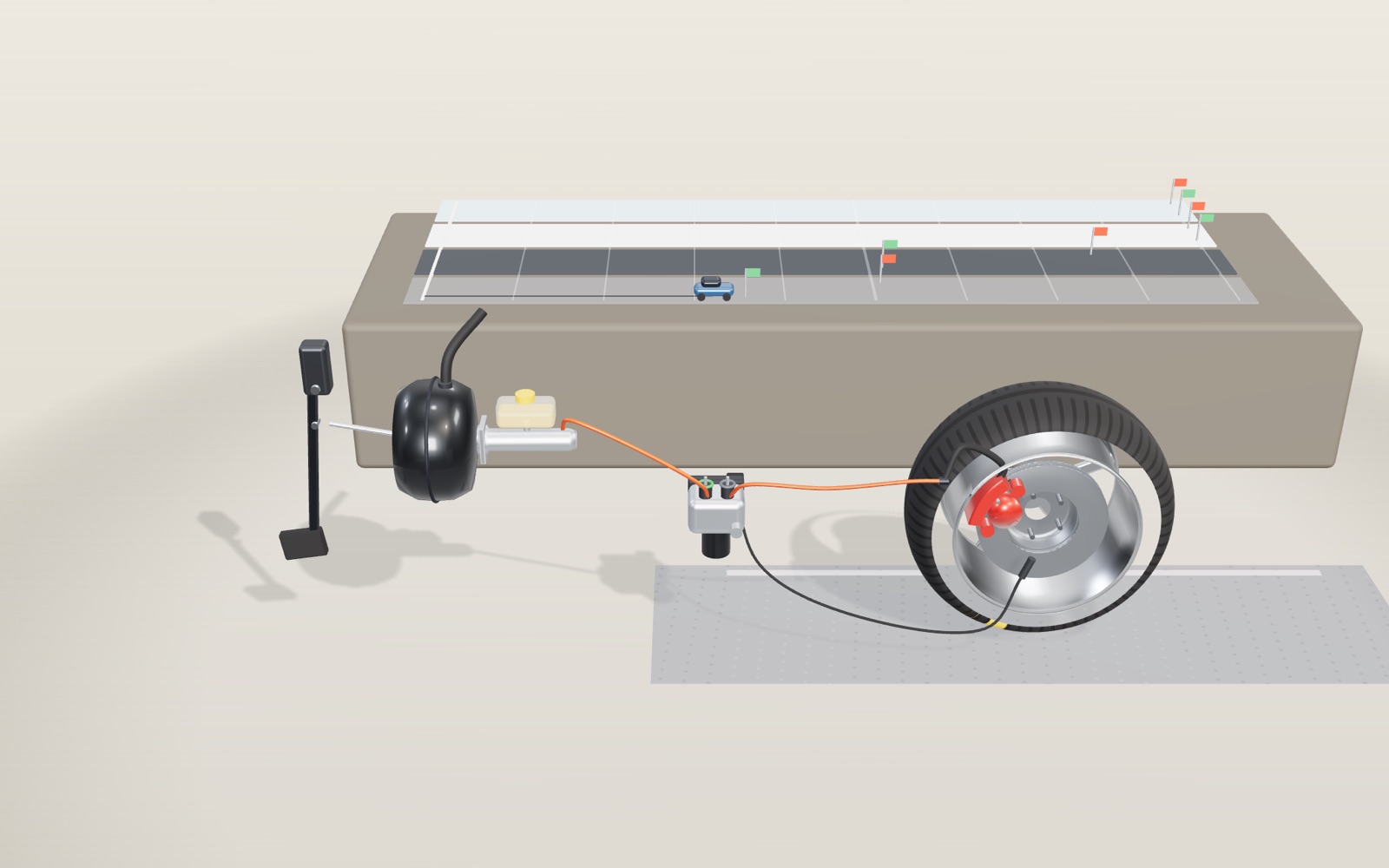
1 / 8 One wheel, from pedal to road The model shows the brake for one front wheel, with the pedal on the left and the wheel on the right. The test track at the back compares stopping distances. The car is braking from 100 km/h with 300 N on the pedal, and the panel in the corner follows the force all the way.
Drag to turn. Scroll or pinch to zoom.
Guide Parts Controls
01 One wheel, from pedal to road The model shows the brake for one front wheel, with the pedal on the left and the wheel on the right. The test track at the back compares stopping distances. The car is braking from 100 km/h with 300 N on the pedal, and the panel in the corner follows the force all the way.
02 Pedal and booster The pedal is a lever with a 4 to 1 ratio, so 300 N from the foot becomes 1,200 N on the pushrod. The vacuum booster behind it adds engine vacuum to that push and sends 4,200 N into the master cylinder.
03 Pressure in the master cylinder The master piston is 22.2 mm across, an area of 3.87 cm². Pushing it with 4,200 N raises the fluid pressure to 10.9 MPa, and because brake fluid hardly squeezes, that pressure reaches every part of the line.
04 A bigger piston at the wheel The caliper piston is 54 mm across, 5.9 times the area of the master piston. The same 10.9 MPa pushes it with 24.9 kN, enough to press the pads on the disc with the weight of 2.5 tonnes. The piston only moves about 0.2 mm for every 1.2 mm the master piston travels.
05 Motion turns into heat The pads rub the spinning disc and the car’s motion becomes heat. One stop from 100 km/h puts about 130 kJ into this disc, warming its 9 kg by about 29 °C. After 18 hard stops with no time to cool it passes 525 °C and starts to glow.
06 When the wheel locks ABS is switched off on a wet road. The brake asks the tyre for 7.4 kN but it can give at most 2.9 kN, so the wheel stops turning and slides. Sliding rubber grips less: μ falls from 0.80 to 0.51 and the stop grows to 76 m.
07 ABS lets go and grabs again With ABS on, the control unit watches wheel speed. When slip passes 20% it shuts the inlet valve and opens the outlet valve, the wheel speeds up again, and pressure is built back. In this model that happens about 14 times a second.
08 Three roads, two ways to stop Green flags show the stop with ABS, red flags the stop with locked wheels: 36 and 51 m dry, 52 and 76 m wet. On ice both take about 790 m. Steering is on, and only the rolling tyre can move the car one lane over.
Brake pedal A lever pivoted at the top. The foot pushes 0.4 m from the pivot and the pushrod sits 0.1 m from it, so the pedal multiplies the foot force four times (model). Vacuum booster A drum split by a rubber diaphragm. Engine vacuum on one side and air on the other add their push to the driver’s, 3.5 times the input in this model. Master cylinder A piston 22.2 mm across pushes on sealed brake fluid. The reservoir on top keeps the cylinder full as the pads wear. See inside shows the piston. Brake lines Steel pipes and a flexible hose carry the pressure to the wheel. They turn orange with pressure: the first pipe shows the master cylinder, the second what reaches the caliper. ABS modulator A valve block with a pump and its control unit. An inlet valve can shut off the line and an outlet valve can let fluid out, so pressure at one wheel can be held or dropped many times a second. Wheel speed sensor A magnetic sensor facing a toothed ring of 48 teeth on the hub. Each tooth that passes makes a pulse. The tip flashes with the pulses and goes still when the wheel locks. Caliper A floating caliper with one piston on the inboard side. When the piston pushes the inner pad, the body slides on two pins and pulls the outer pad onto the disc with the same force. Caliper piston 54 mm across, with 5.9 times the area of the master piston. At 10.9 MPa it presses the pad with 24.9 kN. Brake pads Friction material on steel backing plates, one on each face of the disc. Pad friction on cast iron is taken as 0.4. The gap at rest is drawn about ten times too large so it shows. Ventilated disc Two grey-iron faces 300 mm across, joined by 36 vanes that pump air through the middle. Its colour follows the temperature worked out from the heat of each stop. Wheel and tyre Rolling radius 0.31 m, carrying a quarter of a 1,500 kg car (3,679 N). The yellow mark shows whether the tyre is turning. Skid marks appear when slip passes 25%. Test track Lanes at 1:40: dry asphalt, wet asphalt, compacted snow and ice. Green flags mark the stop with ABS, red flags the stop with locked wheels. The blue car runs the current stop.