Loading the model
This device cannot show the 3D model. You can read the guide steps below as text.
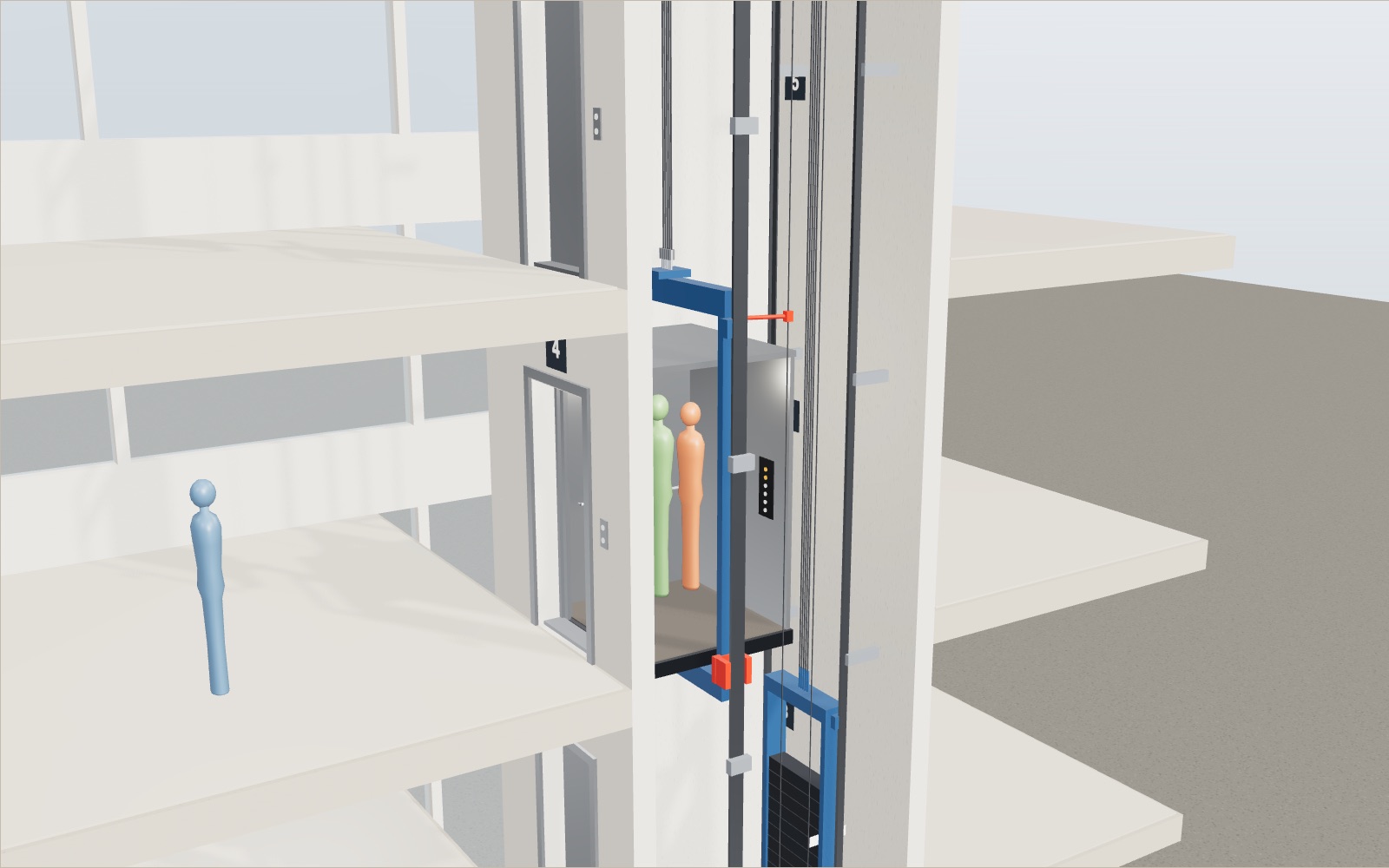
1 / 10 A lift in section This is a six-stop passenger lift cut open from the front. The car runs on rails in a concrete shaft. The counterweight runs beside it, and the machine sits in a room on top. Floors are 3 m apart, so the car travels 15 m from the bottom stop to the top.
Drag to turn. Scroll or pinch to zoom.
Guide Parts Controls
01 A lift in section This is a six-stop passenger lift cut open from the front. The car runs on rails in a concrete shaft. The counterweight runs beside it, and the machine sits in a room on top. Floors are 3 m apart, so the car travels 15 m from the bottom stop to the top.
02 The ropes are not wound up Five ropes run from the car, over the traction sheave and the deflector sheave, and down to the counterweight. The motor turns the sheave and friction in the grooves moves the ropes. When the car goes up, the counterweight comes down by the same distance.
03 The counterweight balances half the load The car weighs 1,000 kg and may carry 1,000 kg. The counterweight is 1,450 kg, the car plus 45% of the rated load. With six passengers (450 kg) the two sides weigh the same and the motor only has to overcome friction. Watch the car and the counterweight pass each other.
04 What the motor has to lift With 13 passengers the car side is 525 kg heavier than the counterweight. At a 0.32 m sheave radius that is 525 × 9.81 × 0.32 = 1,648 N·m. Without a counterweight it would be 6,200 N·m. The chart shows both lines for every number of passengers.
05 Drag the counterweight Grab the counterweight and drag it up or down to change its weight, from the empty car alone to the car plus the whole rated load. The energy chart under the controls shows what a round trip costs the motor. It is lowest between 45 and 52%, which is why real counterweights balance the car plus 40 to 50% of the rated load.
06 Calls answered in order The car waits at floor 1. Someone inside has pressed 5 and 2, someone on floor 3 wants to go up and someone on floor 4 wants to go down. The car keeps going up while it has calls ahead, so it stops at 2, 3 and 5, then turns and stops at 4.
07 Be the operator Before automatic control, an operator drove the car and chose every stop. Press Be the operator, pick a rush and press Start: ten people appear on the landings, each showing the floor they want. Send the car by pressing floors in your own order, then compare your average wait with three rules on the same ten people.
08 The door interlock The doors at floor 3 are being held open and a passenger has pressed 6. The lock on the landing door is open, so its switch is open, and the controller will not start the car. Let go of the doors with the toggle and the car leaves as soon as the lock closes.
09 When the ropes break The ropes are cut and the car falls freely, shown here at a quarter of real speed. The governor turns faster with the car. At 2.01 m/s, 1.15 times the rated speed, it locks its rope. The rope pulls the linkage, the wedges grip the rails, and the car stops after about 55 cm in all.
10 How fast a tall building's lifts go Set the rated speed to 21 m/s, the speed Hitachi reports for its lift in the Guangzhou CTF Finance Centre. In this 15 m shaft the car never gets above 3.9 m/s, because it has to slow down again almost as soon as it has sped up. Over 440 m the same lift takes about 42 s.
Car A stainless cab on a steel frame (the sling) with a crosshead on top and a plank underneath. With its doors and safety gear it weighs 1,000 kg in the model. Each smooth figure inside stands for one 75 kg passenger. Counterweight A steel frame stacked with cast-iron filler weights, 1,450 kg in the model: the empty car plus 45% of the 1,000 kg rated load. It runs on its own rails and moves the opposite way to the car. Hoist ropes Five steel wire ropes, each tied to the car at one end and the counterweight at the other. They are not wound up. They lie over the sheave and are moved by friction. Traction sheave A grooved wheel 640 mm across on the motor shaft. The ropes sit in its grooves and are driven by friction alone. The smaller deflector sheave beside it spaces the ropes out so the counterweight hangs clear of the car. Machine and motor A gearless permanent-magnet motor turns the sheave directly. A spring-applied brake on the drum holds the car whenever the motor is not powered, and is lifted electrically to run. Guide rails T-section steel rails bolted to the shaft walls with brackets, two for the car and two for the counterweight. Guide shoes keep the car centred, and the safety gear grips the car rails in an emergency. Overspeed governor A sheave in the machine room driven by its own rope loop, which is tied to the car and held taut by a weighted pulley in the pit. Flyweights swing out with speed. Above the trip speed a jaw locks the governor rope. Safety gear Wedges in red housings at the foot of the car frame, either side of each rail. When the locked governor rope pulls the linkage up, the wedges ride up into the gap and squeeze the rails until the car stops. Landing doors and interlocks Each floor has its own pair of sliding doors. A lock on the header hooks them shut and closes a switch only when they are locked. The car may not start unless every landing door is shut and locked. Buffers Springs on the pit floor under the car and the counterweight. They are the last stop if the car runs past the bottom floor, and they set how much clear space there must be in the pit. Controller The cabinet that holds the drive and the logic. It collects every call, decides the order of stops, and refuses to run while any safety switch in the chain is open.