Loading the model
This device cannot show the 3D model. You can read the guide steps below as text.
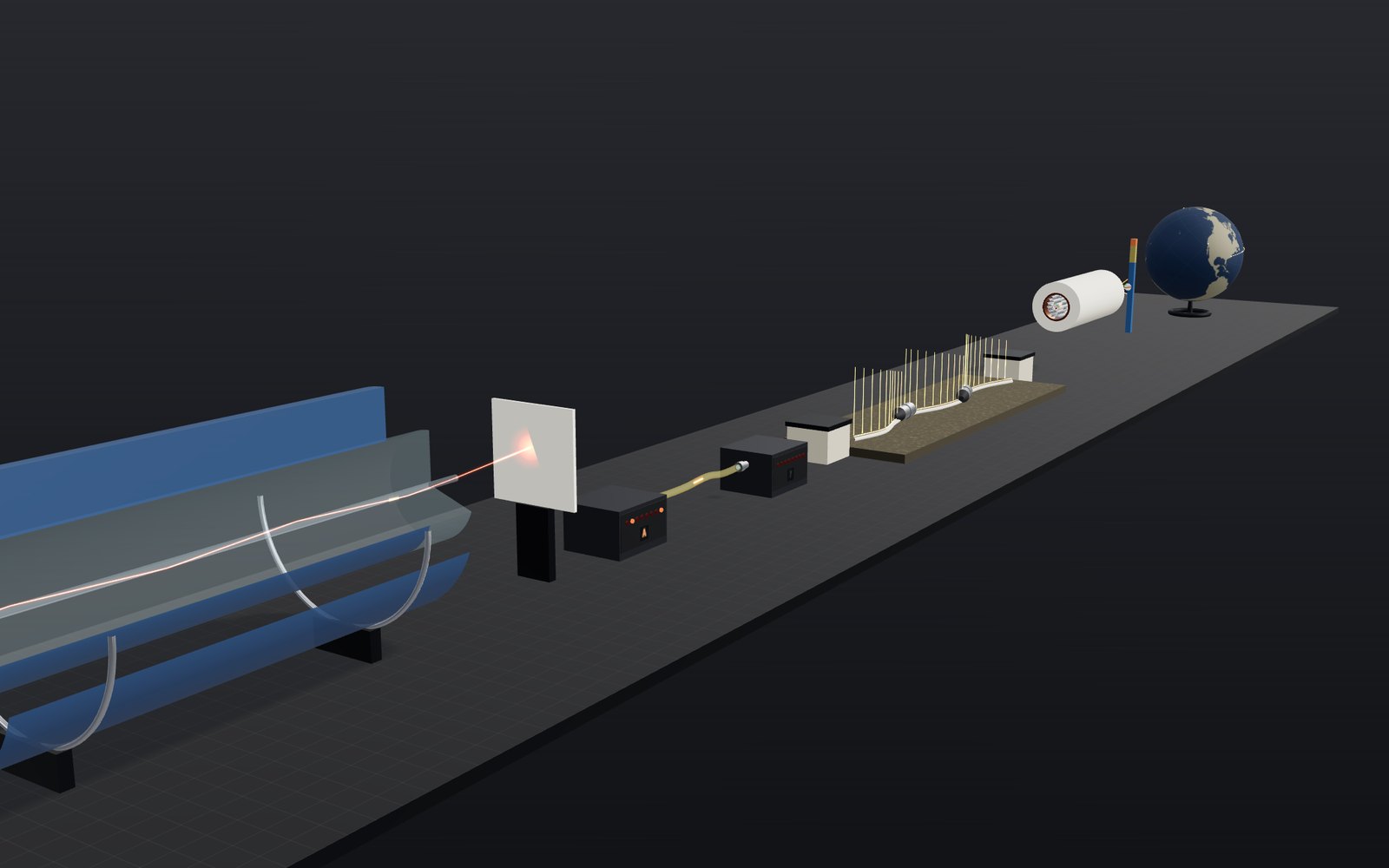
1 / 8 A strand of glass and the cable it lives in The bench holds five stations. On the far left a fibre is cut open to show the glass inside; on the far right a globe shows three real cable routes. The bar under the picture jumps to each station.
Drag to turn. Scroll or pinch to zoom.
Guide Parts Controls
01 A strand of glass and the cable it lives in The bench holds five stations. On the far left a fibre is cut open to show the glass inside; on the far right a globe shows three real cable routes. The bar under the picture jumps to each station.
02 The glass inside the plastic The light travels in the core, which is only 8.2 µm across. The cladding around it is glass too, 125 µm wide, with a slightly lower refractive index. A 242 µm plastic coating covers both. The model keeps these proportions.
03 Past the critical angle, no light escapes Here the ray meets the core wall at 87°. The critical angle is arcsin(1.4440 / 1.4508), which works out to 84.46°. At any larger angle the wall reflects all of the light, so the spot at the far end stays bright.
04 Below it, the light leaks out At 80° the ray is steeper than the critical angle. Only 0.8% reflects at the first bounce; the rest crosses the cladding and is absorbed by the coating. Drag the incidence angle in Controls and watch the far end.
05 Ones and zeros as flashes The transmitter switches the laser on for a 1 and off for a 0. The letter A is 01000001. At 10 Gbit/s each bit lasts 100 picoseconds and occupies about 2 cm of glass. Choose another letter with the slider.
06 Why the cable needs amplifiers Submarine fibre loses about 0.17 dB of light per kilometre. Over a 70 km span that adds up to 11.9 dB, leaving 6.5% of the light. A repeater on the seabed puts it back. Try longer spans or lossier fibre.
07 Thicker cable in shallow water This is double armour, 35.9 mm across, for water shallower than about 600 m where anchors and trawls reach. Deeper down one armour layer is enough, and below about 2000 m the bare 17 mm cable is used. Move the depth slider.
08 How long the Atlantic takes Light in the fibre travels at c / 1.4682, about 204,000 km/s. MAREA is 6,605 km long, so a signal takes 32.3 ms one way and 64.7 ms there and back. The other routes are on the slider.
Laser A semiconductor laser at 1550 nm, an infrared wavelength the eye cannot see. The model draws its light red. Core Glass 8.2 µm across with a refractive index about 0.5% higher than the glass around it. All the signal travels here. Cladding Glass 125 µm across. Its lower index is what makes total internal reflection possible at the core wall. Coating Two layers of acrylate bring the fibre to 242 µm. They protect the glass surface and soak up stray light. Photodiode Turns each arriving flash into a small current. The receiver reads a 1 when the current passes a threshold. Repeater A pressure housing on the seabed with erbium-doped fibre amplifiers inside, one for each fibre in each direction. Fibre tube A plastic tube with the fibres floating in gel, so the cable can stretch a little without pulling on the glass. Strength wires 24 high-strength steel wires in two layers. They carry the cable's weight while it is laid or lifted for repair. Copper sheath A welded copper tube that carries direct current to the repeaters and keeps water and hydrogen out. Polyethylene jacket Insulates the copper from seawater at up to 15,000 volts. In deep water this is the outside of the cable, 17 mm across. Armour wires Galvanised steel wires 3.35 mm thick, one or two layers, under tarred yarn. Added where anchors and trawls reach.