Loading the model
This device cannot show the 3D model. You can read the guide steps below as text.
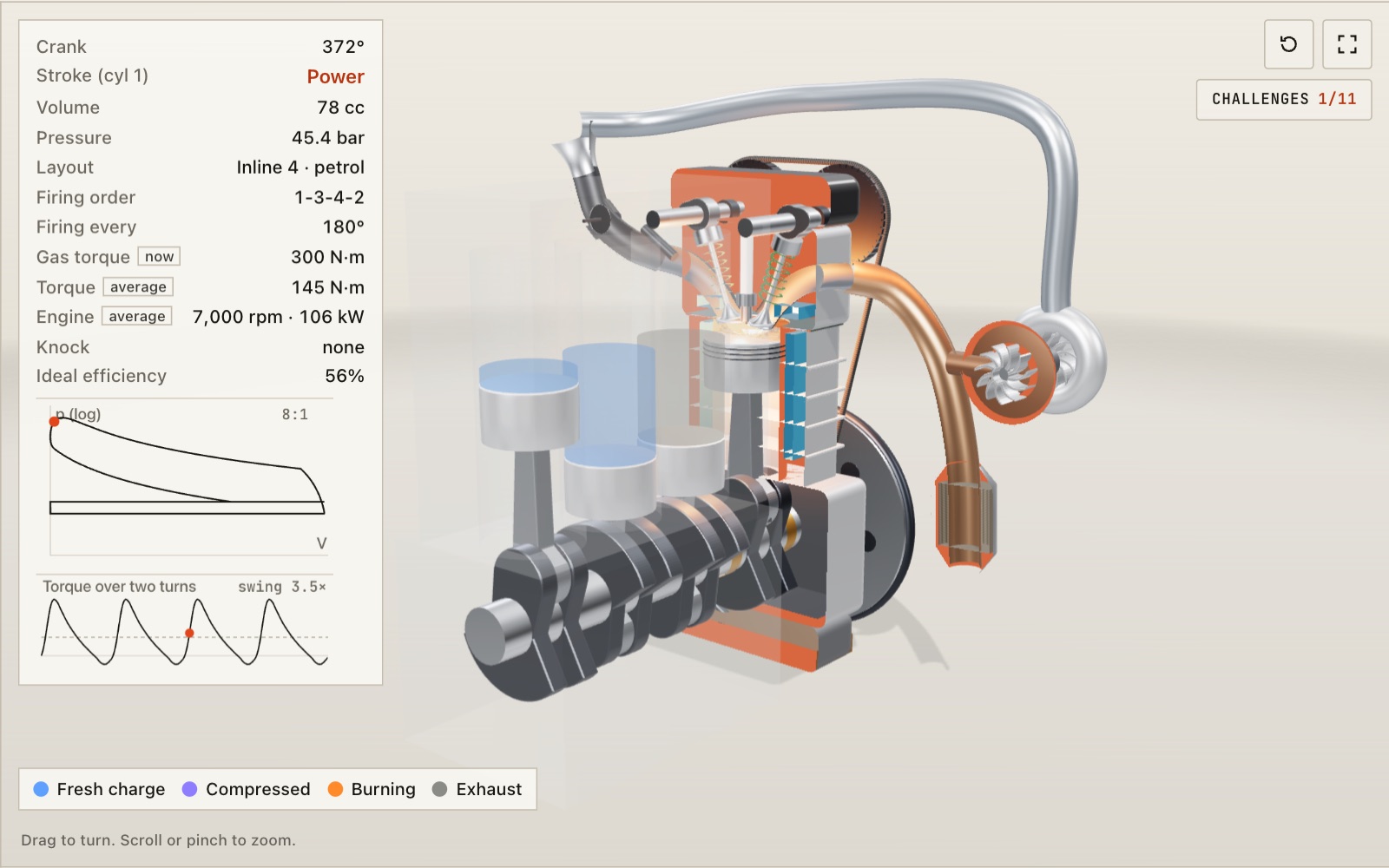
1 / 12 One cylinder, cut in half The front half of the block and head has been cut away. The red surfaces are where it was cut. Turn on "Show cut half" to see the whole engine.
Drag to turn. Scroll or pinch to zoom.
Guide Parts Controls
01 One cylinder, cut in half The front half of the block and head has been cut away. The red surfaces are where it was cut. Turn on "Show cut half" to see the whole engine.
02 1. Intake The inlet valve is open and the piston moves down, so the pressure above it drops and the air and fuel mixture flows in. Crank 0° to 180°.
03 2. Compression With both valves shut, the piston rises and squeezes the mixture to a tenth of its volume. Watch the pressure climb in the readout.
04 3. Spark and power This runs very slowly. The plug fires just before the top, and the burning gas pushes the piston down. This is the only stroke that does work. Crank 360° to 540°.
05 4. Exhaust Near the bottom the exhaust valve opens, and the rising piston pushes the burnt gas out. Then the cycle starts again.
06 Valve timing Seen from behind. The belt turns the camshafts at half the crank speed, because each valve opens only once in two crank turns. The timing circle under Controls lets you shift the cams and watch them turn here.
07 Crank and rod The rod and crank turn straight-line motion into rotation. The flywheel keeps the engine turning through the three strokes that do no work.
08 Four cylinders, one crankshaft Cylinders 2 to 4 are drawn as ghosts. They fire in the order 1-3-4-2, half a turn apart, so one of them is always on its power stroke. Watch the torque graph: it no longer drops below zero for most of the cycle.
09 A V8 fires every 90° Two banks of four at 90°, with the crank pins set at right angles (cross-plane). Eight power strokes in two turns overlap each other, and the torque swing is the smallest of all the layouts here.
10 Diesel: no spark Switch on Diesel. The piston crown sits 4.5 mm higher, so the air is squeezed to 1/18 of its volume and gets hot enough to light the fuel. The injector sprays at about 10° before the top and the fuel burns as it enters.
11 Coolant and oil Coolant (blue) runs up the jacket beside the bore, over the chamber and back down. Oil (amber) is drawn from the pan, pumped up to the main bearings and drains back.
12 Two strokes instead of four Switch on Compare two-stroke. The drawing on the right is a two-stroke cylinder on the same crank. The piston itself opens and shuts ports in the wall, so it fires once every turn. The orange line in the torque graph is its torque.
Piston 86 mm across. Three rings seal it against the cylinder wall. Connecting rod 145 mm between centres. It turns the up-and-down motion into rotation. Crankshaft Crank radius 43 mm, so the stroke is 86 mm. Counterweights opposite the pin. Flywheel Stores energy from the power stroke to carry the engine through the other three. Valves Inlet valve on the left, exhaust on the right. Each opens 9.2 mm. Camshafts One lobe per valve. They turn once for every two turns of the crankshaft. Timing belt 21 teeth on the crank sprocket and 42 on each cam pulley, so the ratio is exactly 2 to 1. Spark plug Fires 15° before top dead centre in this model. Cylinder head Holds the ports, valves and camshafts. Cylinder block The bore the piston slides in. Section shown in red. Crankcase Carries the crankshaft bearings and encloses the moving parts. Intake and exhaust Air and fuel in on the left, burnt gas out on the right. Piston rings Two compression rings stop the gas leaking past. The lowest ring scrapes oil off the wall. Gudgeon pin A 21 mm steel pin joins the piston to the small end of the rod. Valve springs They pull each valve shut again once the cam lobe has passed. Counterweights The heavy webs opposite the crank pin balance the pin and the big end of the rod. Fuel injector Petrol: sprays into the intake port while the valve is shut. Diesel: sprays straight into the cylinder about 10° before the top. Throttle valve A butterfly in the intake. Closing it lowers the pressure of the charge, which is how a petrol engine makes less power. Catalytic converter A ceramic honeycomb coated with platinum-group metals. It turns CO, unburnt fuel and NOx into CO2, water and nitrogen. Water jacket Coolant passages around the bore and over the chamber carry heat to the radiator. Head gasket A thin layered steel sheet that seals gas, coolant and oil between block and head. Oil pan Holds the oil at the bottom of the engine. The pump draws from here. Main bearings Thin shells lined with soft metal. While the engine runs, the crank journal floats on a film of oil and does not touch them. Oil pump Draws oil from the pan through a strainer and pushes it to the bearings, the camshafts and the underside of the piston.