Loading the model
This device cannot show the 3D model. You can read the guide steps below as text.
1 / 12 Layers at the end of summer On 1 October the top of the model lake is still warm and the deep water is cooler. Warm water is lighter, so the layers stay apart. Drag to turn the view.
Drag to turn. Scroll or pinch to zoom.
Guide Parts Controls
01 Layers at the end of summer On 1 October the top of the model lake is still warm and the deep water is cooler. Warm water is lighter, so the layers stay apart. Drag to turn the view.
02 Autumn cooling As the air cools, the surface water cools, gets heavier and sinks. The warm top layer grows deeper week by week.
03 The overturn at 4 °C When the surface reaches the temperature of the deep water, the whole lake mixes from top to bottom. It keeps mixing until all of it is near 4 °C, the temperature at which fresh water is densest.
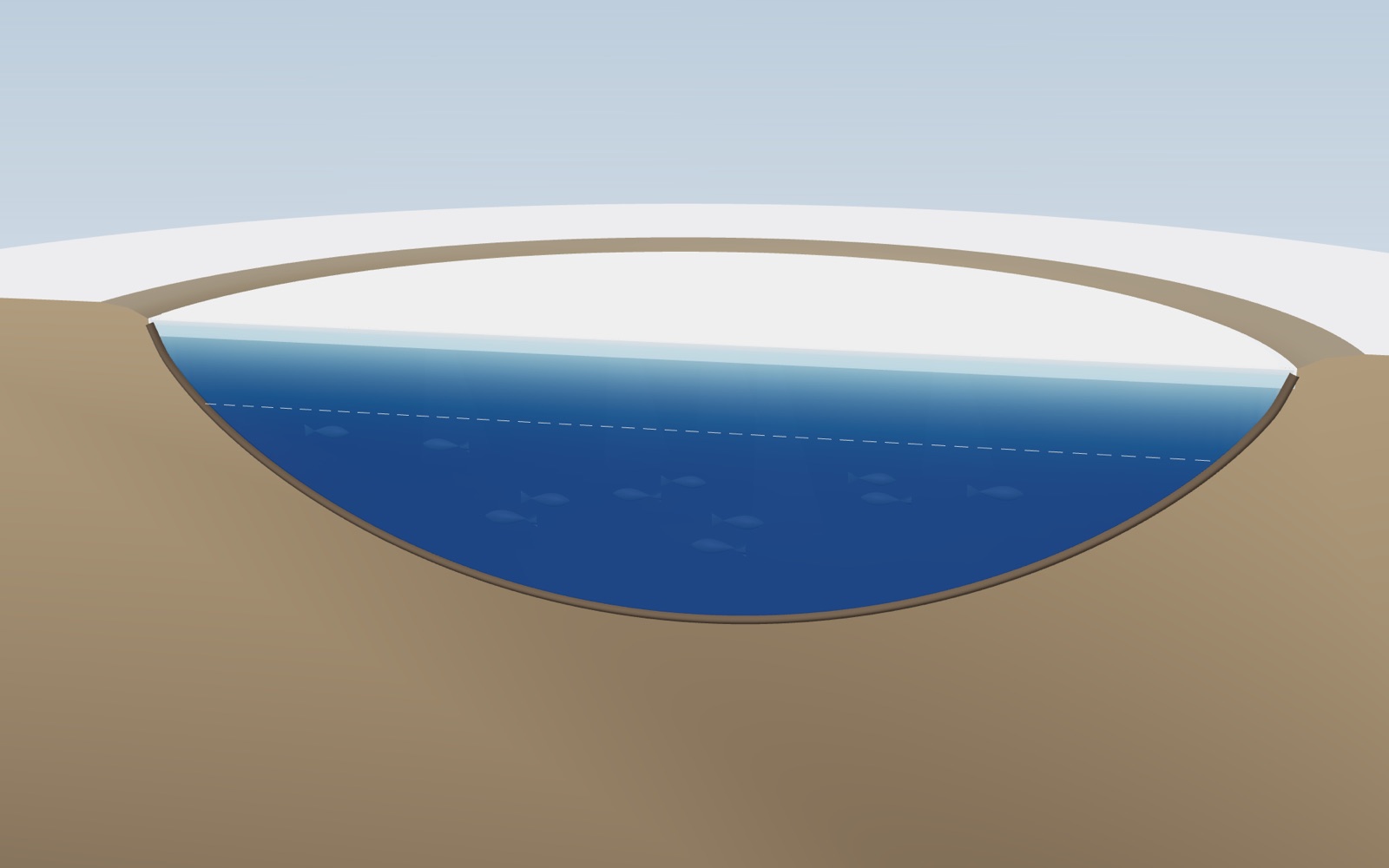
04 Colder water stays on top Below 4 °C fresh water gets lighter again. Water cooled to 3, 2 or 1 °C no longer sinks, so a thin cold layer forms on top of the 4 °C water. The dashed line on the cut face marks where the water reaches about 4 °C.
05 Ice forms at the top Once that thin top layer reaches 0 °C on a cold, calm night, ice forms on the surface. The lake does not have to cool all the way down first.
06 Why the ice floats Ice is about 8 % less dense than liquid water (916.7 against 999.8 kg/m³ at 0 °C), so it floats with about a tenth above the water. The Crystals exhibit shows the hexagonal rings of molecules that cause this.
07 Ice thickens with the square root of the cold Ice grows from the underside, and heat has to leave through the ice already there. Thickness grows with the square root of the freezing degree-days: four times the cold gives twice the ice.
08 Snow on the ice With snow on top, the ice grows more slowly (α 1.7 to 2.4 instead of 2.7 in the Corps of Engineers table), and slush that freezes on top makes weaker white ice.
09 Life under the ice Fish wait out the winter in the 4 °C water. Under snow-covered ice little light gets through, plants make less oxygen, and in long winters oxygen can run low.
10 Sea water is different Sea water freezes at about −1.8 °C and keeps getting denser all the way down to its freezing point. Cold surface water keeps sinking, so a deep layer must cool before ice can form. In the model the same winter freezes much later.
11 Ice safety The thickness on this stage is a model. Never use it to judge real ice. Official tables from the Minnesota DNR, the Canadian Red Cross and Korea's safety portal are in the Controls tab.
12 Spring ice-out In spring the ice thins and breaks up, the surface warms through 4 °C and the lake mixes again: the spring overturn.
Ice sheet Ice grows downward from the surface. It floats because it is about 8 % less dense than the water; here 91.7 % of its thickness sits below the waterline. Drawn thicker than scale. Snow and white ice Snow insulates the ice and slows its growth. When slush freezes on top it makes white, bubbly ice, which the Minnesota DNR says is only about half as strong as clear ice. Cold top layer In winter the coldest water, near 0 °C, floats on top because it is lighter than 4 °C water. This is the layer that freezes. Deep water Fresh water is densest at 3.98 °C. After the autumn overturn the deep water stays close to that temperature all winter, under the ice. Fish Most lake fish spend the winter slowed down in the deeper, slightly warmer water. Drawn as smooth shapes. Lake bed A curved basin 20 m deep at the centre in the model. Depth is drawn about 7 times taller than the width to make the layers visible. Light Clear ice lets a lot of light through; snow on the ice blocks most of it. The shafts fade with snow cover (a picture, not a measured value).