Loading the model
This device cannot show the 3D model. You can read the guide steps below as text.
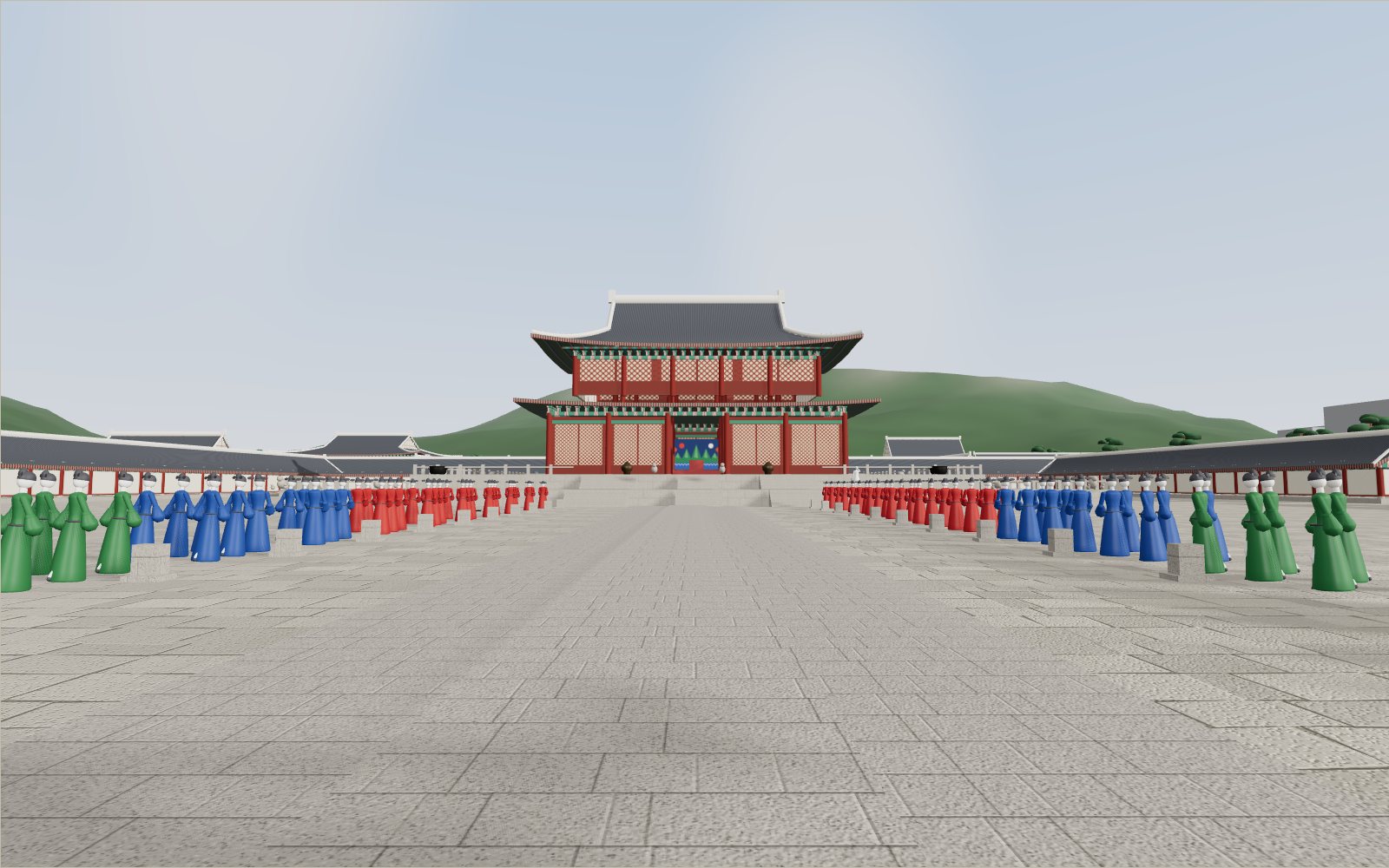
1 / 15 The morning assembly You stand in the courtyard of Geunjeongjeon in the 1880s. Officials in red, blue and green robes walk in from the side gates, find their rank stones and bow four times toward the hall. The robes are coloured by grade; nobody in the model has a face.
Drag to turn. Scroll or pinch to zoom.
Guide Parts Controls
01 The morning assembly You stand in the courtyard of Geunjeongjeon in the 1880s. Officials in red, blue and green robes walk in from the side gates, find their rank stones and bow four times toward the hall. The robes are coloured by grade; nobody in the model has a face.
02 Rank stones Twelve stones run along each side of the royal path: grades one to three have a senior and a junior stone, four to nine only the senior one. Civil officials stood on the east, military officials on the west. Under "Me" you can pick a rank and find your stone.
03 Rain on the stone slabs The courtyard is paved with rough, uneven granite slabs. Watch the rain darken the joints first. Turn rain off with the control or press R.
04 The upper terrace Two tiers of stone with balustrades. By the stairs stand an iron water vessel (deume) and stone guardians of the four directions; zodiac animals sit on the posts, but the dragon, dog and pig are missing.
05 Inside the throne hall The front half of the hall is cut away. The throne sits on a dais under a canopy; behind it is the screen of the Sun, Moon and Five Peaks. On the ceiling two golden dragons have seven claws on each foot.
06 Figures on the roof Look up at a corner of the upper roof. Seven clay figures sit on each hip ridge, led by the Tang monk of the Chinese novel Xiyouji. Gyeonghoeru has eleven, the most of any building in Korea.
07 Gyeonghoeru The banquet pavilion stands on an island in a pond of about 128 by 113 m. Three stone bridges join it to the east bank. It rests on 48 stone pillars: 24 square ones outside and 24 round ones inside.
08 A banquet at night On the upper floor officials sit in rows for a banquet, as the pavilion was built for envoys and court celebrations. Lanterns hang along the eaves. Turn on "Seasons" to see the 24 outer pillars named after the seasonal divisions.
09 Amisan Behind the queen’s hall the earth dug for the Gyeonghoeru pond was heaped into a terraced garden. The four hexagonal brick chimneys carried the smoke of the floor heating away from the hall.
10 Hyangwonjeong A hexagonal pavilion on an island, built about 1885 according to the tree rings of its timber. Its bridge was moved to the south side in 1953 and went back to the north in 2021.
11 After 1592 The year bar is on 1592. The palace burned in the Japanese invasion and lay empty for about 270 years. Only the stone terraces and the pillars of Gyeonghoeru stand; trees grow in the courtyards.
12 The colonial period In 1930 most of the halls are gone. A stone building 131 m long, the Government-General of Korea, stands between Gwanghwamun and Geunjeongmun, and the gate has been moved to the east wall.
13 The crooked gate In 1990 the old Government-General building is a museum. The concrete Gwanghwamun of 1968 stands 11.2 m north and 13.5 m east of its real place, turned 3.75° off the axis. Walk through it.
14 The changing of the guard Today the guards change at Gwanghwamun at 10:00 and 14:00 except on Tuesdays. The model plays the 14 steps in about 90 seconds; "Guard change" shows the real times in Seoul.
15 The palace from above From high up the axis runs from the woldae through four gates to the throne hall and the king’s and queen’s halls. Slide the year bar to watch the palace fill, empty and fill again.
Assembly, front rows Where the tour starts. Courtyard from the gate The rank stones and the royal path. Upper terrace Deume and stone guardians. Inside the throne hall Throne, screen and dragons. In front of Gwanghwamun The gate and its woldae. Royal stream and bridge Yeongjegyo and its beasts. Gyeonghoeru from the bank The pavilion on 48 pillars. Gyeonghoeru, upper floor The banquet floor. Amisan chimneys Behind the queen’s hall. Chimney of ten symbols Jagyeongjeon. Hyangwonjeong The pavilion on its island. Geoncheonggung King Gojong’s residence. The 1926 building The Government-General building. Whole palace from above Bird’s-eye view. Geunjeongjeon The throne hall. Rank stones 24 stones in the courtyard. Deume Iron water vessels. Seven-clawed dragons On the ceiling. Ten longevity symbols A brick wall chimney. The spire 54.7 m, removed in 1995.