Loading the model
This device cannot show the 3D model. You can read the guide steps below as text.
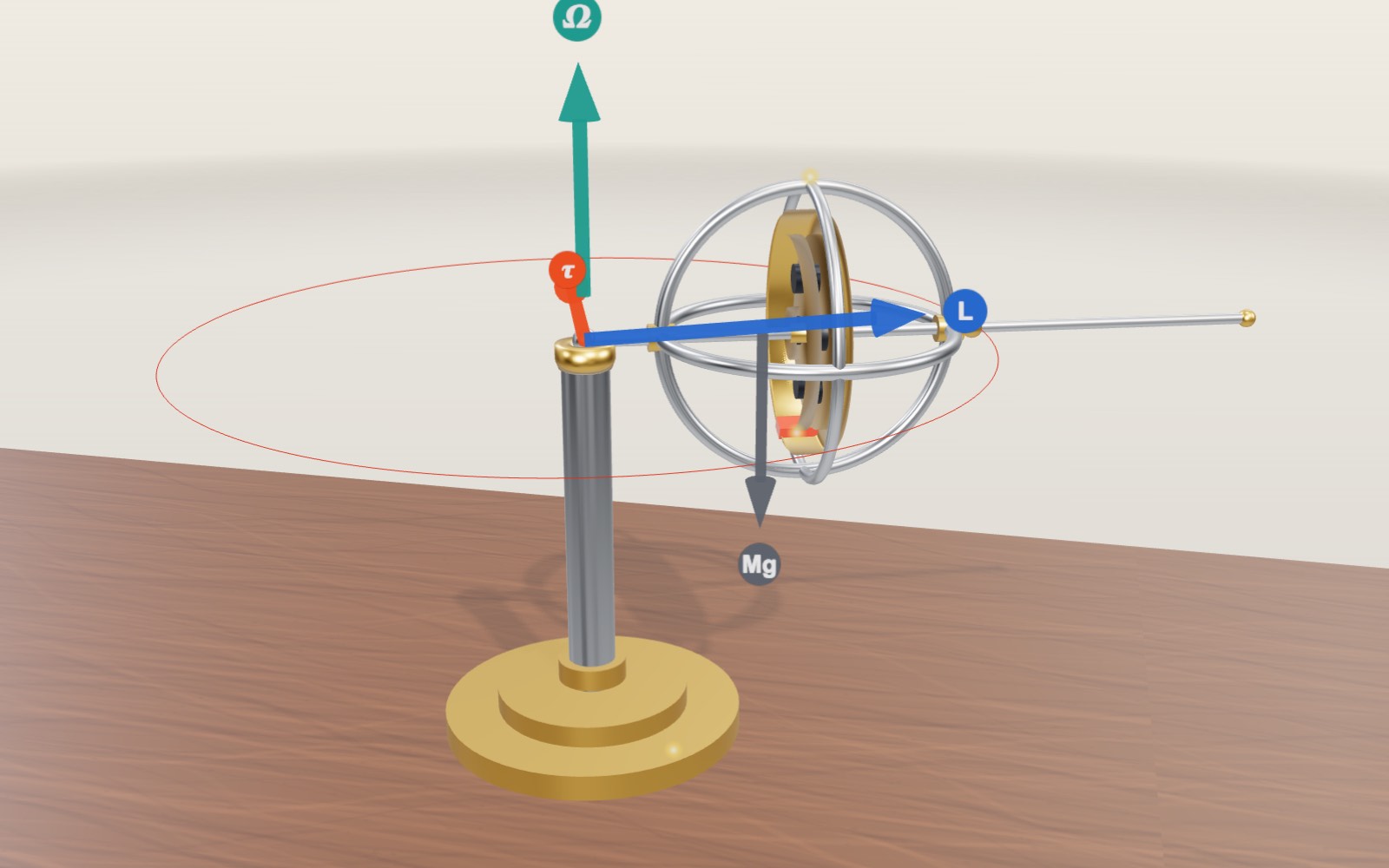
1 / 10 A wheel that does not fall The brass wheel spins at 3,000 rpm and only one end of its axle rests on the post. Instead of dropping, it swings slowly around the post. That sideways turning is called precession. On screen the wheel itself turns 50 times slower than the model.
Drag to turn. Scroll or pinch to zoom.
Guide Parts Controls
01 A wheel that does not fall The brass wheel spins at 3,000 rpm and only one end of its axle rests on the post. Instead of dropping, it swings slowly around the post. That sideways turning is called precession. On screen the wheel itself turns 50 times slower than the model.
02 Spin it and push it yourself Swipe across the rim of the wheel to spin it faster. Then grab the end of the axle and push it down: instead of dropping, the axle swings sideways. Push it sideways and it climbs. The purple arrow is your finger's force and the red arrow is the torque it adds.
03 Without spin it simply falls With the spin at zero the same wheel is a pendulum hanging off a pivot. It drops in about 0.1 seconds and leans against the post. Raise the spin again and the model lifts it back to level.
04 The weight makes a torque The weight Mg acts 80 mm out from the pivot, so it tries to twist the axle downward. That twist is the torque τ = r × Mg, 0.314 N·m here. The red arrow shows it: horizontal, and at right angles to the axle.
05 The torque turns L, not the axle A spinning wheel carries angular momentum L along its axle (blue). Torque changes L at the rate dL/dt = τ. Because τ is sideways, the tip of L moves sideways and never down, and the axle follows it around the post.
06 Faster spin, slower precession The precession rate is Ω = τ / (I·ω). Doubling the spin halves it. At 6,000 rpm the wheel goes around in 5.7 seconds instead of 2.8. Move the spin slider and watch the measured rate follow the curve in the readout.
07 Let go from rest and it nods Real hands rarely give the wheel exactly the right sideways speed. Released from rest at 1,500 rpm, the axle dips about 18° and bobs up and down while it precesses. That wobble is nutation. The red line traces the end of the axle, and the model runs in slow motion.
08 Friction slows it and it falls With friction on, the bearing slows the wheel and the pivot drags on the circling. As the spin drops, the precession gets faster and the axle droops, until the wheel leans on the post. Spin it again with a swipe to lift it. The friction values are model values.
09 Three gimbals keep the direction The fork on the left turns and rocks, but each gimbal is free to turn on its pins, so no torque reaches the wheel. The wheel's axle keeps pointing the same way while the rings move around it.
10 The gyro in a phone vibrates instead A phone's gyro has no spinning wheel. A tiny silicon mass is driven back and forth. When the chip turns, the Coriolis force 2mΩv pushes the mass sideways, and comb-shaped capacitors measure the shift, a few nanometres at most.
Post Steel column on a brass foot. It carries the whole weight of the gyroscope through one point. Pivot cup A shallow brass cup. The ball on the end of the axle sits in it and can turn any way. Frame Three steel rings around the wheel with bearings for the axle. It does not spin, so the vectors start from it. Wheel Brass, 110 mm across, with most of its mass in the rim. The model gives it I = 4.5 × 10⁻⁴ kg·m² about the axle. Gimbal mount A brass fork on a ball joint. The slider turns it and the model rocks it as a hand would. Outer gimbal Turns on the fork about the vertical pins. It takes up turns of the mount about that axis. Middle gimbal Turns inside the outer gimbal about a second axis at right angles to the first. Inner gimbal and wheel Carries the spinning wheel. With three free pivots no torque reaches it, so it keeps its direction. Gyro chip A few millimetres square on a circuit board, like the motion sensor in a phone. Shown real size. Sense frame Silicon frame hung on springs that let it move only across the drive direction. Its fingers form capacitors. Proof mass Driven back and forth along one axis. When the chip turns, the Coriolis force pushes it sideways.