Loading the model
This device cannot show the 3D model. You can read the guide steps below as text.
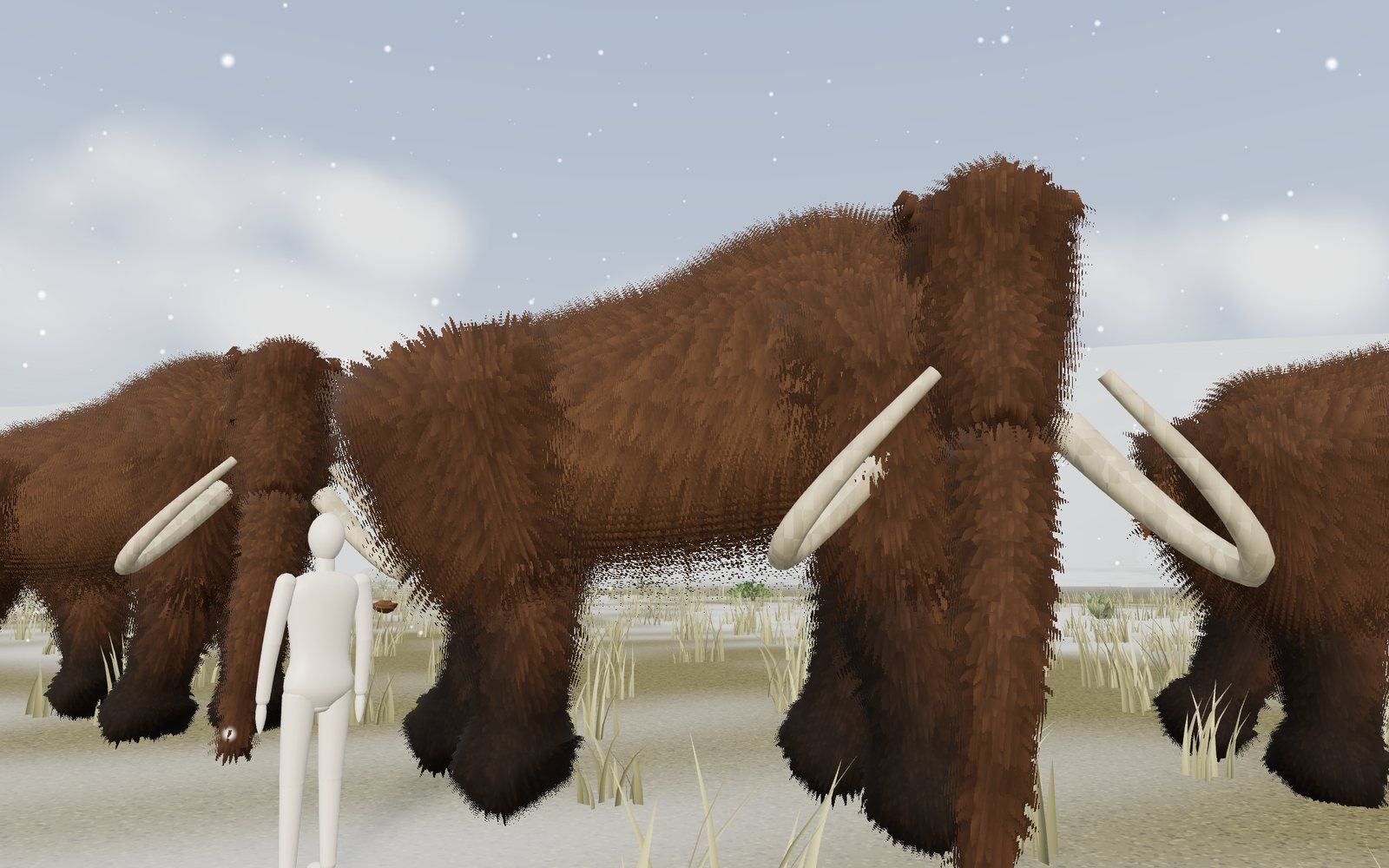
1 / 17 A herd in the snow You start on the mammoth steppe 32,000 years ago. A herd of woolly mammoths walks past in a snowstorm; turn on the sound to hear the ground thud. The time slider in Controls runs from 50,000 years ago to today.
Drag to turn. Scroll or pinch to zoom.
Guide Parts Controls
01 A herd in the snow You start on the mammoth steppe 32,000 years ago. A herd of woolly mammoths walks past in a snowstorm; turn on the sound to hear the ground thud. The time slider in Controls runs from 50,000 years ago to today.
02 Next to a person, an elephant and a bus The line-up sets down a 1.7 m person, a big African bush elephant and a 12 m bus. A woolly mammoth stood about 3 to 3.5 m at the shoulder, a little lower than the elephant. Type your own height under Me to resize the person.
03 Woolly rhinoceros A grazer that carried its head low. Its front horn was long and flat; the longest one found measures more than 1.6 m along the curve.
04 Giant deer Megaloceros carried antlers up to about 3.6 m across. It outlived the mammoths of the mainland and was still alive in western Siberia about 7,700 years ago.
05 The ice at its maximum The slider jumps to 21,000 years ago, the coldest time of the last glacial: the Earth about 6 °C colder on average and the sea about 125 m lower. Move the slider toward today and the ice front pulls back.
06 Cave lion The cave lion was bigger than today's lions. It lived from Europe to Yukon and died out about 14,000 years ago.
07 The painted chamber Inside the hill, charcoal and ochre animals cover the wall: lions, horses, rhinos, a mammoth, a bison, a giant deer and a bear, the kinds painted at Chauvet about 36,000 years ago.
08 Cave bear Bigger than most brown bears, yet the chemistry of most of its bones points to a diet of plants. It disappeared about 28,500 years ago.
09 Huts of mammoth bone People on the plains of Ukraine and Russia built huts from mammoth jaws, skulls and tusks. A ring at Kostenki, about 25,000 years old, used bones from more than 60 mammoths.
10 Stuck in the tar In what is now Los Angeles, natural asphalt trapped animals, and predators came for them and were trapped too. More than 2,000 sabre-toothed cats have come out of La Brea.
11 Columbian mammoth The giant of North America, up to about 4 m at the shoulder, bigger than the woolly mammoth and bigger than most living elephants.
12 Glyptodon An armadillo as big as a small car. Ancient DNA from its shell placed it inside the armadillo family.
13 The Bering land bridge At 21,000 years ago the sea floor between Asia and America is dry land. Walk south to the far shore: that is one of the challenges.
14 The bridge goes under At 10,000 years ago the sea has risen and the bridge is under water. In the model it floods when the sea rises past about 50 m below today, about 11,000 years ago.
15 The last mammoths Wrangel Island, 4,500 years ago. The island herd lived here until about 4,000 years ago, after the Great Pyramid of Giza was built.
16 Today At today's date the forest has spread over the steppe, the glacier is gone and the sea covers the bridge. Most of the big animals have left the park; the ones still standing live on today.
17 Aurora over the ice Night on the glacier edge, 21,000 years ago, with the snow stopped. Green light from oxygen high in the air moves across the northern sky.
Woolly mammoth About the size of an African elephant, with small ears, a short tail and long hair over thick underfur. It ate more than 200 kg of grass a day. Woolly mammoth (Wrangel Island) The last mammoths. Cut off on Wrangel Island when the sea rose, they lived there until about 4,000 years ago. The first study in 1993 called them dwarfs; how much smaller they were is still argued. Columbian mammoth Bigger than the woolly mammoth, up to about 4 m at the shoulder. It lived south of the ice sheets across much of North America. How hairy it was is not known. American mastodon Not a mammoth but a more distant relative: shorter and stockier, with straighter tusks and teeth for chewing leaves and twigs. Pygmy mammoth Mammoths that reached the Channel Islands off California shrank over many generations to about 1.7 m at the shoulder. Woolly rhinoceros A grazer with a low head and a long, flattened front horn. It lived across northern Eurasia but never crossed into America. Elasmotherium A giant rhino of the steppes of Eastern Europe and Central Asia. Dates on its bones show it lived until at least 39,000 years ago. Steppe bison Once the most common big grazer of Beringia and North America. It crossed Beringia from Asia about 160,000 years ago. Aurochs The wild ancestor of domestic cattle, with long horns that curved forward. The last one died in Poland in 1627. Ancient bison A big bison of North America, common at La Brea. Southern bison like it gave rise to today's American bison. Musk ox Still alive. Its outer hair hangs almost to the ground over a fine underwool. Herds stand in a ring to face wolves. Saiga antelope Still alive in Central Asia. Its swollen nose warms cold air and filters dust. It crossed into Alaska about 40,000 years ago. Alpine ibex Still alive in the Alps. Males carry long curved horns with knobs along the front. Giant deer (Megaloceros) The giant deer, often called the Irish elk, though it was not an elk and not only Irish. Its antlers spanned up to about 3.6 m, and it lived until about 7,700 years ago in western Siberia. Reindeer Still alive, called caribou in North America. Both males and females grow antlers, the only deer that do. Moose Still alive. The largest deer living today, with broad, flat antlers. Stag-moose A North American deer as tall as a moose, with antlers that split into many small palms. It died out at the end of the ice age. Red deer Still alive across Europe. Stags carry branched antlers and roar in the autumn rut. Wild horse Still alive as Przewalski's horse in Mongolia. Horses are among the animals painted most often in ice age caves. Yukon horse A small horse of Beringia, about 1.2 m at the shoulder. Horses vanished from North America about 12,000 years ago. Western horse A horse of ice age California, found at La Brea, larger than the Yukon horse. Hippidion A South American horse with a deep notch above its nose. It died out at the end of the ice age. Western camel (Camelops) A camel of western North America, taller than a dromedary. Whether it had a hump is not known. Guanaco Still alive. A wild relative of the llama on the plains and mountains of South America. Macrauchenia A long-necked South American hoofed mammal. Ancient DNA shows it was a distant relative of horses and rhinos. It is often drawn with a short trunk; that is debated. Cave lion A lion bigger than today's that lived from Europe to Yukon. It died out about 14,000 years ago in Eurasia and about a thousand years later in Alaska and Yukon. American lion A lion of North America south of the ice sheets, one of the biggest cats of its time. Smilodon (sabre-toothed cat) California's state fossil, with long sabre canines. More than 2,000 have been dug out of La Brea. Smilodon populator The biggest sabre-toothed cat, from South America, up to about 400 kg in some estimates. Scimitar cat (Homotherium) The scimitar cat: shorter, serrated canines, slender legs, a powerful neck and a short tail. About 200 kg. Eurasian lynx Still alive. A cat of northern forests with tufted ears and wide, furry paws. Dire wolf Heavier than most grey wolves, with a bigger head and teeth. More than 5,000 have come out of La Brea, the commonest mammal there. Grey wolf Still alive. The ice age wolves of Yukon and Alaska died out about 12,000 years ago; wolves living there today came later. Arctic fox Still alive. It turns white in winter and lives on lemmings and leftovers. Dhole Still alive in Asia but gone from Europe, where it hunted during the ice age. Coyote Still alive. Coyotes are common at La Brea and outlived the dire wolf. Cave hyena A big spotted hyena that dragged bones into caves. It disappeared from northern Eurasia about 31,000 years ago. Wolverine Still alive. A heavy weasel of the north that hunts and eats carcasses. Cave bear Bigger than most brown bears, with a domed forehead. It disappeared about 28,500 years ago. Giant short-faced bear On its hind legs it stood about 3.4 m tall, one of the largest meat-eating land mammals of North America. Brown bear Still alive. The grizzly of North America is the same species. Polar bear Still alive. It hunts seals on the sea ice. Harlan's ground sloth The largest and commonest of the three ground sloths at La Brea, up to about 1,360 kg. Jefferson's ground sloth About the size of an ox and up to 3 m long. It died out about 11,000 years ago. Shasta ground sloth A smaller ground sloth of western North America, also found at La Brea. Megatherium A ground sloth as big as an elephant, from the pampas of South America. Eremotherium A giant ground sloth that ranged from South America into the southern United States. Glyptodon An armadillo as big as a small car, covered by a shell of fused bony plates. Doedicurus A glyptodont with a spiked club at the end of its tail. Toxodon A heavy South American grazer. Proteins from its bones show it was a distant relative of horses and rhinos. Giant beaver Up to 2 m long and about 100 kg, the largest rodent of ice age North America. Collared lemming Still alive. A small rodent of the tundra that turns white in winter. Mountain hare Still alive. It turns white in winter where snow lies long. Wild boar Still alive across Europe and Asia. Flat-headed peccary About the size of a wild boar, 75 cm at the shoulder. It died out about 11,000 years ago. Teratornis A huge bird related to condors, with wings about 3.5 m across. Many have been found at La Brea. California condor Still alive, barely: it nearly died out in the 1980s. Ice age condors fed on the carcasses of big mammals. Golden eagle Still alive. It hunts hares and marmots over open country. Snowy owl Still alive. A white owl of the tundra that hunts lemmings. Andean condor Still alive. One of the largest flying birds today, with wings about 3 m across. Great auk A flightless seabird of the North Atlantic, about 80 cm tall. The last known pair was killed in 1844. Walrus Still alive. Its tusks are long upper canines; it dives to about 80 m to feed on clams. Steller's sea cow A sea cow up to about 8 m long that grazed kelp. Described in 1741, hunted out by 1768. Bearded seal Still alive. It feeds on the sea floor and is named after its long whiskers. Modern humans Our species. People of the last ice age sewed fur clothes, carved ivory and painted caves. Neanderthals Our closest relatives. They disappeared about 40,000 years ago after a few thousand years of overlap with our species in Europe. Mammoth steppe The largest grassland of the last glacial ran from Spain across Siberia to Canada. The air was cold and dry, so grass and herbs grew where forest stands today. Glacier edge Ice sheets covered most of Canada and northern Europe. Meltwater spread gravel in front of the ice. Move the time slider and the ice front pulls back. Cave Cave bears slept through winter in caves and hyenas used them as dens. People painted the walls. Walk into the hill to find the painted chamber. Camp Hunters on the plains of Ukraine and Russia built round huts from mammoth bones. Some rings of bones are about 25,000 years old. La Brea tar pits Natural asphalt in what is now Los Angeles trapped animals for tens of thousands of years. Predators came for the stuck animals and were trapped too. Pampas South America had its own giants: ground sloths as big as elephants, glyptodonts in bony shells and the heavy grazer Toxodon. Coast and land bridge With the sea far lower than today, Asia and America were joined by dry land. The bridge flooded about 11,000 years ago. Mammoth herd The first scene: woolly mammoths cross the steppe in a snowstorm 32,000 years ago, passing 5 to 7 m from where you start. Painted chamber Animals in charcoal and red ochre, after the kinds painted at Chauvet and Lascaux. It gets dark inside; you carry a torch. Mammoth-bone huts A ring of mammoth jaws stacked chin down, skulls above, tusks over the roof and hides on top, as found at Mezhyrich in Ukraine. Stuck in the tar A Columbian mammoth caught in asphalt with its calf on the bank, like the figures in the Lake Pit at La Brea. Bering land bridge Walk south to the far shore. When the sea rises above about 50 m below today, the bridge goes under. Wrangel Island The last mammoths lived here until about 4,000 years ago. Set the time slider to 4,500 years ago to see them. Frozen calf Permafrost keeps skin and organs. A calf like Lyuba comes out of a riverbank when the frozen silt thaws. Footprints People and a giant ground sloth crossed this lake bed. At White Sands the oldest human prints are dated to 23,000 to 21,000 years ago. Ice front The ice here is about 40 m high. The boulder in front of you was carried here by the glacier. People for scale Smooth mannequins 1.7 m tall, without faces, stand beside the main animals. Enter your own height under Me and they take your height. Size line-up Sets a person, an African elephant and a 12 m bus side by side in front of you.