Loading the model
This device cannot show the 3D model. You can read the guide steps below as text.
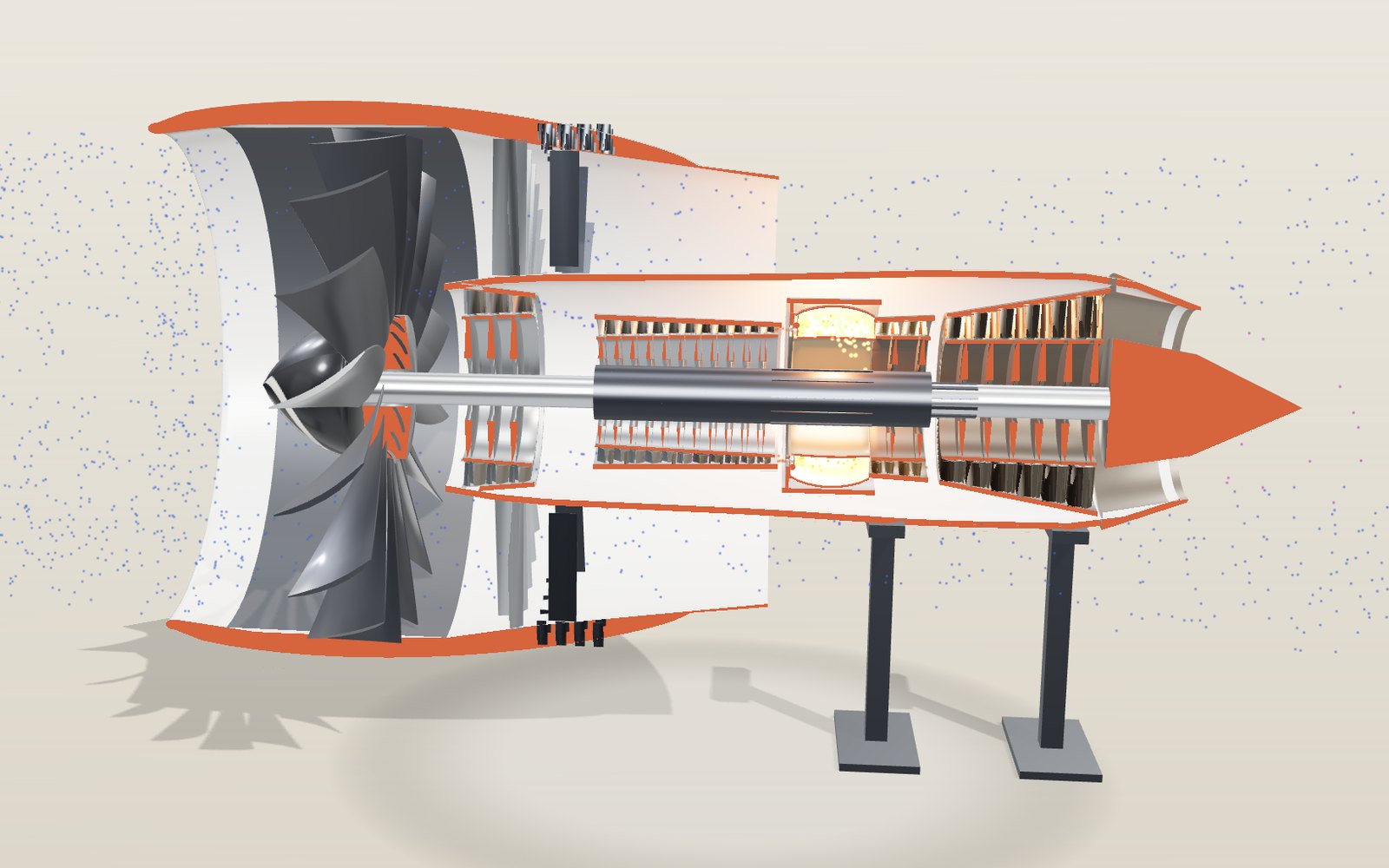
1 / 17 One turbofan, cut along its axis The half facing you is cut away; the red faces are the cut. Blue dots are cold air and turn purple, orange and red as it heats. The readout gives thrust, fuel and spool speeds.
Drag to turn. Scroll or pinch to zoom.
Guide Parts Controls
01 One turbofan, cut along its axis The half facing you is cut away; the red faces are the cut. Blue dots are cold air and turn purple, orange and red as it heats. The readout gives thrust, fuel and spool speeds.
02 The fan does most of the work Sixteen wide blades move about 1,300 kg of air a second. Ten parts in eleven go around the core, and that cool, slow stream makes most of the thrust.
03 Eleven stages of squeezing Each row of moving blades speeds the air up and each row of fixed vanes slows it down again, turning speed into pressure. By the last stage the air is at about 42 bar and over 900 K.
04 Fuel burns in a ring 22 nozzles spray kerosene into the annular combustor. The gas reaches about 1,700 K at constant pressure; that heat is what the turbines live on.
05 A turbine blade up close This blade sits in gas hotter than its own melting point. It is grown as one nickel crystal, cooled from inside through rows of tiny holes, and painted with a ceramic layer.
06 Two shafts at two speeds The low-pressure turbine turns the fan on the inner shaft at up to 2,500 rpm. The high-pressure spool around it runs at up to 11,000 rpm.
07 Two jets leave the engine The hot core jet leaves at about 330 m/s and the fan stream at about 270 m/s. Thrust is the air going out faster than it came in, times how much air there is.
08 A smaller fan At bypass ratio 4 the same core makes less thrust from the same fuel. Watch the gold fuel-per-thrust line in the lab rise as the fan shrinks.
09 Reverse thrust after landing The rear of the nacelle slides back. Doors close the bypass duct and cascade vanes send the fan air forward, so the engine pushes back on the aircraft.
10 Starting the engine Air from the APU spins the high-pressure spool. At about 20 percent the fuel opens and the igniters spark; after light-off the engine accelerates to idle on its own.
11 A fighter engine and its afterburner A three-stage fan, a short core and a long jet pipe. Lighting the afterburner burns fuel again behind the turbine: more thrust, about twice the fuel.
12 Where it began: the turbojet Whittle's and von Ohain's engines threw the air outward with a centrifugal impeller and burned it in cans. All the air goes through the flame, so the jet is fast and noisy.
13 A gearbox inside the fan In the geared turbofan the low-pressure turbine spins about three times faster than the fan. Five planet gears share the load between them.
14 Turboprop A free power turbine drives the propeller through a reduction gearbox. Below about 600 km/h a propeller moves a lot of air gently, which saves fuel.
15 Turboshaft The same gas generator, but the power turbine sends nearly everything down the output shaft to a helicopter rotor. The readout shows shaft power in kilowatts.
16 Ramjet: no moving parts At Mach 3 the inlet cone squeezes the air by itself. The air slows below the speed of sound, burns behind the flame holders and leaves through the nozzle.
17 Scramjet: burning in supersonic air Above Mach 5 slowing the air would heat it too much. The scramjet burns hydrogen in air that stays supersonic, as the X-43A did at Mach 9.6 in 2004.
Fan On the airliner model 16 composite blades about 3.2 m across at bypass ratio 10; the tips pass the speed of sound. The fighter engine has a three-stage fan instead. Nacelle and inlet The casing around the engine. The inlet slows the air smoothly before the fan, and the dark lining over the fan absorbs noise. Bypass duct Air that skips the core. Guide vanes straighten it, and on an airliner it makes most of the thrust. Booster (low-pressure compressor) The stages behind the fan that raise the core pressure first. On the turbojet this is a centrifugal impeller. High-pressure compressor Eleven stages on the airliner model, each about 1.3 times the pressure of the one before. Front stages titanium, rear stages nickel alloy. Combustor A ring-shaped chamber with fuel nozzles (cans on the early turbojet). Burning kerosene heats the gas to about 1,700 K. High-pressure turbine The hottest blades in the engine. They drive the high-pressure compressor and need internal cooling and a ceramic coating. Low-pressure turbine Stages that drive the fan and booster through the inner shaft. Low-pressure shaft The inner shaft from the low-pressure turbine to the fan. On the airliner model up to 2,500 rpm. High-pressure shaft The hollow outer shaft joining the high-pressure turbine and compressor. Up to 11,000 rpm on the airliner model. Nozzle Where the hot gas leaves. The fighter's nozzle opens wider when the afterburner is lit. Thrust reverser The rear sleeve slides back, blocker doors close the duct and cascade vanes turn the fan air forward. The turbojet uses two buckets instead. Afterburner Spray rings and flame holders in the jet pipe burn fuel a second time behind the turbine. Reduction gearbox On the geared fan a sun gear, five planets and a ring slow the fan to about a third of the turbine speed. Turboprops and turboshafts have one too. Propeller Six blades on the turboprop. Their pitch turns past flat to push backwards after landing. Power turbine A free turbine on its own shaft that takes the energy left in the gas and sends it to the propeller or the rotor. Output shaft Runs forward through the middle of the engine from the power turbine to the gearbox. Rotor mast The helicopter's main rotor, shown as a stub. The turboshaft drives it through a main gearbox. Inlet cone The spike of the ramjet. Its shock waves slow and squeeze the incoming air without any compressor. Flame holders and injectors V-gutter rings that keep a ramjet flame alight in fast air; in the scramjet, struts that inject hydrogen into supersonic air. Turbine blade, close up One high-pressure turbine blade: single-crystal nickel alloy, rows of cooling holes, a ceramic coating and a fir-tree root.